In:
Proceedings of CoNLL-2000 and LLL-2000,
pages 209-218, Lisbon, Portugal, 2000.The Acquisition of Word Order by
a Computational Learning System
Aline Villavicencio
C o m p u t e r L a b o r a t o r y , University of C a m b r i d g e New M u s e u m s Site, C a m b r i d g e , CB2 3QG, E n g l a n d , U K
Aline. V i l l a v i c e n c i o @ c l . cam. ac. u k
A b s t r a c t
The purpose of this work is to investigate the process of grammatical acquisition from data. We are using a computational learning sys- tern that is composed of a Universal G r a m m a r with associated parameters, and a learning al- gorithm, following the Principles and Parame- ters Theory. The Universal G r a m m a r is imple- mented as a Unification-Based Generalised Cat- egorial Grammar, embedded in a default inher- itance network of lexical types. The learning al- gorithm receives input from a corpus annotated with logical forms and sets the parameters based on this input. This framework is used as basis to investigate several aspects of language acqui- sition. In this paper we are concentrating on the acquisition of word order for different learners. The results obtained show the different learners having a similar performance and converging to- wards the target g r a m m a r given the input data available, regardless of their starting points. It also shows how the amount of noise present in the input data affects the speed of convergence of the learners towards the target.
1 I n t r o d u c t i o n
In trying to solve the question of how to get a machine to automatically learn linguistic infor- mation from data, we can look at the way people do it. Gold (1967) when investigating language identification in the limit, obtained results that implied that natural languages could not be learned only on the basis of positive evidence. These results were used as a confirmation for the proposal that children must have some innate knowledge about language, the Universal Gram- mar (UG), to help t h e m overcome the prob- lem of the poverty of the stimulus and acquire
a g r a m m a r on the basis of positive evidence only. According to Chomsky's Principles and Parameters Theory (Chomsky 1981), the UG is composed of principles and parameters, and the process of learning a language is regarded as the setting of values of a number of parame- ters, given exposure to this particular language. We employ this idea in the learning framework implemented.
In this work we are interested in investigating the acquisition of grammatical knowledge from data, focusing on the acquisition of word or- der, that reflects the underlying order in which constituents occur in different languages (e.g. SVO and SOV languages). The learning sys- tem is equipped with a UG and associated pa- rameters, encoded as a Unification-Based Gen- eralised Categorial Grammar, and a learning al- gorithm that fixes the values of the parameters to a particular language. The learning algo- r i t h m follows the Bayesian Incremental Param- eter Setting (BIPS) algorithm (Briscoe 1999), and when setting the parameters it uses a Mini- m u m Description Length (MDL) style bias to choose the most probable g r a m m a r that de- scribes the data well, given the goal of converg- ing to the target grammar. In section 2 we de- scribe the components of the learning system. In section 3, we investigate the acquisition of word order within this framework and discuss the results obtained by different learners. Fi- nally we present some conclusions and future work.
2
The Learning System
more detail in the following sections. 2.1 T h e U n i v e r s a l G r a m m a r
The UG consists of p r i n c i p l e s a n d p a r a m e - t e r s , and the latter are set according to the linguistic environment (Chomsky 1981). This proposal suggests that h u m a n languages follow a common set of principles and differ among one another only in finitely many respects, rep- resented by a finite number of parameters that can vary according to a finite number of val- ues (which makes t h e m learnable in Gold's paradigm). In this section, we discuss the UG and associated parameters, which are for- malised in terms of a Unification-Based Gen- eralised Categorial G r a m m a r (UB-GCG), em- bedded in a default inheritance network of lex- ical types. We concentrate on the description of word order parameters, which reiiect the ba- sic order in which constituents occur in different languages.
UB-GCGs extend the basic Categorial Gram- mars ((Bar Hillel, 1964)) by including the use of attribute-value pairs associated with each cate- gory and by using a larger set of rules and op- erators. Words, categories and rules are repre- sented in terms of typed default feature struc- tures (TDFSS), that encode orthographic, syn- tactic and semantic information. There are two types of categories: atomic categories (s - s e n t e n c e - , n p - n o u n p h r a s e - , a n d n - n o u n ) , that are saturated, and complex cat- egories, that are unsaturated. Complex cate- gories have a functor category (defined in RE- SUET), and a list of subcategorised elements (de- fined in ACTIVE), with each element in the list defined in terms of two features: SIGN, encoding the category, and DIRECTION, encoding the di- rection in which the category is to be combined (where VALUE can be either f o r w a r d or b a c k - w a r d ) . As an example, in English an intransi- tire verb (s\np) is encoded as shown in figure 1, where only the relevant attributes are shown. In this work, we employ the rules of (forward and backward) application, (forward and back- ward) composition and generalised weak permu- ration. A more detailed description of the UB- GCG used can be found in (Villavicencio 2000). T h e UG is implemented as a UB-GCG, era- bedded in a default inheritance network of lex- ical types (Villavicencio 1999), implemented in the YADU framework (Lascarides and Copes-
take 1999). T h e categories and rules in the g r a m m a r are defined as types in the hierarchy, represented in terms of TDFSS and the feature- structures associated with any given category or rule are defined by the inheritance chain. W i t h different sub-networks used to encode dif- ferent kinds of linguistic knowledge, linguistic regularities are encoded near the top of a net- work, while types further down the network are used to represent sub-regularities or exceptions. Thus, types are concisely defined, with only specific information being described, since more general information is inherited from the super- types. T h e resulting UB-GCG is compact, since it avoids r e d u n d a n t specifications and the infor- m a t i o n is structured in a clear and concise way t h r o u g h the specification of linguistic regulari- ties and sub-regularities and exceptions.
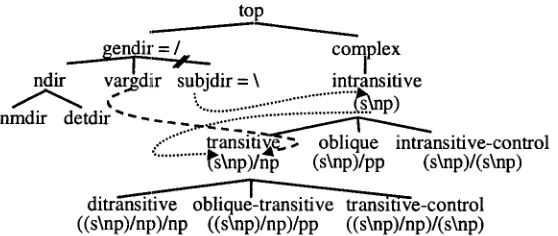
Regarding the categories o f the UB-GCG, word order parameters are those that specify the direction of each element in the subcate- gorisation list of a complex category. In figure 1, s u b j d i r is a parameter specifying that the np subject is to be combined backwards. As the categories are defined in terms of an inheritance hierarchy, the parameters (and their values) in these categories are propagated t h r o u g h o u t the hierarchy, from supertypes to subtypes, which inherit this information by default. There are 28 parameters defined, and they are also in a hier- archical relationship, with the supertype being g e n d i r , which specifies, by default, the general direction for a language, and from which all the other parameters inherit. A m o n g the subtypes, we have s u b j d i r , which specifies the direction of the subject, v a r g d i r , which specifies the di- rection of the other verbal arguments and n d i r , which specifies the direction of nominal care- gories. A fragment of the parameters hierarchy can be seen in figure 2. W i t h these 28 binary- valued parameters the UG defines a space of almost 800 grammars.
intransitive
RESULT : SIGN : s /
J
ACTIVE : SIGN : n p
[ subjdir
DIRECTION : [VALUE
backw d]]
Figure 1: Intransitive Verb type gendir
s u b j d i r vargdir ndir
/ \
n m d i r d e t d i r
Figure 2: Fragment of The Parameters Hierar- chy
a default inheritance schema reduces the pieces of information to be acquired by the learner, since the information is structured and what it learns is not a single isolated category, but a structure that represents this information in a general manner. This is a clear and concise way of defining the UG with the parameters being straightforwardly defined in the categories, in a w a y that takes advantage of the default in- heritance m e c h a n i s m , to propagate information about parameters, throughout the lexical inher- itance network.
g e n d i r is defined, by default, as f o r w a r d , cap- turing the fact that it is a predominantly right- branching language, and all its subtypes, like s u b j d i r and v a r g d i r inherit this default in- formation. Then an intransitive verb, which has the direction of the subject specified by s u b j d i r , will be defined as S/NP, with s u b - j d i r having default value f o r w a r d . However, as in English, the subject NP occurs to the left of the verb, utterances with the subject to the left will trigger a change in s u b j d i r to b a c k - w a r d , which overrides the default value, break- ing the inheritance chain, figure 3. As a re- sult, intransitive verbs are defined as S\NP, fig- ure 1, for the grammar to account for these sentences. In the syntactic dimension of this network, intransitive verbs can be considered the general case of verbs, and the information defined in this node is propagated through the hierarchy to its subtypes, such as the transitive verbs, figure 3. For the learner, the information about subjects ( s u b j d i r = b a c k w a r d ) has al- ready been acquired while learning intransitive verbs, and the learner does not need to learn it again for transitive verbs, which not only in- herit this information, but also have the direc- tion for the object defined by v a r g d i r ( v a r g d i r = f o r w a r d ) , as shown in figure 3. The use of
2.2 T h e Corpus
The UG has to be general enough to capture the grammar for any language, and the param- eters have to be set to account for a particular language, based on exposure to that language. This can be obtained by means of a corpus of utterances, annotated with logical forms, which is described in this section. Among these sen- tences, some will be triggers for certain param- eters, in the sense that, to parse that sentence, some of the parameters will have to be set to a given value. We are using the Sachs cor- pus (Sachs 1983) from the CHILDES project (MacWhinney 1995), that contains interactions between only one child and her parents, from the age of 1 year and 1 month to 5 years and 1 month. From the resulting corpus, we extracted material for generating two different corpora: one containing only the child's sentences and the other containing the caretakers' sentences. The caretakers' corpus is given as input to the learner to mirror the input to which a child learning a language is exposed. And the child's corpus is used for comparative purposes.
top
.._._~_~' = / complex
I
ndir var.gdiir subjdir = \ intransitive
,2
...
nrndir detdir . . . ,~::::: ... """"f"'"'~~.'"'"''.
... tra'n's~tiv.e..~ oblique intransitive-control ... ~ p ) / ~ p (s~np)/pp (s~np)/(s\np) d i t r a ~ s i t ~ = ~ ' ~ - ~ e _ c o n t r o l
((s\np)/np)/np ((s~np)/np)/pp ((s~np)/np)/(s~np) Figure 3: A Fragment of the Network of Types
structions (intransitives, transitives, ditransi- tives, obliques, control verbs, verbs with senten- tim complements, etc), declarative, imperative and interrogative sentences, and u n b o u n d e d de- pendencies (wh-questions and relative clauses), among others. Thus the caretakers' corpus con- tains sentences annotated with logical forms, and an example can be seen in figure 4, for the sentence I will take him, where a simplified ver- sion of the relevant attributes is shown, for rea- sons of clarity. Each predicate in the semantics list is associated with a word in the sentence, and, among other things, it contains informa- tion about the identifier of the predicate (SIT), the required arguments (e.g. ACTOR and UN- DERGOER for the verb take), as well as about the interaction with other predicates, specified by the boxed indices (e.g. t a k e : A C T O R = [] =
/:SIT).
This g r a m m a r is not only used for anno- tating the corpus, but is also the target to which the learner has to converge. At the m o m e n t around 1,300 utterances were a n n o t a t e d with corresponding logical forms, with data ranging from when the child is 14 months old to 20 months old.2.3 T h e L e a r n i n g A l g o r i t h m
The learning algorithm implernents the Bayesian Incremental Parameter Setting (BIPS) algorithm defined by Briscoe (1999). The parameters are binary-valued, where each possible value in a parameter is associated with a prior and a posterior probability. The value with highest posterior probability is used as the current value. Initially, in the learning process, the posterior probability associated with each parameter is initialised to the prior probability, and these values are going to define
the parameter settings used. Then, as trigger sentences are successfully parsed, the posterior probabilities of the parameter settings that al- lowed the sentence to be parsed are reinforced. Otherwise, when a sentence cannot be parsed (with the correct logical form) the learning algorithm checks if a successful parse can be achieved by changing the values of some of the parameters, in constrained ways. If that is the case, the posterior probability of the values used are reinforced in each of the parameters, and if they achieve a certain threshold, they are retained as the current values, otherwise the previous values are kept. This constraint on the setting of the parameters ensures that a trigger does not cause an immediate change to a different grammar. T h e learner, instead, has to wait for enough evidence in the data before it can change the value of any parameter. As a consequence, the learner behaves in a more conservative way, being robust to noise present in the input data.
[image:4.596.174.453.83.201.2]s i g n
ORTH : <i, will, take, h i m > CAT : s
SEM [ will ]
: S I T : [5]
ARGU~IENT : []
• take ]
SIT: [] ACTOR: []
UNDERGOER : [] L S I T :
[] ]
Figure 4: Sentence: I will take him
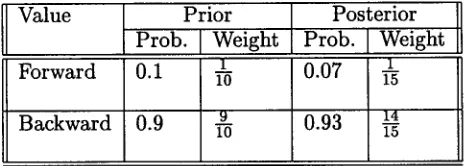
9/10 for b a c k w a r d , corresponding to a proba- bility of 0.9. The posterior is initialised with the same values as the prior, and as b a c k w a r d has a higher posterior probability it is used as the current value for the parameter. These initial parameter values determine the initial gram- mar for the learner. As triggers are processed, they provide evidence for certain parameters and these are represented as additions to the denominator and/or numerator of each of the posterior weights of the parameter values. Ta- ble 2 shows the status of the parameter after 5 triggers that provided evidence for the value b a c k w a r d . Initially, the learner uses the evi- dence provided by the triggers to choose certain parameter values, in order to be able to parse these triggers successfully while generating the appropriate logical form. After that, the trig- gers are used to reinforce these values, or to negate them.
Table 1: Initialisation of a Parameter
Value Prior Posterior
Prob. [Weight Prob. [Weight
1 0.1 1
Forward O. 1 1-o 1o
Backward 0.9 ~ 10 0.9 10
and specifies its own value, breaking the inheri- tance chain. For instance, in figure 3, s u b j d i r overrides the default value specified by g e n d i r , breaking the inheritance chain. Unset subtype parameters inherit, by default, the current value of their supertypes, and while they are unset they do not influence the values of their super- types.
As the parameters are defined in a default inheritance hierarchy, each time the posterior probability of a given parameter is updated, it is necessary to update the posterior probabili- ties of its supertypes and examine the current parameter settings to determine what the most appropriate hierarchy for these settings is, given the goal of converging to the target. The learner has a preference for grammars (and thus hi- erarchies) that not only model the data (rep- resented by the current settings) well, but are also compact, following the Minimum Descrip- tion Length (MDL) Principle. In this case, the most probable grammar in the grammar space, among the ones consistent with the parameter settings, is the one where the default inheritance hierarchy is the more concise, having the min- imum number of non-default parameter values specified, as described in (Villavicencio 2000).
Table 2: Status of the Parameter
The 28 word order parameters are defined in a hierarchical relation, with the supertype pa- rameters being set in accordance with the sub- types, to reflect the value of the majority of the subtypes. In this way, as the values of the sub- types are being set, they influence the value of the supertypes. If the value of a given sub- type differs from the value of the supertype, the subtype overrides the inherited default value
Value
Forward
I Prior Posterior
Prob. I Weight Prob. I Weight
1 0.07 1
O. 1 1-o 1-5
[image:5.596.104.480.80.164.2] [image:5.596.55.287.509.596.2] [image:5.596.297.532.628.711.2]3
The Acquisition
o f W o r d O r d e r We are investigating the acquisition of word order, which reflects the underlying order in which constituents occur in different languages. In this section we describe one experiment, where we compare the performance, of differ- ent learners under four conditions. Each learner is given as input the annotated corpus of sen- tences paired with logical forms, and they have to change the values of the parameters corre- sponding to the relevant constituents to account for the order in which these constituents ap- pear in the input sentences. We defined five different learners corresponding to five differ- ent initialisations of the parameter settings of the UG, to investigate how the init~alisations, or starting points, of the learners influence con- vergence to the target grammar. The first one, the unset learner, is initialised with all param- eters unset, and the others, the default learn- ers, are each initialised with default parameter values corresponding to one of four basic word orders, defined in terms of the canonical orderof the verb (V), subject (S) and objects (O): S V O , S O V , V S O and O V S . W e initialised the parameters subjdir, vargdir and gendir of the default learners according to each of the basic orders, with gendir having the same direction as vargdir, and all the other parameters hav- ing unset values. These parameters have the
prior and posterior probabilities initialised with 0.1 for one value and 0.9 for the other. In this way, an SVO learner, for example, is initialised with s u b j d i r having as current value backward (0.9), v a r g d i r forward (0.9) and g e n d i r for- ward (0.9).
The sentences in the input corpus are pre- sented to a learner only once, sequentially, in the original order. The input to a learner is pre-processed by a system [Waldron, 2000] that assigns categories to each word in a sentence. The sentences with their putative category as- signments are given as input to the learner. The learner then evaluates the category assignments for each sentence and only uses those that are valid according to the UG to set the parame- ters; the others are discarded. The corpus con- tains 1,041 English sentences (which follow the SVO order), but from these only a small propor- tion are triggers for the parameters, in the sense that, for the learner to process them, it has to
select certain parameter values. As each trigger- ing sentence is processed, the learner changes or reinforces its parameter values to reflect the or- der of constituents in these sentences.
We wanted to check how the different learners performed in a normal noisy environment, with a limited corpus as input, and also to check if there is an interaction between the different ini- tialisations and the noise in the input data. To do that we tested how the learners performed under four conditions. Each condition was run 10 times for each learner, and we report here the average results obtained.
3.1 C o n d i t i o n 1 : L e a r n e r s - 1 0 in a
Noisy Environment
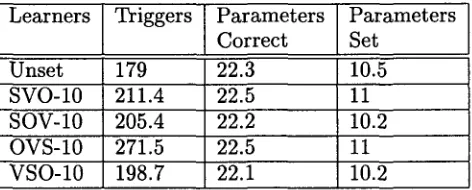
In the first condition, we initialised the param- eters s u b j d i r , v a r g d i r and g e n d i r of the de- fault learners with the prior and posterior prob- abilities of 0.1 corresponding to a weight of 1/10, and probabilities of 0.9 to a weight of 9/10. Results from the first experiment can be seen in table 3, where the learners are specified in the first column, the number of input triggers in the second, the number of correct parameters in relation to the target is in the third, and the number of parameters that are set with these triggers is in the fourth column.
Table 3: Convergence of the different learners - Learners-10
Learners Triggers Parameters Parameters Correct Set
-Unset 179 22.3 10.5
SVO-10 211.4 22.5 11
-SOV-10 205.4 22.2 10.2
OVS-10 271.5 22.5 11
VSO-10 198.7 22.1 10.2
The results show no significant variation in the performance of the different Learners. This is the case with the number of parameters that are correct in relation to the target, with an av- erage of 22.3 parameters out of 28, and also with the number of parameters that are set given the triggers available, with an average of 10.5 pa- rameters out of 28.
[image:6.596.319.555.494.589.2]S u b j d i r - N o i s y E n v i r o n m e n t
1
= 0.9 [- - - Unset
svo- o
~" I s o v - l o
a
'~ 0.6 [ VSO-IO
0.5
Triggers
Figure 5: Convergence of S u b j d i r - Learners-10 - Noisy Environment
the time needed for each learner to converge: the closer the starting point of the learner was to the target, the faster it converged, as can be seen in figure 5, for the s u b j d i r parame- ter. This figure shows all the learners converg- ing to the target value, with high probability, and with a convergence pattern very similar to the one presented by the unset learner. Even those default learners that were initialised with values incompatible with the target soon over- came this initial bias and converged to the tar- get. The same thing happens for v a r g d i r and
gendir. This figure also shows some sharp falls in the convergence to the target value, for these learners. For example, the unset learner had a sharp drop in probability, which fell from 0.94 to 0.85, around trigger 16. These declines were caused by noise in the category assignments of the input triggers, which provided incorrect ev- idence for the parameter values.
3.2 Condition 2 : L e a r n e r s - 1 0 in a
Noise-free Environment
In order to test if and how much of the learn- ers' performance was affected by the presence of noisy triggers, using the same initialisations as the ones in condition 1, we tested how the learners performed in a noise-free environment. To obtain such an environment, as each trigger was processed, a module was used for correcting the category assignment, if noise was detected. The results are shown in table 4.
These learners have performances similar to
Table 4: Convergence of the different learners - Learners-10 - Noise-free
Learners Triggers Parameters Parameters Correct Set
Unset 235.1 22.3 10.6
SVO-10 227.9 22.3 10.6
SOV-10 213.9 22.6 11.2
OVS-10 212.2 22.3 10.6
VSO-10 172.4 22 10
those in condition 1 (section 3.1), with an av- erage of 22.3 of the 28 parameters correct in relation to the target, and an average of 10.6 pa- rameters that can be set with the triggers avail- able. But, in this condition the convergence was slightly faster for all learners, as can be seen in figure 6. These results show that, indeed, the presence of noise slows down the convergence of the learners, because they need more triggers to compensate for the effect produced by the noisy triggers.
3.3 Condition 3 : L e a r n e r s - 5 0 in a N o i s y E n v i r o n m e n t
We then tested if the use of stronger weights to initialise the learners would affect the learn- ers performance. The parameters s u b j d i r ,
[image:7.596.102.439.75.261.2] [image:7.596.294.536.361.457.2]1
= 0.9
'~ 0.8
0.7
~
0.60.
0.5
Subjdir- Noise-free Environment
iiiii I I I - - . . .
//
!a
I
r ! ! i ! i ; i i
Triggers
- - Unset
-- -- SVO-IO
SOV- 10
. . . OVS-IO
. . . VSO-IO
Figure 6: Convergence of S u b j d i r - Learners-10 - Noise-free Environment
weight of 45/50 for the probability ot70.9. These weights provide an extreme bias for each of the learners. In this condition, the learners were tested again in a normal noisy environment.
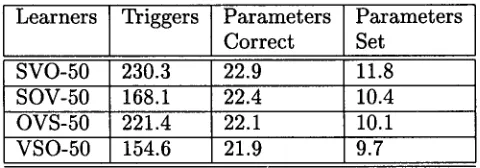
Figure 7 shows the convergence patterns pre- sented by these learners for the s u b j d i r param- eter. The effect produced by the noise was in- creased with these stronger weights, such that all the learners had a slower convergence to the target. Even those default leaxners initialised with values compatible with the target had a slightly slower convergence when compared to those in condition 1, with weaker weights, be- cause they had to overcome the stronger initial bias before converging to the target values. But, in spite of that, the performance of the learners is only slightly affected by the stronger weights, as shown in table 5. They had a performance similar to the ones obtained by the learners in the previous conditions, as shown in figure 8, comparing these learners with those in condi- tion 1.
3.4 C o n d i t i o n 4 : L e a r n e r s - 5 0 in a
N o i s e - f r e e E n v i r o n m e n t
When the noise-free environment was used with these stronger weights, the convergence pattern was slightly faster for all learners, when com- pared to condition 3 (which used a noisy envi- ronment), but still slower than conditions 1 and 2, as shown in figure 9. These learners had a similar performance to those obtained in all the previous conditions, as can be seen in table 6,
Noisy Environment
28
i 20 16 [] Set
12 I [ ] Correct
8
4
0 J i ~ -
" ~ y j ~ y J : J ; J
Learners
Figure 8: Learners in Noisy Environment
and in figure 10, which also shows the results obtained by the learners in condition 2, which
Table 5: Convergence of the different learners - Learners-50 - Noise
Learners Triggers Parameters Parameters Correct Set
SVO-50 230.3 22.9 11.8
SOV-50 168.1 22.4 10.4
OVS-50 221.4 22.1 10.1
[image:8.596.161.468.79.268.2] [image:8.596.322.559.322.472.2] [image:8.596.321.561.631.715.2]1
.,
,,~ 0.9 "~ 0.8
.~ 0.7 "~ 0.6
O I1.
0.5
Subjdir - Noisy Environment
Triggers
l SVO-50
soy-50 - ... OVS-50
- - VSO-50
Figure 7: Convergence of Subjdir - Learners-50 - Noisy E n v i r o n m e n t
Subjdir- Noise-free Environment
~o.
"~0.
3 0 .
"E
1
, r - Triggers
I
~ S V O - 5 0 SOV-50 ~ . ... OVS-50 - - VSO-50Figure 9: Convergence of Subjdir - Learners-50 - Noise-free E n v i r o n m e n t
used weaker weights.
Table 6: Convergence of the different learners - Learners-50 - Noise Free
Learners Triggers P a r a m e t e r s P a r a m e t e r s
Correct Set
SVO-50 221.7 23.2 11.5
SOV-50 195.4 23.2 11.8
OVS-50 223.2 22.1 9.9
VSO-50 223.4 21.8 9.8
3.5 D i s c u s s i o n
[image:9.596.126.445.80.255.2] [image:9.596.140.444.304.487.2]a significant delay in convergence, w]~ere the fi- nal posterior probability was up to 10% lower than in the noise-free case (e.g. for the OVS learner), as can be seen in figures 7 and 9. Nonetheless, these learners were robust to the presence of noise in the input data, only select- ing or changing a value for a given parameter when there was enough evidence for that. As a consequence, all the learners were converging towards the target, even with the small amount of available triggers, regardless of the initialisa- tions and the presence of noise. This is the case even with an extreme bias in the initial values. Moreover, the learners make effective use of the inheritance mechanism to propagate default val- ues, with an average of around 4.2 non-default specifications for these learners.
4 C o n c l u s i o n a n d F u t u r e W o r k
The purpose of this work is to investigate the process of grammatical acquisition from a com- putational perspective, focusing on the acqui- sition of word order from data. Five different learners were implemented in this framework and we investigated how the starting point for the learners affects their performance in con- verging to the target and its interaction with noise. The learners were all converging towards the target grammar, where the different start- ing points and the presence of noise affected only convergence times, with learners more far away from the target having a slower conver- gence pattern. Future works include annotat- ing more data to have a bigger corpus, and run- ning more experiments with this corpus, testing how much data is required for all the triggers
Noise-Free Environment
o4 ,,__., . . .
Learners
to converge, with high probability to the tar- get grammar. After that, we will concentrate on investigating the acquisition of subcategori- sation frames and argument structure, using the same framework for learning. Although this is primarily a cognitive computational model, it is potentially relevant to the development of more adaptive NLP technology.
5 A c k n o w l e d g e m e n t s
I would like to thank Ted Briscoe for his com- ments and advice on this paper, and Fabio Nemetz for his support. Thanks also to the anonymous reviewers for their comments. The research reported on this paper is supported by doctoral studentship from CAPES/Brazil.
R e f e r e n c e s
Bar Hillel, Y. Language and Information. Wesley, Reading, Mass. 1964.
Briscoe, T. The Acquisition of Grammar in an
Evolving Population of Language Agents. Linkop-
ing Electronic Articles in Computer and Informa- tion Science, http://www.ep.liu.se/ea/cis/1999. Chomsky, N. Lectures on Government and Binding.
Foris Publications, 1981.
Gold, E.M. Language Identification in the Limit. In- formation and Control, v.10, p.447-474, 1967. Lascarides, A. and Copestake, A. Default Represen-
tation in Constraint-based Frameworks. Compu-
tational Linguistics, v.25 n.1, p.55-105, 1999. MacWhinney, B. The CHILDES Project: Tools for
Analyzing Talk. Second Edition, 1995.
Sachs, J. Talking about the there and then: the emer- gence of displaced reference in parent-child dis-
course. In K. E. Nelson editor, Children's lan-
guage, v.4, 1983.
Villavicencio, A. Representing a System of Lexical
Types Using Default Unification. Proceedings of
EACL, 1999.
Villavicencio, A. The Acquisition of a Unification-
Based Generalised Categorial Grammar. Proceed-
ings of the Third CLUK Colloquium, 2000. Waldron, B. Learning Natural Language within the
framework of categorial grammar. Proceedings of
the Third CLUK Colloquium, 2000.
[image:10.596.74.309.546.690.2]