165
Self-Learning Architecture for Natural Language Generation
Hyungtak Choi, Siddarth K. M., Haehun Yang, Heesik Jeon, Inchul Hwang, Jihie Kim
Samsung Research, Samsung Electronics Co. Ltd., Seoul, Korea
{ht777.choi, siddarth.km, haehun.yang, heesik.jeon, inc.hwang, jihie.kim}@samsung.com
Abstract
In this paper, we propose a self-learning architecture for generating natural lan-guage templates for conversational assis-tants. Generating templates to cover all the combinations of slots in an intent is time consuming and labor-intensive. We ex-amine three different models based on our proposed architecture - Rule-based model, Sequence-to-Sequence (Seq2Seq) model and Semantically Conditioned LSTM (SC-LSTM) model for the IoT domain - to reduce the human labor required for tem-plate generation. We demonstrate the fea-sibility of template generation for the IoT domain using our self-learning architec-ture. In both automatic and human evalua-tion, the self-learning architecture outper-forms previous works trained with a fully human-labeled dataset. This is promis-ing for commercial conversational assis-tant solutions.
1 Introduction
Intelligent Conversational Assistants are prevalent now. They have been integrated into a wide range of IoT devices. Various recent studies on stochas-tic language generation have been conducted in NLG. Although these stochastic approaches out-perform traditional LSTM language models, they have drawbacks including the requirement of large training datasets, low accuracy of trained mod-els and lack of naturalness of generated sen-tences. Therefore, Most of commercial conversa-tional assistant services adopt template-based ap-proach (Cheyer and Guzzoni, 2014; Mirkovic and Cavedon, 2011) to implement natural language generation. This approach is robust and feasi-ble for commercialization, but requires creating a
large number of templates. In this approach, one needs to manually generate NLG templates that cover all the possible combinations of intents and slots.1 There are statistical approaches for gen-erating templates with 2, 3 and 4 slots (Narayan et al., 2011), but they suffer from exponential com-plexity as the number of slots increases. In addi-tion, substitution-based implementation with Sim-pleNLG (Gatt and Reiter, 2009) can handle some of the cases, but this is not versatile enough. The number of templates required to cover all possible combinations of slots is:
No. Templatesn= 2n−1 (1)
wherenis the total number of possible slots. The value is exponential as shown in equation 1. Man-ually generating an exponential number of tem-plates is undesirable, especially when the intents get more complex.
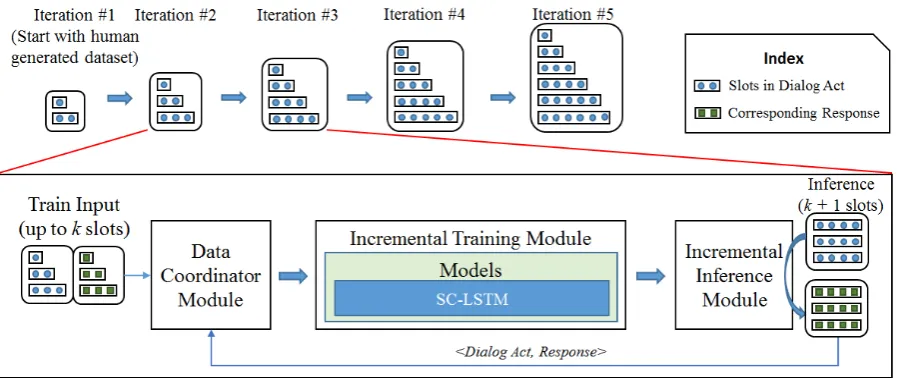
We propose a self-learning architecture for NLG which solves the problem of generating an exponential number of templates. In order to gen-erate informative and natural sentences, arguably, it is more important to generate consistent sys-tem responses with limited syntactic information than to generate error prone system responses with more variation in their grammatical form. In our proposed solution, we start with an initial training set containing less than or equal to 2 slots per in-tent, and iteratively build our model to increase its ability to cover more complex inputs. Thus, the
re-1
Throughout this paper, intentdenotes the intention of user utterance andslotdenotes the variable part (slot value) and its name if any (slot name). Slot can be replaced by an-other phrase in user utterances or responses. NLG will be generated fromdialog actand it will be written asIntent(
Figure 1: Proposed Self-Learning Architecture for NLG.
quired number of human generated templates de-creases from2n−1to n1
+ n2
=O(n2).
2 Related Work
Several approaches have been studied for NLG systems. The template-based approach (McRoy et al., 2003; Channarukul et al., 2002) is most commonly used, because it guarantees the advan-tage of completely controlling the output quality. However, that approach has two main disadvan-tages. First, it is labor-intensive to generate and maintain templates (Galley et al., 2001). Second, it does not scale well when domains are changed or expanded (Channarukul et al., 2002; Reiter, 1996). Recently, various stochastic NLG meth-ods such as Sequence to Sequence generation with attention (Seq2Seq w/ attn) (Duˇsek and Jurˇc´ıˇcek, 2016) and Semantically Conditioned LSTM (SC-LSTM) (Wen et al., 2015) have been studied to overcome the disadvantages of template-based ap-proaches. They also aim to remove the need for manual alignment of training dataset. They are directly trained on a data corpus and reduce the human effort required for producing templates. Other End-to-End deep learning approaches have been studied (Gehrmann et al., 2018), along with domain adaptation (Dethlefs, 2017), to solve the problem of domain specificity. Though they pro-duce state-of-the-art results among stochastic ap-proaches, the generated sentences are not natural enough for real-world conversational assistant ser-vices, where even the slightest mistakes can be detrimental. Another hurdle while training these models is the issue of finding the right dataset
for training (Gatt and Krahmer, 2018). We show that our proposed self-learning architecture can outperform existing neural models and greatly re-duce human effort compared to template-based ap-proaches without compromising much on output quality.
3 Self-Learning Architecture for NLG
In this section, we explain the proposed architec-ture to resolve the problem discussed above. We also briefly explain the models that we use for re-sponse generation, namely, Rule-based, Seq2Seq and SC-LSTM. Initially, all dialog acts in the training dataset contain all the combinations of slots with less thank2slots per training instance.
As a preparation step, we manually generate the initial training dataset ashDialogAct, Responsei pairs for all the combinations of slots with up to two slots per instance. With the initial value ofk
as 2, see Algorithm 1.
Thus, we have successfully increased the size of our training dataset. Sample data for succes-sive training steps is shown in Table 1. We exper-imented with three different models for response generation task using Dialog Acts: Rule-based model, Seq2Seq model and SC-LSTM model.
Figure 1 depicts the flow for the self-learning architecture.
3.1 Rule-Based Approach
This method was inspired by (Filippova, 2010), where shortest path finding algorithms are used
2All references tokin this paper denote the number of
Algorithm 1Self Learning Architecture
1: whilek <max slotsdo
2: Train a new language generation model that generates responses from dialog acts con-taining up tokslots
3: Generate responses containingk+ 1slots using Dialog Acts containingk+ 1slots and the model trained above
4: Augment the training dataset with the in-ferred sentences containingk+ 1slots from the previous step
5: k=k+ 1 6: end while
to summarize multiple sentences. Although it is straightforward to understand and gives good scores on metrics such as longest common subsequence (LCS) metric used by (Zhao et al., 2002), the approach is different from our objec-tive. We need to conserve all information from the source sentence. Consequently, we use the shortest common supersequence (SCS) for our task. Finding SCS of more than two sentences is an NP-complete problem (R¨aih¨a and Ukkonen, 1981), therefore we simplify it by considering SCS of two sentences.
Assumption 1: If sentence X is a good response for slot combination A and sentenceY
is one for combinationB, then their SCSZ will be a good response for slot combinationA∪B. An example ofA, B, XandY is
A :up(functionname=temperature;devicename=’ airconditioner’),
B :up(functionname=temperature;location=’bedr oom’),
X :I will turn up the temperature for the aircon-ditioner,
Y :I will turn up the temperature in the bedroom. The SCS of X andY is “I will turn up the tem-perature for the airconditioner in the bedroom”, which is plausible response sentence forA∪B.
Assumption 2: SCS Z will be an even better response if|A\B|and|B\A|are small.
Based on Assumptions 1 and 2 above, it is natural to think of a simple algorithm (see Algorithm 2) which generates natural response given slot com-binationA. There can be numerous candidates, so we opt for the shortest one.
Algorithm 2Rule-Based Generation
1: procedurePROTO RULE BASED(A, i, j)
2: A1 =GET UTTERANCE(A\A[i])
3: A2 =GET UTTERANCE(A\A[j]) 4: returnSCS(A1, A2)
5: end procedure
6: procedureRULE BASED(A)
7: for(0≤i < j <|A|)do
8: Yi,j =PROTO RULE BASED(A, i, j)
9: end for
10: Yb = arg minYi,j{NUM WORDS(Yi,j)}
11: returnYb
12: end procedure
3.2 Sequence to Sequence with Attention
Seq2Seq model (Sutskever et al., 2014) has been widely used in many machine learning tasks. For our task, we use an LSTM-based encoder and de-coder model with Attention mechanism (Duˇsek and Jurˇc´ıˇcek, 2016). The LSTM encoder takes a sequence of Dialog Acts as input, where each slot is a symbol in the vocabulary. While decod-ing, they use an LSTM-based re-ranker at the end to calculate slot errors and penalize responses that have wrong slots as compared to the input Dialog Act.
3.3 Semantically Conditioned LSTM
The SC-LSTM Model (Wen et al., 2015) deals with the issue of repetitive word generation in LSTM-based NLG. It receives the Dialog Act in the form of a bit vector, where each bit in the vec-tor denotes whether a particular slot-value pair ex-ists in the Dialog Act. This model tries to mitigate the issue by using additional control cell along with the standard LSTM cell. The control cell pro-duces a surface realization which accurately en-codes the input information and helps in cutting off repetitive words.
4 Experiments and Results
4.1 Dataset for Initial Training
Phase Data # of slots Sample training dataset
Phase 1 Training
data
1 Dialog Act: up(functionname=temperature;devicename=‘airconditioner’) Response: I turned up the temperature of the airconditioner
2 Dialog Act: up(functionname=temperature;devicename=‘airconditioner’;location=‘bedroom’) Response: I turned up the temperature of the airconditioner in the bedroom
Test data 3 Dialog Act: up(functionname=temperature;location=‘bedroom’;date=‘saturday’;time=‘7 am’) Response: I will turn up the temperature in the bedroom on Saturday at 7 am
Phase 2
1 Dialog Act: up(functionname=temperature;devicename=‘airconditioner’) Response: I turned up the temperature for the airconditioner
Training
data 2
Dialog Act: up(functionname=temperature;devicename=‘airconditioner’;location=‘bedroom’) Response: I turned up the temperature for the airconditioner in the bedroom
3 Dialog Act: up(functionname=temperature;location=‘bedroom’;date=‘saturday’;time=‘7 am’) Response: I will turn up the temperature in the bedroom on Saturday at 7 am
[image:4.595.72.527.61.195.2]Test data 4 Dialog Act: up(functionname=temperature;devicename=‘airconditioner’;time=‘4 pm’;date=‘saturday’;location=‘living room’) Response: I will turn up the temperature of the airconditioner in the living room on Saturday at 4 pm
Table 1:Sample data from IoT dataset. The first line of each example is Dialog Act and the next line is the corresponding response. For test data, the second line is inferred response. Notice that the inferred response is being reused in Phase 2.
Category Model BLEU Score (Slot count)
1∼2 slots trainset / 3 slots testset
1∼3 slots trainset / 4 slots testset
1∼4 slots trainset / 5 slots testset
1∼5 slots trainset / 6 slots testset
Fully Seq2Seq w/ attn 70.3 72.3 77.2 82.9
Human Labeled SC-LSTM 86.6 85.3 80.9 87.4
Self-Learning
Rule-Based 74.2 71.9 72.8 72.9
Seq2Seq w/ attn 65.3 54.4 45.9 42.9
SC-LSTM 86.6 85.8 84.0 94.9
Table 2: BLEU score Results. Test results fork= 2tok= 5
Category Model Mean Human
Ranking
Fully Seq2Seq w/ attn 3.16
Human Labeled SC-LSTM 2.02
Self-Learning
Rule-Based 2.39
Seq2Seq w/ attn 3.6
SC-LSTM 1.55
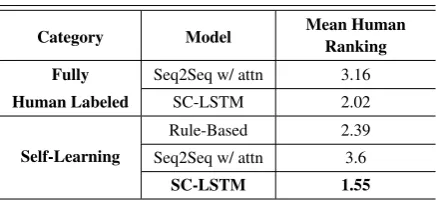
Table 3: Human Evaluation Results. For the human ranking, 1 is highest ranked and 5 is
lowest ranked.
model as the training set. In the first training it-eration, eachhDialogAct, Responseipair in the dataset consists of a maximum of two slots. For each training iteration, we split the available train-ing dataset into 4 : 1 partitions for training and validation respectively. For testing, we use human generated hDialogAct, Responsei pairs which contain one more slot compared to the dataset used in the training step. For comparison, we also trained our neural models using human generated test pairs with less than k slots combined with original train dataset. They are also evaluated us-ing the test dataset which containsk+ 1slots per pair.
4.2 Evaluation Metrics
To evaluate our models, we measure BLEU scores and use a human evaluation. The BLEU score is then-gram similarity between the reference re-sponse and the generated rere-sponse. Higher BLEU scores indicate a better model. The whole test set was used to measure BLEU scores. For human rat-ing, we asked 21 human evaluators to rank the out-puts of all five models, considering the grammat-ical correctnessandinformativenessof the gen-erated responses. Then we calculated the Mean Rank for each model. Lower Mean Rank indicates a better model. Randomly chosen 10 responses with 3 to 5 slots were used for human rating.
4.3 Results
[image:4.595.72.291.390.496.2]addi-tional gated cell which plays the role of sentence planning to produce a surface realization which accurately encodes the input information. When the model encounters a Dialog Act with more slot-value pairs than those in the training dataset, it rec-ognizes the extra slot and generates the response. The Seq2Seq model captures the same relation above using attention. However Seq2Seq-model could not outperform the SC-LSTM model, when it encounters a Dialog Act with more slots than the model was originally trained on. Therefore it fails on our self-learning task. The Rule-based model produces reasonable outputs, but its output heavily depends on the nature of input data and requires human effort. One interesting observa-tion is that the BELU score was the highest when the maximum number of slots was used. We think the BLEU score can increase when the number of target slots rises above a certain level, because the dataset with more slots has more training re-sponses and has rere-sponses about more complex combinations of slots.
5 Conclusion
This paper presents a self-learning architecture for NLG. We experimented with three different mod-els: Rule-based, Seq2Seq and SC-LSTM models in the IoT domain. Our data-efficient architecture not only reduces human effort, but also outper-forms models trained on the fully human labeled dataset. We think the proposed method can reduce the effort of building large-scale NLG systems for commercial conversational assistant solutions. In future work, we plan to apply other neural models to our architecture, and extend that architecture to cover multi-domain generation tasks.
Acknowledgments
We would like to thank Heriberto Cuay´ahuitl and Seonghan Ryu for helpful discussions.
References
Songsak Channarukul, Susan McRoy, and Syed S. Ali. 2002. Jyag & idey: A template-based generator and its authoring tool. InAAAI/IAAI.
Adam Cheyer and Didier Guzzoni. 2014. Method and apparatus for building an intelligent automated as-sistant. US Patent 8,677,377.
Nina Dethlefs. 2017. Domain transfer for deep natural language generation from abstract meaning
repre-sentations. IEEE Computational Intelligence Mag-azine, 12:18–28.
Ondˇrej Duˇsek and Filip Jurˇc´ıˇcek. 2016. Sequence-to-sequence generation for spoken dialogue via deep syntax trees and strings.
Katja Filippova. 2010. Multi-sentence compression: Finding shortest paths in word graphs. InCOLING.
Michel Galley, Eric Fosler-Lussier, and Alexandros Potamianos. 2001. Hybrid natural language gener-ation for spoken dialogue systems. InProceedings of the 7th European Conference on Speech Commu-nication and Technology (EUROSPEECH01), page 17351738, Aalborg, Denmark.
Albert Gatt and Emiel Krahmer. 2018. Survey of the state of the art in natural language generation: Core tasks, applications and evaluation. J. Artif. Int. Res., 61(1):65–170.
Albert Gatt and Ehud Reiter. 2009. Simplenlg: A re-alisation engine for practical applications. In Pro-ceedings of the 12th European Workshop on Natu-ral Language Generation, ENLG ’09, pages 90–93, Stroudsburg, PA, USA. Association for Computa-tional Linguistics.
Sebastian Gehrmann, Falcon Dai, Henry Elder, and Alexander Rush. 2018. End-to-end content and plan selection for natural language generation.
Kallirroi Georgila, Carla Gordon, Hyungtak Choi, Jill Boberg, Heesik Jeon, and David Traum. 2018. To-ward low-cost automated evaluation metrics for in-ternet of things dialogues. InProceedings of the 9th International Workshop on Spoken Dialogue Sys-tems Technology (IWSDS).
Susan McRoy, Songsak Channarukul, and Syed S. Ali. 2003. An augmented template-based approach to text realization. Natural Language Engineering, 9:381–420.
Danilo Mirkovic and Lawrence Cavedon. 2011. Di-alogue management using scripts. US Patent 8,041,570.
Karthik Sankaran Narayan, Charles Lee Isbell, and David L. Roberts. 2011. Dextor: Reduced effort au-thoring for template-based natural language genera-tion. InAIIDE.
Kari-Jouko R¨aih¨a and Esko Ukkonen. 1981. The shortest common supersequence problem over bi-nary alphabet is np-complete. Theor. Comput. Sci., 16:187–198.
Ehud Reiter. 1996. Building natural-language genera-tion systems. CoRR, cmp-lg/9605002.
Tsung-Hsien Wen, Milica Gasic, Nikola Mrksic, Pei-Hao Su, David Vandyke, and Steve Young. 2015. Semantically conditioned lstm-based natural lan-guage generation for spoken dialogue systems.