C o r p u s - b a s e d M e t h o d for A u t o m a t i c I d e n t i f i c a t i o n o f
S u p p o r t V e r b s
for N o m i n a l i z a t i o n s
G r e g o r y G r e f e n s t e t t e
S i m o n e Teufel
Rank Xerox Research Centre
Universit£t Stuttgart
38240 Meylan, France
Institut ffir maschinelle Sprachverarbeitung
g r e f e n © x e r o x . f r
D 70174 Stuttgart 1
s imone~ ims. uni- stuttgart, de
Abstract
Nominalization is a highly pro- ductive p h e n o m e n a in m o s t lan- guages. T h e process of nominaliza- tion ejects a verb f r o m its syntactic role into a nominal position. T h e original verb is often replaced by a semantically e m p t i e d s u p p o r t verb (e.g., make a proposal). T h e choice
of a s u p p o r t verb for a given nomi- nalization is unpredictable, causing a p r o b l e m for language learners as well as for n a t u r a l language pro- cessing systems. We present here a m e t h o d of discovering s u p p o r t verbs f r o m an untagged corpus via low-level syntactic processing and comparison of arguments attached to verbal forms and potential nom- inalized forms. T h e result of the process is a list of potential s u p p o r t verbs for the nominalized f o r m of a given predicate.
1 Introduction
Nominalization, the t r a n s f o r m a t i o n of a ver- bal phrase into a nominal form, is possible in m o s t languages (Comrie and T h o m p s o n , 1990). Nominalizations are used for a vari- ety of stylistic reasons: to avoid repetitions
of a verb, to avoid awkward intransitive uses of transitive verbs, in technical descriptions where passive is c o m m o n l y used, etc.
T h o u g h , as a result of nominalization, the original verb is ejected from its syntactic po- sition, it often retains m a n y of its t h e m a t i c roles. T h e original agents and patients can
T h e semantically impoverished verb, often called a s u p p o r t verb, to be used with a nom- inalized predicate structure is unpredictable. Allerton (1982)[p. 76] writes:
Perhaps the m o s t serious prob- lem for these structures is t h a t there is no constant selection of the e m p t y verb: s o m e t i m e s we find have, s o m e t i m e s take, s o m e t i m e s give, and rarely pay; s o m e t i m e s we have a choice between two or m o r e e m p t y verbs e.g. have/take a look . . . We have little choice b u t to record such irregularities in the lexicon . . .
For this reason, the collocational choice of a s u p p o r t verb for a given nominalization is a difficult p r o b l e m for language learners, as well as for n a t u r a l language processor implemen- tation.
We present here a m e t h o d of deriving prob- able s u p p o r t verbs for nominalized predicates from corpora using low-level syntactic anal- ysis and simple frequency statistics over its results. This a u t o m a t i c procedure m a y be looked upon as an aid to lexicographers, as an independent extraction tool, or as a verifica- tion of lexical collocation i n f o r m a t i o n stored in a machine-based lexicon.
1.1 T h e r q o m i n a l i z a t i o n C l i n e
The phenomenon of nominalization in En- glish happens when a verb is replaced by a noun construction using a gerundive or nomi- nal form of the verb. The original subject and objects of the verb can reappear as Saxon or Norman genitives modifying the nominalized form.
Quirk et al. (Quirk et al., 1985) distin- guish nominalizations between deverbal and verbal nouns. Examples of these are advice vs. killing. Deverbal nouns are defined as records of the action having taken place rather than as description of the action itself. This ac- counts for the contrast between their arriving for a month and . t h e i r arrival for a month.
Deverbal nouns can be replaced by regu- lar count nouns in any context, for exam- ple painting as a deverbal noun in Brown's paintings of his daughter can be replaced by photograph whereas this is not the case with the verbal noun painting in The painting of Brown is as skillful as that of Gainsborough which describes the action of painting itself (Quirk et al., 1985)[p.1291].
As the following evidence shows, the se- mantics of the verb and much of its syntactic structure can be retained by either of its nom- inalized forms:
She was surprised that the enemy de- stroyed the city.
She was surprised by the enemy('s) de- stroying the city.
She was surprised by the enemy's de- struction of the city.
The cline of nominalization can be seen in the morphological changes 1 that some predi- cate undergo as they move from an inflected verb (e.g. destroyed) to non-inflected verbal noun (destroying) to a deverbal noun (de- struction).
In this article we shall consider only dever- bal nouns 2 since these are the nominalizations involving the collocational phenomena of sup- port verbs.
A remaining problem with the deverbal nouns is that the meaning of such nouns can become concretized over time, by a
aThe morphological processes involved in transforming verbs into nominalizations are de- scribed in (Quirk et at., 1985), Sections 1.43 (con- version) and 1.30 (suffixation). See also 17.52 for discussion of this cline.
2On a practical level, we will also accept as deverbal nouns those forms ending in -ing which are marked as nouns in our lexicon, e.g. warning.
metonymic association. Compare the uses of proposal in :
He made his formal proposal to the full committee.
He put the proposal in the drawer.
The concrete uses of deverbal nouns are not involved in support verb constructions since they have lost the semantics of actions, and their attending thematic roles.
2
A
very simple approach and
its problems
Looking for support verbs for nominalizatious might seem an easy problem at first, given that these support verbs are always the main verb for which the nominalization is the direct object. W h a t is needed is a low-level parser that extracts verb-object relations from cor- pora. Given such a parser, one might be tempted to extract all the main verbs for a given nominalized form and consider tile most frequent of these verbs the expected support verbs.
As will be seen below, this approach is too simple. The examples given above for pro- posal show that a given word form m a y be used with a meaning anywhere along the cline from true nominalization to concrete nouns. Counting verbs of which these concrete nouns are direct objects will create noise hiding the true support verbs.
Since real nominalizations are those that still have verbal character, i.e. they have retained the semantic roles from the verb, we will try to recognize true nominalized uses by comparing the most frequent argu- m e n t / a d j u n c t structures found in the corpus around verbal uses of a given predicate to those syntactic structures found around tile candidate nominalized forms 3.
We will define true nominalizations as those which have a parallel syntactic structure to the original verb. This is also in keeping with the definition of nominalizations given in (Quirk et al., 1985)[p. 1288]:
A noun phrase . . . w h i c h has a systematic correspondence with a clause structure will be termed a
N o m i n a l i z a t i o n . T h e noun head of such a phrase is n o r m a l l y related morphologically to a verb, or to an adjective (i.e., a deverbal or dead- jectival noun).
In this article we have been restricting the t e r m nominalization to the noun heading the noun phrase.
3 M e t h o d
In this section we explain our m e t h o d for extracting s u p p o r t verbs for nominalizations. We suppose t h a t we are given a pair of words: a y e r b and its nominalized form. As explained in the previous section, we are interested in extracting only nominalized forms which have not become concrete nouns, and t h a t this will be done by comparing syntactic structures at- tached to the verb and noun forms. In order to e x t r a c t corpus evidence related to these phenomena, we proceed as follows:
1. We generate all the morphologically related forms of the word pair using a lexical transducer for English
( K a r t t u n e n et al., 1992). This list of words will be used as corpus filter.
2. T h e lines of the corpus are tokenized (Grefenstette and T a p a n a i n e n , 1994), and only sentences containing one of the word forms in the filter are retained.
3. T h e corpus lines retained are
part-of-speech tagged (Cutting et al., 1992). This allows us to divide the corpus evidence into verb evidence and noun evidence.
4. Using a robust surface parser
(Grefenstette, 1994), we derive the local syntactic p a t t e r n s involving the verbal f o r m and the nominalized form.
5. Considering t h a t nominalized forms retain some of the verbal characteristics of the underlying predicate, we want to extract the m o s t c o m m o n
a r g u m e n t / a d j u n c t structures found around verbal uses of the predicate. As an a p p r o x i m a t i o n , we extract here all the prepositional phrases found after the verb.
6. For n o m i n a l forms, we select only those uses which involve a r g u m e n t / a d j u n c t structures similar to phrases extracted in the previous step. For these selected nominalized forms, we extract the verbs of which these forms are the direct
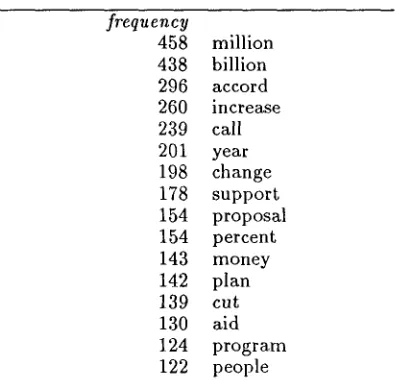
frequency
458 million 438 billion 296 accord 260 increase 239 call 201 year 198 change 178 s u p p o r t 154 proposal 154 percent 143 m o n e y 142 plan 139 cut 130 aid 124 p r o g r a m 122 people
Figure 1: The m o s t c o m m o n nouns preced- ing the m o s t c o m m o n prepositions following 'propose', and appearing in the s a m e environ- ment.
object. We sort these verbs by frequency.
7. This sorted list is the list of candidate s u p p o r t verbs for the nominalization.
This m e t h o d assumes t h a t the verb and the nominalized f o r m of the verb are given. We have experimented with a u t o m a t i c a l l y ex- tracting the nominalized f o r m by using the prepositional p a t t e r n s extracted for the verb in step 5. We extracted 6 m e g a b y t e s of news- p a p e r articles containing a form of the verb
propose: propose, proposes, proposed, propos- ing. Since one use of nominalization is to avoid repetition of the verb form, we suppose t h a t the nominalization of propose is likely to a p p e a r in the s a m e articles. We extracted the three m o s t c o m m o n prepositions following a form of propose (step 5). We then extracted the nouns appearing in these s a m e artigles and which preceded these prepositions.~oThe results 4 a p p e a r in figure 1. Since a nomilml- ized form is normally morphologically related to the verb form, almost any morphological comparison m e t h o d will pick proposal from this list.
[image:3.596.343.542.72.263.2]frequency
167 reject 127 hear 114 m a k e
81 file
Figure 2: Most c o m m o n verbs of which 'ap- peal' is m a r k e d as direct object.
4
E x p e r i m e n t with
appeal-appeal
We have taken for e x a m p l e the case of the verb appeal which was interesting since its c o r r e s p o n d i n g deverbal n o u n shares the s a m e surface f o r m appeal. In order to extract cor- pus evidence, we used a lexical t r a n s d u c e r of English that, given the surface word appeal,
p r o d u c e d all the inflected forms appeal, ap- peal's, appealing, appealed, appeals and ap- peals '.
Using these surface forms as a filter, we scanned 134 M e g a b y t e s of tokenized Asso- ciated Press newswire stories f r o m the year 19895. As a result o f filtering, 6704 sen- tences (1 M b y t e of text) were extracted. This text was part-of-speech tagged using the Xe- rox H M M tagger ( C u t t i n g et al., 1992). T h e lexical entries c o r r e s p o n d i n g to appeal were t a g g e d with the following tags: as a n o u n (3910 times), as an active or infinitival verb (1417), as a progressive verb (292), and as a past participle (400).
This tagged text was then parsed by a low-level d e p e n d e n c y parser (Grefenstette, 1994)[Chap 3]. F r o m the o u t p u t of the de- p e n d e n c y parser we e x t r a c t e d all the lexically n o r m a l i z e d verbs of which appeal was tagged as a direct object. T h e m o s t c o m m o n of these verbs are shown in Figure 2.
O u r speaker's intuition tells us t h a t the s u p p o r t verb for the nominalized use of ap- peal is make. But this d a t a does n o t give us e n o u g h i n f o r m a t i o n to m a k e this j u d g e m e n t , since concrete versions as a separate entity are n o t distinguishable f r o m n o m l n a l i z a t i o n s of the verb.
In order to separate nominalized uses of the predicate appeal f r o m concrete uses, we will refer to the linguistic discussion presented in the i n t r o d u c t i o n t h a t says t h a t n o m i n a l - izations retain some of the a r g u m e n t / a d j u n c t s t r u c t u r e of the verbal predicate. This is ver- ified in the corpus since we find m a n y parallel
SThis corresponds to 20 million words of text.
structures involving appeal b o t h as a verb and as a noun, such as:
Vice President Salvador Laurel said today that an ailing Ferdinand Mar- cos may not survive the year and a p p e a l e d t o P r e s i d e n t C o r a z o n A q u i n o to allow her ousted predeces- sor to die in his homeland.
Mrs. Marcos made a p u b l i c a p p e a l
to P r e s i d e n t C o r a z o n A q u l n o to allow Marcos to return to his home- land to die.
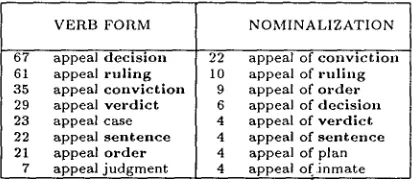
Indeed, if we e x a m i n e a c o m m o n n o m i n a l - ization t r a n s f o r m a t i o n , i.e. t h a t of t r a n s f o r m - ing the direct o b j e c t of a verb into a N o r m a n genitive of the n o m i n a l i z e d form, we find a great overlap in the lexical a r g u m e n t s 6.
VERB FORM N O M I N A L I Z A T I O N
22 appeal of c o n v i c t i o n 67 appeal d e c i s i o n
61 appeal r u l i n g 35 appeal c o n v i c t i o n 29 appeal v e r d i c t 23 appeal case 22 appeal s e n t e n c e 21 appeal o r d e r
7 appeal j u d g m e n t
10 appeal of r u l i n g 9 appeal of o r d e r 6 appeal of d e c i s i o n 4 appeal of v e r d i c t 4 appeal of s e n t e n c e 4 appeal of plan 4 appeal of.inmate
T h e parser's o u t p u t allowed us to e x t r a c t p a t t e r n s involving prepositional phrases fol- lowing n o u n phrases headed by appeal as well as those following verb sequences headed by appeal. T h e m o s t c o m m o n prepositional phrases found after appeal as a verb began with the prepositions7: Lo (466 times), for
(145), in (18), on (12), wilh (5), etc. T h e prepositional phrases following appeal as a n o u n are headed by to (321 times), for (253),
in (200), of (134), from (78), on (34), etc. T h e correspondence between the m o s t fre- quent prepositions allowed us to consider t h a t the p a t t e r n s o f a n o u n phrase headed by
appeal followed by one these prepositional phrases (i.e., begun with to, for, and in) con- stituted true n o m i n a l i z a t i o n s s. T h e r e were
6We decided not to use this type of data in our experiments because matching lexical arguments requires much larger corpora than the ones we had extracted for the other verbs tested.
rWe ignored prepositionM phrases headed by
by as being probable passivizations, since our parser does not recognize passive patterns involv- ing by.
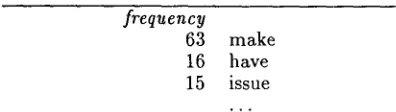
[image:4.596.265.474.298.389.2]frequency
63 m a k e 16 have 15 issue
Figure 3: Most c o m m o n verbs supporting the structure NP P P where ' a p p e a l ' heads the NP and where one of {to, for, in} begins the PP.
774 instances of these patterns.
T h e parser's o u t p u t further allowed us to extract the verbs for which these nominaliza- tions were considered as the direct objects. 318 of these nominal syntactic p a t t e r n s in- cluding to, f o r and in were found. Of these patterns, the m a i n verb supporting the objec- tive nominalizations are shown in Figure 3.
These results suggest t h a t the support verb for the nominalization of appeal is make.
5
O t h e r P r e d i c a t e E x a m p l e s
and D i s c u s s i o n
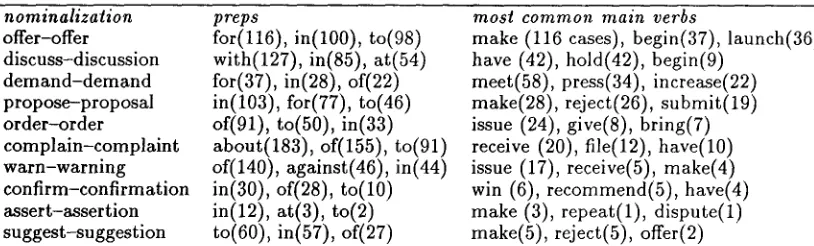
W h e n the s a m e filtering technique is applied to s u b c o r p o r a derived for other nominaliza- tion pairs, we obtain the results given in Fig- ure 4. For each v e r b - n o u n pair all sentences containing any f o r m of the words were ex- tracted f r o m the AP corpus. T h e sentences were processed as explained in section 3. For each verbal use, the m o s t frequent preposi- tional phrases following the verbs were tab- ulated and the three m o s t frequent preposi- tions were retained. For example, the m o s t frequent prepositions beginning prepositional phrases following verb uses of the l e m m a of- f e r were for, in and to. These prepositions were used to select probable nominalizations by extracting noun uses of the predicates t h a t were i m m e d i a t e l y followed by preposi- tional phrases headed by one of the three m o s t frequent verbal prepositions. For these ex- tracted noun phrases, when they were found in a direct object position, the main verbs were t a b u l a t e d which gives the results in Fig- ure 4.
Some of the results in Figure 4 correspond to our naive intuitions of collocational sup- p o r t verbs, such as make an offer. For dis- cussion, b o t h have and hold a p p e a r equally frequently. But other words show the limita- tions of this m e t h o d , we would expect make a demand where we find meet a demand. In the s a m e subcorpus, although we find make a demand 77 times, meet a demand is two- a n d - a - h a l f times m o r e c o m m o n . Could this be
because, in a newswire corpus, meeting a de- mand is m o r e newsworthy t h a n making one? If we just look at the cases where demand
is modified by the indefinite article; which m i g h t correspond to the m o r e generic n o m - inalizations one spontaneously creates when generating examples, we find t h a t in the cor- pus make a demand occurs slightly m o r e often than meet a demand, ten times vs. six times, but this is too rare to use as a criterion.
In other cases, such as with proposal and
assertion we find make and reject with almost equal frequency, and though make m i g h t well be considered a s u p p o r t verb, it is hard to accept reject as semantically empty. T h o u g h
reject is more a consequence t h a n an a n t o n y m of make a proposal, this raises the question, to which we have no answer, of whether s u p p o r t verbs have an equally e m p t y a n t o n y m .
A more interesting case is the a p p e a r a n c e of issue for order and warning where we would expect give. Looking into the corpus evidence, we find issue a restraining order
46 times, and give any type of order only 16 times. This evidence suggest a limita- tion of our word-based approach. Multi-word phrases, such as the nominalized phrase re- straining order, m i g h t take a different s u p p o r t verb t h a n the simple unqualified word forms, such as order.
6 C o n c l u s i o n s
Nominalization is a very productive process. T h e proper choice of collocational s u p p o r t verbs for nominalizations in English is a dif- ficult task for language learners given the unpredictability of the semantically e m p t i e d verb t h a t fulfills the syntactic role. Given a robust parser and large corpus, the sim- ple technique of extracting the m o s t c o m m o n verbs for which the nominalized f o r m is the di- rect object is not always sufficient, since com- pletely deverbal concrete noun uses share the same lexical surface form. C o m p a r i n g argu- m e n t / a d j u n c t structures involving the verbal uses of the predicate and using the m o s t com- m o n of these structures as filters on the sur- face forms possibly corresponding to nominal- izations captures the linguistic fact t h a t nom- inalizations retain the syntactic structures of their underlying predicate. W h e n these fil- ters are applied, the m o s t c o m m o n supporting verb in the corpus for the recognized nominal- ized p a t t e r n s seems to correspond to native speakers' intuition of the s u p p o r t verb asso- ciated with the nominalization.
[image:5.596.129.327.74.130.2]nominalization
offer-offer
discuss-discussion demand-demand propose-proposal order-order
complain-complaint warn-warning confirm-confirmation assert-assertion suggest-suggestion
preps
for(ll6), in(100), to(98) with(127), in(85), at(54) for(37), in(28), of(22) in(103), for(77), to(46) of(91), to(50), in(33) about(183), of(155), to(91) of(140), against(46), in(44) in(30), of(28), to(10) in(12), at(3), to(2) to(60), in(57), of(27)
most common main verbs
make (116 cases), begin(37), launch(36) have (42), hold(42), begin(9)
meet(58), press(34), increase(22) make(28), reject(26), submit(19) issue (24), give(8), bring(7) receive (20), file(12), have(10) issue (17), receive(5), make(4) win (6), recommend(5), have(4) make (3), repeat(l), dispute(l) make(5), reject(5), offer(2)
Figure 4: Most common verbs supporting the structure found for other nominalization pairs using the syntactic structure filtering mechanism.
megabyte corpus of newspaper text from which was extracted evidence for appeal
and other predicates shows how this auto- mated procedure can be applied to any verb- nominalization pair given a large corpus and a robust parser. Other work in automated sup- port verb discovery using bilingual dictionar- ies as a source has been reported in Fontenelle (1993).
It remains to be seen whether these statis- tical results are more useful to lexicographers than their more traditional tools of key-word- in-context files and T-score measures. Human experiments would be necessary to demon- strate this. Another useful test of the re- sults would be to compare the results given by this technique against machine-readable dictionary-derived data.
In conclusion, the interest of this technique is its general approach to corpus linguistics as one of multiple passes over the same corpus material, using results of previous passes to filter and refine data extracted on subsequent passes. We believe that this approach, cou- pled with lexical resources and robust parsers, offers much promise for the future of corpus exploitation.
R e f e r e n c e s
D. J. Allerton. 1982. Valency and the English verb. Academic Press, London.
Bernard Comrie and Sandra A. Thompson. 1990. Lexical nominalization. In Tim- othy Shopen, editor, Language Typology and Syntactic Description, volume 3. Cam- bridge University Press, Cambridge.
Doug Cutting, Julian Kupiec, Jan Pedersen, and Penelope Sibun. 1992. A practical part-of-speech tagger. Proceedings of the
Third Conference on Applied Natural Lan- guage Processing, April.
Thierry Fontenelle. 1993. Using a bilingual computerized dictionary to retrieve sup- port verbs and combinatorial information.
Acta Linguistica Hungaraica, 41(1-4):109- 121.
G. Grefenstette and P. Tapanainen. 1994. What is a word, what is a sentence? Prob- lems of tokenization. In 3rd Conference on Computational Lexicography and Text Research, Budapest, Hungary, 7-10 July. COMPLEX'94.
Gregory Grefenstette. 1994. Explorations in Automatic Thesaurus Discovery. Kluwer Academic Press, Boston.
Lauri Karttunen, Ronald M. Kaplan, and An- nie Zaenen. 1992. Two-level morphology with composition. In Proceedings COLING '92, pages 141-148, Nantes, France, August
23-28.
Randolph Quirk, Sidney Greenbaum, Geof- frey Leech, and Jan Svartvik. 1985. A
[image:6.596.55.462.74.197.2]