SAP-RI: A Constrained and Supervised Approach for Aspect-Based
Sentiment Analysis
Nishtha Malhotra1,2∗, Akriti Vij1,2,∗, Naveen Nandan1andDaniel Dahlmeier1 1Research & Innovation, SAP Asia, Singapore
2Nanyang Technological University, Singapore
{nishtha.malhotra,akriti.vij,naveen.nandan,d.dahlmeier}@sap.com
Abstract
We describe the submission of the SAP Research & Innovation team to the Se-mEval 2014 Task 4: Aspect-Based Senti-ment Analysis (ABSA). Our system fol-lows a constrained and supervised ap-proach for aspect term extraction, catego-rization and sentiment classification of on-line reviews and the details are included in this paper.
1 Introduction
The increasing popularity of the internet as a source of information, and e-commerce as a way of life, has led to a major surge in the number of reviews that can be found online, for a wide range of products and services. Consequently, more and more consumers have taken to consulting these on-line reviews as part of their pre-purchase research before deciding on availing services from a local business or investing in a product from a particu-lar brand. This calls for innovative techniques for the sentiment analysis of online reviews so as to generate accurate and relevant recommendations.
Sentiment analysis has been extensively studied and applied in different domains. Predicting the sentiment polarity (positive, negative, neutral) of user opinions by mining user reviews (Hu and Liu, 2004; Liu, 2012; Pang and Lee, 2008; Liu, 2010) has been of high commercial and research interest. In these studies, sentiment analysis is often con-ducted at one of the three levels: document level,
sentence levelorattribute level.
Through the SemEval 2014 Task 4 on Aspect Based Sentiment Analysis (Pontiki et al., 2014), we explore sentiment analysis at the aspect level.
∗The work was done during an internship at SAP. This work is licenced under a Creative Commons Attribution 4.0 International License. Page numbers and proceedings footer are added by the organizers. License details: http: //creativecommons.org/licenses/by/4.0/
The task consists of four subtasks: in subtask 1 as-pect term extraction, participants need to identify the aspect terms present in a sentence and return a list containing all distinct aspect terms, in sub-task 2 aspect term polarity, participants were to determine the polarity of each aspect term in a sen-tence, in subtask 3aspect category detection, par-ticipants had to identify the aspect categories dis-cussed in a given sentence, and in subtask 4aspect category polarity, participants were to determine the polarity of each aspect category. The polarity classification subtasks consider sentiment analysis to be a three-way classification problem between positive, negative and neutral sentiment. On the other hand, the aspect category detection subtask is a multi-label classification problem where one sentence can be labelled with more than one as-pect category.
In this paper, we describe the submission of the SAP-RI team to the SemEval 2014 Task 4. We make use of supervised techniques to extract the aspects of interest (Jakob and Gurevych, 2010), categorize them (Lu et al., 2011) and predict the sentiment of customer online reviews onLaptops
andRestaurants. We developed a constrained sys-tem for aspect-based sentiment analysis of these online reviews. The system is constrained in the sense that we only use the training data that was provided by the challenge organizers and no other external data sources. Our system performed rea-sonably well, especially with aF1score of 75.61% for the aspect category polarity subtask, 79.04%
F1 score on the aspect category detection task and
66.61% F1 score on the aspect term extraction task.
2 Subtask 1: Aspect Term Extraction
Given a review with annotated entities in the train-ing set, the task was to extract the aspect terms for reviews in the test set. For this subtask, training, development and testing were conducted for both
the laptop and the restaurant domain.
2.1 Features
Each review was represented as a feature vector made up of the following features:
• Word N-grams: all unigrams, bigrams and
trigrams from the review text
• Casing:presence or absence of capital case/ title case words
• POS tags:POS tags of a word and its
neigh-bours
• Parse dependencies and relations: parse
dependency relations of the aspects, i.e., presence/absence of adjectives and adverbs in the dependency parse tree
• Punctuation Marks: presence/absence of
punctuation marks, such as?,!
2.2 Method
We approach the task by casting it as a sequence tagging task where each token in a candidate sen-tence is labelled as either Beginning, Inside or
Outside (BIO). We then employ conditional ran-dom fields (CRF), which is a discriminative, prob-abilistic model for sequence data with state-of-the-art performance (Lafferty et al., 2001). A linear-chain CRF tries to estimate the conditional prob-ability of a label sequence y given the observed featuresx, where each labelytis conditioned on
the previous labelyt−1. In our case, we use BIO
CoNLL-style tags (Sang and De Meulder, 2003). During development, we split the training data in the ratio of 60:20:20 as training, development (dev) and testing (dev-test). We train the CRF model on the training set of the data, perform feature selection based on the dev set, and test the resulting model on the dev-test. In all ex-periments, we use the CRF++1 implementation
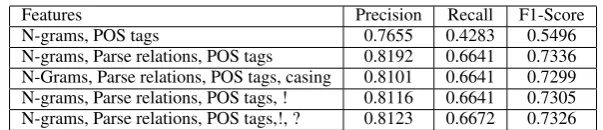
of conditional random fields with the parameter c=4.0. This value was chosen based on manual observation. We perform a feature ablation study and the results are reported in Table 1. Features listed in section 2.1 were those that were retained for the final run.
1code.google.com/p/crfpp/
3 Subtask 2: Aspect Term Polarity Estimation
For this subtask, the training, development and testing was done using reviews on laptops and restaurants. Given the aspect terms in a sentence, the task was to predict their sentiment polarities.
3.1 Features
For each review, we used the following features:
• Word N-grams: all lowercased unigrams,
bigrams and trigrams from the review text
• Polarity of neighbouring adjectives:
ex-tracted word sentiment from SentiWordNet lexicon (Baccianella et al., 2010)
• Neighbouring POS tags:the POS tags of up
to neighbouring 3 words
• Parse dependencies and relations: parse
dependency relations of the aspects, i.e., presence/absence of adjectives and adverbs in the dependency parse tree
3.2 Method
For each aspect term of a sentence, the afore-mentioned features were extracted. For exam-ple, for the term Sushi in the sentence Sushi was delicious., the following feature vector is constructed, {aspect: ’sushi’, advmod:’null’, amod:’delicious’, uni sushi: 1, uni was: 1, uni delicious, uni the: 0, ..}.
We then treat the aspect sentiment polarity es-timation as a multi-class classification task where each instance would be labelled as eitherpositive,
negativeorneutral. For the classification task, we experimented with Naive Bayes and Support Vec-tor Machines (SVM) – both linear and RBF ker-nels – and it was observed that linear SVM per-formed best. Hence, we use linear SVM for the classification task. Table 2 summarizes the results obtained from our experiments for various feature combinations. The classifiers used are implemen-tations from scikit-learn2, which is also used for
the remaining tasks.
4 Subtask3: Aspect Category Detection
Given a review with annotated entities or aspect terms, the task was to predict the aspect categories.
Features Precision Recall F1-Score
N-grams, POS tags 0.7655 0.4283 0.5496
[image:3.595.147.449.60.125.2]N-grams, Parse relations, POS tags 0.8192 0.6641 0.7336 N-Grams, Parse relations, POS tags, casing 0.8101 0.6641 0.7299 N-grams, Parse relations, POS tags, ! 0.8116 0.6641 0.7305 N-grams, Parse relations, POS tags,!, ? 0.8123 0.6672 0.7326
Table 1: Training-phase experimental results for Subtask 1 on Restaurant reviews.
Features Laptops Restaurants
Neighbouring words, 2,3 POS grams, bigrams, trigrams, Sentiment,1,2 ngram lower 0.4196 0.5997 Parse Relations, 2,3 POS grams, bigrams, trigrams, Sentiment, 1,2 ngram lower 0.5869 0.6375 Parse Relations, Neighbouring words, bigram, trigrams, Sentiment, 1,2 ngram lower 0.5848 0.6380 Parse Relations, 2,3 POS grams, Neighbouring words, Sentiment, 1,2 ngram lower 0.5890 0.6240 Parse Relations, 2,3 POS grams , Neighbouring words, bigram, trigrams, 1,2 ngram lower 0.5626 0.6239 Parse Relations, 2,3 POS grams , Neighbouring words, bigram, trigrams, Sentiment 0.5922 0.6409
Table 2: Training-phase experimental results (Accuracy) for Subtask 2.
As one sentence in a review could belong to mul-tiple aspect categories, we model the task as a multi-label classification problem, i.e., given an instance, predict all labels that the instance fits to.
4.1 Features
We experimented with different features, for ex-ample unigrams, dependency tree relations, bi-grams, POS tags and sentiment of the words (Sen-tiWordNet), but using just the unigrams alone hap-pened to yield the best result. The feature vector was merely a bag-of-words vector indicating the presence or absence of a word in an instance.
4.2 Method
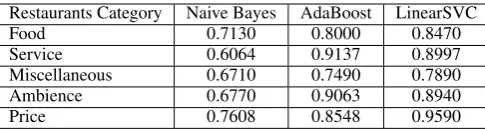
The training instances were divided into 5 sets based on the aspect categories and thereby, we treated the multi-label classification task as 5 dif-ferent binary classification tasks. Hence, we used an ensemble of binary classifiers for the multi-label classification. An SVM model was trained using one classifier per class to distinguish it from all other classes. For the binary classification tasks, directly estimating a linear separating func-tion (such as linear SVM) gave better results, as shown in Table 3. Finally, the results of the 5 bi-nary classifiers were combined to label the test in-stance.
The category Miscellaneous was observed to have the lowest accuracy, probably due to the fact that miscellaneous captures all those aspects terms that do not have a clearly defined category.
5 Subtask4 Aspect Category Polarity Detection
For each review with pre-labelled aspect cate-gories, the task was to produce a model which predicts the sentiment polarity of each aspect cat-egory.
5.1 Features
The training data contains reviews with the po-larity for the corresponding aspect category. The models performed best on using just unigram and bigram features.
5.2 Method
The training instances were split into 5 sets based on the aspect categories. We make use of the sen-timent polarity classifier, as described in section 3.2, thereby, training one sentiment polarity classi-fier for each aspect category. Table 4 indicates the performance of different classifiers for this task, using features as discussed in section 5.1.
6 Results
Restaurants Category Naive Bayes AdaBoost LinearSVC
Food 0.7130 0.8000 0.8470
Service 0.6064 0.9137 0.8997
Miscellaneous 0.6710 0.7490 0.7890
Ambience 0.6770 0.9063 0.8940
[image:4.595.177.420.61.126.2]Price 0.7608 0.8548 0.9590
Table 3: Training-phase experimental results (F1score) for Subtask 3.
Restaurants Category Naive Bayes AdaBoost LinearSVC
Food 0.7136 0.6711 0.7417
Service 0.6733 0.5244 0.6688
Miscellaneous 0.4756 0.3170 0.4756
Ambience 0.6574 0.7232 0.6885
Price 0.7477 0.7752 0.6651
Table 4: Training-phase experimental results (F1score) for Subtask 4.
highF1score, for example, in subtask 3 a
bag-of-words feature set proved to yield a relatively high
F1 score. In general, for the classification tasks, we observe that the linear SVM performs best.
Subtask Dataset Best score Our score Rank
1 Laptops 74.55 66.61 8/27
1 Restaurants 84.01 77.88 12/29
2 Laptops 70.48 58.56 18/32
2 Restaurants 80.95 69.92 22/36
3 Restaurants 88.57 79.04 7/21
[image:4.595.70.294.338.414.2]4 Restaurants 82.92 75.61 5/25
Table 5: Results (F1 score and ranking) for the
Semeval-2014 test set.
7 Conclusion
In this paper, we have described the submission of the SAP-RI team to the SemEval 2014 Task 4. We model the classification tasks using linear SVM and the term extraction task using CRF in order to develop an aspect-based sentiment analysis sys-tem that performs reasonably well.
Acknowledgement
The research is partially funded by the Economic Development Board and the National Research Foundation of Singapore.
References
Stefano Baccianella, Andrea Esuli, and Fabrizio Sebas-tiani. 2010. SentiWordNet 3.0: An enhanced lexi-cal resource for sentiment analysis and opinion min-ing. InProceedings of the Seventh Conference on International Language Resources and Evaluation (LREC’10), volume 10, pages 2200–2204.
Minqing Hu and Bing Liu. 2004. Mining and summa-rizing customer reviews. InProceedings of the tenth ACM SIGKDD International Conference on Knowl-edge Discovery and Data Mining, pages 168–177. Niklas Jakob and Iryna Gurevych. 2010. Extracting
opinion targets in a single-and cross-domain setting with conditional random fields. InProceedings of the 2010 Conference on Empirical Methods in Nat-ural Language Processing, pages 1035–1045. John Lafferty, Andrew McCallum, and Fernando
Pereira. 2001. Conditional random fields: Prob-abilistic models for segmenting and labeling se-quence data. InProceedings of the Eighteenth In-ternational Conference on Machine Learning, pages 282–289.
Bing Liu. 2010. Sentiment analysis and subjectiv-ity. InHandbook of Natural Language Processing, pages 627–666. Chapman & Hall, 2 edition. Bing Liu. 2012. Sentiment analysis and opinion
min-ing. Synthesis Lectures on Human Language Tech-nologies, 5(1):1–167.
Bin Lu, Myle Ott, Claire Cardie, and Benjamin Tsou. 2011. Multi-aspect sentiment analysis with topic models. In Proceedings of Sentiment Elicitation from Natural Text for Information Retrieval and Ex-traction, pages 81–88.
Bo Pang and Lillian Lee. 2008. Opinion mining and sentiment analysis. Foundations and trends in infor-mation retrieval, 2(1-2):1–135.
Maria Pontiki, Dimitrios Galanis, John Pavlopou-los, Haris Papageorgiou, Ion AndroutsopouPavlopou-los, and Suresh Manandhar. 2014. SemEval-2014 Task 4: Aspect based sentiment analysis. InProceedings of the 8th International Workshop on Semantic Evalu-ation (SemEval 2014).