Improving String Processing for Temporal Relations
David Woods, Tim FernandoADAPT Centre
Computational Linguistics Group School of Computer Science and Statistics
Trinity College Dublin, Ireland
[email protected],[email protected]
Abstract
This paper presents a refinement of the superposition operation on strings which are used to represent temporal relation information such as is found in documents annotated with TimeML. Superposition is made demonstrably more efficient by interleaving generation with testing, rather than generating and then testing. The strings offer compact visual appeal while remaining an attractive option for computation and reasoning. Motivated by Freksa’s semi-interval relations, a suggestion is also made for a potential method of representing partial information in these strings so as to allow for analysis at different granularities, and for more flexibility when dealing with cases of ambiguity.
1 Introduction
A string ofnsets↵1↵2· · ·↵ncan be used to represent a sequence of events and time periods such that the linear order and inter-relations of the events are clearly apparent, while remaining compact. Such a string is read from left to right chronologically, with each ↵i, i 2 {1,2, . . . , n}, depicting one ofn moments in time, and specifying the set of exactly those temporal propositions, or fluents, which hold simultaneously at that momenti. A fluenta 2 ↵i is understood to be occurring before another fluent
a0 2↵j iffi < janda0 2/ ↵i.
Note that these strings do not (necessarily) offer any information concerning real duration: a fluent may occur in several string positions, but this does not affect any interpretation of its duration, only its relation to other fluents, i.e. if the symbolaappears in both↵i and↵i+1, the event it stands for is not
understood as being twice as long as if the symbol had only appeared in↵i. Fluents representing fixed time points may be used to give a sense of real time (e.g. a = “5pm on 25th May 2018”). Because of this, a string in which ↵i = ↵i+1 for any1 i < n will not have its interpretation affected if either ↵i or↵i+1 are deleted. For example, the string{a}{a}{a, b}{b}{b}is equivalent in interpretation to
{a}{a, b}{b}. A string featuring these repetitions is said tostutter, and the process of removing stutter from a string is calledblock compression(Fernando, 2015; Woods et al., 2017).
Throughout this paper, each string position ↵i will be drawn as a box, with for the empty set?, allowing the strings to be read like strips of film. Events are treated as bounded intervals, such that they have a beginning and ending – this is represented through the use of bounding empty sets – although this assumption is not required by the string framework: the finite event a, drawn as a , as opposed to non-finite eventa0, drawn as a0 .
By superposing multiple strings, large amounts of information may be condensed into a single string, which offers a timeline-like visual appeal. The strings may be used to encode and reason about interval relations, as in Allen (1983), and also to aid visualisation in the annotation process. It is hoped that this approach may be seen as complementary to existing graphical tools. In Section 3, a refinement is offered of the superposition operation discussed in Woods et al. (2017) which preserves relational infor-mation under reduct, and interleaves generation with testing of results for a more efficient calculation. A
potential extension of the framework is also shown in Section 4 such as to allow for incomplete informa-tion, and for Freksa (1992)’s semi-interval relations to be represented. This would enable reasoning over partial or uncertain information, or in case coarser analysis was desired.
2 Motivation
Several attempts have been made to create a visualisation system which best represents the temporal relations found in TimeML (TimeML Working Group, 2005; Pustejovsky et al., 2010), particularly for use as an annotation aid, including Tango (Pustejovsky et al., 2003; Verhagen et al., 2006), using labelled arcs in a directed graph, and T-BOX (Verhagen, 2005a), using relative placement of boxed temporal propositions. A clear advantage of T-BOX is that it presents the information in a way that makes it easy to quickly gain a sense of a document’s overall temporal structure, due to its intuitive use of arrows, box-inclusion, and stacking.
Using strings as a representational tool presents the same intuitive structure, with a timeline-like left-to-right layout, but in a compact format which may also be used for computations, rather than being a purely visual entity.
Although these strings may be used for other problems (see Fernando (2015)), one of their more obvious uses is as a tool for the simultaneous visualisation of and reasoning about collections of Allen (1983)’s interval relations, such as those which appear (slightly renamed) as TLINKs in documents annotated with TimeML. A TLINK, or temporal link, is a tag featuring a pair of temporal entities, either event instances or time periods, from the text of the document and a relation between them, which can be translated to a string.
By way of example, taking a tag <TLINK lid="l5" relType="BEFORE" timeID="t86" relatedToTime="t82"/>1 (t86 referring to a five year period, and t82 being the document
cre-ation time), it is straightforward to convert this to a string: find the Allen relcre-ation which corre-sponds to the relTypeattribute, then substituteaand a0 in Table 1 with the values of timeID(or eventInstanceID) and relatedToTime(or relatedToEventInstance), respectively, to give “t86beforet82” – t86 t82 , which is interpreted as saying that the five year period occurred before the document creation time. By converting all of a document’s TLINKs to strings and superposing them with one another, a picture begins to build up of the document’s overall temporal structure.
As Derczynski (2016, p. 2) points out, the choice of representation for temporal relation types is critical, as choosing the right relation for arbitrary pairs of events is difficult. By using these strings, an annotator would be able to see the state of the document as a whole, and receive suggestions when there are constraints on the possible relations they may choose, given other relations. For example, given “x duringy” – y x, y y and “yduringz” – z y, z z , there is only one possible relation between xandz: “xduringz” – z x, z z . In scenarios such as this, where there is only one possibility, the system should be able to fill it in automatically, but in other cases, it might suggest to an annotator that only a certain group of relations is feasible.
The ultimate goal here would be to achieve full temporal closure over the document. If the temporal entities were (as in Tango) represented as nodes on a graph, and the relations between them as the arcs, this would look like a fully connected graph, with an arc from every node to every other node. Using strings instead, a single, timeline-like string would be computable, which would contain all of the temporal relation information of the document. It would be possible to determine the relation between any two (or more) events in a single operation, and to quickly examine subsections of the timeline, or see the relative ordering of a specific subset of events (see reduct and projections, Section 3).
Reaching this somewhat lofty target in an automatic way seems unlikely, at least for now, as the number of relations given in a typical document from TimeBank (Pustejovsky et al., 2006), the largest corpus of documents annotated with TimeML, is far short of the totalN(N 1)/2(forN fluents) links mentioned by Verhagen (2005b, p. 3), and in most cases, there is simply not enough information to compute everything. See Section 4 for further discussion on this matter.
One benefit the strings offer from an automation point of view is the ability to quickly determine inconsistent labellings in TimeML documents. If superposition of any two strings produces an empty language, then there is an incompatibility between them (e.g. “xbefore y” – x y and “x after y” – y x ), and there is a problem with the document. As some inconsistencies are only revealed through transitivities, superposing more than two strings will often present further issues.
Since the superposition operation would be used very frequently in any system that employed these strings for visualisation or computation, it is critical that it be made as efficient as possible.
3 Constraints for superposition of strings
Superposition in its simplest form is defined as the componentwise union of two strings of equal length:
↵1↵2· · ·↵n&↵10↵02· · ·↵0n := (↵1[↵01)(↵2[↵02)· · ·(↵n[↵0n) (1)
for example
a b c & a a d = a a, b c, d (2)
This is extended to languages (sets of strings)LandL0:
L&L0 := [
n 0
{s&s0|s2Ln, s0 2L0n} (3)
whereLnandL0nare the sets of strings of lengthninLandL0, respectively.
In order to extend this operation further to strings of unequal lengths, it should first be said thatsand s0arebc-equivalentif they block compress to the same string, that isbc(s) = bc(s0). The inverse of the
block compression operation may be used to introduce stutter in the strings which are to be superposed, and generate an infinite language of bc-equivalent strings:
bc 1(s) =↵+1↵2+· · ·↵+n ifs= bc(↵1↵2· · ·↵n) (4)
These languages are then superposed, and the results are block compressed to give a finite set, the asyn-chronous superpositionofsands0(noting thatbc(s) = bc(s0) () s0 2bc 1bc(s)):
s&⇤ s0 := {bc(s00)|s002bc 1bc(s) & bc 1bc(s0)} (5)
For example:
x z &⇤ x y z ={x x, y z , x x, y x, z z , x y, z z , x x, y y, z z , x x, z y, z z } (6)
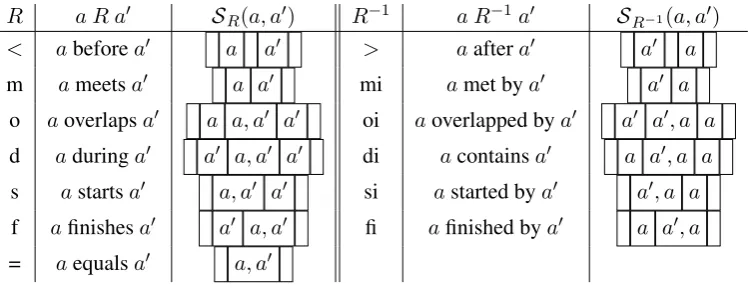
Interestingly, the thirteen Allen interval relations given in
AR := {<, >,d, di, f, fi, m, mi, o, oi, s, si,=} (7)
are represented by the asynchronous superposition
a &⇤ a0 ={SR(a, a0)|R2 AR} (8)
R a R a0 SR(a, a0) R 1 a R 1a0 SR 1(a, a0)
< abeforea0 a a0 > aaftera0 a0 a
m ameetsa0 a a0 mi amet bya0 a0 a
o aoverlapsa0 a a, a0 a0 oi aoverlapped bya0 a0 a0, a a
d aduringa0 a0 a, a0 a0 di acontainsa0 a a0, a a
s astartsa0 a, a0 a0 si astarted bya0 a0, a a
f afinishesa0 a0 a, a0 fi afinished bya0 a a0, a
[image:4.595.113.490.61.208.2]= aequalsa0 a, a0
Table 1: Allen interval relations in strings
It should be noted that neither the basic (&) or asynchronous (&⇤) forms of superposition pay attention
to the semantics of the strings on which they operate. For instance, in (2), there is no way to determine the actual relation betweencandd, given the strings a b c and a a d . Similarly, the strings x z and x y z suggest a contradiction in (6), since each contains a different relation betweenxandz, only one of which could be veridical at once.
An upper bound on the length of the strings to be generated when using inverse block compression is established asn+n0 1in Woods et al. (2017), wherenandn0 are the respective lengths of input stringssands0. However, while this limit is an obvious and necessary improvement on generating the infinite languagebc 1bc(s) & bc 1bc(s0)in (5), further constraints are required in order for superposition
to truly be effective.
Some additional notation is presented here which will prove helpful in describing the present issue and its solution. The following string will be used for demonstrative purposes, withlt=“last Tuesday”, js=“John sleeps”,f a=“a fire alarm sounds”:
lt lt, js lt, js, f a lt, js lt =“John slept through the fire alarm last Tuesday” (9)
Thevocabularyof a stringswill be said to be the union of each of its components:
voc(s) :=
n
[
i=1
↵i (10)
This makessan MSOvoc(s)-model,2interpreting eacha2 voc(s)as the set of string positions wherea occurs. The vocabulary of (9) is{lt, js, f a}.
For any set A, the A-reduct of a stringsis defined as the componentwise intersection of swith A (Fernando, 2016):
⇢A(↵1↵2· · ·↵n) := (↵1\A)(↵2\A)· · ·(↵n\A) (11)
resulting in a string⇢A(s)with vocabularyvoc(s)\A. For example, settingA={lt, f a}, theA-reduct of (9) is the string lt lt lt, f a lt lt .
A stringswill also be said toproject toanother strings0if thevoc(s0)-reduct ofsblock compresses tos0:
bc(⇢voc(s0)(s)) =s0 (12)
For example, a string projects to itself precisely if it is stutterless. Additionally, a languageLcan be said to project to a strings0 if every strings2 Lprojects tos0. As an MSOvoc(s)-model, a stringssatisfies a R a0ifsprojects toSR(a, a0)
s|=a R a0 () bc(⇢{a,a0}(s)) =SR(a, a0) (13)
and “ais a bounded interval ins” if sprojects to a . The string in (9) can be said to satisfy, for instance, “ltcontainsf a”, since it projects to the string lt f a, lt lt (“The fire alarm sounded at some point last Tuesday”). It also satisfies “ltcontainsjs”, and “jscontainsf a”, as well as the inverses of these three relations.
In general, every string ins&⇤s0will project back to bothsands0, providedvoc(s)\voc(s0) =?.
However, if this condition of disjoint vocabulary does not hold, then s &⇤ s0 need not preserve the projections. For example, the superposition of “xbeforey” – x y and “ybeforez” – y z should, presumably,3 result in a language containing exactly one string, namely x y z (“x happened beforeydid, which happened beforez”). This string projects to both of the strings which made it, preserving that original information, and further projects to “xbeforez” – x z , demonstrating one of the transitivities of the Allen interval relations i.e. the possible relation(s) betweenaanda00, given a R a0anda0R0a00.
Asynchronous superposition in its current form, in fact, will produce a language of 270 strings, five of which project to x y , five which project to y z , and just one ( x y z ) which projects to both. Of these 270 strings, 245 will project to y y , which is plainly invalid by the earlier assertion that only finite intervals should be expected (i.e. for any fluenta 2 voc(s), sshould project to a ). By requiring that the resulting language of a superposition can project back to each of its “parent” strings, it is ensured that the original information is not lost, and allows for the calculation of the transitivities which are essential to temporal reasoning in Allen (1983) and Freksa (1992).
In Woods et al. (2017, p. 130), the potential results of a superposition are generated and then tested, checking each one for validity (using an algorithm based on matching string positions). While this does produce the correct output, it involves extensive overgeneration, even in the most basic of cases. Here an approach is presented which interleaves testing with generation, ensuring that only valid results are generated at all.
⇥is fixed as an infinite set of fluents, andF in(⇥)as the set of finite subsets of⇥, such that any string sis inF in(⇥)⇤. Given⌃,⌃0 2F in(⇥), a function
&⌃,⌃0 : (F in(⇥)⇤⇥F in(⇥)⇤)!2F in(⇥)⇤ (14)
is defined, mapping a pair(s, s0) 2 F in(⇥)⇤⇥F in(⇥)⇤ of strings to a sets&⌃,⌃0 s0 ✓ F in(⇥)⇤ of
strings as follows:
✏&⌃,⌃0 ✏ := {✏} (15)
where✏is the empty string (of length 0)
✏&⌃,⌃0 s := ? fors6=✏ (16a) s&⌃,⌃0 ✏ := ? fors6=✏ (16b)
and for↵, ↵0 2F in(⇥)
↵s&⌃,⌃0 ↵0s0 := (
{(↵[↵0)s00|s002L(↵, s, ↵0, s0,⌃,⌃0)} if⌃\↵0 ✓↵and⌃0\↵✓↵0 †
? otherwise
(17) whereL(↵, s, ↵0, s0,⌃,⌃0)is
(↵s&⌃,⌃0 s0) [ (s&⌃,⌃0 ↵0s0) [ (s&⌃,⌃0 s0) (18)
(from which it follows that any string in s &⌃,⌃0 s0 has length less than length(s) + length(s0)). If ⌃ = ⌃0 =?, then (†) holds vacuously, and&⌃,⌃0 is functionally identical to the existant asynchronous
superposition operation&⇤. Otherwise, (†) can be used to prevent those invalid superpositions which do not project to bothsands0.
3The assumption here being that all occurrences of a fluent symbol, whether appearing in one string or several, refer to the same
Proposition 1. For all⌃,⌃0 2 F in(⇥) ands, s0 2 F in(⇥)⇤, s&⌃,⌃0 s0 selects those strings from s&?,? s0 which project to both the⌃-reduct ofsand the⌃0-reduct ofs0
s&⌃,⌃0 s0 = {s002s&?,?s0|bc(⇢voc(s)\⌃(s00)) = bc(⇢⌃(s))and
bc(⇢voc(s0)\⌃0(s00)) = bc(⇢⌃0(s0))} (19)
Corollary 2. For all s, s0 2 F in(⇥)⇤ that are stutterless, if ⌃ = voc(s) and ⌃0 = voc(s0), then s&⌃,⌃0 s0selects those strings froms&?,?s0 which project tosands0
s&⌃,⌃0 s0 = {s00 2s&?,? s0|bc(⇢⌃(s00)) =sandbc(⇢⌃0(s00)) =s0} (20)
Corollary 2 suggests that to preserve information under projection during superposition, vocabulary constrainedsuperposition should be used:
s&vcs0 := s&voc(s),voc(s0)s0 (21)
Below, (22) shows a short worked example for x y &vc y z .4
( [ )( x y &vc y z [ x y &vc y z [ x y &vc y z ) (22a)
( )(?[(x [ )(x y &vc y z [ y &vc y z [ y &vc y z )[?) (22b)
( x)(?[?[(y [ y )(y &vc z [ &vc y z [ &vc z )) (22c)
( x y)(?[?[( [ z )( &vc [✏&vc z [✏&vc )) (22d)
( x y z )(( [ )( &vc✏[✏&vc [✏&vc✏)[?[?) (22e)
( x y z )({✏}) = x y z (22f)
Compare the steps above with the procedure for asynchronous superposition. First, the padded forms of x y and y z must be generated, each of which are superposed together (in this case,20⇥20
strings):
{ x y & y z , . . . , x y & y z } (23)
Next, each of the resulting400strings is block compressed, to form a set of 53 possible strings:
{ x, y y, z , . . . , x, y y, z } (24)
Finally, each of these strings is tested to ensure that it projects to both x y and y z , reducing the set to{ x y z }.
Below in Table 2 are some speed-tests comparing asynchronous superposition’s generate-then-test approach against vocabulary constrained superposition, each run in the same test environment5with the same inputs. The correct strings are found by each algorithm, so the notable element here is simply the difference in time (the mean time of 1001 runs is given in milliseconds). Column 5 shows the percentage decrease in time to produce the final result from &⇤ to &vc , with a mean decrease over these six examples of 72.27%.
4It is worth mentioning that, although &
vc is written in each of (22),⌃and⌃0are fixed as{x, y}and{y, z}, respectively, at
the first step of this procedure.
s s0 Time tos&⇤ s0 Time tos&vcs0 Decrease in time
x y y z 0.3207ms 0.0659ms 79.45%
x y y x 0.3207ms 0.0180ms 94.39%
x y x z 0.6124ms 0.2238ms 63.46%
x y x z 0.1528ms 0.1059ms 30.69%
x y u v 22.4016ms 5.3616ms 76.07%
[image:7.595.93.503.63.190.2]w w, x x y w z 4.7403ms 0.4955ms 89.55%
Table 2: Comparison of &⇤ and &vc
Although these particular inputs are, for the most part, quite basic and arbitrarily chosen, they do illustrate how preventing the problematic strings as they are generated, as in vocabulary constrained superposition, is generally quicker than generating all of the syntactically possible strings then testing them for validity, as asynchronous superposition does. The mean percentage decrease for all pairs of stringss2 SR(x, y) ands0 2 SR(y, z), withR2 AR, is 34.11%. Withs2 SR(x, y)ands0 2 SR(u, v)the mean decrease is 64.51%, and with both stringss, s02 SR(x, y), it is 74.28%, which seems to suggest that there are large
gains in efficiency to be made in the cases whenvoc(s) \ voc(s0) =?and whenvoc(s) =voc(s0).
4 Beyond Allen’s relations
While treating all temporal propositions as finite, bounded intervals makes it straightforward to represent Allen’s interval relations as strings, the situation is more complicated when the data is incomplete (as it most often is). If a superposition results in a language of size> 1, it is impossible to narrow that set down to a single, correct string without further information. In this scenario, we are left with a number of possible strings, each representing a different timeline of the events, only one of which is veridical.
Taking an example from TimeBank,6two of the TLINKs are converted to their string representations, featuring three distinct event instances (ei1,ei2, andei12):
<TLINK relType="IBEFORE" eventInstanceID="ei1" relatedToEventInstance="ei2"/>
“ei1meetsei2” – ei1 ei2 (25)
<TLINK relType="AFTER" eventInstanceID="ei12" relatedToEventInstance="ei1"/>
“ei12afterei1” – ei1 ei12 (26)
Superposing these two strings gives a language with five strings, each of which projects to one of a disjunction of the possible Allen relations betweenei2andei12(see Table 3).
s bc(⇢{ei2,ei12}(s)) ei2R ei12 ei1 ei2 ei2, ei12 ei2 ei12, ei2 ei2finished byei12
ei1 ei2 ei2, ei12 ei2 ei2 ei12, ei2 ei2 ei2containsei12
ei1 ei2 ei12 ei2 ei12 ei2meetsei12
ei1 ei2 ei12 ei2 ei12 ei2beforeei12
ei1 ei2 ei2, ei12 ei12 ei2 ei2, ei12 ei12 ei2overlapsei12
Table 3: Results of superpositions2 ei1 ei2 &vc ei1 ei12
It is impossible to determine which of the five is the correct relation for ei2 andei12 given just the
present data.
Given enough information, the exact relation between every fluent should be specifiable, achieving complete document closure and allowing the creation of a single string whose vocabulary is the set of the
[image:7.595.122.477.558.689.2]document’s temporal propositions. The relation between any two entitieseande0would be determinable by applying the block compressed{e, e0}-reduct to the string, and seeing which Allen relation it projected to. However, in typical discourse (and the documents of TimeBank), this often cannot be done: two events may be presented ambiguously in their temporal ordering, either due to unclear wording, or due to the fact that the events were not put in any kind of relation to each other in the text. For example
The girl stopped singing when the music on the radio ended. (27)
It is evident that the music and the girl’s singing ended at the same time, but it’s unclear as to which started first, or if they started at the same time: the information just isn’t there. It might be surmised that there is a probable correspondence between the music and the singing, and they likely started together, but it is not possible to be certain. Perhaps she was singing to the song before as well, or perhaps she only sang the last verse of the song.
Freksa (1992) proposed the use of semi-interval relations based on conceptual neighbourhoods to allow for description and reasoning about this kind of uncertainty, as well as coarser-level reasoning. A potential method for extending the expressivity of the strings discussed in this paper so as to allow for these semi-intervals is described below.
First, an interval a will now be said to be bounded in a string s if that string projects to pre(a) a post(a) , where pre(a) and post(a) are negations of aconjoined with a formula specify-ing thataoccurs immediately to the right (in the case of pre(a)) or to the left (in the case of post(a)). Allowing non-atomic formulas such as these inside the string components does pose a risk of trivialising the work done by superposition, and so further study is perhaps required here before making a decision on what exactly should be permitted. For now, in any case, these symbols are taken as being allowed.
The example in Table 3 is repeated here, with these new bordering symbols made visible (for the sake of conciseness,ei2andei12are abbreviated toxandy, respectively):
x R y prepost(s)
xfinished byy pre(x), pre(y) x, pre(y) x, y post(x), post(y) xcontainsy pre(x), pre(y) x, pre(y) x, y post(x), y post(x), post(y)
xmeetsy pre(x), pre(y) x, pre(y) post(x), y post(x), post(y)
xbeforey pre(x), pre(y) x, pre(y) post(x), pre(y) post(x), y post(x), post(y)
[image:8.595.87.510.405.512.2]xoverlapsy pre(x), pre(y) x, pre(y) x, y post(x), y post(x), post(y)
Table 4: Applying pre and post tos
From Figure 7, p21 of Freksa (1992), it can be seen that the list of Allen relations here corresponds to the Freksa relation “older”, which has the constraint that the beginning point ofxshould be before the beginning point ofy. Table 5 shows what happens when a block compressed{pre(x), pre(y)}-reduct is
performed on the strings of Table 4:
x R y bc(⇢{pre(x),pre(y)}(prepost(s))) xfinished byy pre(x), pre(y) pre(y)
xcontainsy pre(x), pre(y) pre(y)
xmeetsy pre(x), pre(y) pre(y)
xbeforey pre(x), pre(y) pre(y)
xoverlapsy pre(x), pre(y) pre(y)
Table 5: Performing a block compressed{pre(x), pre(y)}-reduct
It is clear from this that each of the Allen relations which make up the “older” Freksa relation project to pre(x), pre(y) pre(y) . In fact, only these five Allen relations will project to that string, and as such
[image:8.595.186.409.593.697.2]Allen relations. Below are the characteristic projections for some of the more “simple” Freksa relations (note that some relations have multiple projections which could be considered characteristic, but just one is shown for each):
s|=aol “older”b ()sprojects to pre(a), pre(b) pre(b) (28a)
s|=ayo “younger”b ()sprojects to pre(a), pre(b) pre(a) (28b)
s|=asb “survived by”b ()sprojects to post(a) post(a), post(b) (28c)
s|=asv “survives”b ()sprojects to post(b) post(a), post(b) (28d)
s|=ahh “head to head with”b ()sprojects to pre(a), pre(b) (28e)
s|=att “tail to tail with”b ()sprojects to post(a), post(b) (28f)
s|=abd “born before death of”b ()sprojects to pre(a) post(b) (28g)
s|=adb “died after birth of”b ()sprojects to pre(b) post(a) (28h)
These relations are dubbed simple here as they can all be projected to a single string with no further extensions to the framework, which would permit condensing a language of results from a superposition into a single string which is characteristic of that language. Conversely, the remaining Freksa relations all involve either a conjunction or disjunction of constraints, and thus require further mechanics in order to fit with this string representation.
For example, the relation “contemporary of” can be defined as
s|=act “contemporary of”b ()sprojects to pre(a) post(b)
andsprojects to pre(b) post(a) (29)
and “precedes” can be
s|=apr “precedes”b ()sdoesnotproject to pre(b) post(a) (30)
where “precedes” is effectively the opposite of “died after birth of”. This is obviously not ideal – while (29) is indeed a reduction from the nine Allen relations which correspond to “contemporary of”, a con-junction of two strings cannot easily be used as an input to another superposition. (30) is a bit better in that there’s only one string involved, but again, it’s difficult to superpose a negated string.
An option here is to expand again the symbols which can be boxed: allowing any pair of fluentsaand a0to be conjoined within a string component such that for any↵iin a strings
a^a0 2↵i () a2↵ianda0 2↵i (31)
for example
⇢{x^y}( x x, y y ) = x, y (32)
This allows for further Freksa relations to be represented as single strings
s|=act “contemporary of”b ()sprojects to a^b (33a)
s|=apr “precedes”b ()sprojects to pre(b) post(a)^b (33b)
s|=asd “succeeds”b ()sprojects to pre(a) a^post(b) (33c)
While these methods do seem to have some potential, further work needs to be done in order to fully integrate the concept of semi-intervals into this framework. For example, consider
which produces a language of 25 strings. The relation “bolder thanc” can be derived from this result without too much difficulty, but the relation betweencanddis more problematic. There is not enough data to suggest any of Allen’s or Freksa’s relations with any kind of certainty, and this total lack of information cannot be represented as anything remotely concise using strings. The question then arises as to what to do with this result.
The number of times each Allen relation occurred in the 25 strings could potentially be examined, and a guess hazarded based on the most frequently occurring one, but this approach would require careful testing to determine whether there is real merit. For example, of the 25 strings in (34), five of them (20%) in the resulting language suggest the relation “cbefored”, three (12%) for each of “overlaps”, “contains”, “finished by”, and “meets”, with the remaining eight Allen relations featuring in just one (4%) string each. This means 68% of those strings project to one of the five relations corresponding to “colder thand” – but there is no way to say for sure what relation there truly is betweencanddwithout additional data.
Though it should be proved by experiment, it may be more beneficial in scenarios like this to simply leave the strings separate, and to not superpose them. Seeing two separate strings is plausibly more useful to an annotator than 25 alternate possibilities. Generalising from this, one could imagine that, rather than aiming for a single string representing the entire document’s temporal structure, a number of maximal substrings are given instead, each of which contain as much information as can be made certain – that is, all strings are superposed with each other only under the condition that the language generated by superposition contains exactly one string (or group of strings corresponding to a single Freksa relation). In this way, the document’s structure would still be visualised, but in chunks rather than a single timeline. As an example, taking one of the smaller documents from TimeBank,7translate all of the TLINKs to strings (35), then superpose until there are no more options for superposition which produce a single-string language. The resulting set of single-strings (36) are the maximal subsingle-strings for the document.
{ ei80 t10 , ei73 t9 , ei74 ei73 ,
ei75 ei74 , ei73, ei76 , ei81 ei80, ei81 } (35)
{ ei75 ei74 ei73, ei76 t9 , ei81 ei80, ei81 t10 } (36)
5 Conclusion
An efficient refinement was given for the superposition operation using an approach which interleaves generation with testing of valid strings, and a method was described for increasing the expressiveness of temporal strings to allow for some level of partial information based on semi-intervals.
There is still further experimentation to be done on how exactly to best handle cases with incomplete data, especially in large documents. Derczynski (2016) notes that a careful balance is needed between being exact in distinguishing relations, and not letting the set of relations available become too large. The question of precisely what to do when the result of a superposition cannot be condensed to a single string needs to be answered, and whether to allow for branching timelines in cases of non-determinism. Tooling is also in development to demonstrate the uses of the strings, in particular as a visualisation aid which may complement existing tools for the annotation process.
Acknowledgements
This research is supported by Science Foundation Ireland (SFI) through the CNGL Programme (Grant 12/CE/I2267) in the ADAPT Centre (https://www.adaptcentre.ie) at Trinity College Dublin. The ADAPT Centre for Digital Content Technology is funded under the SFI Research Centres Pro-gramme (Grant 13/RC/2106) and is co-funded under the European Regional Development Fund.
References
James F Allen. 1983. Maintaining Knowledge About Temporal Intervals. Communications of the ACM, 26(11):832–843.
Leon Derczynski. 2016. Representation and Learning of Temporal Relations. InProceedings of COLING 2016, the 26th International Conference on Computational Linguistics: Technical Papers, pages 1937–1948.
Tim Fernando. 2015. The Semantics of Tense and Aspect: A Finite-State Perspective. In S Lappin and C Fox, editors,The Handbook of Contemporary Semantic Theory, number August, pages 203–236. John Wiley & Sons. Tim Fernando. 2016. On Regular Languages Over Power Sets. Journal of Language Modelling, 4(1):29–56.
Christian Freksa. 1992. Temporal Reasoning Based on Semi-Intervals. Artificial Intelligence, 54:199–227.
Leonid Libkin. 2004. Monadic Second-Order Logic and Automata. InElements of Finite Model Theory, pages 113–140. Springer Berlin Heidelberg, Berlin, Heidelberg.
James Pustejovsky, Inderjeet Mani, Luc Belanger, Linda van Guilder, Robert Knippen, Andrew See, Jon Schwarz, and Marc Verhagen. 2003. Tango final report. InARDA Summer Workshop on Graphical Annotation Toolkit for TimeML, MITRE Bedford and Brandeis University.
James Pustejovsky, Marc Verhagen, Roser Sauri, Jessica Littman, Robert Gaizauskas, Graham Katz, Inderjeet Mani, Robert Knippen, and Andrea Setzer. 2006. TimeBank 1.2 LDC2006T08. Web Download: https: //catalog.ldc.upenn.edu/LDC2006T08. Philadelphia: Linguistic Data Consortium.
James Pustejovsky, Kiyong Lee, Harry Bunt, and Laurent Romary. 2010. ISO-TimeML: An International Standard for Semantic Annotation. InLREC, volume 10, pages 394–397.
TimeML Working Group. 2005. TimeML 1.2.1. A Formal Specification Language for Events and Temporal Expressions. http://www.timeml.org/publications/timeMLdocs/timeml_1.2.1.html# tlink.
Marc Verhagen, Robert Knippen, Inderjeet Mani, and James Pustejovsky. 2006. Annotation of Temporal Relations with Tango. Proceedings of the 5th Languange Resources and Evaluation Confernece (LREC 2006), (May 2014):2249–2252.
Marc Verhagen. 2005a. Drawing TimeML Relations with T-BOX. In Graham Katz, James Pustejovsky, and Frank Schilder, editors, Annotating, Extracting and Reasoning about Time and Events, number 05151 in Dagstuhl Seminar Proceedings, Dagstuhl, Germany. Internationales Begegnungs und Forschungszentrum f¨ur Informatik (IBFI), Schloss Dagstuhl, Germany.
Marc Verhagen. 2005b. Temporal closure in an annotation environment. Language Resources and Evaluation, 39(2-3):211–241.