Proceedings of the Thirteenth Workshop on Innovative Use of NLP for Building Educational Applications, pages 154–158
Chengyu Cloze Test
Zhiying Jiang, Boliang Zhang, Lifu Huang and Heng Ji
Computer Science Department Rensselaer Polytechnic Institute
{jiangz6, zhangb8, huangl7, jih}@rpi.edu
Abstract
We present a neural recommendation model forChengyu, which is a special type of Chi-nese idiom. Given a query, which is a sentence with an empty slot where the Chengyu is taken out, our model will recommend the Chengyu candidate that best fits the slot context. The main challenge lies in that the literal meaning of a Chengyu is usually very different from its figurative meaning. We propose a neural approach to incorporate the definition of each Chengyu as background knowledge. Experi-ments on both Chengyu cloze test and coher-ence checking in college entrance exams show that our system achieves 89.5% accuracy on cloze test and outperforms human experts who attended competitive universities in China. We will make all of our data sets and resources publicly available as a new benchmark for re-search purposes1.
1 Introduction
Chengyu (“成 语”, literal translation: “form
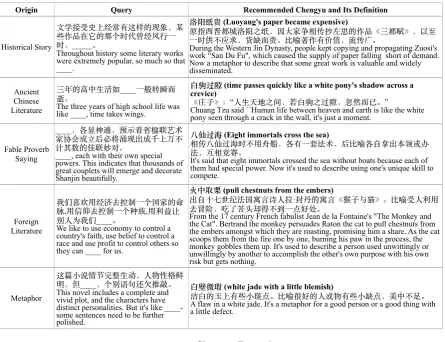
phrases”) is a special type of Chinese idiom, and represents one of the most beautiful, fascinat-ing and unique aspects of the Chinese language. 96% Chengyus consist of four characters each. Chengyus were mainly created from ancient sto-ries, literature and sayings which can be traced back to thousands of years ago. Some exam-ples are shown in Table 1. More than 7,000 Chengyus are still widely used in the modern Chinese, Japanese, Korean and Vietnamese lan-guages. Like idioms in other languages, us-ing Chengyu appropriately makes communication more compelling and engaging because they in-troduce powerful imagery and figurative meanings that differ from their literal meanings.
When learning Chinese phrases, Chengyus are always the most difficult to understand and
mem-1https://github.com/bazingagin/chengyu data
orize. Second-language learners generally have a love-hate relation with Chengyu and tend to avoid it. A typical way to measure a Chinese learner’s Chengyu knowledge is “Cloze Test”, in which the learner is asked to supply the best Chengyu that has been removed from a sentence. It’s consid-ered as one of the most difficult problems in Chi-nese college entrance language and literature ex-ams, and has been the focus of several TV tal-ent shows in China such as the Chinese Idiom Congress by CCTV. This motivated us to develop the first Chengyu recommendation system to as-sist Chinese learners. Given a context sentence (“query”) with a Chengyu removed, the system will automatically recommend the best Chengyu to fill in the blank.
The four characters in each Chengyu are of-ten unintelligible without understanding the back-ground story. For example, “沉鱼落雁 (literal translation: sink fish fall swallow)” and “闭月羞
花(literal translation: hide moon shame flower)” were used to summarize four stories of the top four beauties in ancient China: Xi Shi, Wang Zhao-jun, Diao Chan and Yang Yuhuan. They were being so beautiful that fish sank, birds fell from the sky, the moon hid, and flowers were shamed. As a result, we cannot compose the meaning of a Chengyu only based on its four characters. More-over, each Chengyu is highly succinct, compact and synthetic. For example, “一日三秋 (literal
translation: one day three autums)” means greatly missing someone so that one day feels as long as three years. However, its key meaning “missing” is not in this Chengyu.
To address these challenges, we create a new Chengyu Cloze Test benchmark, which consists of 108,987 query sentences and 7,395 target Chengyus. Each Chengyu is associated with a def-inition, which describes its general meanings and scenarios where it occurs. Then we develop an
Origin Query Recommended Chengyu and Its Definition
Historical Story
⽂学接受史上经常有这样的现象,某 些作品在它的那个时代曾经风⾏⼀ 时,_____。
Throughout history some literary works were extremely popular, so much so that ____.
洛阳纸贵 (Luoyang's paper became expensive)
原指西晋都城洛阳之纸,因⼤家争相传抄左思的作品《三都赋》,以⾄ ⼀时供不应求,货缺⽽贵。⽐喻著作有价值,流传⼴。
During the Western Jin Dynasty, people kept copying and propagating Zuosi's work “San Du Fu", which caused the supply of paper falling short of demand. Now a metaphor to describe that some great work is valuable and widely disseminated.
Ancient Chinese Literature
三年的⾼中⽣活如____⼀般转瞬⽽
逝。
The three years of high school life was like ____, time takes wings.
⽩驹过隙 (time passes quickly like a white pony's shadow across a crevice)
《庄⼦》:“⼈⽣天地之间,若⽩驹之过隙,忽然⽽已。”
Chuang Tzu said ``Human life between heaven and earth is like the white pony seen through a crack in the wall, it's just a moment.
Fable Proverb Saying
____,各显神通,预⽰着省楹联艺术
家协会成⽴后必将涌现出成千上万不 计其数的佳联妙对。
____, each with their own special powers. This indicates that thousands of great couplets will emerge and decorate Shanjin beautifully.
⼋仙过海 (Eight immortals cross the sea)
相传⼋仙过海时不⽤⾈船,各有⼀套法术,后⽐喻各⾃拿出本领或办 法,互相竞赛。
It's said that eight immortals crossed the sea without boats because each of them had special power. Now it's used to describe using one's unique skill to compete.
Foreign Literature
我们喜欢⽤经济去控制⼀个国家的命
脉,⽤信仰去控制⼀个种族,⽤利益让
别⼈为我们____。
We like to use economy to control a country's faith, use belief to control a race and use profit to control others so they can ____ for us.
⽕中取栗 (pull chestnuts from the embers)
出⾃⼗七世纪法国寓⾔诗⼈拉·封丹的寓⾔《猴⼦与猫》。⽐喻受⼈利⽤
去冒险,吃了苦头却得不到⼀点好处。
From the 17 century French fabulist Jean de la Fontaine's "The Monkey and the Cat". Bertrand the monkey persuades Raton the cat to pull chestnuts from the embers amongst which they are roasting, promising him a share. As the cat scoops them from the fire one by one, burning his paw in the process, the monkey gobbles them up. It's used to describe a person used unwittingly or unwillingly by another to accomplish the other's own purpose with his own risk but gets nothing.
Metaphor
这篇⼩说情节完整⽣动,⼈物性格鲜
明,但____,个别语句还⽋推敲。
This novel includes a complete and vivid plot, and the characters have distinct personalities. But it's like ____- some sentences need to be further polished.
⽩璧微瑕 (white jade with a little blemish)
洁⽩的⽟上有些⼩斑点。⽐喻很好的⼈或物有些⼩缺点,美中不⾜。
[image:2.595.78.524.61.403.2]A flaw in a white jade. It's a metaphor for a good person or a good thing with a little defect.
Table 1: Chengyu Examples
attentive neural network architecture to select the most appropriate Chengyu to fit in the slot context of each query. We first encode query sentence and Chengyu definitions using a bi-directional long short-term memory (Bi-LSTM) network ( Hochre-iter and Schmidhuber, 1997). To better capture the correlation between the query and the defini-tion, we apply a soft attention to assign a weight to each word in the query sentence, and predict a matching score for each candidate Chengyu. Our system significantly outperforms human learners who attended top universities in China.
2 Related Work
Our Chengyu cloze test task is similar to read-ing comprehension (Hermann et al., 2015; Cui et al.,2016;Chen et al.,2016;Kadlec et al.,2016; Seo et al., 2016). However, it’s more challeng-ing because the context includes a sentence in-stead of a paragraph, the Chengyu phrase itself does not convey its figurative meaning, and there are many more candidate answers. Very few Nat-ural Language Processing techniques have been applied to understand or recommend Chengyu.
Chung (2009) studied a subset of Chinese fig-urative language, focusing on Chinese five el-ements and body part terms. Limited efforts have used Chengyu dictionaries to expand Chinese emotion lexicon (Xu et al., 2010) and improve Chinese word segmentation (Chan and Chong, 2008; Sun and Xu, 2011; Wang and Xu, 2017). Chengyus differ from metaphors in other lan-guages (Tsvetkov et al.,2014;Shutova,2010) be-cause they do not follow the grammatical structure and syntax of the modern Chinese.
3 Approach
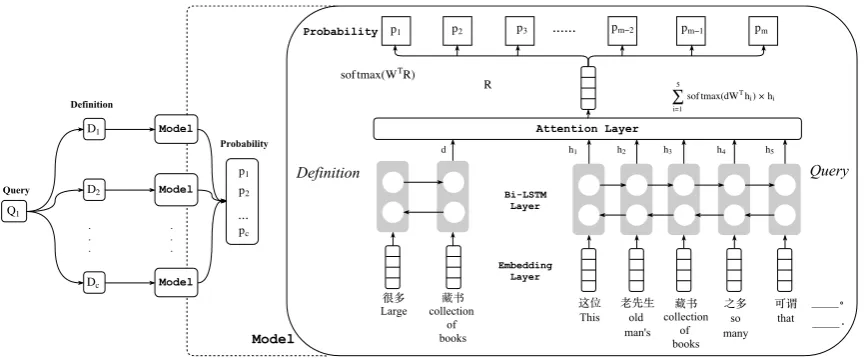
Figure1shows the overall architecture of our ap-proach. For a query and the definition of a candi-date Chengyu, we first apply a word segmentation tool jieba2 to segment query and definition into
words, and apply a Bi-LSTM network to encode each word with a contextual embedding. In order to better capture the correlation between a query and a Chengyu, we further compare the represen-tations of the Chengyu definition and the contex-tual embedding of each word in the query, and
Figure 1: Architecture Overview
take the weighted sum of the query word contex-tual embeddings as input to a linear function to determine the probability score of the candidate Chengyu. Next we show the approach details.
Encoding Given a queryq and a Chenyu defi-nitiondj from the target Chengyu databaseD = {d1, d2, ..., dm}, we apply two Bi-LSTM net-works to encode them separately. Each Bi-LSTM network leverages long distance features from the whole sentence to capture the context information by using a memory cell (Hochreiter and Schmid-huber,1997). Each word inqanddjis assigned a contextual embedding.
Attention To better capture the correlation be-tween a query and each Chengyu definition, we use an attention mechanism (Bahdanau et al., 2014;Sutskever et al., 2014) to compare the se-mantic relatedness of each word in the query sen-tence with the meaning of each Chengyu defini-tion.
Given the hidden states H = h0, h1, ..., hn of the Bi-LSTM encoding the query sentence, where hi denotes the concatenation of the hidden states of word wi with forward and backward LSTMs, the attention layer sum over hi with learnable weight α: R = Pni=1αi · hi, where R is the weighted sum vector representation of the query. αi is a learnable weight which is computed by αi = Pnexp(ei)
i=1exp(ei)andei =d
T·W
α·hi, whereWα is a parameter to capture the relevance between a query and a definition flexibly (Chen et al.,2016). dT is the last hidden hidden state of the Bi-LSTM encoding the definition.
Training With the weighted sum vector repre-sentation of the queryR, we apply a softmax func-tion to compute the probability of each candidate Chengyudjto be filled into the slot.
oi =WTβR
pi =
exp(oi)
Pm
j=1exp(oj)
,
where Wβ maps the final representation of the query into Rm, and m is the number of classes. Then we optimize the log likelihood: L =Pmj=1yjlog(pj), whereyj is 0 or 1 depend-ing on if the truth is Chengyudj or not.
Prediction For prediction, we take a query with each Chengyu definition (q,dj),1≤j≤mas in-put, and predict a probability matrixM∈Rm×m, wheremis the number of candidates. For exam-ple, a choose-one-from-four task will have m = 4. The final predicted Chengyudj is selected by argmax(M[:, j]),1≤j≤m.
4 Experiments
4.1 Data and Setting
TYPE QUERY SYSTEM GROUND TRUTH ANALYSIS
Incorporating Definition
这事已势不可遏,任何想阻挡他 的⼈都如____,简直是不⾃量 ⼒。
This event is unstoppable, anyone who tries to stop it will be like ____, almost not recognizing his/her own limited power.
蚍蜉撼树 an ant shaking a tree, to describe one
fails to recognize one’s limited power
蚍蜉撼树 an ant shaking a tree, to describe one
fails to recognize one’s limited power
The definition significantly enriches the semantic meanings of Chengyu itself. 蚍蜉撼树(an ant shaking a tree) is a metaphor to describe ⾃不 量⼒(fail to recognize one's own limited power).
Attention Mechanism
刘备思贤若渴,三请诸葛亮的故 事在我国可是____,⼈⼈皆知的 佳话。
It's ____ well known by everyone in our country that Liu Bei was eager to recruit talents and invited Zhu Geliang three times.
家喻户晓 well known by
every family
家喻户晓 well known by
every family
By incorporating the attention mechanism, our approach can better capture the correlations between query context and Chengyu definition. our approach successfully selects 家喻户晓 (well known by every family) to fill in the slot since it shares similar semantic meanings with query context word 知 (known).
World Knowledge
村上春树____,29岁才写他的第 ⼀部作品。
Haruki Murakami ____, he was already at age 29 when he wrote his first works.
画龙点睛 bring the painted dragon to life by putting in the pupils
of its eyes
⼤器晚成 takes a long time
to make a great instrument
We need to know “age 29” is relatively late to produce the first works for a writer.
Discourse Coherence
⼈们⾯临灾难,不得不____,离 开他们⾃⼰的村落。
When facing disasters, people had to ____ and leave their own villages.
逍遥法外 at large
背井离乡 leave one’s
hometown
Our system focused on the shared meaning of escape/leave while ignored this Chengyu has a specific object “the arm of the law”.
Sentiment Analysis
多少⼈认为⼀个作家不仅能妙笔 ⽣花,也是____的。
Many people think that a writer can not only write like an angel but also ____.
⼤⾔不惭
brag shamelessly speak eloquently⼜若悬河
⼤⾔不惭 (brag shamelessly) expresses very negative sentiment while ⼜若悬河 (speak eloquently) includes positive sentiment.
Negation Detection
你在他⾯前说那些话,实在是班 门弄斧,不知____。
The words you said in front of him were really like showing off axe in front of Lu Ban, without knowing ____.
孤陋寡闻 with very limited
knowledge and scanty information
天⾼地厚 high as heaven,
deep as earth
Our system did not detect negation clues and thus failed to select the right Chengyu antonyms.
Grammatical Structure
写⽂章先要构思好,不要下笔千 ⾔,____。
We should think about the plot carefully before write an article, don't write down thousands of words, ____.
词不达意 the words fail to express the meaning
离题万⾥ get away from the title ten thousands
of miles
When multiple Chengyus appear in the same query sentence, they tend to follow the same grammatical structure.
Rhythm
爱是⼈性的美的⼒量,爱是爱你年 少时的____,更爱你年⽼时⽩发苍 苍。
Love is the beauty of humanity. To love is to love your youthful vigor like ____ as well as your gray hair.
意⽓风发 high-spirited and
vigorous
桃之夭夭 the peach trees in
full blossom
Multiple chengyus tend to appear in rhythmical form. In this example, “苍苍”(pronunciation: Cāng Cāng) and “夭夭”(Yāo Yāo) are both reduplication with similar vowel pronunciations.
[image:4.595.74.524.61.534.2]Correct Remaining Challenges
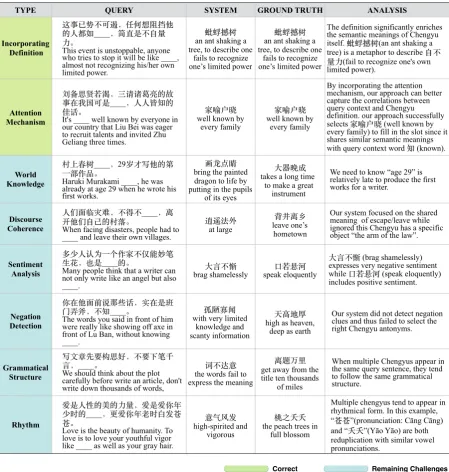
Table 2: Detailed Analysis on Correct Examples and Remaining Challenges
from four candidates consisting of the ground-truth and three other randomly selected ones to fill in the slot. (2)coherence checking in college en-trance exam: we collected 14 problem sets from (1998, 2000) China college entrance exam, where each problem set consists of four sentences includ-ing Chengyus. We let the system select the sen-tence that contains the most appropriate Chengyu that fits into the context in a coherent way. For comparison with human, we asked two Chinese native speakers (not system developers) who at-tended top universities in China to perform the same tests.
4.2 Results and Analysis
Cloze Test Coherence Checking in College Entrance Exam
Human 70% 42.3%
System 89.5% 35.7%
Table 3: System and Human Accuracy Comparison
For example, our system output “白驹过隙(time passes quickly like a white pony’s shadow across a crevice)” and ground truth “光阴似箭(time flies)”
are near synonyms. Table 2shows some correct examples and the remaining challenges that re-quire capabilities beyond lexical semantics.
5 Conclusions and Future Work
We created a new benchmark dataset for a new task of Chengyu cloze test. We also proposed a neural model which leverages the definitions of Chengyu as background knowledge and outper-forms human experts. In the future we will explore collective inference to rank multiple Chengyus in the same discourse simultaneously, and incorpo-rate richer linguistic clues based on structures and rhythms.
Acknowledgments
This work was supported by the U.S. DARPA LORELEI Program No. HR0011-15-C-0115 and U.S. ARL NS-CTA No. W911NF-09-2-0053. The views and conclusions contained in this document are those of the authors and should not be inter-preted as representing the official policies, either expressed or implied, of the U.S. Government. The U.S. Government is authorized to reproduce and distribute reprints for Government purposes notwithstanding any copyright notation here on.
References
Dzmitry Bahdanau, Kyunghyun Cho, and Yoshua Ben-gio. 2014. Neural machine translation by jointly learning to align and translate. arXiv preprint arXiv:1409.0473.
Samuel W.K. Chan and Mickey W.C. Chong. 2008. An agent-based approach to chinese word segmentation. In Proceedings of the Sixth SIGHAN Workshop on Chinese Language Processing.
Danqi Chen, Jason Bolton, and Christopher D Man-ning. 2016. A thorough examination of the cnn/daily mail reading comprehension task. arXiv preprint arXiv:1606.02858.
Siaw-Fong Chung. 2009. A corpus-based study on fig-urative language through the chinese five elements and body part terms. In Proceedings of Computa-tional Linguistics and Chinese Language Process-ing.
Yiming Cui, Ting Liu, Zhipeng Chen, Shijin Wang, and Guoping Hu. 2016. Consensus attention-based neural networks for chinese reading comprehension. arXiv preprint arXiv:1607.02250.
Karl Moritz Hermann, Tomas Kocisky, Edward Grefenstette, Lasse Espeholt, Will Kay, Mustafa Su-leyman, and Phil Blunsom. 2015. Teaching ma-chines to read and comprehend. InAdvances in Neu-ral Information Processing Systems, pages 1693– 1701.
Sepp Hochreiter and J¨urgen Schmidhuber. 1997. Long short-term memory. Neural computation, 9(8):1735–1780.
Rudolf Kadlec, Martin Schmid, Ondrej Bajgar, and Jan Kleindienst. 2016. Text understanding with the attention sum reader network. arXiv preprint arXiv:1603.01547.
Minjoon Seo, Aniruddha Kembhavi, Ali Farhadi, and Hannaneh Hajishirzi. 2016. Bidirectional attention flow for machine comprehension. arXiv preprint arXiv:1611.01603.
Ekaterina Shutova. 2010. Models of metaphor in nlp. InProceedings of the 48th annual meeting of the as-sociation for computational linguistics, pages 688– 697. Association for Computational Linguistics.
Weiwei Sun and Jia Xu. 2011. Enhancing chinese word segmentation using unlabeled data. InProceedings of the 2011 Conference on Empirical Methods in Natural Language Processing.
Ilya Sutskever, Oriol Vinyals, and Quoc V Le. 2014. Sequence to sequence learning with neural net-works. InAdvances in neural information process-ing systems, pages 3104–3112.
Yulia Tsvetkov, Leonid Boytsov, Anatole Gershman, Eric Nyberg, and Chris Dyer. 2014. Metaphor detec-tion with cross-lingual model transfer. In Proceed-ings of the 52nd Annual Meeting of the Association for Computational Linguistics (Volume 1: Long Pa-pers), volume 1, pages 248–258.
Chunqi Wang and Bo Xu. 2017. Convolutional neu-ral network with word embeddings for chinese word segmentation. In Proceedings of the The 8th In-ternational Joint Conference on Natural Language Processing.