Proceedings of the 2nd Workshop on Stylistic Variation, pages 29–38
Evaluating Creative Language Generation:
The Case of Rap Lyric Ghostwriting
Peter Potash, Alexey Romanov, Anna Rumshisky
Department of Computer Science University of Massachusetts Lowell
{ppotash,aromanov,arum}@cs.uml.edu
Abstract
Language generation tasks that seek to mimic human ability to use language creatively are difficult to evaluate, since one must consider creativity, style, and other non-trivial aspects of the generated text. The goal of this pa-per is to develop evaluations methods for one such task, ghostwriting of rap lyrics, and to provide an explicit, quantifiable foundation for the goals and future directions for this task. Ghostwriting must produce text that is sim-ilar in style to the emulated artist, yet dis-tinct in content. We develop a novel evalua-tion methodology that addresses several com-plementary aspects of this task, and illustrate how such evaluation can be used to meaning-fully analyze system performance. We provide a corpus of lyrics for 13 rap artists, annotated for stylistic similarity, which allows us to as-sess the feasibility of manual evaluation for generated verse.
1 Introduction
Language generation tasks are often among the most difficult to evaluate. Evaluating machine translation, image captioning, summarization, and other similar tasks is typically done via compari-son with existing human-generated “references”. However, human beings also use language cre-atively, and for the language generation tasks that seek to mimic this ability, determining how accu-rately the generated text represents its target is in-sufficient, as one also needs to evaluate creativ-ity and style. We believe that one of the reasons such tasks receive little attention is the lack of sound evaluation methodology, without which no task is well-defined, and no progress can be made. The goal of this paper is to develop an evaluation methodology for one such task, ghostwriting, or more specifically, ghostwriting of rap lyrics.
Ghostwriting is ubiquitous in politics, literature, and music; as such, it introduces a distinction
be-tween the performer/presenter of text, lyrics, etc, and the creator of text/lyrics. The goal of ghost-writing is to present something in a style that is believable enough to be credited to the performer. In the domain of rap specifically, rappers some-times function as ghostwriters early on before em-barking on their own public careers, and there are even businesses that provide written lyrics as a service1. The goal of automatic ghostwriting is therefore to create a system that can take as in-put a given artist’s work and generatesimilaryet uniquelyrics.
Our objective in this work is to provide a quan-tifiable direction and foundation for the task of rap lyric generation and similar tasks through (1) developing an evaluation methodology for such models and (2) illustrating how such evaluation can be used to analyze system performance, in-cluding advantages and limitations of a specific language model developed for this task. As an il-lustration case, we use the ghostwriter model pre-viously proposed in exploratory work by Potash et al. (2015), which uses a recurrent neural network (RNN) with Long Short-Term Memory (LSTM) for rap lyric generation.
The following are the main contributions of this paper. We present a comprehensive manual eval-uation methodology of the generated verses along three key aspects: fluency, coherence, and style matching. We introduce an improvement to the semi-automatic methodology used by Potash et al. (2015) that automatically penalizes repetitive text, removing the need for manual intervention. Fi-nally, we build a corpus of lyrics for 13 rap artists, each with his own unique style, and conduct a comprehensive evaluation of the LSTM model performance using the new evaluation
methodol-1http://www.rap-rebirth.com/, http://www.precisionwrittens.com/ rap-ghostwriters-for-hire/
ogy. The corpus includes style matching annota-tion for select verses in dataset, which can form a gold standard for future work on automatic rep-resentation of similarity between artists’ styles. The resulting rap lyric dataset is publicly available from the authors’ website2.
Additionally, we believe that the annotation method we propose for manual style evaluation can be used for other similar generation tasks. One example is ’Deep Art’ work in the computer vision community that seeks to apply the style of a par-ticular painting to other images (Gatys et al.,2015; Li and Wand,2016). Although manual inspection of results of such models suggests reasonable suc-cess, a systemic evaluation methodology has yet to be proposed. With this in mind, we make the in-terface used for style evaluation in this work avail-able for public use.
Our evaluation results highlight the truly multi-faceted nature of the ghostwriting task. While hav-ing a shav-ingle measure of success is clearly desir-able, our analysis shows the need for complemen-tary metrics that evaluate different components of the overall task. Indeed, despite the fact that our test-case LSTM model outperforms a baseline model across numerous artists based on automated evaluation, the full set of evaluation metrics is able to showcase the LSTM model’s strengths and weakness. The coherence evaluation demonstrates the difficulty of incorporating large amounts of training data into the LSTM model, which in-tuitively would be desirable to create a flexible ghostwriting model. The style matching experi-ments suggest that the LSTM is effective at captur-ing an artist’s general style, however, this may in-dicate that it tends to form ‘average’ verses, which are then more likely to be matched with existing verses from an artist rather than another random verse from the same artist. Overall, the evalua-tion methodology we present provides an explicit, quantifiable foundation for the ghostwriting task, allowing for a deeper understanding of the task’s goals and future research directions.
2 Related Work
Previous work that explores text generation for artistic purposes, such as poetry and lyrics, gen-erally uses either automated or manual evalua-tion. We would like to point out that none of
2http://text-machine.cs.uml.edu/ ghostwriter/
the works discussed below implement models that generate complete verses from scratch (including verse structure), which is the goal of the models we aim to evaluate. In terms of manual evalua-tion, Barbieri et al. (2012) have a set of annota-tors evaluate generated lyrics along two separate dimensions: grammar and semantic relatedness to song title. The annotators rate the dimensions with scores 1-3. A similar strategy is used by Gerv´as (2000), where the author has annotators evaluate generated verses with regard to syntactic correct-ness and overall aesthetic value, providing scores in the range 1-5. Wu et al. (2013) have anno-tators determine the effectiveness of various sys-tems based on fluency as well as rhyming. Some heuristic-based automated approaches have also been used, e.g., by Oliveira et al. (2014) who use a simple automatic heuristic that awards lines for ending in a termination previously used in the gen-erated stanza. Malmi et al. (2015) evaluate their generated lyrics based on the verses’ rhyme den-sity, on the assumption that a higher rhyme density means better lyrics.
3 Dataset
For our evaluation experiments, we selected the following list of artists in four different categories:
• Three top-selling rap artists according to Wikipedia3: Eminem, Jay Z, Tupac
• Artists with the largest vocabulary according to Pop Chart Lab4: Aesop Rock, GZA, Sage Francis
• Artists with the smallest vocabulary accord-ing to Pop Chart Lab: DMX, Drake
• Best classified artists from Hirjee and Brown (2010b) using rhyme detection features5: Fabolous, Nototious B.I.G., Lil’ Wayne
We collected all available songs from the above artists from the siteThe Original Hip-Hop (Rap) Lyrics Archive - OHHLA.com - Hip-Hop Since 19926. We removed the metadata, line repetiton markup, and chorus lines, and tokenized the lyrics 3http://en.wikipedia.org/wiki/List_of_ best-selling_music_artists
4http://popchartlab.com/products/ the-hip-hop-flow-chart
5Specifically, the authors used their automated rhyme de-tection tool to generate rhyme statistics of verses, and used those rhyme features, along with more shallow features such as syllable count and word repetition, to classify the artist of the verse.
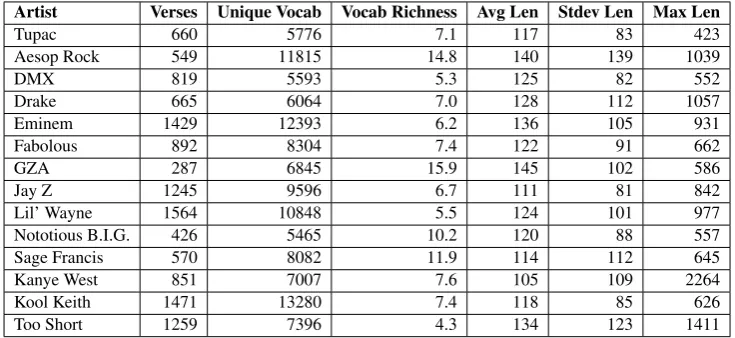
using the NLTK library (Bird et al.,2009). Since the preprocessing was done heuristically, the re-sulting dataset may still contain some text that is not actual verse, but rather dialogue or chorus lines. We therefore filter out all verses that are shorter than 20 tokens. Statistics of our dataset are shown in Table1.
4 Evaluation Methodology
We believe that adequate evaluation for the ghost-writing task requires both manual and automatic approaches. The automated evaluation methodol-ogy enables large-scale analysis of the generated verse. However, given the nature of the task, the automated evaluation is not able to assess certain critical aspects of fluency and style, such as the vocabulary, the tone, and the themes preferred by a particular artist. In this section, we present a manual methodology we propose for evaluating these aspects of the generated verse, as well as an improvement to the automatic methodology pro-posed by Potash et al. (2015).
4.1 Manual Evaluation
We have designed two annotation tasks for manual evaluation. The first task is to determine how flu-ent and coherflu-ent the generated verses are. The sec-ond task is to evaluate manually how well the gen-erated verses match the style of the target artist. Fluency/Coherence Evaluation Given a gener-ated verse, we ask annotators to determine the flu-ency and coherence of the lyrics. Even though our evaluation is for systems that produce entire verses, we follow the work of Wu (2014) and an-notate fluency, as well as coherence, at the line level. To assess fluency, we ask to what extent a given line can be considered a valid English utter-ance. Since a language model may produce highly disjointed verses as it progresses through the train-ing process, we offer the annotator three options for grading fluency: strongly fluent, weakly flu-ent, and not fluent. If a line is disjointed, i.e., it is only fluent in specific segments of the line, the annotators are instructed to mark it as weakly flu-ent. The grade of not fluent is reserved for highly incoherent text.
To assess coherence, we ask the annotator how well a given line matches the preceding line. That is, how believable is it that these two lines would follow each other in a rap verse. We offer the an-notators the same choices as in the fluency
eval-uation: strongly coherent, weakly coherent, and not coherent. During the training process, a lan-guage model may output the same line repeatedly. We account for this in our coherence evaluation by defining the consecutive repetition of a line as not coherent. This is important to define because the line on its own may be strongly fluent, however, it is not correct to consider a verse that consists of a single fluent line repeated indefinitely to be coher-ent.
Style Matching The goal of the style matching annotation is to determine how well a given verse captures the style of the target artist. In this an-notation task, a user is presented with a verse and asked to compare it against four other verses. The goal is to pick the verse that is written in a similar style. One of the four choices is always a verse from the same artist that was used to generate the verse being evaluated. The other three verses are chosen from the remaining artists in our dataset. Each verse is evaluated in this manner four times, each time against different verses, so that it has the chance to get matched with a verse from each of the remaining twelve artists. The generated verse is considered stylistically consistent if the annota-tors tend to select the verse that belongs to the tar-get artist. To evaluate the difficulty of this task, we also perform style matching annotation for authen-tic verse, in which the evaluated verse is not gen-erated, but rather is an actual existing verse from the target artist.7
4.2 Automated Evaluation
The automated evaluation we describe below at-tempts to capture computationally the dual aspects of “unique yet similar” in a manner originally pro-posed byPotash et al.(2015).
Uniqueness of Generated Lyrics We use a modified tf-idf representation for verses, and cal-culate cosine similarity between generated verses and the verses from the training data to determine novelty (or lack thereof). In order to determine which training verse a generated verse matches the most, we calculate the maximum similarity score across all training verses.
Artist Verses Unique Vocab Vocab Richness Avg Len Stdev Len Max Len
Tupac 660 5776 7.1 117 83 423
Aesop Rock 549 11815 14.8 140 139 1039
DMX 819 5593 5.3 125 82 552
Drake 665 6064 7.0 128 112 1057
Eminem 1429 12393 6.2 136 105 931
Fabolous 892 8304 7.4 122 91 662
GZA 287 6845 15.9 145 102 586
Jay Z 1245 9596 6.7 111 81 842
Lil’ Wayne 1564 10848 5.5 124 101 977
Nototious B.I.G. 426 5465 10.2 120 88 557
Sage Francis 570 8082 11.9 114 112 645
Kanye West 851 7007 7.6 105 109 2264
Kool Keith 1471 13280 7.4 118 85 626
[image:4.595.115.483.62.231.2]Too Short 1259 7396 4.3 134 123 1411
Table 1: Rap lyrics dataset statistics. Vocabulary richness measures how varied an artist’s vocabulary is, computed as the total number of words divided by vocabulary size.
Stylistic Similarity via Rhyme Density of Lyrics We use the rhyme detection tool provided by Hir-jee and Brown (2010a) calculate the rhyme den-sity of a given verse, with the ultimate goal of evaluating how well the generated verse models an artist’s style (specifically, rhyme style in this case). The point of an effective system is not to produce arbitrary rhymes: it is to produce rhyme types and rhyme frequency similar to the target artist. For the ghostwriter models trained exclu-sively on the verses of a given artist, the vocabu-lary of the generated verse is closed with respect to the training data. In that case, assessing how similar the generated vocabulary is to the target artist is not important. Instead, we focus on rhyme density, which is defined as the number of rhymed syllables divided by the total number of syllables (Hirjee and Brown, 2010a). Certain artists dis-tinguish themselves by having more complicated rhyme schemes, such as the use of internal8 or polysyllabic rhymes9. Rhyme density is able to capture this in a single metric.
However, this rhyme detection method is not designed to deal with highly repetitive text, which the LSTM model produces often in the early stages of training. Since the same phoneme is re-peated (because the same word is rere-peated), the rhyme detection tool generates a false positive. Potash et al. (2015) dealt with this by manually inspecting the rhyme densities of verses generated in the early stages of training to determine if a
gen-8e.g. “New York City gritty committee pity the fool” and “How I made it you salivated over my calibrated”
9e.g. “But it was your op to shop stolen art/Catch a swollen heart form not rolling smart”.
erated verse should be kept for the evaluation pro-cedure.
In order to fully automate their method, we ac-count for the presence of repetitive text by weight-ing the rhyme density of a given verse by its en-tropy. More specifically, for a given verse, we calculate entropy at the token level and divide by total number of tokens in that verse. Verses with highly repetitive text will have a low entropy, which results in down-weighting the rhyme den-sity of verses that produce false positive rhymes due to their repetitive text.
has the value of the target artist. We give more de-tail below.
5 Lyric Generation Experiments
The main generative model we use in our evalu-ation experiments is an LSTM. Similar toPotash et al.(2015), we use an n-gram model as a base-line system for automated evaluation. We refer the reader to the original work for a detailed descrip-tion. After every 100 iterations of training10 the LSTM model generates a verse. For the baseline model, we generate five verses at values 1-9 for n. We see a correspondence between highernand higher iteration: as both increase, the models be-come more ‘fit’ to the training data.
For the baseline model, we use the verses gener-ated at different n-gram lengths (n= 1...9) to
ob-tain the values for regression. At every value ofn, we take the average rhyme density and maximum similarity score of the five verses that we generate to create a single data point for rhyme density and maximum similarity score, respectively.
To enable comparison, we also create nine data points from the verses generated by the LSTM, which is done as follows: a separate model for each artist is trained for a minimum of 16,400 iter-ations. We take the verses generated every 2,000 iterations, from 0 to 16,000 iterations, giving us nine points. The averages for each point are ob-tained by using the verses generated in iterations
±x, x∈ {100,200,300,400}for each interval of 2,000.
6 Results
We present the results of our evaluation exper-iments using both manual evaluation and auto-mated analysis.
6.1 Fluency/Coherence
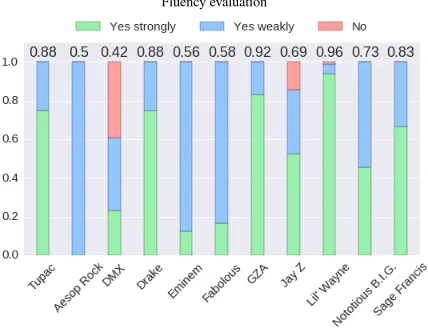
In order to fairly compare the fluency/coherence of verses across artists, we use the verses generated by each artist’s model at 16,000 iterations. We apply the fluency/coherence annotation method-ology from Section 4.1. Each line is annotated by two annotators. Annotation results are shown in Figure 2 and Figure 3. For each annotated verse, we report the percentage of lines annotated as strongly fluent, weakly fluent, and not fluent, as well as the corresponding percentages for coher-ence. We convert the raw annotation results into
10Training is done in batches with two verses per batch.
what more could i say i wouldn t be here today if the old school didn t pave the way grand puba
(a) Tupac’s generated verse that was evaluated for fluency (0.88) and coherence (1.00). The verse is generally fluent, however, the ending of the second verse represents a break in fluency that results in the line being labeledweakly fluent. This break in fluency does not affect the perfect fluency score.
i m gon na be alright or die
i m a dog and i m the dog and i m a dog but i m gon na be alright
and i m gon na be alright
(b) DMX’s generated verse that was evaluated for fluency (0.42) and coherence (0.36). The overall repetitiveness con-tributes to the verse’s lack of coherence, and the second line in particular contributes to the verse’s general lack of fluency.
Figure 1: A qualitative analysis of verses annotated for fluency and coherence.
a single score for each verse by treating the la-bels “strongly fluent”, “weakly fluent”, and “not fluent” as numeric values 1, 0.5, and 0, respec-tively. Treating each annotation on a given line separately, we calculate the average numeric rat-ing for a given verse:
Fluency= #sf + 0.5#wf
#a (1)
where#sf is the number of times any line is
la-beled strongly fluent,#wf is the number of times
any line is labeled weakly fluent, and #a is the total annotations provided for a verse, which is equal to the number of lines × 2. Coherence is calculated in a similar manner. In terms of practically implementing the annotation method-ology, an annotators annotates an average of 8.5 lines per minute (this includes fluency and coher-ence). For our experiments, it took 3.3 hours to annotate 1,687 lines. A qualitative analysis of flu-ency/coherence annotation is given in Figure1.
6.2 Style Matching
Artist AuthenticMatch% Match Generated
A% Raw agreement % Match% MatchA% Raw agreement %
Tupac 35.0 50.0 40.0 45.0 57.1 35.0
Aesop Rock 30.0 25.0 40.0 37.5 100.0 10.0
DMX 40.0 71.4 35.0 27.5 30.0 50.0
Drake 32.5 44.4 45.0 37.5 40.0 25.0
Eminem 12.5 00.0 50.0 35.0 50.0 30.0
Fabolous 25.0 12.5 40.0 45.0 50.0 40.0
GZA 52.5 72.7 55.0 32.5 22.2 45.0
Jay Z 35.0 42.9 35.0 22.5 22.2 45.0
Lil’ Wayne 27.5 22.2 45.0 37.5 57.1 35.0
Notorious B.I.G. 25.0 0.00 35.0 27.5 33.3 30.0
Sage Francis 52.5 66.7 45.0 22.5 16.7 30.0
[image:6.595.88.510.61.223.2]Average 33.4 37.1 42.3 33.6 43.5 34.1
Table 2: The percentage of correct matches and the inter-annotator agreement in style matching evaluation
Fluency evaluation
Figure 2: Percentage of lines annotated as strongly fluent, weakly fluent, and not fluent. The numbers above the bars reflect the total score of the artist (higher is better). The resulting mean is 0.723 and the standard deviation is 0.178.
matching annotations are shown in Table 2. We present two different views of the results. First, each annotation for a page is considered separately and we calculate:
M atch% = #m
#a (2)
where #m is the number of times, on a given page, the chosen verse actually came from the tar-get artist, and #ais the total number of annota-tions done. For a given artist, five verses were evaluated, each verse appeared on four separate pages, and each page is annotated twice, so #a is equal to 40. Since in each case (i.e., page) the classes are different, we cannot use Fleiss’ kappa directly. Raw agreement for style annota-tion, which corresponds to the percentage of times
[image:6.595.74.288.266.432.2]Coherence evaluation
Figure 3: Percentage of lines annotated as strongly coherent, weakly coherent, and not coherent. The numbers above the bars reflect the total score of the artist (higher is better). The resulting mean is 0.713 and the standard deviation is 0.256.
annotators picked the same verse (whether or not they are correct) is shown in the column ’Raw agreement %’ in Table2.
We also report annotators’ joint ability to guess the target artist correctly, which we compute as follows:
M atchA% =
#mA
#sA (3)
where#sAis the number of times the annotators agreed on a verse on the same page, and#mAis the number of times that the agreed upon verse is from the target artist.
[image:6.595.310.523.266.427.2]pages total, resulting in a total annotation time of 29 hours.
[image:7.595.82.284.120.319.2]6.2.1 Artist Confusion
Figure 4: Fraction of confusions between artists
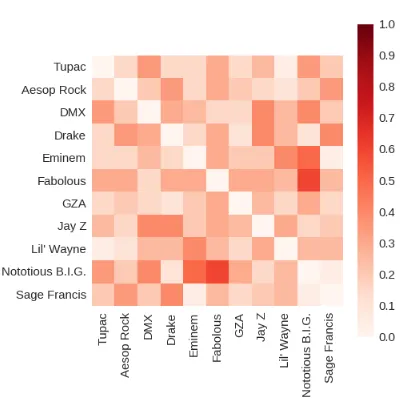
The results of style-matching annotation pro-vides us with an interesting insight into the sim-ilarity between two artists’ styles. This is captured by theconfusionbetween two artists during the an-notation of the pages with authentic verses, which is computed as follows:
Conf usion(a, b) = #c(a, b) + #c(b, a) #p(a, b) + #p(b, a) (4)
where #p(a, b) is the number of times a verse
from artistais presented for evaluation and a verse from artist b is shown as one of four choices; #c(a, b) is the number of times the verse from
artistbwas chosen as the matching verse. The re-sulting confusion matrix is presented in Figure4. We intend for this data to provide a gold standard for future experiments that would attempt to en-code the similarity of artists’ styles. For example, if we were to try to embed an artist, we could use the confusion results as gold standard similarity scores between the artists’ embeddings to deter-mine how effective the embedding methodology is.
6.3 Automated Evaluation
The results of our automated evaluation are shown in Table3. For each artist, we calculate their av-erage rhyme density across all verses. We then use this value to determine at which iteration this
rhyme density is achieved during generation (us-ing the regression line for rhyme density). Next, we use the maximum similarity regression to de-termine the maximum similarity score at that it-eration. Low maximum similarity score indicates that we have maintained stylistic similarity while producing new, previously unseen lyrics.
Note that the reason for negative numbers in Ta-ble3is that in the beginning of training (in case of LSTM) and at a low n-gram length (for the base-line model), the models actually achieved a rhyme density that exceeded the artist’s average rhyme density. As a result, the rhyme density regression line hits the average rhyme density on a negative iteration.
7 Discussion
In order to understand better the interaction be-tween the four metrics we have introduced in this paper, we examined correlation coefficients be-tween different measures of quality for generated verse (see Table 4). The lack of strong correla-tion supports the nocorrela-tion that different aspects of verse quality should be addressed separately and are, in fact, complementary. Even the measures offluencyandcoherence, despite sharing a similar goal, have a relatively low correlation of 0.4.
de-Artist Avg Rhyme Density Similarity N-gram Similarity iterationBaseline LSTM
Tupac 0.302 0.024 −2 0.065 −3168
Aesop Rock 0.349 0.745 7 0.460 12 470
DMX 0.341 0.663 6 0.431 8271
Drake 0.341 0.586 5 0.519 9949
Eminem 0.325 0.337 3 0.302 8855
Fabolous 0.360 1.353 14 0.569 14 972
GZA 0.280 0.520 4 0.616 14 939
Jay Z 0.365 0.499 5 0.463 15 147
Lil’ Wayne 0.362 0.619 6 0.406 9249
Notorious B.I.G. 0.383 0.701 7 0.428 3723
Sage Francis 0.415 0.764 8 0.241 −187
Average - 0.619 - 0.409
-Table 3: The results of the automated evaluation. The bold indicates the system with a lower similarity at the target rhyme density.
Coherence Fluency Similarity Matching Coherence 1.000 0.398 0.102 -0.285 Fluency 0.398 1.000 0.137 -0.276 Similarity 0.102 0.137 1.000 0.092 Matching -0.285 -0.276 0.092 1.000
Table 4: The correlation between the four metrics we have developed: Coherence, Fluency, similar-ity score based on automated evaluation (Similar-ity), and Style Matching (Matching).
viation was 0.178. Referring to Table5, we have yet to find a linguistic statistic that accounts for this variance in fluency score amoung the artists.
Coherence Fluency Similarity Matches Verses -0.509 -0.084 0.133 0.111
Tokens -0.463 -0.229 -0.012 0.507
[image:8.595.104.495.61.242.2]Vocab Richness 0.214 0.116 -0.263 0.107
Table 5: The correlation between the number of verses/tokens and average coherence, fluency, and similarity scores, as well asM atchA%at 16000 iterations.
As can be seen from Table 2, the M atch%
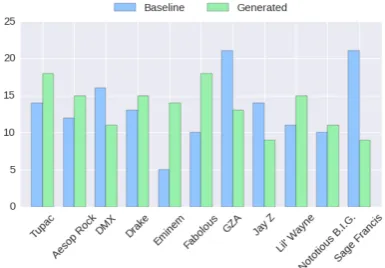
score suggests that the LSTM-generated verses are able to capture the style of the artist as well as the original verses. Furthermore, M atchA% is significantly higher for the LSTM model, which means that the annotators agreed on matching verses more frequently (see Figure5as well). We believe this means that the LSTM model, trained on all verses from a given artist, is able to cap-ture the artist’s “average” style, whereas authen-tic verses represent a random selection that are less likely, statistically speaking, to be similar to
another random verse. One aspect to which the match results for authentic verse point is that prac-tically, in terms of artist style, certain artists are more distinct, making them better suited to be tar-get artists for the ghostwriting tasks. For example, GZA recorded the highestM atch%, M atchA%, and agreement percentage, meaning his style is the most distinguishable. Note that as expected, there is a strong correlation between the number of tokens in the artist’s data and the frequency of agreed-upon correct style matches (cf. Table 5). Since verses vary in length, this correlation is not observed for verses. Finally, the absence of strong correlation with vocabulary richness suggests that the uniqueness of the tokens themselves is not as important as the sheer volume.
Figure 5: The numbers of style matches in the Style Matching evaluation. The maximum possi-ble number is 40.
[image:8.595.319.512.533.667.2]Artist Max Len % of training completed Tupac 454 69.7
[image:9.595.80.283.61.202.2]Aesop Rock 450 91.0 DMX 361 64.9 Drake 146 82.3 Eminem 452 90.8 Fabolous 278 47.3 GZA 433 81.1 Jay Z 449 98.5 Lil’ Wayne 253 92.7 Nototious B.I.G. 253 83.0 Sage Francis 280 53.9 Average - 77.8
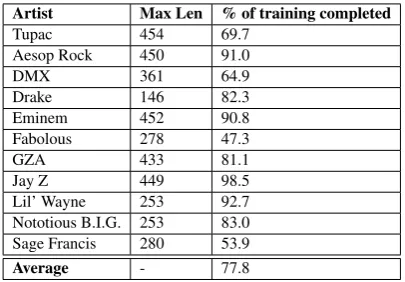
Table 6: The maximum lengths of generated verses and % of training completed on which the verse is generated
verse. For example, the length of the generated verses should be evaluated, since the models we examined do generate line breaks and also decide when to end the verse. Table6shows the longest verse generated for each artist, and also the point at which it was achieved during the training. We note that although 10 of the 11 models are able to generate long verses (up to a full standard de-viation above the average verse length for that au-thor), it takes a substantial amount of time, and the correlation between the average verse length for a given an artist and the verse length achieved by the model is weak (0.258). This suggests that model-ing the specific verse structure, includmodel-ing length, is one aspect that should be better addressed in the future.
Lastly, we note that the fully automated methodology we propose is able to replicate the results of the previously available semi-automatic method for the rapper Fabolous, which was the only artist evaluated byPotash et al.(2015). Fur-thermore, the results of automated evaluation for the 11 artists confirm that the LSTM model gener-alizes better than the baseline model.
8 Conclusions and Future Work
In this paper, we have presented a comprehensive evaluation methodology for the task of ghostwrit-ing rap lyrics, which captures complementary as-pects of this task and its goals. We developed a manual evaluation method that assesses sev-eral key properties of generated verse, and cre-ated a data set of authentic verse, manually an-notated for style matching. Previously proposed semi-automatic evaluation method has now been fully automated, and shown to replicate results
of the original method. We have shown how the proposed evaluation methodology can be used to evaluate an LSTM-based ghostwriter model. We believe our evaluation experiments also clearly demonstrate that complementary evaluation meth-ods are required to capture different aspects of the ghostwriting task.
Lastly, our evaluation provides key insights into future directions of the generative models them-selves. For example, the automated evaluation shows how the LSTM’s inability to integrate new vocabulary makes it difficult to achieve truly de-sirable similarity scores; future generative models can draw on the work of (Graves,2013;Bowman et al.,2015) in an attempt to leverage other artists’ lyrics.
References
Gabriele Barbieri, Franc¸ois Pachet, Pierre Roy, and Mirko Degli Esposti. 2012. Markov constraints for generating lyrics with style. In ECAI, pages 115– 120.
Steven Bird, Ewan Klein, and Edward Loper. 2009. Natural Language Processing with Python. O’Reilly Media.
Samuel R Bowman, Luke Vilnis, Oriol Vinyals, An-drew M Dai, Rafal Jozefowicz, and Samy Ben-gio. 2015. Generating sentences from a continuous space. arXiv preprint arXiv:1511.06349.
Leon A Gatys, Alexander S Ecker, and Matthias Bethge. 2015. A neural algorithm of artistic style.
arXiv preprint arXiv:1508.06576.
Pablo Gerv´as. 2000. Wasp: Evaluation of different strategies for the automatic generation of spanish verse. InProceedings of the AISB-00 Symposium on Creative & Cultural Aspects of AI, pages 93–100.
Alex Graves. 2013. Generating sequences with recurrent neural networks. arXiv preprint arXiv:1308.0850.
Hussein Hirjee and Daniel Brown. 2010a. Using auto-mated rhyme detection to characterize rhyming style in rap music.
Hussein Hirjee and Daniel G Brown. 2010b. Rhyme analyzer: An analysis tool for rap lyrics. In Pro-ceedings of the 11th International Society for Music Information Retrieval Conference. Citeseer.
Eric Malmi, Pyry Takala, Hannu Toivonen, Tapani Raiko, and Aristides Gionis. 2015. Dopelearning: A computational approach to rap lyrics generation.
arXiv preprint arXiv:1505.04771.
Hugo Gonc¸alo Oliveira, Raquel Herv´as, Alberto D´ıaz, and Pablo Gerv´as. 2014. Adapting a generic plat-form for poetry generation to produce spanish po-ems. In5th International Conference on Computa-tional Creativity, ICCC.
Peter Potash, Alexey Romanov, and Anna Rumshisky. 2015. Ghostwriter: Using an LSTM for automatic rap lyric generation. In Proceedings of the 2015 Conference on Empirical Methods in Natural Lan-guage Processing.
Dekai Wu, Karteek Addanki, Markus Saers, and Meriem Beloucif. 2013. Learning to freestyle: Hip hop challenge-response induction via transduction rule segmentation. In 2013 Conference on Em-pirical Methods in Natural Language Processing (EMNLP 2013), Seattle, Washington, USA.
Karteek Addanki Dekai Wu. 2014. Evaluating impro-vised hip hop lyrics–challenges and observations. In
LREC.
[image:10.595.331.504.137.302.2]A Appendix: Additional visualizations
[image:10.595.96.270.396.564.2]Figure 6: The maximum similarity score of the n-gram model byn.
Figure 7: The maximum similarity score of the LSTM model by epoch. Note that LSTM model does not achieve as high a similarity as the n-gram model even on the latter epochs.
[image:10.595.324.499.521.653.2]