Proceedings of the SIGDial 2019 Conference, pages 432–441 432
Which aspects of discourse relations are hard to learn? Primitive
decomposition for discourse relation classification
Charlotte Roze1, Chlo´e Braud1, Philippe Muller2 1 Universit´e de Lorraine, CNRS, LORIA
Nancy, France
{charlotte.roze, chloe.braud}@loria.fr,
2IRIT, CNRS, Universit´e of Toulouse
Toulouse, France
Abstract
Discourse relation classification has proven to be a hard task, with rather low performance on several corpora that notably differ on the relation set they use. We propose to de-compose the task into smaller, mostly binary tasks corresponding to various primitive con-cepts encoded into the discourse relation defi-nitions. More precisely, we translate the dis-course relations into a set of values for at-tributes based on distinctions used in the map-pings between discourse frameworks proposed bySanders et al.(2018). This arguably allows for a more robust representation of discourse relations, and enables us to address usually ig-nored aspects of discourse relation prediction, namely multiple labels and underspecified an-notations. We study experimentally which of the conceptual primitives are harder to learn from the Penn Discourse Treebank English corpus, and propose a correspondence to pre-dict the original labels, with preliminary em-pirical comparisons with a direct model.
1 Introduction
Discourse parsing is a crucial task for natural lan-guage understanding, as it accounts for the coher-ence of a text by identifying semantic and prag-matic links between sentences and clauses. The links are sometimes marked by explicit lexical items, so-called discourse connectives, but very often they rely on several lexical cues, contextual interpretation or even world knowledge, in which case they are called “implicit” relations. Automat-ing discourse parsAutomat-ing consists in findAutomat-ing which sentences or clauses are directly related in a text, and with what type of semantico-pragmatic rela-tion. The examples below demonstrate each type of relation, with the explicit discourse connective marked in bold, and example labels inspired by the Penn Discourse Treebank 2.0 (Prasad et al.,2008) relation set.
(1) Climate change is caused by anthropic activi-ties,butpolitics are not doing anything about it.
Comparison.Concession.Contra-expectation
(2) Climate is changing. Humans generate too much CO2.
Contingency.Cause.Reason
Several theoretical frameworks exist for dis-course analysis, the most well-known being Rhetorical Structure Theory (RST, Mann and Thompson,1988), and Segmented Discourse Rep-resentation Theory (SDRT,Asher and Lascarides,
2003). The Penn Discourse Treebank (PDTB,
Prasad et al., 2008) is an English annotated cor-pus with its own theoretical assumptions. It is the largest resource for discourse relations and has been used in several studies to demonstrate the dif-ficulty of automatically identifying implicit dis-course relations, e.g. (Xue et al., 2016; Bai and Zhao,2018). The PDTB relies on a three-level hi-erarchy of rhetorical functions, and multiple rela-tions can be annotated for each example.
As empirical models have shown rather low re-sults for implicit relation classification, with only incremental improvements in spite of the variety of approaches that have been tried, it appears a lot of the necessary information is still not leveraged in discourse parsing.
But it could be argued also that the difficulty lies in the way we model the task, especially these la-bels on which there is no consensus and generally a low inter-annotator agreement.
clas-sification tasks where we try to predict these prim-itives of the discourse relations rather than the re-lations themselves.
More precisely, we experimentally testSanders et al. (2018)’s recent proposal of an inventory of so-called dimensions (called here primitives) of the discourse relations that could be seen as an in-terface between the various existing frameworks.
Our first contribution is thus to implement this mapping, from annotated relations to a set of prim-itives, and from a predicted set of primitives to compatible relation labels.
Our second contribution is an empirical inves-tigation of the separate primitives and how diffi-cult they are to predict. One advantage of this ap-proach is that it can provide underspecified labels, which is why we focus for now on the PDTB, as its hierarchical organisation of relation types nat-urally lends itself to a classification mixing gran-ularities. Our approach can also address predict-ing or comparpredict-ing against multiple labels between pairs of sentences or clauses. This allows us to stay closer to the annotation, contrary to all exist-ing work, limited to a subset of relations.
Finally, we hope to provide a framework to in-vestigate the validity of different conceptual de-compositions of discourse relations.1
This paper is organized as follows. In Section2, we briefly review work on discourse relation iden-tification. In Section3, we present discourse rela-tion decomposirela-tion, with a focus on the mapping presented in (Sanders et al., 2018), before detail-ing, in Section 4, our proposal for an operational mapping. The Section5presents our experimental framework – the systems compared and the eval-uation strategy. Finally, we detail in Section6the models built and the data used, before reporting our results in Section7.
2 Discourse relation classification
Previous work on discourse relation identification generally separated the classification of implicit and explicit examples, and mainly focused on im-plicit ones, considered as the hardest task. Per-formance on this task are, however, still low: the current best are reported in (Bai and Zhao,2018), where it is proposed to augment word embeddings with subword and contextual embeddings, and to combine sentence and sentence pair
representa-1Our code is available athttps://gitlab.inria.
fr/andiamo/relations.
tions. They report 45.73 to 48.22% in accuracy – depending on the sections used for evaluation – for level 2 relation classification (11 labels), and 51.06% in F1for multiclass classification of level
1 relations (4labels).
For explicit relation classification, the last scores come from the CoNLL shared tasks on shallow discourse parsing (Xue et al.,2015,2016).
Mihaylov and Frank (2016) use similarity mea-sures based on word embeddings and report 78.34% in F1 on blind test and 89.80% on
sec-tion 23.Kido and Aizawa(2016) propose to build a specific classifier forComparisonsubtypes and report75.43% on blind test and90.22% on section 23. These scores are computed on relations of the PDTB, with a modified inventory of20 relations designed to make data more balanced by mixing various levels of the hierarchy.
The organizers of the shared tasks also provide scores for all relations: at best54.60on blind test and64.34% on section 23 (Xue et al.,2016).
All previous work made simplifying assump-tions for the task: systems are restricted to a sub-set of relations, and ignore multiple annotations and under-specified annotations of relations. On the contrary, our approach aims at considering the problem of discourse relation prediction in the most general way.
3 Existing approach for mapping relations into primitives
Discourse frameworks and their corresponding annotated corpora rely on different assumptions, among them the set of discourse relations they consider, covering overlapping or identical con-cepts under different names and definitions, and they are hard to reconcile.
There have been a few attempts to formalize the various types of information encoded by dis-course relations, and give it some structure (Hovy,
3.1 Cognitive approach to Coherence Relations
More recently, within the context of the COST TextLink Action,2Sanders et al.(2018) provided a mapping intodimensionsfor sets or hierarchies of relations from RST, PDTB and SDRT. These map-pings rely on an extended version of the primitives originally introduced in the Cognitive approach to Coherence Relations or CCR (Sanders et al.,1992,
1993). In the following we will use the term prim-itiveto describe what is rather ambiguously called
dimensionin (Sanders et al.,2018).
In CCR, the link between two discourse units is described by values for a set of primitives. The core CCR primitives are: basic operation, polar-ity, source of coherence, implication order, and
temporality. According to Sanders et al. (2018), these primitives are shared by all coherence rela-tions and are validated by a number of psycholin-guistic and/or corpus-based studies.
We use the following notation:PandQare two propositions (events, states, speech acts, claims, etc.) expressed in the discourse units linked by a relation. Each relation is characterized by the way in which its arguments map ontoP andQ.
Basic operation This primitive makes a dis-tinction between additive relations (typically ex-pressed by connectives and oralso) that involve a logical conjunction (P&Q) andcausalrelations (typically expressed by connectives because or
since) that involve an implication (P →Q).
Polarity Polarity distinguishes betweenpositive
and negative (or adversative) relations. Nega-tive relations (expressed for instance by connec-tives but, although oreven if), differ from posi-tive relations (expressed for instance bybecause) in that they imply the negation of either P orQ or some of their implications in their semantics. Note that this negation does not need to be ex-plicit/linguistically marked. In (3), the negated proposition would be thatthe biofuel costs more, as an expected consequence of the higher produc-tion costs. Note that this primitive must not be confused with sentiment polarity.
(3) The biofuel is more expensive to produce, but by reducing the excise-tax the govern-ment makes it possible to sell the fuel for the same price.
Comparison.Concession.Contra-expectation
2Seehttp://www.textlink.ii.metu.edu.tr.
Source of coherence This primitive has two possible values namedobjectiveandsubjectivein CCR. It refers to a common distinction in the lit-erature, for instancesubject matterversus presen-tationalrelations forMann and Thompson(1988).
Objectiverelations link discourse units at the level of their propositional content (as a result gener-ally expresses anobjectiverelation), whereas sub-jectiverelations operate at epistemic or speech act level: the speaker is “involved in the construction of the relation” (Sanders et al.,2018) (sinceseems to have a preference for markingsubjective rela-tions).
Implication order This primitive is only appli-cable for causal relations (value for this primi-tive is set to non-applicable (NA) foradditive re-lations). For relations involving an implication P → Q, it indicates the order in whichP andQ are described in the linguistic argumentsS1andS2
of the relation. IfS1expressesP(antecedent),
im-plication order isbasic, whereas ifS1expressesQ
(consequent), implication order isnon-basic. Typ-ically, connectives thus andbecause respectively express relations inbasicandnon-basicorder.
Temporality A relation can have a temporal as-pect or not, and when it does it can be chrono-logical(then),anti-chronological(previously), or
synchronous(meanwhile).
Additional features Sanders et al. (2018) in-troduce additional features that represent distinc-tions which are more detailed than those used in the original CCR framework, in order to provide the most specific mapping possible. These addi-tional features are:conditional,alternative, speci-ficity (and refinements: specificity-equivalence,
specificity-example), goal and list. Their values are negative by default (-). In our experiments, we did not retain features that only apply to part of the relations falling under the respective category (goalandlist). We keep as primitives:conditional
(if,unless),alternative(or) andspecificity(in par-ticular, in fact). In order to have quite generic primitives, we merged refinements on specificity
into one primitive, so that each primitive is posi-tive (+) for more than one PDTB label.
Class Type Subtype Pol. Basic op. Impl. order SoC Temp.
Comparison neg NS NS NS NS
Comparison Contrast Juxtaposition neg add NA obj NS(any)
Comparison Contrast Opposition neg add NA obj NS(any)
Comparison Pragmatic contrast neg add NA sub NS(NA)
Comparison Concession neg cau NS NS NS
Comparison Concession Expectation neg cau non-b NS(obj|sub) NS(anti|NA)
Comparison Concession Contra-expectation neg cau basic NS(obj|sub) NS(anti|NA)
Comparison Pragmatic concession neg cau NS sub NS
Table 1: Sample of our classification into core primitives, for relations within the class Comparison. Primitives arepolarity(Pol.),basic operation(Basic op.), implication order(Impl. order),source of coherence(SoC) and
temporality(Temp.). Bold indicates modified or new values w.r.t.Sanders et al.(2018) (see Section4.1). Original ones are indicated in parenthesis. NS (non-specified) unifies different unspecified labels from the original model.
they used common portions of PDTB 2.0 and RST-DT, in order to test the validity of the mapping. The outcome is that only a partial mapping is pos-sible at this stage, because of discourse segmenta-tion issues, and a lot of contextually underspeci-fied or ambiguous correspondences.
As a first step we focus on providing a practical correspondence between PDTB annotations and the set of CCR primitives described by Sanders et al.(2018). It is the mapping we rely on in our experiments (with a few changes on the possible values for each primitive, see Section4).
4 Proposal for an operational mapping
In this study, we focus on the PDTB 2.0 (Prasad et al.,2007). This corpus has been annotated with explicit and implicit discourse relations.3 As pre-viously said, in the PDTB, relations are organized into a three-level hierarchy with4coarse-grained classes,16types and23 subtypes. Examples can be annotated at any levels and annotators were asked to choose a more general relation when hes-itating between different relations within a group; some annotation disagreements were adjudicated by annotating at the upper level. Moreover, anno-tators were allowed to suggest up to two relations per explicit example, and up to four per implicit.
PDTB annotation thus presents several partic-ularities that are almost always ignored by auto-mated approaches: relations at different levels of granularity, under-specified relations and possibly multiple relations for a single pair of text seg-ments. Moreover, studies on discourse relation classification are always limited to a subset of
re-3As in previous work on this task, we ignore the Entity
re-lation. Note that no mapping was provided in (Sanders et al.,
2018) for this relation.
lations, for example by focusing on level 1 or 2 relations.
Decomposing relations into primitive concepts allows us to tackle the problem in all its general-ity. First, the primitives can precisely be used to encode distinctions at the finest level of the hierar-chy (level 3) such as distinction onsource of co-herencefor pragmatic (subjective) or level 3 (the finest level) relations. Second, even when several relations cannot be distinguished by their values for each primitive, we do not need to merge them: they are mapped into the same set of values for dimensions, and in the reverse mapping (see Sec-tion5.1), they can be mapped into a subset of re-lations. Finally, we are not limited by the problem of small number of annotated instances for some relations.
In this section, we describe specificities of our operational mapping.
4.1 Primitives and possible values
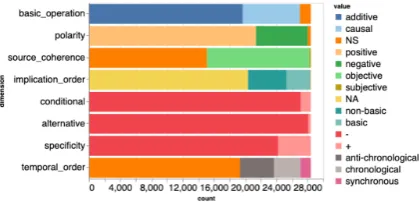
The set of primitives and their possible values used in our experiments are presented in Figure1, along with their distribution in our training dataset (see Section 6.1) after operational mapping. Possible values for core primitives present minor changes compared to the ones adopted by Sanders et al.
Figure 1: Distribution of values for each dimension
Non-specified value (NS) For all core primi-tives (i.e. non binary primiprimi-tives), in addition to val-ues described in previous section (e.g.additiveand
causalfor primitivebasic operation), we add the valueNS(non-specified) to the set of possible val-ues.
NSvalue does not exist as a “label” in (Sanders et al., 2018) mapping, but there are cases of ambiguity/under-specification: in the original CCR mapping, value for the primitive source of coherence is set to obj|sub for a number of relations, primitive temporal order has value
syn|chron|NAforExpansion.List, etc. In our map-ping, when there is an ambiguity on a primitive value, we associate the valueNS(see Table 1for our mapping for classComparisonrelations).
NS value is also used for ambiguities raised by the need to associate primitive values to re-lations that are not end-labels of the PDTB hierarchy, end-labels being relations at level 2 that have no subtypes (such as Tempo-ral.Synchronous) or relations at level 3 (such as
Contingency.Cause.Result). Sanders et al.(2018) provide a mapping for each end-label but not for less specific labels. Since PDTB contains examples annotated with level 1 (classes) or 2 (types) relations which are not end-labels – under-specified relations –, we also need to provide a mapping into primitives for these relations in our experiments. For example, we set primitivebasic operation to value NS for Comparison, as some relations within this class areadditive, and some others arecausal(see Table1).
Non-applicable value (NA) We keep valueNA
for dimension implication order, associated with relations that do not involve an implication ( addi-tiverelations).
On the other hand, we remove it for dimension
temporal order. This is motivated by the fact that relations from Temporal class have a somewhat
special status among discourse relations: it is not always clear whether they are rhetoric or semantic relations (especially when annotated in addition of another relation). Temporalrelations represent 66.3% of multiple relations in PDTB, and they can co-occur with relations from any other class. Furthermore, temporal relations can co-occur with relations which are associated with the value NA
(non-applicable) fortemporal orderin the original mapping ofSanders et al.(2018).4
As there is no relation in PDTB data that seem to be incompatible with a specified value for tem-poral order, we removeNAvalue for this primitive (it is present in possible values fortemporal order
in CCR), and keep onlyNSas a default value.
4.2 Multiple relations: merging sets of primitive values
On the overall corpus used in our experiments (see Section6.1),4.4%relations are multiple relations, i.e. several relations have been annotated in the original PDTB. As previously said,Sanders et al.
(2018) applied their mapping into values per prim-itive on RST-DT and PDTB’s common sections. However, they give no information about a map-ping into primitives for cases where multiple re-lations were annotated in the PDTB: they select the PDTB relation that most closely corresponds to the RST label.
Our goal being different here, we want to take all annotated information into account. In case of multiple relations, we map each relation into a set of primitive values, and then merge values when they are different. Our actual merging prefer-ably outputs non-specified values, but other op-tions should be tested in future work, e.g. keep most specific values.
For basic operation, polarity, source of coher-ence andtemporal order, if values to be merged are different, the primitive value is set toNS.
For binary primitives (conditional, alternative,
specificity), value is set to positive (+) if at least one of the merged values ispositive, andnegative
(-) otherwise.
Forimplication order, if one of the two distinct values to be merged isNAand the other is not (i.e.
basic,non-basicorNS), we keep the second value. If the two distinct values are different from NA,
implication orderis set toNS.
4 For instance, there are 198 co-occurrences of
4.3 Refinements and adding of missing relation
When mapping PDTB relations into primitives, we operated refinements on occurrences of Ex-pansion.Alternative.Disjunctive, whose values for primitives are quite under-specified when strictly applying the mapping of Sanders et al. (2018): values are non-specified (NS) forbasic operation
and source of coherence, and we do not know whether the additional feature conditionalor al-ternativemust be set to a positive value (+). The only specified primitive ispolarity, which is neg-ative. Leaving this level of under-specification would mean having the same set of primitive val-ues for class Comparison and sub-type Expan-sion.Alternative.Disjunctive.
But as suggested by Sanders et al. (2018), markers such as unless indicate that the re-lation is causal-conditional rather than addi-tive-alternative. For some occurrences of Ex-pansion.Alternative.Disjunctive, connectives from PDTB annotations (unless,either...orandor) were used to determine which of the two sub-cases ofExpansion.Alternative.Disjunctivewas present, and associate the correct set of primitive values.
Sanders et al. (2018) provide no mapping for PDTB relation Comparison.Pragmatic conces-sion, for which there is no description in PDTB annotation manual. This label being quite explicit, we associate to it the same primitive values as
Comparison.Concession, except forsource of co-herence, set tosubjective(see Table1).
5 Experiments
Our main goal is to assess which primitives are harder to identify, we thus build separate mod-els for each of them, i.e. basic operation, polar-ity,source of coherence,implication order, tempo-rality,conditional,alternativeandspecificity(see Section3for definitions).
In addition, we compute the performance of our systems on discourse relations using a reverse mapping from a set of predicted values for each primitive to a relation, or, more precisely, to a set of potential relations. We describe the reverse mapping in Section5.1.
We also train systems on the task of directly pre-dicting discourse relations, in order to check the validity of our models and to compare to the pre-dictions derived from the primitives.
Recall that we aim at keeping all the
particular-ities of the PDTB annotations, meaning the mul-tiple relations and the relations at different levels of granularity. This calls for specific evaluation metrics, relying on hierarchical multi-label mea-surement, that we describe in Section5.2.
5.1 Reverse mapping
Our approach consists in building separate sys-tems dedicated to each primitive, in order to split a hard task into several, arguably simpler tasks. One possible goal of this approach is to predict discourse relations based on the predicted primi-tives. In order to do that, we need a mapping in the reverse way, i.e. from primitives to (PDTB) re-lations. Note that we need to map primitives to any level relation, since examples in the PDTB can be annotated with various granularities. This could also be used to limit our system to a set of rela-tionsa posteriori, without retraining the primitives models. Our reverse mapping, which outputs a set of relations, is defined as follows: starting with a set containing all the possible relations, we remove relations that are not compatible with the primitive values predicted.
More precisely, for each binary primitive, if the predicted value is negative (-), we remove all re-lations with a positive value for the primitive. For primitivesbasic operation,polarity,source of co-herenceandtemporal order, if predicted value is not NS, we remove all relations with a different “specified” (nonNS) value for the primitive which is different from predicted value. For instance, if
polarity is positive, all relations associated with
negative polarityare excluded.
For primitive implication order, at first, we treatedNAvalue as a “specified” value in our re-verse mapping: a predicted valueNAfor implica-tion order excluded all relations with a non NA
value for this primitive, i.e. all causal relations were removed. This first mapping led to cases where the set of compatible relations was empty. In all these cases, basic operationwas predicted
causal and primitive implication order was pre-dicted NA, which is theoretically inconsistent: if not specified,implication ordershould be NS. In order to keep the information specified in other primitives, we decided to treat NA value for im-plication order as an NS value. It suggests that keeping these two distinct values should be recon-sidered.
un-der a class) remain in the set of possible rela-tions, we remove these subtypes (or types) from the set, and keep the type (or class) – i.e. the up-per lever underspecified relation. For instance, if the set containsTemporal.Asynchronousand Tem-poral.Synchrony, these labels are removed: only the less specific labelTemporalremains in the set. When only some subtypes of a type (or some types under a class) remain in the set of possible relations, we keep them along with the type (or class).
5.2 Evaluation measures
Our experimental setup raises a number of ques-tions with respect to the evaluation: mapping a set of primitive values back to a PDTB label im-plies there might be underspecifications and cor-responding to a disjunction of relations, either a coarse-grain label in the hierarchy or a set of possi-ble relations. To account for the first case, we can apply measures for hierarchical classification; the second case can be taken care of by measures for multi-label classification, which are needed any-way to take PDTB annotations without restric-tions. There has not been much work on hierarchi-cal discourse relation classification except ( Ver-sley, 2011), and the evaluation was just done at each granularity level, with either exact matching or a Dice coefficient between sets of labels (a rel-ative overlap measure). For a more general mea-sure, we use hierarchical precision and recall ( Kir-itchenko et al., 2005) on the set of all predicted relations. For instance a predicted X.Y evaluated against a gold X.Z.T would get 0.5 precision (one level correct, one incorrect), and 0.33 recall (2 out of 3 levels missing from the prediction). For multi-labels, all levels are put in the same set.
To have an idea of the upper bound we could obtain this way, we also evaluated by considering only the best predicted label, with respect to hi-erarchical F-score, and prefixed the corresponding measures with max-h.
6 Settings
6.1 Data
The PDTB (Prasad et al.,2007) is a corpus of En-glish newswire, containing2,159articles from the Wall Street Journal. We use the section 23 as test set. In the following sections, we present results for both explicit and implicit examples. Contrary to existing studies, we give results for all the labels
annotated in the data (in particular, our results are not limited to level 1 or 2 relations). There are 41 distinct relation labels in the corpus, with 30 end-labels (mainly level 3 end-labels, but also level 2 end-labels that have no sub-types), and 11 “intermediate” la-bels (such asContigency.CauseorComparison).
6.2 Model architecture
We have separate classifiers for each dimension, and we compare the mapping from these to a full relation with a direct PDTB relation prediction.
Infersent is an architecture for sentence relation prediction, initially proposed to train transferable sentence representation from a semantic inference task to be fine-tuned on various sentence and sen-tence pair classification tasks. It takes as input two text fragmentss1ands2(sentence or clause here),
mapped to pretrained word embeddings (GloVe), encode each separately with a bi-LSTM with tied weights, and combine the final LSTM states to predict a relation. The combination is a concatena-tion of the representaconcatena-tions provided for each argu-ment, their absolute difference, and their element-wise product.
Each argument of the relation is thus encoded as a vector of dimensionn, and the combined rep-resentation is a vector of dimension 4n for each separate relation dimension to predict, for various values ofn.
6.3 Hyper-parameters
Models are trained for each dimension separately, with a maximum of 15 epochs and early stopping. An additional fully connected layer can be added on top of the combination of argument representa-tions, and we vary the size of the layer with 0 (no layer), 512, or 4096 dimensions. We also tried dif-ferent regularization values (weight decay):10−n, withn ∈ {−8,1}. The best setting on the devel-opment set was chosen as our configuration for the final test.
7 Results
We describe here the performances obtained for our systems for each primitive separately, and use the reverse mapping to evaluate performance on relations as annotated in the PDTB.
7.1 Predicting primitives
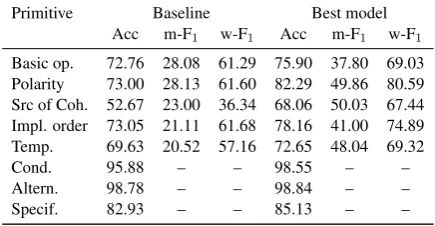
Primitive Baseline Best model Acc m-F1 w-F1 Acc m-F1 w-F1
[image:8.595.73.291.64.177.2]Basic op. 72.76 28.08 61.29 75.90 37.80 69.03 Polarity 73.00 28.13 61.60 82.29 49.86 80.59 Src of Coh. 52.67 23.00 36.34 68.06 50.03 67.44 Impl. order 73.05 21.11 61.68 78.16 41.00 74.89 Temp. 69.63 20.52 57.16 72.65 48.04 69.32 Cond. 95.88 – – 98.55 – – Altern. 98.78 – – 98.84 – – Specif. 82.93 – – 85.13 – –
Table 2: Scores of the systems for each primitive on test set (section 23 of the PDTB). The baseline is a majority classifier. We report Accuracy (“Acc”), and, for non-binary tasks, macro averaged F1(“m-F1”) and
weighted F1(“w-F1”).
Some primitives, such as basic operation and
polarity, correspond to major distinctions with respect to PDTB hierarchy: their values deter-mine distinctions between top-level classes. Other primitives characterize more restricted sets of rela-tions (alternative,specificity) or label distinctions at level 3 (source of coherence).
Table 2 shows performance for each primitive separately. We observe that among core primi-tives, basic operation demonstrates the least im-provement (on accuracy, macro averaged F1 and weighted F1) with respect to the baseline, and thus should be a priority for further work. For primitive
polarity, whose distribution of values are compa-rable (see Figure1), results are quite better. When looking at the confusion matrix for this primitive, we observe that 95% ofpositiverelations and 50% of negative relations are correctly labeled. For primitivebasic operation, only 14% ofcausal re-lations are correctly labeled (rere-lations are mainly labeled as positive). For primitive temporal or-der, results are lower than for primitivepolarity. Relations are mainly labeled asNS(non-specified, which is the majority class) for this primitive.
The greatest improvement with respect to the baseline is for primitivesource of coherence, but this result must be tempered by the fact that there are a very small number ofsubjective relations in our dataset (less than 1%).5 A further study with more data aboutsubjectiverelations could be more informative.
5
It should be noted that there is a potential loss of information due to the absence of a subjective version for Contingency.Cause.Result (whereas the subjective ver-sion ofContingency.Cause.ReasonisContingency.Pragmatic cause.Justification) in the PDTB 2.0 hierarchy (whereas present in PDTB 3).
We also looked at the difference when predict-ing primitives for implicit and explicit relations, and it appears there is almost no improvement on implicit over the baseline, which seems to confirm that primitives should not be considered in isola-tion. Less distinctive primitives show high accu-racy mainly because they are unspecified most of the time.
7.2 Relation identification
Table3 summarizes the scores obtained for rela-tion identificarela-tion, either when the relarela-tion label is obtained via the reverse mapping from the pre-dicted primitives (row “Primitives”), or for sys-tems directly trained to predict discourse relations (row “Relations”). We report accuracy as done in the literature by considering a prediction as cor-rect if it contains one of the gold labels, and use hierarchical measures to have a more general set-ting. Again, our models generally outperform the baseline, often by a large margin, showing the relevance of Infersent architecture to perform the task. Accuracy is much lower than predicting di-rectly the relations, which can be explained by the fact that primitives are learned independently from each other.
By analyzing the predictions, we observed that
Explicit Implicit All
Acc h-R h-P max-h-R max-h-P Acc h-R h-P max-h-R max-h-P Acc h-R h-P max-h-R max-h-P
PDTB relations
[image:9.595.77.525.62.124.2]Baseline 23.5 25.35 26.13 27.02 27.33 15.73 30.5 34.72 31.38 35.5 20.03 27.65 29.97 28.97 30.98 Primitives 46.27 35.56 26.43 59.93 69.59 19.12 20.63 10.52 35.61 45.99 34.15 28.89 19.32 49.07 59.05 Relations 59.08 63.63 65.3 67.4 67.8 28.35 39.76 42.11 40.57 42.67 45.35 52.97 54.95 55.42 56.58
Table 3: Scores of the systems for relation prediction, using the full relation set of the PDTB. The predicted relations are either inferred from the predicted primitives (“Primitives”), or directly predicted (“Relations”).We report hierarchical recall (h-R) and hierarchical precision (h-P), along with max-h-P max-h-R, and accuracy.
8 Conclusion
We have taken a theoretical proposition for map-ping discourse framework to apply it to discourse relation decomposition into primitives, in the con-text of the PDTB English corpus. This allows us to have a simple representation of PDTB anno-tations as a set of semantic and pragmatic primi-tives, allowing for general representations in case of underspecification. We have shown a simple experiment to learn these concepts separately and compare them to a direct relation classifier. Of course the primitives are not independent from each other, so learning them in isolation is bound to be less accurate than learning fully specified re-lation, but this framework lends itself straightfor-wardly to a multi-task learning setting and will be subject of future work. Other interesting perspec-tives include testing whether, when learning prim-itives on a training corpus without some relations, we can predict them correctly based on their con-ceptual decomposition (something akin to 0-shot learning); and finally, applying this decomposition to other discourse framework (RST or SDRT) can make cross-corpora training and prediction possi-ble.
9 Acknowledgement
This work was supported partly by the french PIA project “Lorraine Universit´e d’Excellence”, refer-ence ANR-15-IDEX-04-LUE, and the PEPS blanc from CNRS (INS2I).
References
Nicholas Asher and Alex Lascarides. 2003. Logics of conversation. Cambridge University Press.
Hongxiao Bai and Hai Zhao. 2018. Deep enhanced representation for implicit discourse relation recog-nition. In Proceedings of the 27th International Conference on Computational Linguistics.
Christian Chiarcos. 2014. Towards interoperable dis-course annotation. disdis-course features in the
ontolo-gies of linguistic annotation. InProceedings of the Ninth International Conference on Language Re-sources and Evaluation, LREC 2014, Reykjavik, Ice-land, May 26-31, 2014., pages 4569–4577.
Vera Demberg, Fatemeh Torabi Asr, and Merel Schol-man. 2017. How consistent are our discourse anno-tations? Insights from mapping RST-DT and PDTB annotations.CoRR, abs/1704.08893.
Eduard H. Hovy. 1990. Parsimonious and profligate approaches to the question of discourse structure re-lations. In Proceedings of the Fifth International Workshop on Natural Language Generation.
Yusuke Kido and Akiko Aizawa. 2016. Discourse re-lation sense classification with two-step classifiers.
Proceedings of the CoNLL-16 shared task.
Svetlana Kiritchenko, Stan Matwin, and A. Fazel Famili. 2005. Functional annotation of genes using hierarchical text categorization. In in Proc. of the BioLINK SIG: Linking Literature, Information and Knowledge for Biology (held at ISMB-05).
Alistair Knott. 1997. A Data-Driven Methodology for Motivating a Set of Coherence Relations. Ph.D. the-sis, University of Edinburgh.
William C. Mann and Sandra A. Thompson. 1988. Rhetorical Structure Theory: Toward a functional theory of text organization. Text, 8:243–281.
Todor Mihaylov and Anette Frank. 2016. Discourse re-lation sense classification using cross-argument se-mantic similarity based on word embeddings. Pro-ceedings of the CoNLL-16 shared task.
Rashmi Prasad, Nikhil Dinesh, Alan Lee, Eleni Milt-sakaki, Livio Robaldo, Aravind Joshi, and Bonnie Webber. 2008. The Penn Discourse TreeBank 2.0. InProceedings of LREC.
Rashmi Prasad, Eleni Miltsakaki, Nikhil Dinesh, Alan Lee, Aravind Joshi, Livio Robaldo, and Bonnie Webber. 2007. The Penn Discourse TreeBank 2.0 annotation manual.
Ted Sanders, Wilbert Spooren, and Leo Noordman. 1992. Toward a taxonomy of coherence relations.
Discourse Processes, 15:1–35.
of discourse representation. Cognitive Linguistics, 4:93–134.
Ted J.M. Sanders, Vera Demberg, Jet Hoek, Merel C.J. Scholman, Fatemeh Torabi Asr, Sandrine Zufferey, and Jacqueline Evers-Vermeul. 2018. Unifying di-mensions in coherence relations: How various an-notation frameworks are related.Corpus Linguistics and Linguistic Theory.
Yannick Versley. 2011. Towards finer-grained tagging of discourse connectives. In Proceedings of the Workshop Beyound Semantics: Corpus-based Inves-tigations of Pragmatic and Discourse Phenomena.
Nianwen Xue, Hwee Tou Ng, Sameer Pradhan, At-tapol Rutherford, Bonnie Webber, Chuan Wang, and Hongmin Wang. 2016. Conll 2016 shared task on multilingual shallow discourse parsing. In Proceed-ings of the CoNLL-16 shared task.