Proceedings of NAACL-HLT 2018, pages 420–425
Improving Coverage and Runtime Complexity for Exact Inference in
Non-Projective Transition-Based Dependency Parsers
Tianze Shi Cornell University [email protected]
Carlos Gómez-Rodríguez Universidade da Coru˜na [email protected]
Lillian Lee Cornell University [email protected]
Abstract
We generalize Cohen, Gómez-Rodríguez, and Satta’s (2011) parser to a family of non-projective transition-based dependency parsers allowing polynomial-time exact infer-ence. This includes novel parsers with better coverage thanCohen et al.(2011), and even a variant that reduces time complexity toOpn6q,
improving on prior bounds. We hope that this piece of theoretical work inspires design of novel transition systems with better coverage and better run-time guarantees.
1 Introduction
Non-projective dependency trees are those con-taining crossing edges. They account for12.59%
of all training sentences in the annotated Uni-versal Dependencies (UD) 2.1 data (Nivre et al., 2017), and more than20%in each of 10 languages
among the 54 in UD 2.1 with training treebanks. But modeling non-projectivity is computationally costly (McDonald and Satta,2007).
Some transition-based dependency parsers have deduction systems that use dynamic programming to enableexactinference in polynomial time and space (Huang and Sagae,2010;Kuhlmann et al., 2011). For non-projective parsing, though, the only tabularization of a transition-based parser is, to our knowledge, that of Cohen et al. (2011). They define a deduction system for (an isomor-phic variant of) Attardi’s (2006) transition sys-tem, which covers a subset of non-projective trees. The exact inference algorithm runs inOpn7qtime,
wherendenotes sentence length.
In this paper, we show howCohen et al.’s (2011) system can be modified to generate a new fam-ily of deduction systems with corresponding tran-sition systems. In particular, we present three novel variants of the degree-2Attardiparser,
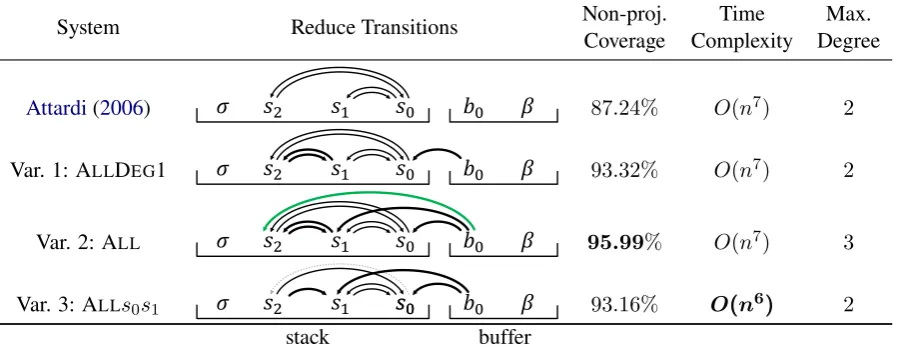
sum-marized in Fig. 1 (our technique can also be ap-plied to generalized Attardi (2006) systems; see
§3.2). The first two bring non-projective cover-age for UD 2.1 to as high as 95.99% by adding
extra transitions, and yet retain the same time complexity. The third reduces time complex-ity for exact inference to Opn6q and space com-plexity fromOpn5q toOpn4q, while still
improv-ing empirical coverage from87.24%to93.16%.1
Code and full statistics for all treebanks can be found at https://github.com/tzshi/
nonproj-dp-variants-naacl2018.
These theoretical improvements are a step to-wards making recent state-of-the-art results in transition-based parsing with exact inference (Shi et al.,2017) extensible to practical non-projective parsing, by exemplifying the design of transi-tion systems with better coverage on highly non-projective datasets and, for one variant, bringing the runtime complexity one level closer to feasi-bility.
2 Transition-based Parsing
We first introduce necessary definitions and nota-tion.
2.1 A General Class of Transition Systems A transition system is given by a 4-tuple pC, T, cs, Cτq, whereC is a set of configurations,
T is a set of transition functions between
config-urations, cs is an initialization function mapping an input sentence to an initial configuration, and
Cτ ĂCdefines a set of terminal configurations.
1Faster exact inference algorithms have been defined for
some sets of mildly non-projective trees (e.g. Pitler et al. (2013); seeGómez-Rodríguez(2016) for more), but lack an underlying transition system. Having one has the practical advantage of allowing generative models, as inCohen et al. (2011), and transition-based scoring functions, which have yielded good projective-parsing results (Shi et al.,2017); plus the theoretical advantage of providing a single framework supporting greedy, beam-search, and exact inference.
System Reduce Transitions Non-proj. Coverage
Time Complexity
Max. Degree
Attardi(2006) ê O6 O5 O4 >4 Ú 87.24% Opn7q 2
Var. 1: ALLDEG1 ê O6 O5 O4 >4 Ú 93.32% Opn7q 2
Var. 2: ALL ê O6 O5 O4 >4 Ú 95.99% Opn7q 3
Var. 3: ALLs0s1 ê O6 O5 OO44 >4 Ú 93.16% Opppn6qqq 2
[image:2.595.76.526.66.242.2]stack buffer
Figure 1:Attardi’s (2006) transition system of degree2and our variants. Solid arrows denote the
inven-tory of reduce transitions; each arrow points from the head to the modifier of the edge created by that transition. Thedegreeof a transition is the distance between the head and modifier. Green highlights the single degree-3 transition. Thick arrows and gray dotted arrows represent additional and deleted
transitions with respect to the originalAttardi(2006) system. Coverage refers to the percentage of non-projective sentences (a total of 76,084 extracted from 604,273 training sentences in UD 2.1) that the systems are able to handle.
We employ a tripartite representation for con-figurations: pσ, β, Aq, where the three elements
are as follows. σ and β are disjoint lists called
the stack and buffer, respectively. Each depen-dency arc ph, mq in the resolved arcs set A has
head h and modifier m. For a length-n input
sentence w, the initial configuration is cspwq “ prs,r0,1, ..., ns,Hqwhere the0in the initial buffer
denotes a special node representing the root of the parse tree. All terminal configurations have an empty buffer and a stack containing only0.
Indexing from 0, we write si andbj to denote item i on the stack (starting from the right) and item j on the buffer (from the left), respectively.
We use vertical bars to separate different parts of the buffer or stack. For example, when concerned with the top three stack items and the first item on the buffer, we may writeσ|s2|s1|s0andb0|β.
2.2 Attardi’s (2006) System
We now introduce the widely-usedAttardi(2006) system, which includes transitions that create arcs between non-consecutive subtrees, thus allowing it to produce some non-projective trees. To simplify exposition, here we presentCohen et al.’s (2011) isomorphic version.
The set of transitions consists of a shift transi-tion (sh) and four reduce transitransi-tions (re). A shift
moves the first buffer item onto the stack:
shrpσ, b0|β, Aqs “ pσ|b0, β, Aq.
A reduce transition reh,m creates a dependency arc between h (head) and m (modifier) and
re-ducesm. For example,
res0,s1rpσ|s1|s0, β, Aqs “ pσ|s0, β, AY tps0, s1quq.
Row 1 of Fig.1depicts the fourAttardireduces. The distance betweenhandmin areh,m tran-sition is called its degree. A system limited to degree-1transitions can only parse projective
sen-tences. As shown in Fig. 1, Attardi’s (2006) system has two degree-2 transitions (res0,s2 and
res2,s0) that allow it to cover 87.24% of the non-projective treesin UD 2.1. More generally, an At-tardisystem of degreeDaddsres0,sD andresD,s0
to the system of degreeD´1.
3 Improving Coverage
A key observation is that a degree-DAttardi
sys-tem does not contain all possible transitions of degree within D. Since prior empirical work
has ascertained that transition systems using more transitions with degree greater than 1 can
maintain run-time guarantees, as there exists a known trade-off between coverage and complex-ity (Gómez-Rodríguez, 2016). We want to use Cohen et al.’s (2011)’s exact-inference algorithm forAttardi-based degree-Dnon-projective
depen-dency parsing systems, which was previously ana-lyzed as havingOpn3D`1qtime complexity.2Our contributionis systems that improve the degree-2
Attardi (2006) system’s non-projective coverage, and yet (i) one has degree 3 but still the same Opn7qruntime asCohen et al.(2011), rather than Opn3¨3`1q; and (ii) another has degree 2 but
bet-terruntime thanCohen et al.’s (2011) system.
Here, we first sketch the existing exact inference algorithm,3and then present our variants.
3.1 Cohen et al.’s (2011) Exact Inference The main idea of the algorithm is to group tran-sition sequences into equivalence classes and con-struct longer sequences from shorter ones. For-mally, for m ě 1, Cohen et al. (2011) define
a length-m computation as a sequence of m
ap-plications of transitions to configurations: c0 ÝÑt1
c1¨ ¨ ¨ ÝÑtm cm, where ti P T and tipci´1q “ ci for i P 1..m. As depicted in Fig. 2, a length-mI-computationrh1, i, h2, h3, jsis any length-m computation where (1) c0 “ pσ|h1, i|β, Aq and
cm “ pσ|h2|h3, j|β1, A1q for some σ, β, β1, A, andA1; and (2) for allk P1..m,ck’s stack hasσ
as base and length at least|σ| `2. Only condition
(1) is relevant to this paper:4 it states that the net effect of an I-computation is to replace the right-most item h1 on the stack with items h2 andh3, while advancing the buffer-start fromitoj.
The dynamic programming algorithm is speci-fied as a deduction system, where each transition corresponds to a deduction rule. The shift rule is:
sh: rh1, i, h2, h3, js
rh3, j, h3, j, j`1s
.
Each reduce rule combines two I-computations into a larger I-computation, e.g. (see Fig.3):
res0,s1 :
rh1, i, h2, h3, ks rh3, k, h4, h5, js rh1, i, h2, h5, js
,
2While Opn7q or Opn10q is not practical, the result is
still impressive, since the search space is exponential.Cohen et al.(2011) were inspired byHuang and Sagae’s (2010) and Kuhlmann et al.’s (2011) dynamic-programming approach for projective systems.
3SeeCohen et al.(2011) for full description.
4Condition (2) is used for proving completeness of the
de-duction system (Cohen et al.,2011).
[image:3.595.320.517.64.175.2]Figure 2: From Cohen et al. (2011, Fig. 2): schematic of I-computationrh1, i, h2, h3, js.
Figure 3: Illustration of deduction ruleres0,s1.
with the side condition thath4modifiesh5.5Other reduce transitions have similar deduction rules, with the same two premises, but a different con-clusion depending on the reduced stack item. As an illustration:
res2,s0 :
rh1, i, h2, h3, ks rh3, k, h4, h5, js rh1, i, h2, h4, js
.
The goal of deduction is to produce the I-computation rϵ,0, ϵ,0, ϵs, using the shift and
re-duce deduction rules starting from the axiom rϵ,0, ϵ,0,1s, corresponding to the first and
manda-tory shift transition moving the root node from buffer to stack. ϵ stands for an empty stack or buffer. As analyzed by Cohen et al. (2011), di-rect tabularization for this deduction system takes
Opn5q space and Opn8q time. With adaptation of the “hook trick” described inEisner and Satta (1999), we can reduce the running time toOpn7q.
3.2 Our New Variants
In this section, we modifyCohen et al.’s (2011) set of reduce deduction rules to improve coverage or
5This side condition can be interpreted as a grammar rule
[image:3.595.327.502.217.350.2]time complexity. Since each such deduction rule corresponds to a reduce transition, each revision to the deduction system yields a variant ofAttardi’s (2006) parser. In other words, generalization of the deduction system gives rise to a family of non-projective transition-based dependency parsers.
We first explain why there are exactly nine reduce transitions R “ tres0,s1,res1,s0,res0,s2,
res2,s0,res1,s2,res2,s1,reb0,s0,reb0,s1,reb0,s2u that
can be used in Cohen et al.’s (2011) exact infer-ence algorithm, without allowing a reduction with head bi for i ě 1.6 (Note that Cohen et al.’s (2011) reduce rules are precisely the first four el-ements ofR.) From Fig.3we infer that the con-catenation of I-computationsrh1, i, h2, h3, ksand rh3, k, h4, h5, jsyields a configuration of the form pσ|h2|h4|h5, j|β, Aq. For the application of a re-duce rule to yield a valid I-computation, by condi-tion (1) of the I-computacondi-tion definicondi-tion, first, the head and modifier must be selected from the “ex-posed” elementsh2,h4,h5, andj, corresponding tos2,s1,s0,b0, respectively; and second, the mod-ifier can only come from the stack. Ris precisely the set of rules satisfying these criteria. Further, every reduce transition fromRis compatible with Eisner and Satta’s (1999) “hook trick”. This gives us the satisfactory result that the Opn7q running time upper bound still holds for transitions inR, even though one of them has degree 3.
Next, we consider three notable variants within the family of R-based non-projective transition-based dependency parsers. They are given in Fig.1, along with their time complexities and em-pirical coverage statistics. The latter is computed using static oracles (Cohen et al., 2012) on the UD 2.1 dataset (Nivre et al., 2017).7 We report the global coverage over the 76,084 non-projective sentences from all the training treebanks.
One might assume that adding more degree-1 transitions wouldn’t improve coverage of trees with non-crossing edges. On the other hand, since their addition doesn’t affect the asymptotic run-time, we define ALLDEG1 to include all five degree-1 transitions from R into theAttardi (2006) system. Surprisingly, using ALLDEG1 im-proves non-projective coverage from 87.24% to
93.32%.
Furthermore, recall that we argued above that,
6Such reductions might prove interesting in the future. 7We also compare results from symbolic execution of the
dynamic programming algorithms on short sentences as a double check.
by construction, using any of the transitions in Rstill preserves the originalOpn7q run-time
up-per bound for Cohen et al.’s (2011) exact infer-ence algorithm. We therefore define ALL to
in-clude all 9 reduce transitions inR; it runs in time
Opn7q despite the fact that reb0,s2 P R has
de-gree 3, a significant improvement over the best previously-known bound for degree-3 systems of
Opn10q. Moreover, as shown in Fig.1, this variant
improves non-projective coverage to95.54%.
Now, if our goal is to reduce run-time, we can start with anAttardi(2006) system of degree 1 in-stead of 2, which, as previously mentioned, can only handle projective sentences, but which has runtimeOpnp3¨1q`1q “ Opn4q. Reasoning about
the analog ofRwith respect toKuhlmann et al.’s (2011) exact inference algorithm — the projective predecessor of Cohen et al. (2011) — brings us to the degree-2 set of reduce rulestres0,s1,res1,s0,
reb0,s1u. This system, however, can only handle
leftward non-projective arcs.
Instead, we return to ALL, but discard transi-tions reducing s2, thus derivingALLs0s1, which still produces both left and right non-projective arcs, but has a run-time lower than Opn7q,
which we show as follows. Since s2 cannot be reduced, when concatenating rh1, i, h2, h3, ks and rh3, k, h4, h5, js, the larger I-computation we deduce will be either rh1, i, h2, h4, js or rh1, i, h2, h5, js, so that the first three indices of the conclusion item remain the same as those of the first premise. In addition, the only remaining deduction rule, a shift, produces deduction items of the formrh1, j, h1, j, j`1s. Hence, all deriv-able items will be of the form rh1, i, h1, h3, js, with only four unique indices, instead of five. It follows that the exact inference algorithm for this variant runs in Opn6q time, improving from Opn7q. The tabularization takes Opn4q space, a reduction from the original Opn5q as well. In
terms of empirical coverage, this new system can handle93.16%of the non-projective sentences in UD 2.1, more than Attardi’s (2006) system, but fewer than our other two variants.
Generally, for adegree-DAttardi(2006)-based
system, one may apply our first two variants to im-prove its non-projective coverage while maintain-ing the previously-analyzedOpn3D`1qtime plexity, or the third variant to reduce its time com-plexity down to Opn3Dq, and space complexity
4 Conclusion
We have introduced a family of variants of Co-hen et al.’s (2011) Attardi-based transition sys-tem and its associated dynamic programming al-gorithm. Among these, we have highlighted novel algorithms that (1) increase non-projective cov-erage without affecting computational complexity for exact inference, and (2) improve the time and space complexity for exact inference, even while providing better coverage than the original parser. Specifically, our ALLs0s1runs inOpn6qtime and
Opn4q space (improving fromOpn7q andOpn5q,
respectively) while providing coverage of 93.16% of the non-projective sentences in UD 2.1.
Exact inference for transition-based parsers has recently achieved state-of-the-art results in projec-tive parsing (Shi et al.,2017). The complexity im-provements achieved in this paper are a step to-wards making their exact-inference, projective ap-proach extensible to practical, wide-coverage non-projective parsing.
Acknowledgments
We thank the reviewers for their time and care-ful reading, and reviewer 2 for suggestions that improved our presentation. TS and LL were supported in part by a Google Focused Re-search Grant to Cornell University. CG has re-ceived funding from the European Research Coun-cil (ERC), under the European Union’s Horizon 2020 research and innovation programme (FAST-PARSE, grant agreement No 714150), from the TELEPARES-UDC project (FFI2014-51978-C2-2-R) and the ANSWER-ASAP project (TIN2017-85160-C2-1-R) from MINECO, and from Xunta de Galicia (ED431B 2017/01). LL was also sup-ported in part by NSF grant SES-1741441. Any opinions, findings, and conclusions or recommen-dations expressed in this material are those of the author(s) and do not necessarily reflect the views of the National Science Foundation or other spon-sors.
References
Giuseppe Attardi. 2006. Experiments with a multilan-guage non-projective dependency parser. In Pro-ceedings of the Tenth Conference on Computational Natural Language Learning (CoNLL-X), pages 166– 170, New York City, New York, USA.
Shay B. Cohen, Carlos Gómez-Rodríguez, and Gior-gio Satta. 2011. Exact inference for generative
probabilistic non-projective dependency parsing. In
Proceedings of the 2011 Conference on Empirical Methods in Natural Language Processing (EMNLP), pages 1234–1245, Edinburgh, Scotland, UK.
Shay B. Cohen, Carlos Gómez-Rodríguez, and Gior-gio Satta. 2012. Elimination of spurious ambigu-ity in transition-based dependency parsing. ArXiv e-prints, 1206.6735.
Jason Eisner and Giorgio Satta. 1999. Efficient pars-ing for bilexical context-free grammars and head au-tomaton grammars. InProceedings of the 37th An-nual Meeting of the Association for Computational Linguistics (ACL), pages 457–464, College Park, Maryland, USA.
Carlos Gómez-Rodríguez. 2016. Restricted non-projectivity: Coverage vs. efficiency. Computa-tional Linguistics, 42(4):809–817.
Liang Huang and Kenji Sagae. 2010. Dynamic pro-gramming for linear-time incremental parsing. In
Proceedings of the 48th Annual Meeting of the Asso-ciation for Computational Linguistics (ACL), pages 1077–1086, Uppsala, Sweden.
Marco Kuhlmann, Carlos Gómez-Rodríguez, and Gior-gio Satta. 2011. Dynamic programming algorithms for transition-based dependency parsers. In Pro-ceedings of the 49th Annual Meeting of the Associ-ation for ComputAssoci-ational Linguistics: Human Lan-guage Technologies (ACL-HLT), pages 673–682, Portland, Oregon, USA.
Ryan McDonald and Giorgio Satta. 2007.On the com-plexity of non-projective data-driven dependency parsing. InProceedings of the Tenth International Conference on Parsing Technologies (IWPT), pages 121–132, Prague, Czech Republic. Association for Computational Linguistics.
Gómez Guinovart, Berta Gonzáles Saavedra, Ma-tias Grioni, Normunds Gr¯uz¯ıtis, Bruno Guillaume, Nizar Habash, Jan Hajiˇc, Jan Hajiˇc jr., Linh Hà Mỹ, Kim Harris, Dag Haug, Barbora Hladká, Jaroslava Hlaváˇcová, Florinel Hociung, Petter Hohle, Radu Ion, Elena Irimia, Tomáˇs Jelínek, Anders Jo-hannsen, Fredrik Jørgensen, H¨uner Kas¸ıkara, Hi-roshi Kanayama, Jenna Kanerva, Tolga Kayade-len, Václava Kettnerová, Jesse Kirchner, Natalia Kotsyba, Simon Krek, Veronika Laippala, Lorenzo Lambertino, Tatiana Lando, John Lee, Phương Lê H`ông, Alessandro Lenci, Saran Lertpradit, Her-man Leung, Cheuk Ying Li, Josie Li, Keying Li, Nikola Ljubeˇsi´c, Olga Loginova, Olga Lya-shevskaya, Teresa Lynn, Vivien Macketanz, Aibek Makazhanov, Michael Mandl, Christopher Manning, Cătălina Mărănduc, David Mareˇcek, Katrin Marhei-necke, Héctor Martínez Alonso, André Martins, Jan Maˇsek, Yuji Matsumoto, Ryan McDonald, Gustavo Mendonc¸a, Niko Miekka, Anna Missil¨a, Cătălin Mititelu, Yusuke Miyao, Simonetta Montemagni, Amir More, Laura Moreno Romero, Shinsuke Mori, Bohdan Moskalevskyi, Kadri Muischnek, Kaili M¨u¨urisep, Pinkey Nainwani, Anna Nedoluzhko, Gunta Neˇspore-B¯erzkalne, Lương Nguy˜ên Thị, Huy`ên Nguy˜ên Thị Minh, Vitaly Nikolaev, Hanna Nurmi, Stina Ojala, Petya Osenova, Robert ¨Ostling, Lilja Øvrelid, Elena Pascual, Marco Passarotti, Cenel-Augusto Perez, Guy Perrier, Slav Petrov, Jussi Piitulainen, Emily Pitler, Barbara Plank, Martin Popel, Lauma Pretkalnin¸a, Prokopis Prokopidis, Ti-ina Puolakainen, Sampo Pyysalo, Alexandre Rade-maker, Loganathan Ramasamy, Taraka Rama, Vinit Ravishankar, Livy Real, Siva Reddy, Georg Rehm, Larissa Rinaldi, Laura Rituma, Mykhailo Roma-nenko, Rudolf Rosa, Davide Rovati, Benoˆıt Sagot, Shadi Saleh, Tanja Samardˇzi´c, Manuela Sanguinetti, Baiba Saul¯ıte, Sebastian Schuster, Djamé Seddah, Wolfgang Seeker, Mojgan Seraji, Mo Shen, At-suko Shimada, Dmitry Sichinava, Natalia Silveira, Maria Simi, Radu Simionescu, Katalin Simkó, Mária ˇSimková, Kiril Simov, Aaron Smith, An-tonio Stella, Milan Straka, Jana Strnadová, Alane Suhr, Umut Sulubacak, Zsolt Szántó, Dima Taji, Takaaki Tanaka, Trond Trosterud, Anna Trukhina, Reut Tsarfaty, Francis Tyers, Sumire Uematsu, Zdeˇnka Ureˇsová, Larraitz Uria, Hans Uszkoreit, Sowmya Vajjala, Daniel van Niekerk, Gertjan van Noord, Viktor Varga, Eric Villemonte de la Clerg-erie, Veronika Vincze, Lars Wallin, Jonathan North Washington, Mats Wirén, Tak-sum Wong, Zhuoran Yu, Zdenˇek ˇZabokrtský, Amir Zeldes, Daniel Ze-man, and Hanzhi Zhu. 2017. Universal Dependen-cies 2.1. LINDAT/CLARIN digital library at the In-stitute of Formal and Applied Linguistics (ÚFAL), Faculty of Mathematics and Physics, Charles Uni-versity.
Emily Pitler, Sampath Kannan, and Mitchell Marcus. 2013. Finding optimal 1-endpoint-crossing trees.
Transactions of the Association of Computational Linguistics, 1:13–24.
Tianze Shi, Liang Huang, and Lillian Lee. 2017.