Proceedings of NAACL-HLT 2018, pages 386–396
Before Name-calling: Dynamics and Triggers of Ad Hominem Fallacies
in Web Argumentation
Ivan Habernal† Henning Wachsmuth‡ Iryna Gurevych† Benno Stein‡ †Ubiquitous Knowledge Processing Lab (UKP) and Research Training Group AIPHES
Department of Computer Science, Technische Universit¨at Darmstadt, Germany
www.ukp.tu-darmstadt.de www.aiphes.tu-darmstadt.de ‡Faculty of Media, Bauhaus-Universit¨at Weimar, Germany
<firstname>.<lastname>@uni-weimar.de
Abstract
Arguing without committing a fallacy is one of the main requirements of an ideal debate. But even when debating rules are strictly enforced and fallacious arguments punished, arguers of-ten lapse into attacking the opponent by an ad hominem argument. As existing research lacks solid empirical investigation of the ty-pology of ad hominem arguments as well as their potential causes, this paper fills this gap by (1) performing several large-scale annota-tion studies, (2) experimenting with various neural architectures and validating our work-ing hypotheses, such as controversy or reason-ableness, and (3) providing linguistic insights into triggers of ad hominem using explainable neural network architectures.
1 Introduction
Human reasoning is lazy and biased but it per-fectly serves its purpose in the argumentative con-text (Mercier and Sperber, 2017). When chal-lenged by genuine back-and-forth argumentation, humans do better in both generating and evaluat-ing arguments (Mercier and Sperber,2011). The dialogical perspective on argumentation has been reflected in argumentation theory prominently by the pragma-dialectic model of argumentation (van Eemeren and Grootendorst, 1992). Not only sketches this theory an ideal normative model of argumentation but also distinguishes the wrong ar-gumentative moves, fallacies (van Eemeren and Grootendorst, 1987). Among the plethora of prototypical fallacies, notwithstanding the contro-versy of most taxonomies (Boudry et al., 2015),
ad hominemargument is perhaps the most famous one. Arguing against the person is considered faulty, yet is prevalent in online and offline dis-course.1
1According to ‘Godwin’s law’ known from the
in-ternet pop-culture (https://en.wikipedia.org/wiki/
Although the ad hominem fallacy has been known since Aristotle, surprisingly there are very few empirical works investigating its properties. WhileSahlane (2012) analyzed ad hominem and other fallacies in several hundred newspaper edi-torials, others usually only rely on few examples, as observed by de Wijze (2002). As Macagno
(2013) concludes, ad hominem arguments should be considered as multifaceted and complex strate-gies, involving not a simple argument, but sev-eral combined tactics. However, such research, to the best of our knowledge, does not exist. Very little is known not only about the feasibility of ad hominem theories in practical applications (the NLP perspective) but also about the dynamics and triggers of ad hominem (the theoretical counter-part).
This paper investigates the research gap at three levels of increasing discourse complexity: ad hominem in isolation, direct ad hominem with-out dialogical exchange, and ad hominem in large inter-personal discourse context. We asked the following research questions. First, what qualita-tive and quantaqualita-tive properties do ad hominem ar-guments have in Web debates and how does that reflect the common theoretical view (RQ1)? Sec-ond, how much of the debate context do we need for recognizing ad hominem by humans and ma-chine learning systems (RQ2)? And finally, what are the actual triggers of ad hominem arguments and can we predict whether the discussion is go-ing to end up with one (RQ3)?
We tackle these questions by leveraging Web-based argumentation data (Change my View on Reddit), performing several large-scale annotation studies, and creating a new dataset. We exper-iment with various neural architectures and
ex-Godwin’s_law), if a discussion goes on long enough, sooner or later someone will compare someone or something to Adolf Hitler.
trapolate the trained models to validate our work-ing hypotheses. Furthermore, we propose a list of potential linguistic and rhetorical triggers of ad hominem based on interpreting parameters of trained neural models.2 This article thus presents the first NLP work on multi-faceted ad hominem fallacies in genuine dialogical argumentation. We also release the data and the source code to the re-search community.3
2 Theoretical background and related work
The prevalent view on argumentation emphasizes its pragmatic goals, such as persuasion and group-based deliberation (van Eemeren et al.,2014), al-though numerous works have dealt with argument as product, that is, treating a single argument and its properties in isolation (Toulmin,1958; Haber-nal and Gurevych, 2017). Yet the social role of argumentation and its alleged responsibility for the very skill of human reasoning explained from the evolutionary perspective (Mercier and Sperber,
2017) provide convincing reasons to treat argu-mentation as an inherently dialogical tool.
The observation that some arguments are in fact ‘deceptions in disguise’ was made already by Aristotle (Aristotle and Kennedy (transla-tor), 1991), for which the term fallacyhas been adopted. Leaving the controversial typology of fallacies aside (Hamblin,1970;van Eemeren and Grootendorst, 1987;Boudry et al., 2015), thead hominemargument is addressed in most theories. Ad hominem argumentation relies on the strat-egy of attacking the opponent and some feature of the opponent’s character instead of the counter-arguments (Tindale,2007). With few exceptions, the following five sub-types of ad hominem are prevalent in the literature: abusive ad hominem (a pure attack on the character of the opponent), tu quoque ad hominem(essentially analogous to the “He did it first” defense of a three-year-old in a sandbox), circumstantial ad hominem(the “practice what you preach” attack and accusation of hypocrisy),bias ad hominem(the attacked op-ponent has a hidden agenda), and guilt by as-sociation (associating the opponent with some-body with a low credibility) (Schiappa and Nordin,
2An attempt to address the plea for thinking about
prob-lems, cognitive science, and the details of human language (Manning,2015).
3https://github.com/UKPLab/
naacl2018-before-name-calling-habernal-et-al
2013; Macagno, 2013; Walton, 2007; Hansen,
2017; Woods, 2008). We omit examples here as these provided in theoretical works or text-books are usually artificial, as already criticized by (de Wijze,2002) or (Boudry et al.,2015).
The topic of fallacies, which might be consid-ered as sub-topic of argumentation quality, has re-cently been investigated also in the NLP field. Ex-isting works are, however, limited to the mono-logical view (Wachsmuth et al., 2017; Habernal and Gurevych,2016b,a;Stab and Gurevych,2017) or they focus primarily on learning fallacy recog-nition by humans (Habernal et al.,2017, 2018a). Another related NLP sub-field includes abusive language and personal attacks in general.Wulczyn et al.(2017) investigated whether or not Wikipedia talk page comments are personal attacks and an-notated 38k instances resulting in a highly skewed distribution (only 0.9% were actual attacks). Re-garding the participants’ perspective, Jain et al.
(2014) examined principal roles in 80 discussions from the Wikipedia: Article for Deletion pages (focusing on stubbornness or ignoredness, among others) and found several typical roles, including ‘rebels’, ‘voices’, or ‘idiots’. In contrast to our data under investigation (Change My View de-bates), Wikipedia talk pages do not adhere to strict argumentation rules with manual moderation and have a different pragmatic purpose.
Reddit as a source platform has also been used in other relevant works. Saleem et al. (2016) de-tected hateful speech on Reddit by exploiting par-ticular sub-communities to automatically obtain training data. Wang et al. (2016) experimented with an unsupervised neural model to cluster so-cial roles on sub-reddits dedicated to computer games. Zhang et al.(2017) proposed a set of nine comment-level dialogue act categories and anno-tated 9k threads with 100k comments and built a CRF classifier for dialogue act labeling. Unlike these works which were not related to argumenta-tion,Tan et al.(2016) examined persuasion strate-gies on Change My View using word overlap fea-tures. In contrast to our work, they focused solely on the successful strategies with delta-awarded posts. Using the same dataset, Musi (2017) re-cently studied concession in argumentation.
3 Data
un-derstand other perspectives on the issue’, in other words an online platform for ‘good-faith’ argu-mentation hosted on Reddit.4 A user posts a sub-mission (also called original post(er); OP) and other participants provide arguments to change the OP’s view, forming a typical tree-form Web dis-cussion. A special feature of CMV is that the OP acknowledges convincing arguments by giving a delta point (∆). Unlike the vast majority of in-ternet discussion forums, CMV enforces obeying strict rules (such as no ‘low effort’ posts, or accus-ing of beaccus-ing unwillaccus-ing to change view) whose vi-olation results into deleting the comment by mod-erators. These formal requirements of an ideal de-bate with the notion of violating rules correspond to incorrect moves in critical discussion in the nor-mative pragma-dialectic theory (van Eemeren and Grootendorst, 1987). Thus, violating the rule of ‘not being rude or hostile’ is equivalent to com-mitting ad hominem fallacy. For our experiments, we scraped, in cooperation with Reddit, the com-plete CMV including the content of the deleted comments so we could fully reconstruct the fal-lacious discussions, relying on the rule violation labels provided by the moderators. The dataset contains≈2M posts in 32k submissions, forming 780k unique threads.
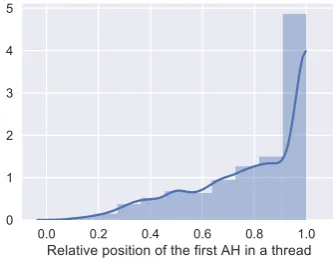
We will set up the stage for further experiments by providing several quantitative statistics we per-formed on the dataset. Only 0.2% posts in CMV are ad hominem arguments. This contrasts with a typical online discussion: Coe et al.(2014) found 19.5% of comments under online news articles to be incivil. Most threads contain only a single ad hominem argument (3,396 threads; there are 3,866 ad hominem arguments in total in CMV); only 35 threads contain more than three ad hominem argu-ments. In 48.6% of threads containing a single ad hominem, the ad hominem argument is the very last comment. This corresponds to the popular be-lief that if one is out of arguments, they start at-tacking and the discussion is over. This trend is also shown in Figure 1 which displays the rela-tive position of the first ad hominem argument in a thread. Replying to ad hominem with another ad hominem happens only in 15% of the cases; this speaks for the attempts of CMV participants to keep up with the standards of a rather rational discussion.
Regarding ad hominem authors, about 66% of
[image:3.595.326.493.61.191.2]4https://www.reddit.com/r/changemyview/
Figure 1: ‘No discussion after ad hominem.’ Dis-tribution of the number of comments before the first ad hominem is committed proportional to the thread length.
them start attacking ‘out of blue’, without any pre-vious interaction in the thread. On the other hand, 11% ad hominem authors write at least one ‘nor-mal’ argument in the thread (we found one outlier who committed ad hominem after writing 57 nor-mal arguments in the thread). Only in 20% cases, the ad hominem thread is an interplay between the original poster and another participant. It means that there are usually more people involved in an ad hominem thread. Unfortunately, sometimes the OP herself also commits ad hominem (12%).
We also investigated the relation between the presence of ad hominem arguments and the sub-mission topic. While most subsub-missions are ac-companied by only one or two ad hominem ar-guments (75% of submissions), there are also ex-tremes with over 50 ad hominem arguments. Man-ual analysis revealed that these extremes deal with religion, sexuality/gender, U.S. politics (mostly Trump), racism in the U.S., and veganism. We will elaborate on that later in Section4.2.
4 Experiments
The experimental part is divided into three parts according to the increasing level of discourse com-plexity. We first experiment with ad hominem in isolation in section 4.1, then with direct ad hominem replies to original posts without dialog-ical exchange in section 4.2, and finally with ad hominem in a larger inter-personal discourse con-text in section4.3.
4.1.1 Data verification
Ad hominem arguments labeled by the CMV mod-erators come with no warranty. To verify their re-liability, we conducted the following annotation studies. First, we needed to estimate parame-ters of crowdsourcing and its reliability. We sam-pled 100 random arguments from CMV without context: positive candidates were the reported ad hominem arguments, whereas negative candidates were sampled from comments that either violate other argumentation rules or have a delta label. To ensure the maximal content similarity of these two groups, for each positive instance the semantically closest negative instance was selected.5 We then experimented with different numbers of Amazon Mechanical Turk workers and various thresholds of the MACE gold label estimator (Hovy et al.,
2013); comparing two groups of six workers each and 0.9 threshold yielded almost perfect inter-annotator agreement (0.79 Cohen’s κ). We then used this setting (six workers, 0.9 MACE thresh-old) to annotate another 452 random arguments sampled in the same way as above.
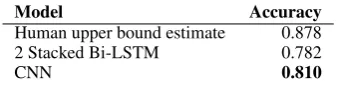
Crowdsourced ‘gold’ labels were then com-pared to the original CMV labels (balanced bi-nary task: positive instances (ad hominem) and negative instances) reaching accuracy of 0.878. This means that the ad hominem labels from CMV moderators are quite reliable. Manual er-ror analysis of disagreements revealed 11 missing ad hominem labels. These were not spotted by the moderators but were annotated as such by crowd workers.
4.1.2 Recognizing ad hominem arguments We sampled a larger balanced set of positive in-stances (ad hominem) and negative inin-stances us-ing the same methodology as in section4.1.1, re-sulting in 7,242 instances, and casted the task of recognition of ad hominem arguments as a binary supervised task. We trained two neural classifiers, namely a 2-stacked bi-directional LSTM network (Graves and Schmidhuber, 2005), and a convolu-tional network (Kim, 2014), and evaluated them using 10-fold cross validation. Throughout the paper we use pre-trainedword2vecword
embed-dings (Mikolov et al., 2013). Detailed
hyperpa-5Similarity was computed using a cosine similarity of
av-erage embedding vectors multiplied by the argument length difference to minimize length-related artifacts. The sample was balanced with roughly 50% positive and 50% negative instances.
Model Accuracy
Human upper bound estimate 0.878 2 Stacked Bi-LSTM 0.782
[image:4.595.331.500.61.104.2]CNN 0.810
Table 1: Prediction of ad hominem arguments
rameters are described in the source codes (link provided in section1). As results in Table1show, the task of recognizing ad hominem arguments is feasible and almost achieves the human upper bound performance.
4.1.3 Typology of ad hominem
While binary classification of ad hominem as pre-sented above might be sufficient for the purpose of red-flagging arguments, theories provide us with a much finer granularity (recall the typology in sec-tion 2). To validate whether this typology is em-pirically relevant, we executed an annotation ex-periment to classify ad hominem arguments into the provided five types (plus ‘other’ if none ap-plies). We sampled 200 ad hominem arguments from threads in which interlocution happens only between two persons and which end up with ad hominem. The Mechanical Turk workers were shown this last ad hominem argument as well as the preceding one. Each instance was anno-tated by 16 workers to achieve a stable distribu-tion of labels as suggested by Aroyo and Welty
(2015). While 41% arguments were categorized as abusive, other categories (tu quoque, circum-stantial, and guilt by association) were found to be rather ambiguous with very subtle differences. In particular, we observed a very low percentage agreement on these categories and a label distri-bution spiked around two or more categories. Af-ter a manual inspection we concluded that (1) the theoretical typology does not account for longer ad hominem arguments that mix up different at-tacks and that (2) there are actual phenomena in ad hominem arguments not covered by theoreti-cal categories. These observations reflect those of
Macagno(2013, p. 399) about ad hominem moves as multifaceted strategies.
We thus propose a list of phenomena typical to ad hominem arguments in CMV based on our em-pirical study. For this purpose, we follow up with another annotation experiment on 400 arguments, with seven workers per instance.6 The goal was
6Here we decided on seven workers per item by relying
to annotate a text span which made the argument an ad hominem; a single argument could contain several spans. We estimated the gold spans us-ing MACE and performed a manual post-analysis by designing a typology of causes of ad hominem together with their frequency of occurrence. The results and examples are summarized in Table2.
4.1.4 Results and interpretation
The data verification annotation study (section
4.1.1) has two direct consequences. First, the high
κ score (0.79) answers RQ2: for recognizing ad hominem argument, no previous context is neces-sary. Second, we still found 5% overlooked ad hominem arguments in CMV thus a moderation-facilitating tool might come handy; this can be served by the well-performing CNN model (0.810 accuracy; section4.1.2).
The existing theoretical typology of ad hominem arguments, as presented for example in most textbooks, provides only a very simplified view. On the one hand, some of the categories which we found in the empirical labeling study (section 4.1.3) do map to their corresponding counterparts (such as the vulgar insults). On the other hand, some ad hominem insults typ-ical to online argumentation (illiteracy insults, condescension) are not present in studies on ad hominem. Hence, we claim that any potential typology of ad hominem arguments should be multinomial rather than categorical, as we found multiple different spans in a single argument.
4.2 Triggers of first level ad hominem
In the following section, we increase the complex-ity of the studied discourse by taking the original post into account.
4.2.1 Annotation study
We already showed that ad hominem arguments are usually preceded by a discussion between the interlocutors. However, 897 submissions (origi-nal posts; OPs) have at least one intermediate ad hominem (in other words, the original post is di-rectly attacked). We were thus interested in what triggers these first-level ad hominem arguments. We hypothesize two causes: (1) thecontroversyof the OP, similarly to some related works on news comments (Coe et al., 2014) and (2) the reason-ableness of the OP (whether the topic is reason-able to argue about). We model both features on a three-point scale, namelycontroversy: 1 = ‘not
re-ally controversial’, 2 = ‘somehow controversial’, 3 = ‘very controversial’ andreasonableness: 1 = ‘quite stupid’, 2 = ‘neutral’, 3 = ‘quite reason-able’.7
We sampled two groups of OPs: those which had some ad hominem arguments in any of its threads but no delta (ad hominem group) and those without ad hominem but some deltas (Delta group). In total, 1,800 balanced instances were an-notated by five workers and the resulting value was averaged for each item.8
Statistical analysis of the annotated 1,800 OPs revealed that ad hominem arguments are associ-ated with more controversial OPs (mean contro-versy 1.23) while delta-awarded arguments with less controversial OPs (mean controversy 1.06; K-S test;9 statistics 0.13, P-value: 7.97×10⁻⁷).
On the other hand, reasonableness does not seem to play such a role. The difference between ad hominem in reasonable OPs (mean 1.20) and delta in reasonable OPs (mean 1.11) is not that statis-tically strong; (K-S test statistics: 0.07, P-value: 0.02).
4.2.2 Regression model for predicting controversy and reasonableness
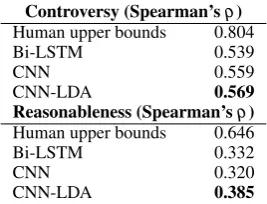
We further built a regression model for predict-ing controversy and reasonableness of the OPs. Along with Bi-LSTM and CNN networks (same models as in 4.1.2) we also developed a neu-ral model that integrates CNN with topic distri-bution (CNN+LDA). The motivation for a topic-incorporating model was based on our earlier ob-servations presented in section 3. In particular, we trained an LDA topic model (k = 50) (Blei et al.,2003) on the heldout OPs and during train-ing/testing, we merged the estimated topic distri-bution vector with the output layer after convolu-tion and pooling. We performed 10-fold cross val-idation on the 1,800 annotated OPs and got rea-sonable performance for controversy prediction (ρ
7Examples of not really controversial: ”I Don’t Think Monty Python is Funny”, very controversial: ”Blacks are generally intellectual inferior to the other major races”, quite stupid:”Burritos are better than sandwiches”, and quite rea-sonable: ”Nations whose leadership is based upon religion are fundamentally backwards”.
8A pilot crowd sourcing annotation with 5 + 5 workers
showed a fair reliability for controversy (Spearman’sρ0.804) and medium reliability for reasonableness (Spearman’s ρ
0.646).
9Kolmogorov-Smirnov (K-S) test is a non-parametric test
Type (%) Example spans
Vulgar insult 31.3 ”Your just an asshole”, ”you dumb fuck”, etc.
Illiteracy insult 13.0 ”Reading comprehension is your friend”, ”If you can’t grasp the concept, I can’t help you”
Condescension 6.5 ”little buddy”, ”sir”, ”boy”, ”Again, how old are you?”
Ridiculing and sarcasm 6.5 ”Thank you so much for all your pretentious explanations”, ”Can you also use Google?”
‘Idiot’-insults 6.5 ”Ever have discussions with narcissistic idiots on the internet? They are so tir-ing”
Accusation of stupidity 4.3 ”You have no capability to understand why”, ”You’re obviously just Nobody with enough brains to operate a computer could possibly believe something this stupid”
Lack of argumentation skills 4.3 ”You’re making the claims, it’s your job to prove it. Don’t you know how debat-ing works?”, ”You’re trash at debatdebat-ing.”
Accusation of trolling 3.9 ”You’re just a dishonest troll”, ”You’re using troll tactics”
Accusation of ignorance 3.5 ”Please dont waste peoples time pretending to know what you’re talking about”, ”Do you even know what you’re saying?”
”You didn’t read what I wrote” 3.0 ”Read what I posted before acting like a pompous ass”, ”Did you even read this?” ”What you say is idiotic” 2.6 ”To say that people intrinsically understand portion size is idiotic.”, ”Your second
paragraph is fairly idiotic”
Accusation of lying 2.6 ”Possible lie any harder?”, ”You are just a liar.” ”You don’t face the facts and
ig-nore the obvious” 1.7 ”Willful ignorance is not something I can combat”, ”How can you explain that?You can’t because it will hurt your feelings to face reality” Accusation of ad hominem or
other fallacies 1.7 ”You started with a fallacy and then deflected.”, ”You still refuse to acknowledgethat you used a strawman argument against me” Other 8.3 ”Wow. Someone sounds like a bit of an anti-semite”, ”You’re too dishonest to
[image:6.595.71.530.66.380.2]actually quote the verse because you know it’s bullshit”
Table 2: What makes an argument ad hominem: results of the empirical study of labeling spans in 400 ad hominem arguments.
Controversy (Spearman’sρ) Human upper bounds 0.804
Bi-LSTM 0.539
CNN 0.559
CNN-LDA 0.569
Reasonableness (Spearman’sρ) Human upper bounds 0.646
Bi-LSTM 0.332
CNN 0.320
CNN-LDA 0.385
Table 3: Results of predicting controversy and reason-ableness of the original post.
0.569) and medium performance for reasonable-ness prediction (ρ0.385), respectively; both using the CNN+LDA model (see Table3).
We then used the trained model and extrap-olated on all held-out OPs (1,267 ad hominem and 10,861 delta OPs, respectively). The analy-sis again showed that ad hominem arguments tend to be found under more controversial OPs whereas delta arguments in the less controversial ones (K-S test statistics: 0.14, P-value: 1×10⁻¹⁸). For reasonableness, the rather low performance of the predictor does not allow us draw any conclusions on the extrapolated data.
4.2.3 Results and interpretation
Controversy of the original post is immediately heating up the debate participants and correlates with a higher number of direct ad hominem re-sponses. This corresponds to observations made in comments in newswire where ‘weightier’ top-ics tended to stir incivility (Coe et al.,2014). On the other hand, ‘stupidity’ (or ‘reasonableness’) does not seem to play any significant role. The CNN+LDA model for predicting controversy (ρ
0.569) might come handy for signaling potentially ‘heated’ discussions.
4.3 Before calling names
In this section, we focus on the dialogical aspect of CMV debates and dynamics of ad hominem fallacies. Although ad hominem arguments ap-pear in many forms (Section 4.1.3), we treat all ad hominem arguments equal in the following ex-periments.
4.3.1 Data sampling
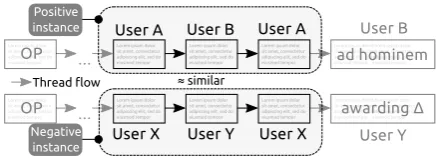
[image:6.595.113.247.433.535.2]Figure 2: Sampling instances for learning triggers of ad hominem.
number of intermediate attacks. However, pos-sible causes of the argumentative dynamics that ends up with an ad hominem argument remain an open question, which has been addressed in nei-ther argumentation theory nor in cognitive psy-chology, to the best of our knowledge. We thus cast an explanation of triggers and dynamics of ad hominem discussions as a supervised machine learning problem and draw theoretical insights by a retrospective interpretation of the learned mod-els.
We sample positive instances by taking three contextual arguments preceding the ad hominem argument from threads which are an interplay be-tween two persons. Negative samples are drawn similarly from threads in which the argument is awarded with ∆ as shown in Figure 2.10 Each instance consists of the three concatenated argu-ments delimited by a special OOV token. This re-sulted in 2,582 balanced training instances.
4.3.2 Neural models
The alleged lack of interpretability of neural net-works has motivated several lines of approaches, such as layer-wise relevance propagation (Arras et al., 2017) or representation erasure (Li et al.,
2016), both on sentiment analysis. As our task at hand deals with multi-party discourse that presum-ably involves temporal relations important for the learned representation, we opted for a state-of-the-art self-attentive LSTM model. In pstate-of-the-articular, we re-implemented the Structured Self-Attentive Em-bedding Neural Network (SSAE-NN) (Lin et al.,
2017) which learns an embedding matrix repre-sentation of the input using attention weights. To make the attention even more interpretable, we re-placed the final non-linear MLP layers with a sin-gle linear classifier (softmax). By summing over one dimension of the attention embedding matrix, each word from the input sequence gets associated
10To ensure as much content similarity as possible, we
used the same similarity sampling as in section4.1.1.
with a single attention weight that gives us insights into the classifier’s ‘features’ (still indirectly, as the true representation is a matrix; see the origi-nal paper).11 The learning objective is to recog-nize whether the thread ends up in an ad hominem argument or a delta point. We trained the model in 10-fold cross-validation and although our goal is not to achieve the best performance but rather to gain insight, we also tested a CNN model (accu-racy 0.7095) which performed slightly worse than the SSAE-NN model (accuracy 0.7208).
4.3.3 Results and interpretation
During testing the model, we projected atten-tion weights to the original texts as heat maps and manually analyzed 191 true positives (ad hominem threads recognized correctly), as well as 77 false positives (ad hominem threads misclassi-fied as delta) and 84 false negatives (delta as ad hominem), in total about 120k tokens. The full output is available in the supplementary materials, we use IDs as a reference in the following text.
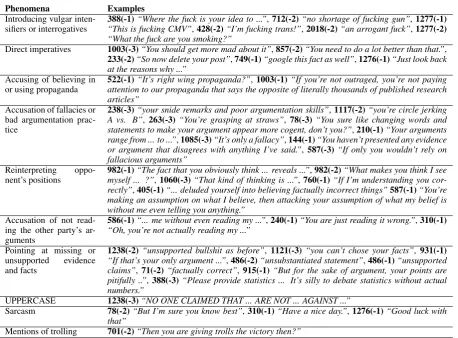
In the following analysis, we solely relied on the weights of words or phrases learned by the atten-tion model, see an example in Figure3. Based on our observations, we summarize several linguis-tic and argumentative phenomena with examples most likely responsible for ad hominem threads in Table4.
The identified phenomena have few interest-ing properties in common. First, they all are topic-independent rhetorical devices (except for the loaded keywords at the bottom). Second, many of them deal with meta-level argumentation, i.e., arguing about argumentation (such as missing sup-port or fallacy accusations). Third, most of them do not contain profanity (in contrast to the actual ad hominem arguments of which a third are vul-gar insults; cf. Table2). And finally, all of them should be easy to avoid.
Misleading ‘features’ False positives revealed properties that misled the network to classify delta threads as ad hominem threads.
• These includetopic words(such asracism,
blacks, slave, abortion) which reflects the im-plicit bias in the data.
• Actual interest mixed with indifference in
11We also experimented with regularizing the attention
[image:7.595.71.292.61.140.2]587 ah t1 cm7djx3
(OOV comment begin) If only you would n’t rely on [ fallacious ] ( http : OOV ) [ arguments ] ( http : OOV ) to make your point. So no , I do n’t realize how stupid and naive I am. All I ’ve realized is that you
are n’t actually prepared to have an actual discussion .
(OOV comment begin) What god do you believe in ? And it ’s not a fallacy when it ’s very comparable to the most popular gods .
(OOV comment begin) You ’re making an assumption on what I believe , then attacking your assumption of what my belief is without me even telling you anything. OOV It is a OOV It ’s the comparison itself that is OOV If they were n’t comparable at all , then it ’d be impossible to commit the OOV You can compare apples to oranges , but the moment you use your fingernails to peel an apple you look like an idiot .
Figure 3: An example of reconstructed word weight heat map extracted from the attention matrix for a thread which ends up in ad hominem; three previous arguments are shown (see Figure2for sampling details).
Phenomena Examples Introducing vulgar
inten-sifiers or interrogatives 388(-1)“This is fucking CMV”“Where the fuck is your idea to ...”,428(-2)“I’m fucking trans!”,712(-2),“no shortage of fucking gun”2018(-2)“an arrogant fuck”,,1277(-1)1277(-2) “What the fuck are you smoking?”
Direct imperatives 1003(-3)“You should get more mad about it”,857(-2)“You need to do a lot better than that.”, 233(-2)“So now delete your post”,749(-1)“google this fact as well”,1276(-1)“Just look back at the reasons why ...”
Accusing of believing in
or using propaganda 522(-1)attention to our propaganda that says the opposite of literally thousands of published research“It’s right wing propaganda?”, 1003(-1)“If you’re not outraged, you’re not paying articles”
Accusation of fallacies or bad argumentation prac-tice
238(-3)“your snide remarks and poor argumentation skills”,1117(-2)“you’re circle jerking A vs. B”, 263(-3)“You’re grasping at straws”, 78(-3)“You sure like changing words and statements to make your argument appear more cogent, don’t you?”,210(-1)“Your arguments range from ... to ...”,1085(-3)“It’s only a fallacy”,144(-1)“You haven’t presented any evidence or argument that disagrees with anything I’ve said.”, 587(-3)“If only you wouldn’t rely on fallacious arguments”
Reinterpreting
oppo-nent’s positions 982(-1)myself ... ?”“The fact that you obviously think ... reveals ...”,1060(-3)“That kind of thinking is ...”,760(-1),982(-2)“If I’m understanding you cor-“What makes you think I see rectly”,405(-1)“... deluded yourself into believing factually incorrect things”587(-1)“You’re making an assumption on what I believe, then attacking your assumption of what my belief is without me even telling you anything.”
Accusation of not read-ing the other party’s ar-guments
586(-1)“... me without even reading my ...”,240(-1)“You are just reading it wrong.”,310(-1) “Oh, you’re not actually reading my ...”
Pointing at missing or unsupported evidence and facts
1238(-2)“unsupported bullshit as before”, 1121(-3) “you can’t chose your facts”, 931(-1) “If that’s your only argument ...”,486(-2)“unsubstantiated statement”,486(-1)“unsupported claims”,71(-2)“factually correct”, 915(-1)“But for the sake of argument, your points are pitifully ..”,388(-3)“Please provide statistics ... It’s silly to debate statistics without actual numbers.”
UPPERCASE 1238(-3)“NO ONE CLAIMED THAT ... ARE NOT ... AGAINST ...”
Sarcasm 78(-2)“But I’m sure you know best”,310(-1)“Have a nice day.”,1276(-1)“Good luck with that”
[image:8.595.70.527.96.254.2]Mentions of trolling 701(-2)“Then you are giving trolls the victory then?” Loaded keywords Nazi, rape, racist
[image:8.595.73.532.344.682.2]sarcasmis also problematic (185(-2)“That’s a very interesting ...”).
• Another problematic phenomena is also ex-pressed disagreement(678(-2)“overheated rhetoric”, 203(-2) “But I suppose this ar-gument is ...”, 230(-2) “But I don’t think it’s quite ...”, 938(-1) “I disagree too, how-ever ...”).
False negatives were caused basically by pres-ence of many ‘informative’ content words (980
unemployment, quarterly publication, inflation data,474actual publications, this experiment, bi-ological ailments, medical doctorate,1214 gradu-ate degree, education, health insurance) and mis-interpreted sarcasm(285(-1)“Also this is a cute analogy”).
5 Conclusion
In this article, we investigated ad hominem argu-mentation on three levels of discourse complexity. We looked into qualitative and quantative proper-ties of ad hominem arguments, crowdsourced la-beled data, experimented with models for predic-tion (0.810 accuracy;4.1.2), and proposed an up-dated typology of ad hominem properties (4.1.3). We then looked into the dynamics of argumenta-tion to examine the relaargumenta-tion between the quality of the original post and immediate ad hominem ar-guments (4.2). Finally, we exploited the learned representation of Self-Attentive Embedding Neu-ral Network to search for features triggering ad hominem in one-to-one discussions. We found several categories of rhetorical devices as well as misleading features (4.3.3).
There are several points that deserve further investigation. First, we have ignored meta-information of the debate participants, such as their overall activity (i.e., whether they are spam-mers or trolls). Second, the proposed typology of ad hominem causes has not yet been post-verified empirically. Third, we expect that personality traits of the participants (BIG5) may also play a significant role in the argumentative exchange. We leave these points for future work.
We believe that our findings will help gain better understanding of, and hopefully keep restraining from, ad hominem fallacies in good-faith discus-sions.
Acknowledgments
This work has been supported by the ArguAna Project GU 798/20-1 (DFG), and by the DFG-funded research training group “Adaptive Prepara-tion of InformaPrepara-tion form Heterogeneous Sources” (AIPHES, GRK 1994/1).
References
Aristotle and George Kennedy (translator). 1991. On Rhetoric: A Theory of Civil Discourse. Oxford Uni-versity Press, USA.
Lora Aroyo and Chris Welty. 2015. Truth is a lie: Crowd truth and the seven myths of human annotation. AI Magazine 36(1):15–24.
https://doi.org/10.1609/aimag.v36i1.2564.
Leila Arras, Gr´egoire Montavon, Klaus-Robert M¨uller, and Wojciech Samek. 2017. Explaining Recurrent Neural Network Predictions in Sentiment Analysis. In Proceedings of the 8th Workshop on Computa-tional Approaches to Subjectivity, Sentiment and So-cial Media Analysis. Association for Computational Linguistics, Copenhagen, Denmark, pages 159–168.
http://www.aclweb.org/anthology/W17-5221. David M. Blei, Andrew Y. Ng, and Michael I.
Jor-dan. 2003. Latent dirichlet allocation. Jour-nal of Machine Learning Research 3:993–1022.
http://dl.acm.org/citation.cfm?id=944919.944937. Maarten Boudry, Fabio Paglieri, and Massimo
Pigliucci. 2015. The Fake, the Flimsy, and
the Fallacious: Demarcating Arguments in
Real Life. Argumentation 29(4):431–456.
https://doi.org/10.1007/s10503-015-9359-1. Kevin Coe, Kate Kenski, and Stephen A. Rains.
2014. Online and Uncivil? Patterns and Deter-minants of Incivility in Newspaper Website Com-ments. Journal of Communication64(4):658–679.
https://doi.org/10.1111/jcom.12104.
Stephen de Wijze. 2002. Complexity, Relevance and Character: Problems with Teaching the ”Ad Hominem” Fallacy. Educational Philosophy and Theory 35(1):31–56. https://doi.org/10.1111/1469-5812.00004.
Alex Graves and J¨urgen Schmidhuber. 2005.
Framewise phoneme classification with bidi-rectional LSTM and other neural network ar-chitectures. Neural Networks 18(5):602–610.
https://doi.org/10.1016/j.neunet.2005.06.042. Ivan Habernal and Iryna Gurevych. 2016a. What
makes a convincing argument? Empirical anal-ysis and detecting attributes of convincingness in Web argumentation. In Proceedings of the 2016 Conference on Empirical Methods in Natu-ral Language Processing. Association for Computa-tional Linguistics, Austin, Texas, pages 1214–1223.
Ivan Habernal and Iryna Gurevych. 2016b. Which ar-gument is more convincing? Analyzing and predict-ing convincpredict-ingness of Web arguments uspredict-ing bidirec-tional LSTM. In Proceedings of the 54th Annual Meeting of the Association for Computational Lin-guistics (Volume 1: Long Papers). Association for Computational Linguistics, Berlin, Germany, pages 1589–1599. http://www.aclweb.org/anthology/P16-1150.
Ivan Habernal and Iryna Gurevych. 2017. Argu-mentation Mining in User-Generated Web Dis-course. Computational Linguistics 43(1):125–179.
https://doi.org/10.1162/COLI a 00276.
Ivan Habernal, Raffael Hannemann, Christian Pol-lak, Christopher Klamm, Patrick Pauli, and Iryna Gurevych. 2017. Argotario: Computational Ar-gumentation Meets Serious Games. In Pro-ceedings of the 2017 Conference on Empirical Methods in Natural Language Processing: Sys-tem Demonstrations. Association for Computational Linguistics, Copenhagen, Denmark, pages 7–12.
http://www.aclweb.org/anthology/D17-2002. Ivan Habernal, Patrick Pauli, and Iryna Gurevych.
2018a. Adapting Serious Game for Fallacious Ar-gumentation to German: Pitfalls, Insights, and Best Practices. In Proceedings of the Eleventh Interna-tional Conference on Language Resources and Eval-uation (LREC 2018). European Language Resources Association (ELRA), Miyazaki, Japan, page (to ap-pear).
Ivan Habernal, Henning Wachsmuth, Iryna Gurevych, and Benno Stein. 2018b. The Argument Reason-ing Comprehension Task: Identification and Recon-struction of Implicit Warrants. InProceedings of the 2018 Conference of the North American Chapter of the Association for Computational Linguistics: Hu-man Language Technologies. Association for Com-putational Linguistics, New Orleans, LA, page (to appear).https://arxiv.org/abs/1708.01425.
Charles L. Hamblin. 1970. Fallacies. Methuen, Lon-don, UK.
Hans Hansen. 2017. Fallacies. In Edward N. Zalta, editor, The Stanford Encyclopedia of Philosophy, Metaphysics Research Lab, Stanford University.
http://plato.stanford.edu/entries/fallacies/.
Dirk Hovy, Taylor Berg-Kirkpatrick, Ashish Vaswani, and Eduard Hovy. 2013. Learning whom to trust with MACE. In Proceedings of NAACL-HLT 2013. Association for Computational Lin-guistics, Atlanta, Georgia, pages 1120–1130.
http://www.aclweb.org/anthology/N13-1132. Siddharth Jain, Archna Bhatia, Angelique Rein, and
Eduard Hovy. 2014. A Corpus of Participant Roles in Contentious Discussions. InProceedings of the Ninth International Conference on Language Re-sources and Evaluation (LREC’14). European Lan-guage Resources Association (ELRA), Reykjavik, Iceland, pages 1751–1756.
Yoon Kim. 2014. Convolutional neural networks for sentence classification. In Proceedings of the 2014 Conference on Empirical Methods in Natural Lan-guage Processing (EMNLP). Association for Com-putational Linguistics, Doha, Qatar, pages 1746– 1751.http://www.aclweb.org/anthology/D14-1181.
Jiwei Li, Will Monroe, and Dan Jurafsky. 2016.
Understanding Neural Networks through
Representation Erasure. In arXiv preprint.
http://arxiv.org/abs/1612.08220.
Zhouhan Lin, Minwei Feng, Cicero Nogueira dos Santos, Mo Yu, Bing Xiang, Bowen Zhou, and Yoshua Bengio. 2017. A Structured Self-attentive Sentence Embedding. In Proceedings of the 5th International Conference on Learning Repre-sentations (ICLR). Toulon, France, pages 1–15.
http://arxiv.org/abs/1703.03130.
Fabrizio Macagno. 2013. Strategies of char-acter attack. Argumentation 27(4):369–401.
https://doi.org/10.1007/s10503-013-9291-1.
Christopher D. Manning. 2015.
Compu-tational Linguistics and Deep Learning.
Computational Linguistics 41(4):701–707.
https://doi.org/10.1162/COLI a 00239.
Hugo Mercier and Dan Sperber. 2011. Why
do humans reason? Arguments for an
argu-mentative theory. The Behavioral and Brain Sciences 34(2):57–74; discussion 74–111.
https://doi.org/10.1017/S0140525X10000968.
Hugo Mercier and Dan Sperber. 2017. The Enigma of Reason. Harvard University Press, Cambridge, MA, USA.
Tomas Mikolov, Ilya Sutskever, Kai Chen, Greg S Cor-rado, and Jeff Dean. 2013. Distributed representa-tions of words and phrases and their composition-ality. In C. J. C. Burges, L. Bottou, M. Welling, Z. Ghahramani, and K. Q. Weinberger, editors, Ad-vances in Neural Information Processing Systems 26, Curran Associates, Inc., pages 3111–3119.
Elena Musi. 2017. How did you change my view? A corpus-based study of concessions’ argumen-tative role. Discourse Studies page (in press).
https://doi.org/10.1177/1461445617734955.
Ahmed Sahlane. 2012. Argumentation and fal-lacy in the justification of the 2003 War
on Iraq. Argumentation 26(4):459–488.
https://doi.org/10.1007/s10503-012-9265-8.
Edward Schiappa and John P. Nordin. 2013. Argumen-tation: Keeping Faith with Reason. Pearson UK, 1st edition.
Christian Stab and Iryna Gurevych. 2017. Recognizing Insufficiently Supported Arguments in Argumenta-tive Essays. In Proceedings of the 15th Confer-ence of the European Chapter of the Association for Computational Linguistics (EACL 2017). Associa-tion for ComputaAssocia-tional Linguistics, pages 980–990.
http://www.aclweb.org/anthology/E17-1092. Chenhao Tan, Vlad Niculae, Cristian
Danescu-Niculescu-Mizil, and Lillian Lee. 2016. Winning Arguments: Interaction Dynamics and Persuasion Strategies in Good-faith Online Discussions. In Pro-ceedings of the 25th International Conference on World Wide Web. ACM, Montreal, CA, page (to ap-pear). http://arxiv.org/abs/1602.01103.
Christopher W. Tindale. 2007.Fallacies and Argument Appraisal. Cambridge University Press, New York, NY, USA, critical reasoning and argumentation edi-tion.
Stephen E. Toulmin. 1958. The Uses of Argument. Cambridge University Press.
Frans H. van Eemeren, Bart Garssen, Erik C. W. Krabbe, A. Francisca Snoeck Henkemans, Bart Verheij, and Jean H. M. Wagemans. 2014. Handbook of Argumentation Theory. Springer, Berlin/Heidelberg.
Frans H. van Eemeren and Rob Grootendorst. 1987. Fallacies in pragma-dialectical
per-spective. Argumentation 1(3):283–301.
https://doi.org/10.1007/BF00136779.
Frans H. van Eemeren and Rob Grootendorst. 1992. Argumentation, communication, and fallacies: a pragma-dialectical perspective. Lawrence Erlbaum Associates, Inc.
Henning Wachsmuth, Nona Naderi, Ivan Haber-nal, Yufang Hou, Graeme Hirst, Iryna Gurevych, and Benno Stein. 2017. Argumentation Qual-ity Assessment: Theory vs. Practice. In Pro-ceedings of the 55th Annual Meeting of the As-sociation for Computational Linguistics (Volume 2: Short Papers). Association for Computational Linguistics, Vancouver, Canada, pages 250–255.
http://aclweb.org/anthology/P17-2039.
Douglas Walton. 2007. Media Argumentation: Di-alect, Persuasion and Rhetoric. Cambridge Univer-sity Press.
Alex Wang, William L. Hamilton, and Jure Leskovec. 2016. Learning Linguistic Descriptors of User Roles in Online Communities. In Proceedings of 2016 EMNLP Workshop on Natural Language Pro-cessing and Computational Social Science. Associ-ation for ComputAssoci-ational Linguistics, Austin, Texas, pages 76–85. http://aclweb.org/anthology/W16-5610.
John Woods. 2008. Lightening up on the
Ad Hominem. Informal Logic 27(1):109.
https://doi.org/10.22329/il.v27i1.467.
Ellery Wulczyn, Nithum Thain, and Lucas Dixon. 2017. Ex Machina: Personal Attacks Seen at Scale. In Proceedings of the 26th national Conference on World Wide Web. Inter-national World Wide Web Conferences Steering Committee, Perth, Australia, pages 1391–1399.
https://doi.org/10.1145/3038912.3052591.