61
A framework for streamlined statistical prediction using topic models
Vanessa Glenny1,2
1ARC Centre of Excellence for Mathematical and Statistical Frontiers (ACEMS) 2School of Mathematical Sciences, The University of Adelaide, SA 5005, Australia 3Data to Decisions CRC Stream Lead
Jonathan Tuke1,2 Nigel Bean1,2 Lewis Mitchell1,2,3
Abstract
In the Humanities and Social Sciences, there is increasing interest in approaches to infor-mation extraction, prediction, intelligent link-age, and dimension reduction applicable to large text corpora. With approaches in these fields being grounded in traditional statisti-cal techniques, the need arises for frameworks whereby advanced NLP techniques such as topic modelling may be incorporated within classical methodologies. This paper pro-vides a classical, supervised, statistical learn-ing framework for prediction from text, us-ing topic models as a data reduction method and the topics themselves as predictors, along-side typical statistical tools for predictive mod-elling. We apply this framework in a Social Sciences context (applied animal behaviour) as well as a Humanities context (narrative analysis) as examples of this framework. The results show that topic regression models per-form comparably to their much less efficient equivalents that use individual words as pre-dictors.
1 Introduction
For the past 20 years, topic models have been used as a means of dimension reduction on text data, in order to ascertain underlying themes, or ‘topics’, from documents. These probabilistic models have frequently been applied to machine learning prob-lems, such as web spam filtering (Li et al.,2013), database sorting (Krestel et al., 2009) and trend detection (Lau et al.,2012).
This paper develops a methodology for incorpo-rating topic models into traditional statistical re-gression frameworks, such as those used in the Social Sciences and Humanities, to make pre-dictions. Statistical regression is a supervised method, however it should be noted the majority of topic models are themselves unsupervised.
When using text data for prediction, we are of-ten confronted with the problem of condensing the data into a manageable form, which still retains the necessary information contained in the text. Methods such as using individual words as predic-tors, orn-grams, while conceptually quite simple, have a tendency to be extremely computationally expensive (with tens of thousands of predictors in a model). Except on extremely large corpora, this inevitably leads to overfitting. As such, meth-ods that allow text to be summarised by a handful of (semantically meaningful) predictors, like topic models, gives a means to use large amounts of text data more effectively within a supervised predic-tive context.
This paper outlines a statistical framework for predictive topic modelling in a regression context. First, we discuss the implementation of a rela-tively simple (and widely used) topic model, latent Dirichlet allocation (LDA) (Blei et al.,2003), as a preprocessing step in a regression model. We then compare this model to an equivalent topic model that incorporates supervised learning, supervised LDA (sLDA) (Blei and McAuliffe,2008).
Using topic models in a predictive framework necessitates estimating topic proportions for new documents, however retraining the LDA model to find these is computationally expensive. Hence we derive an efficient likelihood-based method for es-timating topic proportions for previously unseen documents, without the need to retrain.
further topic models, dependent on the needs of the corpus and response in question.
1.1 Definitions
The following definitions are used when consider-ing topic models.
Vocabulary (V): a set of v unique elements (generally words) from which our text is com-posed.
Topic(φ): a probability distribution over the vo-cabulary. That is, for word i in the vocabulary, a probabilitypi ∈ [0,1] is assigned of that word appearing, given the topic, with Pv
i=1pi = 1. In general, there are a fixed number k of topics, φ={φ1, ..., φk}.
Document (w): a collection of nj units (or words) from the vocabulary. Depending on the topic model, the order of these words within the document may or may not matter.
Corpus (D): a collection of m documents over which the topic model is applied. That is, D = {w1, ...,wm}, each with length nj, j =
1,2, ..., m.
Topic proportion (θj): a distribution of topics over the documentj. A corpus will then have an
m×kmatrixθ, where each rowj = 1,2, ..., m
corresponds to the distribution of topics over doc-umentj.
2 LDA regression model
Latent Dirichlet allocation (LDA) (Blei et al.,
2003), due to its simplicity and effectiveness, con-tinues to be the basis for many topic models today. When considering topic regression, we take LDA as our ‘baseline’ model;i.e., we measure all subse-quent models against the performance of the LDA regression model.
LDA is an unsupervised process that assumes both topics and topic proportions are drawn from Dirichlet distributions. One reason for its simplic-ity is that it makes the ‘bag of words’ assumption. LDA assumes the process outlined in Algorithm1
when generating documents.
Here, α (lengthk) and β (length v) are hyper-parameters of the distributions of theθj andφl re-spectively.
When topic modelling, we are generally in-terested in inferring topic proportions θ =
{θ1, ..., θm} and topics φ themselves, given the
forl= 1,2, ..., kdo
generate thektopicsφl∼Dir(β);
end
forj= 1,2, ..., mdo
letnj ∼Poisson(ξ), the length of documentj;
choose the topic proportionsθj ∼Dir(α);
fori= 1,2, ..., nj do
choose the topic assignment
zji ∼Multi(θj);
choose a wordwji∼Multi(φzji);
end
create the document
wj ={wji}i=1,2,...,nj;
end
Algorithm 1:LDA generative process.
corpusD. That is, we wish to find
P(θ,φ|D, α, β) = P(θ,φ,D|α, β) P(D|α, β) .
The denominator, P(D|α, β), the probability of the corpus, is understandably generally in-tractable to compute. For the purposes of this pa-per, we use collapsed Gibbs sampling as outlined in Griffiths and Steyvers (2004), as an approxi-mate method for finding the LDA model given the corpus.
2.1 Regression model and number of topics
Given an LDA model on a corpus with some corre-sponding response variable, we use the topic pro-portions generated as predictors in a regression model. More specifically, we use the topic pro-portions θ as the predictors, as the amount of a document belonging to each topic may be indica-tive of its response.
0 20 40 60 80
0.18 0.19 0.20 0.21 0.22 0.23 θ
^ 1
count
(a)θ1= 0.2
0 20 40 60
0.38 0.40 0.42 θ
^ 1
count
[image:3.595.80.524.64.230.2](b)θ1= 0.4
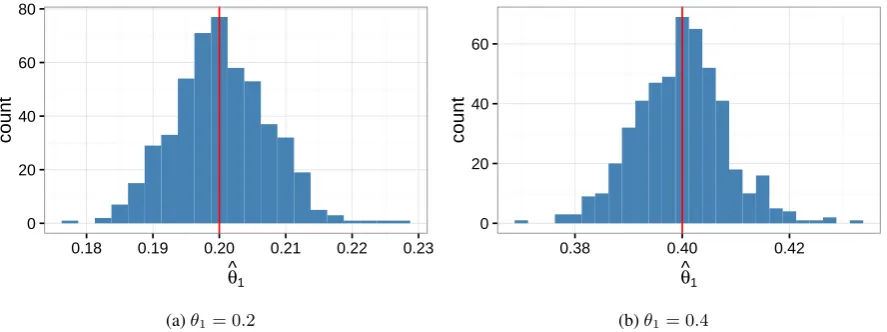
Figure 1: Histograms of the maximum likelihood estimates ofθ1 for corpora of two topics, given relative true values of0.2and0.4.
that reduces the cross validation prediction er-ror (CVPE) (Geisser,1975) of the corresponding LDA regression model, found from K-fold cross validation of the model on the corpus. The CVPE is here defined to be
CVPEK = K
X
i=1
mi
mMSEi,
whereKis the number of folds,miis the number of documents in theith fold, andmthe total num-ber of documents in the corpus. The mean square error for theith fold, denoted by MSEi, is defined as
MSEi=
X
j∈Ci
1 mi
(yj−yˆj)2,
whereyˆj is the model estimate of responseyj for all documents in the setCi, theith fold. It follows that the better a model performs, the smaller the MSE and thus the CVPE.
While we choose the best number of topics based on the information in the regression model, it should be noted that LDA is still unsupervised, and that the topics have not been generated with the response in mind.
2.2 Introducing new documents
When it comes to prediction, we generally have a corpus for which we find our regression model, and use this model to predict the response of new documents that are not in the original corpus. Be-cause our regression model requires us to knowθj, the topic proportion, for any new documentj, we have two options. Either the topic model can be
retrained with the new document added to the cor-pus, and the regression model retrained with the new topics on the old documents, or the topic pro-portions can be found based on the existing topic model.
For both efficiency’s sake (i.e., to avoid retrain-ing the model for every prediction), and for the sake of true prediction, the second option is prefer-able. Particularly in cross validation, it is neces-sary to have a completely distinct traning and test set of data. In retraining a topic model with new documents, we do not have a clear distinction be-tween the two sets.
Blei et al. (2003) outline a procedure for esti-mating the topic proportions of a held-out docu-ment, however this procedure follows a posterior approach that requires variationally inferring the posterior parameters, which are then used to ap-proximate the expected number of words belong-ing to each topic, as an estimate forθj.
We propose here a likelihood-based approach to estimation of topic proportions of new documents, by treating the problem as a case of maximum likelihood estimation. That is, we want to findθˆj, the estimate of θj that maximises the likelihood of documentj occurring, given our existing topic model. Therefore, we aim to maximise
L(θj) = f(wj|θj)
= f(wj1, ..., wjnj|θj),
● ●
0.08 0.09 0.10 0.11 0.12
0.08 0.09 0.10 0.11 0.12 θ
^ 1
θ
^ 2
2 4 6 8
count
(a){θ1, θ2}={0.1,0.1}
● ●
0.28 0.29 0.30 0.31 0.32
0.18 0.19 0.20 0.21 0.22 θ
^ 1
θ
^ 2
1 2 3 4 5 6 7
count
[image:4.595.77.513.64.231.2](b){θ1, θ2}={0.2,0.3}
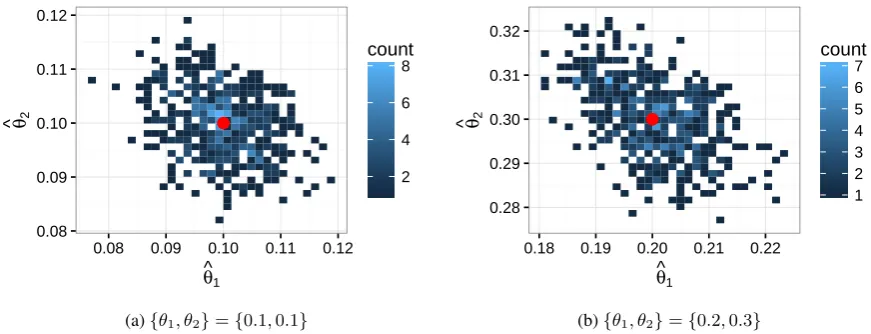
Figure 2: Histograms of the maximum likelihood estimates of{θ1, θ2}for corpora of three topics, given relative true values of{0.1,0.1}and{0.2,0.3}.
express this as
L(θj) = nj
Y
i=1
f(wji|θj).
The law of total probability gives
L(θj) = nj
Y
i=1 k
X
l=1
f(wji|zji=l, θj)f(zji =l|θj),
wherezji is the topic assignment for theith word in documentj. However, as the choice of wordwji is independent of the topic proportionsθj given its topic assignmentzji, we can write
L(θj) = nj
Y
i=1 k
X
l=1
f(wji|zji =l)f(zji =l|θj).
The likelihood is now expressed as the products of the topic proportions and the topics themselves.
L(θj) = nj
Y
i=1 k
X
l=1
φl,wjiθjl.
If we express the document as a set of word counts N = {N1, ..., Nv}, where Ni is the number of times the ith word of the vocabulary appears in documentj, then we can write the log likelihood ofθj as
l(θj) =N·log (θjφ).
In order to deal with words that appear in a new document, and not the original corpus, we assign a probability of 0 to any such word of appearing in any of thektopics; this is equivalent to removing those words from the document.
To demonstrate the effectiveness of this method for estimation, we generate documents for which we know the topics and topic proportions. Sup-pose there exists a corpus comprising of two top-ics, with a vocabulary of 500 words. Given an as-sumed LDA model, we generate 500 documents with lengths between 5,000 and 10,000 words.
Given our newly generated documents, and known topics φ, we are able to test the valid-ity of the MLE process outlined above by finding the estimates θˆj for each document j and com-paring them to known topic proportionsθj. Fig-ure 1 shows the results of the MLE method for finding topic proportion estimates for documents with certain true values ofθj. From these figures, there is a tight clustering around the true valueθj, and thus it is reasonable to assume that the MLE process for estimating the topic proportions of a new document given previously existing topics is sound. This process also holds for greater num-bers of topics, as evidenced in Figure 2, which estimates topic proportions for a three-topic doc-ument.
3 sLDA regression model
cor-pus, based on the topics prevalent in the document. When inferring the sLDA model, we are therefore inclined to find topics that best suit the response and therefore the prediction problem at hand.
Unlike LDA, we treat the topicsφas unknown constants rather than random variables. That is, we are interested in maximising
P θ,z|D,y,φ, α, η, σ2,
where η and σ2 are parameters of the normally distributed response variable, yj ∼ N(ηTz¯j, σ2), wherez¯j = (1/nj)P
nj i=1zji.
As with LDA, this probability is computation-ally intractable, and thus we require an approxima-tion method for model inference. For the purposes of this paper, we use a variational expectation-maximisation (EM) algorithm, as outlined inBlei and McAuliffe(2008).
When it comes to choosing the model with the most appropriate number of topics for the regres-sion problem at hand, we use the same method as outlined for the LDA regression model in Section
2.1.
The method behind sLDA is specifically devel-oped for prediction. As such, we are able to com-pute the expected responseyj from the document wjand the model{α,φ, η, σ2}. For a generalised linear model (as we use in this paper), this is ap-proximated by
E
Yj|wj, α,φ, η, σ2
≈Eq
µ ηT¯zj
,
whereµ ηT¯zj
= EYj|ζ =ηT¯zj
andζ is the natural parameter of the distribution from which the response is taken. Again, further detail on this method is found inBlei and McAuliffe(2008).
4 HMTM regression model
Topic modelling is designed as a method of di-mension reduction, and as such we often deal with large corpora that cannot otherwise be analysed computationally. Given the complexity of human language, we therefore have to choose what in-formation about our corpus is used to develop the topic model. The previous two models, LDA and sLDA, have relied on the ‘bag of words’ assump-tion in order to maintain computaassump-tional efficiency. While for some corpora, the loss of all informa-tion relating to language and document structure may not have a particularly large effect on the pre-dictive capability of the topic model, this may not hold for all prediction problems.
One simple way of introducing structure into the model is through a hidden Markov model (HMM) structure (Baum and Eagon,1967;Baum et al., 1970); in fact, there already exist multiple topic models which do so. We look here at the hid-den Markov topic model (HMTM) (Andrews and Vigliocco,2010), which assumes that the topic as-signment of a word in a document is dependent on the topic assignment of the word before it. That is, the topic assignments function as the latent states of the HMM, with words in the document being the observations. The HMTM assumes the gen-erative process outlined in Algorithm2for docu-ments in a corpus.
forl= 1,2, ..., kdo
generate topicsφl∼Dir(β);
end
forj= 1,2, ...mdo
generate starting probabilities πj ∼Dir(α);
forl= 1,2, ..., kdo
generate thelth row of the transition matrix,Θj,Θjl∼Dir(γl);
end
choose the topic assignment for the first wordzj1∼Multi(πj);
select a word from the vocabulary
wj1 ∼Multi(φzj1);
fori= 2,3, ..., nj do
choose the topic assignmentzjibased on transition matrixΘj;
select a word from the vocabulary
wji ∼Multi(φzji);
end
create the documentwj ={wji}i=1,...,nj;
end
Algorithm 2:HMTM generative process.
Here, α, β and γ = {γ1, ..., γk} are Dirichlet priors of the starting probabilities, topics and tran-sition probabilities respectively.
When it comes to prediction, we are able to use the transition matrices for each document Θj as predictors, but to keep consistency with the previ-ous models we take the equilibrium distributions of the matrices as the topic proportions θj. That is, we findθj such that
θjΘj =θj, and θje= 1.
variables, as opposed tok(k−1)when using the transition matrixΘj. As models are often fit us-ing hundreds of topics (Blei, 2012; Griffiths and Steyvers,2004), this makes models faster to com-pute. We choose the number of topicskhere with the same method outlined in Section2.1.
4.1 Introducing new documents
Like with the LDA regression model, we require a method for estimating the topic proportionθj of any new documents from which we are predicting a response, that does not involve retraining the en-tire model. To do so, we rely on techniques used for HMMs; specifically, we use a modified Baum-Welch algorithm.
The Baum-Welch algorithm is used as an approximate method to find an HMM Ω =
{Θ,φ,π}, given some observed sequence (in this case, a document). However, the key difference here is that our emission probabilities (or topics) φare common across all documents in our corpus, and thus when introducing any new documents for prediction we assume that we already know them. Given the Baum-Welch algorithm calculates for-ward and backfor-ward probabilities based on an as-sumed model, and updates estimates iteratively, we may simply take our assumed φfound from the initial HMTM as the truth and refrain from up-dating the emission probabilities.
We are generally dealing with very small prob-abilities in topic modelling -φgenerally has tens of thousands of columns (the length of the vo-cabulary) over which probabilities must sum to one. While in theory this does not change how we would approach parameter estimation, compu-tationally these probabilities are frequently recog-nised as zero. To make the process more numer-ically stable, we implement the adapted Baum-Welch algorithm demonstrated and justified in
Shen(2008).
While we are ultimately interested in finding topic proportions θj for prediction, the Baum-Welch algorithm finds the transition matrixΘjfor
some document. We are able to deal with this in the same way as finding the original HMTM re-gression model, by takingθj to be the equilibrium probabilities ofΘj.
5 Testing the topic regression models
To demonstrate the use of topic models in a re-gression framework, we apply them to a
prob-lem involving online advertisements. Specifically, we have a corpus containing 4,151 advertisements taken from the trading website, Gumtree1, per-taining to the sale of cats in Australia, and hand-labelled by an expert. Of these advertisements, 2,187 correspond to relinquished cats and 1,964 to non-relinquished. We train a model to predict ‘relinquished status’ from the text of an advertise-ment, using a topic regression model. A cat is con-sidered to be relinquished if it is being given up by its owner after a period of time, as opposed to cats that are sold, either by breeders or former owners. In order to improve efficiency and model qual-ity, we first clean our text data. Details on the cleaning steps can be found in AppendixA.1.
5.1 Word count model
Before investigating regression models that use topic proportions as predictors, it is worth devel-oping a ‘gold standard’ model,i.e., a model whose predictive capability we aim to match with our topic regression models. Because the problem here involves a relatively small corpus (advertise-ments with a median word count of 35), we are able to compare our topic regression models to a model that uses individual words as its predictors. In a much larger corpus, this kind of prediction would be cumbersome to compute - hence our re-liance on topic models and other dimension reduc-tion techniques.
Because we are predicting a categorical, binary variable, we use logistic regression. Rather than using all words in the corpus (as this would dras-tically overfit the model), we use a step-up algo-rithm based on the Akaike information criterion (AIC) (Akaike,1974) to choose the most signifi-cant words for the model, without overfitting.
Instead of applying the step-up process to the entire vocabulary (of exactly 13,000 words), we apply it to the 214 most common words (i.e., words that appear in at least 2.5% of the docu-ments in the corpus). The chosen model uses 97 predictors, with coefficients appearing consistent with what you would expect from the problem: for example, the wordkitten is indicative of non-relinquished advertisements, while cat is the op-posite, which is expected as younger cats are less likely to be relinquished.
To assess the predictive capability of this and other models, we require some method by which
0.00 0.25 0.50 0.75 1.00
0.00 0.25 0.50 0.75 1.00
FPR
TPR
LDA sLDA (2) sLDA (26) Word count
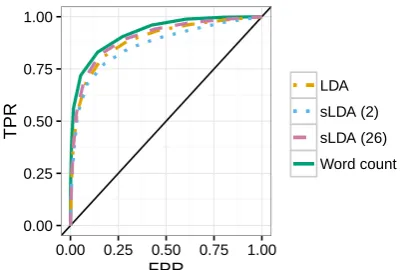
Figure 3: Threshold-averaged ROC curves of the word count model, LDA regression model, and sLDA regres-sion models with two and 26 topics respectively.
we can compare the models. For that purpose, we use receiver operating characteristic (ROC) curves as a visual representation of predictive effective-ness. ROC curves compare the true positive rate (TPR) and false positive rate (FPR) of a model’s predictions at different threshold levels. The area under the curve (AUC) (between 0 and 1) is a nu-merical measure, where the higher the AUC is, the better the model performs.
We cross-validate our model by first randomly splitting the corpus into a training set (95% of the corpus) and test set (5% of the corpus). We then fit the model to the training set, and use it to predict the response of the documents in the test set. We repeat this process 100 times. The threshold-averaged ROC curve (Fawcett,2006) is found from these predictions, and shown in Figure
3. Table1shows the AUC for each model consid-ered.
Model AUC 95% CI
Word count 0.9264 (0.9234,0.9294)
LDA 0.8913 (0.8871,0.8955)
sLDA (2 topics) 0.8588 (0.8534,0.8642)
sLDA (26 topics) 0.9030 (0.8988,0.9073)
Table 1: TArea under the curve (AUC) for the models used on the Gumtree dataset, with their 95% confidence intervals.
5.2 Topic regression models
Using the method outlined in Section 2.1, we choose the LDA regression model with 26 topics as the ‘best’ for this problem. Inspection of the top words included in these 26 topics shows indi-vidual topics associated with different breeds (e.g.,
‘persian’, ‘manx’) as well as urgency of selling (e.g., ‘urgent’, ‘asap’), suggesting that the model is not overfit to the data. We generate a threshold-averaged ROC curve using the same cross valida-tion method as earlier, yielding an area under the curve (AUC) of0.8913. The curve can be seen in Figure3. While not as high as the AUC for the word count model, the LDA regression model is significantly more efficient, taking only3%of the time to calculate.
We can compare this result to that of an sLDA regression model. The model chosen for this prob-lem has two topics, giving a threshold-averaged ROC curve under cross validation with an AUC of 0.8588. It is surprising that the LDA regres-sion model should outperform sLDA, as sLDA in-corporates the response variable when finding the most appropriate topics. However, this can be attributed to the number of topics in the model: the sLDA regression model with 26 topics outper-forms the LDA model, with an AUC of0.9030.
The word count model still outperforms the sLDA model, however once again the topic regres-sion model is significantly more efficient, taking only0.6%of the time to calculate. Further details on the models and their calculation can be found in AppendixA.2.
6 Incorporating language structure
When evaluating the usefulness of incorporating document structure into a topic model for regres-sion, we require a corpus and problem that we would expect would be heavily influenced by this structure. To understand the predictive capability of the HMTM regression model over that of the more simplistic LDA, we therefore consider pre-dicting the storylines of the 2003 filmLove Actu-ally2, known for its interwoven yet still quite dis-tinct storylines. We therefore ask if we are able to predict to which storyline a scene belongs, based on the dialogue in that scene.
The film consists of 79 scenes, each pertaining to one of 10 storylines. The scenes were hand-classified by storyline, and their dialogue forms the documents of our corpus. We once again clean our data; more detail can be found in Appendix
A.1.
[image:7.595.77.278.64.199.2]6.1 Word count model
As with the Gumtree dataset, we first construct a word count model against which we can measure the performance of our topic regression models. Once again, this can be done because we are work-ing with a small corpus; otherwise, we would gen-erally consider this approach to be computation-ally too heavy.
As we have a categorical, non-binary response variable (storyline) with 10 levels, we use a multi-nomial logistic regression model. We again use a step-up process with AIC as the measure to de-termine which words in our vocabulary to use as predictors in our model. As our vocabulary con-sists of only 1,607 unique words, we consider all of them in our step-up process. After applying this process, the model with three predictors,minister, nightandaround, is chosen.
We are no longer able to easily apply ROC curves as a measure of performance to this prob-lem, as we are dealing with a non-binary response. We instead use a Brier score (Brier and Allen,
1951), a measure for comparing the predictive per-formance of models with categorical responses. The Brier score is
BS= 1 m
m
X
j=1 s
X
i=1
(ˆyji−oji)2,
whereyˆjiis the probability of documentj belong-ing to storyline i, and oji = 1if documentj be-longs to storylinei, and0otherwise, for document
j = 1,2, ..., mand storylinei= 1,2, ..., s. Each term in the sum goes to zero the closer the model gets to perfect prediction, and as such our aim is to minimise the Brier score in choosing a model.
For each document in the corpus, we find the probabilities of each outcome by using the re-maining 78 documents (or training dataset) as the corpus in a multinomial logistic regression model with the same three predictors as found above. Due to the fact that the training dataset here is smaller than the Gumtree dataset, we perform leave-one-out cross validation on each document in the corpus (rather than using a 95/5 split). We then predict the outcome based on the words found in the left-out document (or test dataset), and re-peat for all 79 scenes. However, due to the short length of some scenes, and the fact that unique words must be thrown out, we restrict the testing to 57 of the 79 scenes: the remaining scenes do not
generate a numerically stable approximation forθj for the HMTM regression model.
The Brier score calculated using this method for the step-up word count model is0.8255.
6.2 Topic regression models
For the LDA regression model for this problem, we determine the ‘best’ number of topicskto be 16. As with the word count model, we use the Brier score to evaluate the performance of this model compared to others in the chapter. We again use the leave-one-out cross validation approach to predict the probabilities of a scene belonging to each storyline.
The Brier score found for the LDA regression model is 1.6351. While this is higher and there-fore worse than the Brier score for the word count model above, this is not unexpected and we are more interested in seeing how the LDA model fares against other topic models.
We compare these results to the HMTM regres-sion model, as outlined in Section4. We choose the model with 12 topics, according to the CVPE. The Brier score calculated from 57 scenes for the HMTM regression model is 1.5749. While still not up to the standard of the word count model at
0.8255, this appears to be a slight improvement on the LDA model, meaning that dropping the ‘bag of words’ assumption may in fact improve the predic-tive performance of the model. However, it should be kept in mind that the LDA model is better at handling short documents. It would be worth ap-plying these models to corpora with longer docu-ments in future, to see how they compare. Further details on the computation of these models can be found in AppendixA.2.
One of the motivating ideas behind having topic dependencies between consecutive words, as in the HMTM model, is that some documents will have a predisposition to stay in the same topic for a long sequence, such as a sentence or a paragraph. This argument particularly applies to narrative-driven corpora such as theLove Actually corpus. To that end, we may adapt the HMTM described above so that the model favours long sequences of the same topic, by adjusting the Dirichlet priors of the transition probabilities,γ={γ1, ..., γk}, to favour on-diagonal elements. By specifying these priors to be
γls=
(
0.99 + 0.01/k if l=s
for l = 1,2, ..., k, we choose the persistent HMTM regression model with three topics. This results in a Brier score of0.9124, which is a mas-sive improvement on the original HMTM regres-sion model and makes it very competitive with the word count model. Table 2summarises these re-sults.
Model Accuracy Brier score
Word count 26.58 0.8255
LDA 12.66 1.6351
HMTM 14.04 1.5749
Persistent HMTM 15.58 0.9124
Table 2: Table of the percentage of hard classifications of storylines for each left-out scene in the corpus that are correct, alongside the Brier score, for each model.
7 Discussion and further research
This paper outlines and implements a streamlined, statistical framework for prediction using topic models as a data processing step in a regression model. In doing so, we investigate how various topic model features affect how well the topic re-gression model makes predictions.
While this methodology has been applied to three specific topic models, the use of any partic-ular topic model depends heavily on the kind of corpus and problem at hand. For that reason, it may be worth applying this methodology to incor-porate different topic models in future, depending on the needs of the problem at hand.
In particular, we investigate here the influence of both supervised methods, and the incorporation of document structure. A logical next step would be to propose a model that incorporates these two qualities, in order to see if this improves predic-tive capability on corpora with necessary language structure.
References
Hirotugu Akaike. 1974. A new look at the statistical model identification. IEEE Transactions on Auto-matic Control, 19(6):716–723.
Mark Andrews and Gabriella Vigliocco. 2010. The hidden Markov topic model: A probabilistic model of semantic representation. Topics in Cognitive Sci-ence, 2(1):101–113.
Leonard E Baum and J A Eagon. 1967. An inequality with applications to statistical estimation for prob-abilistic functions of Markov processes and to a
model for ecology. Bulletin of the American Mathe-matical Society, 73(3):360–363.
Leonard E Baum, Ted Petrie, George Soules, and Nor-man Weiss. 1970. A maximization technique occur-ring in the statistical analysis of probabilistic func-tions of Markov chains. The Annals of Mathemati-cal Statistics, 41(1):164–171.
David M Blei. 2012. Probabilistic topic models.
Com-munications of the ACM, 55(4):77–84.
David M Blei and Jon D McAuliffe. 2008. Supervised topic models. In Advances in Neural Information
Processing Systems, pages 121–128.
David M Blei, Andrew Y Ng, and Michael I Jordan. 2003. Latent Dirichlet allocation. Journal of
Ma-chine Learning Research, 3:993–1022.
Glenn W Brier and Roger A Allen. 1951. Verification of weather forecasts. InCompendium of Meteorol-ogy, pages 841–848. Springer.
Tom Fawcett. 2006. An introduction to ROC analysis.
Pattern Recognition Letters, 27(8):861–874.
Seymour Geisser. 1975. The predictive sample reuse method with applications. Journal of the American Statistical Association, 70(350):320–328.
Thomas L Griffiths and Mark Steyvers. 2004. Find-ing scientific topics. Proceedings of the National
Academy of Sciences, 101(suppl 1):5228–5235.
Ralf Krestel, Peter Fankhauser, and Wolfgang Nejdl. 2009. Latent Dirichlet allocation for tag recommen-dation. In Proceedings of the Third ACM
Confer-ence on Recommender Systems, pages 61–68. ACM.
Jey Han Lau, Nigel Collier, and Timothy Baldwin. 2012. On-line trend analysis with topic models:\# twitter trends detection topic model online.
Pro-ceedings of COLING 2012, pages 1519–1534.
Jiwei Li, Claire Cardie, and Sujian Li. 2013. Topic-Spam: A topic-model based approach for spam de-tection. In51st Annual Meeting of the Association for Computational Linguistics: Proceedings of the
Conference, volume 2, pages 217–221.
Martin Porter. 2001. Snowball: A language for stemming algorithms. Available at
http://snowballstem.org. Last checked 13
De-cember 2017.
Dawei Shen. 2008. Some mathematics for HMM.
Massachusetts Institute of Technology.
A Appendix
A.1 Text cleaning
The following steps were taken to clean the Gumtree corpus:
• conversion to lower case,
• removal of stop words (i.e., common words such astheandforthat contribute little lexi-cally), and
• removal of grammatical information from words (i.e., stemming).
When stemming words in this paper, we use the stemming algorithm developed by Porter for the Snowball stemmer project (Porter, 2001). Simi-larly, when removing stop words, we use the (En-glish language) list compiled, again, in the Snow-ball stemmer project.
In cleaning the Love Actually corpus, we per-form the first three steps outlined here. However, unlike with the Gumtree dataset, we do not stem words, as grammatical information is more perti-nent when incorporating language structure.
A.2 Topic model inference
For each topic model, we choose the best number of topics from models generated with between two and 40 topics.
For the LDA models found in this paper, we use theLDAfunction from the R package topicmod-els, with the following parameters:
• burnin=1000,
• iterations=1000, and
• keep=50.
The sLDA model in this paper was found using theslda.emfunction from the R packagelda, with the following parameters:
• alpha=1.0,
• eta=0.1,
• variance=0.25,
• num.e.iterations=10, and
• num.m.iterations=4.