24
CLPsych 2019 Shared Task: Predicting the Degree of Suicide Risk in
Reddit Posts
Ayah Zirikly1,Philip Resnik2,Ozlem Uzuner¨ 3,4, andKristy Hollingshead5
1Rehabilitation Medicine Department, National Institutes of Health, Bethesda, MD, USA 2Linguistics and UMIACS CLIP Laboratory, University of Maryland, College Park, MD, USA
3George Mason University, Fairfax, VA, USA
4Massachusetts Institute of Technology, Cambridge, MA, USA 5Florida Institute for Human and Machine Cognition, Pensacola, FL, USA
[email protected], [email protected], [email protected], [email protected]
Abstract
The shared task for the 2019 Workshop on Computational Linguistics and Clinical Psy-chology (CLPsych’19) introduced an assess-ment of suicide risk based on social media postings, using data from Reddit to identify users at no, low, moderate, or severe risk. Two variations of the task focused on users whose posts to the r/SuicideWatch subreddit indicated they might be at risk; a third task looked at screening users based only on their more everyday (non-SuicideWatch) posts. We received submissions from 15 different teams, and the results provide progress and insight into the value of language signal in helping to predict risk level.
1 Introduction
Predicting risk of suicide is hard. McHugh et al.(2019), reviewing 70 studies, conclude that suicidality cannot be predicted effectively using the standard practice of clinicians asking people in person about suicidal thoughts: 80% of pa-tients who were not already undergoing psychi-atric treatment and who died of suicide denied having suicidal thoughts when asked by a general practitioner. They conclude that their study, along with with other recent meta-analyses, “highlight a high degree of uncertainty about the statistical strength of commonly used approaches to suicide risk assessment.”
On a similar theme, after carefully reviewing more than three hundred studies, Franklin et al. (2016) conclude that predictive ability for suicidal thoughts and behaviors (STBs) has not improved across 50 years of research.Nock et al.(2019) ob-serve that, in contrast to other fatal problems like flu or tuberculosis, deaths by suicide are as preva-lent now as they were a hundred years ago, a lack of progress resulting in large part because “we lack a firm understanding of the fundamental properties
of STBs, and when, why, and among whom they unfold” — not least because suicidal thoughts and behaviors rarely occur in a research laboratory.
Coppersmith et al.(2018) offer a powerful ex-ample of the information that is available beyond the research laboratory. They observe that for many people the “clinical whitespace” — long in-tervals between healthcare encounters — is occu-pied by frequent use of social media, an oppor-tunity for obtaining data “in situ” (Nock et al., 2019), and they demonstrate that this information can be tapped effectively in order to build create automated binary classifiers for screening.
This progress raises two new problems, though. First, when binary screening systems are de-ployed, the number of people flagged as at risk will far exceed clinical capacity for intervention. So, rather than a binary classification, a finer grained assessment for degree of risk is needed, in order to support decisions about intervention pri-ority. Second, obtaining relevant data for devel-oping, improving, and validating classifiers is ex-tremely difficult. Coppersmith and colleagues, for example, went to considerable effort to obtain do-nations of private social media data for research on suicide, and these sensitive materials are not easy to share with the broader research community.1
With these considerations in mind, we have for-mulated a new shared task for research commu-nity participation, based on a dataset introduced by Shing et al. (2018). In order to address the limits of binary classification, we formulate tasks based on a multi-level assessment of suicide risk
1
designed for social media, similar in spirit to pre-vious CLPsych shared tasks on four-way assess-ment of crisis risk in a peer support forum (Milne et al.,2016;Milne,2017). In order to address eth-ical access to and sharability of data, we focus on materials collected from Reddit, where posts are public and anonymous, and further de-identified by us; see Section 2. A limitation of the tasks is that we lack information about actual outcomes (suicide attempts or competions); we instead use human annotations of risk level as a starting point. In that regard this year’s exercise can be viewed at minimum as establishing face validity for the idea of extracting meaningful signal related to suicidal-ity from Reddit posts, and more optimistically as a step along the path to clinically meaningful pre-dictions.
2 Data
2.1 Source dataset
We derived our shared task data from the dataset introduced by Shing et al. (2018). Shing et al. began with a collection intended to contain es-sentially every publicly available Reddit posting from its beginning in 2005 into summer 2015, and identified a subset of users potentially at risk by extracting all users who had posted to the r/SuicideWatchsubreddit.2 The process was anal-ogous to the data collection method pioneered by Coppersmith et al. (2014) for a variety of men-tal health conditions, where an explicit signal for candidate (potentially relevant) Twitter users was defined by specifying a self-report pattern, e.g. I have been diagnosed with [condition], and then matching posts were reviewed manually to iden-tify candidates where the signal does not appear genuine, such as sarcastic or joking references. For the suicidality dataset, posting on Suicide-Watch constituted the signal, and Shing et al. (2018) collected 11,129 candidate users on Sui-cideWatch, accounting for a total of 1,556,194 posts across Reddit, along with a comparable number of control users who did not post on Sui-cideWatch.3
2The r/SuicideWatch subreddit, https://www.
reddit.com/r/SuicideWatch/, is a forum providing “peer support for anyone struggling with suicidal thoughts, or worried about someone who may be at risk”. Henceforth we refer to it simply as SuicideWatch.
3It is worth noting that, subsequent toShing et al.’s col-lection and annotation,Gaffney and Matias(2018) reported on an analysis showing that the widely used Baumgartner Reddit collection, whichShing et al.had used as their
start-2.2 User-level annotation
As discussed in more detail byShing et al.(2018), annotation involved the assessment of risk for a randomly selected subset of 621 users on a four-level scale, based on their SuicideWatch posts. A detailed set of annotation instructions drawing on prior literature (Joiner et al., 1999; Corbitt-Hall et al.,2016), created in consultation with suicide prevention experts, identified four families of risk factors, described as follows:
• Thoughtsincludes not only explicit ideation but also, e.g., feeling they are a burden to oth-ers or having a “f*** it” (screw it, game over, farewell) thought pattern;
• Feelings includes, e.g., a lack of hope for things to get better, or a sense of agitation or impulsivity (mixed depressive state,Popovic et al.(2015));
• Logisticsincludes, e.g., talking about meth-ods of attempting suicide (even if not plan-ning), or having access to lethal means like firearms;
• Context includes, e.g. previous attempts, a significant life change, or isolation from friends and family.
Using this assessment scheme, Shing et al. ob-tained annotations both from experts and from crowdsource workers for a randomly selected sub-set of users based on their SuicideWatch postings, assigning one of the following risk levels (a to d):
(a) No Risk (or “None”): I don’t see evidence that this person is at risk for suicide;
(b) Low Risk: There may be some factors here that could suggest risk, but I don’t really think this person is at much of a risk of sui-cide;
(c) Moderate Risk: I see indications that there could be a genuine risk of this person making a suicide attempt;
ing point, has a number of gaps and limitations. However,
(d) Severe Risk: I believe this person is at high risk of attempting suicide in the near future.
It is important to note that this process produced risk assessments at the level of individual users, not of individual posts. Inter-rater reliability was achieved for experts (Krippendorff’s α = 0.81) (to our knowledge the first published demonstra-tion of reliability for clinical assessment of sui-cidality based on social media), along with fair agreement among crowdsourcers (Krippendorff’s α = 0.55). Analysis of the results also showed that when crowdsource workers make mistakes relative to experts’ judgments, they tend to err on the side of caution — a good thing in a setting where false positives are a better kind of error than false negatives.
In the absence of data about outcomes (see dis-cussion in Section6), we expect the expert anno-tations to represent “truth” more accurately than crowdsourced judgments. However, for the shared task we elected to create both training and test data using the crowdsourced annotations, rather than using expert judgments as test data. We made this choice for two reasons. First, at least this first time creating a shared task on Reddit suicidality assessment, we wished to avoid the extra difficul-ties encountered in machine learning when there are mismatches between the training set and the test set. Second, we anticipate the possibility of re-peating this shared task, and would like to lay the groundwork for a head-to-head comparison of re-sults; obtaining crowdsourced judgments to create fresh test data will be considerably more practical than obtaining more expert judgments.
2.3 Reddit posts and metadata
For our tasks, the evidence we have about users’ mental state comes from their Reddit posts. In-formation provided to participant teams included post id (a unique identifier for the post), user id (a unique numeric identifier for the user who au-thored the post), timestamp (time the post was cre-ated, encoded as a Unix epoch), subreddit (the name of the subreddit where the post appeared), post title (title of the post) and post body (text contents of the post).4
As discussed further in Section7, although Red-dit data are publicly available and the site was
4Unix epochs are a widely used standard for encoding time. Any timestamp is represented as the number of seconds that have passed since 00:00:00 Thursday, 1 January 1970, Coordinated Universal Time (UTC), minus leap seconds.
created specifically for anonymous posting, dis-cussions on the platform nonetheless need to be viewed as sensitive and subject to careful ethi-cal consideration (Benton et al.,2017;Chancellor et al., 2019). For that reason, a number of steps were taken to further remove identifying informa-tion from the dataset for the shared task.
First, although Reddit is a site for anony-mous discussion, it is possible for users to put identifying information in their self-selected user names; although most select names like awe-someprogrammer, in principle nothing on the site would prevent someone from naming her-self mary-smith-UMDsophomore-born7July2002. Therefore the dataset replaces the self-selected user names with arbitrary numeric identifiers for the user id.
Second, automatic processing was performed on post titles and bodies, to replace IP addresses, email addresses, URLs, and person entities with special tokens.5 For example, a processed post body might resemble this made-up example: Tak-ing a great class from PERSON PERSON . If you want to learn more about it drop me a line at
EMAIL or check it out at URL .
In addition, we filtered out all posts contain-ing Arabic uscontain-ing the langdetect library.6 We also performed data-cleaning steps to remove encoding issues or special string sequences that tokenizers such as spaCy’s would fail to handle.
3 Tasks
Teams participated in one or more of the following three tasks.
• Task A is about risk assessment: the task sim-ulates a scenario in which there is already on-line evidence that a person might be in need of help (e.g., because they have posted to a relevant online forum or discussion, in this case r/SuicideWatch), and the goal is to as-sess their level of risk from what they posted. This task uses the smallest amount of data, with each user typically having no more than a few SuicideWatch posts.
• Task B is the same risk assessment problem as task A, but in addition to the Suicide-Watch posts (which identify that they may need help), teams can also use the users posts
5
elsewhere on Reddit (which might tell you more about them or their mental state). On average each user we collected data for has more than 130 posts on Reddit, and the sub-reddit categories are wildly diverse, from Ac-counting to mylittlepony to SkincareAddic-tiontozombies.
• Task C is about screening. This task simu-lates a scenario in which someone has opted in to having their social media monitored (e.g., a new mother at risk for postpartum de-pression, a veteran returning from a deploy-ment, a patient whose therapist has suggested it) and the goal is to identify whether they are at risk even if they have not explicitly pre-sented with a problem. Here predictions are made only from users posts that are not on SuicideWatch.
For all tasks, we provided participating teams with training and test data using an 80-20 split. In or-der to keep the original labels’ distribution in the split, we applied the proportional training/test split separately for each label. The statistics of the data are shown in Tables1and2. Note the large num-ber of posts in tasks B and C, which makes these two tasks more challenging given the extra infor-mation and noise the participants have about each user.
train test total
a 127 32 159
b 50 13 63
c 113 28 141
d 206 52 258
[image:4.595.113.250.476.567.2]control 497 124 621 total 993 249 1242
Table 1: Number of users in training and test data
Task A Task B Task C
train 919 57015 56096
test 186 9610 14231
Table 2: Number of posts for each task per split
4 Shared task submissions
Fifteen teams participated in at least one task, with 12 participating in task A, 11 in task B, and 8 in task C. Each team was permitted to submit up to
3 runs per task, and each identified a primary sys-tem that would be used in the official results and rankings. The full number of submissions we re-ceived for tasks A, B, and C were 33, 28, and 22, respectively. Teams were given in total (train-ing and test(train-ing) about four weeks to develop their systems, generating predictions on test data dur-ing a roughly week-long interval at the end. Ta-ble3shows the participating teams and the tasks they submitted to, with per-task rankings (see Sec-tion5).
In this section, we list the common preprocess-ing steps that the teams used prior to trainpreprocess-ing and testing. Additionally, we descibe the approaches followed (machine learning models and features if applicable) in Sections 4.2and4.3. In section6, we provide more details about the top systems per task.
Team A B C
Affective Computing 7 7
ASU (Ambalavanan et al.,2019) 2 5
CAMH† 5 2 2
Chen et al.(2019) 4 CLaC (Mohammadi et al.,2019) 1 5 1 CMU (Allen et al.,2019) 8
IBM data science (Morales et al.,2019) 12 10 4 IDLab (Bitew et al.,2019) 4
JXUFE† 9 8
SBU-HLAB (Matero et al.,2019) 3 1 3 TsuiLab (Ruiz et al.,2019) 3
TTU (Iserman et al.,2019) 6 8
UniOvi-WESO (Hevia et al.,2019) 10 11
uOttawa† 9 7
[image:4.595.101.261.619.659.2]USI-UPF (R´ıssola et al.,2019) 11 6 6
Table 3: CLPsych 2019 participating teams and rank-ings (no paper is available for teams indicated with†)
4.1 Data preprocessing
Ekphra-sis (Baziotis et al.,2017), a tool set that is tailored for social media data. Iserman et al. (2019) ap-plied two-stage error spelling correction using edit distance from augmented dictionary entries.
4.2 Approaches
4.3 Model inputs
The submitted systems used a wide range of input representations on the post and user level. We can distinguish several main categories:
• Embeddings on the word, sentence or docu-ment (post/posts) level. In addition to GloVe and word2vec, we mostly see the more re-cently introduced contextualized embedding techniques such as ELMo (Peters et al.,2018) and BERT (Devlin et al.,2018).
• Lexicon-based features. Teams used dic-tionaries mainly to capture emotions repre-sented in the user’s posts. Examples of dic-tionaries used are NRC (Mohammad,2017) and LIWC (Tausczik and Pennebaker,2010). These features were generally represented as the normalized count of post per category. Other lexicons were employed to capture user-level features including age and gen-der (Sap et al., 2014), and assessment of the Big-5 personality traits (Schwartz et al., 2013).
• N-gram features, mainly in the form of uni-grams with TF-IDF weighting.
• Meta-features such as the time when the post was made available (i.e. timestamp) or the post’s subreddit (Tasks B and C).
• Topic models such as LDA (Blei et al.,2003) and Empath (Fast et al.,2016).
We also see keywords to identify certain behav-iors such as motivations linked to suicidality us-ing a set of keywords; clinical findus-ings in terms of UMLS (Bodenreider, 2004) keywords in the posts, flagging the suicide-related unique iden-tifiers (CUIs); and language style similarity be-tween posts in the same subreddit.
4.4 Models
The submissions for the shared task range from conventional machine learning approaches to deep neural network models. Support vector machines (SVM) and logistic regression are frequently used,
in addition to the occasional decision tree and ran-dom forests approach. These approaches often in-volve feature engineering, where we see a wide variety and extensive combinations of the features mentioned above (Section4.3).
The neural network models, on the other hand, depend mainly on embeddings, though teams opted to use the embeddings output from the lan-guage models in different ways. Many teams fine-tune the embeddings on either the full training data, the SuicideWatch subset, or on each of the title and body of the posts to create separate lan-guage models. Some teams used models that were pre-trained on Wikipedia and some other large corpora as-is in their system.
The most commonly used neural architecture is convolutional neural networks (CNN) on the user or post level, where in the latter case an aggre-gation step is needed to produce the final out-come. Other frequently employed architectures were long-short term memory (LSTM) networks or recurrent neural networks (RNNs) and LSTMs with an attention mechanism. Some teams exper-imented with multichannel neural networks in a multi-task learning setting.
5 Results
5.1 Metrics
The official metric used in this shared task is the macro-averaged F1 score. This metric was also used in previous CLPsych shared tasks that clas-sified online posts into one of four labels (Milne et al., 2016; Milne, 2017); as a way of defining a single figure of merit, macro-averaging treats each class as contributing equally to performance, which helps avoid performance on a single class dominating the result when there is class imbal-ance (cf. Table1).
wasting valuable human effort on no-risk cases.7 For each of the three tasks we report official rankings based on the primary system identified by the team. Additionally, in Section6we report on the best run in terms of macro-F1 score, whether primary or not.
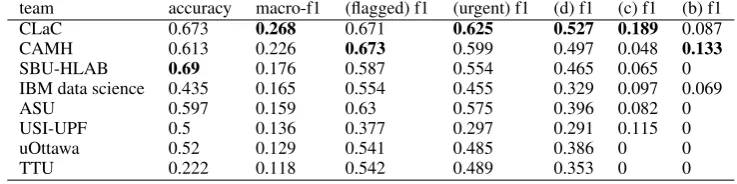
Tables4,5, and6provide the results of the pri-mary runs of the participating teams for each of the three tasks, ranked by highest macro-F1 score. For tasks A and C, the CLaC team (Mohammadi et al.,2019) ranks first with a combination of con-ventional and neural models: an SVM is employed at the end of the pipeline, where it acts as a meta-classifier on top of a set of CNN, LSTM, Bi-RNN and Bi-GRU neural networks. However, for both of those tasks, the primary runs do not gen-erate the bestunofficialmacro-F1 score on the test set: a different variation on the CLaC approach, in which SVM uses as input both the neural fea-tures and the predicted class probabilities from the SVM, yields the best macro-F1 score, 0.533 for task A as compared with 0.481 for the primary system. On the other hand, the CAMH system, which uses a stacked parallel CNN with LIWC and a universal sentence encoder (Cer et al.,2018), produced the best unofficial F1 score for task C: 0.278 as compared to 0.268 for the CLaC primary system.
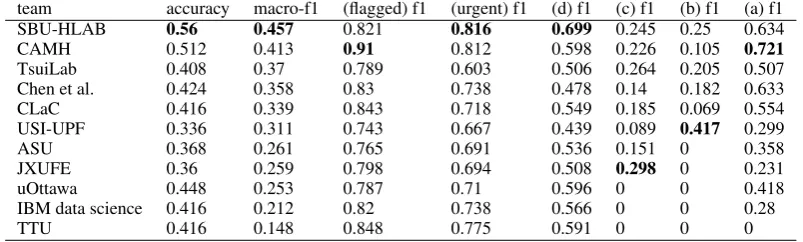
For task B the best official score is 0.457, ob-tained by the HLAB team, where the system used logistic regression with features from Suicide-Watch and non-SuicideSuicide-Watch language that were processed separately. The best unofficial F1 score (0.504) is also obtained by HLAB system, using BERT features generated separately from Suicide-Watch and non-SuicideSuicide-Watch posts.
6 Discussion
In comparing the results of tasks A and B, we note that systems, especially the top systems, perform comparably in terms of predicting the severe risk label (d). This suggests that, in general, infor-mation about all the other Reddit posts by a user does not necessarily add noise that hurts the per-formance, but rather, in some instances, it might have positive impact. Surprisingly identifying se-vere risk posts in task C yields good results given
7Similarly to the previous shared tasks with four-way labeling, we exclude the no-risk label a in evaluation for screening task C. However, macro-F1 score is calculated over all four labels for tasks A and B.
that the set of available posts excludes Suicide-Watch and other mental health subreddits. How-ever, the overall F1 score is low, which suggests that future work should focus on correctly classi-fying the non-severe risk labels (candb). Across tasks, classifying label bhas a low performance, which is mainly due to its smaller training size in comparison to the other labels. Additionally, and as expected, all systems are better at predict-ing the two extreme labels (danda) as opposed to the medium-risk labels(candb).
As a way to augment the training data and to benefit from other available datasets, Hevia et al. (2019) experimented with including Rea-chOut data from the CLPsych 2016 and 2017 shared tasks (Milne et al.,2016;Milne,2017). Un-fortunately, adding this dataset resulted in slightly worse performance. Although both datasets adopt a four-way scale, the annotation guidelines are dif-ferent and there is no guaranteed one-to-one map-ping between the two.
One of the interesting findings from the dif-ferent systems is that severe-risk users appear to use a distinct vocabulary in comparison to the rest of the labels. This would support the intuition of building separate language models for Suicide-Watch and non-SuicideSuicide-Watch, or special features that can benefit from emotion and mental-health related lexicons.
Interestingly, we note that most submitted sys-tems over-predict label d when the correct label isc. This confirms the value of reporting the ur-gentF1 score, noting that, in some instances, the distinction between the two labels is hard even for the crowdsourcers (Shing et al.,2018). Addi-tionally, a number of the false positives observed concern users seeking advice for a relative or a friend as opposed to themselves. This suggests that building models specifically to separate such cases would be of value.
7 Ethical considerations
team accuracy macro-f1 (flagged) f1 (urgent) f1 (d) f1 (c) f1 (b) f1 (a) f1
CLaC 0.504 0.481 0.922 0.776 0.543 0.4 0.244 0.737
ASU 0.544 0.477 0.882 0.826 0.655 0.281 0.316 0.656
SBU-HLAB 0.56 0.459 0.842 0.839 0.692 0.235 0.25 0.658
IDLab 0.544 0.445 0.852 0.789 0.673 0.292 0.167 0.649
CAMH 0.528 0.435 0.897 0.783 0.623 0.327 0.083 0.708
TTU 0.504 0.402 0.902 0.844 0.6 0.14 0.2 0.667
Affective Computing 0.592 0.378 0.92 0.862 0.685 0.065 0 0.762
CMU 0.472 0.373 0.876 0.773 0.545 0.302 0 0.646
JXUFE 0.464 0.364 0.882 0.779 0.571 0.217 0.087 0.582
UniOvi-WESO 0.512 0.312 0.897 0.821 0.633 0.062 0 0.553
USI-UPF 0.376 0.291 0.753 0.707 0.475 0.408 0 0.281
IBM data science 0.432 0.178 0.861 0.788 0.594 0 0 0.118
Table 4: Official results of task A primary systems ordered by macro-F1 score
team accuracy macro-f1 (flagged) f1 (urgent) f1 (d) f1 (c) f1 (b) f1 (a) f1
SBU-HLAB 0.56 0.457 0.821 0.816 0.699 0.245 0.25 0.634
CAMH 0.512 0.413 0.91 0.812 0.598 0.226 0.105 0.721
TsuiLab 0.408 0.37 0.789 0.603 0.506 0.264 0.205 0.507
Chen et al. 0.424 0.358 0.83 0.738 0.478 0.14 0.182 0.633
CLaC 0.416 0.339 0.843 0.718 0.549 0.185 0.069 0.554
USI-UPF 0.336 0.311 0.743 0.667 0.439 0.089 0.417 0.299
ASU 0.368 0.261 0.765 0.691 0.536 0.151 0 0.358
JXUFE 0.36 0.259 0.798 0.694 0.508 0.298 0 0.231
uOttawa 0.448 0.253 0.787 0.71 0.596 0 0 0.418
IBM data science 0.416 0.212 0.82 0.738 0.566 0 0 0.28
TTU 0.416 0.148 0.848 0.775 0.591 0 0 0
Table 5: Official results of task B primary systems ordered by macro-F1 score
7.1 Participants and research oversight
Social media posts are a window into people’s thoughts and often into details of their lives. This has enormous value in understanding and predict-ing mental health, but it stands in tension with con-cerns about privacy, and formalized ethical stan-dards only address these issues to a limited extent. The dataset used in this shared task was derived from previously existing, publicly available ma-terial on Reddit, and we obtained an Institutional Review Board (IRB) determination that work us-ing the material constitutes “secondary research for which consent is not required”, including the ability to share the dataset with other researchers, under the U.S. Federal Policy for the Protection of Human Subjects.8 However, we also took sev-eral additional steps regarding participant protec-tion and research oversight.
First, although a key characteristic of Reddit is its focus on anonymity (Gutman, 2018), users retain the ability to volunteer identifying infor-mation. As discussed in Section 2.3, therefore, we implemented additional, conservative mea-sures for automatic de-identification to reduce the
8https://www.hhs.gov/ohrp/
regulations-and-policy/regulations/ common-rule/index.html
possibility of including any identifying informa-tion in either metadata or text data. In informal review of two sets of 100 randomly sampled post-ings from our training data, after de-identification — one from all postings and the other just from SuicideWatch — we found zero instances of per-sonally identifying information in either text or metadata.
In addition, in order for teams to participate in the shared task, we required them (a) to provide evidence that their own organization’s IRB (or equivalent ethical review board) had reviewed and approved their research activity using the dataset, (b) to provide a data management plan including provisions for appropriate protection of the data, and (c) to affirm that all team members had read Benton et al. (2017) and were committed to its broad ethical principles.9 Mindful of Chancellor et al.’s call to include key stakeholders in the re-search process, the design of participant applica-tions and their reviewing took place in consulta-tion with clinical and domain experts at the Amer-ican Association of Suicidology.
[image:7.595.92.502.63.192.2] [image:7.595.97.499.227.348.2]team accuracy macro-f1 (flagged) f1 (urgent) f1 (d) f1 (c) f1 (b) f1
CLaC 0.673 0.268 0.671 0.625 0.527 0.189 0.087
CAMH 0.613 0.226 0.673 0.599 0.497 0.048 0.133
SBU-HLAB 0.69 0.176 0.587 0.554 0.465 0.065 0
IBM data science 0.435 0.165 0.554 0.455 0.329 0.097 0.069
ASU 0.597 0.159 0.63 0.575 0.396 0.082 0
USI-UPF 0.5 0.136 0.377 0.297 0.291 0.115 0
uOttawa 0.52 0.129 0.541 0.485 0.386 0 0
TTU 0.222 0.118 0.542 0.489 0.353 0 0
Table 6: Official results of task C primary systems ordered by macro-F1 score
7.2 The role of predictive models
Social media’s window into the “clinical whites-pace” (Coppersmith et al., 2018) offers the po-tential to identify and intervene with people who do not or cannot receive attention through conven-tional healthcare interactions. At the same time, algorithmic prediction of suicidality creates new challenges, such as creating potentially stigmatiz-ing labels for false or even true positives, or gen-erating an overwhelming number of new cases re-quiring intervention.
We cannot hope to address these issues in a sin-gle shared task, but we did have them in mind when designing it. Our view, informed by re-search in other domains, is that the most substan-tial, rapid progress on a problem takes place when a community is constructed around a common task with common data, even when the task and data are not perfect. (As is the case here, for exam-ple, in starting with crowdsourced judgments; see Section2.2.) The way to understand tradeoffs and consequences involving false negatives and false positives is to build systems that make predictions, and then to involve clinicians and other practition-ers in discussion of what those systems do, and how this relates to the real-world need — which makes CLPsych, as the venue for this shared task, just as important as the shared task itself.
8 Conclusions
The CLPsych 2019 shared task succeeded in its primary aims, which were to elicit community in-terest and effort in the problem of suicidality as-sessment using social media, and to lay solid foun-dations for work on this problem that will ulti-mately lead to deployable technology. The best results here show strong performance in culling out, among users who have posted to Reddit’s Sui-cideWatch forum, those who are in urgent need of attention, and, conversely, in distinguishing peo-ple who might need attention from those who are
at no risk. We also see a solid start on the even more challenging problem of identifying users in need of attention from more ordinary posts that donotcome from SuicideWatch. On evalution of finer grained, four-way classification we find that the medium risk categories (low and moderate, as opposed to no risk or severe risk) are more chal-lenging for systems, just as they are more difficult for human judges (Shing et al.,2018).
We aim to address some of the limitations of the present shared task in the near future. Although crowdsourced judgments permit easily repeatable evaluations, we also hope to facilitate community-level evaluation against expert judgments. We are also working on the creation of secure commu-nity infrastructure for research on sensitive men-tal health data, in order to reduce practical obsta-cles and reduce data privacy concerns by bringing researchers to the data, rather than disseminating data out to researchers. Our ultimate goal is to create an environment where rapid progress can be achieved by combining the benefits of large scale, publicly available, annotated data, as ex-plored here, with private social media and asso-ciated outcomes obtained using fully consented, donated data (e.g. via OurDataHelps.org, Copper-smith et al.(2018)).
Acknowledgments
[image:8.595.112.481.63.155.2]References
Kristen Allen, Shrey Bagroy, Alex Davis, and Tamar Krishnamurti. 2019. ConvSent at CLPsych 2019 task a: Using post-level sentiment features for sui-cide risk prediction on Reddit. InProceedings of the Sixth Workshop on Computational Linguistics and Clinical Psychology.
Ashwin Karthik Ambalavanan, Pranjali Dileep Jagtap, Soumya Adhya, and Murthy Devarakonda. 2019. Using contextual representations for suicide risk as-sessment from internet forums. In Proceedings of the Sixth Workshop on Computational Linguistics and Clinical Psychology.
Christos Baziotis, Nikos Pelekis, and Christos Doulk-eridis. 2017. Datastories at semeval-2017 task 4: Deep lstm with attention for message-level and topic-based sentiment analysis. In Proceedings of the 11th International Workshop on Semantic Eval-uation (SemEval-2017), pages 747–754, Vancouver, Canada. Association for Computational Linguistics.
Adrian Benton, Glen Coppersmith, and Mark Dredze. 2017. Ethical research protocols for social media health research. In Proceedings of the First ACL Workshop on Ethics in Natural Language Process-ing, pages 94–102.
Semere Kiros Bitew, Giannis Bekoulis, Johannes Deleu, Lucas Sterckx, Klim Zaporojets, Thomas De-meester, and Chris Develder. 2019. Predicting sui-cide risk from online postings in Reddit the UGent-IDLab submission to the CLPysch 2019 shared task A. InProceedings of the Sixth Workshop on Com-putational Linguistics and Clinical Psychology.
David M Blei, Andrew Y Ng, and Michael I Jordan. 2003. Latent dirichlet allocation. Journal of ma-chine Learning research, 3(Jan):993–1022.
Olivier Bodenreider. 2004. The unified medical lan-guage system (umls): integrating biomedical termi-nology. Nucleic acids research, 32(suppl 1):D267– D270.
Daniel Cer, Yinfei Yang, Sheng-yi Kong, Nan Hua, Nicole Limtiaco, Rhomni St John, Noah Constant, Mario Guajardo-Cespedes, Steve Yuan, Chris Tar, et al. 2018. Universal sentence encoder. arXiv preprint arXiv:1803.11175.
Stevie Chancellor, Michael L Birnbaum, Eric D Caine, Vincent Silenzio, and Munmun De Choudhury. 2019. A taxonomy of ethical tensions in inferring mental health states from social media. In Proceed-ings of the 2nd ACM Conference on Fairness, Ac-countability, and Transparency (FAT* ’19).
Lushi Chen, Abeer Aldayel, Nikolay Bogoychev, and Tao Gong. 2019. Similar minds post alike: Assess-ment of suicide risk by hybrid language and behav-ioral model. InProceedings of the Sixth Workshop on Computational Linguistics and Clinical Psychol-ogy.
Glen Coppersmith, Mark Dredze, and Craig Harman. 2014. Quantifying mental health signals in Twitter. In Proceedings of the Workshop on Computational Linguistics and Clinical Psychology: From Linguis-tic Signal to Clinical Reality, pages 51–60.
Glen Coppersmith, Ryan Leary, Patrick Crutchley, and Alex Fine. 2018. Natural language processing of so-cial media as screening for suicide risk. Biomedical Informatics Insights, 10:1178222618792860.
Darcy J Corbitt-Hall, Jami M Gauthier, Margaret T Davis, and Tracy K Witte. 2016. College students’ responses to suicidal content on social networking sites: an examination using a simulated Facebook newsfeed. Suicide and life-threatening behavior, 46(5):609–624.
Jacob Devlin, Ming-Wei Chang, Kenton Lee, and Kristina Toutanova. 2018. Bert: Pre-training of deep bidirectional transformers for language understand-ing.arXiv preprint arXiv:1810.04805.
Ethan Fast, Binbin Chen, and Michael S Bernstein. 2016. Empath: Understanding topic signals in large-scale text. In Proceedings of the 2016 CHI Con-ference on Human Factors in Computing Systems, pages 4647–4657. ACM.
Joseph C Franklin, Jessica Ribeiro, Kathryn Fox, Kate Bentley, Evan Kleiman, Xieyining Huang, Kather-ine Musacchio, Adam Jaroszewski, Bernard Chang, and Matthew Nock. 2016. Risk factors for suici-dal thoughts and behaviors: A meta-analysis of 50 years of research. Psychological bulletin, 143. DOI 10.1037/bul0000084.
Devin Gaffney and J Nathan Matias. 2018. Caveat emptor, computational social science: Large-scale missing data in a widely-published Reddit corpus.
PloS one, 13(7):e0200162.
Rachel Gutman. 2018. Reddit’s case for anonymity on the Internet. The Atlantic.
Alejandro Gonz´alez Hevia, Rebeca Cerezo Men´endez, and Daniel Gayo-Avello. 2019. Analyzing the use of existing systems for the CLPsych 2019 shared task. InProceedings of the Sixth Workshop on Computa-tional Linguistics and Clinical Psychology.
Matthew Honnibal and Ines Montani. 2017. spaCy 2: Natural language understanding with bloom embed-dings, convolutional neural networks and incremen-tal parsing. To appear.
Micah Iserman, Taleen Nalabandian, and Molly E. Ire-land. 2019. Dictionaries and decision trees for the 2019 CLPsych shared task. In Proceedings of the Sixth Workshop on Computational Linguistics and Clinical Psychology.
Matthew Matero, Akash Idnani, Youngseo Son, Sal-vatore Giorgi, Huy Vu, and Mohammadzaman Za-mani. 2019. Suicide risk assessment with multi-level dual-context language and BERT. In Proceed-ings of the Sixth Workshop on Computational Lin-guistics and Clinical Psychology.
Catherine M McHugh, Amy Corderoy, Christo-pher James Ryan, Ian B Hickie, and Matthew Michael Large. 2019. Association between suicidal ideation and suicide: meta-analyses of odds ratios, sensitivity, specificity and positive predictive value. BJPsych open, 5(2).
David N. Milne, Glen Pink, Ben Hachey, and Rafael A. Calvo. 2016. CLPsych 2016 shared task: Triaging content in online peer-support forums. In Proceed-ings of the Third Workshop on Computational Lin-guistics and Clinical Psychology, pages 118–127, San Diego, CA, USA. Association for Computa-tional Linguistics.
D.N. Milne. 2017. Triaging content in online peer-support: an overview of the 2017 CLPsych shared task. Available online at http://clpsych.
org/shared-task-2017.
Saif M Mohammad. 2017. Word affect intensities.
arXiv preprint arXiv:1704.08798.
Elham Mohammadi, Hessam Amini, and Leila Kos-seim. 2019. CLaC at clpsych 2019: Fusion of neural features and predicted class probabilities for suicide risk assessment based on online posts. In Proceed-ings of the Sixth Workshop on Computational Lin-guistics and Clinical Psychology.
Michelle Morales, Danny Belitz, Natalia Chernova, Prajjalita Dey, and Thomas Theisen. 2019. An in-vestigation of deep learning systems for suicide risk assessment. In Proceedings of the Sixth Workshop on Computational Linguistics and Clinical Psychol-ogy.
Matthew K. Nock, Franchesca Ramirez, and Osiris Rankin. 2019. Advancing Our Understanding of the Who, When, and Why of Suicide Risk. JAMA Psy-chiatry, 76(1):11–12.
Matthew E Peters, Mark Neumann, Mohit Iyyer, Matt Gardner, Christopher Clark, Kenton Lee, and Luke Zettlemoyer. 2018. Deep contextualized word rep-resentations. arXiv preprint arXiv:1802.05365.
Dina Popovic, Eduard Vieta, Jean-Michel Azorin, Jules Angst, Charles L Bowden, Sergey Mosolov, Allan H Young, and Giulio Perugi. 2015. Suicide attempts in major depressive episode: evidence from the bridge-ii-mix study. Bipolar disorders, 17(7):795–803.
Esteban A. R´ıssola, Diana Ram´ırez-Cifuentes, Ana Freire, and Fabio Crestani. 2019. Suicide risk as-sessment on social media: USI-UPF at the CLPsych 2019 shared task. In Proceedings of the Sixth Workshop on Computational Linguistics and Clin-ical Psychology.
Victor Ruiz, Lingyun Shi, Jorge Guerra, Wei Quan, Neal Ryan, Candice Biernesser, David Brent, and Fuchiang Tsui. 2019. CLPsych2019 shared task: Predicting users suicide risk levels from their Red-dit posts on multiple forums. InProceedings of the Sixth Workshop on Computational Linguistics and Clinical Psychology.
Maarten Sap, Gregory Park, Johannes Eichstaedt, Mar-garet Kern, David Stillwell, Michal Kosinski, Lyle Ungar, and Hansen Andrew Schwartz. 2014. Devel-oping age and gender predictive lexica over social media. InProceedings of the 2014 Conference on Empirical Methods in Natural Language Processing (EMNLP), pages 1146–1151.
H Andrew Schwartz, Johannes C Eichstaedt, Mar-garet L Kern, Lukasz Dziurzynski, Stephanie M Ra-mones, Megha Agrawal, Achal Shah, Michal Kosin-ski, David Stillwell, Martin EP Seligman, et al. 2013. Personality, gender, and age in the language of social media: The open-vocabulary approach.
PloS one, 8(9):e73791.
Han-Chin Shing, Suraj Nair, Ayah Zirikly, Meir Friedenberg, Hal Daum´e III, and Philip Resnik. 2018. Expert, crowdsourced, and machine assess-ment of suicide risk via online postings. In Proceed-ings of the Fifth Workshop on Computational Lin-guistics and Clinical Psychology: From Keyboard to Clinic, pages 25–36. Association for Computational Linguistics.