Proceedings of the Natural Legal Language Processing Workshop 2019, pages 55–66 55
Developing and Orchestrating a Portfolio of Natural Legal
Language Processing and Document Curation Services
Georg Rehm1, Juli´an Moreno-Schneider1, Jorge Gracia2, Artem Revenko3, Victor Mireles3,Maria Khvalchik3,Ilan Kernerman4,Andis Lagzdins5,Marcis Pinnis5,
Arturs Vasilevskis5,Elena Leitner1,Jan Milde1,Pia Weißenhorn1
1DFKI GmbH, Germany;2University of Zaragoza, Spain;
3Semantic Web Company, Austria;4K Dictionaries, Israel;5Tilde, Latvia
Corresponding author:[email protected]
Abstract
We present a portfolio of natural legal lan-guage processing and document curation ser-vices currently under development in a collab-orative European project. First, we give an overview of the project and the different use cases, while, in the main part of the article, we focus upon the 13 different processing services that are being deployed in different prototype applications using a flexible and scalable mi-croservices architecture. Their orchestration is operationalised using a content and document curation workflow manager.
1 Introduction
We present a portfolio of various Natural Legal Language Processing and Document Curation ser-vices currently under development in the collab-orative EU project LYNX, in which a consortium of partners from academia and industry develops a platform for the easier and more efficient process-ing of documents from the legal domain. First, our platform is acquiring data and documents related to compliance from multiple jurisdictions in dif-ferent languages with a focus on Spanish, German, Dutch, Italian and English, along with terminolo-gies, dictionaries and other language resources. Based on this collection of structured data and un-structured documents we create the multilingual Legal Knowledge Graph (LKG). Second, a set of flexible language processing services is developed to analyse and process the data and documents to integrate them into the LKG. Semantic process-ing components annotate, structure, and interlink the LKG contents. The LKG is incrementally aug-mented by linking to external data sets, by discov-ering topics and entities linked implicitly, as well
as by using machine translation services to pro-vide access to documents, previously unavailable, in certain languages. Finally, three pilots are de-veloped that exploit the LKG in industry use cases. The remainder of this article is structured as fol-lows. Section2describes the different use cases, while, in the main part of the article (Section 3), we focus upon the 13 different processing services used in the prototype applications . The orches-tration of the services is operationalised using a content and document curation workflow manager (Section4). After a brief review of related work (Section 5) we summarise the article and take a look at future work (Section6).
2 Use Cases
Within LYNX we work with three different use cases embedded in use case scenarios. In the fol-lowing, we briefly sketch the three use cases.
The objective of the contract analysisuse case is to enhance compliance with data protection obligations through automation, reducing costs, corporate risks and personal risks. The prototype analyses data protection legislation and case law from the EU and Member States and contracts be-tween controllers, data subjects, processors, data processing policies and general contracts.
Thelabour lawuse case provides access to ag-gregated and interlinked legal information regard-ing labour law across multiple legal orders, juris-dictions, and languages. The prototype analyses labour legislation from the EU and Member States, and jurisprudence related to labour law issues.
geothermal energy. A user can submit a RFP or feasibility study to the system and is then informed which standards or regulations must be taken into consideration to carry out the considered project in a compliant manner. This scenario will innovate and speed up existing compliance related services.
3 NLLP Services
In the following main part of this article we describe many of the Natural Legal Language Processing services currently under development in our project: Term Extraction (Section 3.1), Lexical Resources (Section 3.2), Named En-tity Recognition (Section 3.3), Concept Extrac-tion (SecExtrac-tion 3.4), Word Sense Disambigua-tion (SecDisambigua-tion 3.5), Temporal Expression Anal-ysis (Section 3.6), Legal Reference Resolution (Section 3.7), Text Structure Recognition (Sec-tion 3.8), Text Summarisation (Section 3.9), Ma-chine Translation (Section 3.10), Legal Knowl-edge Graph Population (Section 3.11), Semantic Similarity (Section3.12) and Question Answering (Section 3.13). This set of services is heteroge-neous: some of the services make use of other ser-vices, some services extract or annotate informa-tion (e. g., NER or Temporal Expression Analy-sis), while others operate on full documents (e. g., summarisation or machine translation), yet others provide a user interface (e. g., QA).
3.1 Term Extraction
To enable the creation of a taxonomy for a certain use case, domain or company, we use the cloud-based Tilde Terminology term extraction service1. It extracts terms from different corpora follow-ing the methodology byPinnis et al. (2012). As a result, the platform creates a SKOS vocabulary containing terms, contexts and references to their source documents. Each term comes with a rank-ing score to describe the terms specificity in the source corpora compared to a general language corpus. The score is calculated based on TF-IDF (Sp¨arck Jones,1972) and co-occurrence statistics for multi-word terms (Pinnis et al., 2012). Once the term extraction workflow has been triggered, a corresponding online platform takes over. The workflow starts with plain text extraction from dif-ferent file formats, then all plain-text documents are annotated, and a single collection of terms is created. As multiple surface forms of the same
1https://term.tilde.com
term may appear in the text, term normalisation is performed. This term collection is the first step towards, initially, creating or, later on, enriching the Legal Knowledge Graph. The collection can be used for creating hierarchical taxonomies aug-mented with multilingual information and linked to other knowledge bases.
3.2 Lexical Resources for the Legal Domain
An essential aspect of the LKG is its capability to be easily adaptable across domains and sectors. It is based on both dependent and domain-independent vocabularies, which will be accessi-ble through a common RDF graph. The domain-dependent vocabularies account for particular ter-minologies coming from the legal sector and our use case domains (e. g., EuroTermBank2). The domain-independent vocabularies are taken from families of monolingual, bilingual and multilin-gual dictionaries published by one of our project partners, such as Global, Password, and Ran-dom House.3 They contain various cross-lingual links for the five languages served by our plat-form (Dutch, English, German, Italian, Spanish). Besides their overall coverage of solely domain-independent vocabularies, they contain informa-tion on words and phrases that include also or only domain-dependent meanings (e. g., court for the former, lawyer for the latter). The motivation of relying on domain-independent dictionary data for the LKG is thus twofold: first, they provide a common substrate across domains that facili-tates traversing semantically annotated documents coming from different specialised domains (e. g., Legal or Oil & Gas); second, they support certain NLP functionalities such as Word Sense Disam-biguation and Word Sense Induction by providing a common catalogue of word senses. The data is being remodeled in RDF according to the Ontolex Lemon Lexicography Module Specification4 and is accessed by the platform via a RESTful API. The LKG has a common core part (terminologies, sets of annotated legal corpora), but can be ex-panded to accommodate the necessities of partic-ular use cases (e. g., to store private contracts).
2http://www.eurotermbank.com 3
3.3 Named Entity Recognition
The service for named entity recognition (NER) includes the elaboration of corresponding seman-tic classes and the preparation of a German lan-guage data set. Several state of the art mod-els were trained, i. e., Conditional Random Fields (CRFs) and bidirectional Long-Short Term Mem-ory Networks (BiLSTMs), and evaluated (Finkel et al., 2005; Faruqui and Pad´o, 2010; Benikova et al., 2014, 2015; Huang et al., 2015; Lample et al., 2016; Riedl and Pad´o, 2018, etc.). For training and evaluating the system we used a data set of German court decisions that was manually annotated with seven coarse-grained and 19 fine-grained classes: names and citations of people (person, judge, lawyer), location (country, city, street, area), organisation (organisation, company, institution, court, brand), legal norm (law, legal regulation, European legal norm), case-by-case regulation (regulation, contract), case law, and le-gal literature. The data set consists of approxi-mately 67,000 sentences and around 54,000 anno-tated entities. For the experiment, two tools for sequence labeling were chosen. These are sklearn-crfsuite (CRFs)5 and UKPLab-BiLSTM (BiL-STMs)6 (Reimers and Gurevych, 2017). Three different models and two classifications each are developed for each of these model families (19 and seven classes, respectively). For CRFs these are (1) CRF-F with features, (2) CRF-FG with fea-tures and gazetteers, (3) CRF-FGL with feafea-tures, gazetteers, and the lookup table. For BiLSTMs we used (1) BiLSTM-CRF without character em-beddings, (2) CRF+, and (3) BiLSTM-CNN-CRF with character embeddings generated by BiLSTM and by a CNN. In order to reliably estimate the performance of the models, we use stratified 10-fold cross-validation, which prevents overfitting during training. The stratification guar-antees that the semantic classes are equally fre-quent in the test set relative to the size of the train-ing set, which avoids measurement errors in the case of unbalanced data. The results were mea-sured with precision, recall, and F1-measure. The BiLSTM models performed better compared to CRF (see Table 1), the F1 values were between 93.75–95.46 % for the fine-grained classes and
5
https://sklearn-crfsuite.readthedocs. io/en/latest/
6https://github.com/UKPLab/ emnlp2017-bilstm-cnn-crf
between 94.68–95.95 % for the coarse-grained classes. By contrast, the CRF models reached 93.05–93.23 % and 93.11–93.22 %. Overall, the CRF models achieved about 1–10 % lower scores per class than the BiLSTMs. The models pro-vide the best results in the fine-grained classes of judges, courts and laws; their F1 values were 95 %. Performance was an F1 value over 90 % in the classes countries, institutions, case laws and legal literature. The recognition of the classes per-sons, lawyers, cities, companies, legal regulations, European legal norms and contracts varied from 84 % to 93 %. In contrast, the values in the classes streets, landscapes, organisations and regulations were the lowest and amounted to 69–80 % with the CRF models and to 72–83 % with BiLSTM. The worst result was observed in the class brands. With CRF, a maximum F1 value of 69.61 % was reached and with BiLSTM a maximum F1value of 79.17 %. The current NER tool is a working pro-totype. It already provides named entities locally, but is still being evaluated further. As of now, the service is available for German texts, but it can be easily adapted to other languages.
3.4 Concept Extraction
Table 1: F1values of the CRF and BiLSTM models for the coarse-grained classes.
Class CRFs BiLSTMs
F FG FGL CRF CRF+ CNN-CRF
Person 91.74 92.20 92.16 94.74 95.41 95.12 Location 89.26 89.45 90.18 91.68 93.31 92.57 Organisation 90.87 90.99 91.11 91.37 92.87 93.21 Legal norm 95.67 95.77 95.86 96.77 97.98 97.79 Case-by-case regulation 86.94 86.96 86.39 85.43 90.61 90.43 Case law 93.23 93.25 93.08 96.56 96.99 96.78 Legal literature 91.92 92.06 92.11 93.84 94.42 94.02
Total 93.11 93.22 93.22 94.68 95.95 95.79
documents in different languages, combining the knowledge derived from them, as well as multi-lingual search and recommendation. The Concept Extraction service works in as many languages as the taxonomies have labels in, and thus we can leverage multinational efforts for creating multi-lingual taxonomies such as EUROVOC7 or UN-BIS8. Furthermore, in the case where documents are in English, Spanish, Dutch, German, French, Italian, Czech or Slovak languages, additional lin-guistic processing increases the recall. The service can be used for production. It is available in most European languages.
3.5 Word Sense Disambiguation
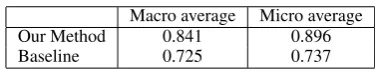
To enable the use of incomplete KGs for automatic text annotations, we introduce a robust method for discriminating word senses using thesaurus infor-mation like hypernyms, synonyms, types/classes, which is contained in the KG. The method uses collocations to induce word senses and to discrim-inate the thesaurus sense from others. Its main novelty is using thesaurus information already at the stage of sense induction. The given KG en-ables us to cast the task to a binary scenario, namely telling apart the KG sense from all the others. This method does not require all possi-ble senses of a word to be contained in the KG, which makes it especially useful in a production environment, where usually only incomplete KGs are available. We take as input a corpus, thesaurus information, and a concept from the KG, one of whose labels is found throughout the corpus (the target label). We want to distinguish, for each document in the data set, whether the target label is used in the thesaurus sense or not.9 Thus, the
7
https://publications.europa.eu/en/ web/eu-vocabularies/
8
http://metadata.un.org/?lang=en
9Without loss of completeness we consider only the case
when the target label is used in the same sense in all occur-rences in a document. One can, of course, consider the
con-Table 2: Cocktails WSID accuracy scores
Macro average Micro average
Our Method 0.841 0.896
Baseline 0.725 0.737
Table 3: MeSH WSID accuracy scores
Macro average Micro average
Our Method 0.723 0.739
Baseline 0.680 0.735
end result is a partition of the corpus into two dis-joint collections: “this” and “other”. The collec-tion “this” contains the documents that feature the target label in the thesaurus sense, the collection “other” contains any other sense which does not match the domain captured in the thesaurus, which can be more than one. The experiments were conducted on two data sets10 created specifically
for this task: Cocktails and MeSH (Revenko and Mireles,2017) (Table3). This service is used for any kind of entity linking, especially after NER. This is done to correctly identify which named en-tities are indeed within the vocabulary scope of the LKG. The service is a working prototype. It is language agnostic, i. e., works for any language as long as the text can be tokenised correctly.
3.6 Temporal Expression Analysis
Documents from the legal domain contain a multi-tude of temporal expressions that can be analysed, normalised (i. e., semantically interpreted) and further exploited for document and information mining purposes. We implemented a prototype for the analysis of time expressions in German-language legal documents, especially court deci-sions and legislative texts. Temporal expresdeci-sions
text of every occurrence of the target label as a separate doc-ument, therefore extending the method to disambiguate every single occurrence of the target label.
[image:4.595.321.509.227.265.2]Table 4: Comparison of the results of the original version of HeidelTime (HT) with the modified (HT nV) on the evaluation corpus. The last line indicates the improvement.
strict partial strict+value partial+value
P R F1 P R F1 P R F1 Acc P R F1 Acc
HT 86.8 86.0 86.4 89.5 88.1 88.8 86.1 85.3 85.7 99.2 88.4 87.1 87.8 98.9 HTnV 94.9 92.0 93.5 96.6 93.5 95.0 94.0 91.1 92.5 99.0 95.3 92.3 93.8 98.7
+ 8.2 6.1 7.1 7.1 5.4 6.2 7.9 5.8 6.9 0.2 6.9 5.1 6.0 0.2
include dates, e. g., “1. Januar 2000” (1st January 2000), durations, e. g., “f¨unf Kalenderjahre” (five calendar years) and repeating time intervals, e. g., “jeden Monat” (every month). Such expressions should not only be identified, but also normalised by translating them into a standardised ISO for-mat. Since no suitable data set existed, a text col-lection was prepared and annotated with tempo-ral expressions using the TimeML standard. Pre-viously, the automatic identification of temporal expressions (temporal tagging) has been mainly focused on English and domains such as news and narrative texts. Research showed that this task is domain- and language-sensitive, i. e., sys-tems have to be adapted to the specific domain or language to ensure consistent performance. We can confirm this observation: during the an-notation of the corpus deficits had become ap-parent, which concerned not only the annota-tion guidelines, but also the performance of the rule-based temporal tagger HeidelTime (Str¨otgen and Gertz, 2010), which was subsequently ex-tended. One of the specifics of the domain are references to other legal texts which contain (al-leged) dates (“Richtlinie 2008 / 96 /EG”, “Direc-tive 2008 / 96 /EG”). Other peculiarities of the do-main and/or language are the frequent use of com-pounds such as “Kalenderjahr” (calendar year), “F¨alligkeitsmonat” (due month) or “Bankarbeit-stag” (banking day), generic use of temporal ex-pressions such as “jeweils zum 1. Januar” (1st Jan-uary of each year) and event-anchored temporal expressions “Tag der Verk¨undigung” (proclama-tion day). Based on our new annotated corpus, HeidelTime was adapted to the domain. The eval-uation showed that the adjustments made to Hei-delTime significantly improved its performance (Table4. Particularly noteworthy is the recall with an increase of approx. 10 percentage points. Nor-malisation remains problematic, which is also due to generic or event-based uses of temporal expres-sions as well as legal references.
3.7 Legal Reference Resolution
References to other documents are another class of expressions used in abundance in documents from the legal domain. The considered problem con-sists in recognizing and, ideally resolving, such references. Usually, editors attempt to be consis-tent and follow patterns to reference other docu-ments. The developed methodology, currently im-plemented as a language-agnostic prototype, fol-lows this assumption and attempts to discover patterns used in a semi-automatic manner. The discovered patterns are constructed from features that are either individual tokens (e. g., “Decision”, “EU”, etc.) or processed features (e. g., “DIGITS” as a placeholder for numbers). We use a seed col-lection of documents, where references have been manually annotated and resolved. For each refer-ence we collect the tokens preceding the referrefer-ence and analyse the features present in these tokens. Next we aggregate the most common combina-tions of features – these form “patterns”. Example of a pattern could be {“EU”, “Decision”, “DIG-ITS/DIGITS”}or{“the”, “data”, “subject”}. The second pattern is an example of a common combi-nations of tokens in text and does not necessarily indicate a reference. To filter out such irrelevant patterns from the seed documents we extract the strings containing the candidate pattern, but not containing a reference. If several such strings are found the pattern is discarded. In the next step the most common undiscarded patterns are presented to the user who can accept several patterns that are later used to discover new references, enabling the recursive improvement of patterns.
3.8 Text Structure Recognition
cor-rectly because many legal references also contain this type of information, ideally enabling automat-ically linking to the correct part of the text, in-stead of the whole document. Robust text struc-ture recognition is still an open research question. Many approaches have been suggested in different fields, such as Optical Layout Recognition (OLR) for unstructured documents or markup-based ap-proaches for structured documents. We try to cover both in our prototype.
Unstructured documents do not contain any structure information whatsoever, they are often provided in plain text. To process (plain) text, we start by applying a pattern based approach (regular expressions) that allows the identification of the ti-tle, headings and running text or paragraphs. Af-ter that, we apply topic detection to all those parts (both titles and running texts) in order to cluster sections with related topics.
Structured documents include structural infor-mation (e. g., markup). We consider two ways of analysing them: (1) defining a mapping between the elements important and relevant for the use cases addressed by our platform and the structural elements of the documents; and (2) extracting the plain text from the document and then applying the techniques for unstructured documents.
3.9 Text Summarisation
To enable our users to work with legal documents more efficiently, we experiment with summarisa-tion services (Allahyari et al., 2017). While ex-tractive summarisation has been popular in the past, the progress in neural technologies has re-newed the interest in abstractive summarisation, i. e., generating new sentences that capture a doc-ument’s meaning. This approach requires highly complex models and a lot of training data. In the absence of labeled training data, extractive methods are often used as the basis for abstrac-tive methods, by assigning relevance scores to sen-tences in an unsupervised way. Abstractive sum-marisation is often augmented using word embed-dings (Mikolov et al., 2013; Pennington et al.,
2014) that provide a shared semantic space for those strongly related sentences that do no share the same but similar or related words. We de-velop two methods. The first tool is based on TF-IDF (Neto et al., 2000). This is a popular baseline as it is easy to implement, unsupervised, and language independent. Instead of using
bag-of-words sentence representations, our approach tries to improve on this, by analysing the texts first. Searching the embedding space of all words used in the text, we cluster similar words so that morphological variants of a word like “tree” and “trees” or “eat” and “eating”, but also synonyms like “fast” and “rapid” are considered as belong-ing to the same cluster. Based on these group-ings we encode all documents and then calcu-late the weights for the sentences using TF-IDF. The second tool is based on the concept of cen-troids (Rossiello et al., 2017; Ghalandari, 2017) and benefits from the composability of word em-beddings. Initially, keywords and concepts are ex-tracted from the document. By composing their embeddings, the centroid is created, which repre-sents the document’s condensed meaningful infor-mation. It is then projected into the embedding space together with all sentence embeddings. Sen-tences receive relevance scores depending on their distance to the centroid in the embedding space. To avoid redundancy in the summary, sentences that are too similar to the ones already added to the summary are not used. Both tools can be used for multiple languages, single and multi-document summarisation. The current version of the cen-troid text summarisation is a working prototype. It already provides extractive summaries for single and multiple documents, but is still being tested and optimised. The service is only available for English but can be adapted to other languages by training new embeddings.
3.10 Machine Translation
To enable multilingualism and cross-lingual ex-traction, linking and search, we use the Machine Translation (MT) service Tilde MT11. In order to populate and process the Legal Knowledge Graph in a multilingual way, custom Neural Machine Translation (NMT) systems were trained for se-lected language pairs – English ↔ Spanish, En-glish ↔ German, and English ↔ Dutch. In-domain business case specific legal data was gath-ered and processed prior to training the NMT sys-tems on a mix of broad-domain and in-domain data to be able to translate both in-domain and out-of-domain texts. Marian was used for training (Junczys-Dowmunt et al., 2018). The translation service provides support for a runtime scenario as well as for asynchronous processes, i. e.,
Table 5: Evaluation results of NMT systems
Language pair Sentence pairs BLEU to EN from EN English↔Dutch 41,639,299 43.54 34.12 English↔Spanish 81,176,632 32.52 38.36 English↔German 24,768,821 38.73 44.73
ing background data curation processes. The syn-chronous translation service endpoint serves trans-lation functionality for texts and documents anno-tated with the Natural Language Processing Inter-change Format ontology (NIF) (Hellmann et al.,
2013). The systems were automatically evaluated using BLEU (Papineni et al., 2002) on held-out evaluation sets. The sets were created from the in-domain parts of the parallel corpora used for train-ing of the NMT systems. Table5contains statis-tics of the training data and the automatic evalua-tion results of the NMT systems.
3.11 Legal Knowledge Graph Population
For the definition of our Knowledge Graph, we benefit from predefined vocabularies such as EU-ROVOC. However, their knowledge is limited to that intended by their creators, and their level of specificity and focus will, in general, not match the ones required for an application. One possible option of extending existing knowledge resources is the large-scale analysis of documents in which entities contained in the knowledge resources have been identified, and to identify as well as to extract new relations, claims, or facts, explicitly men-tioned in the documents. This approach mimics the process in which a human reads and under-stands documents. In our project we follow distant supervision (Ren et al.,2017). It takes a text cor-pus as input and 1) identifies sentences containing entity pairs for which relations are known, 2) uses machine learning to derive a statistical classifier to recognize these examples, and 3) applies this classifier to sentences that, by virtue of the classes of entities they contain, could also include an in-stance of a relation. The result is a list of sentences which have been annotated as containing a given relation. The relations included so far in this first experimental deployment, are of the type person is located in locationandlocation is contained in location. They will be expanded with domain spe-cific relations such as activity requires permit or
permit was issued on date. So far, such relations can be recognized in English language texts, but training for German, Spanish and Dutch, using the
same distant supervision approach is possible due to the multilingual nature of general purpose cor-pora and knowledge graphs (e. g., DBPedia).
3.12 Semantic Similarity
Using the services mentioned above, documents in the LKG are annotated to semantically describe their content and provenance. This added extra knowledge is useful for several applications, such as search, question answering, classification and recommendations, all of which rely on a notion of document similarity. Many such notions exist, and they are usually encoded in a functionsthat assigns, to every pair of documents, a number be-tween0and1, with1denoting the documents be-ing identical (Gomaa and Fahmy,2013). We use a hybrid type of similarity measure. First, the text entailed by the document, such as the resolution of temporal or geographical references, is performed. Second, similarity itself is computed using a linear combination of text-based and knowledge-based similarities. The former are encoded by cosine-similarity of TF-IDF vectors (of the documents or their translations), and the latter by the over-lap (as measured by Jaccard coefficient of entities that the two documents either mention directly, or are linked in the LKG to mentioned ones. The overlaps are weighted depending on how far away in the LKG the entities mentioned in the docu-ment are, and the weight coefficients are deter-mined, along with the coefficients of the linear combination, by training a linear regression classi-fier (B¨ar et al.,2012). This approach allows us to detect similarity between documents even if they have only few entities in common, by considering the knowledge about these entities. Additionally, by comparing mentions of entities instead of their surface forms, the multilingual nature of the LKG is exploited. The knowledge-based component of the similarity computation is language agnostic, while the text-based depends only on basic NLP tools (e. g., stemming, stop-word removal) which are available for English, German, Spanish and Dutch, among others. In order to compare doc-uments in two different languages, machine trans-lation between them, or to a third language must be available. The semantic similarity service is a prototype, requiring further testing and refining.
3.13 Question Answering
answer, extracted from a document in a given cor-pus. The end-to-end system consists of three com-ponents: 1) The Query Formulation module trans-forms a question into a query, which can be ex-panded using a domain specific vocabulary from the LKG. The query is then processed through an indexer to obtain matching documents from the corresponding corpora. 2) The Answer Genera-tion module extracts potential answers from the retrieved documents from the LKG. 3) The An-swer Selection module identifies the best anAn-swer based on various criteria such as local structure of the text and global interaction between each pair of words based on specific layers of the model. The QA service is the central component of two of our use cases. In these, a user asks a natural language question along with additional information such as an appropriate jurisdiction. The question is meant to trigger a query on a set of documents related to the specific jurisdiction. These additional param-eters influence the search in the Answer Selection module by determining which subset of the docu-ments should be used. With the help of the Ma-chine Translation service, the QA service is able to return answers in languages different from the documents’ language. The benefit from the ser-vice would be the time reduction in search for a relevant article in the legislation. For a question such as “How long is paternity leave?”, the sys-tem returns relevant paragraphs and articles from the Labor Law that can be further processed by the lawyer. The QA service works for English and can be retrained and adopted to other languages.
4 Orchestration of Individual Services
Our technology platform is based on microser-vices, which provide multiple advantages, espe-cially in a collaborative project with a distributed set of partners from academia and industry, includ-ing use case partners. Microservices are small and autonomous and can be developed more efficiently than a monolithic, integrated system. In addition, the development and deployment of microservices can, to a very large extent, be automated, also fa-cilitating the monitoring of individual services. A crucial advantage is concerned with the scalability of systems based on microservices, which is a lot easier than scaling monolithic systems. The com-munication between different services is executed over HTTP, the interfaces are documented using the OpenAPI specification. For the deployment
of the containerised microservices we use Open-Shift; alternative technologies such as, among oth-ers, Kubernetes, could also be used.
In our project we conceptualise the specific re-quirements of the different use cases as content curation workflows (Schneider and Rehm,2018b;
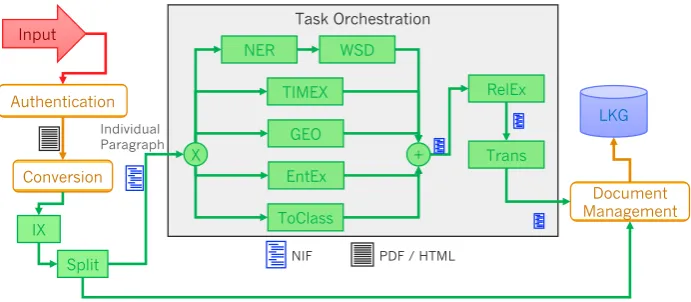
Bourgonje et al., 2016a,b; Rehm et al., 2018). Workflows are defined as the execution of spe-cific services to perform the processing of one or more documents under the umbrella of a certain task or use case. The specification of a workflow includes its input and output as well as the func-tionality it is supposed to perform: annotate or en-rich a document, add a document to the knowl-edge base, search for information, etc. The project offers compliance-related features and functional-ities through common services and data sets in-cluded in the LKG. Workflows make use of these services to implement the required functionality. The content curation workflows for the different use cases that we prototypically implement in the project have been defined as follows. We per-formed a systematic analysis of the microservices, developed in parallel, and matched them with the required functionalities for each use case. First, we determine the principal elements involved in each use case, i. e., the services, input and output. Second, we define the order in which the services have to be executed. Third, we identify the shared components in the different workflows. Currently we have defined five different workflows. Two are defined for the acquisition and population of the LKG with new information, the other three are de-fined to address the requirements of each use case (see Figures1to3in the appendix). We currently work with two alternative workflow management implementations that take care of the orchestra-tion of services. The first one is based on Ca-munda BPM,12 including a logic layer that
man-ages the various processes (including NIF anno-tations). The second approach is based on Rab-bitMQ,13 an open-source message broker, on top
of which we developed our own solution for paral-lelising processing steps and improving the perfor-mance of the overall orchestration. In both cases, the main concept of the service orchestration is fo-cused on the use of queuing systems, so that most of the processes could be executed in parallel and either synchronous or asynchronously.
12
5 Related Work
There are several systems, platforms and ap-proaches that are related to the technology plat-form, which is under development in the project LYNX. In the wider area of legal document pro-cessing, technologies from several fields are rele-vant, among others, knowledge technologies, cita-tion analysis, argument mining, reasoning and in-formation retrieval. A literature overview can be found in (Schneider and Rehm,2018a) and ( Ag-noloni and Venturi,2018).
Commercial Systems and Services – The Lex-isNexis14 system is the market leader in the legal domain; it offers services, such as legal research, practical guidance, company research and media-monitoring as well as compliance and due dili-gence. WestLaw is an online service that allows legal professionals to find and consult relevant le-gal information.15 One of its goals is to enable professionals to put together a strong argument. There are also smaller companies that offer legal research solutions and analytic environments, such as RavelLax,16, or Lereto17. A commercial search engine for legal documents, iSearch, is a service offered by LegitQuest.18 The Casetext CARA Re-search Suite allows uploading a brief and then re-trieving, based on its contents, useful case law.19 There is also a growing number of startup compa-nies active in the legal domain.
Research Prototypes –Most of the documented research prototypes were developed in the 1990s under the umbrella of Computer Assisted Legal Research (CALR) (Span, 1994). In the follow-ing we briefly review several of these systems, which usually focus on one very specific feature or functionality. One example is the open source software for the analysis and visualisation of net-works of Dutch case law (van Kuppevelt and van Dijck, 2017). This technology determines rele-vant precedents (analysing the citation network of case law), compares them with those identified in the literature, and determines clusters of related cases. A similar prototype is described by ( Ag-noloni et al., 2017). (Gifford, 2017) propose a search engine for legal documents where
argu-14
https://www.lexisnexis.com 15
http://legalsolutions.thomsonreuters. com/law-products/westlaw-legal-research/
16http://ravellaw.com 17https://www.lereto.at 18
https://www.legitquest.com 19https://casetext.com
ments are extracted from appellate cases and are accessible either through selecting nodes in a lit-igation issue ontology or through relational key-word search. Lucem (Bhullar et al.,2016) is a sys-tem that tries to mirror the way lawyers approach legal research, developing visualisations that pro-vide lawyers with an additional tool to approach their research results. Eunomos is a prototype that semi-automates the construction and analysis of knowledge (Boella et al.,2012).
6 Summary and Future Work
This article presents the technology platform cur-rently under development in the project LYNX, fo-cusing upon processing services. These serve two main purposes: 1) to extract semantic information from a large and heterogeneous set of documents to ingest the extracted information into the Legal Knowledge Graph; 2) to extract semantic infor-mation from documents that users of the platform work with. In addition to the semantic extrac-tion of informaextrac-tion and knowledge, we provide services for the processing and curation of whole documents (summarisation, translation) with the goal of mapping extracted terms and concepts to the LKG, and services that aim at accessing the LKG (question answering). We currently exper-iment with two different curation workflow man-agers to make specific sets of services available for specific use cases. Future work includes com-pleting development work on the services, adapt-ing the services to all languages required in the project’s use cases, implementing the prototype applications and developing the freely accessible web interface of the platform.
Acknowledgments
This work has been partially funded by the project LYNX, which has received funding from the European Union’s Horizon 2020 research and innovation programme under grant agreement no. 780602. For more information please see
http://www.lynx-project.eu.
References
framework for the automatic extraction of legal links. In (Wyner and Casini,2017), pages 113–118.
Tommaso Agnoloni and Giulia Venturi. 2018. Seman-tic processing of legal texts. In Jacqueline Visconti, editor, Handbook of Communication in the Legal Sphere, pages 109–138. De Gruyter, Berlin, Boston. Mehdi Allahyari, Seyedamin Pouriyeh, Mehdi Assefi, Saeid Safaei, Elizabeth D Trippe, Juan B Gutier-rez, and Krys Kochut. 2017. Text Summariza-tion Techniques: A brief Survey. arXiv preprint arXiv:1707.02268.
Daniel B¨ar, Chris Biemann, Iryna Gurevych, and Torsten Zesch. 2012. Ukp: Computing seman-tic textual similarity by combining multiple con-tent similarity measures. In Proceedings of the First Joint Conference on Lexical and Computa-tional Semantics-Volume 1: Proceedings of the main conference and the shared task, and Volume 2: Pro-ceedings of the Sixth International Workshop on Se-mantic Evaluation, pages 435–440. Association for Computational Linguistics.
Darina Benikova, Chris Biemann, Max Kisselew, and Sebastian Pad. 2014. GermEval 2014 Named En-tity Recognition Shared Task: Companion Paper. In
Proceedings of the KONVENS GermEval workshop, pages 104–112, Hildesheim, Germany.
Darina Benikova, Seid Muhie Yimam, Prabhakaran Santhanam, and Chris Biemann. 2015. Germaner: Free open german named entity recognition tool. In Proceedings of the International Conference of the German Society for Computational Linguistics and Language Technology, GSCL 2015, University of Duisburg-Essen, Germany, 30th September - 2nd October 2015, pages 31–38.
Jagjoth Bhullar, Nathan Lam, Kenneth Pham, Adithya Prabhakaran, and Albert Joseph Santillano. 2016.
Lucem: A Legal Research Tool, 63. Computer En-gineering Senior Theses.
G. Boella, L. di Caro, L. Humphreys, L. Robaldo, and L. van der Torre. 2012. Nlp challenges for eunomos, a tool to build and manage legal knowledge.
Peter Bourgonje, Julian Moreno-Schneider, Jan Nehring, Georg Rehm, Felix Sasaki, and Ankit Srivastava. 2016a. Towards a Platform for Curation Technologies: Enriching Text Collections with a Semantic-Web Layer. In The Semantic Web, number 9989 in Lecture Notes in Computer Sci-ence, pages 65–68. Springer. ESWC 2016 Satellite Events. Heraklion, Crete, Greece, May 29 – June 2, 2016 Revised Selected Papers.
Peter Bourgonje, Juli´an Moreno Schneider, Georg Rehm, and Felix Sasaki. 2016b. Processing Doc-ument Collections to Automatically Extract Linked Data: Semantic Storytelling Technologies for Smart Curation Workflows. InProceedings of the 2nd In-ternational Workshop on Natural Language Gener-ation and the Semantic Web (WebNLG 2016), pages
13–16, Edinburgh, UK. The Association for Com-putational Linguistics.
Manaal Faruqui and Sebastian Pad´o. 2010. Train-ing and evaluatTrain-ing a german named entity recog-nizer with semantic generalization. In Semantic Approaches in Natural Language Processing: Pro-ceedings of the 10th Conference on Natural Lan-guage Processing, KONVENS 2010, September 6-8, 2010, Saarland University, Saarbr¨ucken, Germany, pages 129–133. universaar, Universit¨atsverlag des Saarlandes / Saarland University Press / Presses uni-versitaires de la Sarre.
Jenny Rose Finkel, Trond Grenager, and Christo-pher D. Manning. 2005. Incorporating non-local information into information extraction systems by gibbs sampling. InACL 2005, 43rd Annual Meeting of the Association for Computational Linguistics, Proceedings of the Conference, 25-30 June 2005, University of Michigan, USA, pages 363–370. The Association for Computer Linguistics.
Demian Gholipour Ghalandari. 2017. Revisiting the Centroid-based Method: A Strong Baseline for Multi-Document Summarization. arXiv preprint arXiv:1708.07690.
Matthew Gifford. 2017. Lexridelaw: an argument based legal search engine. InICAIL ’17.
Wael H Gomaa and Aly A Fahmy. 2013. A survey of text similarity approaches. International Journal of Computer Applications, 68(13):13–18.
Sebastian Hellmann, Jens Lehmann, S¨oren Auer, and Martin Br¨ummer. 2013. Integrating NLP using Linked Data. In 12th International Semantic Web Conference. 21-25 October.
Zhiheng Huang, Wei Xu, and Kai Yu. 2015. Bidi-rectional LSTM-CRF models for sequence tagging.
CoRR, abs/1508.01991.
Marcin Junczys-Dowmunt, Roman Grundkiewicz, Tomasz Dwojak, Hieu Hoang, Kenneth Heafield, Tom Neckermann, Frank Seide, Ulrich Germann, Alham Fikri Aji, Nikolay Bogoychev, Andr´e F T Martins, and Alexandra Birch. 2018. Marian: Fast Neural Machine Translation in C++. arXiv preprint arXiv:1804.00344.
Dafne van Kuppevelt and Gijs van Dijck. 2017. An-swering legal research questions about dutch case law with network analysis and visualization. In (Wyner and Casini,2017), pages 95–100.
Tomas Mikolov, Ilya Sutskever, Kai Chen, Greg S Cor-rado, and Jeff Dean. 2013. Distributed Representa-tions of Words and Phrases and their Composition-ality. InAdvances in neural information processing systems, pages 3111–3119.
Joel Larocca Neto, Alexandre D Santos, Celso AA Kaestner, Neto Alexandre, D Santos, et al. 2000. Document Clustering and Text Summarization.
Kishore Papineni, Salim Roukos, Todd Ward, and Wei-Jing Zhu. 2002. BLEU: a Method for Automatic Evaluation of Machine Translation. InProceedings of the 40th annual meeting on association for com-putational linguistics, pages 311–318. Association for Computational Linguistics.
Jeffrey Pennington, Richard Socher, and Christopher Manning. 2014. Glove: Global Vectors for Word Representation. InProceedings of the 2014 confer-ence on empirical methods in natural language pro-cessing (EMNLP), pages 1532–1543.
M¯arcis Pinnis, Nikola Ljubeˇsi´c, Dan S¸tef˘anescu, In-guna Skadin¸a, Marko Tadi´c, and Tatiana Gornos-tay. 2012. Term Extraction, Tagging, and Mapping Tools for Under-Resourced Languages. In Proceed-ings of the 10th Conference on Terminology and Knowledge Engineering (TKE 2012), June 2012, pages 193–208, Madrid, Spain.
Georg Rehm, Juli´an Moreno Schneider, Peter Bour-gonje, Ankit Srivastava, Rolf Fricke, Jan Thom-sen, Jing He, Joachim Quantz, Armin Berger, Luca K¨onig, S¨oren R¨auchle, Jens Gerth, and David Wab-nitz. 2018. Different Types of Automated and Semi-Automated Semantic Storytelling: Curation Tech-nologies for Different Sectors. InLanguage Tech-nologies for the Challenges of the Digital Age: 27th International Conference, GSCL 2017, Berlin, Ger-many, September 13-14, 2017, Proceedings, num-ber 10713 in Lecture Notes in Artificial Intelli-gence (LNAI), pages 232–247, Cham, Switzerland. Gesellschaft f¨ur Sprachtechnologie und Computer-linguistik e.V., Springer. 13/14 September 2017.
Nils Reimers and Iryna Gurevych. 2017. Reporting score distributions makes a difference: Performance study of lstm-networks for sequence tagging. In
Proceedings of the 2017 Conference on Empirical Methods in Natural Language Processing, pages 338–348. Association for Computational Linguis-tics.
Xiang Ren, Zeqiu Wu, Wenqi He, Meng Qu, Clare R Voss, Heng Ji, Tarek F Abdelzaher, and Jiawei Han. 2017. Cotype: Joint extraction of typed entities and relations with knowledge bases. InProceedings of the 26th International Conference on World Wide Web, pages 1015–1024. International World Wide Web Conferences Steering Committee.
Artem Revenko and V´ıctor Mireles. 2017. Discrimina-tion of word senses with hypernyms. In Proceed-ings of the 5th International Workshop on Linked
Data for Information Extraction co-located with the 16th International Semantic Web Conference (ISWC 2017), Vienna, Austria, October 22, 2017., volume 1946 ofCEUR Workshop Proceedings, pages 50–61. CEUR-WS.org.
Martin Riedl and Sebastian Pad´o. 2018. A named en-tity recognition shootout for german. In Proceed-ings of the 56th Annual Meeting of the Association for Computational Linguistics (Volume 2: Short Pa-pers), volume 2, pages 120–125. Association for Computational Linguistics.
Gaetano Rossiello, Pierpaolo Basile, and Giovanni Se-meraro. 2017. Centroid-based Text Summarization through Compositionality of Word Embeddings. In
Proceedings of the MultiLing 2017 Workshop on Summarization and Summary Evaluation Across Source Types and Genres, pages 12–21.
Julian Moreno Schneider and Georg Rehm. 2018a. Cu-ration Technologies for the Construction and Utilisa-tion of Legal Knowledge Graphs. InProceedings of the LREC 2018 Workshop on Language Resources and Technologies for the Legal Knowledge Graph, pages 23–29, Miyazaki, Japan. 12 May 2018.
Julian Moreno Schneider and Georg Rehm. 2018b. To-wards a Workflow Manager for Curation Technolo-gies in the Legal Domain. In Proceedings of the LREC 2018 Workshop on Language Resources and Technologies for the Legal Knowledge Graph, pages 30–35, Miyazaki, Japan. 12 May 2018.
Georges Span. 1994. Lites: An intelligent tutoring sys-tem shell for legal education. International Review of Law, Computers & Technology, 8(1):103–113. Karen Sp¨arck Jones. 1972. A Statistical Interpretation
of Term Specificity and Its Application in Retrieval.
Journal of Documentation, 28:11—-21.
Jannik Str¨otgen and Michael Gertz. 2010.HeidelTime: High Quality Rule-based Extraction and Normaliza-tion of Temporal Expressions. In Proceedings of the 5th International Workshop on Semantic Evalua-tion, SemEval ’10, pages 321–324, Stroudsburg, PA, USA. Association for Computational Linguistics.
Adam Z. Wyner and Giovanni Casini, editors. 2017.
A Appendix: Examples of Use-Case-specific Curation Workflows
The following three figures are additional material with regard to Section4. They provide illustrative examples of use-case-specific processing service and curation workflows.
COMMON WORKFLOWS
Task Orchestration
Authentication
Conversion
Document Management
NIF PDF / HTML
NER
TIMEX
GEO
EntEx
ToClass WSD
RelEx
Trans
X +
Input
LKG
IX
Split
Individual Paragraph
Table of contents of document (list of paragraphs)
Figure 1: Legal Knowledge Graph population workflow
SCENARIO 1:+CONTRACT ANALYSIS
Task Orchestration
Authentication
Conversion
Conversion
NIF PDF NER
TIMEX
GEO
EntEx
ToClass WSD
RelEx
Search Summ
Trans
IX
X +
Output Input
Split
X
SemSim +
JSON HTML/TXT/JSON
[image:12.595.126.472.122.273.2]LKG
Figure 2: Workflow of the Contract Analysis use case
SCENARIO 2:+LABOUR LAW
Task Orchestration Authentication
Conversion ManagementDocument
NIF Questions Summ QaDoc
Input
Output
JSON
[image:12.595.97.509.326.491.2]