Mapping Verbs In Different Languages to Knowledge Base Relations
using Web Text as Interlingua
Derry Tanti Wijaya Carnegie Mellon University
5000 Forbes Avenue Pittsburgh, PA, 15213
Tom M. Mitchell Carnegie Mellon University
5000 Forbes Avenue Pittsburgh, PA, 15213
Abstract
In recent years many knowledge bases (KBs) have been constructed, yet there is not yet a verb resource that maps to these growing KB resources. A resource that maps verbs in different languages to KB relations would be useful for extracting facts from text into the KBs, and to aid alignment and integration of knowledge across different KBs and lan-guages. Such a multi-lingual verb resource would also be useful for tasks such as machine translation and machine reading. In this pa-per, we present a scalable approach to auto-matically construct such a verb resource us-ing a very large web text corpus as a kind of interlingua to relate verb phrases to KB rela-tions. Given a text corpus in any language and any KB, it can produce a mapping of that language’s verb phrases to the KB relations. Experiments with the English NELL KB and ClueWeb corpus show that the learned English verb-to-relation mapping is effective for ex-tracting relation instances from English text. When applied to a Portuguese NELL KB and a Portuguese text corpus, the same method au-tomatically constructs a verb resource in Por-tuguese that is effective for extracting relation instances from Portuguese text.
1 Introduction
In recent years a variety of large knowledge bases (KBs) have been constructed e.g., Freebase (Bol-lacker et al., 2008), DBpedia (Auer et al., 2007), NELL (Carlson et al., 2010), and Yago (Suchanek et al., 2007). These KBs consist of (1) an on-tology that defines a set of categories (e.g.,
Sport-sTeam, City), (2) another part of the ontology that
defines relations with these categories as argument types (e.g., teamPlaysInCity(SportsTeam, City)),
(3) KB entities which instantiate these categories (e.g., Steelers ∈ SportsTeam), and (4) KB entity
pairs which instantiate these relations (e.g.,
(Steel-ers, Pittsburgh) ∈teamPlaysInCity). The KB
on-tology also specifies constraints (e.g., mutual exclu-sion, subset) among KB categories and relations.
Despite recent progress in KB construction, there is not yet a verb resource that maps to these KBs: one that contains verb phrases1that identify KB re-lations. Such a verb resource can be useful to aid KB relation extraction. A distribution of verb phrases associated with any given KB relation is also a KB-independent representation of that relation’s seman-tics which can form the basis of aligning ontologies across arbitrary KBs (Wijaya et al., 2013). Given a KB and verb resources in different languages that map to the KB, we can also begin to align knowl-edge expressed in different languages.
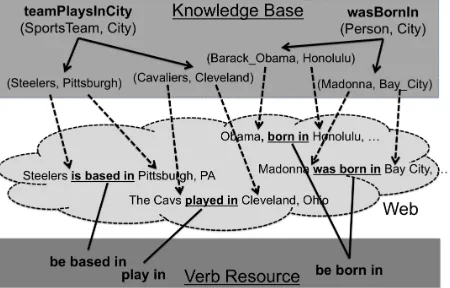
We introduce here an approach to mapping verb phrases to KB relations using a very large ClueWeb corpus (Callan et al., 2009) as a kind of interlgua. Our approach grounds each KB relation in-stance (e.g., teamPlaysInCity(Steelers, Pittsburgh)) in mentions of its argument pair in this text, then represents the relation in terms of the verb phrases that connect these paired mentions (see Fig. 1). For a high coverage mapping, we train on both labelled and unlabelled data using expectation maximization (EM). We introduce argument type checking during
1In this paper we use the term “verb phrase” and “verb”
in-terchangeably; both referring to either verb or verb+preposition
Figure 1: Mapping verb phrases to relations in KB through
Web-text as interlingua. Each relation instance is grounded by its mentions in the Web-text. The verbs that co-occur with
men-tions of the relation’s instances are mapped to that relation.
the EM process to ensure only verbs whose argu-ment types match the relation’s arguargu-ment types are mapped to the relation. We also incorporate con-straints defined in the KB ontology to find a verb to relation mapping consistent with these constraints.
Our contributions are: (1) We propose a scal-able EM-based method that automatically maps verb phrases to KB relations by using the mentions of the verb phrases with the relation instances in a very large unlabeled text corpus. (2) We demon-strate the effectiveness of the resource for extract-ing relation instances in NELL KB. Specifically, it improves the recall of both the supervised- and the unsupervised- verb-to-relation mapping; demon-strating the benefit of semi-supervised learning on unlabeled Web-scale text. (3) We demonstrate the flexibility of the method, which is both KB- and language-independent, by using the same method for constructing English verb resource to automat-ically construct a Portuguese verb resource. (4) We make our verb resources publicly available2.
2 Method
2.1 Terminology
We define a NELL KB to be a 6-tuple
(C, IC, R, IR, Subset, M utex).Cis the set of cate-gories e.g., SportsTeam i.e.,cj ∈C ={c1, ..., c|C|}.
IC is the set of category instances which are
2
http://www.cs.cmu.edu/%7Edwijaya/mapping.html
entity-category pairs e.g., (Cleveland, City) i.e.,IC ={(em,cj) |em ∈cj, cj ∈C}.
R is the set of relations e.g., teamPlaysInCity i.e., ri ∈ R = {r1, ..., r|R|}. We also define ftype to be a function that when applied to a relation
ri returns the argument type signature of the rela-tion ftype(ri) = (cj, ck) for somecj, ck ∈ C e.g.,
ftype(teamPlaysInCity) = (SportsTeam, City).
IR is the set of relation instances which are entity-relation-entity triples e.g., (Cava-liers, teamPlaysInCity, Cleveland) i.e., IR =
{(em,ri,en)|(em, en)∈ri, ri ∈R, em ∈cj, en∈
ck, ftype(ri) = (cj, ck)};IR=Ir1 ∪Ir2 ∪... Ir|R|.
Subset is the set of all subset constraints among relations in R i.e., Subset = {(i, k) : Iri ⊆
Irk}. For example{(person, ceoOf, company)} ⊆
{(person, worksFor, company)}.
M utex is the set of all mutual exclusion con-straints among relations inRi.e.,M utex={(i, k) : Iri∩Irk =φ}. For example{(drug, hasSideEffect,
physiologicalCondition)} ∩ {(drug, possiblyTreats, physiologicalCondition)}=φ.
Each KB entityem can be referred to by one or more noun phrases (NPs). For example, the entity
Cavaliers, can be referred to in text using either the
NP “Cleveland Cavaliers” or the NP “The Cavs”3.
We defineNen(em)to be the set of English NPs cor-responding to entityem.
We defineSV Oto be the English Subject-Verb-Object (SVO) interlingua4consisting of tuples of the form(nps, vp, npo, w), wherenpsandnpoare noun phrases (NP) corresponding to subject and object, respectively,vpis a verb phrase that connects them, andwis the count of the tuple.
2.2 Data Construction
We construct a datasetDfor mapping English verbs to NELL KB relations. First, we convert each tu-ple in SV Oto its equivalent entity pair tuple(s) in
SV O0 ={(em, vp, en, w)|nps∈Nen(em), npo ∈
Nen(en), (nps, vp, npo, w) ∈ SV O}. Then, we construct D fromSV O0 as a collection of labeled and unlabeled instances.
3defined by the canReferTo relation in NELL KB
4
The set of labeled instances is D` =
{(y(em,en),v(em,en))} where y(em,en) ∈ {0,1}|R| is a bit vector of label assignment, each bit repre-senting whether the instance belongs to a particular relation i.e.,yi
(em,en) = 1 ⇐⇒ (em, en) ∈ri and 0 otherwise. v(em,en) ∈ R|V|is a |V|-dimensional vector of verb phrase counts that connect em and
en in SV O0 (V is the set of all verb phrases) i.e.,
v(pem,en) is the number of times the verb phrasevp connectsemandeninSV O0.
The collection of unlabeled instances is con-structed from entity pairs in SV O0 whose label assignment y are unknown (its bits are all zero) i.e., Du = {(y
(em,en),v(em,en)) | (em,∗, en,∗) ∈
SV O0,(em,∗, en)∈/ IR}.
An instance in our dataset d(em,en) ∈ D is therefore either a labeled or unlabeled tuple i.e.,
d(em,en)= (y(em,en),v(em,en)).
We letftype(d(em,en))return the argument type of the instance i.e., ftype(d(em,en)) = (cj, ck) where
(em, cj)and(en, ck)∈IC.
We let fverb(d(em,en)) return the set of all verb phrases that co-occur with the instance inSV O0i.e.,
fverb(d(em,en)) ={vp|(em, vp, en,∗)∈SV O0}. When applied to a relationri, we letfverb(ri) re-turn the set of all verb phrases that co-occur with instances in Dwhose types match that of the rela-tion i.e., fverb(ri) = {vp | ∃ d(em,en) ∈ D, vp ∈
fverb(d(em,en)), ftype(d(em,en)) =ftype(ri)}.
2.3 Model
We train a Naive Bayes classifier on our dataset. Given as input a collectionD` of labeled instances andDu of unlabeled instances, it outputs a classi-fier,θˆ, that takes an unlabeled instance and predicts its label assignment i.e., for each unlabeled instance
d(em,en) ∈ Du the classifier predicts the label as-signmenty(em,en)using v(em,en)as features:
P(yi
(em,en)= 1|d(em,en); ˆθ)
=P(ri| ˆ
θ)P(d(em,en)|ri; ˆθ) P(d(em,en)|θˆ)
=
P(ri|θˆ)| V|
Q p=1
P(vp|ri; ˆθ)v p
(em,en)
|R|
P k=1
P(rk|θˆ)| V|
Q p=1
P(vp|rk; ˆθ)v p
(em,en)
(1)
If the task is to classify the unlabeled instance into a single relation, only the bit of the relation with the highest posterior probability is set i.e,y(kem,en) = 1
wherek= arg maxiP(yi(em,en) = 1|d(em,en); ˆθ).
2.3.1 Parameter Estimation
To estimate model parameters (the relation prior probabilities θˆri ≡ P(ri|θˆ) and prob-abilities of a verb given a relation θˆvp|ri ≡ P(vp|ri; ˆθ)) from both labeled and unlabeled data, we use an Expectation Maximization (EM) algo-rithm (Nigam et al., 2006). The estimates are computed by calculating a maximum a posteriori estimate of θ, i.e. θˆ = arg maxθ L(θ|D) =
arg maxθ log(P(D|θ)P(θ)).
The first term,P(D|θ)is calculated by the prod-uct of all the instance likelihoods:
P(D|θ)
= Y
d(em,en)∈Du |R|
X
i=1
P(ri|θ)P(d(em,en)|ri;θ)
× Y
d(em,en)∈D`
X
{i|yi
(em,en)=1}
P(ri|θ)P(d(em,en)|ri;θ)
(2)
The second term, P(θ), the prior distribution over parameters is represented by Dirichlet priors:
P(θ) ∝ |
R|
Q
i=1
((θri)α1−1
|QV|
p=1
(θvp|ri)α2−1) where α1
and α2 are parameters that effect the strength of the priors. In this paper we setα1 = 2and α2 =
1 +σ(Pe(vp|ri)), wherePe(vp|ri)is the initial bias of the verb-to-relation mapping. Thus, in this paper we defineP(θ)as:
P(θ) = |R|
Y
i=1 (P(ri|θ)
|V|
Y
p=1
(P(vp|ri;θ)σ(Pe(vp|ri))) (3)
We can see from this thatσ(Pe(vp|ri))is a con-jugate prior onP(vp|ri;θ)withσ as the confidence parameter. This conjugate prior allows incorpora-tion of any existing knowledge (Secincorpora-tion 2.3.2) we may have about the verb-to-relation mapping.
From Equation 2, we see that log P(D|θ)
contains a log of sums, which makes a maxi-mization by partial derivatives computationally in-tractable. Using EM, we instead maximize the
the posterior distribution of the y labels given by:
arg maxθE(y|D;θ)[log P(D|θ)].
In the E-step, we use the current estimates of the parametersθˆt to compute ˆyt = E[y|D; ˆθt]the ex-pected label assignments according to the current model. In practice it corresponds to calculating the posterior distribution over theylabels for unlabeled instances P(yi
(em,en) = 1 |d(em,en); ˆθt) (Equation 1) and using the estimates to compute its expected label assignmentˆyt(em,en).
In the M-step, we calculate a new maximum a posteriori estimate for θˆ(t+1) which maximizes the expected log likelihood of the complete data,
Lc(θ|D;ˆyt) =log(P(θt)) + ˆyt[log P(D|θt)]:
Lc(θ|D;ˆyt) =log(P(θt))
+ X
d(em,en)∈D
|R|
X
i=1
y(etim,en)log P(ri|θ)P(d(em,en)|ri;θ)
(4)
Lc(θ|D;y) bounds L(θ|D) from below (by ap-plication of Jensen’s inequality E[log(X)] ≤ log(EX)). The EM algorithm produces parameter estimatesθˆthat correspond to a local maximum of
Lc(θ|D;y). The relation prior probabilities are thus estimated using current label assignments as:
P(ri|θˆ(t+1)) =
1 + P
d(em,en)∈D yti
(em,en)
|R|+|D| (5)
The verb-to-relation mapping probabilities are es-timated in the same manner:
P(vp|ri; ˆθ(t+1)) =
σi(t+1)(Pe(vp|ri)) + P d(em,en)∈D
vp(em,en)yti (em,en)
σ(t+1)i +| V|
P s=1
P d(em,en)∈D
vs (em,en)y
ti (em,en)
(6)
We start with σ = |V|and gradually reduce the impact of prior by decayingσwith a decay parame-ter of 0.8 at each iparame-teration in the manner of (Lu and Zhai, 2008)). This will allow the EM to gradually pick up more verbs from the data to map to relations. EM iteratively computes parametersθ1, ...,θt us-ing the above E-step and M-step update rule at each iterationt, halting when there is no further improve-ment in the value ofLc(θ|D;y).
2.3.2 Prior Knowledge
In our prior P(θ), we incorporate knowledge about verb-to-relation mappings from the text pat-terns learned by NELL to extract relations. This is our way of aligning our verb-to-relation mappings with NELL’s current extractions. Coupled Pattern Learner (CPL) (Carlson et al., 2010) is a component in NELL that learns these contextual patterns for ex-tracting instances of relations and categories.
We consider only CPL’s extraction patterns that contain verb phrases. Given a setEri of CPL’s ex-traction patterns for a relationri, and Eri,vp as the set of extraction patterns in Eri that contains the
verb phrasevp, we computePe(vp|ri) = | Eri,vp | |Eri |
and use them as priors in our classifier (Equation 3).5
2.3.3 Argument Type Checking
Although some verbs are ambiguous (e.g., the verb “play” may express several relations:
mu-sicianPlaysMusicalInstrument, athletePlaysSport, actorPlaysMovie, etc), knowing the types of the
verbs’ arguments can help disambiguate the verbs (e.g., the verb “play” that takes a
musicalInstru-ment type as object is more likely to express the
musicianPlaysMusicalInstrument relation).
There-fore, we incorporate argument type checking in our EM process to ensure that it maps verbs to relations whose argument types match:
• In the E-Step, we make sure that unlabeled instances are only labeled with relations that have the same argument types as the instance
and that share some verbs with the instance.
In other words, in the E-step we compute
P(yi
(em,en) = 1 | d(em,en)) if ftype(ri) =
ftype(d(em,en))and f(verb)(ri)∪ {vp|Eri,vp6=
∅}∩f(verb)(d(em,en))6=∅.
• In the M-step, we make sure that verbs are only mapped to relations whose argument types match at least one of the instances that co-occur with the verbs inSV O0. In other words, in the M-step we computeP(vp|ri)ifvp ∈fverb(ri) orEri,vp6=∅.
5
2.3.4 Incorporating Constraints
In the E-step, for each unlabeled instance, given the probabilities over relation labels P(y(iem,en) =
1 | d(em,en); ˆθt), and Subset and M utex con-straints6, similar to (Dalvi et al., 2015), we use a Mixed-Integer Program (MIP) to produce its bit vec-tor of label assignment as output:ˆyt(em,en).
The constraints among relations are incorporated as constraints on bits in this bit vector. For exam-ple, if for an unlabeled instance (Jeff Bezos,
Ama-zon), a bit corresponding to the relation ceoOf is set
then the bit corresponding to the relation worksFor should also be set due to the subset constraint: ceoOf
⊆ worksFor. For the same instance, the bit
cor-responding to competesWith should not be set due to the mutual exclusion constraint ceoOf ∩ com-petesWith =φ. The MIP formulation for each un-labeled instance thus tries to maximize the sum of probabilities of selected relation labels after penaliz-ing for violation of constraints (Equation 7), where
ζikare slack variables forSubsetconstraints andδik are slack variables forM utexconstraints:
maximize
y(em,en),ζik,δik |R|
X
i=1 yi
(em,en)×P(y i
(em,en)= 1|d(em,en); ˆθ t)
− X
(i,k)∈Subset ζik −
X
(i,k)∈M utex δik
!
subject to,
yi(em,en)≤ y(ekm,en)+ζik,∀(i, k)∈Subset yi(em,en)+yk(em,en)≤1 +δik,∀(i, k)∈M utex ζik, δik≥0, yi(em,en)∈ {0,1},∀i, k (7)
Our algorithm that includes argument type check-ing and constraints is summarized in Algorithm 1.
2.4 Portuguese Verb Mapping
To map Portuguese verbs to relations in Portuguese NELL, which is an automatically and independently constructed KB separate from English NELL, we use the Portuguese NELL and Portuguese text cor-pus SV Opt7 and construct a dataset Dpt. Given
6The Subset and M utex constraints are obtained
as part of the NELL KB ontology, which is publicly available at the NELL Read The Web project website: http://rtw.ml.cmu.edu/resources/.
7We obtain the Portuguese SVO from the NELL-Portuguese
team at Federal University of Sao Carlos.
Algorithm 1The EM Algorithm for Verb-to-Relation Mapping
Input: D=D`∪Duand an initial naive Bayes classifierθ1from
labeled documentsD`only (using Equations 5 and 6)
Output: θT that include verbs to relations mappings given by P(vp|ri;θT)
1: fort= 1 ...Tdo
2: E-Step:
3: ford(em,en)∈Dudo 4: ComputeP(yi
(em,en)= 1|d(em,en);θt) ∀ri∈Rthat
satisfy argument types checking (Equation 1)
5: Find a consistent label assignmentyt
(em,en)by solving
MIP (Equation 7)
6: end for
7: M-step: Recompute model parametersθt+1based on current
label assignments (Equation 5 and 6) respecting argument type checking
8: if convergence (Lc(θt+1),Lc(θt))then
9: break
10: end if
11: end for
12: returnθT
English Portuguese Portuguese
NELL NELL NELL+en
|R| 317 302 302
|IR| 135,267 5,675 12,444
|D`| 85,192 2,595 5,412
|Du| 240,490 595,274 1,186,329
Table 1: Statistics of KB facts and dataset constructed
Dpt, we follow the same approach as before to find a mapping of Portuguese verbs to relations. Since Portuguese NELL is newly constructed, it contains fewer facts (category and relation instances) than English NELL, and hence its datasetDpt` has fewer labeled instances (see Table 1).
Adding more relation instances to Portuguese NELL can result in more labeled instances in the dataset Dpt, a more productive EM, and a better verb-to-relation mapping. Since each category and each relation in Portuguese NELL ontology has a one-to-one mapping in English NELL ontology, we can add relation instances to Portuguese NELL from the corresponding English NELL relations.
English NELL however, has only English noun phrases (NPs) to refer to entities in its relation in-stances. To add more labeled instances inDpt us-ing English relation instances, we need to find in-stantiations of these English relation instances in PortugueseSV Opt, which translates to finding Por-tuguese NPs that refer to English NELL entities. For example, Portuguese NP: “Artria torcica interna” for English NELL entity: internal mammary artery.
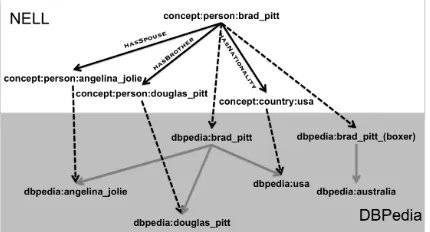
enti-Figure 2: Mapping NELL entity Brad Pitt to DBPedia.
ties to Portuguese NPs, we use DBPedia (Auer et al., 2007) which has structured information about Wikipedia pages in many languages. The idea is to map each English NELL entity em to its corre-sponding English DBPedia page and therefore its Portuguese DBPedia page8. We use the structured information of the Portuguese page in DBPedia: its title and label as the set of Portuguese NPs corre-sponding to the English entity,Npt(em).
More specifically, for each English NELL en-tity em with English NPs that can refer to it,
Nen(em), we find candidate English DBPedia pages that can refer to the entity. We do this by com-puting Jaccard similarities (Jaccard, 1912; Chap-man, 2009) of the entity’s NPs with titles and la-bels of English DBPedia pages. We select pages with Jaccard similarities of more than 0.6 as can-didates e.g., for English NELL entity Brad Pitt we find candidate English pages: http://dbpedia. org/page/Brad_Pitt (Brad Pitt, the US actor) and http://dbpedia.org/page/Brad_Pitt_ (boxer)(Brad Pit, the Australian boxer).
Then, we construct a graph containing nodes that are: (1) the NELL entity that we want to map to DBPedia, (2) its candidate DBPedia pages, (3) other entities that have relations to the entity in NELL KB, and (4) the candidate DBPedia pages of these other entities (see Fig. 2 for the NELL entity Brad Pitt).
We add as edges to this graph: (1) the refer-to edges between entities in NELL and their can-didate pages in DBPedia (dashed edges in Fig. 2), (2) the relation edges between the entities in NELL KB (black edges), and (3) the hyperlink edges
be-8Almost every DBPedia English page has a corresponding
Portuguese page
tween the pages in DBPedia (gray edges). In this graph we want to use the knowledge that NELL has already learned about the entity to narrow its candi-dates down to the page that the entity refers to. The idea is that relatedness among the entities in NELL implies relatedness among the DBPedia pages that refer to the entities. We use Personalized Page Rank (Page et al., 1999) to rank candidate DBPedia pages in this graph and pick the top ranked page as the page that can refer to the NELL entity.
For example, to find the DBPedia page that can refer to our NELL entity Brad Pitt, we use NELL’s knowledge about this entity to rank its candidate pages. As seen in Fig. 2, DBPedia page of Brad
Pitt, the US actor (dbpedia:brad pitt) is highly
con-nected to other pages (dbpedia:angelina jolie,
db-pedia:douglas pitt, dbpedia:usa) that are in turn
connected to the NELL entity Brad Pitt. dbpe-dia:brad pitt is thus ranked highest and picked as
the page that can refer to the NELL entity Brad Pitt. Once we have an English DBPedia page that can refer to the NELL entityem, we can obtain the cor-responding Portuguese page from DBPedia. The ti-tle and label of the Portuguese page becomes the set of Portuguese NPs that can refer to the NELL en-tity i.e., Npt(em) (see Table 2 for examples). Us-ing Npt(em) we find instantiations of English re-lation instances in SV Opt to add as labeled in-stances inDpt. Portuguese NELL enriched with En-glish NELL (i.e., Portuguese NELL+en) has more than double the amount of relation instances, la-beled and unlala-beled instances (Table 1) than Por-tuguese NELL. In the experiments, we observe that this translates to a better verb-to-relation mapping.
Mapping NELL to DBPedia is also useful because it can align existing knowledge and add new knowl-edge to NELL. For example, by mapping to DBPe-dia, we can resolve abbreviations (e.g., the NELL entity: COO as “Chief Operations Officer” in En-glish or “Diretor de Operac¸o˜es” in Portuguese), or resolve a person entity (e.g., the NELL entity:
Uta-maro as “Kitagawa UtaUta-maro”, the virtual artist).
3 Experiments
3.1 Pre-processing
[image:6.612.79.294.61.177.2](Man-English NELL entity Portuguese NPs
Amazonian Brown Brocket “Veado-Roxo”, “Fuboca”
COO “Diretor de Operac¸o˜es”
Utamaro “Kitagawa Utamaro”
Notopteridae “Peixe-faca”
1967 Arab Israeli War “Guerra dos Seis Dias”, “Guerra de 1967”
[image:7.612.313.540.57.256.2]Food Products “Produtos Alimenticios”, “Alimento”, “Comida”, ... Table 2: Example Portuguese NPs learned for NELL entities
ning et al., 2014)). We lemmatize verbs in Por-tugueseSV Opt(using LemPORT (Rodrigues et al., 2014)) and expand contracted prepositions.
For better precision and to make our method scale to a large text corpus, we focus on mapping verbs that are important for a relation based on how often the verbs co-occur with entity pairs that match the relation’s argument type. For each argument type in the EnglishSV Owe consider only the top 50 verbs (in terms of tf-idf scores) for mapping. We use tf-idf scores to adjust for the fact that some verbs appear more frequently in general. For each of these verbs, we also use only the top 50 entity pairs that co-occur with the verb in theSV O(in terms of co-occurrence counts) to construct our datasetD.
For Portuguese verb-to-relation mapping, since
SV Optis much smaller than the EnglishSV O(i.e., it contains only about 22 million entity pair-verb triples compared to the 600 million triples in the En-glishSV O), we use all the Portuguese entity pairs and verbs for mapping. To adjust for the fact that some verbs appear more frequently in general, we use tf-idf scores instead of co-occurrence counts for the values of v(em,en)in the M-step (Equation 6).
3.2 Evaluation
We set aside 10% of D` for testing. Given a test instancet(em,en)and the trained model, we can pre-dict the label assignmenty(em,en)using Eq. 1. This simulates the task of relation extraction where we predict relation(s) that exist between the entity pair int(em,en).
We compare predicted labels of these test in-stances to the actual labels and measure precision, recall and F1 values of the prediction. We evalu-ate NELL relations that have more than one labeled instances inD` (constructed using the method de-scribed in section 2.2). For experiments on the En-glish NELL, we evaluate 77 relations, with an
aver-Figure 3: Performance on leaf relations.
age of 23 (and a median of 11) training instances per relations. For experiments on the Portuguese NELL+en, which is Portuguese NELL enriched with relation instances from English NELL, we evaluate 85 relations, with an average of 31 (and a median of 10) training instances per relations. We compare the prediction produced by our approach: EM with that of other systems: CPL, DIRT, and NB.
In CPL, we obtain verb-to-relation mapping weights from NELL’s CPL patterns and hand-labeled verb phrases (see Section 2.3.2). In DIRT, we obtain verb-to-relation mapping weights in an unsupervised manner (Lin and Pantel, 2001) based on their mutual information over labeled training in-stances. In Naive Bayes (NB) we learn the verb-to-relation mapping weights from labeled training in-stances. In contrast to the other systems, EM allows learning from both labeled and unlabeled instances. To make other systems comparable to our pro-posed method, For NB and DIRT we add CPL weights as priors to their verb-to-relation mapping weights. For all these other systems, we also incor-porate type-checking during prediction in that unla-beled instances are only launla-beled with relations that have the same argument types as the instance.
[image:7.612.86.286.58.148.2]Figure 4: Performance on all relations.
Portuguese NELL that the verb-to-relation mapping obtained by EM results in predictions that have a much higher recall and comparable precision.
In Figure 3, we also observe a gain in performance when we run EM on Portuguese NELL+enwhich is Portuguese NELL enriched with relation instances from English NELL obtained using our DBPedia linking in section 2.4. More labeled instances results in higher recall and precision. This shows the useful-ness of aligning and merging knowledge from many different KBs to improve verb-to-relation mapping and relation extraction in general.
We show the micro-averaged performance of the systems on all relations of English NELL and Por-tuguese NELL (Fig. 4). Here, we incorporate hi-erarchical and mutual exclusive constraints between relations in our EM, allowing a test instance to be classified into more than one relation while respect-ing these constraints. Like before, we observe that the verb-to-relation mapping obtained by EM results in predictions with a much higher recall and compa-rable precision to other systems which do not incor-porate constraints between relations.
In the experiments we also observe that NB per-forms comparably or better than DIRT. We hypothe-size that it is because NB obtains its verb-to-relation mapping in a supervised manner while DIRT ob-tains its mapping in an unsupervised manner.
[image:8.612.312.545.277.403.2]We also conduct experiments to investigate how much influence type-checking has on prediction. We show performance over instances whose types alone are not enough to disambiguate their assignments
Figure 5: Performance on English NELL relations with and
without type-checking.
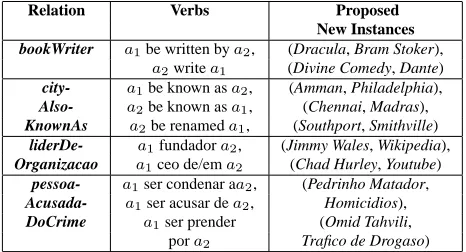
Relation Verbs Proposed
New Instances
bookWriter a1be written bya2, (Dracula, Bram Stoker),
a2writea1 (Divine Comedy, Dante)
city- a1be known asa2, (Amman, Philadelphia),
Also- a2be known asa1, (Chennai, Madras),
KnownAs a2be renameda1, (Southport, Smithville)
liderDe- a1fundadora2, (Jimmy Wales, Wikipedia),
Organizacao a1ceo de/ema2 (Chad Hurley, Youtube)
pessoa- a1ser condenar aa2, (Pedrinho Matador,
Acusada- a1ser acusar dea2, Homicidios),
DoCrime a1ser prender (Omid Tahvili,
pora2 Trafico de Drogaso)
Table 3: Some relations’ verbs and proposed new instances
(i.e., when more than one relation shares their ar-gument type signatures) to see the merits of verb-to-relation mapping on prediction (Fig. 5). We observe that verbs learned by EM results in a better predic-tion even when used without type-checking (EM (-)
Type) than using type-checking alone (by picking
majority class among relations that have the correct type) (Type Only). Adding type checking improves performance even further (EM). This shows how verbs learning is complementary to type-checking.
verb-to-relation mapping obtained by EM (Table 3).
EM learns in average 177 English verbs and 3310
Portuguese verbs per relation; and propose in av-erage 1695 new instances per relation for English NELL, and 6426 new instances per relation for tuguese NELL. It learns less English verbs than Por-tuguese due to the filtering of English data (Sec-tion 3.1) and a high degree of inflec(Sec-tion in Por-tuguese verbs. The smaller size of PorPor-tuguese KB also means more of its proposed instances are new.
4 Related Work
Existing verb resources are limited in their ability to map to KBs. Some existing resources classify verbs into semantic classes either manually (e.g. WordNet (Miller et al., 1990)) or automatically (e.g. DIRT (Lin and Pantel, 2001)). However, these classes are not directly mapped to KB relations. Other re-sources provide relations between verbs and their ar-guments in terms of semantic roles (e.g. PropBank (Kingsbury and Palmer, 2002), VerbNet (Kipper et al., 2000), FrameNet (Ruppenhofer et al., 2006)). However, it is not directly clear how the verbs map to relations in specific KBs.
Most existing verb resources are also manually constructed and not scalable. A verb resource that maps to KBs should grow in coverage with the KBs, possibly by leveraging large corpora such as the Web for high coverage mapping. One system that leverages Web-text as an interlingua is (Wijaya et al., 2013). However, they use it to map KBs to KBs, and obtain a verb-to-relation mapping only in-directly. They also compute heuristic confidences in verb-to-relation mappings from label propagation scores, which are not probabilities. In contrast, we map verbs directly to relations, and obtainP(vp|ri) as an integral part of our EM process.
In terms of systems that learn mappings of tex-tual patterns to KB relations, CPL (Carlson et al., 2010) is one system that is most similar to our pro-posed approach in that it also learns text patterns for KB relations in a semi-supervised manner and uses constraints in KB ontology to couple the learning to produce extractors consistent with these constraints. However, CPL uses a combination of heuristics in its learning, while we use EM. In our experiments, we use CPL patterns that contain verbs as priors and
show that our approach outperforms CPL in terms of effectiveness for extracting relation instances.
In terms of the relation extraction, there are distantly-supervised methods that can produce verb groupings as a by product of relation extraction. One state-of-the-art uses matrix factorization and univer-sal schemas to extract relations (Riedel et al., 2013). In this work, they populate a database of a uni-versal schema (which involves surface form predi-cates and relations from pre-existing KBs such as Freebase) by using matrix factorization models that learn latent feature vectors for relations and entity tuples. One can envision obtaining a verb group-ing for a particular relation by predictgroup-ing verb sur-face forms that occur between entity tuples that are instances of the relation. However, unlike our pro-posed method that learns mapping between typed-verbs to relations, they do not incorporate argument types in their learning, preferring to learn latent en-tity representation from data. Although this im-proves relation extraction, they observe that it hurts performance of surface form prediction because a single surface pattern (like “visit”) can have mul-tiple argument types (visit-location, person-visit-person, etc). Unlike our method, it is not clear in their method how argument types of surface pat-terns can be dealt with. Furthermore, it is not clear how useful prior constraints between relations (sub-set, mutex, etc.) can be incorporated in their method.
5 Conclusion
Acknowledgments
We thank members of the NELL team at CMU and Federal University of Sao Carlos for their helpful datasets, comments, and suggestions. This research was supported by DARPA under contract number FA8750-13-2-0005.
References
S¨oren Auer, Christian Bizer, Georgi Kobilarov, Jens Lehmann, Richard Cyganiak, and Zachary Ives. 2007. Dbpedia: A nucleus for a web of open data. In The
semantic web.
Kurt Bollacker, Colin Evans, Praveen Paritosh, Tim Sturge, and Jamie Taylor. 2008. Freebase: a collabo-ratively created graph database for structuring human knowledge. In SIGMOD.
J. Callan, M. Hoy, C. Yoo, and L. Zhao. 2009. Clueweb09 data set. boston.lti.cs.cmu.edu.
Andrew Carlson, Justin Betteridge, Bryan Kisiel, Burr Settles, Estevam R Hruschka Jr, and Tom M Mitchell. 2010. Toward an architecture for never-ending lan-guage learning. In AAAI, volume 5, page 3.
Sam Chapman. 2009. Simmetrics. URL http://sourceforge. net/projects/simmetrics/. SimMet-rics is a Similarity Metric Library, eg from edit dis-tance’s (Levenshtein, Gotoh, Jaro etc) to other met-rics,(eg Soundex, Chapman). Work provided by UK Sheffield University funded by (AKT) an IRC spon-sored by EPSRC, grant number GR N, 15764.
Bhavana Dalvi, Einat Minkov, Partha P Talukdar, and William W Cohen. 2015. Automatic gloss finding for a knowledge base using ontological constraints. In
Proceedings of the Eighth ACM International Confer-ence on Web Search and Data Mining, pages 369–378.
ACM.
Paul Jaccard. 1912. The distribution of the flora in the alpine zone. New phytologist, 11(2):37–50.
Paul Kingsbury and Martha Palmer. 2002. From tree-bank to proptree-bank. In LREC. Citeseer.
Karin Kipper, Hoa Trang Dang, and Martha Palmer. 2000. Class-based construction of a verb lexicon. In
AAAI/IAAI, pages 691–696.
Dekang Lin and Patrick Pantel. 2001. Discovery of infer-ence rules for question-answering. Natural Language
Engineering, 7(04):343–360.
Yue Lu and Chengxiang Zhai. 2008. Opinion integra-tion through semi-supervised topic modeling. In
Pro-ceedings of the 17th international conference on World Wide Web, pages 121–130. ACM.
Christopher D. Manning, Mihai Surdeanu, John Bauer, Jenny Finkel, Steven J. Bethard, and David McClosky.
2014. The Stanford CoreNLP natural language pro-cessing toolkit. In Proceedings of 52nd Annual
Meet-ing of the Association for Computational LMeet-inguistics: System Demonstrations, pages 55–60.
George A Miller, Richard Beckwith, Christiane Fell-baum, Derek Gross, and Katherine J Miller. 1990. In-troduction to wordnet: An on-line lexical database*.
International journal of lexicography, 3(4):235–244.
Kamal Nigam, Andrew McCallum, and Tom Mitchell. 2006. Semi-supervised text classification using em.
Semi-Supervised Learning, pages 33–56.
Lawrence Page, Sergey Brin, Rajeev Motwani, and Terry Winograd. 1999. The pagerank citation ranking: bringing order to the web.
Sebastian Riedel, Limin Yao, Andrew McCallum, and Benjamin M Marlin. 2013. Relation extraction with matrix factorization and universal schemas.
Ricardo Rodrigues, Hugo Gonc¸alo Oliveira, and Paulo Gomes. 2014. Lemport: a high-accuracy cross-platform lemmatizer for portuguese. Maria Jo˜ao Varanda Pereira Jos´e Paulo Leal, page 267.
Josef Ruppenhofer, Michael Ellsworth, Miriam RL Petruck, Christopher R Johnson, and Jan Scheffczyk. 2006. Framenet ii: Extended theory and practice. Fabian M Suchanek, Gjergji Kasneci, and Gerhard
Weikum. 2007. Yago: a core of semantic knowledge. In Proceedings of the 16th international conference on
World Wide Web, pages 697–706. ACM.
Derry Wijaya, Partha Pratim Talukdar, and Tom Mitchell. 2013. Pidgin: ontology alignment using web text as interlingua. In Proceedings of the 22nd ACM