A study of N-gram and Embedding Representations
for Native Language Identification
Sowmya Vajjala Sagnik Banerjee
Iowa State University, USA
sowmya,[email protected]
Abstract
We report on our experiments with N-gram and embedding based feature rep-resentations for Native Language Identifi-cation (NLI) as a part of the NLI Shared Task 2017 (team name: NLI-ISU). Our best performing system on the test set for written essays had a macro F1 of 0.8264 and was based on word uni, bi and tri-gram features. We explored n-tri-grams cov-ering word, character, POS and word-POS mixed representations for this task. For embedding based feature representations, we employed both word and document embeddings. We had a relatively poor per-formance with all embedding representa-tions compared to n-grams, which could be because of the fact that embeddings capture semantic similarities whereas L1 differences are more stylistic in nature.
1 Introduction
Native Language Identification (NLI) refers to the task of identifying the native language (L1) of a writer based on their writings in another language (L2). Identifying the L1 of a writer is useful in applications such as authorship attribution, foren-sic linguistics, language instruction and Second Language Acquisition (SLA) (Koppel et al.,2005;
Estival et al., 2007; Jarvis and Crossley, 2012). While early work on this problem began at the beginning of this century (Tomokiyo and Jones,
2001; Jarvis et al., 2004), there has been an in-creased interest in this task since 2012, with the availability of some publicly accessible corpora (Brooke and Hirst, 2012; Tetreault et al., 2012;
Bykh and Meurers,2012).
The First NLI Shared Task (Tetreault et al.,
2013) and the release of large corpora such as
TOEFL11 corpus of non-native English ( Blan-chard et al., 2013) and EFCAMDAT corpus (Geertzen et al., 2013) resulted in a surge of re-search in this area in the past few years. While most of the NLI research has been on English, there is a significant amount of work on other lan-guage texts such as Chinese, Finnish and Arabic (Malmasi and Dras,2015;Malmasi,2016). Start-ing form surface lStart-inguistic forms such as words and characters to deeper syntactic structures, a range of features have been explored for this task in the past five years.
The last few years saw the field of NLI advance in both the directions of feature engineering and modeling. However, irrespective of what model-ing choices were made, results seem to show that word level features still are the most predictive ones as a single group (e.g., Jarvis et al., 2013;
Gebre et al., 2013) for this data. So, in this pa-per, we take a step back from complex feature and model engineering, and explore how far can we get by doing classification using simpler feature rep-resentations based on words, characters and POS tags. While our current experiments (team name: NLI-ISU), done as a part of the NLI Shared Task 2017 (Malmasi et al.,2017), do not result in any improvements over existing approaches, we be-lieve they provide insights into the nature of the task and why n-grams may still be needed for this task despite the presence of more compact embed-ding representations for texts.
The rest of this paper is organized as follows: The next section describes some of the related work and puts our experiments in context. Sec-tion 3 briefly describes the corpus used. We de-scribe our methodology including feature descrip-tion in Secdescrip-tion4. Our experiments and results are discussed in Section 5. Section 6 concludes the paper with pointers to future work.
2 Related Work
Native Language Identification is generally treated as a supervised text classification problem in com-putational linguistics literature. (Koppel et al.,
2005) can be described as one of the early works that considers NLI as a supervised machine learn-ing problem. Uslearn-ing a corpus of texts from Inter-national Corpus of Learner English (ICLE) along with word and letter n-grams and errors made by the learners as features, they achieved a classifica-tion accuracy of over 80%.
Along with n-grams, syntactic features based on parse structures were also shown to be useful for the task in the past (Wong and Dras,2011) re-sulting in accuracies in the range of 80-85% with ICLE data. Extending the n-gram based feature sets to larger n-gram sizes and using a combination of word and POS tag n-grams, Bykh and Meur-ers(2012) achieved an accuracy of 89.7% on the same dataset. With combinations of n-grams, lexi-cal and syntactic features,Brooke and Hirst(2012) explored NLI with multiple corpora, and achieved accuracies of over 90% on ICLE data. Summariz-ing the research on NLI until then,Tetreault et al.
(2012) explored a range of features on ICLE and introduced the TOEFL11 corpus for NLI ( Blan-chard et al.,2013).
This corpus was used in the first Native Lan-guage Identification shared task (Tetreault et al.,
2013). 29 teams participating in the task, and wide range of lexical and syntactic feature representa-tions were explored. The best performing sys-tem (Jarvis et al.,2013) resulted in an accuracy of 83.6% and used word, char, POS n-gram features. After this shared task, interest in NLI contin-ued with different groups exploring both finer fea-ture representations and diverse ensemble meth-ods for combining multiple classification mod-els. These explorations resulted in an accuracy gain of up to 2% on the 2013 shared task test set (Ionescu et al., 2014; Bykh and Meurers, 2014,
2016). More recently, (Malmasi and Dras,2017) reported an accuracy of 87.1% on the 2013 test set, using an ensemble of meta classifiers and a range of word level and syntactic features. Apart from TOEFL11, other corpora such as EFCAM-DAT (Geertzen et al., 2013) were also used for NLI in the recent past (e.g.,Nisioi,2015).
While most of the work in NLI happened in En-glish, a substantial body of NLI research happened in the past two years covering at least six other
languages (cf.Malmasi and Dras,2015;Malmasi,
2016). In addition to using the written responses, a recent development has been the use of speech transcripts and audio features for dialect identifi-cation (Malmasi et al.,2016) and native language identification (Schuller et al.,2016). In this back-ground, the NLI Shared Task 2017 was proposed, with an additional spoken language component.
While a range of feature representations and modeling representations have been explored from this task, it has been shown that word/character level n-grams have been unreasonably effective as a single feature group (e.g., Jarvis et al., 2013;
Gebre et al., 2013;Bykh et al.,2013). AsJarvis et al.(2013) concluded, ”complex features” such as suffixes, length, lexical variety etc did not result in any major improvement over n-gram features. Further, other complex and memory intensive rep-resentations such as constituency and dependency parses did not result in large performance im-provements without the support of stronger mod-els and ensemble learners.
In this background, in this paper, we take a step back from exploring new feature extraction methods and new modeling techniques, and re-investigate the role of surface feature represen-tations in NLI. Word and document embeddings became popular and useful alternatives to n-gram features in several classification tasks in the recent past as they result in dense representation com-pared to sparse n-gram features. Hence, in addi-tion to word, character and POS n-grams, we also explored the use of embedding based feature rep-resentations for this task.
3 Data
scores for the essays. We discarded two texts from the training data which had only two-three token responses (e.g., ”I agree”) before starting with fea-ture extraction.
The shared task task also had a speech track, where the goal is to predict the speaker’s L1 based on a transcription of a 45 second recording. There were 11000 spoken transcriptions (1000 per L1) in the training data and 1100 (100 per L1) in the de-velopment set, similar to the essay section of the corpus. The transcriptions were produced in re-sponse to 9 prompts. While the original record-ings were not provided, i-vectors, which are low-dimensional representations of the speech signals were provided using the Kaldi toolkit (http: //kaldasr.org). We did not use the i-vectors and only did preliminary n-gram based ex-periments on that data as well.
Test Data: Test data for both written and spo-ken texts had 1100 texts each (100 per L1 in each case). i-vectors were provided for the spoken files in the test data as well.
4 Features
As mentioned earlier, we explored two kinds of feature representations in this task: n-grams and embeddings.1
4.1 N-gram Representations
We explored N-gram representations at the level of words, characters, POS tags and mixed word-POS representations. Binary feature representa-tion with a minimum n-gram frequency of 10 was used as a common setting for across all features. The maximum number of features was capped at 100K for most of the experiments, to limit feature explosion and over-fitting to rare n-grams. We did not find any significant differences between using binary, count and TF-IDF representations.
Word n-grams : Word n-grams are used in almost all the previous NLI approaches, and we start with them as well. We explored 1– 8 lower cased n-grams with/without punctuation, with/without stemming and with/without spell check. We used the Enchant spell checker through the PyEnchant library (http://pyenchant. readthedocs.io). We considered two n-gram representations using spell-checker:
1code for the feature extraction and classification is hosted at: https://github.com/nishkalavallabhi/ NLIST2017/for replication purposes.
• replace the spelling error with the most likely word suggested by the checker
• replace the error with a pseudo-word
Spelling errors were used as features in earlier NLI approaches (Koppel et al.,2005;Gebre et al.,
2013). But we are not aware of any previous work that pre-processed for spelling errors before n-gram extraction.
Char n-grams : We explored 2–10 character grams (lower cased), with/without crossing over word boundaries for n-gram extraction. Punctu-ation was not included while extracting character n-grams.
POS n-grams : We explored 1–5 POS grams. We extracted features using both NLTK tagger and Stanford POS tagger.
Word-POS mixed n-grams : (Bykh and Meur-ers, 2012) in the past used Open Class POS n-grams where n-n-grams for open class words (nouns, verbs, adjectives, and cardinal numbers) were re-placed by their POS tags and the other words are left as is while calculating n-grams. Similarly, skip word n-grams have also been explored in NLI re-search before (Malmasi and Cahill, 2015). We extended such feature representations further by other Word-POS mixed representations such as: replacing only nouns, or only verbs with their tags, or replacing all except prepositions etc. We con-sider such mixed representations as a form of skip gram representations, where the gap has a name (POS tag, for example). We used NLTK tagger for feature extraction.
4.2 Embedding Representations
Embedding based representations are seen as an alternative to the sparse n-gram based representa-tions in the recent past as they resulted in dense feature representations for text. Hence, we ex-plored word and document level embeddings for this task, using several models. We used gensim2
to train and classify using embedding features.
Word Embeddings : We trained the embed-dings using the entire training corpus, and tun-ing the number of dimensions ustun-ing cross vali-dation. We tried with both CBOW (continuous bag-of-words) and skip-gram. In our experience, CBOW generated the vector representations better
than skip-grams. For all the settings a minimum word count of 5 was set. The negative sampling rate, for all the settings, was left at default. We did change the negative sampling rate in the hope of obtaining better results but the results we obtained was not significantly better than the default case. For each of the settings, we explored 100 to 1000 features in an increment of 100 and a window set-ting of 5 to 15 in increments of 2.
Three different methods were used to get the vector representations for documents using these word embeddings:
• summed vector of all the word embeddings
• averaged vector for all the word embeddings
• a combination of average and standard devi-ation
For building these word embeddings, we used Word2Vec (Mikolov et al., 2013) and FastText (Joulin et al.,2016).
Document Embeddings : In addition to word embeddings, vector representations were also generated for an entire document with dis-tributed memory (dm) and disdis-tributed bag-of-words (dbow) architectures (Le and Mikolov,
2014) using Doc2Vec tool. Number of dimensions ranged from 100 to 500 in 100 increments and the window size ranged from 5 to 50. We did not use negative sampling as it was shown in previous re-search that negative sampling will result in a doc-ument embedding that is biased to content words (Lau and Baldwin,2016) whereas function words are important in the task of NLI.
For document embeddings, we used two repre-sentations:
• Doc2Vec-Full: Using the entire training data to construct an unsupervised Doc2Vec model
• Doc2Vec-PerL1: Using training data per L1 to build 11 Doc2Vec models, and use the con-catenation of vectors from all 11 models per text during classification training and testing. Additionally, we also explored the use of Effi-cient, Compositional, Order-sensitive n-gram Em-beddings (ECO) proposed recently byPoliak et al.
(2017) for constructing the document embeddings. In ECO embeddings, vector representation of neighbouring words (both occurring before and af-ter) are averaged to obtain the numeric representa-tion of the current word. We used the pre-trained
word vectors from Wikipedia dump with dimen-sionality ranging from 100 to 700 as provided by
Poliak et al. (2017).3 to generate document
em-beddings
5 Results
We used Logistic Regression and SVMs with de-fault parameters to train our classification models. While there are no significant differences between both the algorithms, logistic regression was much faster. So, unless otherwise stated, we report the results with logistic regression in the rest of this paper. We submitted runs for both the ESSAY track and the SPEECH track. For the SPEECH track we worked with the transcripts directly and not with the i-vectors. macro-F1 and classification accuracy were used as the evaluation measures for this task.
• Run 1: Word 1-3 grams + incl. punctuation + no stemming
• Run 2: Word 1-3 grams + POS Bi, Tri grams
• Run 3: Character n-grams (2–10), crossing word boundaries.
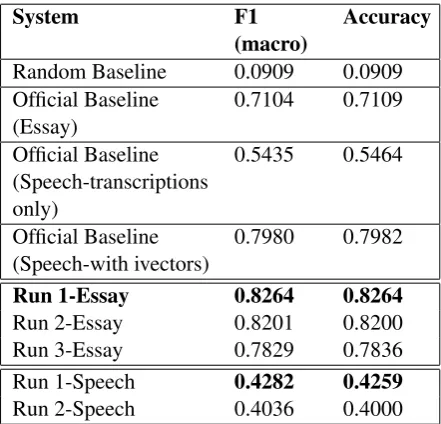
Table1shows the results on test set for our sub-mitted systems using Logistic Regression.
System F1
(macro) Accuracy
Random Baseline 0.0909 0.0909 Official Baseline
(Essay) 0.7104 0.7109
Official Baseline (Speech-transcriptions only)
0.5435 0.5464
Official Baseline
(Speech-with ivectors) 0.7980 0.7982
Run 1-Essay 0.8264 0.8264
Run 2-Essay 0.8201 0.8200 Run 3-Essay 0.7829 0.7836 Run 1-Speech 0.4282 0.4259
Run 2-Speech 0.4036 0.4000
Table 1: Official Submissions for the ESSAY and SPEECH tracks
Word n-grams (range: 1–3) turned out to be most predictive feature representation among the ones we tried. N-grams beyond 3 did not result
[image:4.595.307.528.450.662.2]in a significant improvement in accuracy. While adding bi-, tri-grams resulted in about 9% im-provement in accuracy over unigrams, adding 4-8 grams did not result in any significant performance difference on development set.
Stemming consistently resulted in a decrease in performance compared to non-stemmed features, and including punctuation always resulted in a 2-3% increase in accuracy on the development set for all settings we explored.4 Adding POS based
features to word n-grams did not result in any sig-nificant difference in the accuracy. For character n-grams, there was a 3.2% decrease in accuracy on the development set when we did not consider n-grams across word boundaries.
Spell checking: We did not find spell checking particularly useful for this task. Both our spell check feature representations did not result in any improvement in the results on the development set. It could be because we set our minimum frequency threshold to 10 and the error patterns are not fre-quent and consistent enough in the dataset. On the other hand, this may also imply that the peo-ple from the same native language may not always have a consistent spelling error pattern significant enough to be distinguishable from another native language group.
Using only POS n-grams did not result in an ac-curacy beyond 60% using both the taggers, for n = 1 to 8. Combining them with word n-grams did not result in any improvement either, as it was seen in Run 2 results in Table1.
Mixed Word-POS representations: In terms of mixed word-POS representations, we explored the following representations using the NLTK tagger:
• Rep 1: Replace all nouns, pronouns and punctuation markers with a single string for each category.
• Rep 2: Same as the above representation, but having retaining punctuation tags for all punctuation markers
• Rep 3: Same as Rep 2, but replacing all verb tags with a single string.
4Since the classification accuracy was very sensitive to decisions such as stemming and punctuation, and to how the features are extracted, we are sharing our final list of word tri-gram features for both essay and speech tracks extracted us-ing LightSide (Mayfield and Ros´e,2013) on github for repli-cation purposes.
• Rep 4: All words except prepositions were replaced with a common tag, and all punctu-ations were replaced with a common tag.
• Rep 5: OCPOS representation as described in
Bykh and Meurers(2012).
For all these cases, we trained classification models with 1–8 n-grams, minimum frequency of 10, and up to 300K features. While some of these mixed word-POS representations were not explored for this task before, none of the models give an accuracy beyond 75% on the development set. It has to be noted that we used only Logis-tic Regression and SVM for classification. But, it is unlikely that another classification algorithm would result in a dramatic increase with these fea-ture representations. We did not explore ensem-ble models where different feature representations are combined as multiple models instead of a large single model.
In addition to training classifiers, we also briefly explored using distance measures from stylistics and authorship attribution research such as Bur-row’s Delta (Burrows, 2002) and other related measures (Evert et al.,2015) using 100-1000 most frequent word, character and POS n-grams in the corpus. We did not find them particularly useful for this task, with highest accuracies of less than 60% on the development set. This could be due to the fact that Delta based measures are usually used on much longer texts, typically full length texts or novels.5
Speech Data: As mentioned earlier, for speech transcripts, we did not use the i-vectors and only used the above mentioned n-gram features. They were not as useful predictors for speech as they were for essays. One possible reason could be the fact that we have much smaller texts compared to written texts. However, i-vectors, which cap-ture the acoustic feacap-tures, clearly play an impor-tant role in NLI for speech data, as it was seen from the improvement over baseline they achieved on development set, as it was indicated in the doc-umentation for corpus release.
5.1 With Embeddings on Development Set
In addition to the submitted runs, we explored word and document embedding based feature rep-5We used Stylo (Eder et al.,2016) and JGAAP (https:
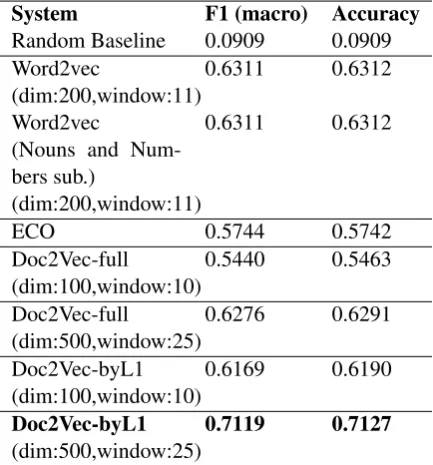
resentations that were described in Section 4 for this task. Our experiments with these represen-tations did not result in better results than word and character n-grams. Table2shows a summary of the most predictive results with embedding fea-tures in our experiments.
System F1 (macro) Accuracy
Random Baseline 0.0909 0.0909 Word2vec
(dim:200,window:11)0.6311 0.6312 Word2vec
(Nouns and Num-bers sub.)
(dim:200,window:11)
0.6311 0.6312
ECO 0.5744 0.5742
Doc2Vec-full
(dim:100,window:10)0.5440 0.5463 Doc2Vec-full
(dim:500,window:25)0.6276 0.6291 Doc2Vec-byL1
(dim:100,window:10)0.6169 0.6190
Doc2Vec-byL1
[image:6.595.73.290.157.390.2](dim:500,window:25)0.7119 0.7127 Table 2: Results for the ESSAY track with Em-bedding Features on Development data
For word embeddings, we achieved a macro F1 of 0.63 with Word2Vec (number of features 200 and window size 11), using SVM. We exper-imented with various levels of negative sampling but we could not attain any improvement. What is more interesting to note is that the system per-formance remains the same even when nouns and numbers are substituted. We repeated our exper-iments by averaging the word vectors with their corresponding TF-IDF values but we did not any improvement of performance. Training the em-beddings on spell corrected data did not produce better results.
For larger number of features we noticed that the system performed better on the training set than it did on the development set clearly hint-ing at over-fitthint-ing. We performed 5 fold cross-validation, with multiple parameter settings and using linear, rbf and polynomial kernels, in a bid to find optimum parameter settings which would lead to the best classifier. Linear kernel emerged out as the winner for the optimum parameter set-tings for Word2Vec.
We got a macro F1 of 0.57 with ECO
embed-dings (number of features 700 and window size 4) using SVM. The reason for a poorer performance of ECO embeddings compared to Word2Vec could be the training corpus. ECO embeddings were trained on Wikipedia dump and not the training corpus as was the case for Word2Vec embeddings. Training embeddings on the shared task’s training corpus could have possibly captured the specific features of the corpus instead of more general lan-guage features from Wikipedia corpus.
FastText performed much worse than Word2Vec and ECO, and was even below baseline with some of the parameter settings. We found that the performance of the system did not change appreciably when the number of features was increased, indicating that a large number of features may not be essential or desirable to capture all the stylistic differences in the corpus.
With Doc2Vec, concatenating the vectors from L1 specific doc2vec models performed much bet-ter than training a single Doc2Vec model on the entire dataset, giving a macro F1 of 0.7119 (500 features per L1, window size 25, dbow representa-tion) using Logistic Regression. Doc2Vec-byL1 was consistently better than Doc2Vec-full in all the parameter settings we explored, always result-ing in over 7% increase in accuracy.
Number of features and window size seemed to have a good influence on the classification per-formance and window sizes below 10 resulted in low performance for L1 classification. It was also shown in a previous empirical evaluation that dbow favors larger window sizes (Lau and Bald-win,2016), although the longest they had was 15. Overall, from what we observed so far, training L1 specific Doc2Vec models may result in better performance for this task. Finding a better way to combine L1 specific features instead of just con-catenating everything may boost the performance further.
5.2 Prompt based classification
classifi-cation.
Doc2Vec-Full models for prompt based clas-sification achieved accuracy of over 95% on the development for smaller feature/dimension sizes (10–20) and window sizes (5–10) using logistic regression. A dimensionality of 5 already gave an accuracy of 73% on the development set for prompt classification (8 prompts in essays cor-pus). This clearly indicates that the embeddings were able to capture topical differences between prompts easily even in a low dimensional space.
From a comparison of Doc2vec experiments for L1 and prompt classification, we can conclude that embeddings are more suitable when the categories have more semantic and less stylistic differences. However, an interesting observation from L1 clas-sification using Doc2Vec was the influence of win-dow size on classification performance. Perfor-mance steadily improved with both larger dimen-sions and larger window sizes. Whether this cap-tures something unique about stylistic variation is something that should be more systematically ex-plored in future.
6 Discussion
We described some of our experiments that study the usefulness of n-gram and embedding based feature representations for Native Language Iden-tification as a part of the NLI Shared Task 2017. Our main conclusions so far are:
• Word uni–trigram features performed the best as a single group for classifying writ-ten texts, and there is no significant improve-ment in terms of adding infrequent trigrams or adding n-grams beyond 3.
• Character n-grams (n=2–10) were the sec-ond best performing feature group for written texts.
• Results with word and character n-grams could not be replicated with speech tran-scripts.
• Word and document embedding features did not give better results than n-grams, possibly because they capture semantic similarities in-stead of stylistic aspects.
6.1 Outlook
While modeling innovations may result in perfor-mance improvement, they make predictions more
and more opaque. For NLI to be useful in ap-plications such as language instruction or in lan-guage generation (e.g. generating texts with in-dividual writing style in applications such as ma-chine translation) we may need interpretable mod-els. More qualitative analysis and eventually more concrete stylistic features for specific L1 back-grounds need to be developed. With this goal, and inspired by previous work on learning stylistic variation for language generation (Lin,2012) and learning to segment phrasal features (instead of words) for sentiment analysis (Tang et al.,2014), we plan to focus on working towards better fea-ture representations that may result in generaliz-able insights into the nature of L1 influence on L2 writing.
References
Daniel Blanchard, Joel Tetreault, Derrick Higgins, Aoife Cahill, and Martin Chodorow. 2013. Toefl11: A corpus of non-native english. Technical report, Educational Testing Service.
Julian Brooke and Graeme Hirst. 2012. Robust, Lexi-calized Native Language Identification. In Proceed-ings of COLING 2012. The COLING 2012 Orga-nizing Committee, Mumbai, India, pages 391–408.
http://www.aclweb.org/anthology/C12-1025.
John Burrows. 2002. delta: a measure of stylistic dif-ference and a guide to likely authorship. Literary and linguistic computing17(3):267–287.
Serhiy Bykh and Detmar Meurers. 2012. Native Lan-guage Identification using Recurringn-grams –
In-vestigating Abstraction and Domain Dependence.
In Proceedings of COLING 2012. The COLING 2012 Organizing Committee, Mumbai, India, pages 425–440. http://www.aclweb.org/anthology/C12-1027.
Serhiy Bykh and Detmar Meurers. 2014. Exploring Syntactic Features for Native Language Identifica-tion: A Variationist Perspective on Feature Encod-ing and Ensemble Optimization. In Proceedings of COLING 2014, the 25th International Confer-ence on Computational Linguistics: Technical Pa-pers. Dublin, Ireland, pages 1962–1973.
Serhiy Bykh and Detmar Meurers. 2016. Advanc-ing lAdvanc-inguistic features and insights by label-informed feature grouping: An exploration in the context of native language identification. In Proceedings of COLING 2016, the 26th International Conference on Computational Linguistics: Technical Papers. The COLING 2016 Organizing Committee, Osaka, Japan, pages 739–749.
linguistically motivated features in native language identification. the 8th NAACL Workshop on Innova-tive Use of NLP for Building Educational Applica-tions (BEA8)pages 197–206.
Maciej Eder, Jan Rybicki, and Mike Kestemont. 2016. Stylometry with r: a package for
compu-tational text analysis. R Journal 8(1):107–121.
http://journal.r-project.org/archive/2016-1/eder-rybicki-kestemont.pdf.
Dominique Estival, Tanja Gaustad, Son Bao Pham, Will Radford, and Ben Hutchinson. 2007. Author profiling for English emails. InProceedings of the 10th Conference of the Pacific Association for Com-putational Linguistics. Melbourne, Australia, pages 263–272.
Stefan Evert, Thomas Proisl, Thorsten Vitt, Christof Sch¨och, Fotis Jannidis, and Steffen Pielstr¨om. 2015.
Towards a better understanding of burrows’s delta in literary authorship attribution. In Proceedings of the Fourth Workshop on Computational Linguis-tics for Literature. Association for Computational Linguistics, Denver, Colorado, USA, pages 79–88.
http://www.aclweb.org/anthology/W15-0709.
Binyam Gebrekidan Gebre, Marcos Zampieri, Peter Wittenburg, and Tom Heskes. 2013. Improving na-tive language identification with tf-idf weighting. In the 8th NAACL Workshop on Innovative Use of NLP for Building Educational Applications (BEA8). pages 216–223.
Jeroen Geertzen, Theodora Alexopoulou, and Anna Korhonen. 2013. Automatic linguistic annotation of large scale l2 databases: The ef-cambridge open lan-guage database (efcamdat). In Proceedings of the 31st Second Language Research Forum. Somerville, MA: Cascadilla Proceedings Project.
Radu Tudor Ionescu, Marius Popescu, and Aoife Cahill. 2014. Can characters reveal your native lan-guage? A language-independent approach to native language identification. InProceedings of the 2014 Conference on Empirical Methods in Natural Lan-guage Processing (EMNLP). Association for Com-putational Linguistics.
Scott Jarvis, Yves Bestgen, and Steve Pepper. 2013. Maximizing Classification Accuracy in Native Lan-guage Identification. InProceedings of the Eighth Workshop on Innovative Use of NLP for Building Educational Applications. Association for Compu-tational Linguistics, Atlanta, Georgia, pages 111– 118.
Scott Jarvis, Gabriela Castaneda-Jim´enez, and Ras-mus Nielsen. 2004. Investigating l1 lexical transfer through learners wordprints. In Second Language Research Forum (SLRF). State College, PA.
Scott Jarvis and Scott Crossley, editors. 2012. Ap-proaching Language Transfer Through Text Classi-fication: Explorations in the Detection-based Ap-proach, volume 64. Multilingual Matters Limited, Bristol, UK.
Armand Joulin, Edouard Grave, Piotr Bojanowski, and Tomas Mikolov. 2016. Bag of tricks for efficient text classification.arXiv preprint arXiv:1607.01759. Moshe Koppel, Jonathan Schler, and Kfir Zigdon.
2005. Determining an author’s native language by mining a text for errors. In Proceedings of the eleventh ACM SIGKDD international confer-ence on Knowledge discovery in data mining. ACM, Chicago, IL, pages 624–628.
Jey Han Lau and Timothy Baldwin. 2016. An em-pirical evaluation of doc2vec with practical
in-sights into document embedding generation. In
Proceedings of the 1st Workshop on Representa-tion Learning for NLP. Association for Computa-tional Linguistics, Berlin, Germany, pages 78–86.
http://anthology.aclweb.org/W16-1609.
Quoc Le and Tomas Mikolov. 2014. Distributed repre-sentations of sentences and documents. In Proceed-ings of the 31st International Conference on Ma-chine Learning (ICML-14). pages 1188–1196. Jing Lin. 2012. Using a rewriting system to model
in-dividual writing styles. Ph.D. thesis, University of Aberdeen.
Shervin Malmasi. 2016. Native Language Identification: Explorations and Applica-tions. Ph.D. thesis, Macquarie University.
http://hdl.handle.net/1959.14/1110919.
Shervin Malmasi and Aoife Cahill. 2015. Mea-suring feature diversity in native language
iden-tification. In Proceedings of the Tenth
Work-shop on Innovative Use of NLP for Building Ed-ucational Applications. Association for Computa-tional Linguistics, Denver, Colorado, pages 49–55.
http://www.aclweb.org/anthology/W15-0606.
Shervin Malmasi and Mark Dras. 2015. Multilingual native language identification. Natural Language Engineeringpages 1–53.
Shervin Malmasi and Mark Dras. 2017.
Na-tive language identification using stacked
generalization. CoRR abs/1703.06541.
http://arxiv.org/abs/1703.06541.
Shervin Malmasi, Keelan Evanini, Aoife Cahill, Joel Tetreault, Robert Pugh, Christopher Hamill, Diane Napolitano, and Yao Qian. 2017. A Report on the 2017 Native Language Identification Shared Task. In Proceedings of the 12th Workshop on Building Educational Applications Using NLP. Association for Computational Linguistics, Copenhagen, Den-mark.
Elijah Mayfield and Carolyn Penstein Ros´e. 2013. 8 lightside. Handbook of Automated Essay Evalua-tion: Current Applications and New Directionspage 124.
Tomas Mikolov, Ilya Sutskever, Kai Chen, Greg S Cor-rado, and Jeff Dean. 2013. Distributed representa-tions of words and phrases and their compositional-ity. InAdvances in neural information processing systems. pages 3111–3119.
Sergiu Nisioi. 2015. Feature Analysis for Na-tive Language Identification, Springer Inter-national Publishing, Cham, pages 644–657.
https://doi.org/10.1007/978-3-319-18111-049.
Adam Poliak, Pushpendre Rastogi, M. Patrick Martin, and Benjamin Van Durme. 2017. Efficient,
com-positional, order-sensitive n-gram embeddings. In
Proceedings of the 15th Conference of the European Chapter of the Association for Computational Lin-guistics: Volume 2, Short Papers. Association for Computational Linguistics, Valencia, Spain, pages 503–508. http://www.aclweb.org/anthology/E17-2081.
Bjrn Schuller, Stefan Steidl, Anton Batliner, Ju-lia Hirschberg, Judee K. Burgoon, Alice Baird, Aaron Elkins, Yue Zhang, Eduardo Coutinho, and Keelan Evanini. 2016. The INTER-SPEECH 2016 Computational Paralinguistics Challenge: Deception, Sincerity & Native
Lan-guage. In Interspeech 2016. pages 2001–2005.
https://doi.org/10.21437/Interspeech.2016-129. Duyu Tang, Furu Wei, Bing Qin, Li Dong, Ting
Liu, and Ming Zhou. 2014. A joint segmen-tation and classification framework for sentiment
analysis. In Proceedings of the 2014
Confer-ence on Empirical Methods in Natural Language Processing (EMNLP). Association for Computa-tional Linguistics, Doha, Qatar, pages 477–487.
http://www.aclweb.org/anthology/D14-1054.
Joel Tetreault, Daniel Blanchard, and Aoife Cahill. 2013. A Report on the First Native Language Iden-tification Shared Task. InProceedings of the Eighth Workshop on Building Educational Applications Us-ing NLP. Association for Computational Linguis-tics, Atlanta, GA, USA.
Joel Tetreault, Daniel Blanchard, Aoife Cahill, and Martin Chodorow. 2012. Native tongues, lost and found: Resources and empirical evaluations
in native language identification. In Proceedings
of COLING 2012. The COLING 2012 Organiz-ing Committee, Mumbai, India, pages 2585–2602.
http://www.aclweb.org/anthology/C12-1158.
Laura Mayfield Tomokiyo and Rosie Jones. 2001. You’re not from’round here, are you?: naive bayes detection of non-native utterance text. In Proceed-ings of the second meeting of the North American Chapter of the Association for Computational Lin-guistics on Language technologies. Association for Computational Linguistics, pages 1–8.
Sze-Meng Jojo Wong and Mark Dras. 2011. Ex-ploiting Parse Structures for Native Language
Iden-tification. In Proceedings of the 2011
Confer-ence on Empirical Methods in Natural Language Processing. Association for Computational Linguis-tics, Edinburgh, Scotland, UK., pages 1600–1610.