Relabeling Syntax Trees to Improve Syntax-Based Machine Translation
Quality
Bryant Huang
Language Weaver, Inc. 4640 Admiralty Way, Suite 1210
Marina del Rey, CA 90292 [email protected]
Kevin Knight
Information Sciences Institute University of Southern California
4676 Admiralty Way Marina del Rey, CA 90292
Abstract
We identify problems with the Penn Tree-bank that render it imperfect for syntax-based machine translation and propose methods of relabeling the syntax trees to improve translation quality. We develop a system incorporating a handful of relabel-ing strategies that yields a statistically sig-nificant improvement of 2.3 BLEU points over a baseline syntax-based system.
1 Introduction
Recent work in statistical machine translation (MT) has sought to overcome the limitations of phrase-based models (Marcu and Wong, 2002; Koehn et al., 2003; Och and Ney, 2004) by making use of syntactic information. Syntax-based MT of-fers the potential advantages of enforcing syntax-motivated constraints in translation and capturing long-distance/non-contiguous dependencies. Some approaches have used syntax at the core (Wu, 1997; Alshawi et al., 2000; Yamada and Knight, 2001; Gildea, 2003; Eisner, 2003; Hearne and Way, 2003; Melamed, 2004) while others have integrated syn-tax into existing phrase-based frameworks (Xia and McCord, 2004; Chiang, 2005; Collins et al., 2005; Quirk et al., 2005).
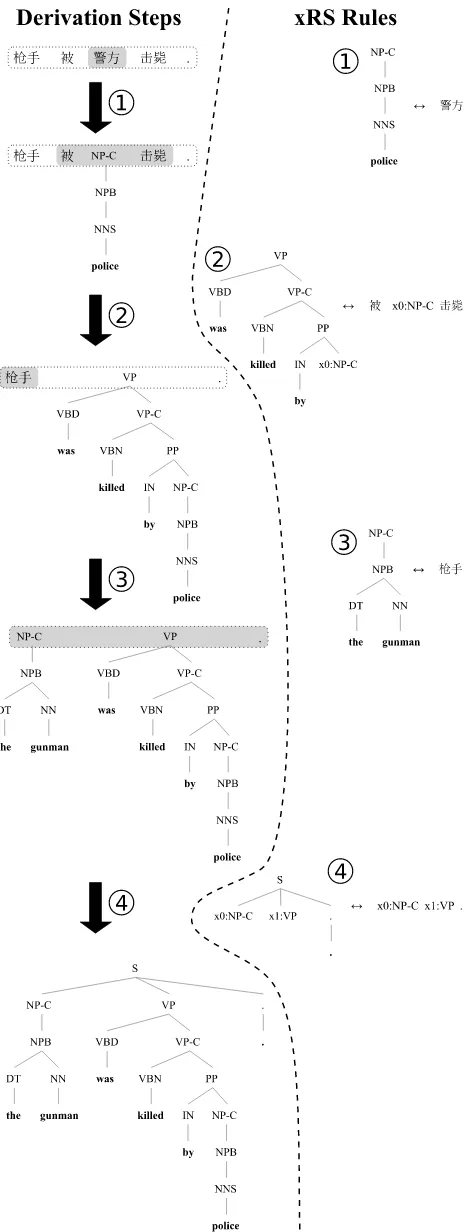
In this work, we employ a syntax-based model that applies a series of tree/string (xRS) rules (Gal-ley et al., 2004; Graehl and Knight, 2004) to a source language string to produce a target language phrase structure tree. Figure 1 exemplifies the translation
process, which is called aderivation, from Chinese
into English. The source string to translate (
.) is shown at the top left. Rule 1
replaces the Chinese word
(shaded) with the EnglishNP-Cpolice. Rule 2 then builds aVPover
the NP-C
sequence. Next, is translated as theNP-Cthe gunmanby rule3. Finally, rule 4
combines the sequence ofNP-C VP. into anS,
denot-ing a complete tree. The yield of this tree gives the target translation:the gunman was killed by police .
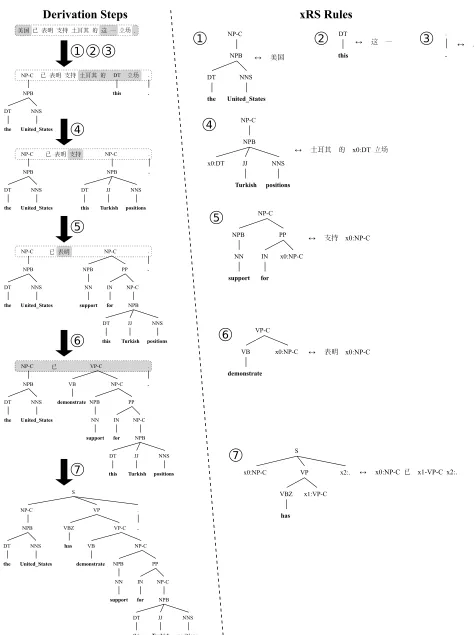
The Penn English Treebank (PTB) (Marcus et al., 1993) is our source of syntactic information, largely due to the availability of reliable parsers. It is not clear, however, whether this resource is suitable, as is, for the task of MT. In this paper, we argue that the overly-general tagset of the PTB is problematic for MT because it fails to capture important grammati-cal distinctions that are critigrammati-cal in translation. As a solution, we propose methods of relabeling the syn-tax trees that effectively improve translation quality. Consider the derivation in Figure 2. The output translation has two salient errors: determiner/noun number disagreement (*this Turkish positions) and
auxiliary/verb tense disagreement (*has demon-strate). The first problem arises because the DT
tag, which does not distinguish between singular and plural determiners, allows singular this to be used
with plural NNS positions. In the second problem,
theVP-Ctag fails to communicate that it is headed by
the base verb (VB) demonstrate, which should
pre-vent it from being used with the auxiliaryVBZhas.
Information-poor tags likeDTandVP-Ccan be
rela-beled to encourage more fluent translations, which is the thrust of this paper.
Figure 1: A derivation from a Chinese sentence to an English tree.
Section 2 describes our data and experimental procedure. Section 3 explores different relabeling approaches and their impact on translation qual-ity. Section 4 reports a substantial improvement in BLEU achieved by combining the most effective re-labeling methods. Section 5 concludes.
2 Experimental Framework
Our training data consists of 164M+167M words of parallel Chinese/English text. The English half was parsed with a reimplementation of Collins’ Model 2 (Collins, 1999) and the two halves were word-aligned using GIZA++ (Och and Ney, 2000). These three components — Chinese strings, English parse trees, and their word alignments — were inputs to our experimental procedure, which involved five steps: (1) tree relabeling, (2) rule extraction, (3) de-coding, (4)n-best reranking, (5) evaluation.
This paper focuses on step 1, in which the orig-inal English parse trees are transformed by one or more relabeling strategies. Step 2 involves extract-ing minimal xRS rules (Galley et al., 2004) from
the set of string/tree/alignments triplets. These rules are then used in a CKY-type parser-decoder to trans-late the 878-sentence 2002 NIST MT evaluation test set (step 3). In step 4, the output 2,500-sentencen
-best list is reranked using ann-gram language model
trained on 800M words of English news text. In the final step, we score our translations with 4-gram BLEU (Papineni et al., 2002).
Separately for each relabeling method, we ran these five steps and compared the resulting BLEU score with that of a baseline system with no re-labeling. To determine if a BLEU score increase or decrease is meaningful, we calculate statistical significance at 95% using paired bootstrap resam-pling (Koehn, 2004; Zhang et al., 2004) on 1,000 samples.
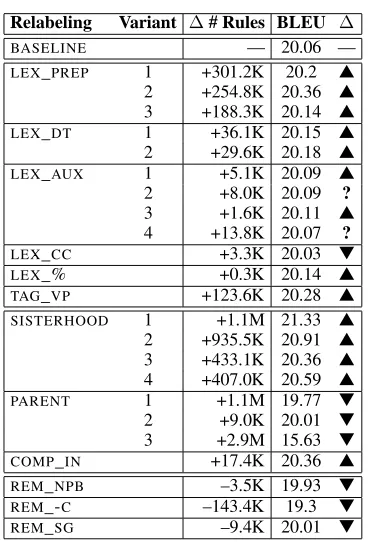
Figure 3 shows the results from each relabel-ing experiment. The second column indicates the change in the number of unique rules from the base-line number of 16.7M rules. The third column gives the BLEU score along with an indication whether it is a statistically significant increase (▲), a statisti-cally significant decrease (▼), or neither (?) over
Relabeling Variant ∆# Rules BLEU ∆
BASELINE — 20.06 — LEX_PREP 1 +301.2K 20.2 ▲
2 +254.8K 20.36 ▲
3 +188.3K 20.14 ▲ LEX_DT 1 +36.1K 20.15 ▲
2 +29.6K 20.18 ▲ LEX_AUX 1 +5.1K 20.09 ▲
2 +8.0K 20.09 ?
3 +1.6K 20.11 ▲
4 +13.8K 20.07 ?
LEX_CC +3.3K 20.03 ▼
LEX_% +0.3K 20.14 ▲
TAG_VP +123.6K 20.28 ▲
SISTERHOOD 1 +1.1M 21.33 ▲
2 +935.5K 20.91 ▲
3 +433.1K 20.36 ▲
4 +407.0K 20.59 ▲ PARENT 1 +1.1M 19.77 ▼
2 +9.0K 20.01 ▼
3 +2.9M 15.63 ▼
COMP_IN +17.4K 20.36 ▲
REM_NPB –3.5K 19.93 ▼
REM_-C –143.4K 19.3 ▼
[image:4.612.318.535.58.217.2]REM_SG –9.4K 20.01 ▼
Figure 3: For each relabeling method and variant, the impact on ruleset size and BLEU score over the baseline.
3 Relabeling
The small tagset of the PTB has the advantage of being simple to annotate and to parse. On the other hand, this can lead to tags that are overly generic. Klein and Manning (2003) discuss this as a prob-lem in parsing and demonstrate that annotating ad-ditional information onto the PTB tags leads to im-proved parsing performance. We similarly propose methods of relabeling PTB trees that notably im-prove MT quality. In the next two subsections, we explore relabeling strategies that fall under two cate-gories introduced by Klein and Manning — internal annotation and external annotation.
3.1 Internal Annotation
Internal annotation reveals information about a
node and its descendants to its surrounding nodes (ancestors, sisters, and other relatives) that is other-wise hidden. This is paramount in MT because the contents of a node must be understood before the node can be reliably translated and positioned in a sentence. Here we discuss two such strategies:
lexi-Figure 4: Rules before and after lexicalization.
calization and tag annotation.
3.1.1 Lexicalization
Many state-of-the-art statistical parsers incor-porate lexicalization to effectively capture
word-specific behavior, which has proved helpful in our system as well. We generalize lexicalization to al-low a lexical item (terminal word) to be annotated onto any ancestor label, not only its parent.
Let us revisit the determiner/noun number dis-agreement problem in Figure 2 (*this Turkish po-sitions). If we lexicalize allDTs in the parse trees,
the problematicDTis relabeled more specifically as DT_this, as seen in rule 20 in Figure 4. This also
produces rules like 40, where both the determiner
and the noun are plural (notice the DT_these), and 400
, where both are singular. With such a ruleset, 20
could only combine with 400, not 40, enforcing the
grammatical outputthis Turkish position.
We explored five lexicalization strategies, each targeting a different grammatical category. A com-mon translation mistake was the improper choice of prepositions, e.g.,responsibility to attacks.
Lexical-izing prepositions proved to be the most effective lexicalization method (LEX_PREP). We annotated a preposition onto both its parent (INor TO) and its
grandparent (PP) since the generic PPtag was often
at fault. We tried lexicalizing all prepositions (vari-ant 1), the top 15 most common prepositions (vari(vari-ant 2), and the top 5 most common (variant 3). All gave statistically significant BLEU improvements, espe-cially variant 2.
[image:4.612.94.278.59.330.2](LEX_DT), which we encountered previously in Fig-ure 4. This addresses two featFig-ures of Chinese that are problematic in translation to English: the infre-quent use of articles and the lack of overt number in-dicators on nouns. We lexicalized these determiners:
the,a,an,this,that,these, orthose, and grouped
to-gether those with similar grammatical distributions (a/an,this/that, andthese/those). Variant 1 included
all the determiners mentioned above and variant 2 was restricted totheanda/anto focus only on
arti-cles. The second slightly improved on the first. The third type was auxiliary lexicalization (LEX_AUX), in which all forms of the verb be
are annotated with _be, and similarly with do and have. The PTB purposely eliminated such
distinc-tions; here we seek to recover them. However, auxiliaries and verbs function very differently and thus cannot be treated identically. Klein and Man-ning (2003) make a similar proposal but omit do.
Variants 1, 2, and 3, lexicalizehave,be, anddo,
re-spectively. The third variant slightly outperformed the other variants, including variant 4, which com-bines all three.
The last two methods are drawn directly from Klein and Manning (2003). In CC lexicalization
(LEX_CC), both but and & are lexicalized since
these two conjunctions are distributed very differ-ently compared to other conjunctions. Though help-ful in parsing, it proved detrimental in our system. In%lexicalization (LEX_%), the percent sign (%) is
given its ownPCTtag rather than its typical NNtag,
which gave a statistically significant BLEU increase.
3.1.2 Tag Annotation
In addition to propagating up a terminal word, we can also propagate up a nonterminal, which we call
tag annotation. This partitions a grammatical
cat-egory into more specific subcategories, but not as fine-grained as lexicalization. For example, a VP
headed by a VBG can be tag-annotated asVP_VBG
to represent a progressive verb phrase.
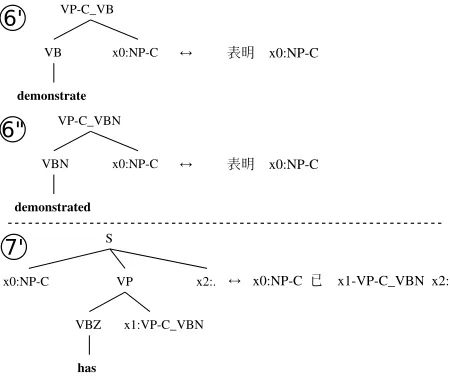
Let us once again return to Figure 2 to address the auxiliary/verb tense disagreement error (*has demonstrate). The auxiliaryhasexpects aVP-C,
per-mitting the bare verb phrasedemonstrateto be
incor-rectly used. However, if we tag-annotate allVP-Cs,
rule 6 would be relabeled as VP-C_VB in rule 60
[image:5.612.313.538.62.252.2]and rule7 as70 in Figure 5. Rule60 can no longer
Figure 5: Rules before and after tag annotation.
join with 70, while the variant rule 600 can, which
produces the grammatical resulthas demonstrated.
We noticed many wrong verb tense choices, e.g., gerunds and participles used as main sentence verbs. We resolved this by tag-annotating everyVPand VP-Cwith its head verb (TAG_VP). Note that we group VBZand VBPtogether since they have very similar
grammatical distributions and differ only by number. This strategy gave a healthy BLEU improvement.
3.2 External Annotation
In addition to passing information from inside a node to the outside, we can pass information from the external environment into the node through ex-ternal annotation. This allows us to make
transla-tion decisions based on the context in which a word or phrase is found. In this subsection, we look at three such methods: sisterhood annotation, parent annotation, and complement annotation.
3.2.1 Sisterhood Annotation
The single most effective relabeling scheme we tried was sisterhood annotation. We annotate each
nonterminal with#Lif it has any sisters to the left, #Rif any to the right,#LRif on both sides, and
noth-ing if it has no sisters. This distnoth-inguishes between words that tend to fall on the left or right border of a constituent (often head words, likeNN#Lin anNP
orIN#Rin aPP), in the middle of a constituent
Figure 6: A bad translation fixable by sisterhood or parent annotation.
(often particles and pronouns, likeRPand PRP). In
our outputs, we frequently find words used in posi-tions where they should be disallowed or disfavored. Figure 6 presents a derivation that leads to the ungrammatical output *deeply love she. The
sub-ject pronounsheis incorrectly preferred over the
ob-ject formherbecause the most popular NP-C
trans-lation for is she. We can sidestep this mistake
through sisterhood-annotation, which yields the re-labeled rules 30 and 40 in Figure 7. Rule 40
ex-pects anNP-Con the right border of the constituent
(NP-C#L). Sinceshenever occurs in this position in
the PTB, it should never be sisterhood-annotated as an NP-C#L. It does occur with sisters to the right,
which gives the NP-C#R rule 30. The object NP-C
her, on the other hand, is frequently rightmost in a
constituent, which is reflected in theNP-C#Lrule300.
Using this rule with rule 40 gives the desired result
deeply love her.
We experimented with four sisterhood annotation (SISTERHOOD) variants of decreasing complexity. The first was described above, which includes right-most (#L), leftmost (#R), middle (#LR), and alone (no
annotation). Variant 2 omitted #LR, variant 3 kept
only#LR, and variant 4 only annotated nodes
[image:6.612.320.538.64.154.2]with-out sisters. Variants 1 and 2 produced the largest gains from relabeling: 1.27 and 0.85 BLEU points, respectively.
Figure 7: Rules before and after sisterhood annota-tion.
Figure 8: Rules before and after parent annotation.
3.2.2 Parent Annotation
Another common relabeling method in parsing is
parent annotation(Johnson, 1998), in which a node
is annotated with its parent’s label. Typically, this is done only to nonterminals, but Klein and Man-ning (2003) found that annotating preterminals as well was highly effective. It seemed likely that such contextual information could also benefit MT.
Let us tackle the bad output from Figure 6 with parent annotation. In Figure 8, rule4 is relabeled as
rule40 and expects anNP-CˆVP, i.e., anNP-Cwith a VPparent. In the PTB, we observe that theNP-Cshe
never has aVP parent, whileher does. In fact, the
most popular parent for theNP-CherisVP, while the
most popular parent forsheisS. Rule3 is relabeled
as theNP-CˆSrule30 andheris expressed as the NP-CˆVPrule300. Only rule300 can partner with rule40,
which produces the correct outputdeeply love her.
We tested three variants of parent annota-tion (PARENT): (1) all nonterminals are parent-annotated, (2) only S nodes are parent-annotated,
and (3) all nonterminals are parent- and grandparent-annotated (the annotation of a node’s parent’s par-ent). The first and third variants yielded the largest ruleset sizes of all relabeling methods. The second variant was restricted only to S to capture the
[image:6.612.310.538.205.296.2]em-bedded clauses (likeSˆS-C). Unfortunately, all three
variants turned out to be harmful in terms of BLEU.
3.2.3 Complement Annotation
In addition to a node’s parent, we can also anno-tate a node’s complement. This captures the fact that words have a preference of taking certain comple-ments over others. For instance, 96% of cases where theINof takes one complement in the PTB, it takes
NP-C. On the other hand,althoughnever takesNP-C
but takesS-C99% of the time.
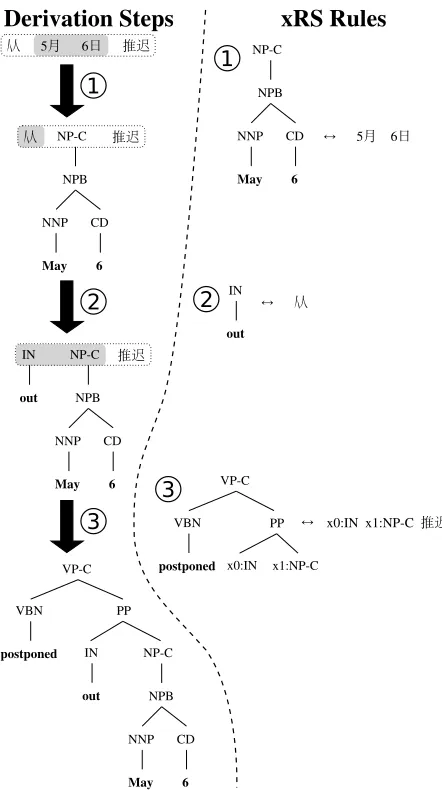
Consider the derivation in Figure 9 that results in the bad output *postponed out May 6. The IN out
is incorrectly allowed despite the fact that it almost never takes anNP-Ccomplement (0.6% of cases in
the PTB). A way to restrict this is to annotate the
IN’s complement. Complement-annotated versions
of rules 2 and 3 are given in Figure 10. Rule
2
is relabeled as the IN/PP-C rule 20 since PP-C
is the most common complement for out (99% of
the time). Since rule300 expects anIN/NP-C, rule20
is disqualified. The preposition from (rule 200), on
the other hand, frequently takesNP-Cas complement
(82% of the time). Combining rule200 with rule30
ensures the correct outputpostponed from May 6.
Complement-annotating all IN tags with their
complement if they had one and only one comple-ment (COMP_IN) gave a significant BLEU improve-ment with only a modest increase in ruleset size.
3.3 Removal of Parser Annotations
Many parsers, though trained on the PTB, do not preserve the original tagset. They may omit func-tion tags (like-TMP), indices, and null/gap elements
or add annotations to increase parsing accuracy and provide useful grammatical information. It is not obvious whether these modifications are helpful for MT, so we explore the effects of removing them.
The statistical parser we used makes three re-labelings: (1) base NPs are relabeled as NPB, (2)
argument nonterminals are suffixed with -C, and
(3) subjectless sentences are relabeled from S to SG. We tried removing each annotation individually
[image:7.612.315.536.56.451.2](REM_NPB, REM_-C, and REM_SG), but doing so significantly dropped the BLEU score. This leads us to conclude these parser additions are helpful in MT.
Figure 9: A bad translation fixable by complement annotation.
Figure 10: Rules before and after complement anno-tation.
4 Evaluation
[image:7.612.319.536.502.586.2]∆# Rules BLEU Relabeling Variant Ind. Cum. Ind. Cum.
BASELINE — — 20.06 20.06 LEX_% +0.3K +0.3K 20.14 20.14 LEX_DT 2 +29.6K +29.9K 20.18 20.3
[image:8.612.75.296.63.156.2]TAG_VP +123.6K +153.5K 20.28 20.43 LEX_PREP 2 +254.8K +459.0K 20.36 21.25 SISTERHOOD 1 +1.1M +1.5M 21.33 22.38
Figure 11: Relabelings in the additive system and their individual/cumulative effects over the baseline.
2,TAG_VP, LEX_PREP variant 2, andSISTERHOOD variant 1. These relabelings contributed to a 2.3 ab-solute (11.6% relative) BLEU point increase over the baseline, with a score of 22.38. Figure 11 lists these relabelings in the order they were added.
5 Conclusion
We have demonstrated that relabeling syntax trees for use in syntax-based machine translation can sig-nificantly boost translation performance. It is naïve to assume that linguistic resources can be immedi-ately useful out of the box, in our case, the Penn Treebank for MT. Rather, we targeted features of the PTB tagset that impair translatability and proposed relabeling strategies to overcome these weaknesses. Many of our ideas effectively raised the BLEU score over a baseline system without relabeling. Finally, we demonstrated through an additive system that re-labelings can be combined together to achieve an even greater improvement in translation quality.
Acknowledgments
This research was supported in part by NSF grant IIS-0428020. We would like to thank Greg Lang-mead, Daniel Marcu, and Wei Wang for helpful comments. This paper describes work conducted while the first author was at the University of South-ern California/Information Sciences Institute.
References
Hiyan Alshawi, Srinivas Bangalore, and Shona Douglas. 2000. Learning dependency translation models as collections of finite state head transducers. Computational Linguistics,
26(1):45–60.
David Chiang. 2005. A hierarchical phrase-based model for statistical machine translation. InProceedings of ACL-05.
Michael Collins, Philipp Koehn, and Ivona Kuˇcerová. 2005. Clause restructuring for statistical machine translation. In
Proceedings of ACL-05, pages 531–540.
Michael Collins. 1999.Head-driven statistical models for nat-ural language parsing. Ph.D. thesis, University of
Pennsyl-vania.
Jason Eisner. 2003. Learning non-isomorphic tree mappings for machine translation. InProceedings of ACL-03 (Com-panion Volume), pages 205–208.
Michel Galley, Mark Hopkins, Kevin Knight, and Daniel Marcu. 2004. What’s in a translation rule? In Proceed-ings of HLT/NAACL-04, pages 273–280.
Dan Gildea. 2003. Loosely tree-based alignment for machine translation. InProceedings of ACL-03.
Jonathan Graehl and Kevin Knight. 2004. Training tree trans-ducers. InProceedings of HLT/NAACL-04, pages 105–112.
Mary Hearne and Andy Way. 2003. Seeing the wood for the trees: Data-Oriented Translation. InProceedings of MT Summit IX.
Mark Johnson. 1998. PCFG models of linguistic tree represen-tations.Computational Linguistics, 24(4):613–632.
Dan Klein and Christopher D. Manning. 2003. Accurate unlex-icalized parsing. InProceedings of ACL-03, pages 423–430.
Philipp Koehn, Franz Josef Och, and Daniel Marcu. 2003. Statistical phrase-based translation. In Proceedings of HLT/NAACL-03.
Philipp Koehn. 2004. Statistical significance tests for machine translation evaluation. InProceedings of EMNLP-04.
Daniel Marcu and William Wong. 2002. A phrase-based, joint probability model for statistical machine translation. In Pro-ceedings of EMNLP-02.
Mitchell Marcus, Beatrice Santorini, and Mary A. Marcinkiewicz. 1993. Building a large annotated cor-pus of English: the Penn Treebank. Computational Linguistics, 19(2):313–330.
I. Dan Melamed. 2004. Statistical machine translation by pars-ing. InProceedings of ACL-04, pages 653–660.
Franz Josef Och and Hermann Ney. 2000. Improved statistical alignment models. InProceedings of ACL-00.
Franz Josef Och and Hermann Ney. 2004. The alignment tem-plate approach to statistical machine translation. Computa-tional Linguistics, 30(4):417–449.
Kishore Papineni, Salim Roukos, Todd Ward, and Wei-Jing Zhu. 2002. BLEU: a method for automatic evaluation of machine translation. InProceedings of ACL-02.
Chris Quirk, Arul Menezes, and Colin Cherry. 2005. De-pendency treelet translation: syntactically informed phrasal SMT. InProceedings of ACL-05, pages 271–279.
Dekai Wu. 1997. Stochastic inversion transduction grammars and bilingual parsing of parallel corpora. Computational Linguistics, 23(3):377–403.
Fei Xia and Michael McCord. 2004. Improving a statistical MT system with automatically learned rewrite patterns. In
Proceedings of COLING-04.
Kenji Yamada and Kevin Knight. 2001. A syntax-based statis-tical translation model. InProceedings of ACL-01.