178
Acquiring Structured Temporal Representation
via Crowdsourcing: A Feasibility Study
Yuchen Zhang Brandeis University
Nianwen Xue Brandeis University
Abstract
Temporal Dependency Trees are a structured temporal representation that represents tem-poral relations among time expressions and events in a text as a dependency tree struc-ture. Compared to traditional pair-wise tem-poral relation representations, temtem-poral de-pendency trees facilitate efficient annotations, higher inter-annotator agreement, and efficient computations. However, annotations on tem-poral dependency trees so far have only been done by expert annotators, which is costly and time-consuming. In this paper, we introduce a method to crowdsource temporal dependency tree annotations, and show that this representa-tion is intuitive and can be collected with high accuracy and agreement through crowdsourc-ing. We produce a corpus of temporal depen-dency trees, and present a baseline temporal dependency parser, trained and evaluated on this new corpus.
1 Introduction
Temporal relation extraction is an important NLP task for a range of downstream applications, such as question answering, summarization, and sto-ryline generation. This task has attracted a sig-nificant amount of research interest (Pustejovsky et al., 2003a; Verhagen et al., 2007, 2010; Uz-Zaman et al., 2012; Bethard et al., 2016, 2017;
Dligach et al., 2017; Leeuwenberg and Moens,
2017;Ning et al.,2017,2018a,b;Zhang and Xue,
2018a,b). One practical challenge in temporal re-lation extraction is to represent the temporal rela-tions in a text in a way that is feasible for man-ual annotation and producing training data for ma-chine learning models. Given a text of nevents and time expressions, there are n2
possible re-lations if the temporal relation between all pairs of events and time expressions is annotated. This quickly becomes infeasible even for a text of mod-est length. One way to address this problem is to
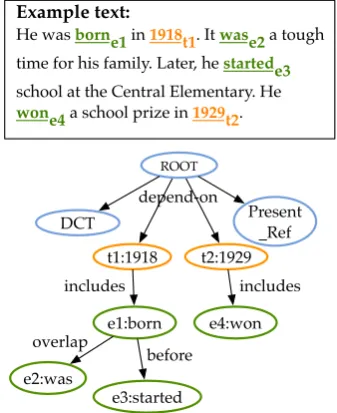
represent the temporal relations in a text as a Tem-poral Dependency Tree (TDT) structure (Zhang and Xue, 2018b). TDT models all time expres-sions and events in a text as “nodes” in a depen-dency tree, and temporal relations between each time/event and its parent time/event as “edges” in the tree. Figure 1 gives an example text and its TDT. Each (parent, child) pair in Figure1 is an-notated with a temporal relation. The number of temporal relations that need to be annotated in a text is therefore linear to the number of events and time expressions in a text, making the annotation task feasible. At the same time, additional tem-poral relations can be inferred as needed based on the TDT structure. For example, in Figure1since “1918”includesthe “born” event and “1929” in-cludesthe “won” event, it can be inferred that the “born” event occurredbeforethe “won” event.
By providing annotators with detailed guide-lines and training them in multiple iterations,
Zhang and Xue(2018b) have shown that the TDT representation can be annotated with high inter-annotator agreement. Zhang and Xue (2018a) further show that a neural ranking model can be successfully trained on the corpus. However, this “traditional” approach to annotation is time-consuming and expensive. The question we want to answer in this paper is whether TDT can be performed with crowdsourcing, a method that has gained popularity as a means to acquire linguis-tically annotated data quickly and cost-effectively for NLP research.
Crowdsourcing has been used to annotate data for a wide range of NLP tasks that include ques-tion answering, word similarity, text entailment, word sense disambiguation, machine translation, information extraction, summarization, and se-mantic role labeling (Snow et al., 2008; Finin et al., 2010; Zaidan and Callison-Burch, 2011;
key to acquiring high quality data via crowd-sourcing is to make sure that the tasks are in-tuitive or can be decomposed into inin-tuitive sub-tasks. In this paper, we show that it is possible to acquire high quality temporal dependency struc-tures through crowdsourcing, and that a temporal dependency parser can be successfully trained on crowdsourced TDTs.
The rest of the paper is organized as follows. We first explain in detail how we set up this depen-dency tree crowdsourcing annotation task (§2). In (§3) we present experimental results that show that if temporal dependency structures are broken into smaller subtasks, high inter-annotator agreement can be achieved. In (§4), we show that crowd-source data can be used to successfully train tem-poral dependency parsers, including an attention-based neural model (§4). We discuss related work (§5) and conclude with future work (§6).
The main contributions of this paper are: (1) we introduce an effective approach to crowdsource structured temporal annotations, a relatively com-plex annotation task; (2) we build an English temporal dependency tree corpus through crowd-sourcing that we plan to make publicly available; and (3) we experiment with automatic temporal dependency parsers on this new corpus and report competitive results.
Example text:
He was borne1 in 1918t1. It wase2 a tough time for his family. Later, he startede3 school at the Central Elementary. He wone4 a school prize in 1929t2.
e1:born t1:1918 includes t2:1929 e4:won includes e2:was overlap e3:started before depend-on ROOT
[image:2.595.96.265.471.678.2]DCT Present_Ref
Figure 1: Example text and its temporal dependency tree. The nodes in blue are meta nodes (e.g., doc-ument creation time “DCT”, present reference time “Present Ref”, etc.), the nodes in orange are time ex-pressions, and the nodes in green are events.
2 Crowdsourcing Tasks Setup
2.1 Data Setup
Our TDT annotations are performed on top of the TimeBank corpus (Pustejovsky et al.,2003b), with time expressions and events already extracted. Following (Zhang and Xue,2018b), we focus only on events that are matrix verbs (i.e. main verbs) in a sentence. In order to extract matrix verbs, we use the gold constituent trees for the part of TimeBank that overlaps with the Penn Treebank, and parse the rest of TimeBank with the Berkeley Neural Parser (Kitaev and Klein, 2018). All time expressions in TimeBank are kept.
To facilitate quality control in crowdsourcing and agreement evaluation, we distinguish two sub-sets of the TimeBank dataset: (1) TB-small is a small subset of 10 short Wall Street Journal news documents with 59 matrix verbs. (2) TB-dense consists of the same 36 documents as in the TimeBank-Dense corpus (Cassidy et al., 2014). It contains 654 matrix verbs. small and TB-dense are annotated by both crowd workers and experts.
2.2 Annotation Tasks
We set up two annotation tasks. The first is full temporal dependency tree annotation, where crowd workers need to annotate both the depen-dency tree structure and the temporal relations between each parent and child. The second is relation-only annotation, where crowd workers are given the gold temporal dependency trees and their job is just to label the temporal relation for each parent-child pair.
2.3 Crowdsourcing Design
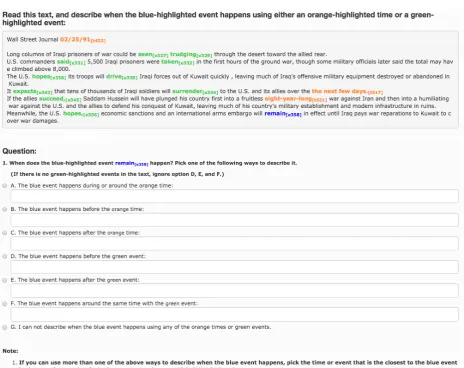
relation between the two. See Appendix A for ex-ample crowdsourcing instructions and questions.
Following standard crowdsourcing quality con-trol, we perform a qualifying test on both annota-tion tasks. Any crowd worker who wants to work on these tasks needs to complete annotations on TB-small and reach at least 70% accuracy against the expert gold annotation. We also perform a surviving test on the relation-only annotation task. Crowd workers have to maintain at least a cumula-tive accuracy of 70% for their annotation. Workers with a lower accuracy will get blocked from the task and all of their annotations will be discarded. Every annotation is completed by at least 3 anno-tators and the majority vote is the final annotation.
3 Annotation Experiments
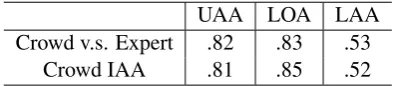
Crowdsourcing annotations on the full TimeBank corpus was performed. We report Inter-Annotator Agreement (IAA) scores in Table1.
UAA LOA LAA
Crowd v.s. Expert .82 .83 .53
Crowd IAA .81 .85 .52
Table 1: Inter-Annotator Agreement scores between crowdsourced and expert annotations, and IAAs among crowd worker annotations.
First, crowdsourced majority annotations on TB-dense are evaluated against expert annota-tions, representing the quality of the crowdsourced data. For this comparison, the standard depen-dency parsing evaluation metrics (K¨ubler et al.,
2009) are used as our IAA scores: structure-only annotation subtask is evaluated with the Unlabeled Attachment Agreement (UAA) score, relation-only annotation subtask is evaluated with the Label Only Agreement (LOA) score, and full pipeline annotation is evaluated with the Labeled Attachment Agreement (LAA) score.
Second, crowd worker annotations are com-pared against each other, indicating the difficulty, consistency, and confidence of the crowdsourced data. Since crowd workers annotate isolated events/times instead of full dependency structures, the standard dependency parsing metrics are not applicable for this comparison1. Therefore, we adopt the Worker Agreements With Aggregate (WAWA) metric (Ning et al.,2018a) as our IAA
1And for the same reason, Cohen’s kappa and Fleiss’
kappa scores are not applicable here either.
scores. WAWA indicates the average number of crowd worker responses agreed with the aggregate answer (i.e. majority aggregation for each annota-tion instance), representing the agreements among crowd workers and how consistent their annota-tions are with each other.
As shown in the table, high accuracies and agreements are achieved for both the subtasks of structure annotation and relation-only annotation (above 80%).
Statistics on our corpus and other similar TimeBank-based temporal relation corpora are presented in Table 2. As the number of tempo-ral relations is linear to the number of events and time expressions in a text, fewer temporal relations need to be annotated in our corpus. In compari-son, the recently crowdsourced temporal structure corpus MATRES (Ning et al. (2018a), see Sec-tion5for more details) only annotates verb events in a document while TB-dense annotates a larger number of time expressions and events in a much smaller number of documents. Our corpus retains the full set of TimeBank time expressions and cov-ers comparable number of events as MATRES. We pay $0.01 for each individual annotation and the entire TimeBank TDT annotation cost about $300 in total.
Docs Timex Events Rels
TimeBank 183 1,414 7,935 6,418
TB-Dense 36 289 1,729 12,715
MATRES 275 - 1,790 13,577
[image:3.595.82.280.350.393.2]This work 183 1,414 2,691 4,105
Table 2: Documents, timex, events, and temporal rela-tion statistics in various temporal corpora.
4 System Experiments
We experiment with a state-of-the-art attention-based neural temporal dependency parser (Zhang and Xue, 2018a)2 on our newly annotated data.
Our training data consists of two parts. The first part is the crowdsourced temporal dependency an-notations over the TimeBank documents (exclud-ing documents that are in the dev and test sets in the TimeBank-Dense corpus3). The second part is our expert-annotated TDTs on the TimeBank-Dense training set documents. The parser is tuned
2
https://github.com/yuchenz/tdp_ ranking
3Standard TimeBank-Dense train/dev/test split can be
and evaluated on our expert TDT annotations on the TimeBank-Dense dev and test sets, respec-tively. This neural model represents words with bi-LSTM vectors and uses an attention-based mecha-nism to represent multi-word time expressions and events.
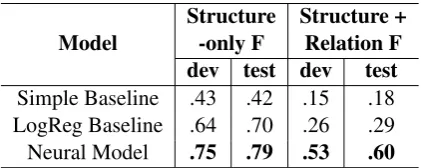
We also experiment with two baseline parsers fromZhang and Xue(2018a): (1) a simple base-line that takes an event’s immediate previous time expression or event as its parent and assigns the majority “overlap” as the temporal relation be-tween them; and (2) a logistic regression model that represents time expressions and events with their time/event type features, lexical features, and distance features. Table3shows the performance of these systems on our data.
Model
Structure -only F
Structure + Relation F dev test dev test
Simple Baseline .43 .42 .15 .18
LogReg Baseline .64 .70 .26 .29
[image:4.595.76.287.291.375.2]Neural Model .75 .79 .53 .60
Table 3: Parsing results of the simple baseline, logis-tic regression baseline, and the neural temporal depen-dency model.
Improved performance over the simple base-line with both the LogReg system and the Neu-ral system show that tempoNeu-ral dependency infor-mation can be learned from this crowdsourced corpus. Comparisons between the LogReg base-line and the Neural model show that the Neu-ral model adapts better to new data sets than the LogReg model with manually-crafted language-specific features.
5 Related Work
Although crowdsourcing is widely used in other NLP tasks, there have been only a few temporal relation annotation tasks via crowdsourcing. The first attempt on crowdsourcing temporal relation annotations is described in Snow et al. (2008). They selected a restricted subset of verb events from TimeBank and performed strict before/after temporal relation annotation through crowdsourc-ing. They reported high agreements showing that simple temporal relations are crowdsourceable.
Ng and Kan(2012) adopts the TimeML represen-tation from the TimeBank, and crowdsourced tem-poral annotations on news articles crawled from
news websites. Their experiments show that the large crowdsourced data improved classifier per-formance significantly. However, both of these works focused on pair-wise temporal relations and didn’t experiment with crowdsourcing more com-plex temporal structures. Vempala and Blanco
(2018) uses a crowdsourcing approach to collect temporal and spatial knowledge. However, they first automatically generated such knowledge and then used crowdsourcing to either validate or dis-card these automatically generated information, and crowdsourcing was not utilized to do anno-tation from scratch.
Ning et al.(2018a) proposed a “multi-axis” rep-resentation of temporal relations in a text, and pub-lished the MATRES corpus by annotating “multi-axis” temporal structures on top of the TempEval-3 data through crowdsourcing. In this representa-tion, events are annotated on different “axes” ac-cording to their eventuality types, and for events on the same axis, pair-wise temporal relations are annotated. Their annotation task is broken down to two smaller subtasks too. In the first subtask, crowd workers annotate whether an event is on a given axis. In the second subtask, crowd workers annotate the temporal relations between pairs of events on the same axis. The main differences be-tween their work and ours are as follows. First, they only model events, excluding time expres-sions which are important temporal components in text too. Second, our temporal dependency tree representation is very different from their multi-axis temporal representation, which requires dif-ferent crowdsourcing task designs. In their first subtask, crowd workers need to distinguish differ-ent evdiffer-entuality types, while our annotation exper-iments show that crowd workers can also consis-tently recognize “parents” as defined inZhang and Xue(2018b) for given events.
6 Conclusion and Future Work
References
Steven Bethard, Guergana Savova, Wei-Te Chen, Leon Derczynski, James Pustejovsky, and Marc Verhagen. 2016. Semeval-2016 task 12: Clinical tempeval. In Proceedings of the 10th International Workshop on Semantic Evaluation (SemEval-2016), pages 1052– 1062.
Steven Bethard, Guergana Savova, Martha Palmer, and James Pustejovsky. 2017. Semeval-2017 task 12: Clinical tempeval. In Proceedings of the 11th International Workshop on Semantic Evalua-tion (SemEval-2017), pages 565–572.
Taylor Cassidy, Bill McDowell, Nathanael Chambers, and Steven Bethard. 2014. An annotation frame-work for dense event ordering. InProceedings of the 52nd Annual Meeting of the Association for Compu-tational Linguistics (Volume 2: Short Papers), vol-ume 2, pages 501–506.
Dmitriy Dligach, Timothy Miller, Chen Lin, Steven Bethard, and Guergana Savova. 2017. Neural tem-poral relation extraction. InProceedings of the 15th Conference of the European Chapter of the Associa-tion for ComputaAssocia-tional Linguistics: Volume 2, Short Papers, volume 2, pages 746–751.
Tim Finin, Will Murnane, Anand Karandikar, Nicholas Keller, Justin Martineau, and Mark Dredze. 2010. Annotating named entities in twitter data with crowdsourcing. InProceedings of the NAACL HLT 2010 Workshop on Creating Speech and Language Data with Amazon’s Mechanical Turk, pages 80–88. Association for Computational Linguistics.
Nikita Kitaev and Dan Klein. 2018. Constituency parsing with a self-attentive encoder. In Proceed-ings of the 56th Annual Meeting of the Association for Computational Linguistics (Volume 1: Long Pa-pers), Melbourne, Australia. Association for Com-putational Linguistics.
Sandra K¨ubler, Ryan McDonald, and Joakim Nivre. 2009. Dependency parsing. Synthesis Lectures on Human Language Technologies, 1(1):1–127.
Tuur Leeuwenberg and Marie-Francine Moens. 2017. Structured learning for temporal relation extraction from clinical records. In Proceedings of the 15th Conference of the European Chapter of the Asso-ciation for Computational Linguistics, pages 1150– 1158.
Elena Lloret, Laura Plaza, and Ahmet Aker. 2013. An-alyzing the capabilities of crowdsourcing services for text summarization. Language resources and evaluation, 47(2):337–369.
Jun-Ping Ng and Min-Yen Kan. 2012. Improved tem-poral relation classification using dependency parses and selective crowdsourced annotations. Proceed-ings of COLING 2012, pages 2109–2124.
Qiang Ning, Zhili Feng, and Dan Roth. 2017. A struc-tured learning approach to temporal relation extrac-tion. InProceedings of the 2017 Conference on Em-pirical Methods in Natural Language Processing, pages 1027–1037.
Qiang Ning, Hao Wu, and Dan Roth. 2018a. A multi-axis annotation scheme for event temporal relations. arXiv preprint arXiv:1804.07828.
Qiang Ning, Zhongzhi Yu, Chuchu Fan, and Dan Roth. 2018b. Exploiting partially annotated data in tempo-ral relation extraction. InProceedings of the Seventh Joint Conference on Lexical and Computational Se-mantics, pages 148–153.
James Pustejovsky, Jos´e M Castano, Robert Ingria, Roser Sauri, Robert J Gaizauskas, Andrea Set-zer, Graham Katz, and Dragomir R Radev. 2003a. Timeml: Robust specification of event and tempo-ral expressions in text. New directions in question answering, 3:28–34.
James Pustejovsky, Patrick Hanks, Roser Sauri, An-drew See, Robert Gaizauskas, Andrea Setzer, Dragomir Radev, Beth Sundheim, David Day, Lisa Ferro, et al. 2003b. The timebank corpus. InCorpus linguistics, volume 2003, page 40. Lancaster, UK.
Pranav Rajpurkar, Robin Jia, and Percy Liang. 2018. Know what you don’t know: Unanswerable ques-tions for squad.arXiv preprint arXiv:1806.03822.
Rion Snow, Brendan O’Connor, Daniel Jurafsky, and Andrew Y Ng. 2008. Cheap and fast—but is it good?: evaluating non-expert annotations for natu-ral language tasks. InProceedings of the conference on empirical methods in natural language process-ing, pages 254–263. Association for Computational Linguistics.
Naushad UzZaman, Hector Llorens, James Allen, Leon Derczynski, Marc Verhagen, and James Pustejovsky. 2012. Tempeval-3: Evaluating events, time ex-pressions, and temporal relations. arXiv preprint arXiv:1206.5333.
Alakananda Vempala and Eduardo Blanco. 2018. An-notating temporally-anchored spatial knowledge by leveraging syntactic dependencies. InProceedings of the Eleventh International Conference on Lan-guage Resources and Evaluation (LREC-2018).
Marc Verhagen, Robert Gaizauskas, Frank Schilder, Mark Hepple, Graham Katz, and James Pustejovsky. 2007. Semeval-2007 task 15: Tempeval temporal relation identification. In Proceedings of the 4th International Workshop on Semantic Evaluations, pages 75–80. Association for Computational Lin-guistics.
Omar F Zaidan and Chris Callison-Burch. 2011. Crowdsourcing translation: Professional quality from non-professionals. InProceedings of the 49th Annual Meeting of the Association for Computa-tional Linguistics: Human Language Technologies-Volume 1, pages 1220–1229. Association for Com-putational Linguistics.
Yuchen Zhang and Nianwen Xue. 2018a. Neural rank-ing models for temporal dependency structure pars-ing. InProceedings of the 2018 Conference on Em-pirical Methods in Natural Language Processing, pages 3339–3349.
A Appendix: Example Crowdsourcing Instructions and Questions