Critical Reflections on Evaluation Practices in Coreference Resolution
Gordana Ili´c Holen
Department of Informatics University of Oslo
Norway
Abstract
In this paper we revisit the task of quantitative evaluation of coreference resolution systems. We review the most commonly used metrics (MUC,B3,CEAFandBLANC) on the basis of their evaluation of coreference resolution in five texts from the OntoNotes corpus. We ex-amine both the correlation between the met-rics and the degree to which our human judge-ment of coreference resolution agrees with the metrics. In conclusion we claim that loss of information value is an essential factor, insuf-ficiently adressed in current metrics, in human perception of the degree of success or failure of coreference resolution. We thus conjec-ture that including a layer of mention infor-mation weight could improve both the coref-erence resolution and its evaluation.
1 Introduction and motivation
Coreference resolution (CR) is the task of link-ing together multiple expressions of a given entity (Yang et al., 2003). The field has experienced a surge of interest with several shared tasks in re-cent years: SemEval 2010 (Recasens et al., 2010), CoNLL 2011 (Pradhan et al., 2011) and CoNLL 2012 (Pradhan et al., 2012). However the field has from the very start been riddled with problems re-lated to the scoring and comparison of CR systems. Currently there are five metrics in wider use: MUC
(Vilain et al., 1995),B3(Bagga and Baldwin, 1998),
the twoCEAFmetrics (Luo, 2005) and BLANC
(Re-casens and Hovy, 2011). As there is no global agree-ment on which metrics are the most appropriate, the
above-mentioned shared tasks have used a combi-nation of several metrics to evaluate the contenders. Although coreference resolution is a subproblem of natural language understanding, coreference resolu-tion evaluaresolu-tion metrics have predominately been dis-cussed in terms of abstract entities and hypothetical system errors. In our view, it is of utmost importance to observe actual texts and actual system errors.
2 Background: The metrics
In this section, we will present the five metrics in the usual terms of precision, recall and F-score. We fol-low the predominant practice and use the term men-tion for individual referring expressions, andentity for sets of mentions that refer to the same object (Luo et al., 2004). We use the termkey entity (K) for gold entities, andresponse entity (R)for entities which were produced by the CR system.
2.1 Link-based: MUC and BLANC
The MUC metric (Vilain et al., 1995) is based on
comparing the number of links in the key entity (|K| −1) to the number of links missing from the response entity, routinely calculated as the number of partitions of the key entity|p(K)|minus one, so
Recall = (|K|−1)|K−(|−|p(K)1 |−1) = |K||−|K|−p(K)1 |. For the whole document, recalls for entities are simply added: Recall = PP|Ki|−|p(Ki)|
(|Ki|−1) In calculating
pre-cision, the case is inverted: The base entity is now the response, and the question posed is how many missing links have to be added to the key partitions to form the response entity.
BLANC(Recasens and Hovy, 2011) is a variant of
the Rand index (Rand, 1971) adapted for the task
of coreference resolution. TheBLANCmetric makes
use of both coreferent and non-coreferent links, cor-rect and incorcor-rect. The final precision, recall and F-score are the average of the P, R and F-score of corresponding coreferential and non-referential val-ues. However, since this is an analysis of isolated entities, there are no non-coreferential links. For that reason, in this paper we only present corefer-ential precision, recall and F-score for this metric:
Pc= rc+wcrc ,Rc = rc+wnrc andFc = P2Pc+RcRcc, where
rc is the number of correct coreferential links, wc the number of incorrect coreferential links, andwn is the number of non-coreferential links incorrectly marked as coreferent by the system.
2.2 Entity and mention-based: B3and CEAF
B3 (Bagga and Baldwin, 1998) calculates precision
and recall for every mention in the document, and then combines them to an overall precision and re-call. Precision of a single mentionmiis the number
of correct mentions in the response entity Ri that
containsmidivided by the total number of mentions
inRi. Recall of mi is again the number of correct
mentions inRi, this time divided by the number of
mentions in the key entityKi that contains mention
mi. The precision and recall for the entire
docu-ment can be calculated as weighted sums of preci-sion and recall of the individual mentions. The de-fault weight, also used in this experiment is 1
n, where
nis the number of mentions in the document.
CEAF(Luo, 2005) is based on the best alignment
of subsets of key and response entities. For any mapping g ∈ Gm the total similarity Φ(g) is the
sum of all similarities. The best alignment g∗ is
found by maximizing the sum of similarities Φ(g) between the key and response entities, while the maximum total similarity is the sum of the best sim-ilarities. Precision and recall are defined in terms of the similarity measure Φ(g∗): P = PΦ(g∗)
iφ(Ri,Ri) R= P Φ(g∗)
iφ(Ki,Ki).
There are two versions of CEAF with different
similarity measures, φm(K, R) = |K ∩ R| and
φe(K, R) = |2K|K|+∩|RR||. φe is the basis for CEAFe
which shows a measure of correct entities while
CEAFm, based onφm, shows the percentage of
cor-rectly resolved mentions.
MUC B3 CEAFe CEAFm BLANC MELA
MUC – 0.46 0.22 0.47 0.35 0.63
B3 0.59 – 0.47 0.56 0.42 0.61
CEAFe 0.46 0.59 – 0.51 0.26 0.38
CEAFm 0.57 0.70 0.62 – 0.46 0.60
BLANC 0.57 0.70 0.57 0.68 – 0.35
[image:2.612.315.542.56.126.2]MELA 0.59 0.73 0.59 0.70 0.70 –
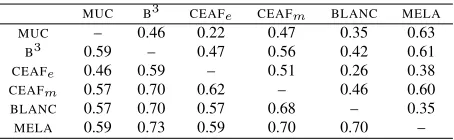
Table 1: Kendallτrank correlation coefficient for teams participating in CoNLL shared tasks, with CoNLL 2011 in the upper right, CoNLL 2012 in the lower left corner.
3 Correlating CoNLL shared tasks results
To illustrate the complexity of the present evaluation best practices, we have applied the Kendallτ rank
correlation coefficient to the ratings the metrics gave coreference resolution systems that competed in the two recent CoNLL shared tasks. The official metrics of the CoNLL shared tasks was MELA (Denis and
Baldridge, 2009), a weighted average of MUC, B3
andCEAFe.
The results for CoNLL 2011 (Table 1) show a rather weak correlation among the metrics go-ing down to as low as 0.22 between CEAFe and MUC. Somewhat surprisingly, the two link-based
metrics,MUCandBLANC, also show a low degree of
agreement (0.35), while the mention-based metrics,
CEAFm and B3, show the highest agreement of all
non-composite metrics. However, this agreement is not particularly high either as the two metrics agree on just above the half of all the cases (0.56).
The results for CoNLL 2012 show much higher correlation among the metrics ranging from 0.46 to 0.70. AgainCEAFm andB3 show the highest
corre-lation, but unlike in 2011 BLANC“joins” this
clus-ter. CEAFeandMUCare again least correlated, while CEAFe and BLANC, in 2011 almost independent,
show average correlation (0.57) in 2012.
In our view, comparatively low correlations as well as surprising variation from year to year sug-gests a certain degree of ’fuzziness’ in quantitative coreference resolution evaluation. We leave the in-vestigation of variation between the two years for future work.
4 Error analysis
the development corpus of the CoNLL 2011 Shared Task (Pradhan et al., 2011), one text from each of the five represented genres: Broadcast Conversa-tions (BC), Broadcast News (BN), Magazine (MZ), News Wire (NW) and Web Blogs and News Groups (WB). The texts were chosen as randomly as pos-sible, the only constraint being length1. The gold
standard texts are originally from OntoNotes 4.0, and contain 64 mentions distributed among 21 key entities. The response texts are the output of Stan-ford’s Multi-Pass Sieve Coreference Resolution Sys-tem (Lee et al., 2011).
4.1 Categorization
Instead of classifying entities according to their score by some of the metrics, or a combination of several of them, as done by the CoNLL shared tasks, we have based the classification on a notion of lin-guistic common sense – our subjective idea of how humans evaluate the success or failure of CR. We divide key/response entity pairs into four categories:
• Category 1: Perfect match
• Category 2: Partial match
• Category 3: Merged entities
• Category 4: Failed coreference resolution
We will concentrate on the amount of informational value from the key entity that has been preserved in the response entity. In the course of these experi-ments, our aim is to see if that rather informal idea can be operationalized in a way amenable to future use in automated CR and/or quantitative evaluation.
4.1.1 Category 1: Perfect match
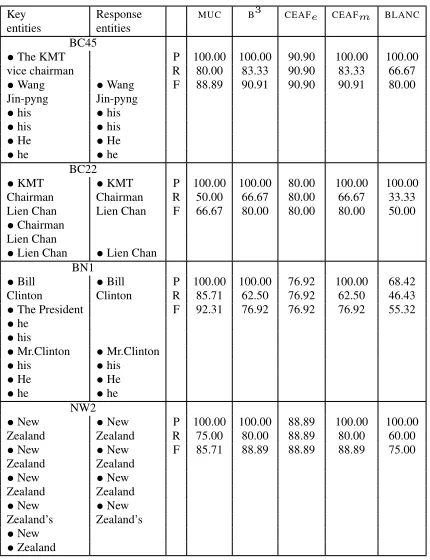
This class consists of four key/response entity pairs with complete string match. The key and response entities being identical, all metrics show unanimously precision and recall of 100%. The informational value is, of course, completely pre-served. Unfortunately, those examples are few and simple: They constitute only 19% of the entities and 14% of mentions in this sample, and all seem to be achieved by the simplest form of string matching.
Key Response MUC B3 CEAF
e CEAFm BLANC entities entities
BC45
•The KMT P 100.00 100.00 90.90 100.00 100.00 vice chairman R 80.00 83.33 90.90 83.33 66.67 •Wang •Wang F 88.89 90.91 90.90 90.91 80.00 Jin-pyng Jin-pyng
•his •his •his •his •He •He •he •he
BC22
•KMT •KMT P 100.00 100.00 80.00 100.00 100.00 Chairman Chairman R 50.00 66.67 80.00 66.67 33.33 Lien Chan Lien Chan F 66.67 80.00 80.00 80.00 50.00 •Chairman
Lien Chan
•Lien Chan •Lien Chan BN1
•Bill •Bill P 100.00 100.00 76.92 100.00 68.42 Clinton Clinton R 85.71 62.50 76.92 62.50 46.43 •The President F 92.31 76.92 76.92 76.92 55.32 •he
•his
•Mr.Clinton •Mr.Clinton •his •his •He •He •he •he
NW2
•New •New P 100.00 100.00 88.89 100.00 100.00 Zealand Zealand R 75.00 80.00 88.89 80.00 60.00 •New •New F 85.71 88.89 88.89 88.89 75.00 Zealand Zealand
•New •New Zealand Zealand •New •New Zealand’s Zealand’s •New
[image:3.612.320.535.55.335.2]•Zealand
Table 2: Category 2a: Partial match (partial entities)
4.1.2 Category 2: Partial match
The partial response entities can be divided in two subcategories:2a)The cases where the response en-titiesare partial, i.e.they form a proper subset of the key entity mentions (Table 2) and 2b) The cases where the response mentions are partial, i.e. sub-strings of the corresponding key mentions (Table 3). The scoring of the examples has followed CoNLL shared tasks’ strict mention detection requirements2
with the consequence that Category 2b entities have received considerably lower scores than the Cate-gory 2a entities even in cases where the loss of informational value has been comparable. For in-stance, the response entity NW1 (Table 3) has re-ceived an average F-score of 56.67%, but its loss of informational value is comparable to that in enti-ties BC45 and BN1 (Table 2). The BC45’s response entity has lost the information that Jiyun Tian
is a vice-chief, while entities BC45 and BN1 have lost the information that the person referred to
1The texts longer than five sentences were discarded, to
make the analysis tractable.
2Only response mentions with boundaries identical to the
isThe KMT vice chairman (BC45) andThe President (BN1). However, the latter mentions have received a considerably higher average F-score of 88.32% and 75.68% respectively. This indicates that stricter mention detection requirements do not necessarily improve the quality of CR evaluation.
Key Response MUC B3 CEAFe CEAFm BLANC entities entities
MZ22
•a school in •a school P 0.00 50.00 50.00 50.00 0.00 Shenzhen for in Shenzhen R 0.00 50.00 50.00 50.00 0.00 the children of F 0.00 50.00 50.00 50.00 0.00 Hong Kong
expats
•the school •the school in Shenzhen in Shenzhen
NW0
•China’s •People’s P 0.00 0.00 0.00 0.00 0.00 People’s Congress R 0.00 0.00 0.00 0.00 0.00 Congress F 0.00 0.00 0.00 0.00 0.00 •China’s •People’s
People’s Congress Congress
NW1
•vice-chief •committee P 50.00 66.67 66.67 66.67 33.33 committee member R 50.00 66.67 66.67 66.67 33.33 member Jiyun Tian F 50.00 66.67 66.67 66.67 33.33 Jiyun Tian
•Jiyun Tian •Jiyun Tian •He •He
NW5
•China’s •China’s P 0.00 50.00 50.00 50.00 0.00 People’s People’s R 0.00 50.00 50.00 50.00 0.00 Congress Congress F 0.00 50.00 50.00 50.00 0.00 delegation delegation
led by vice-chief committee member Jiyun Tian
[image:4.612.331.521.57.287.2]•the •the delegation delegation from China’s from China’s People’s People’s Congress Congress
Table 3: Category 2b: Partial match (partial mentions).
4.1.3 Category 3: Merged entities
This category consists of response entities that contain mentions from two or more key entities (Ta-ble 4). Our sample contains only four examples in this category, but it is still possible to discern two subcategories:
1. The new information is incorrect
In the key entity MZ40, the sex of the gender-neutral
her ten-year-old childhas been given by the mention him. Replacing it with the mention
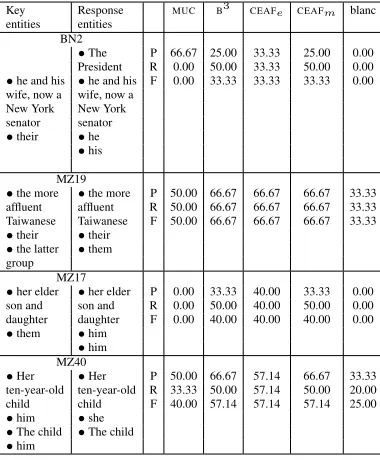
shein the response entity gives the wrong informa-tion about the child’s sex. Entities BN2 and MZ17 also belong to this subcategory, but here the men-tions in the response entity are morphologically in-consistent, thus making the mistake easier to detect.
2. The new information is correct or neutral
In entity pair MZ19 the key mentionthe latter groupwas replaced with response mentionthem,
Key Response MUC B3 CEAF
e CEAFm blanc entities entities
BN2
•The P 66.67 25.00 33.33 25.00 0.00 President R 0.00 50.00 33.33 50.00 0.00 •he and his •he and his F 0.00 33.33 33.33 33.33 0.00 wife, now a wife, now a
New York New York senator senator •their •he
•his
MZ19
•the more •the more P 50.00 66.67 66.67 66.67 33.33 affluent affluent R 50.00 66.67 66.67 66.67 33.33 Taiwanese Taiwanese F 50.00 66.67 66.67 66.67 33.33 •their •their
•the latter •them group
MZ17
•her elder •her elder P 0.00 33.33 40.00 33.33 0.00 son and son and R 0.00 50.00 40.00 50.00 0.00 daughter daughter F 0.00 40.00 40.00 40.00 0.00 •them •him
•him MZ40
•Her •Her P 50.00 66.67 57.14 66.67 33.33 ten-year-old ten-year-old R 33.33 50.00 57.14 50.00 20.00 child child F 40.00 57.14 57.14 57.14 25.00 •him •she
•The child •The child •him
Table 4: Category 3: Merged entities
the omitted and replacement mentions having very similar informational content.
As expected, the scores in Category 3 are lower then those in Category 2 (as a whole), but they are still consistently better than the scores of the Cate-gory 2b.
4.1.4 Category 4: Unsuccessful coreference resolution
The entities in this category (Table 5) are divided into two subcategories:
No response entity has been given Two of the key entities (MZ38 and NW4) were not aligned with any response entities, and not surprisingly all met-rics agree that the CR precision, recall and F-score equal zero.
The response entities do not contain a single “heavy” mention that is correct Although the re-sponse entities in the remaining entity pairs are non-empty, an intuitive CR evaluation says there is not much sense in aligning near-vacuous mentions if the entity is otherwise wrong or empty. Already in the two rather simple cases of WB0 and WB1 the metrics show large discrepancies: While link-basedMUCandBLANCcorrectly give an F-score of
[image:4.612.83.288.146.427.2]Key Response MUC B3 CEAF
e CEAFm BLANC entities entities
WB0
•the beauty •the one P 0.00 50.00 50.00 50.00 0.00 industry hand R 0.00 50.00 50.00 50.00 0.00 •it •it F 0.00 50.00 50.00 50.00 0.00
WB1
•the consumer •clinical P 0.00 50.00 50.00 50.00 0.00 dermatologists R 0.00 50.00 50.00 50.00 0.00 •they •they F 0.00 50.00 50.00 50.00 0.00
MZ33
•Chang, P 100.00 100.00 75.00 100.00 100.00 Mei-liang, R 50.00 60.00 75.00 60.00 30.00 chairperson F 66.67 75.00 75.00 75.00 46.15 of the TBAD
Women’s Division,
[image:5.612.336.515.55.215.2]•her •her •she •she •Her •Her •she
Table 5: Category 4: Unsuccessful coreference resolution
with a rather high F-score of 50.00.
Entity MZ33 has been awarded high F-scores by all metrics, averaging 67.56%. However, almost all information from the key entity in MZ33 has been lost in the response entity: The key entity contains information on a person, a female, a Taiwanese na-tional, her name (Chang Mei-lian) and the ad-ditional information that she is a chairperson of the TBAD, Women’s Division. The response entity contains the information that its mentions refer to a female, which is most probably a person, but might be a ship, or a well loved pet. None of the metrics indicate that such a substantial loss of information renders the coreference resolu-tion of MZ33 practically useless for a human user.
5 Entity ranking
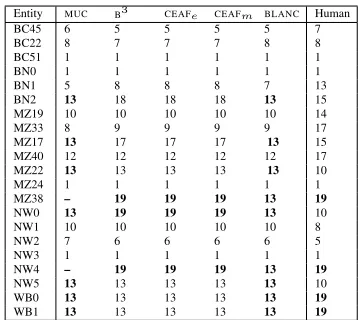
As some of the metrics yield consistently lower F-score levels, it is more appropriate to compare rankings of entities than the actual F-scores (Table 6). We have also – to infuse an iota of old-school armchair linguistics – added a sixth rating column, showing intuitive rankings, based on informational value retained. The lowest rankings for any metric are marked inbold.
The entities showing broad agreement among the metrics are only the best (Category 1) and the worst ones (MZ38 and NW4, Category 4).
The metrics disagreement surfaces with entities WB0 and WB1 of Category 4. The link-based met-rics, MUCand BLANC, rank them last (13th), while
they are ranked much higher (13th out of 19) by
the mention-based and entity-based metrics (B3 and
Entity MUC B3 CEAFe CEAFm BLANC Human
BC45 6 5 5 5 5 7
BC22 8 7 7 7 8 8
BC51 1 1 1 1 1 1
BN0 1 1 1 1 1 1
BN1 5 8 8 8 7 13
BN2 13 18 18 18 13 15
MZ19 10 10 10 10 10 14
MZ33 8 9 9 9 9 17
MZ17 13 17 17 17 13 15 MZ40 12 12 12 12 12 17 MZ22 13 13 13 13 13 10
MZ24 1 1 1 1 1 1
MZ38 – 19 19 19 13 19
NW0 13 19 19 19 13 10
NW1 10 10 10 10 10 8
NW2 7 6 6 6 6 5
NW3 1 1 1 1 1 1
NW4 – 19 19 19 13 19
NW5 13 13 13 13 13 10
WB0 13 13 13 13 13 19
[image:5.612.79.297.56.208.2]WB1 13 13 13 13 13 19
Table 6: Ranking of our example entities.
CEAF). In this case the human evaluator agrees with
the link-based metrics: If there is not a single cor-rect link within an entity, our intuition says that no useful CR has taken place.
However, the presence of a single correct coref-erent link is not sufficient for our intuition of suc-cessful resolution. Consider entities MZ22 and NW5 (Table 3): They also consist of two en-tities where only one is correct, and have re-ceived the same ratings as WB0 and WB1, but in this case we judge CR as much more success-ful. There are two main differences between this and the previous case. Firstly, the correct men-tion is in the previous case a meaning-lean pro-noun (it and they) while the correct mention in this case is a ’full-bodied’ NP (the school in Shenzhen and the delegation from China’s People’s Congress). In addition, in both of the Category 2 entity pairs, the incorrect mention holds an informational value very close or identical to that of the correct mention. This exam-ple illustrates the importance of informational value content of the mentions for the human evaluation of the resolution.
6 Formalizing the intuition
We have earlier (§4.1) introduced a classificaion based on an informal notion of (human) intuitive coreference resolution evaluation. In this section we will try to formalize the classification.
∀x(x∈K↔x∈R) (1)
Category 2 The response entity is a proper subset of the key entity:
∀x(x∈R→x∈K)∧
∃y(y∈K∧y /∈R) (2a) This is the only condition for Category 2a. Cat-egory 2b shares the condition (2a), but to formalize it, we have to addoverlap(x,y)relation. We can de-fine it as a common substring forxandyof a certain
length, possibly including at least one major syntac-tic category, or even the lexical ’head’ if some way of operationalizing that notion is available.
∃x(x∈K∧x∈R)∧
∃y∃z(y∈K∧z∈R∧overlap(y, z)) (2b) We need at least two correct mentions in the sponse entity, and at least one that overlaps, as re-sponse entities containing only one correct mention do not have any correct links.
Category 3 Response entity contains a subset of the key entity mentions as well as additional men-tion(s) belonging to some other entity (E):
∃x(x∈K∧x∈R)∧
∃y(y /∈K∧y ∈R∧y∈E) (3)
Category 4 The entities belonging to this category have a twofold definition: The response entity is ei-ther empty or if it contains one correct mention, it cannot contain an overlapping mention.
∀x(x∈K →x /∈R)∨
∃x(x∈K∧x∈R)→
∀y∀z((y∈K∧z∈R)→ ¬overlap(y, z)) (4)
The classification that has been introduced as a in-formal one in§4.1 is thus computable given an op-erational definition of overlap. In future work we will investigate the distribution of the four error cat-egories on a larger sample.
7 Conclusion and outlook
In this paper we have compared metrics on the ba-sis of their evaluation of coreference resolution per-formed on real-life texts, and contrasted their eval-uation to an intuitive human evaleval-uation of corefer-ence resolution. We conjecture that humans require
both correct coreferent links and correct (whole or partial) mentions of a certain information weight to consider a resolution successful.
This approach has some shortcomings. Firstly, the manual nature of the analysis has imposed a limit on the number of the examples, so our data may not be representative. Secondly, there is un-certainity connected to how well the coreference resolution evaluation metrics are suited to be used in this way. The latter drawback is the more seri-ous one: the metrics were not designed to evaluate single key/response pairs, but whole texts. How-ever, we would argue that if we want to discover new insights into the evaluation process, some level of approximation is necessary. There are at least two arguments in favor of this particular approxi-mation: Firstly, all metrics are based on evaluating key/response pairs. Analyzing their performance at this level can be a reasonable indicator of their per-formance on the text level. Secondly, even if metrics are treated “unfairly”, they are all treated equally.
We thus believe that this work can be seen as an illustration of remaining evaluation challenges in the field of coreference resolution.
A natural extension of this work would be in-cluding more humans in evaluating coreference res-olution systems, to provide a more representative human judgement. This evaluation should then be extended from evaluating coreference resolution of single key/response entity pairs, to assessing the quality of coreference resolution on a text as a whole.
And, finally: Every mention carries an in-formation value, and this weight varies from quite heavy (as in vice-chief committee member Jiyun Tian), to somewhat lighter (Jiyun Tian) to virtually weightless (He). In-formation weights are not distributed randomly, but conform to discourse structure. It would be inter-esting to map the pattern of their distribution, and see if incorporating this information could improve both coreference resolution and its quantitative eval-uation.
8 Acknowledgements
References
Amit Bagga and Breck Baldwin. 1998. Algorithms for scoring coreference chains. In The First Interna-tional Conference on Language Resources and Evalu-ation Workshop on Linguistics Coreference, pages 563 – 566, Granada, Spain.
Pascal Denis and Jason Baldridge. 2009. Global joint models for coreference resolution and named entity classication. Procesamiento del Lenguaje Natural, 42:87–96.
Heeyoung Lee, Yves Peirsman, Angel Chang, Nathanael Chambers, Mihai Surdeanu, and Dan Jurafsky. 2011. Stanford’s multi-pass sieve coreference resolution sys-tem at the CoNLL-2011 Shared Task. InProceedings of the 15th Conference on Computational Natural Lan-guage Learning: Shared Task, pages 28–34, Portland, Oregon.
Xiaoqiang Luo, Abe Ittycheriah Hongyan Jing, Nanda Kambhatla, and Salim Roukos. 2004. A mention-synchronous coreference resolution algorithm based on the Bell tree. InProceedings of the 42nd Annual Meeting of the Association for Computational Linguis-tics, pages 136–143, Barcelona, Spain.
Xiaoqiang Luo. 2005. On coreference resolution per-formance metrics. In Proceedings of Human Lan-guage Technology Conference and Conference on Empirical Methods in Natural Language Processing (HLT/EMNLP), pages 25–32, Vancouver, Canada. Sameer Pradhan, Lance Ramshaw, Mitchell Marcus,
Martha Palmer, Ralph Weischedel, and Nianwen Xue. 2011. CoNLL-2011 Shared Task: Modeling unre-stricted coreference in OntoNotes. InProceedings of the 15th Conference on Computational Natural Lan-guage Learning: Shared Task, pages 1–27, Portland, Oregon.
Sameer Pradhan, Alessandro Moschitti, Nianwen Xue, Olga Uryupina, and Yuchen Zhang. 2012. CoNLL-2012 Shared Task: Modeling multilingual unrestricted coreference in OntoNotes. InProceedings of the Joint Conference on EMNLP and CoNLL: Shared Task, pages 1–40, Jeju Island, Korea.
W. M. Rand. 1971. Objective criteria for evaluation of clustering methods. Journal of American Statistical Association, 66(336):846–850.
Marta Recasens and Eduard Hovy. 2011. BLANC: Im-plementing the Rand index for coreference evaluation.
Natural Language Engineering, 17(04):485–510. Marta Recasens, Lluis M`arquez, Emili Sapena,
M. Ant`onia Marti, Mariona Taul´e, V´eronique Hoste, Massimo Poesio, and Yannick Versley. 2010. Semeval-2010 task 1: Coreference resolution in multi-ple languages. InProceedings of the 5th International
Workshop on Semantic Evaluation, ACL 2010, pages 1–8, Uppsala, Sweden.
Marc Vilain, John Burger, John Aberdeen, Dennis Con-nolly, and Lynette Hirschman. 1995. A model-theoretic coreference scoring scheme. In Proceed-ings of the Sixth Message understanding Conference (MUC-6), pages 45–52, San Francisco, CA.