A method for the approximation of incremental understanding of explicit
utterance meaning using predictive models in finite domains
David DeVault
and
David Traum
Institute for Creative Technologies, University of Southern California,
12015 Waterfront Dr., Playa Vista, CA 90094 USA
{devault,traum}@ict.usc.edu
Abstract
This paper explores the relationship between explicit and predictive models of incremental speech under-standing in a dialogue system that supports a finite set of user utterance meanings. We present a method that enables the approximation of explicit under-standing using information implicit in a predictive understanding model for the same domain. We show promising performance for this method in a corpus evaluation, and discuss its practical application and annotation costs in relation to some alternative ap-proaches.
1
Introduction
In recent years, there has been a growing interest among researchers in methods for incremental natural language understanding (NLU) for spoken dialogue systems; see e.g. (Skantze and Schlangen, 2009; Sagae et al., 2009; Schlangen et al., 2009; Heintze et al., 2010; DeVault et al., 2011a; Selfridge et al., 2012). This work has gen-erally been motivated by a desire to make dialogue sys-tems more efficient and more natural, by enabling them to provide lower latency responses (Skantze and Schlangen, 2009), human-like feedback such as backchannels that in-dicate how well the system is understanding user speech (DeVault et al., 2011b; Traum et al., 2012), and more in-teractive response capabilities such as collaborative com-pletions of user utterances (DeVault et al., 2011a), more adaptive handling of interruptions (Buschmeier et al., 2012), and others.
This paper builds on techniques developed in previous work that has adopted apredictiveapproach to incremen-tal NLU (DeVault et al., 2011a). On this approach, at specific moments while a user’s speech is in progress, an attempt is made to predict what the full meaning of the complete user utterance will be. Predictive models can be contrasted withexplicitapproaches to incremen-tal NLU. We use the termexplicitunderstanding to refer
to approaches that attempt to determine the meaning that has been expressed explicitly in the user’s partial utter-ance so far (without predicting further aspects of mean-ing to come). Explicit understandmean-ing of partial utterances can be implemented using statistical classification or se-quential tagging models (Heintze et al., 2010).
Both predictive and explicit incremental NLU capabil-ities can be valuable in a dialogue system. Prediction can support specific response capabilities, such as sys-tem completion of user utterances (DeVault et al., 2011a) and reduced response latency.1 However, explicit models support additional and complementary capabilities. For instance, depending on the application domain (Heintze et al., 2010) and on the individual utterance (DeVault et al., 2011b), it may be difficult for a system to predict a user’s impending meaning with confidence. Neverthe-less, it may often be possible for systems to determine the meaning of what a user has said so far, and to take action based on this partial understanding. As one exam-ple, items in a user interface could be highlighted when mentioned by a user (Buß and Schlangen, 2011). An-other capability would be to provide grounding feedback, such as verbal back-channels or head nods (in embod-ied systems), to indicate when the system is understand-ing the user’s meanunderstand-ing (Traum et al., 2012). Explicit ut-terance meanings also allow a system to distinguish be-tween meaning that has been expressed and meaning that is merely implied or inferred, which may be less reliable. In the near future, as incremental processing capabilities in dialogue systems grow, it may prove valuable for di-alogue systems to combine both predictive and explicit incremental understanding capabilities.
In this paper, we present a technique for approximating a user’s explicit meaning using an existing predictive un-derstanding framework (DeVault et al., 2011a). The spe-cific new contributions in this paper are (1) to show that
1A simple approach to reducing response latency is to begin to plan
a response to the predicted meaning while the user is still speaking.
an estimate of a user’s explicit utterance meaning can be derived from this kind of predictive understanding model (Section 2); (2) to quantify the performance of this new method in a corpus evaluation (Section 3); (3) to provide concrete examples and discussion of the annotation costs associated with implementing this technique, in relation to some alternative approaches to explicit understanding (Section 4). Our results and discussion show that the proposed method offers promising performance, has rela-tively low annotation costs, and enables explicit and pre-dictive understanding to be easily combined within a di-alogue system. It may therefore be a useful incremental understanding technique for some dialogue systems.
2
Technical Approach and Data Set
In Sections 2.1-2.3, we briefly summarize the data set and approach to predictive incremental NLU (DeVault et al., 2011a) that serves as the starting point for the new work in this paper. Sections 2.4 and 2.5 present our new ap-proach to explicit understanding based on this apap-proach.
2.1 Data set
For the experiments reported here, we use a corpus of user utterances collected with the SASO-EN spoken dia-logue system (Hartholt et al., 2008; Traum et al., 2008). Briefly, this system is designed to allow a trainee to prac-tice multi-party negotiation skills by engaging in face to face negotiation with virtual humans. The scenario in-volves a negotiation about the possible re-location of a medical clinic in an Iraqi village. A human trainee plays the role of a US Army captain, and there are two virtual humans that he negotiates with: Doctor Perez, the head of an NGO clinic, and a local village elder, al-Hassan. The captain’s main objective is to convince the doctor and the elder to move the clinic out of an unsafe marketplace area.
The corpus used for the experiments in this paper in-cludes 3,826 training and 449 testing utterances drawn from user dialogues in this domain. The corpus and its se-mantic annotation are described in (DeVault et al., 2010; DeVault et al., 2011a). All user utterances have been au-dio recorded, transcribed, and manually annotated with the correct NLU output frame for the entire utterance. (We discuss the cost of this annotation in Section 4.) Each NLU output frame contains a set of attributes and values that represent semantic information linked to a domain-specific ontology and task model (Traum, 2003). Exam-ples of the NLU output frames are included in Figures 2, 3, and 5.
2.2 Predictive incremental NLU
This approach uses a predictive incremental NLU mod-ule, mxNLU (Sagae et al., 2009; DeVault et al., 2011a), which is based on maximum entropy classification. The
approach treats entire individual frames as output classes, and extracts input features from partial ASR results. To define the incremental understanding problem, the audio of the utterances in the training data were fed through an ASR module, PocketSphinx (Huggins-Daines et al., 2006), in 200 millisecond chunks, and each partial ASR result produced by the ASR was recorded. Each par-tial ASR result then serves as an incremental input to mxNLU. NLU is predictive in the sense that, for each partial ASR result, the task of mxNLU is to produce as output thecompleteframe that has been associated by a human annotator with the user’scompleteutterance, even if that utterance has not yet been fully processed by the ASR.
The human annotation defines a finite set S =
{S1, ..., SN}of possible NLU output frames, where each frame Si = {e1, ..., en} is a set of key-value pairs or
frame elements. For notation, a user utteranceugenerally creates a sequence ofmpartial ASR resultshr1, ..., rmi, where each ASR resultrjis a partial text such aswe need
to move. LetGudenote the correct (or “gold”) frame for the complete utteranceu. For each resultrjand for each complete frame Si, the maximum entropy model pro-videsP(Gu =Si|rj). The NLU output frameSjNLUis the complete frame for which this probability is highest.
2.3 Performance of predictive incremental NLU
The performance of this predictive incremental NLU framework has been evaluated using the training and test portions of the SASO-EN data set described in Sec-tion 2.1. Performance is quantified by looking at pre-cision, recall, and F-score of the frame elements that compose the predicted (SjNLU)and correct (Gu) frames for each partial ASR result. When evaluated over all the 5,736 partial ASR results for the 449 test utterances, the precision/recall/F-Score of this predictive NLU, in relation to the complete frames, are 0.67/0.47/0.56,
re-spectively. When evaluated on only the ASR results
for complete test utterances, these scores increase to 0.81/0.71/0.76, respectively.
2.4 Assigning probability to frame elements
An interesting question is whether we can use this model to attach useful probabilities not only to complete pre-dicted frames but also to the individual frame elements that make up those frames. To explore this, for each par-tial ASR resultrjin each utteranceu, and for each frame elementein SASO-EN, let us model the probability that
ewill be part of the correct frame for the complete utter-ance as:
P(e∈Gu|rj) =
X
Si:e∈Si
0.00 0.10 0.20 0.30 0.40 0.50 0.60 0.70 0.80 0.90 1.00 0.0
0.1 0.2 0.3 0.4 0.5 0.6 0.7 0.8 0.9 1.0
Probability assigned to frame element
Relativ
e frequency of fr
ame element in correct fr
ame
0 0.1 0.2 0.3 0.4 0.5 0.6 0.7
Relativ
e frequency of probability being assigned to a fr
ame element
Model calibration (left axis)
Perfect calibration (left axis)
[image:3.612.156.454.52.312.2]Relative frequency of assigned probabilities (right axis)
Figure 1: Calibration of frame element probabilities.
This method derives the probability of frame elements from the probabilities assigned to the possible frames that contain them. Computing this sum is straightforward in a finite semantic domain such as SASO-EN.
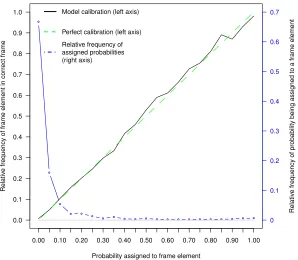
We computed this probability for all frame elements
eand all partial ASR resultsrj in our test set, yielding approximately 478,000 probability values. We grouped these probability values into bins of size 0.05, and cal-culated the frequency with which the frame elements in each bin were indeed present in the correct frameGufor the relevant utteranceu. The results are presented in Fig-ure 1, which shows that the probability values derived from Equation (1) are relatively “well calibrated”, in the sense that the relative frequency with which a frame el-ement is in the final frame is very close to the numeric probability assigned by Equation (1). The figure also shows how frequently the model assigns various proba-bility ranges to frame elements (blue dotted line, plotted against the secondary right axis). Note that most frame elements are assigned very little probability for most par-tial ASR results.
We conclude from these observations that the probabil-ities assigned by (1) could indeed carry useful informa-tion about the likelihood that individual key values will be present in the complete utterance meaning.
2.5 Selecting probable frame elements
In exploring the model of frame element probabilities given in Equation (1), we observed that often the reason
a frame element has lower probability, at a given point within a user utterance, is that it is apredictionrather than something that has been expressed explicitly. Building on this observation, our technique for estimating the user’s explicit meaning uses a probability threshold to select those individual frame elements which are most likely to be in the frame for a complete utterance, according to the predictive model. That is, at each partial result rj, we estimate the user’s explicit meaning using a constructed frame:
SjSUB={e|P(e∈Gu|rj)≥τ} (2)
This approximation could work well if, in practice, the most probable frame elements prove to match fairly closely the user’s non-incremental utterance meaning at the point this frame is constructed. We evaluate this in the next section.
Note that, in general, the returned subset of frame elements may not be identical to any complete frame
Si ∈ S; rather it will correspond to parts of these
com-plete frames or “subframes”.
3
Performance Evaluation
sub-Explicit subframe(with frame element probabilities) Predicted complete frame Annotated subframe
Partial ASR result: hello
0.813 <S>.sem.speechact.type greeting <S>.sem.speechact.type greeting <S>.addressee doctor-perez
<S>.sem.speechact.type greeting
Partial ASR result: hello elder
0.945 <S>.sem.speechact.type greeting 0.934 <S>.addressee elder-al-hassan
<S>.sem.speechact.type greeting <S>.addressee elder-al-hassan
<S>.sem.speechact.type greeting <S>.addressee elder-al-hassan
Figure 2: Explicit subframes and predicted complete frames for two partial ASR results in a user utterance ofhello elder.
frames that represent human judgments of explicit incre-mental utterance meaning.
To collect these judgments, we hand-annotated a word-meaning alignment for 50 random utterances in our test set.2 To perform this annotation, successively larger pre-fixes of each utterance transcript were mapped to succes-sively larger subframes of the full frame for the complete utterance. The annotated subframes for each utterance prefix were selected to beexplicit; they include only those frame elements that are explicitly expressed in the corre-sponding prefix of the user’s utterance. (We discuss the cost of this annotation in Section 4.)
We provide a simple concrete example in Figure 2. This example shows two partial ASR results during an utterance of hello elder by a user. For each par-tial ASR result, three frames are indicated horizon-tally. At the right, labeled “Annotated subframe”, we show the human judgment of explicit incremental ut-terance meaning for this partial utut-terance. Our hu-man judge has indicated that the wordhellocorresponds
to the frame element <S>.sem.speechact.type
greeting, and that the wordshello elder correspond to an expanded frame that includes the frame element <S>.addressee elder-al-hassan.
At the left, labeled “Explicit subframe”, we show the subframe selected by Equation (2) for each par-tial ASR result, with threshold τ = 0.5. A relevant background fact for this example is that in this sce-nario, the user can generally address either of two vir-tual humans who are present, Doctor Perez or Elder Al-Hassan. After the user has said hello, the frame
element<S>.sem.speechact.type greetingis
assigned probability 0.813 by Equation (1), and only this frame element appears in the explicit subframe.
In the middle, labeled “Predicted complete frame”, the figure also shows the full predicted frame from mxNLU at each point. After the user has said hello, the full predicted output includes an additional frame element, <S>.addressee doctor-perez, indicating a pre-diction that the addressee of this user utterance will be Doctor Perez rather than Elder al-Hassan. However, the
2Note that no utterances in ourtrainingset were annotated.
probability assigned to this prediction by Equation (1) is less than0.5, and so this predicted frame element is ex-cluded from the explicit subframe. And indeed, this is the correctexplicitrepresentation of the meaning ofhelloin this system.
This simple example illustrates how our proposed tech-nique can enable a dialogue system to have access to both explicit and predicted utterance meaning as a user’s ut-terance progresses. An excerpt from a more complex utterance is given in Figure 3. This example shows in-cremental outputs for two partial ASR results during a user utterance of we will provide transportation at no cost. In this example, the explicit subframe for we will includes frame elements that convey that the cap-tain (i.e. the user) is promising to do something. This subframe does not exactly match the human judgment of explicit meaning at the right, which does not include
at this point the <S>.sem.agent captain-kirk
and <S>.sem.type event frame elements. How-ever, the explicit subframe more closely matches the hu-man judgment than does the predicted complete frame from mxNLU (middle column), which includes an in-correct prediction that the captain is promising to de-liver medical supplies (represented by the key values <S>.sem.event deliver and <S>.sem.theme medical-supplies). For the next partial ASR re-sult shown in the figure, the explicit subframe correctly adds several additional frame elements which formalize the meaning of the phraseprovide transportationin this scenario as having the army move the clinic out of the market area.
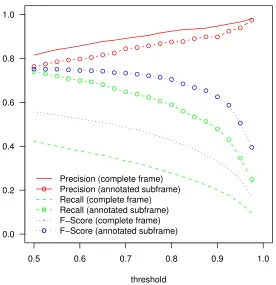
To understand more quantitatively how well this tech-nique works, we evaluated this techtech-nique in the SASO-EN test corpus, using different probability thresholds in the range [0.5,1.0). We present the results in Figure 4. To understand the effect of the thresholdτ, note that, in gen-eral, the effect of selecting a higher threshold should be to “cherry pick” those frame elements which are most likely to appear in the complete frameGu, thereby increasing precision while decreasing recall of the frame elements in
SSUB
Explicit subframe(with frame element probabilities) Predicted complete frame Annotated subframe
Partial ASR result: we will
0.856 <S>.mood declarative 0.824 <S>.sem.agent captain-kirk 0.663 <S>.sem.modal.intention will 0.663 <S>.sem.speechact.type promise 0.776 <S>.sem.type event
<S>.mood declarative <S>.sem.agent captain-kirk <S>.sem.event deliver <S>.sem.modal.intention will <S>.sem.speechact.type promise <S>.sem.theme medical-supplies <S>.sem.type event
<S>.mood declarative <S>.sem.modal.intention will <S>.sem.speechact.type promise
Partial ASR result: we will provide transportation
0.991 <S>.mood declarative 0.990 <S>.sem.agent captain-kirk 0.927 <S>.sem.event move 0.905 <S>.sem.instrument us-army 0.964 <S>.sem.modal.intention will 0.927 <S>.sem.source market
0.964 <S>.sem.speechact.type promise 0.928 <S>.sem.theme clinic
0.989 <S>.sem.type event
<S>.mood declarative <S>.sem.agent captain-kirk <S>.sem.event move <S>.sem.instrument us-army <S>.sem.modal.intention will <S>.sem.source market
<S>.sem.speechact.type promise <S>.sem.theme clinic
<S>.sem.type event
<S>.mood declarative <S>.sem.agent captain-kirk <S>.sem.event move <S>.sem.instrument us-army <S>.sem.modal.intention will <S>.sem.source market
<S>.sem.speechact.type promise <S>.sem.theme clinic
[image:5.612.74.535.83.271.2]<S>.sem.type event
Figure 3: Explicit subframes and predicted complete frames for two partial ASR results in a user utterance of wewill provide transportation at no cost.
0.5 0.6 0.7 0.8 0.9 1.0
0.0 0.2 0.4 0.6 0.8 1.0
threshold o
o
o
Precision (complete frame) Precision (annotated subframe) Recall (complete frame) Recall (annotated subframe) F−Score (complete frame) F−Score (annotated subframe)
[image:5.612.173.449.359.644.2]in the figure evaluate the returned subframes in relation to the complete frameGuassociated with the user’s
com-plete utterance. We see that this method enables us to select subsets of frame elements that are most likely to appear inGu: by increasing the threshold, it is possible to return subframes which are of increasingly higher pre-cision in relation to the final frameGu, but that also have lower recall.
We also evaluated the returned subframes in relation to the hand-annotated subframes, to assess its performance at identifying the user’s explicit meaning. For an utter-ance u that generates partial ASR results hr1, ..., rmi, we denote the hand-annotated subframe corresponding to partial ASR resultrjbyGSUBj . In the lines marked “(an-notated subframe)”, we show the precision, recall, and F-score of the explicit subframe for each ASR resultrj in relation to the annotated subframeGSUBj .
As a first observation, note that at any threshold level, the explicit subframes do better at recalling the hand-annotated subframe elements than they do at recalling the complete frame elements. This means our new method is better at recalling what has been said already by the user than it is at predicting what will be said, as intended. We have seen two examples of this already, for the partial ASR resulthelloin Figure 2, and for the partial ASR re-sultwe willin Figure 3.
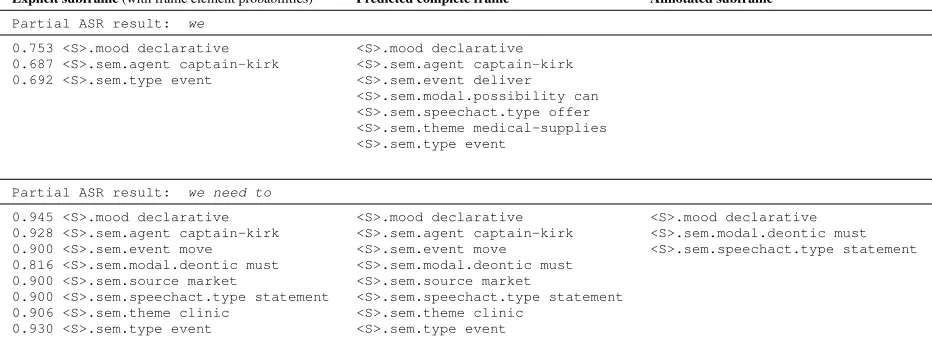
A second observation in Figure 4 is that precision re-mains better against the complete utterance frame than against the hand-annotated subframe (at all threshold lev-els). This indicates that the explicit subframes are often still predicting some aspects of the full frame. An exam-ple of this is given in Figure 5, where the user’s partial utterancewe need tois assigned an explicit subframe that includes frame elements describing an event of moving the clinic, which the user has not said explicitly. This happens because, in the SASO-EN domain, in fact there is nothing else that the interlocutors need to do besides move the clinic. So based on the NLU training data, the data-driven probabilities assigned by Equation (1) de-scribe the additional frame elements as about as probable as the ones capturing thewe need topart of the semantics (given at the right).
Finally, a third observation is that overall, the preci-sion, recall, and F-score results against the annotated sub-frames using our method are surprisingly strong. For example, when evaluating the explicit subframes over all partial ASR results, an F-score of 0.75 is attained at thresholds in the range 0.5-0.55. This F-score is sub-stantially better than the F-score of our predictive NLU in relation to the final full frames, which is 0.56 when evaluated over all partial ASR results. This means that our proposed model works better as an explicit mental NLU than mxNLU works as a predictive incre-mental NLU. Further, we observe that this F-score of
0.75 against hand-annotated subframes is approximately as good as the F-score of 0.76 that is achieved when mxNLU is used to interpret complete utterances. We therefore conclude that the proposed model is a promis-ing and viable approach to explicit incremental NLU in SASO-EN.
4
Discussion and Related Approaches
In this section, we discuss some of the practical aspects of using the technique presented here, in relation to some alternative approaches.
An important consideration for NLU techniques is the cost, in both time and knowledge, of the annotation that is needed. One attractive aspect of our technique is that the only semantic annotation that is required is the asso-ciation of complete user utterances with complete NLU output frames. This task can be performed by anyone fa-miliar with the scenario and the semantic frame format, such as a system developer or scenario designer. In fact, the annotation of the SASO-EN data set we use in this paper has been described in (DeVault et al., 2010), which reports that the overall corpus of 4678 token utterances was semantically annotated at an average rate of about 10 seconds per unique utterance.
The model in Equation (2) is what (Heintze et al., 2010) call ahybrid outputapproach, in which larger and larger frames are provided as partial input grows, but in which a detailed alignment between surface text and frames is not provided by the incremental NLU compo-nent. They contrast hybrid output systems with tech-niques that deliver either whole-frame output (like the predictive mxNLU) oraligned outputthat connects indi-vidual words to their meanings. A data-driven approach to providing aligned outputs would involve preparing a more detailed annotated corpus that aligns individ-ual words and surface expressions to their corresponding frame elements. Given such a word-aligned corpus, one could train several kinds of models to produce the aligned outputs incrementally. One strategy would be to use a se-quential tagging model such as a CRF to tag partial utter-ances with the frame elements that capture their explicit meaning, as in (Heintze et al., 2010).
Ad-Explicit subframe(with frame element probabilities) Predicted complete frame Annotated subframe
Partial ASR result: we
0.753 <S>.mood declarative 0.687 <S>.sem.agent captain-kirk 0.692 <S>.sem.type event
<S>.mood declarative <S>.sem.agent captain-kirk <S>.sem.event deliver <S>.sem.modal.possibility can <S>.sem.speechact.type offer <S>.sem.theme medical-supplies <S>.sem.type event
Partial ASR result: we need to
0.945 <S>.mood declarative 0.928 <S>.sem.agent captain-kirk 0.900 <S>.sem.event move 0.816 <S>.sem.modal.deontic must 0.900 <S>.sem.source market
0.900 <S>.sem.speechact.type statement 0.906 <S>.sem.theme clinic
0.930 <S>.sem.type event
<S>.mood declarative <S>.sem.agent captain-kirk <S>.sem.event move <S>.sem.modal.deontic must <S>.sem.source market
<S>.sem.speechact.type statement <S>.sem.theme clinic
<S>.sem.type event
[image:7.612.73.539.62.237.2]<S>.mood declarative <S>.sem.modal.deontic must <S>.sem.speechact.type statement
Figure 5: Explicit subframes and predicted complete frames for two partial ASR results in a user utterance ofwe need to move the clinic.
ditionally, this task requires a greater degree of linguis-tic knowledge and sophislinguis-tication, as the annotator must be able to segment the utterance and align specific sur-face segments with potentially complex aspects of mean-ing such as modality, polarity, speech act types, and others. An example of the kinds of complexities that arise is illustrated in Figure 3, where the relationship be-tween specific words like “provide” and “transportation” to frame elements like <S>.sem.event move and <S>.sem.theme clinic is not transparent, even if it is straightforward to mark the whole utterance as con-veying that meaning in this domain. We have generally found this alignment task challenging for people without advanced linguistics training.
The reason we describe the method in this paper as an
approximationof explicit NLU is that, partly because it is trained without detailed word-meaning alignments, it can be expected to occasionally include some predictive aspects of user utterance meaning. An example of this is the method’s explicit subframe output for the phrasewe need toin Figure 5.
Another way to approximate explicit NLU would be using the method (Heintze et al., 2010) call an ensem-ble of classifiers; it involves training an individual clas-sifier for each frame key. Like the method presented here, an ensemble of classifiers can be easily trained to predict those frame elements that will appear in the fi-nalframeGu for each utterance. And like our method, prediction with an ensemble of classifiers does not re-quire detailed annotation of word-meaning alignment in the training data. One difference is that, with our method, by selecting an appropriate threshold, it is easy to enforce certain consistency properties on subframe outputs. In an ensemble of classifiers approach, there is no immediate
guarantee that the output frame constructed by the inde-pendent classifiers will be internally consistent from the standpoint of downstream system modules (Heintze et al., 2010). For example, in the SASO-EN domain, an NLU frame should not contain frame elements that mix aspects of events and states in the SASO-EN ontology; e.g., the frame element<S>.sem.type eventshould not co-occur in an NLU output frame with the frame element <S>.sem.object-id market(which would be ap-propriate for a state frame but not for an event frame). With the method proposed here, if we select a threshold
τ that is greater than 0.5, and if none of the complete NLU frames contain incompatible key values (which is relatively easy to enforce as part of the annotation task), then it will be mathematically impossible for two incom-patible frame elements to be returned in a subframe.3
Ultimately, a classification method that is trained on word-meaning aligned data and that uses additional tech-niques to ensure that only valid, grammatical output frames are produced could prove to be an attractive ap-proach. In future work, we will explore such techniques, and compare both their performance as well as their anno-tation and development costs to the approximation tech-nique presented here.
5
Conclusion
The analysis in this paper has explored a method of ap-proximating explicit incremental NLU using predictive
3Suppose frame element ei is incompatible with ej, and that
techniques in finite semantic domains. We have shown that an estimate of a user’s explicit utterance meaning can be derived from an existing predictive understand-ing model in an example domain. We have quantified the performance of this new method in a corpus evalu-ation, showing that the method returns incremental ex-plicit subframes with performance – as measured by pre-cision, recall, and F-Score against hand-annotated sub-frames – that is competitive with a current statistical, data-driven approach for understanding complete spoken utterances in the same domain. We have provided ex-amples that illustrate its strengths and weaknesses, and discussed the annotation costs associated with imple-menting this technique in relation to some alternative ap-proaches. The method requires no additional annotation beyond what is needed for training an NLU module to understand complete spoken utterances. (Hand annota-tion of word-meaning alignment for a small number of utterances may be performed in order to tune the se-lected threshold and evaluate explicit understanding per-formance.) The method provides a free parameter that can be used to target the most advantageous levels of pre-cision and recall for a particular dialogue system applica-tion. In future work, we will explore additional machine learning models that leverage richer training data, and in-vestigate further the combination of explicit and predic-tive techniques.
Acknowledgments
The project or effort described here has been sponsored by the U.S. Army Research, Development, and Engi-neering Command (RDECOM). Statements and opinions expressed do not necessarily reflect the position or the policy of the United States Government, and no official endorsement should be inferred. This material is based upon work supported by the National Science Founda-tion under Grant No. IIS-1219253. Any opinions, find-ings, and conclusions or recommendations expressed in this material are those of the author(s) and do not neces-sarily reflect the views of the National Science Founda-tion.
References
Hendrik Buschmeier, Timo Baumann, Benjamin Dosch, Ste-fan Kopp, and David Schlangen. 2012. Combining incre-mental language generation and increincre-mental speech synthe-sis for adaptive information presentation. InProceedings of the 13th Annual Meeting of the Special Interest Group on Discourse and Dialogue, pages 295–303, Seoul, South Ko-rea, July. Association for Computational Linguistics. Okko Buß and David Schlangen. 2011. Dium - an incremental
dialogue manager that can produce self-corrections. In
Pro-ceedings of the 15th Workshop on the Semantics and Prag-matics of Dialogue (SemDial).
David DeVault, Susan Robinson, and David Traum. 2010. IORelator: A graphical user interface to enable rapid seman-tic annotation for data-driven natural language understand-ing. InFifth Joint ISO-ACL/SIGSEM Workshop on Interop-erable Semantic Annotation.
David DeVault, Kenji Sagae, and David Traum. 2011a. Incre-mental interpretation and prediction of utterance meaning for interactive dialogue.Dialogue & Discourse, 2(1).
David DeVault, Kenji Sagae, and David R. Traum. 2011b. De-tecting the status of a predictive incremental speech under-standing model for real-time decision-making in a spoken dialogue system. InInterspeech, pages 1021–1024. Arno Hartholt, Thomas Russ, David Traum, Eduard Hovy,
and Susan Robinson. 2008. A common ground for vir-tual humans: Using an ontology in a natural language ori-ented virtual human architecture. In European Language Resources Association (ELRA), editor,Proc. LREC, Mar-rakech, Morocco, may.
Silvan Heintze, Timo Baumann, and David Schlangen. 2010. Comparing local and sequential models for statistical incre-mental natural language understanding. InThe 11th Annual Meeting of the Special Interest Group in Discourse and Dia-logue (SIGDIAL 2010).
David Huggins-Daines, Mohit Kumar, Arthur Chan, Alan W. Black, Mosur Ravishankar, and Alex I. Rudnicky. 2006. Pocketsphinx: A free, real-time continuous speech recog-nition system for hand-held devices. In Proceedings of ICASSP.
Kenji Sagae, Gwen Christian, David DeVault, and David R. Traum. 2009. Towards natural language understanding of partial speech recognition results in dialogue systems. In NAACL HLT.
David Schlangen, Timo Baumann, and Michaela Atterer. 2009. Incremental reference resolution: The task, metrics for eval-uation, and a bayesian filtering model that is sensitive to dis-fluencies. InSIGDIAL.
Ethan O. Selfridge, Iker Arizmendi, Peter A. Heeman, and Ja-son D. Williams. 2012. Integrating incremental speech recognition and pomdp-based dialogue systems. In Proceed-ings of the 13th Annual Meeting of the Special Interest Group on Discourse and Dialogue, pages 275–279, Seoul, South Korea, July. Association for Computational Linguistics. Gabriel Skantze and David Schlangen. 2009. Incremental
di-alogue processing in a micro-domain. In Proceedings of EACL 2009.
David Traum, Stacy Marsella, Jonathan Gratch, Jina Lee, and Arno Hartholt. 2008. Multi-party, issue, multi-strategy negotiation for multi-modal virtual agents. InProc. of Intelligent Virtual Agents Conference IVA-2008.
David Traum, David DeVault, Jina Lee, Zhiyang Wang, and Stacy C. Marsella. 2012. Incremental dialogue understand-ing and feedback for multi-party, multimodal conversation. InThe 12th International Conference on Intelligent Virtual Agents (IVA), Santa Cruz, CA, September.