SUT
IME: Evaluation in TempEval-3
Angel X. Chang Stanford University
Christopher D. Manning Stanford University
Abstract
We analyze the performance of SUTIME, a temporal tagger for recognizing and normal-izing temporal expressions, on TempEval-3 Task A for English. SUTIME is available as part of the Stanford CoreNLP pipeline and can be used to annotate documents with temporal information. Testing on the TempEval-3 eval-uation corpus showed that this system is com-petitive with state-of-the-art techniques.
1 Introduction
The importance of modeling temporal information is increasingly apparent in natural language appli-cations, such as information extraction and ques-tion answering. Extracting temporal informaques-tion re-quires the ability to recognize temporal expressions, and to convert them from text to a normalized form that is easy to process. Temporal tagging systems are designed to address this problem. In this paper, we evaluate the performance of the SUTIME(Chang
and Manning, 2012) rule-based temporal tagging system.
We evaluate the performance of SUTIMEon ex-tracting temporal information in TempEval-3 (Uz-Zaman et al., 2013), which requires systems to auto-matically annotate documents with temporal infor-mation using TimeML (Pustejovsky et al., 2003). The TempEval-3 training data contains gold human annotated data from TimeBank, AQUAINT, and a new dataset of silver data automatically annotated using a combination of TipSem (Llorens et al., 2010) and TRIOS (UzZaman and Allen, 2010), two of the
best performing systems from TempEval-2 (Verha-gen et al., 2010).
2 System Description
We use the Stanford CoreNLP1 pipeline with SU-TIME to identify and normalize TIMEX32
ex-pressions. SUTIME is incorporated into Stanford CoreNLP as part of the Named Entity Recognition annotator. For TempEval-3, we use the standard set of rules provided with SUTIME. Since SUTIMEcan also recognize temporal expressions whose values are not specified by TIMEX3, we ran SUTIME in a TIMEX3 compatible mode.3
2.1 SUTime
SUTIME is a rule-based temporal tagger built on regular expression patterns over tokens. Tempo-ral expressions are bounded in their complexity, so many of them can be captured using finite automata. As shown by systems such as FASTUS (Hobbs et al., 1997), a cascade of finite automata can be very effective at extracting information from text. With SUTIME, we follow a similar staged strategy of
(i) building up patterns over individual words to find numerical expressions; then (ii) using patterns over words and numerical expressions to find sim-ple temporal expressions; and finally (iii) forming composite patterns over the discovered temporal ex-pressions.
SUTIME recognizes Time, Duration, Interval, andSetaccording to the TIMEX3 specification. In
1nlp.stanford.edu/software/corenlp.shtml 2www.timeml.org
3sutime.restrictToTimex3 = true
addition, it recognizes nested time expressions and duration ranges. To achieve this it uses a temporal pattern language defined over tokens (a regular ex-pression language for expressing how tokenized text should be mapped to temporal objects). SUTIMEis built on top of TOKENSREGEX,4 a generic frame-work included in Stanford CoreNLP for definining patterns over text and mapping to semantic objects. With TOKENSREGEX we have access to any anno-tations provided by the Stanford CoreNLP system, such as the part-of-speech tag or the lemma. The full specification of the pattern language is available at
nlp.stanford.edu/software/sutime.shtml. To recognize temporal expressions, SUTIME ap-plies three types of rules, in the following order: 1) text regex rules: mappings from simple regular ex-pressions over characters or tokens to temporal rep-resentations; 2) compositional rules: mappings from regular expressions over chunks (both tokens and temporal objects) to temporal representations and 3) filtering rules: in which ambiguous expressions that are likely to not be temporal expressions are re-moved from the list of candidates (such asfalland
springby themselves). The compositional rules are
applied repeatedly until the final list of time expres-sions stablizes.
After all the temporal expressions have been rec-ognized, each temporal expression is associated with a temporal object. Each temporal object is resolved with respect to the reference date using heuristic rules. In this step, relative times are converted to an absolute time, and composite time objects are simplified as much as possible. The final resolution of relative temporal expressions is currently limited due to the usage of simple hard-coded rules (e.g. rel-ative to document date with local context inform-ing before and after heuristics). Finally, SUTIME
will take the internal time representation and pro-duce a TIMEX3 annotation for each temporal ex-pression. SUTIME currently only handles English. It can however, be extended to other languages by creating sets of rules for additional languages.
3 Evaluation
We evaluated SUTIME’s performance on the TempEval-3 Task A for English. Task A consists
4nlp.stanford.edu/software/tokensregex.shtml
of determining the extent of time expressions as de-fined by the TimeML TIMEX3 tag, as well as pro-viding normalized attributes fortypeandvalue. Ex-tracted temporal expressions from the system and the gold are matched, and precision, recall, and F1
are computed. For the evaluation of extents, there are two metrics: a relaxed match score for identi-fying a matching temporal expression, and a strict match that requires the text to be matched exactly. For example, identifyingthe twentieth centurywhen the gold istwentieth centrywill give a relaxed match but not a strict match. For the type and value at-tributes, an accuracy and a measure of theF1 with
respect to the relaxed match is given.
We compare SUTIME’s performance with several
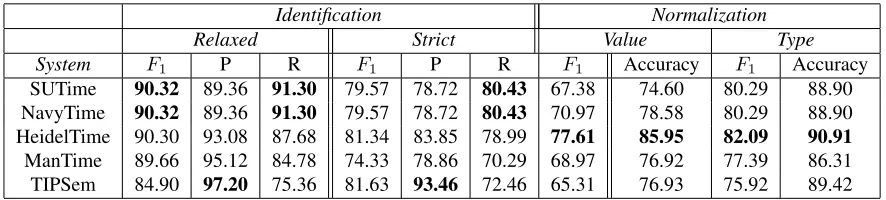
other top systems on the English TempEval-3 Task A. We also include TIPSem which was used to cre-ate the silver data for TempEval-3 as a baseline. Of the systems that prepared multiple runs, we selected the best performing run to report. Table 1 gives the results for these systems on the TempEval-3 evalu-ation set. Interestingly, NavyTime which uses SU-TIMEfor Task A, actually did better than SUTIME
in the value normalization and is effectively the 2nd best system in Task A. The performance of Navy-Time is otherwise identical to SUTIME. In Navy-Time the normalization was tuned to the Navy-TimeBank annotation whereas the SUTIME submission was untuned. SUTIMEhas the highest recall in discov-ering temporal expressions. It also has the high-est overall relaxed F1, slightly higher than
Heidel-Time (Str¨otgen and Gertz, 2010) (cleartk had the highest strictF1of 82.71). Not surprisingly, the
Identification Normalization
Relaxed Strict Value Type
System F1 P R F1 P R F1 Accuracy F1 Accuracy
[image:3.612.82.525.51.151.2]SUTime 90.32 89.36 91.30 79.57 78.72 80.43 67.38 74.60 80.29 88.90 NavyTime 90.32 89.36 91.30 79.57 78.72 80.43 70.97 78.58 80.29 88.90 HeidelTime 90.30 93.08 87.68 81.34 83.85 78.99 77.61 85.95 82.09 90.91 ManTime 89.66 95.12 84.78 74.33 78.86 70.29 68.97 76.92 77.39 86.31 TIPSem 84.90 97.20 75.36 81.63 93.46 72.46 65.31 76.93 75.92 89.42
Table 1: TempEval-3; English Platinum Test set.
4 Error Analysis
Given the small size of the platinum data set, we were able to perform thorough error analysis of the errors made by SUTIMEon the data set.
Table 2 shows the number of temporal expres-sions marked by the evaluation script as being in-correct. The errors can be grouped into three broad categories: i) those proposed by the system but not in the gold (relaxed precision errors), ii) those in the gold but not identified by the system (relaxed recall errors), and iii) temporal expressions with the wrong value (and sometimes type) normalization.
Of the 14 precision errors, many of the temporal expressions suggested by the system are reasonable. For instance,currentis identified by the system. A few of the errors are not actual temporal expres-sions. For example, in the phrase British Summer
Time, Summerwas identified as a temporal
expres-sion which is not correct.
Given SUTime’s high recall, only a few temporal expressions in the gold are not found by the system. In most cases, the temporal expressions missed by SUTIMEdo not have a well defined value associated
with them (e.g. “digital age”, “each season”). Performance using the strict match metric is not as good as some other systems. SUTIME was
derived from GUTime (Mani, 2004) and focuses on matching longer time expressions as per ear-lier guidelines. Thus it is less conformant to the more current TimeML guidelines of having minimal blocks. For instance, SUTIMEtreats 2009-2010 as a range, whereas the gold standard treats it as two separate dates. This results in an incorrect value nor-malization and a recall error.
We now examine the cases where the SUTIME
normalization differed from the gold. Table 3 shows a further breakdown of these errors.
Error type Count System not in gold (precision) 14
[image:3.612.310.523.299.408.2]Gold not in system (recall) 12 Wrong value 32
Table 2: Summary of errors made by SUTIME on the platinum data set
Error type Count
Value incorrectly resolved wrt to DCT 7 Value should not be resolved wrt to DCT 5 DURATION resolved to DATE 6 DATE misidentified as DURATION 3
Wrong granularity 4
Wrong normalization for set 2 Different normalization 3
Other 2
Table 3: Break down of value errors made by SUTime on the platinum data set
One weakness of SUTIME is that temporal ex-pressions are always resolved with respect to the document creation time (DCT). While this heuris-tic works fairly well in most cases, and SUTime can achieve reasonable performance, there are obvious limitations with this approach. For instance, some-times it is more appropriate to resolve the tempo-ral expression with respect to nearby dates or events in the text. As an example, in the test document CNN 20130322 1003 there is the sentence Call me
Sunday night at 8 PM at the resort that is part of
an email of an unknown date. In this case, SUTIME
still attempts to resolve the temporal expression
Sun-day night at 8 PMusing the document creation time
which is incorrect.
un-clear whetherFridayrefers to2011-09-16or 2011-09-23. SUTIMEwill normally resolve to the closest date/time with respect to the reference date. SU-TIMEalso has some rules that will use the verb tense
of the surrounding words to attempt to resolve the ambiguity. For instance, if a verb close to the tem-poral expression has a POS tag of VBD (past tense verb) then the expression will be resolved so that it occurs before the document date.
Most of the type errors are due to confusions be-tween DATE and DURATION. Often SUTIMEwill
attempt to resolve a DURATION as a DATE. For instance, given the phrase “the following decade”, SUTIMEwill attempt to resolve that as a DATE with value 202X (using a DCT of 2013-03-22). While this can be desirable in some cases, this is not what the gold annotation contains: type of DURATION and value ofP1DE. In some other cases, SUTIME
misidentifies DURATION as a DATE. For instance, it lacks rules to parse the 3:07:35 in finishing in
3:07:35as a duration.
Another problem faced by SUTIMEis in figuring
out the correct granularity to use. Given a document date of2013-03-22, it will identifytwo years agoas being2011-03-22. However, since these expressions indicate a less precise date, the gold annotation is a simple2011.
SUTIMEalso provided the wrong normalization for SET in several cases. For the expressionevery
morning, SUTIMEreported a value ofTMOwhen
the gold annotation was XXXX-XX-XXTMO. In other cases, SUTIMEoffered an alternative
normal-ization, for instance, a value of19XXfor the 20th
centuryinstead of just 19. And PTXM instead of
PXMforminutes. In this case, thePTXMis more
correct as theT is required by ISO-8601 to differ-entiate betweenM for month, and M for minutes. The remaining errors are due to lacking rules such as SUTIME’s inability to handle time zones in cer-tain cases.
5 Discussion
As a rule-based system, SUTIME is limited by the coverage of its rule set for the different types of temporal expressions it can recognize. Many of the errors in SUTIMEcan be resolved by adding more rules to the system.
One key to improving the normalization of the value is to have better resolution of ambiguous tem-poral expressions. Identifying when temtem-poral ex-pressions should not be resolved using the document creation time, and how the temporal expression re-lates to other temporal expressions or events within the document is also critical. This suggests that nor-malization can benefit from being able to perform TempEval-3 Task C well.
Another approach to improving the system would be to provide different modes of use: a mode for end users that would like complex temporal expressions to be identified, or a mode for more basic temporal expressions that can be used as input for other tem-poral systems. Allowing for nested TIMEXes would also benefit the system’s performance. For example,
2009-2010 should be a range, with a nested timex
for2009and2010.
Another interesting direction to explore would be to evaluate the performance of SUTIME on
do-mains other than current news. Since SUTIMEalso supports temporal expressions such as holidays and more distant dates such as400 B.C., it would be in-teresting to see how well SUTIMEcan extract these different types of temporal expressions.
6 Conclusion
We have evaluated SUTIME by participating in TempEval-3 Task A and have shown that it is a competitive system for extracting time expressions. By providing it as part of the Stanford CoreNLP pipeline, we hope that it can be easily used as a basic component for building temporally aware systems.
Acknowledgements
We would like to acknowledge Justin Heermann, Jonathan Potter, Garrett Schlesinger and John Bauer for helping to implement parts of the system for TempEval-3.
References
Angel X. Chang and Christopher D. Manning. 2012. SUTIME: A library for recognizing and normalizing time expressions. In8th International Conference on Language Resources and Evaluation (LREC 2012). Jerry R. Hobbs, Douglas E. Appelt, John Bear, David
Tyson. 1997. FASTUS: A cascaded finite-state transducer for extracting information from natural-language text. Finite State Devices for Natural Lan-guage Processing, pages 383–406.
Hector Llorens, Estela Saquete, and Borja Navarro. 2010. TIPSem (English and Spanish): Evaluating CRFs and semantic roles in TempEval-2. In Proceed-ings of the 5th International Workshop on Semantic Evaluation, pages 284–291. Association for Compu-tational Linguistics.
Inderjeet Mani. 2004. Recent developments in temporal information extraction. InProceedings of RANLP03, pages 45–60.
James Pustejovsky, Jos Castao, Robert Ingria, Roser Saur, Robert Gaizauskas, Andrea Setzer, and Graham Katz. 2003. TimeML: Robust specification of event and temporal expressions in text. Inin Fifth Interna-tional Workshop on ComputaInterna-tional Semantics (IWCS-5.
Jannik Str¨otgen and Michael Gertz. 2010. HeidelTime: High quality rule-based extraction and normalization of temporal expressions. InProceedings of the 5th In-ternational Workshop on Semantic Evaluation, pages 321–324.
Naushad UzZaman and James F Allen. 2010. TRIPS and TRIOS system for TempEval-2: Extracting temporal information from text. InProceedings of the 5th In-ternational Workshop on Semantic Evaluation, pages 276–283. Association for Computational Linguistics. Naushad UzZaman, Hector Llorens, Leon Derczynski,
Marc Verhagen, James Allen, and James Pustejovsky. 2013. SemEval-2013 Task 1: TempEval-3: Evaluat-ing time expressions, events, and temporal relations. InProceedings of the 7th International Workshop on Semantic Evaluation, SemEval ’13.