SZTE-NLP at SemEval-2017 Task 10: A High Precision Sequence Model
for Keyphrase Extraction Utilizing Sparse Coding for Feature Generation
G´abor Berend
Department of Informatics, University of Szeged ´Arp´ad t´er 2, H6720 Szeged, Hungary
Abstract
In this paper we introduce our system participating at the 2017 SemEval shared task on keyphrase extraction from scien-tific documents. We aimed at the creation of a keyphrase extraction approach which relies on as little external resources as pos-sible. Without applying any hand-crafted external resources, and only utilizing a transformed version of word embeddings trained at Wikipedia, our proposed system manages to perform among the best partic-ipating systems in terms of precision.
1 Introduction
The sheer amount of scientific publications makes intelligent processing of papers increasingly im-portant. Automated keyphrase extraction tech-niques can mitigate the severe difficulties arising when navigating in massive document collections. Hence, extracting keyphrases from scientific lit-erature has generated substantial academic inter-est over the past years (Witten et al.,1999;Hulth,
2003;Kim et al.,2010;Berend,2016a).
Continuous word representations such as
word2vec (Mikolov et al., 2013) has gained increasing popularity recently. These representa-tions assign some semantically meaningful low dimensional vectorwito the vocabulary entries of
large text corpora.
We demonstrated previously (Berend, 2016b) that useful features can be derived for various se-quence labeling tasks by performing a sparse de-composition of the word embedding matrix. In this paper, we investigate the generalization prop-erties of our proposed approach for the task of keyphrase extraction.
2 Sequence labeling framework
Our sequence labeling framework builds on top of our previous work which aimed at multiple dif-ferent sequence labeling tasks, i.e. part-of-speech tagging and named entity recognition.
2.1 Feature representation
Each token in a sequence is described by a set of feature values and those of its direct neighbors in our model. We relied on multiple sources for de-riving features, i.e.
• sparse coding of dense word embeddings,
• Brown clustering of words,
• word identity features and
• orthographic characteristics.
2.1.1 Sparse coding derived features
The main source of features was sparse coding performed on continuous word embeddings. We demonstrated in (Berend,2016b) that sequence la-beling tasks can largely benefit from the sparse decomposition of dense word embedding matri-ces. That is, given a word embedding matrix W ∈ Rd×|V| – with its columns containing the
ddimensional dense word embeddings – we seek
for its decomposition into a product ofD∈Rd×K
andα ∈ RK×|V|– containing sparse linear com-bination coefficients for each of the word embed-dings – such thatkW−Dαk2
F+λkαk1gets min-imized.
Features for some wordwiare then determined
based on its corresponding vectorαiby taking the
signs and indices of its non-zero coefficients, i.e.
f(wi) ={sign(αi[j])j |αi[j]6= 0},
whereαi[j]denotes thejthcoefficient inαi.
As we observed a consistent benefit of using polyglot (Al-Rfou et al.,2013) embeddings previ-ously, we now also rely on those embeddings for keyphrase extraction.
2.1.2 Brown clustering
Brown clustering (Brown et al., 1992) defines a hierarchical clustering over words and cluster su-persets can be easily turned into features. We used the commonly employed approach of deriving fea-tures from the length-p (p ∈ {4,6,10,20}) pre-fixes of Brown cluster identifiers as it was done
previously by Ratinov and Roth (2009); Turian
et al.(2010) as well.
We used the implementation of Liang (2005)
for determining 1024 Brown clusters1 based on
the same Wikipedia dump which was used upon
the training of the freely available polyglot
word embeddings2 that we relied on for
perform-ing sparse decomposition. 2.1.3 Orthographic features
Orthographic clues can vastly help identifying keyphrases in scientific publications. For this rea-son the below listed indicator features get
deter-mined for some wordw:
• isNumber(w) • isT itleCase(w) • isNonAlnum(w) • containsNonAlnum(w) • prefix(w, i)for1≤i≤4 • suffix(w, i)for1≤i≤4
2.2 Training the model
Features described in Section2.1were utilized in linear chain CRFs (Lafferty et al., 2001) relying on the CRFsuite (Okazaki,2007) implementation. CRFSuite was applied with its default regulariza-tion parameters, i.e. 1.0 and 0.001for `1 and`2 regularization, respectively.
The shared task also required the identifica-tion of keyphrase types beyond merely finding the keyphrases within the text. We handled the fact that keyphrase scopes of different keyphrase types could overlap by training a separate CRF model
1https://github.com/percyliang/ brown-cluster
2https://sites.google.com/site/rmyeid/ projects/polyglot
Sentence Word form Token
Train 35.10% 77.77% 94.59%
Dev 36.19% 86.77% 94.84%
Test 31.84% 83.48% 94.49%
(a) Overall word representation coverages.
Material Process Task
Train 85.03% 91.65% 93.55% Dev 82.60% 92.05% 96.21% Test 80.35% 88.84% 93.14%
[image:2.595.317.513.63.233.2](b) Per-category token-level coverage breakdown. Table 1: Coverages of the word embeddings.
for each keyphrase type and merging the predic-tions of the different models in a post-processing step. The models we trained employ the 5-class BIOES-augmented tagging scheme for the labels. 3 Experiments
In this section we report our evaluations on the SemEval-2017 Task 10 dataset which consists of 350 training, 50 development and 100 test text pas-sages, respectively. Each text passage originates from either Computer Science, Material Sciences or Physics publications and the task was to identify and classify keyphrases into the types ofMaterial, ProcessandTask.
The shared task included both a keyphrase type insensitive (Subtask A) and sensitive (Subtask B) evaluation. Further details about the dataset and the description of the keyphrase types can be ac-cessed in (Augenstein et al.,2017).
The only preprocessing we performed on the shared task data was sentence splitting and tok-enization of input sentences. These steps were ex-ecuted relying on spacy3. In order the sparse
word embedding and Brown clustering-based fea-tures to work effectively, it is important that the a substantial amount of tokens from the shared task data have word representation determined for, i.e. the coverage of the word representations is sat-isfactory.
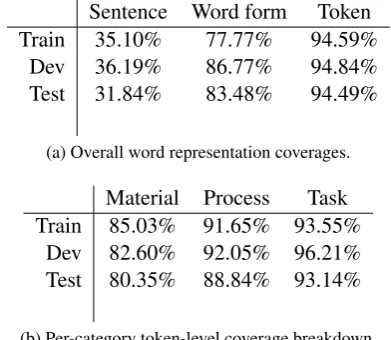
Table1 includes the coverage of the word rep-resentations for the training, development and test sets. Table1acontains the proportion of sentences with all words having a word representation de-termined for, alongside with the same values for
K=128 K=256 K=512 K=1024
λ
=
0.
9
λ
=
0.
7
λ
=
0.
5
λ
=
0.
3
λ
=
0.
1
0.24 0.25 0.27 0.3
0.27 0.27 0.28 0.32 0.29 0.29 0.31 0.31 0.3 0.31 0.31 0.31 0.33 0.32 0.32 0.34
(a) Excluding word identity features
K=128 K=256 K=512 K=1024
λ
=
0.
9
λ
=
0.
7
λ
=
0.
5
λ
=
0.
3
λ
=
0.
1
0.32 0.34 0.36 0.35 0.34 0.34 0.33 0.35 0.34 0.33 0.34 0.33 0.33 0.32 0.33 0.34 0.32 0.34 0.34 0.34
(b) Including word identity features
Figure 1: Micro-averaged F-scores for Subtask B as a function of varyingλandKparameters for sparse coding without Brown clustering-based and orthographic features being used.
Precision Recall F-score
Subtask A 0.51 0.27 0.35
Subtask B avg. 0.40 0.21 0.28
Material 0.46 0.27 0.34
Process 0.39 0.19 0.26
Task 0.09 0.05 0.06
(a) Excluding word identity features.
Precision Recall F-score
Subtask A 0.51 0.30 0.38
Subtask B avg. 0.39 0.23 0.29
Material 0.43 0.29 0.35
Process 0.38 0.20 0.27
Task 0.14 0.05 0.07
[image:3.595.134.479.72.201.2](b) Including word identity features.
Table 2: Results of the official submission on the test data withK = 128, λ= 0.9.
word forms and tokens. Table1bprovides a more
detailed breakdown of the coverages of word rep-resentations for the different keyphrase types also. As subsequent results illustrate, higher word coverage for a certain type of keyphrase does not necessarily imply better performance on that type as e.g.Task-type keyphrases have the highest to-ken coverage, nevertheless, scores are the lowest on that particular type (cf. Table4).
3.1 Results on development data
Figure1illustrates the effect of varying theKand
λhyperparameters of sparse coding when not
re-lying on orthographic or Brown clustering derived features. Figure1billustrates the effect of adding word identity features to the sparse coding derived ones, which suggests that the choice ofK= 1024
Precision Recall F-score
Subtask A 0.49 0.25 0.33
Subtask B avg. 0.37 0.19 0.25
Material 0.42 0.26 0.32
Process 0.36 0.15 0.21
Task 0.13 0.05 0.07
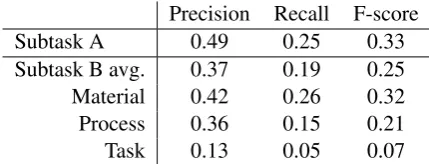
Table 3: Results on the test set with all features usedexcept forthe sparse coding-derived ones.
seems to a reasonable choice for sparse coding since for that value ofK, adding word identity fea-tures over the sparse coding derived ones yields marginal (or no) improvements. Inspecting Fig-ure 1a also reveals that setting the regualrization parameterλtoo high hurts performance.
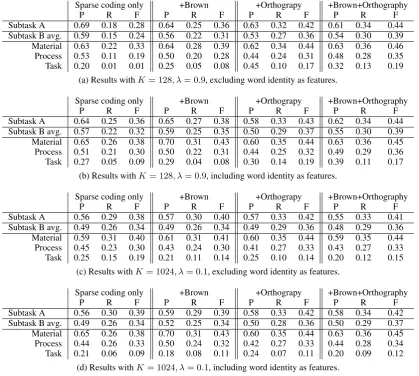
Subsequently, we investigate how does adding orthographic and Brown clustering-derived fea-tures affect results for two extremely different hyperparameter combinations of sparse coding, i.e.K = 128, λ = 0.9andK = 1024, λ = 0.1. These results are presented in Table 4a-4d. Ta-ble4reveals that when orthographic and/or Brown clustering-based features are used in conjunction with the sparse coding derived ones, results be-come more stable, i.e. they are much less affected by the choices of theKandλ. Simultaneously, the importance of word identity features diminishes once orthographic and/or Brown clustering-related ones get involved in the model. This effect is more pronounced when adding orthographic features.
[image:3.595.306.521.263.345.2]Sparse coding only +Brown +Orthograpy +Brown+Orthography
P R F P R F P R F P R F
Subtask A 0.69 0.18 0.28 0.64 0.25 0.36 0.63 0.32 0.42 0.61 0.34 0.44 Subtask B avg. 0.59 0.15 0.24 0.56 0.22 0.31 0.53 0.27 0.36 0.54 0.30 0.39 Material 0.63 0.22 0.33 0.64 0.28 0.39 0.62 0.34 0.44 0.63 0.36 0.46 Process 0.53 0.11 0.19 0.50 0.20 0.28 0.44 0.24 0.31 0.48 0.28 0.35 Task 0.20 0.01 0.01 0.25 0.05 0.08 0.45 0.10 0.17 0.32 0.13 0.19
(a) Results withK= 128, λ= 0.9, excluding word identity as features.
Sparse coding only +Brown +Orthograpy +Brown+Orthography
P R F P R F P R F P R F
Subtask A 0.64 0.25 0.36 0.65 0.27 0.38 0.58 0.33 0.43 0.62 0.34 0.44 Subtask B avg. 0.57 0.22 0.32 0.59 0.25 0.35 0.50 0.29 0.37 0.55 0.30 0.39 Material 0.65 0.26 0.38 0.70 0.31 0.43 0.60 0.35 0.44 0.63 0.36 0.45 Process 0.51 0.21 0.30 0.50 0.22 0.31 0.44 0.25 0.32 0.49 0.29 0.36 Task 0.27 0.05 0.09 0.29 0.04 0.08 0.30 0.14 0.19 0.39 0.11 0.17
(b) Results withK= 128, λ= 0.9, including word identity as features.
Sparse coding only +Brown +Orthograpy +Brown+Orthography
P R F P R F P R F P R F
Subtask A 0.56 0.29 0.38 0.57 0.30 0.40 0.57 0.33 0.42 0.55 0.33 0.41 Subtask B avg. 0.49 0.26 0.34 0.49 0.26 0.34 0.49 0.29 0.36 0.48 0.29 0.36 Material 0.59 0.31 0.40 0.61 0.31 0.41 0.60 0.35 0.44 0.59 0.35 0.44 Process 0.45 0.23 0.30 0.43 0.24 0.30 0.41 0.27 0.33 0.43 0.27 0.33 Task 0.25 0.15 0.19 0.21 0.11 0.14 0.25 0.10 0.14 0.20 0.12 0.15
(c) Results withK= 1024, λ= 0.1, excluding word identity as features.
Sparse coding only +Brown +Orthograpy +Brown+Orthography
P R F P R F P R F P R F
Subtask A 0.56 0.30 0.39 0.59 0.29 0.39 0.58 0.33 0.42 0.58 0.34 0.42 Subtask B avg. 0.49 0.26 0.34 0.52 0.25 0.34 0.50 0.28 0.36 0.50 0.29 0.37 Material 0.65 0.26 0.38 0.70 0.31 0.43 0.60 0.35 0.44 0.63 0.36 0.45 Process 0.44 0.26 0.33 0.50 0.24 0.32 0.42 0.27 0.33 0.44 0.28 0.34 Task 0.21 0.06 0.09 0.18 0.08 0.11 0.24 0.07 0.11 0.20 0.09 0.12
[image:4.595.72.492.62.438.2](d) Results withK= 1024, λ= 0.1, including word identity as features.
Table 4: Ablation experiments on the development set. P=Precision, R=Recall, F=F-scores.
3.2 Results on test data
Based on our experiments on the development data, out official shared task submission employed K = 128, λ = 0.9 alongside with orthographic and Brown clustering-derived features. One of our official submissions relied on word form features, whereas the other dismissed such ones. The final results of our submissions are included in Table2. As our main goal was to verify the applicabil-ity of sparse coding derived features in keyphrase extraction as well, we checked the performance of the model which uses all features except for the sparse coding derived ones. The result of that model is presented in Table3. By comparing these scores with those in Table2, we can see that even
when using a low value for K and a large
reg-ularization parameter λwe manage to get better F-scores when sparse coding related features are employed.
4 Conclusion
In this paper, we proposed an approach for extract-ing keyphrases from scientific publications. A key source of features in our approach were those de-rived from the sparse coding of continuous word embeddings.
In our approach we did not use any task-specific features (such as lists or gazetters), which implies that i) by relying on some extra task specific fea-tures, results could be easily improved on this task and ii) the proposed approach is likely to be suc-cessfully applicable to further sequence labeling tasks without severe modifications.
References
Computa-tional Linguistics, Sofia, Bulgaria, pages 183–192. http://www.aclweb.org/anthology/W13-3520.
Isabelle Augenstein, Mrinal Kanti Das, Sebastian Riedel, Lakshmi Nair Vikraman, and Andrew McCallum. 2017. SemEval 2017 Task 10: ScienceIE -Extracting Keyphrases and Relations from Scientific Publications. In Proceedings of the International Workshop on Semantic Evaluation. Association for Computational Linguistics, Vancouver, Canada.
G´abor Berend. 2016a. Exploiting extra-textual and linguistic information in keyphrase extrac-tion. Natural Language Engineering 22(1):73–95. https://doi.org/10.1017/S1351324914000126.
G´abor Berend. 2016b. Sparse coding of neu-ral word embeddings for multilingual se-quence labeling. CoRR abs/1612.07130. http://arxiv.org/abs/1612.07130.
Peter F. Brown, Peter V. deSouza, Robert L. Mer-cer, Vincent J. Della Pietra, and Jenifer C. Lai. 1992. Class-based n-gram models of natu-ral language. Comput. Linguist. 18(4):467–479. http://dl.acm.org/citation.cfm?id=176313.176316.
Anette Hulth. 2003. Improved automatic keyword extraction given more linguistic knowledge. In
Proceedings of the 2003 Conference on Empiri-cal Methods in Natural Language Processing. As-sociation for Computational Linguistics, Strouds-burg, PA, USA, EMNLP ’03, pages 216–223. https://doi.org/10.3115/1119355.1119383.
Su Nam Kim, Olena Medelyan, Min-Yen Kan, and Timothy Baldwin. 2010. SemEval-2010 task 5: Automatic keyphrase extraction from scientific articles. In Proceedings of the 5th Interna-tional Workshop on Semantic Evaluation. ACL, Morristown, NJ, USA, SemEval ’10, pages 21–26. http://portal.acm.org/citation.cfm?id=1859664.1859668.
John D. Lafferty, Andrew McCallum, and Fernando C. N. Pereira. 2001. Conditional random fields: Probabilistic models for segmenting and label-ing sequence data. In Proceedings of the Eigh-teenth International Conference on Machine Learn-ing. Morgan Kaufmann Publishers Inc., San Fran-cisco, CA, USA, ICML ’01, pages 282–289. http://dl.acm.org/citation.cfm?id=645530.655813.
P. Liang. 2005. Semi-Supervised Learning for Natural Language. Master’s thesis, Massachusetts Institute of Technology.
Tomas Mikolov, Kai Chen, Greg Corrado, and Jef-frey Dean. 2013. Efficient estimation of word rep-resentations in vector space. CoRRabs/1301.3781. http://arxiv.org/abs/1301.3781.
Naoaki Okazaki. 2007. CRFsuite: a fast imple-mentation of Conditional Random Fields (CRFs). http://www.chokkan.org/software/crfsuite/.
Lev Ratinov and Dan Roth. 2009. Design challenges and misconceptions in named entity recognition. In Proceedings of the Thirteenth Conference on Computational Natural Language Learn-ing. Association for Computational Linguistics, Stroudsburg, PA, USA, CoNLL ’09, pages 147–155. http://dl.acm.org/citation.cfm?id=1596374.1596399. Joseph Turian, Lev Ratinov, and Yoshua Bengio.
2010. Word representations: A simple and general method for semi-supervised learning. In Proceedings of the 48th Annual Meeting of the Association for Computational Linguis-tics. Association for Computational Linguistics, Stroudsburg, PA, USA, ACL ’10, pages 384–394. http://dl.acm.org/citation.cfm?id=1858681.1858721. Ian H. Witten, Gordon W. Paynter, Eibe Frank, Carl