Lyb3b at SemEval-2018 Task 12: Ensemble-based Deep Learning Models
for Argument Reasoning Comprehension Task
Yongbin Li1,2, Xiaobing Zhou1,∗
1Yunnan University, Kunming, Yunnan, P.R. China 2Zunyi Medical University, Zunyi, Guizhou, P.R. China
∗Corresponding author,[email protected]
Abstract
Reasoning is a crucial part of natural language argumentation. In order to comprehend an ar-gument, we have to reconstruct and analyze its reasoning. In this task, given a natural lan-guage argument with a reason and a claim, the goal is to choose the correct implicit reason-ing from two options, in order to form a rea-sonable structure of (Reason, Warrant, Claim). Our approach is to build distributed word em-bedding of reason, warrant and claim respec-tively, meanwhile, we use a series of frame-works such as CNN model, LSTM model, GRU with attention model and biLSTM with attention model for processing word vector. Finally, ensemble mechanism is used to inte-grate the results of each framework to improve the final accuracy. Experiments demonstrate superior performance of ensemble mechanism compared to each separate framework. We are the 11th in official results, the final model can reach a 0.568 accuracy rate on the test dataset.
1 Introduction
Argument reasoning comprehension is a crucial part of natural language argumentation, and the re-alization of argument reasoning requires the un-derstanding of the deep meaning of the text by the computer. At the same time, argument rea-soning is also an important evaluation criterion for the understanding of natural language by com-puter. This paper is based on the argument rea-soning comprehension task proposed by (Haber-nal et al., 2018), which proposed a complex, yet scalable crowdsourcing process, and created a new freely licensed dataset based on authentic argu-ments from news comargu-ments. The dataset consists of three parts: train dataset, validation dataset and test dataset, with the quantity being 1210, 316 and 444 respectively.
The task is formally defined as follow: given an argument consisting of a reasonRand a claim
C along with the title and a short description of the debate they occur in, identify the correct war-rant W from two candidates, the goal is to select the correct warrant W that explains reasoning of this particular argument. There are only two op-tions given and only one answer is correct. The key point of the task is that it is difficult to find the answer through the shallow semantics, and the answer is usually implicit.
Being a binary classification task, through pre-liminary experiment, our approach is combining debate title and description into reason, and split-ting a sample {R (with debate title and de-scription) ; C; W 0; W 1; correct label} into two quadruples, which are {R; C; W 0; label}
and {R; C; W 1; label}. On the validation, we employ the same processing mode, determin-ing the matchdetermin-ing degree of fit between a quadru-ples, the highest will be chosen. The four main deep learning(DL) frameworks we employed are based on Convolutional Neural Network(CNN) model, Long Short-Term Memory(LSTM) model, GRU with attention model and Bidirectional Long Short-Term Memory (biLSTM) with attention model, which are based on utilizing word dis-tributed representation onRandCandW respec-tively, on top of models, a dense layer is used to determine the matching degree.
In our paper, an ensemble mechanism is intro-duced into neural network (NN) models, we in-tegrate the results of each model to improve the final accuracy. Experiments demonstrate superior performance of ensemble mechanism compared to each separate model. For confirming the effect of ensemble method, we use each separate model as a reference.
embedding embedding
reason warrant
embedding claim
CNN Maxpool
CNN Maxpool
CNN Maxpool
CNN Maxpool
CNN Maxpool
CNN Maxpool Dropout Dropout Dropout Flatten Flatten Flatten
Dense Softmax
concatenate
[image:2.595.354.480.65.166.2]‖
Figure 1: The architecture of CNN framework
2 Related work
An argument consists of a claim and multiple premises was pointed out in (Damer,2009). Toul-min elaborated on a model of argument in which the reason supports the claim on behalf of a war-rant. The abstract structure of an argument then is reason→ (since) warrant→ (therefore) claim. But, making comprehending and analyzing argu-ments is hard, for claims and warrants are usu-ally implicit (Freeman,2011). The phenomenon is referred to as common knowledge (Macagno and Walton,2014).
Previous, feature extraction and semantic anal-ysis are usually used in natural language argumen-tation. With the development of neural networks, we adopt the method of word distributed repre-sentation from (Hinton,1986), CNN model refers to (Kim,2014), the LSTM model from (Hochre-iter and Schmidhuber, 1997) and be improved by (Graves et al., 2013), the attention mecha-nism from (Hermann et al.,2015), eventually con-verted the task into a classification problem (Wang and Nyberg, 2015). Meanwhile, inspired by the ensemble method in statistical learning domain, we develop a very simple but efficient integrated method.
3 Model description
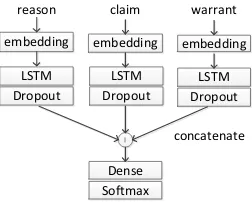
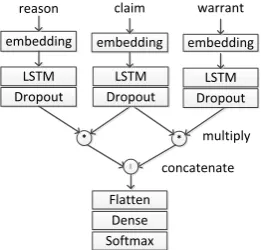
In this section, we describe the four main pro-posed deep learning frameworks, the framework architectures are shown in figure 1 to 4. The main idea of these different systems is the same: learn a distributed vector representation of given reason and claim and warrant candidates, and use a dense layer to measure the matching degree.
embedding embedding
reason warrant
embedding claim
LSTM Dropout
LSTM LSTM
Softmax
Dropout Dropout
Dense
‖ concatenate
Figure 2: The architecture of LSTM framework
3.1 CNN framework
The first framework is based on CNN model. Step one is to obtain word embedding by pre-trained word2vec (Mikolov et al., 2013), the word em-bedding provides the distributed representation for each token in reason, claim and warrant candi-dates respectively. The vectors have dimension-ality of 300 and were trained by 100 billion words of Google News, and was initialized from an un-supervised neural language model.
Reason, claim and warrant will be transformed to a word vector matrix and be entered into CNN layer respectively. In order to get more compos-ite representation of semantic features, we adopted double layer CNN model. The numbers of filters are 64 and 32, and the filter size is set as 3, after each CNN layer, we resort to a MaxPooling layer of size 2.
Above the CNN layer, the output of rea-son, claim and warrant are merged to one and performed flatten operations, through a dense layer, the final output is passed through a two-dimensional softmax layer.
3.2 LSTM framework
LSTM is a special type of RNN that can learn to rely on long-distance history and the immediate previous hidden vector, its a remarkable variation of RNN to alleviate the gradient vanish problem.
[image:2.595.120.241.65.209.2]embedding embedding
reason warrant
embedding claim
LSTM Dropout
LSTM LSTM
Dense Softmax
concatenate
* *
Dropout Dropout
multiply
Flatten
[image:3.595.352.480.63.186.2]‖
Figure 3: The architecture of GRU framework
3.3 GRU with attention
Like the LSTM framework, the masking method is used in the embedding layer. Reason, claim and warrant will be transformed to a word vec-tor matrix and be entered into GRU layer respec-tively. Gated recurrent unit (GRU), was proposed by (Cho et al.,2014) to make each recurrent unit to adaptively capture dependencies of different time scales. Similarly to the LSTM unit, the GRU has gating units that modulates the flow of information inside the unit, without having a separate memory cells. Unlike the LSTM framework, GRU with at-tention return full output sequences, instead of the final output of the model.
Through the GRU layer, reason, claim and war-rant are converted into three vector matrices. Now, we investigate a state-of-the-art attention model for the warrant vector generation based on claim which is called fact matrix, and the claim vector generation based on warrant which is called at-tention matrix. An atat-tention mechanism are used to alleviate weakness by dynamically aligning the more informative parts. Specifically, attention model gives more weights on certain words, just like tf-idf for each word, however, the weight is calculated by another vector. Final, we merge the two sequences to one and perform flatten opera-tions.
3.4 biLSTM with attention
The framework is similar to the above one, just changing the GRU model into a biLSTM model, Single direction LSTMs suffers a weakness of not utilizing the contextual information from the fu-ture tokens. biLSTM utilizes both the previous and future context by processing the sequence on two directions, and generates two independent se-quences of LSTM output vectors.
embedding embedding
reason warrant
embedding claim
BiLSTM Dropout
BiLSTM BiLSTM
Dense Softmax
concatenate
* *
Dropout Dropout
multiply
Flatten
[image:3.595.117.248.65.190.2]‖
Figure 4: The architecture of biLSTM framework
4 Ensemble Methods
Ensemble methods is an important method in sta-tistical learning, which combines a number of weak models into a strong model through a certain combination. The most famous of them are the Bagging algorithm and the Boosting algorithm.
Our method is inspired by the bagging method, the differences between our method and the tradi-tional bagging method are as follows: we use sev-eral strong classifiers for combination, and use all the data to train a single model.
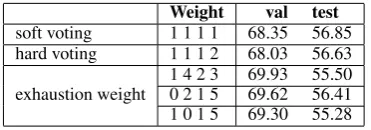
Specifically, we use three ensemble methods. The first method is the soft voting based on Bag-ging method, that is, each framework outputs a class probability and takes the average to judge the category. The second method is hard voting, each framework predicts categories separately, and fi-nally votes. Because four frameworks are used in the paper, the weight of the best framework is set to 2. The third method is finding the best weight which is the best accuracy on the validation dataset by the exhaustive method.
5 Experimental setup
Our approach in this task is realized by keras, we use the accuracy on validation dataset to locate the best parameters. All the results are taken three times, and the average value is taken.
In the experiment, we use the loss function of categorical cross entropy and the optimizer of adaptive moment estimation. The length of rea-son, claim and warrant tokens sequence all take the maximum length, if the length is not enough, then zero is added.
Framework val test
1 Intra-warrant attention 63.8 55.6 2 Intra-warrant attention w/context 63.7 56.0
3 CNN 63.92 52.93
4 LSTM 66.46 54.95
[image:4.595.75.290.61.134.2]5 GRU with attention 67.72 56.19 6 biLSTM with attention 67.09 57.21
Table 1: Results of originator and the four main frame-works which our paper employed
Weight val test
soft voting 1 1 1 1 68.35 56.85 hard voting 1 1 1 2 68.03 56.63
exhaustion weight 1 4 2 30 2 1 5 69.9369.62 55.5056.41 1 0 1 5 69.30 55.28
Table 2: Results of ensemble method
(Habernal et al.,2018), we take the results as the baseline to measure other frameworks. Rows (3) to (6) corresponds to our main four frameworks. Row (3) achieve acceptable results on validation set compared to the baseline. Row (4) has been greatly improved compared with CNN on the vali-dation set and test set, especially on the valivali-dation set, reaching a 66.46% accuracy rate, proving that the LSTM model is more advantageous in process-ing sequence text. Row (5) has a better effect on the validation set and test set, the results have ex-ceeded to the baseline. In these four major frame-works, the result of Row (6) is the most satisfying, improves over the baseline already, especially on the validation set, 4% higher than the baseline, on the test set, the accuracy rate of 57.21% is also reached. From the Table 1, we can perceive that the attention mechanism is beneficial to improve the capability of the model.
We report the performance of ensemble method in Table 2. As can be seen from the result, we can observe that Row (1) uses the soft voting method, which achieves a 68.35% accuracy rate on the val-idation set, which surpasses all the single frame-works. The performance on the test set is also good, reaching 56.85%, more than the baseline model 1%, though it is not as good as the best sult of single framework, but it is also a good re-sult. Row (2) is the hard voting method, which is slightly worse than the soft voting. The weight of Rows (3) to (5) which were found on validation set achieve the highest accuracy on the validation set, more than 69%, this is a huge improvement, but the performance on the test dataset is not the best, the reason may be the overfitting caused by this
method.It needs to be emphasized that soft vot-ing method is adopted in the actual tasks, that is, the Row (1). The other methods listed here are only theoretical discussions on the ensemble method from the perspective of research.
Through these experiments, we can conclude that remarkable results can be achieved through the ensemble method. At the same time, the soft voting method is better than other methods, al-though the results of the validation dataset are not the best in three method, but the effect on test dataset is the best.
6 Conclusion
In this paper, we solve the Argument Reason-ing Comprehension Task by employReason-ing four main frameworks and ensemble mechanism. Through a series of attempts, our experimental results demonstrate that: comparing to a single frame-work, ensembling a series of models can effec-tively improve the accuracy of the model; the re-sults of the single framework are unstable, and the stability of the model can be improved effectively through the ensemble method, the accuracy of the integrated system on the test set is guaranteed to be above 55%; in the experiment, soft voting is a good way to integrate and achieve better results.
Acknowledgments
This work was supported by the Natural Sci-ence Foundations of China No.61463050, No.617-02443, No.61762091, the NSF of Yunnan Province No. 2015FB113, the Project of Innova-tive Research Team of Yunnan Province.
References
Kyunghyun Cho, Bart Van Merri¨enboer, Caglar Gul-cehre, Dzmitry Bahdanau, Fethi Bougares, Holger Schwenk, and Yoshua Bengio. 2014. Learning phrase representations using rnn encoder-decoder for statistical machine translation. arXiv preprint arXiv:1406.1078.
T Edward Damer. 2009. Attacking faulty reasoning: A practical guide to fallacy-free reasoning. Wadsworth Cengage Learning,.
James B Freeman. 2011. Argument structure: Rep-resentation and theory. Argumentation Library, 121(7):1194–1206.
[image:4.595.89.275.183.248.2]signal processing (icassp), 2013 IEEE international
conference on, pages 6645–6649. IEEE.
Ivan Habernal, Henning Wachsmuth, Iryna Gurevych, and Benno Stein. 2018. The Argument Reason-ing Comprehension Task: Identification and Recon-struction of Implicit Warrants. In16th Annual Con-ference of the North American Chapter of the Asso-ciation for Computational Linguistics: Human
Lan-guage Technologies. Association for Computational
Linguistics.
Karl Moritz Hermann, Tomas Kocisky, Edward Grefenstette, Lasse Espeholt, Will Kay, Mustafa Su-leyman, and Phil Blunsom. 2015. Teaching ma-chines to read and comprehend. InAdvances in
Neu-ral Information Processing Systems, pages 1693–
1701.
Geoffrey E Hinton. 1986. Learning distributed repre-sentations of concepts. InProceedings of the eighth annual conference of the cognitive science society, volume 1, page 12. Amherst, MA.
Sepp Hochreiter and J¨urgen Schmidhuber. 1997. Long short-term memory. Neural computation, 9(8):1735–1780.
Yoon Kim. 2014. Convolutional neural net-works for sentence classification. arXiv preprint arXiv:1408.5882.
Fabrizio Macagno and Douglas Walton. 2014.Emotive
language in argumentation. Cambridge University
Press.
Tomas Mikolov, Ilya Sutskever, Kai Chen, Greg S Cor-rado, and Jeff Dean. 2013. Distributed representa-tions of words and phrases and their compositional-ity. InAdvances in neural information processing systems, pages 3111–3119.