Multiplicative Tree-Structured Long Short-Term Memory Networks for
Semantic Representations
Nam Khanh Tran
∗L3S Research Center
[email protected]
Weiwei Cheng
Amazon
[email protected]
Abstract
Tree-structured LSTMs have shown advan-tages in learning semantic representations by exploiting syntactic information. Most exist-ing methods model tree structures by bottom-up combinations of constituent nodes using the same shared compositional function and often making use of input word information only. The inability to capture the richness of com-positionality makes these models lack expres-sive power. In this paper, we propose multi-plicative tree-structured LSTMsto tackle this problem. Our model makes use of not only word information but also relation information between words. It is more expressive, as dif-ferent combination functions can be used for each child node. In addition to syntactic trees, we also investigate the use of Abstract Mean-ing Representation in tree-structured models, in order to incorporate both syntactic and se-mantic information from the sentence. Experi-mental results on common NLP tasks show the proposed models lead to better sentence repre-sentation and AMR brings benefits in complex tasks.
1 Introduction
Learning the distributed representation for long spans of text from its constituents has been a crucial step of various NLP tasks such as text classification (Zhao et al., 2015; Kim,2014), se-mantic matching (Liu et al., 2016), and machine translation (Cho et al., 2014). Seminal work uses recurrent neural networks (RNN) (Elman, 1990), convolutional neural networks ( Kalchbren-ner et al., 2014), and tree-structured neural net-works (Socher et al., 2011; Tai et al., 2015) for sequence and tree modeling. Long Short-Term Memory (LSTM) (Hochreiter and Schmidhuber, 1997) networks are a type of recurrent neural
net-∗ Work done as an intern at Amazon.
𝑐"#$
ℎ"#$
𝑐"
ℎ"
𝑥"#$ 𝑥"
𝑐"#$'
ℎ"#$'
𝑐"#$(
ℎ"#$(
𝑐"
ℎ"
𝑥" 𝑥"#$'
𝑥"#$(
[image:1.595.320.496.244.375.2](a) (b)
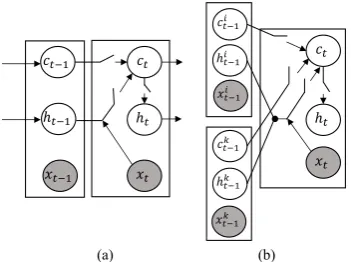
Figure 1: Topology of sequential LSTM and TreeLSTM: (a) nodes in sequential LSTM and (b) nodes in tree-structured LSTM
work that are capable of learning long-term de-pendencies across sequences and have achieved significant improvements in a variety of sequence tasks. LSTM has been extended to model tree structures (e.g., TreeLSTM) and produced promis-ing results in tasks such as sentiment classification (Tai et al.,2015;Zhu et al.,2015) and relation ex-traction (Miwa and Bansal,2016).
Figure 1 shows the topologies of the con-ventional chain-structured LSTM (Hochreiter and Schmidhuber,1997) and the TreeLSTM (Tai et al., 2015), illustrating the input(x), cell(c)and
hid-den node(h)at a time stept. The key difference
between Figure1(a) and (b) is the branching fac-tor. While a cell in the sequential LSTM only de-pends on the single previous hidden node, a cell in the tree-structured LSTM depends on the hidden states of child nodes.
Despite their success, the tree-structured mod-els have a limitation in their inability to fully cap-ture the richness of compositionality (Socher et al., 2013a). The same combination function is used for all kinds of semantic compositions, though the
compositions have different characteristics in na-ture. For example, the composition of the ad-jective and the noun differs significantly from the composition of the verb and the noun.
To alleviate this problem, some researchers propose to use multiple compositional functions, which are predefined according to some parti-tion criterion (Socher et al., 2012, 2013a; Dong et al., 2014). Socher et al. (2013a) defined dif-ferent compositional functions in terms of syntac-tic categories, and a suitable compositional func-tion is selected based on the syntactic categories. Dong et al. (2014) introduced multiple composi-tional functions and a proper one is selected based on the input information. These models accom-plished their objective to a certain extent but they still face critical challenges. The predefined com-positional functions cannot cover all the compo-sitional rules and they add much more learnable parameters, bearing the risk of overfitting.
In this paper, we proposemultiplicative TreeL-STM, an extension to the TreeLSTM model, which injects relation information into every node in the tree. It allows the model to have different semantic composition matrices to combine child nodes. To reduce the model complexity and keep the number of parameters manageable, we define the compo-sition matrices using the product of two dense ma-trices shared across relations, with an intermediate diagonal matrix that is relation dependent.
Though the syntactic-based models have shown to be promising for compositional semantics, they do not make full use of the linguistic informa-tion. For example, semantic nodes are often the argument of more than one predicate (e.g., coref-erence) and it is generally useful to exclude se-mantically vacuous words like articles or comple-mentizers, i.e., leave nodes unattached that do not add further meaning to the resulting representa-tions. Recently,Banarescu et al.(2013) introduced Abstract Meaning Representation (AMR), single rooted, directed, acyclic graphs that incorporate semantic roles, correference, negation, and other linguistic phenomena. In this paper, we investigate a combination of the semantic process provided by TreeLSTM model with the lexical semantic rep-resentation of the AMR formalism. This differs from most of existing work in this area, where syntactic rather than semantic information is in-corporated to the tree-structured models. We seek to answer the question: To what extent can we do
better with AMR as opposed to syntactic represen-tations, such as constituent and dependency trees, in tree-structured models?
We evaluate the proposed models on three com-mon tasks: sentiment classification, sentence latedness, and natural language inference. The re-sults show that the multiplicative TreeLSTM mod-els outperform TreeLSTM modmod-els on the same tree structures. The results further suggest that us-ing AMR as the backbone for tree-structured mod-els is helpful in the complex task such as for longer sentences in natural language inference but not in sentiment classification, where lexical information alone suffices.
In short, our contribution is twofold:
1. We propose the new multiplicative TreeL-STM model that effectively learns distributed representation of a given sentence from its constituents, utilizing not only the lexical formation of words, but also the relation in-formation between the words.
2. We conduct an extensive investigation on the usefulness of lexical semantic represen-tation induced by AMR formalism in tree-structured models.
2 Tree-Structured LSTM
A standard LSTM processes a sentence in a se-quential order, e.g., from left to right. It esti-mates a sequence of hidden vectors given a se-quence of input vectors, through the calculation of a sequence of hidden cell vectors using a gate mechanism. Extending the standard LSTM from linear chains to tree structures leads to TreeL-STM. Unlike the standard LSTM, TreeLSTM al-lows richer network topologies, where each LSTM unit is able to incorporate information from multi-ple child units.
As in standard LSTM units, each TreeLSTM unit contains input gateij, output gateoj, a
mem-ory cellcj, and hidden statehjfor nodej. Unlike
the standard LSTM, in TreeLSTM the gating vec-tors and the memory cell updates are dependent on the states of one or more child units. In addi-tion, the TreeLSTM unit contains one forget gate
fjkfor each childkinstead of having a single
follows:
˜
hj =
X
k∈C(j)
hk,
ij =σ
W(i)xj+U(i)˜hj+b(i)
,
oj =σ
W(o)xj+U(o)˜hj+b(o)
,
fjk =σ
W(f)xj+U(f)hk+b(f)
,
uj =tanh
W(u)xj+U(u)h˜j+b(u)
,
cj =ijuj+
X
k∈C(j)
fjkck,
hj =ojtanh(cj),
(1)
where C(j)is the set of children of node j, k ∈ C(j)in fjk, σ is the sigmoid function, and is
element-wise (Hadamard) product. W(∗), U(∗), b(∗)are model parameters with∗ ∈ {u, o, i, f}.1
3 Multiplicative Tree-Structured LSTM
Encoding rich linguistic analysis introduces many distinct edge types or relations between nodes, such as syntactic dependencies and semantic roles. This opens up many possibilities for parametriza-tion, but was not considered in most exist-ing syntax-aware LSTM approaches, which only make use of input node information.In this paper, we fill this gap by proposing multiplicative TreeLSTM, an extension to the TreeLSTM model, injecting relation information into every node in the tree. The multiplicative TreeLSTM model, mTreeLSTM for short, intro-duces more fined-grained parameters based on the edge types. Inspired by the multiplicative RNN (Sutskever et al., 2011), the hidden-to-hidden propagation in mTreeLSTM contains a separately learned transition matrix Whh for each possible
edge type and is given by
˜
hj =
X
k∈C(j)
Whhr(j,k)hk, (2)
where r(j, k) signifies the connection type
be-tween node k and its parent node j. This
parametrization is straightforward, but requires a large number of parameters when there are many edge types. For instance, there are dozens of syn-tactic edge types, each corresponding to a Stanford dependency label.
1InTai et al.(2015), the TreeLSTM defined in Eq. (1) was
referred to aschild-sum TreeLSTM, which is a good choice for trees with high branching factor.
To reduce the number of parameters and lever-age potential correlation among fine-grained edge types, we learned an embedding of the edge types and factorized the transition matrix Whhr(j,k) by using the product of two dense matrices shared across edge types, with an intermediate diagonal matrix that is edge-type dependent:
Whhr(j,k)=Whmdiag(Wmrejk)Wmh, (3)
where ejk is the edge-type embedding and is
jointly trained with other parameters. The map-ping fromhk to˜hj is then given by
mjk = (Wmrejk)(Wmhhk),
˜
hj =
X
k∈C(j)
Whmmjk. (4)
The gating units – input gatei, output gateo, and forget gatef – are computed in the same way as
in the TreeLSTM with Eq. (1).2
Multiplicative TreeLSTM can be applied to any tree, where connection types between nodes are given. For example, in dependency trees, the se-mantic relations r(j, k) between nodes are pro-vided by a dependency parser.
4 Tree-Structured LSTMs with Abstract
Meaning Representation
Tree-structured LSTMs have been applied suc-cessfully to syntactic parse trees (Tai et al.,2015; Miwa and Bansal,2016). In this work, we look beyondsyntacticproperties of the text and incor-porate semantic properties to the tree-structured LSTM model. Specifically, we utilize the network topology offered by a tree-structured LSTM and incorporate semantic features induced by AMR formalism. We aim to address the following ques-tions: In which tasks using AMR structures as the backbone for the tree-structured LSTM is useful? Furthermore, which semantic properties are use-ful for the given task?
AMR is a semantic formalism where the mean-ing of a sentence is encoded as a smean-ingle rooted, di-rected and acyclic graph (Banarescu et al.,2013). For example, the sentence “A young girl is playing on the edge of a fountain and an older woman is not watching her” is represented as:
2In the rest of the paper, we use the termTreeLSTM in
a/and
p/play-01 w/watch-01
e/edge-01 g/girl
y/young f/fountain
w2/woman
o/old
g2 –
op1 op2
ARG0
ARG1
mod
ARG0 ARG1
ARG1
polarity
[image:4.595.81.293.74.204.2]mod
Figure 2: An AMR representing the sentence “A young girl is playing on the edge of a fountain and an older woman is not watching her”.
(a / and
:op1 (p / play-01 :ARG0 (g / girl
:mod (y / young)) :ARG1 (e / edge-01
:ARG1 (f / fountain))) :op2 (w / watch-01
:ARG0 (w2 / woman :mod (o / old)) :ARG1 g
:polarity -))
The same AMR can be represented as in Figure 2, in which the nodes in the graph (also called con-cepts) map to words in the sentence and the edges represent the relations between words. AMR con-cepts consist of predicate senses, named entity an-notations, and in some cases, simply lemmas of English words. AMR relations consist of core se-mantic roles drawn from the Propbank (Palmer et al., 2005) as well as fine-grained semantic re-lations defined specifically for AMR. Since AMR provides a whole-sentence semantic representa-tion, it captures long-range dependencies among constituent words in a sentence. Similar to other semantic schemes, such as UCCA (Abend and Rappoport, 2013), GMB (Basile et al., 2012), UDS (White et al., 2016), AMR abstracts away from morphological and syntactic variability and generalize cross-linguistically.
To use AMR structures in a tree-structured LSTM, we first parse sentences to AMR graphs and transform the graphs to tree structures. The transformation follows the procedure used by Takase et al.(2016), splits the nodes with an inde-gree larger than one, which mainly present coref-erential concepts, to a set of separate nodes, whose indegrees exactly equal one. We use JAMR ( Flani-gan et al.,2014,2016), a statistical semantic parser
trained on AMR bank, for AMR parsing.
On one hand, the AMR tree structure can be used directly with the TreeLSTM architecture de-scribed in Section 2, in which only node infor-mation is utilized to encode sentences into cer-tain fixed-length embedding vectors. On the other hand, since AMR provides rich information about semantic relations between nodes, the mTreeL-STM architecture is more applicable due to its ca-pability of modeling edges in the tree. We evaluate both encoded vectors produced by TreeLSTM and mTreeLSTM on AMR trees in Section6.
5 Applications
In this section, we describe three specific models that apply the mTreeLSTM architecture and the AMR tree structures described above.
5.1 Sentiment Classification
In this task, we wish to predict the sentiment of sentences, in which two sub-tasks are considered: binary and fine-grained multiclass classification. In the former, sentences are classified into two classes (positiveandnegative), while in the latter they are classified into five classes (very positive, positive, neutral, negative, andvery negative).
For a sentencex, we first apply tree-structured
LSTMs over the sentence’s parse tree to obtain the representation hr at the root node r. A softmax
classifier is then used to predict the classyˆof the
sentence, with pˆθ(y|x) = softmax W(s)hr,
where θ is the model parameters and yˆ =
argmaxypˆθ(y|x). The cost function is the
neg-ative log-likelihood of the true sentiment class of the sentence with L2 regularization.
5.2 Semantic Relatedness
Given a sentence pair, the goal is to predict an integer-valued similarity score in {1,2, ..., K},
where higher scores indicate greater degrees of similarity between the sentences.
FollowingTai et al.(2015), we first produce se-mantic representationhLandhRfor each sentence
in the pair using the described models over each sentence’s parse trees. Then, we predict the sim-ilarity score yˆ using additional feedforward
lay-ers that consider a feature vectorxsconsisting of
both distance and angle between the pair(hL, hR):
ˆ
pθ = softmax W(p)σ W(s)xs, yˆ = r>pˆθ,
where r> = [1,2, . . . , K]. Similar to Tai et al.
such that the ground-truth ratingy∈[1, K]equals r>p and use the regularized KL-divergence from
ˆ
pθtopas the cost function.
5.3 Natural Language Inference (NLI) In this task, the model reads two sentences (a premise and a hypothesis), and outputs a judge-ment of entailment, contradiction, orneutral, re-flecting the relationship between the meanings of the two sentences.
Following Bowman et al. (2016), we frame the inference task as a sentence pair classifica-tion. First we produce representations hP and
hH for the premise and hypothesis and then
con-struct a feature vector xc for the pair that
con-sists of the concatenation of these two vectors, their difference, and their element-wise product. This feature vector is then passed to a feed-forward layer followed by a softmax layer to yield a distribution over the three classes: pˆθ =
softmax W(p)σ W(c)xc. The negative
log-likelihood of the true class labels for sentence pairs is used as the cost function.
6 Experiments
6.1 Hyperparameters and Training
The model parameters are optimized using Ada-Grad (Duchi et al., 2011) with a learning rate of
0.05 for the first two tasks, and Adam (Kingma
and Ba,2015) with a learning rate of0.001for the
NLI task. The batch size of 25was used for all
tasks and the model parameters were regularized with a per-minibatch L2 regularization strength of 10−4. The sentiment and inference classifiers
were additionally regularized using dropout with a dropout rate of0.5.
Following Tai et al. (2015) and Zhu et al. (2015), we initialized the word embeddings with
300-dimensional GloVe vectors (Pennington et al., 2014). In addition, we use the aligner provided by JAMR parser to align the sentences with the AMR trees and then generate the embedding by using the GloVe vectors. The relation embeddings were randomly sampled from an uniform distribution in
[−0.05,0.05] with a size of 100. The word and relation embeddings were updated during training with a learning rate of0.1.
We use one hidden layer and the same dimen-sionality settings for sequential LSTM and tree-structured LSTMs. LSTM hidden states are of size
150. The output hidden size is50for the
related-ness task and the NLI task. Each model is trained for10 iterations. (We did not observe better
re-sults with more iterations.) The same training pro-cedure repeats5times with parameters being
eval-uated at the end of every iteration on the develop-ment set. The model having the best results on the development set is used for final tests.
For all sentences in the datasets, we parse them with constituency parser (Klein and Man-ning, 2003), dependency parser (Chen and Man-ning, 2014), and AMR parser (Flanigan et al., 2014, 2016) to obtain the tree structures. We compare our mTreeLSTM model with two base-lines: LSTM and TreeLSTM. We use the nota-tion (C), (D), and (A) to denote the tree structures that the models are based on, where they stand for constituency trees, dependency trees, and AMR trees, respectively. The code to reproduce the re-sults is available at https://github.com/ namkhanhtran/m-treelstm.3
6.2 Sentiment Classification
For this task, we use the Stanford Sentiment Tree-bank (Socher et al., 2013b) with the standard train/dev/test splits of 6920/872/1821 for the bi-nary classification sub-task, and 8544/1101/2210 for the fine-grained classification sub-task. We used two different settings for training: root-level
and phrase-level. In the root-level setting, each sentence is a data point, while in the phrase-level setting, each phrase is reconstructed from nodes in the parse tree and treated as a separate data point. In the phrase-level setting we obtain much more data for training, but the root-level setting is closer to real-world applications. For AMR trees, we only report results in the root-level setting, as the annotation cost for the phrase-level setting is prohibitively high. We evaluate our models and baseline models at the sentence level.
Table1shows the main results for the sentiment classification task. While LSTM model obtains quite good performance in both settings, TreeL-STM model on constituency tree obtains better re-sults, especially in the phrase level setting, which has more supervision. It confirms the conclu-sion fromTai et al.(2015) that combining linguis-tic knowledge with LSTM leads to better perfor-mance than sequence models in this task. Table1 also shows mTreeLSTM consistently outperforms
3The correctness of our implementation is also suggested
Model Phrase-level Root-level 5-class 2-class 5-class 2-class LSTM 48.0 (1.0) 86.7 (0.7) 45.6 (1.1) 85.6 (0.5) TreeLSTM(C) 49.8(0.8) 87.9(0.9) 46.3 (0.7) 85.8(0.5) TreeLSTM(D) 46.9 (0.2) 85.5 (0.4) 46.0 (0.3) 85.0 (0.4) TreeLSTM(A) n/a n/a 44.4 (0.2) 82.9 (0.6) mTreeLSTM(A) n/a n/a 45.2 (0.5) 83.2 (0.5) mTreeLSTM(D) 47.5 (0.7) 85.7 (0.1) 46.7(0.8) 85.7 (0.8)
Table 1: Accuracy on the Stanford Sentiment Tree-bank dataset with standard deviation in parenthe-ses (numbers in percentage)
.
TreeLSTM on the same tree structures in both set-tings – Whenever a tree structure is applicable to both mTreeLSTM and TreeLSTM, the perfor-mance of mTreeLSTM with that tree structure is better. That is, in phrase-level setting, mTreeL-STM (D) outperforms TreeLmTreeL-STM (D) and simi-larly in root-level setting, mTreeLSTM (D) and mTreeLSTM (A) perform better than TreeLSTM (D) and TreeLSTM (A), respectively. It demon-strates the effectiveness of the relation multipli-cation mechanism and the importance of mod-eling relation information. The TreeLSTM and mTreeLSTM models with AMR trees do not per-form well on this task. Synthetic inper-formation along goes a long way in determining the senti-ment of a sentence. Noisy sentences in this task also impact the accuracy of the AMR parser.
We now dive deep into what the models learn, by listing the composition matrices Whhr(j,k) with
the largest Frobenius norms. These matrices have learned larger weights, which are in turn being multiplied with the child hidden states. That child will therefore have more weight in the com-posed parent vector. In decreasing order of Frobe-nius norm, the relationship matrices for mTreeL-STM on dependency trees are: conjunction, ad-jectival modifier, object of a preposition, negation modifier, verbal modifier. The relationship ma-trices for mTreeLSTM on AMR trees are: nega-tion (:polarity), attribute (:ARG3, :ARG2), modifier (:mod), conjunction (:opN). The model learns that verbal and adjective modifiers are more important than nouns, as they tend to affect the sentiment of sentences.
6.3 Sentence Relatedness
For this task, we use the Sentences Involving Compositional Knowledge (SICK) dataset,
con-Model Pearson Spearman MSE
LSTM .841 (.004) .778 (.006) .304 (.003) TreeLSTM (C) .849 (.005) .790 (.004) .286 (.010) TreeLSTM (D) .863 (.003) .803 (.002) .260 (.005) TreeLSTM (A) .842 (.002) .774 (.001) .299 (.005) mTreeLSTM (A) .853 (.001) .788 (.001) .279 (.002) mTreeLSTM (D) .872(.004) .814(.005) .244(.007)
Table 2: Results on the SICK dataset for semantic relatedness task with standard deviation in paren-theses
sisting of 9927 sentence pairs with the standard train/dev/test split of 4500/500/4927. Each pair is annotated with a relatedness scorey∈[1,5], with 1indicating the two sentences are completely
un-related, and5indicating they are very related.
Fol-lowingTai et al. (2015), we use Pearson, Spear-man correlations and mean squared error (MSE) as evaluation metrics.
Our results are summarized in Table2. The tree-structured LSTMs, both TreeLSTM and mTreeL-STM, reach better performance than the standard LSTM. The model using dependency tree as the backbone achieves best results. The mTreeL-STM with AMR trees obtain slightly better results than the TreeLSTM with constituency trees. The multiplicative TreeLSTM models outperform the TreeLSTM models on the same parse trees, illus-trating again the usefulness of incorporating rela-tion informarela-tion into the model.
Similar to the previous experiment, we list the composition matricesWhhr(j,k)with the largest
Frobenius norms. The relationship matrices for dependency trees include: indirect object, marker for introducing a finite clause subordi-nate to another clause, negation modifier, ad-jectival modifier, phrasal verb particle, conjunc-tion. The relationship matrices for AMR trees are: patient (:ARG1), comparatives and superlatives (:degree), agent (:ARG0), attribute (:ARG3), medium (:medium), possession (:poss), man-ner (:manner).
6.4 Natural Language Inference
In this task, we first look at the SICK dataset de-scribed in the previous section. In this setting each sentence pair is classified into three labels, entail-ment, contradiction, andneutral.
Model All LS Negation LSTM 77.3 (0.5) 74.6 (1.4) 77.5 (0.4) TreeLSTM (C) 79.0 (1.4) 78.1 (2.9) 85.3 (1.2) TreeLSTM (D) 82.9 (0.3) 81.0 (2.6) 84.3 (1.2) TreeLSTM (A) 82.6 (0.2) 84.0 (1.5) 88.2 (0.4) mTreeLSTM (A) 83.3 (0.2) 85.3(0.4) 88.5(0.8) mTreeLSTM (D) 84.0(0.5) 81.6 (1.3) 87.8 (0.8)
Table 3: Accuracy on the SICK dataset for the NLI task with standard deviation in parentheses (num-bers in percentage)
subsets. The first subset,Long Sentence (LS), con-sists of sentence pairs in the test set where the premise sentence contains at least 18 words. We hypothesize that long sentences are more difficult to handle by sequential models as well as tree-structured models. The second subset, Negation, is a set of sentence pairs where negation words (not, n’t or no) do not appear in the premise but appear in the hypothesis. In the test set, 58.7% of these examples are labeled ascontradiction.
Table 3 summarizes the results of our els on different test sets. The mTreeLSTM mod-els obtain highest results, followed by TreeLSTM models. The standard LSTM model does not work well on this task. The results reconfirm the benefit of using the structure information of sen-tences in learning semantic representations. In ad-dition, Table 3 shows that TreeLSTM on depen-dency trees and AMR trees outperform the mod-els with constituency trees. The dependency trees provide some semantic information, i.e., semantic relations between words at some degrees, while AMR trees present more semantic information. The multiplicative TreeLSTM on AMR trees per-form much better than other models on theLSand
Negation subsets. The results on the LS subset shows that mTreeLSTM on AMR trees can han-dle long-range dependencies in a sentence more effectively. For example, only mTreeLSTM (A) is able to predict the following example correctly: Premise: The grotto with a pink interior is be-ing climbed by four middle eastern children, three girls and one boy.
Hypothesis: A group of kids is playing on a col-orful structure.
Label: entailment
Similar to previous experiments, we list the composition matrices with the largest Frobenius norms to get some insights into what the
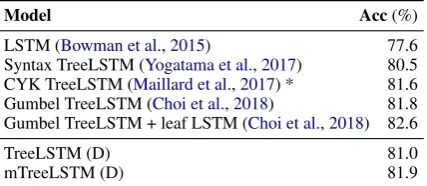
mod-Model Acc(%)
LSTM (Bowman et al.,2015) 77.6 Syntax TreeLSTM (Yogatama et al.,2017) 80.5 CYK TreeLSTM (Maillard et al.,2017) * 81.6 Gumbel TreeLSTM (Choi et al.,2018) 81.8 Gumbel TreeLSTM + leaf LSTM (Choi et al.,2018) 82.6
TreeLSTM (D) 81.0
[image:7.595.90.279.72.162.2]mTreeLSTM (D) 81.9
Table 4: Results on the SNLI dataset. The first group contains results of some best-performing tree-structured LSTM models on this data. (*: a preprint)
Model rDim #Params Acc(%)
TreeLSTM (A) n/a 301K 82.6 mTreeLSTM (A) 50 354K 82.7 mTreeLSTM (A) 75 358K 83.1 mTreeLSTM (A) 100 361K 83.6 mTreeLSTM (A) 200 376K 83.0
Table 5: Effects of the relation embedding size on SICK dataset for the NLI task
els learn. The relationship matrices for mTreeL-STM on dependency trees are: negation modifier, nominal subject, adjectival modifier, direct object, passive auxiliary, adverb modifier. These matri-ces for mTreeLSTM on AMR trees are: attribute (:ARG2), patient (:ARG1), conjunction (:opN), location, negation (:polarity), domain. In contrast to the sentiment classification task, where adjectives are crucial, the model learns that sub-jects and obsub-jects are important to determine the meaning of sentences.
Furthermore, we evaluate our mTreeLSTM model with SNLI (Stanford Natural Language In-ference), a larger NLI dataset (Bowman et al., 2015). It is composed of about 550K/10K/10K sentence pairs in train/dev/test sets. We use de-pendency tree as the backbone for tree-structured LSTMs. All models in Table4use a hidden size of 100 for a fair comparison. The table shows that mTreeLSTM (D) outperforms many other syntax-based TreeLSTM models including TreeL-STM (D), reconfirming our conclusion drawn with SICK.
6.5 Additional Tests and Discussions
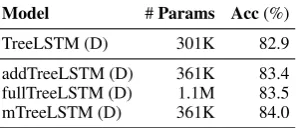
Model #Params Acc(%) TreeLSTM (D) 301K 82.9 addTreeLSTM (D) 361K 83.4 fullTreeLSTM (D) 1.1M 83.5 mTreeLSTM (D) 361K 84.0
Table 6: Comparison between different methods using relation information on the SICK dataset for the NLI task
size and accuracy. Table5shows the model with the relation embedding size of 100 achieves the best accuracy, while the overall impact of the em-bedding size is mild. The multiplicative TreeL-STM has only 1.2 times the number of weights in TreeLSTM (with the same number of hidden units). We did not count the number of parameters in the embedding models since these parameters are the same for all models.
Table6shows a comparison between mTreeL-STM and two other plausible methods for inte-grating relation information with TreeLSTM. In
addTreeLSTM, a relation is treated as an addi-tional node input in the TreeLSTM model; In
fullTreeLSTM, the model corresponds to Eq. (2), where each edge type has a separate transition matrix. Both models achieve better results than TreeLSTM, indicating the usefulness of relation information. While addTreeLSTM and fullTreeL-STM obtain comparable performances, mTreeL-STM outperforms both of them. It is also to note that the number of parameters of mTreeLSTM is much less than those of fullTreeLSTM.
7 Other Related Work
There is a line of research that extends the standard LSTM (Hochreiter and Schmidhuber,1997) in or-der to model more complex structures. Tai et al. (2015) and Zhu et al. (2015) extended sequen-tial LSTMs to tree-structured LSTMs by adding branching factors. They showed such extensions outperform competitive LSTM baselines on sev-eral tasks such as sentiment classification and se-mantic relatedness prediction (which is also con-firmed in this paper).Li et al.(2015) further inves-tigated the effectiveness of TreeLSTMs on various tasks and discussed when tree structures are neces-sary. Chen et al.(2017) combined sequential and tree-structured LSTM for NLI and has achieved state-of-the-art results on the benchmark dataset. Their approach uses n-ary TreeLSTM based on
syntactic constituency parsers. In contrast, we fo-cus more on child-sum TreeLSTM which is better suited for trees with high branching factor.
Previous works have studied the use of relation information. Dyer et al.(2015) considered each syntactic relation as an additional node and in-cluded its embedding to their composition func-tion for dependency parsing. Peng et al. (2017) introduced a different set of parameters for each edge-type in their LSTM-based approach for re-lation extraction. In contrast to these works, our mTreeLSTM model incorporates relation informa-tion via a multiplicative mechanism, which we have shown is more effective and uses less param-eters.
AMR has been successfully applied to a num-ber of NLP tasks, besides the ones we considered in this paper. For example,Mitra and Baral(2016) made use of AMR to improve question answering; Liu et al.(2015) utilized AMR to produce promis-ing results toward abstractive summarization. Us-ing AMR as the backbone in TreeLSTM has been investigated inTakase et al. (2016). They incor-porated AMR information by a neural encoder to the attention-based summarization method (Rush et al., 2015) and it performed well on headline generation. Our work differs from these studies in the sense that we aim to investigate how seman-tic information induced by AMR formalism can be incorporated to tree-structured LSTM models, and study which properties introduced by AMR turn out to be useful in various tasks. In this paper, we use the start-of-the-art AMR parser provided byFlanigan et al.(2016) which additionally pro-vides the alignment between words and nodes in the tree.
Though we have considered AMR in this paper, we believe the conclusions we drew here largely apply to other semantic schemes, such as GMB and UCCA, as well.Abend and Rappoport(2017) has recently noted that the differences between these schemes are not critical, and the main dis-tinguishing factors between them are their relation to syntax, their degree of universality, and the ex-pertise they require from annotators.
8 Conclusions
compositional functions for child nodes, which makes it more expressive. In addition, we inves-tigated how lexical semantic representation can be used with tree-structured LSTMs. Experiments on three common NLP tasks showed that multiplica-tive TreeLSTMs outperform conventional TreeL-STMs, illustrating the usefulness of relation infor-mation. Moreover, with AMR as backbone, tree-structured models can effectively handle long-range dependencies.
Acknowledgments
We would like to thank Matthias Seeger, Cedric Archambeau, Alex Klementiev, Ralf Herbrich, and anonymous reviewers for their helpful com-ments.
References
Omri Abend and Ari Rappoport. 2013. Universal con-ceptual cognitive annotation (UCCA). In Proceed-ings of the 51st Annual Meeting of the Association for Computational Linguistics. ACL, pages 228– 238.
Omri Abend and Ari Rappoport. 2017. The state of the art in semantic representation. InProceedings of the 55th Annual Meeting of the Association for Computational Linguistics. ACL, pages 77–89. Laura Banarescu, Claire Bonial, Shu Cai, Madalina
Georgescu, Kira Griffitt, Ulf Hermjakob, Kevin Knight, Philipp Koehn, Martha Palmer, and Nathan Schneider. 2013. Abstract meaning representation for sembanking. In Proceedings of the 7th Lin-guistic Annotation Workshop & Interoperability with Discourse. pages 178–186.
Valerio Basile, Johan Bos, Kilian Evang, and Noortje Venhuizen. 2012. Developing a large semanti-cally annotated corpus. InProceedings of the 8th Language Resources and Evaluation Conference. LREC, pages 3196–3200.
Samuel R. Bowman, Gabor Angeli, Christopher Potts, and Christopher D Manning. 2015. A large an-notated corpus for learning natural language infer-ence. In Proceedings of the 2015 Conference on Empirical Methods in Natural Language Processing (EMNLP). EMNLP, pages 632–642.
Samuel R. Bowman, Jon Gauthier, Abhinav Ras-togi, Raghav Gupta, Christopher D. Manning, and Christopher Potts. 2016. A fast unified model for parsing and sentence understanding (volume 1). In Proceedings of the 54th Annual Meeting of the Asso-ciation for Computational Linguistics. ACL, pages 1466–1477.
Danqi Chen and Christopher Manning. 2014. A fast and accurate dependency parser using neural net-works. InProceedings of the 2014 Conference on Empirical Methods in Natural Language Process-ing. EMNLP, pages 740–750.
Qian Chen, Xiaodan Zhu, Zhenhua Ling, Si Wei, Hui Jiang, and Diana Inkpen. 2017. Enhanced LSTM for natural language inference. InProceedings of the 55th Annual Meeting of the Association for Compu-tational Linguistics. ACL, pages 1657–1668. Kyunghyun Cho, Bart van Merrienboer, Caglar
Gul-cehre, Dzmitry Bahdanau, Fethi Bougares, Holger Schwenk, and Yoshua Bengio. 2014. Learning phrase representations using rnn encoder-decoder for statistical machine translation. InProceedings of the 2014 Conference on Empirical Methods in Nat-ural Language Processing. EMNLP, pages 1724– 1734.
Jihun Choi, Kang Min Yoo, and Sang goo Lee. 2018. Learning to compose task-specific tree structures. In Proceedings of the 32nd AAAI Conference on Artifi-cial Intelligence (AAAI-18). AAAI.
Li Dong, Furu Wei, Chuanqi Tan, Duyu Tang, Ming Zhou, and Ke Xu. 2014. Adaptive recursive neural network for target-dependent twitter sentiment clas-sification. InProceedings of the 52nd Annual Meet-ing of the Association for Computational LMeet-inguistics (Volume 2). ACL, pages 49–54.
John Duchi, Elad Hazan, and Yoram Singer. 2011. Adaptive subgradient methods for online learning and stochastic optimization. Journal of Machine Learning Research12:2121–2159.
Chris Dyer, Miguel Ballesteros, Wang Ling, Austin Matthews, and Noah Smith. 2015. Transition-based dependency parsing with stack long short-term memory. InProceedings of the 53rd Annual Meeting of the Association for Computational Lin-guistics. ACL, pages 334–343.
Jeffrey L. Elman. 1990. Finding structure in time. Cognitive Science14:179–211.
Jeffrey Flanigan, Chris Dyer, Noah A. Smith, and Jaime Carbonell. 2016. CMU at SemEval-2016 task 8: Graph-based AMR parsing with infinite ramp loss. InProceedings of the 10th International Work-shop on Semantic Evaluation (SemEval-2016). Se-mEval, pages 1202–1206.
Jeffrey Flanigan, Sam Thomson, Jaime Carbonell, Chris Dyer, and Noah A. Smith. 2014. A discrim-inative graph-based parser for the abstract meaning representation. InProceedings of the 52nd Annual Meeting of the Association for Computational Lin-guistics (Volume 1). ACL, pages 1426–1436. Sepp Hochreiter and J¨urgen Schmidhuber. 1997.
Nal Kalchbrenner, Edward Grefenstette, and Phil Blun-som. 2014. A convolutional neural network for modelling sentences. In Proceedings of the 52nd Annual Meeting of the Association for Computa-tional Linguistics (Volume 1). ACL, pages 655–665. Yoon Kim. 2014. Convolutional neural networks for sentence classification. InProceedings of the 2014 Conference on Empirical Methods in Natural Lan-guage Processing. EMNLP, pages 1746–1751. Diederik P. Kingma and Jimmy Ba. 2015. Adam:
A method for stochastic optimization. In The 3rd International Conference on Learning Representa-tions. ICLR.
Dan Klein and Christopher D. Manning. 2003. Ac-curate unlexicalized parsing. InProceedings of the 41st Annual Meeting of the Association for Compu-tational Linguistics. ACL, pages 423–430.
Jiwei Li, Minh-Thang Luong, Dan Jurafsky, and Ed-uard Hovy. 2015. When are tree structures nec-essary for deep learning of representations? In Proceedings of the 2015 Conference on Empirical Methods in Natural Language Processing. EMNLP, pages 2304–2314.
Fei Liu, Jeffrey Flanigan, Sam Thomson, Norman M. Sadeh, and Noah A. Smith. 2015. Toward abstrac-tive summarization using semantic representations. InProceedings of the Conference of the North Amer-ican Chapter of the Association for Computational Linguistics. NAACL.
Pengfei Liu, Xipeng Qiu, Yaqian Zhou, Jifan Chen, and Xuanjing Huang. 2016. Modelling interaction of sentence pair with coupled-LSTMs. In Proceed-ings of the 2016 Conference on Empirical Methods in Natural Language Processing. EMNLP, pages 1703–1712.
Jean Maillard, Stephen Clark, and Dani Yogatama. 2017. Jointly learning sentence embeddings and syntax with unsupervised tree-LSTMs.CoRR. Arindam Mitra and Chitta Baral. 2016. Addressing a
question answering challenge by combining statisti-cal methods with inductive rule learning and reason-ing. InProceedings of the 13th AAAI Conference on Artificial Intelligence. AAAI, pages 2779–2785. Makoto Miwa and Mohit Bansal. 2016. End-to-end
re-lation extraction using LSTMs on sequences and tree structures. InProceedings of the 54th Annual Meet-ing of the Association for Computational LMeet-inguistics (Volume 1). ACL, pages 1105–1116.
Martha Palmer, Daniel Gildea, and Paul Kingsbury. 2005. The proposition bank: An annotated corpus of semantic roles. Computational Linguistics31:71– 106.
Nanyun Peng, Hoifung Poon, Chris Quirk, Kristina Toutanova, and Wen-tau Yih. 2017. Cross-sentence
n-ary relation extraction with graph LSTMs. Trans-actions of the Association for Computational Lin-guisticspages 101–115.
Jeffrey Pennington, Richard Socher, and Christo-pher D. Manning. 2014. GloVe: Global vectors for word representation. In Proceedings of the 2014 Conference on Empirical Methods in Natural Lan-guage Processing. EMNLP, pages 1532–1543. Alexander Rush, Sumit Chopra, and Jason Weston.
2015. A neural attention model for abstractive sen-tence summarization. InProceedings of the 2015 Conference on Empirical Methods in Natural Lan-guage Processing. EMNLP, pages 379–389. Richard Socher, John Bauer, Christopher D. Manning,
and Ng Andrew Y. 2013a. Parsing with composi-tional vector grammars. InProceedings of the 51st Annual Meeting of the Association for Computa-tional Linguistics (Volume 1). ACL, pages 455–465. Richard Socher, Brody Huval, Christopher D. Man-ning, and Andrew Y. Ng. 2012. Semantic compo-sitionality through recursive matrix-vector spaces. In Proceedings of the 2012 Joint Conference on Empirical Methods in Natural Language Process-ing and Computational Natural Language LearnProcess-ing. EMNLP-CoNLL, pages 1201–1211.
Richard Socher, Cliff C. Lin, Andrew Y. Ng, and Christopher D. Manning. 2011. Parsing natural scenes and natural language with recursive neu-ral networks. In Proceedings of the 28th Inter-national Conference on Machine Learning. ICML, pages 129–136.
Richard Socher, Alex Perelygin, Jean Wu, Jason Chuang, Christopher D. Manning, Andrew Y. Ng, and Christopher Potts. 2013b. Recursive deep mod-els for semantic compositionality over a sentiment treebank. InProceedings of the 2013 Conference on Empirical Methods in Natural Language Process-ing. ACL, pages 1631–1642.
Ilya Sutskever, James Martens, and Geoffrey Hinton. 2011. Generating text with recurrent neural net-works. In Proceedings of the 28th International Conference on Machine Learning. ICML, pages 1017–1024.
Kai Sheng Tai, Richard Socher, and Christopher D. Manning. 2015. Improved semantic representations from tree-structured long short-term memory net-works. InProceedings of the 53rd Annual Meet-ing of the Association for Computational LMeet-inguistics and the 7th International Joint Conference on Natu-ral Language Processing. ACL, pages 1556–1566. Sho Takase, Jun Suzuki, Naoaki Okazaki, Tsutomu
Aaron Steven White, Drew Reisinger, Keisuke Sak-aguchi, Tim Vieira, Sheng Zhang, Rachel Rudinger, Kyle Rawlins, and Benjamin Van Durme. 2016. Universal decompositional semantics on universal dependencies. In Proceedings of the 2016 Confer-ence on Empirical Methods in Natural Language Processing. EMNLP, pages 1713–1723.
Dani Yogatama, Phil Blunsom, Chris Dyer, Edward Grefenstette, and Wang Ling. 2017. Learning to compose words into sentences with reinforcement learning. In Proceedings of the 5th International Conference on Learning Representations. ICLR. Han Zhao, Zhengdong Lu, and Pascal Poupart. 2015.
Self-adaptive hierarchical sentence model. In Pro-ceedings of the 24th International Joint Conference on Artificial Intelligence. IJCAI, pages 4069–4076. Xiaodan Zhu, Parinaz Sobhani, and Hongyu Guo.