IITP at SemEval-2017 Task 8 : A Supervised Approach for Rumour
Evaluation
Vikram Singh, Sunny Narayan, Md Shad Akhtar, Asif Ekbal, Pushpak Bhattacharyya Indian Institute of Technology Patna, India
{vikram.mtcs15,sunny.cs13,shad.pcs15,asif,pb}@iitp.ac.in
Abstract
This paper describes our system partici-pation in the SemEval-2017 Task 8 ‘Ru-mourEval: Determining rumour veracity and support for rumours’. The objec-tive of this task was to predict the stance and veracity of the underlying rumour. We propose a supervised classification ap-proach employing several lexical, content and twitter specific features for learning. Evaluation shows promising results for both the problems.
1 Introduction
Twitter along with Facebook is widely used social networking site which generates tons of authen-tic and unauthenauthen-tic information. The purpose of twitter varies from people to people. Twitter has been greatly used as a communication channel and also as an information source (Zhao and Rosson,
2009). However, Twitter like any other social me-dia platform does not always poses authentic in-formation. It also brings a negative by-product called rumour (Castillo et al., 2011; Derczynski and Bontcheva,2014;Qazvinian et al.,2011). Ru-mours are the statement which cannot be verified for its correctness. These rumours may confuse people with the unverified information and drive them in poor decision making. In many organiza-tions(political, administration etc.), detection and support for rumour invites great interest from the concerned authorities.
Recently, researchers across the globe have started addressing the challenges related to ru-mours. A time sequence classification technique has been proposed for detecting the stance against a rumor (Lukasik et al., 2016). Zubiaga et al. (2016) used sequence of label transitions in tree-structured conversations for classifying stance. A
study on speech act classifier for veracity predic-tion is proposed in (Vosoughi, 2015). One of the earlier work reported on rumour detection and classification had used twitter specific and content based features for the prediction (Qazvinian et al.,
2011).
In this paper we present our proposed system submitted as part of the SemEval-2017 shared task on “RumourEval: Determining rumour veracity and support for rumours”. Our system is super-vised in nature and uses a diverse set of features (c.f. Section2.3) for training. The task involves Twitter conversation thread where for every source tweet a number of direct and nested reply tweets are present. An example thread is depicted in Ta-ble1. The task defines two separate sub-problems: A) Support, Deny, Query & Comment (SDQC) classification and B) veracity prediction. The first subtask checks the stance of any tweet(source or reply) w.r.t. the underlying rumour. Reply tweet can be direct or nested. Second subtask predicts the veracity of a rumour i.e. true (rumour),false (not rumour)orunverified (its veracity cannot be verified). Further, there were two variants of the veracity task: closed and open variants. In closed variant, the veracity prediction has to be made solely from the tweet text only. In addition usage of extra data (Wikipedia article, news article etc.) was allowed for the open variant.
The rest of the paper is organized as follows: Section 2presents a brief description of the pro-posed approach. Experimental results and discus-sion is furnished in Section 3. Finally, we con-clude in Section4.
2 System Overview
We adopted a supervised classification approach for both the tasks. We use Decision Tree (DT), Naive Bayes (NB) and Support Vector Machine
Tweet conversation thread Stance Src:Very good on #Putin coup by @CoalsonR: Three Scenarios For A Succession In Russia http://t.co/fotdqxDfEV Support
Rep1:@andersostlund @CoalsonR @RFERL And how Europe will behave in such a case? Deny
Rep2:@andersostlund @RFERL Putin’ll be made a tsar (and the newborn an heir). Back 2 serfdom as Zorkin suggested. Comment
Rep3:@andersostlund @CoalsonR @RFERL uhmmm botox sesions far more likely anyway Comment
Rep4:@andersostlund What are your thoughts on #WhereIsPutin? Query
Rep5:@tulipgrrl Either a simple flue, more serious illness or serious domestic political problems. Comment
Rep6:@andersostlund @tulipgrrl :mask: Deny
Table 1: Twitter conversational thread. Src: Source tweet; Rep#: Replies.
(SVM) as base classifier for prediction of verac-ity. For stance detection, every instance consists of a pair of source-reply tweet. We extracted fea-tures for both the tweets and fed it to the system for the classification. In subsequent subsections we describe dataset, preprocessing and list of fea-tures that we use in this work.
2.1 Dataset
The training dataset consists of 272 source tweets for which 3966 replies tweet are present. For tun-ing the system, validation set contains 256 replies across 25 source tweets. Each source and reply tweet has one of the four label for stance detection namely, support, deny, query and comment. For veracity prediction, each of the source tweets be-longs to one of the three classes i.e.true,falseand
unverified. The gold standard test dataset has 28 source and 1021 reply tweets. A detailed statistics is depicted in Table2.
2.2 Preprocessing
The distribution of different classes in the dataset is very skewed so the first step that we perform is to extract and over sample the under represented class. Classes support, deny and comment were sampled by a factor of 4, 7 and 7 respectively. Af-terwards, we perform normalization of urls and usernames in which all urls and username were replaced by keyword someurl and @someuser re-spectively.
2.3 Features
In this section we describe features that we em-ployed for building the system. We use following set of features for both Subtask A and B.
• Word Embedding: Word vectors has been proved to be an efficient technique in captur-ing semantic property of a word. We use 200-dimension pretrained GloVe model1for com-puting the word embeddings. Sentence
em-1http://nlp.stanford.edu/data/glove.6B.zip
bedding is computed by concatenating em-beddings of all the words in a tweet. We fix the length of each tweet by padding it to the maximum number of tokens.
• Vulgar words: Conversations on Twitter are usually very informal and usage of vulgar words are often in practice. The presence of vulgar words in a sentence declines the orien-tation of it being a fact, hence, less chances of it being a rumour. We use a list of vul-gars words2 3and define a binary feature that takes a value ‘1’ if a token is present in the list, otherwise ‘0’.
• Twitter specific features: We use presence and absence of following twitter specific fea-tures in this work.
– URL and Media: The presence of metadata indicates that the user is pro-viding with more authentic information. Hence less chances of it being a rumour. For subtask A, a user reply with meta-data suggests it to be asupportordeny.
– Punctuation, Emoticons and Abbrevia-tion.
• Word count: Rumour sentences tend to be more elaborative and hence longer while fac-tual data is generally short and precise. Also, user tends to deny a claim in shorter sentence. We, therefore, define number of words in a sentence (excluding stop words and punctua-tions), as a feature.
• POS tag: We use unigram and bigram POS tags extracted from CMU’s ARK4tool. In addition, we also implement few of the task specific features listed below.Subtask A: SDQC
Dataset Source Reply Support Deny Query Comment True False UnverifiedOverall Subtask A: SDQC Subtask B: Veracity Train 272 3966 841 333 330 2734 127 50 95
Dev 25 256 69 11 28 173 10 12 3
[image:3.595.69.531.62.135.2]Test 28 1021 94 71 106 778 8 12 8
Table 2: Distribution of source and reply tweets with their labels in the dataset
• Negation words: Presence of negation word in a tweet signals it to be a denial case. Therefore, we use a binary feature indicat-ing the presence of negation words in the tweet. There were 27 negation words taken into account. The following are the list - no, not, nobody, nothing, none, never, neither, nor, nowhere, hardly, scarcely, barely, don’t, isn’t, wasn’t, shouldn’t, wouldn’t, couldn’t, doesn’t, hasn’t, haven’t, didn’t, ain’t, can’t, doesn’t and won’t.
• Wh- words: Query usually contains
Wh-words (What, Where, Which, When, Who, Why, Whom, Whose). We define a binary feature that fires when a tweet contains one of these words.
Subtask B: Veracity prediction
• Presence of Opinion words: An opinion carrying sentence cannot be a fact, hence, makes it a probable candidate for rumour. We define two features based on MPQA subjec-tivity lexicon (Wilson et al.,2005). The first feature takes opinion word count, whereas, the second feature checks the presence of at least one strongly subjective token in a tweet.
• Number of adjectives: An interesting rela-tion between presence of adjectives in a sen-tence and its subjectivity has been explored in (Hatzivassiloglou and Wiebe, 2000). As per (Wiebe, 2000) the probability of a sentence being subjective, given that there is at least one adjective in the sentence, is 0.545. If a sentence is objective then its chances of be-ing a rumour is very low. Therefore, we use a binary feature that denotes presence/absence of adjectives in a tweet.
Since, prediction in close variants has the limi-tation of using the tweet only, we also extracted ‘presence of media’ as a binary feature value for the open variant only.
3 Experiments and Results
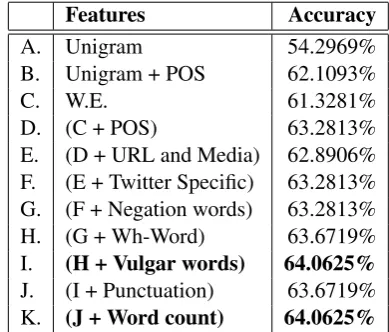
We use scikit learn machine learning package5for the implementation. As defined by shared task, we use classification accuracy and micro-average ac-curacy as evaluation metrics for SDQC and verac-ity prediction respectively. For subtask A, we try various feature combinations to train a SVM clas-sifier. Table 3reports the validation accuracy for SDQC subtasks. As a result we select the feature combination that performs best during the valida-tion phase and submit it for the final predicvalida-tion on the test dataset. In veracity prediction task, we
em-Features Accuracy
A. Unigram 54.2969%
B. Unigram + POS 62.1093%
C. W.E. 61.3281%
D. (C + POS) 63.2813%
E. (D + URL and Media) 62.8906% F. (E + Twitter Specific) 63.2813% G. (F + Negation words) 63.2813% H. (G + Wh-Word) 63.6719% I. (H + Vulgar words) 64.0625%
J. (I + Punctuation) 63.6719% K. (J + Word count) 64.0625%
Table 3: SDQC: Accuracy on Development Set
ploy three classifiers i.e. Decision Tree, SVM and Naive Bayes to the evaluate our system. We ob-serve that the among three classifiers performance of Naive Bayes is comparatively better than oth-ers as shown in Table 4. For evaluation of test dataset we use our best classifier i.e. Naive Bayes. Our system reports an accuracy of 64.1% for the SDQC classification. For subtask B, we also com-pute a confidence score for each prediction. We obtain micro-average accuracies of 39.28% and 28.57% respectively for the open and close vari-ants. Reported root mean squared error (RMSE) for the two variants are 0.746 and 0.807. It should be noted that we were the only team which
[image:3.595.317.512.353.519.2]ted their system in open variant category. Table5
depicts the evaluation result on test dataset.
Classifiers OpenMicro-average AccuracyClosed
Decision Tree 58.23% 54.54%
SVM 58.75% 59.09%
[image:4.595.317.514.62.118.2]Naive Bayes 59.09% 63.0%
Table 4: Veracity: Accuracy on Development Set
Task Accuracy RMSE Subtask A 64.1%
-Subtask B(Open) 39.28% 0.746
[image:4.595.77.286.98.171.2]Subtask B(Closed) 28.57% 0.807
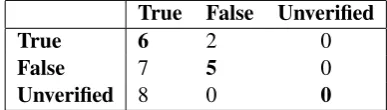
Table 5: Evaluation results on test set. Further, we perform error analysis on the re-sults. Confusion matrix for SDQC classification is depicted in Table 6. We observe that most of the classes were confused with thecommentclass. The possible reason could be the presence of rel-atively high number instances for the comment ‘class’. Similarly, Table 7 &8 shows confusion matrix for both open and closed variants of sub-task B. Recall for ‘true’ is encouraging i.e. 75% but the problem lies with the precision which is merely 28% & 25% for open and close variants respectively.
Support Deny Query Comment
Support 42 2 2 48
Deny 11 9 2 49
Query 9 7 35 55
Comment 125 35 32 586
Table 6: SDQC: Confusion Matrix on test set (S: support, D: deny, Q: query, C: comment)
True False Unverified
True 6 2 0
False 7 5 0
Unverified 8 0 0
Table 7: Veracity (Open): Confusion Matrix on test set
4 Conclusion
In this paper we proposed a supervised approach for determining the support and veracity of a ru-mour as part of the SemEval-2017 shared task on
True False Unverified
True 6 2 0
False 10 2 0
[image:4.595.84.282.216.272.2]Unverified 8 0 0
Table 8: Veracity (Closed): Confusion Matrix on test set
rumour evaluation. As base classification algo-rithm we use Naive Bayes, Support Vector Ma-chine and Decision Tree for building the model. In future, we would like to explore deep learning technique and other relevant features to further im-prove the performance of the system.
References
Carlos Castillo, Marcelo Mendoza, and Barbara Poblete. 2011. Information credibility on twitter. In
Proceedings of the 20th international conference on World wide web. ACM, pages 675–684.
Leon Derczynski and Kalina Bontcheva. 2014. Pheme: Veracity in digital social networks. InUMAP Work-shops.
Vasileios Hatzivassiloglou and Janyce M Wiebe. 2000. Effects of adjective orientation and gradability on sentence subjectivity. In Proceedings of the 18th conference on Computational linguistics-Volume 1. Association for Computational Linguistics, pages 299–305.
Michal Lukasik, PK Srijith, Duy Vu, Kalina Bontcheva, Arkaitz Zubiaga, and Trevor Cohn. 2016. Hawkes processes for continuous time se-quence classification: an application to rumour stance classification in twitter. In Proceedings of 54th Annual Meeting of the Association for Compu-tational Linguistics. Association for Computational Linguistics, pages 393–398.
Vahed Qazvinian, Emily Rosengren, Dragomir R Radev, and Qiaozhu Mei. 2011. Rumor has it: Iden-tifying misinformation in microblogs. In Proceed-ings of the Conference on Empirical Methods in Nat-ural Language Processing. Association for Compu-tational Linguistics, pages 1589–1599.
Soroush Vosoughi. 2015. Automatic detection and ver-ification of rumors on Twitter. Ph.D. thesis, Mas-sachusetts Institute of Technology.
Janyce Wiebe. 2000. Learning subjective adjectives from corpora. InAAAI/IAAI. pages 735–740. Theresa Wilson, Janyce Wiebe, and Paul Hoffmann.
[image:4.595.74.291.477.540.2] [image:4.595.83.277.598.653.2]Dejin Zhao and Mary Beth Rosson. 2009. How and why people twitter: the role that micro-blogging plays in informal communication at work. In Pro-ceedings of the ACM 2009 international conference on Supporting group work. ACM, pages 243–252. Arkaitz Zubiaga, Elena Kochkina, Maria Liakata, Rob