888
m y at SemEval-2019 Task 9: Exploring BERT for Suggestion Mining
Masahiro Yamamoto
Sony Corporation, Tokyo, Japan.
Toshiyuki Sekiya
Sony Corporation, Tokyo, Japan.
Abstract
This paper presents our system to the SemEval-2019 Task 9, Suggestion Mining from Online Reviews and Forums. The goal of this task is to extract suggestions such as the expressions of tips, advice, and recommenda-tions. We explore Bidirectional Encoder Rep-resentations from Transformers (BERT) focus-ing on target domain pre-trainfocus-ing in Subtask A which provides training and test datasets in the same domain. In Subtask B, the cross domain suggestion mining task, we apply the idea of distant supervision. Our system obtained the third place in Subtask A and the fifth place in Subtask B, which demonstrates its efficacy of our approaches.
1 Introduction
In SemEval2019 Task 9, participants are required to build a model which can classify given sen-tences into suggestion and non-suggestion classes. We participate in two sub-tasks: domain specific suggestion mining task (Subtask A1) and cross do-main suggestion mining task (Subtask B2). In Sub-task A, the test dataset belongs to the same domain as the training and development datasets. These datasets are extracted from the suggestion forum for windows platform. In Subtask B, training and test datasets belong to separate domains. More specifically, the domain of the training dataset is entries from the windows forum and that of the test dataset is hotel reviews. Example sentences used in these tasks are listed in Table 1. For a de-scription of these tasks please refer to (Negi et al., 2019).
Subtask A can be viewed as a binary text classi-fication task. Recently, pre-training models, such as OpenAI GPI (Radford et al., 2018) and BERT
1
https://competitions.codalab.org/competitions/19955 2https://competitions.codalab.org/competitions/19956
Subtask A (windows platform)
P: xbox dev mode companion work ipv6 please... N: I do not want to convert MSIs.
Subtask B (hotel review)
P: If you can, upgrade to an Ocean Front Room. N: it doesn’t have a very clean look.
Table 1: Example sentences in the test dataset.Pmeans a positive sentence, i.e. suggestion sentence andN de-notes a negative sentence, i.e. non-suggestion sentence.
(Devlin et al., 2018), have gained much attention with their ability to improve a number of down-stream tasks. These models are pre-trained using unlabeled corpora and then fine-tuned on labeled datasets. We apply BERT to this task because it has achieved state-of-the-art performance in sev-eral text classification tasks. The difference to the original BERT model is that we further pre-train BERT model using an unlabeled corpus related to this domain. More concretely, we extract docu-ments from a windows forum and run additional steps of pre-training using these documents, start-ing from the pre-trained BERT model.
In Subtask B, we apply the idea of distant supervision which has been firstly proposed by (Mintz et al., 2009). Distant supervision is a weakly supervised learning framework which tries to automatically generate noisy training examples. Specifically, we use the rule based system which is provided by the task organizer for creating a noisy training dataset and train the model based on them.
2 System Description
Our model is built using a recent development of pre-training model, BERT. In the following, we describe details of this model first and then explain our systems in Subtask A and Subtask B.
2.1 BERT
BERT, proposed by (Devlin et al., 2018), has been shown to improve several tasks such as sentiment classification, calculating semantic textual similar-ity task, and recognizing textual entailment task. This model consists of several Transformer mod-els (Vaswani et al., 2017) whose parameters are pre-trained on unlabeled corpora, Wikipedia and BooksCorpus (Zhu et al., 2015). Pre-training con-sists of two tasks, masked language modeling and next sentence prediction, and trained models of these unsupervised tasks are available.3
For the classification task, we added one layer to output predictions, suggestion or non-suggestion. These model parameters were then fine-tuned based on the labeled training dataset.
2.2 Subtask A
Subtask A is a classical document classifica-tion task, where training/development/test datasets consist of the same domain. The data has been col-lected from feedback posts on universal windows platform. We mainly use BERT in this task, how-ever, in the following we describe several tech-niques to improve the score.
2.2.1 Target Domain Pre-training
The major difference between BERT and our sys-tem is the target domain pre-training. Typically, BERT training consists of two parts: pre-training on the general domain corpus and fine-tuning on the target task. On the other hand, our system consists of three training steps: pre-training on the general domain corpus, pre-training on the target domain corpus, and fine-tuning on the tar-get task. More concretely, we further pre-train the model using a task specific unlabeled corpus scraped from the universal windows platform de-veloper feedback site.4 These documents are split into sentences and the model is then trained on two unsupervised tasks (i.e. masked language model-ing and next sentence prediction). We should note
3
https://github.com/google-research/bert
4 https://wpdev.uservoice.com/forums/110705-universal-windows-platform
here that we use officially provided pre-trained pa-rameters as initial model papa-rameters and further train the model based on target domain documents to obtain better network parameters.
This target domain pre-training can be consid-ered as a similar framework of Universal Lan-guage Model Fine-Tuning (ULMFiT), proposed by (Howard and Ruder, 2018). In their frame-work, the model is firstly trained on general do-main corpus to capture general features. In ad-dition, the model is further trained on target task data to learn task specific features, and fine-tuned on the target task. This procedure is similar to our system. In other words, our work can be viewed as the extension of BERT model by using the idea of ULMFiT.
2.2.2 Model Averaging
(Reimers and Gurevych, 2017) showed that train-ing deep neural network is sensitive to the initial weights and (Che et al., 2018) showed the effec-tiveness of ensembling models trained with dif-ferent initialization. Furthermore, (Devlin et al., 2018) empirically showed that ensembling BERT models trained with different pre-training check-point leads to performance improvement. We fol-low this work and train three models with differ-ent pre-training checkpoint, then ensemble these models by simply averaging output scores.
2.3 Subtask B
Subtask B is cross-domain suggestion mining, where train and development datasets belong to windows platform domain, while the test dataset belongs to the hotel review domain. In this task, we do not use the datasets provided in Subtask A, because we find that models trained on these datasets tend to have poor performance (see also Sec. 3.2.2). We instead apply the paradigm of dis-tant supervision.
Distant supervision is a framework to generate noisy annotated data automatically and use them as a training dataset. This idea has been firstly pro-posed by (Mintz et al., 2009) and well studied in the field of relation extraction (Riedel et al., 2010; Hoffmann et al., 2011).
2.3.1 Rule Based Labeling
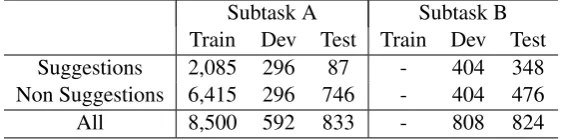
Subtask A Subtask B
Train Dev Test Train Dev Test
Suggestions 2,085 296 87 - 404 348
Non Suggestions 6,415 296 746 - 404 476
[image:3.595.158.439.63.133.2]All 8,500 592 833 - 808 824
Table 2: Statistics of datasets.
method. For example, if a specific word such as ”suggest” is in the sentence, then the sentence is predicted as a suggestion sentence. For more de-tails, please see the code in the official repository.5
2.3.2 Model Training Procedure
After the labeled corpus is generated, we trained a model using this corpus. Here, we do not label all of the unlabeled sentences via the rule based system. Instead, we split the sentences into sev-eral pieces and label one of them by using the rule based system. A model is trained on the noisy la-beled dataset and we label another piece through the trained model. We apply this procedure itera-tively until the model is trained on the last piece. More specifically, our training procedure can be summarized as follows:
1. We prepare the unlabeled hotel review corpus and split it intoNpieces (corpusC1,C2,C3,
...,CN).
2. We apply the baseline method which is pro-vided by the task organizer to the corpusC1
and treat predicted labels as true labels. 3. The model is then trained using the labeled
corpusC1′.
4. We apply the trained model to the corpusC2
and treat predicted labels as true labels. 5. A new model is trained using the labeled
cor-pusC2′ and labels of sentences inC3are
pre-dicted by this model.
6. We iteratively apply the above procedure un-til the model is trained on the corpusCN.
3 Experiments
Table 2 shows the statistics of datasets which are used in Subtask A and Subtask B. These datasets are available at the official repository.6 For evalu-ating systems, F1 score for the positive class, i.e. the suggestion class, is employed.
5
https://github.com/Semeval2019Task9/Subtask-B/blob/master/semeval-task9-baseline.py
6https://github.com/Semeval2019Task9
System Dev F1 Test F1
Baseline 0.721 0.267
BERT BASE (Single) 0.845 0.731 BERT BASE (Sgl. + Tgt.) 0.866 0.755 BERT LARGE (Single) 0.867 0.737 BERT LARGE (Sgl. + Tgt.) 0.882 0.759 BERT LARGE (Ens. + Tgt.) 0.890 0.776
Table 3: Results of Subtask A.SingleorSgl. denotes the single model andEns. means the ensembled mod-els. Tgt.denotes the pre-training on the target domain corpus.
3.1 Subtask A
3.1.1 Settings
We employed the official BERT model. We used both BASE model which has 12 Transformer lay-ers, 12 self-attention heads, and 768 hidden size, and LARGE model which has 24 Transformer layers, 16 self-attention heads, and 1024 hidden size. There are 110 million parameters in total in BASE model and 340 million parameters in LARGE model.
As for the target domain pre-training, we ob-tained the windows review corpus and split it into sentences using NLTK.7 The number of scraped documents is 2,325 and we used these documents as the unlabeled corpus for further pre-training the BERT model.
3.1.2 Results and Discussions
Table 3 shows the results of the experiment. Here, the baseline method is a rule based method as ex-plained in Sec. 2.3.1. From Table 3, we can con-clude the following four things:
First, BERT LARGE model outperformed BERT BASE model despite of the small size of the dataset. In general, it has been known that in-creasing the model size leads to an improvement on large scale tasks such as machine translation, and this does not be applied to small scale tasks
except for (Devlin et al., 2018). They showed a similar tendency in another small scale task. These results demonstrate that large size models improve results not only on large scale tasks but also on small scale tasks, if the model has been well pre-trained.
Second, the effect of the target domain pre-training is not trivial. The improvement can be observed in both BASE and LARGE model. In BASE model, the F1 score is pushed from 0.845 to 0.866 in the development dataset and from 0.731 to 0.755 in the test dataset. In LARGE model, the score is improved from 0.867 to 0.882 in the de-velopment dataset and from 0.737 to 0.759 in the test dataset. These results show that better models are produced by target domain pre-training even if we do not have large, domain-specific documents. Third, ensembling models leads to further per-formance improvement.
Fourth, Test F1 score is much lower than Dev F1 score. This has also been observed by other teams. In concrete, many teams have achieved over 0.850 F1 score on the development dataset, however, no team has achieved over 0.800 F1 score on the test dataset. It might have something to do with the small size of the development dataset size or the difference in the label distribution.
3.2 Subtask B
3.2.1 Settings
In Subtask B, we got unlabeled hotel review docu-ments provided by (Wachsmuth et al., 2014).8 We split documents into sentences using the NLTK package and randomly extracted 500,000 sen-tences. These sentences were further split into 5 pieces.
We firstly ran the baseline method and automat-ically labeled 100,000 sentences. These sentences were used as a training dataset to train the machine learning model. We used the BERT BASE model and set the default hyperparameters except for the training epochs. To avoid over-fitting, we trained the model for only one epoch.
As described in Sec. 2.3, another 100,000 sentences were automatically labeled using the trained model and we trained a new model using this labeled data. We iteratively applied this pro-cedure and submitted results predicted by the final model.
8http://argumentation.bplaced.net/arguana/data
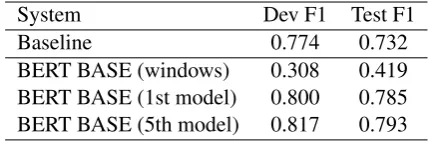
System Dev F1 Test F1
Baseline 0.774 0.732
BERT BASE (windows) 0.308 0.419
BERT BASE (1st model) 0.800 0.785
[image:4.595.308.524.62.133.2]BERT BASE (5th model) 0.817 0.793
Table 4: Results of Subtask B. BERT BASE (win-dows) is the model trained on windows corpus pro-vided in Subtask A.
3.2.2 Results and Discussions
Table 4 shows the results of the experiment. As you can see in Table 4, BERT BASE (win-dows), the model trained on the other domain cor-pus, shows poor performance while the baseline method has achieved a much better score. This motivated us to apply the idea of distant supervi-sion.
The model based on distant supervision signif-icantly outperformed the baseline model. This re-sult shows that the distant supervision idea can be applied successfully in the cross domain sugges-tion mining task. Furthermore, we can see that our iterative approach leads to more performance improvement (from 0.800 to 0.817 in the develop-ment dataset and 0.785 to 0.793 in the test dataset). We currently do not know why the F1 score has been improved, however, one interpretation could be that our iterative framework avoids over-fitting to the one model and learns more general decision boundaries. A detailed study of this effect is future work.
4 Conclusion
This paper explains our submission to Se-mEval2019 Task 9, Subtask A and Subtask B. We explored BERT models focusing on the target do-main pre-training in Subtask A and the idea of the distant supervision in Subtask B. Our approach obtained the third place in Subtask A and the fifth place in Subtask B.
In the future, we will further investigate the ef-fect of these approaches in other tasks.
References
Wanxiang Che, Yijia Liu, Yuxuan Wang, Bo Zheng, and Ting Liu. 2018. Towards better ud pars-ing: Deep contextualized word embeddings, ensem-ble, and treebank concatenation. arXiv preprint
Jacob Devlin, Ming-Wei Chang, Kenton Lee, and Kristina Toutanova. 2018. Bert: Pre-training of deep bidirectional transformers for language
understand-ing. arXiv preprint arXiv:1810.04805.
Raphael Hoffmann, Congle Zhang, Xiao Ling, Luke Zettlemoyer, and Daniel S Weld. 2011. Knowledge-based weak supervision for information extraction of overlapping relations. InProceedings of the 49th Annual Meeting of the Association for Computa-tional Linguistics: Human Language
Technologies-Volume 1, pages 541–550. Association for
Compu-tational Linguistics.
Jeremy Howard and Sebastian Ruder. 2018. Universal language model fine-tuning for text classification. In
Proceedings of the 56th Annual Meeting of the As-sociation for Computational Linguistics (Volume 1:
Long Papers), volume 1, pages 328–339.
Mike Mintz, Steven Bills, Rion Snow, and Dan Juraf-sky. 2009. Distant supervision for relation extrac-tion without labeled data. In Proceedings of the Joint Conference of the 47th Annual Meeting of the ACL and the 4th International Joint Conference on Natural Language Processing of the AFNLP:
Vol-ume 2-VolVol-ume 2, pages 1003–1011. Association for
Computational Linguistics.
Sapna Negi, Tobias Daudert, and Paul Buitelaar. 2019. Semeval-2019 task 9: Suggestion mining from on-line reviews and forums. In Proceedings of the 13th International Workshop on Semantic
Evalua-tion (SemEval-2019).
Alec Radford, Karthik Narasimhan, Time Salimans, and Ilya Sutskever. 2018. Improving language un-derstanding with unsupervised learning. Technical report, OpenAI.
Nils Reimers and Iryna Gurevych. 2017. Reporting score distributions makes a difference: Performance study of lstm-networks for sequence tagging. arXiv
preprint arXiv:1707.09861.
Sebastian Riedel, Limin Yao, and Andrew McCallum. 2010. Modeling relations and their mentions with-out labeled text. In Joint European Conference on Machine Learning and Knowledge Discovery in
Databases, pages 148–163. Springer.
Ashish Vaswani, Noam Shazeer, Niki Parmar, Jakob Uszkoreit, Llion Jones, Aidan N Gomez, Łukasz Kaiser, and Illia Polosukhin. 2017. Attention is all you need. InAdvances in Neural Information
Pro-cessing Systems, pages 5998–6008.
Henning Wachsmuth, Martin Trenkmann, Benno Stein, Gregor Engels, and Tsvetomira Palakarska. 2014. A review corpus for argumentation analysis. In In-ternational Conference on Intelligent Text
Process-ing and Computational LProcess-inguistics, pages 115–127.
Springer.
Yukun Zhu, Ryan Kiros, Rich Zemel, Ruslan Salakhut-dinov, Raquel Urtasun, Antonio Torralba, and Sanja Fidler. 2015. Aligning books and movies: Towards story-like visual explanations by watching movies and reading books. In Proceedings of the IEEE
international conference on computer vision, pages