A Beam-Search Decoder for Normalization of Social Media Text
with Application to Machine Translation
Pidong Wang
Department of Computer Science National University of Singapore
13 Computing Drive Singapore 117417
Hwee Tou Ng
Department of Computer Science National University of Singapore
13 Computing Drive Singapore 117417
Abstract
Social media texts are written in an infor-mal style, which hinders other natural lan-guage processing (NLP) applications such as machine translation. Text normalization is thus important for processing of social media text. Previous work mostly focused on nor-malizing words by replacing an informal word with its formal form. In this paper, to fur-ther improve ofur-ther downstream NLP applica-tions, we argue that other normalization oper-ations should also be performed, e.g., missing word recovery and punctuation correction. A novel beam-search decoder is proposed to ef-fectively integrate various normalization oper-ations. Empirical results show that our system obtains statistically significant improvements over two strong baselines in both normaliza-tion and translanormaliza-tion tasks, for both Chinese and English.
1 Introduction
Social media texts include SMS (Short Message Service) messages, Twitter messages, Facebook up-dates, etc. They are different from formal texts due to their significant informal characteristics, so they always pose difficulties for applications such as ma-chine translation (MT) (Aw et al., 2005) and named entity recognition (Liu et al., 2011), because of a lack of training data containing informal texts. Thus, the applications always suffer from a substantial per-formance drop when evaluated on social media texts. For example, Ritter et al. (2011) reported a drop from 90% to 76% on part-of-speech tagging, and
Foster et al. (2011) found a drop of 20% in depen-dency parsing.
Creating training data of social media texts specif-ically for a text processing task is time-consuming. For example, to create parallel Chinese-English training texts for translation of social media texts, it takes three minutes on average to translate an in-formally written social media text of eleven words from Chinese into English. On the other hand, it takes thirty seconds to normalize the same message, a six-fold increase in speed. After training a text nor-malization system to normalize social media texts, we can use an existing statistical machine translation (SMT) system trained on normal texts (non-social media texts) to carry out translation. So we argue that normalization followed by regular translation is a more practical approach. Thus, text normalization is important for social media text processing.
Most previous work on normalization of social media text focused on word substitution (Beaufort et al., 2010; Gouws et al., 2011; Han and Baldwin, 2011; Liu et al., 2012). However, we argue that some other normalization operations besides word substitution are also critical for subsequent natu-ral language processing (NLP) applications, such as missing word recovery (e.g., zero pronouns) and punctuation correction.
In this paper, we propose a novel beam-search decoder for normalization of social media text for MT. Our decoder can effectively integrate differ-ent normalization operations together. In contrast to previous work, some of our normalization opera-tions are specifically designed for MT, e.g., missing word recovery based on conditional random fields
(CRF) (Lafferty et al., 2001) and punctuation cor-rection based on dynamic conditional random fields (DCRF) (Sutton et al., 2004).
To the best of our knowledge, our work is the first to perform missing word recovery and punc-tuation correction for normalization of social me-dia text, and also the first to perform message-level normalization of Chinese social media text. We in-vestigate the effects on translating social media text after addressing various characteristics of informal social media text through normalization. To show the applicability of our normalization approach for different languages, we experiment with two lan-guages, Chinese and English. We achieved statisti-cally significant improvements over two strong base-lines: an improvement of 9.98%/7.35% in BLEU scores for normalization of Chinese/English social media text, and an improvement of 1.38%/1.35% in BLEU scores for translation of Chinese/English so-cial media text. We created two corpora: a Chinese corpus containing 1,000 Weibo1messages with their normalizations and English translations; and another similar English corpus containing 2,000 SMS mes-sages from the NUS SMS corpus (How and Kan, 2005). As far as we know, our corpora are the first publicly available Chinese/English corpora for nor-malization and translation of social media text2.
2 Related Work
Zhu et al. (2007) performed text normalization of informally written email messages using CRF (Laf-ferty et al., 2001). Due to its importance, normaliza-tion of social media text has been extensively studied recently. Aw et al. (2005) proposed a noisy chan-nel model consisting of different operations: sub-stitution of non-standard acronyms, deletion of fla-vor words, and insertion of auxiliary verbs and sub-ject pronouns. Choudhury et al. (2007) used hid-den Markov model to perform word-level normal-ization. Kobus et al. (2008) combined MT and auto-matic speech recognition (ASR) to better normalize French SMS message. Cook and Stevenson (2009) used an unsupervised noisy channel model consid-ering different word formation processes. Han and Baldwin (2011) normalized informal words using
1
A Chinese version of Twitter atwww.weibo.com
2Available at www.comp.nus.edu.sg/∼nlp/corpora.html
morphophonemic similarity. Pennell and Liu (2011) only dealt with SMS abbreviations. Xue et al. (2011) normalized social media texts incorporating ortho-graphic, phonetic, contextual, and acronym factors. Liu et al. (2012) designed a system combining dif-ferent human perspectives to perform word-level normalization. Oliva et al. (2013) normalized Span-ish SMS messages using a normalization and a pho-netic dictionary. For normalization of Chinese so-cial media text, Xia et al. (2005) investigated infor-mal phrase detection, and Li and Yarowsky (2008) mined informal-formal phrase pairs from Web cor-pora.
All the above work focused on normalizing words. In contrast, our work also performs other normalization operations such as missing word re-covery and punctuation correction, to further im-prove machine translation. Previously, Aw et al. (2006) adopted phrase-based MT to perform SMS normalization, and required a relatively large num-ber of manually normalized SMS messages. In con-trast, our approach performs beam search at the sen-tence level, and does not require large training data.
We evaluate the success of social media text nor-malization in the context of machine translation, so research on machine translation of social media text is relevant to our work. However, there is not much comparative evaluation of social media text transla-tion other than the Haitian Creole to English SMS translation task in the 2011 Workshop on Statistical Machine Translation (WMT 2011) (Callison-Burch et al., 2011). However, the setup of the WMT 2011 task is different from ours, in that the task provided parallel training data of SMS texts and their transla-tions. As such, text normalization is not necessary in that task. For example, the best reported system in that task (Costa-juss`a and Banchs, 2011) did not perform SMS message normalization.
Category Freq. Example
Punctuation 81你好[hi]~(你好。[hi .]);
Pronunciation 47表[watch](不要[don’t]);酱紫(这样子[this]); New word 43萌[bud](可爱[cute]);
Interjection 27好的[ok]哦[oh](好的[ok]); Pronoun 23想要[want](我[i]想要[want]); Segmentation 14表酱紫(不要[don’t]这样子[this]); Pronunciation 2884(for);oredi(already);
Abbreviation 98slp(sleep);whr(where); Prefix 74lect(lecture);doin(doing); Punctuation 69where r u(where r u ?); Interjection 68ok lor .(ok .);
Quotation 24im sure(i ’m sure);dont go(don ’t go);
Be 24i coming;you free?;
Tokenization 19ok.why ?(ok . why ?);
[image:3.612.76.298.55.212.2]Time 2end at 730(end at 7:30);1130 am(11:30 am);
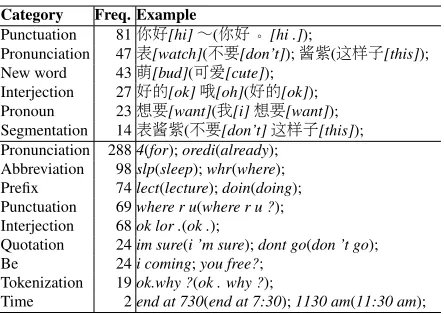
Table 1: Occurrence frequency of various informal char-acteristics in 200 Chinese/English social media texts.
3 Challenges in Normalization of Social Media Text
To better understand the informal characteristics of social media texts, we first analyzed a small sample of such texts in Chinese and English. We crawled 200 Chinese messages from Weibo. The informal characteristics of these messages are shown in the first half of Table 1. The manually normalized form is shown in round brackets, and the English gloss is shown in square brackets. Omitted, extraneous, and misused punctuation symbols occur frequently. On average, each Chinese message contains only less than one informal word, and many informal words are either new words or existing words with new meaning. The messages also contain redundant in-terjections like “哦[oh]”. Pronouns are often omit-ted in Chinese messages, especially for “我[I]”. Chi-nese informal words can be wrongly segmented due to lack of word segmentation training data contain-ing informal words.
Similarly, 200 English SMS messages were ran-domly selected from the NUS SMS corpus (How and Kan, 2005). The informal characteristics of these messages are shown in the second half of Ta-ble 1. We found that our English messages contain more informal words than Chinese messages. En-glish words are shortened in three ways: (1) using a shorter word form with similar pronunciation; (2) abbreviating a formal word; and (3) using only a pre-fix of a formal word. Other informal characteristics include: (1) informal punctuation conventions
in-cluding omitted and misused punctuation; (2) redun-dant interjections; (3) quotation-related problems, e.g., omitted quotation marks; (4) “be” omission; (5) tokenization problems; and (6) informally writ-ten time expressions.
4 Methods
As can be seen in Section 3, social media texts of different languages exhibit different informal char-acteristics. For example, English messages have more informal words than Chinese messages, while punctuation problems are more prevalent for Chi-nese messages. Also, fixing different types of infor-mal characteristics often depends on each other. For example, to be able to correct punctuation, it helps that the surrounding words are already correctly nor-malized. On the other hand, with punctuation al-ready corrected, it will be easier to normalize the surrounding words.
In this section, we first present our punctuation correction method based on a DCRF model, and then present missing word recovery based on a CRF model. Next, we present a novel beam-search de-coder for normalization of social media text, which can effectively integrate different normalization op-erations, including statistical and rule-based normal-ization. Finally, details of text normalization for Chinese and English are presented.
4.1 Punctuation Correction
In normalization of social media text, punctuation correction is also important besides word normal-ization, as the subsequent NLP applications are typ-ically trained on formal texts with correct punctua-tion. We define punctuation correction as correcting punctuation in sentences which may have no or un-reliable punctuation. The task performs three punc-tuation operations: insertion, deletion, and substitu-tion.
per-formed with sentence boundary detection, so they modeled punctuation prediction using a two-layer DCRF model (Sutton et al., 2004).
We also believe that punctuation correction is closely related to sentence boundary detection. Thus, we propose a two-layer DCRF model for punctuation correction. Layer 1 gives the actual punctuation tags None, Comma, Period, Question-Mark, and Exclamatory-Mark. Layer 2 gives the sentence boundary, including tags Declarative-Begin,Declarative-In,Question-Begin,Question-In,
Exclamatory-Begin, andExclamatory-In, indicating whether the current word is at the beginning of (or inside) a declarative, question, or exclamatory sen-tence.
We use word n-grams (n = 1,2,3) and punctu-ation symbols within 5 words before and after the current word as binary features in the DCRF model. As an example, Table 2 shows the tags and features for the word “where” in the message “where|.|? i| can|not|see|you|!|!”, where the punctuation sym-bols after the vertical bars are the corrected symsym-bols.
Tags Content
Layer 1 Question-Mark
Layer 2 Question-Begin
Features Content
unigram <s>@-1 where@0 i@1 can@2 not@3 see@4 you@5
bigram <s>+where@-1 where+i@0 i+can@1 can+not@2 not+see@3 see+you@4 you+</s>@5
trigram <s>+where+i@-1 where+i+can@0 i+can+not@1 can+not+see@2 not+see+you@3 see+you+</s>@4 punctuation .@0 !@5
Table 2: An example of tags and features used in punctu-ation correction.
Due to the lack of informal training texts with cor-rected punctuation, we train our punctuation correc-tion model on formal texts with synthetically cre-ated punctuation errors. We randomly add, delete, and substitute punctuation symbols in formal texts with equal probabilities. Specifically, fors∈ {, .?!},
P(none|s) = P(,|s) = P(.|s) = P(?|s) = P(!|s) = 0.2 denotes the probability of replacing a punctuation symbol s (replacing s by none de-notes deletion); and for a real word (not a punctua-tion symbol)w,P(none|w) =P(,|w) =P(.|w) = P(?|w) = P(!|w) = 0.2 denotes the probability
of inserting a punctuation symbol afterw(inserting
noneafterwdenotes no insertion).
4.2 Missing Word Recovery
As shown in Section 3, some words are often omit-ted in social media texts, e.g., the pronoun “我[I]” in Chinese andbe in English. To fix this problem, we propose a CRF model to recover such missing words. We explain the CRF model usingbe in En-glish. The CRF model has five tags: None,BE,IS,
ARE, andAM. In an input sentence, every token (in-cluding words, punctuation symbols, and a special start-of-sentence placeholder) will be assigned a tag, denoting the insertion of the form ofbeafter the to-ken. We use the samen-gram features as our punc-tuation correction model, but exclude the punctua-tion features. The model is trained on synthetically created training texts in whichbehas been randomly deleted with probability 0.5.
4.3 A Decoder for Text Normalization
When designing our text normalization system, we aim for a general framework that can be applied to text normalization across different languages with minimal effort. This is a challenging task, since so-cial media texts in different languages exhibit differ-ent informal characteristics, as illustrated in Section 3. Motivated by the beam-search decoders for SMT (Koehn et al., 2007), ASR (Young et al., 2002), and grammatical error correction (Dahlmeier and Ng, 2012), we propose a novel beam-search decoder for normalization of social media text.
Given an input message, the normalization de-coder searches for its best normalization, i.e., the best hypothesis, by iteratively performing two sub-tasks: (1) producing new sentence-level hypotheses from hypotheses in the current stack, carried out by
where you . whr you are
whr u
whr you
Dictionary: u=>you
be
where you
Abbreviation: whr=>where
Punctuation
where are you Be
[image:5.612.131.239.70.212.2]where are you ? Punctuation
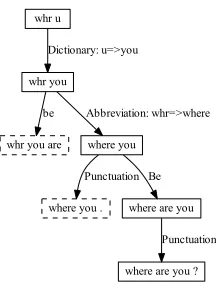
Figure 1: An example search tree when normalizing “whr u”. The solid (dashed) boxes represent good (bad) hy-potheses. The hypothesis producers are indicated on the edges.
in Algorithm 1, and Figure 1 shows an example search tree for an English message.
Algorithm 1The beam-search decoder
INPUT: a raw messageMwhose length isN
RETURN: the best normalization forM
1: initializehypothesisStacks[N+1] and hypothesisProducers;
2: add the initial hypothesisMto stackhypothesisStacks[0];
3: fori←0to N-1do
4: for eachhypoinhypothesisStacks[i]do
5: for eachproducerinhypothesisProducersdo
6: for eachnewHypoproduced byproducerfromhypodo
7: addnewHypotohypothesisStacks[i+1];
8: prunehypothesisStacks[i+1];
9: return the best hypothesis inhypothesisStacks[0...N];
We give the details of the hypothesis producers for Chinese and English social media texts in the next two subsections. A number of the hypothesis producers detect and deal with informal words w
present in a hypothesis by relying on bigram counts ofwin a large corpus of formal texts. Specifically, a wordwin a hypothesis. . . w−1ww1. . . is consid-ered an informal word if both bigrams w−1w and
ww1occur infrequently (≤5) in the formal corpus. Given a hypothesis message h, the feature func-tions include a language model score (the normal-ized sentence probability of h), an informal word count penalty (the number of informal words de-tected inh), and count feature functions. Each count feature function gives the count of the modifications made by a hypothesis producer. The feature
func-tions are used by the decoder to distinguish good hypotheses from bad ones. All feature functions are combined using a linear model to obtain the score for a hypothesish:
score(h) =X i
λifi(h), (1)
wherefi is thei-th feature function with weightλi.
The weights of the feature functions are tuned using the pairwise ranking optimization algorithm (Hop-kins and May, 2011) on the development set.
4.4 Text Normalization for Chinese
Taking into account the informal characteristics of Chinese social media text in Section 3, we design the following hypothesis producers for Chinese text normalization:
Dictionary: We have manually assembled a dic-tionary of 703 informal-formal word pairs from the Internet. The word pairs are used to produce new hypotheses. For example, given a hypothesis “神 马[magical horse] 时候[time]”, if the dictionary contains the word pair “(神马,什 么[what])”, the Dictionary hypothesis producer generates a new hy-pothesis “什么[what]时候[time]”.
Punctuation: A punctuation correction model (Section 4.1) is adopted to correct punctuation in the current hypothesis, e.g., it may normalize “什 么[what]时候[time]” into “什么时候?”.
Pronunciation: We use Chinese Pinyin to model the pronunciation similarity of words. To accom-plish this, we pair some Pinyin initials that sound similar into a group. The groups of paired Pinyin initials are(c, ch), (s, sh), and (z, zh). For exam-ple, given the hypothesis “北京[Beijing]筒子[tube]
来了[come]”, the Pinyin of the informal word “筒 子” is “t ong z i”. The Pinyin of the formal word “同志[comrade]” is “t ong zh i”. Since the sim-ilar sounding Pinyin initials z and zh are paired in a group, a new hypothesis “北京[Beijing] 同
志[comrade]来了[come]” can be produced. In practice, this hypothesis producer can propose many spurious candidatesw0 for an informal word
Pronoun: With the method of Section 4.2, a CRF model is trained to recover the missing pronoun “我[I]”.
Interjection: If a word w in a pre-defined list of frequent redundant interjections appears at the end of a sentence, we produce a new hypothesis by removing w, e.g., from “好的[ok] 哦[oh]” to “好 的[ok]”.
Resegmentation: This hypothesis producer fixes word segmentation problems. If an informal word is a concatenation of two constituent informal words
w1 andw2 in our normalization dictionary, the in-formal word will be segmented into two wordsw1 andw2. As a result, the Dictionary hypothesis pro-ducer can subsequently normalizew1andw2.
4.5 Text Normalization for English
Similar to Chinese text normalization, we also cre-ate the Dictionary, Punctuation, and Interjection hy-pothesis producers for English text normalization. We also add the following English-specific hypoth-esis producers:
Pronunciation: This hypothesis producer uses pronunciation similarity to find formal candidates for a given informal word. It considers a word as a sequence of letters and convert it into a sequence of phones using phrase-based SMT trained on the CMU pronouncing dictionary (Weide, 1998). Simi-lar sounding phones are paired together in a group:
(ah, ao),(ow, uw), and(s, z). To illustrate, in the hy-pothesis “wat is it”, the informal word “wat” maps to the phone sequence “w ao t”. Since the formal word “what” maps to the phone sequence “w ah t” and the phonesahandaoare paired in a group, the new hypothesis “what is it” is generated.
Be: We train a CRF model to recover missing wordsbe, as described in Section 4.2.
Retokenization: This hypothesis producer fixes tokenization problems. More precisely, given an in-formal word which is not a URL or email address and contains a period, it splits the informal word at the period. For example, “how r u.where r u” is nor-malized to “how r u . where r u”.
Prefix: This hypothesis producer generates a for-mal wordw0for an informal wordwifwis a prefix ofw0. To avoid spurious candidates, we only gener-atew0 if|w| ≥3and|w0| − |w| ≤4.
Quotation: If an informal word ends with a letter
in(m, s, t)and if the word produced by inserting a quotation mark before the letter is a formal word, a new hypothesis with the quotation mark inserted is produced. This hypothesis producer thus generates “i’m” from “im”, “she’s” from “shes”, “isn’t” from “isnt”, etc.
Abbreviation: Letters denoting the vowels in a formal word are often deleted to form an infor-mal word. This hypothesis producer generates a formal word w0 from an informal word w if w0
can be obtained fromwby adding missing vowels. To avoid spurious candidates, we only consider w
where|w| ≥2.
Time: If a number can be a potential time expres-sion and appears after “at” or before “am” or “pm”, a new hypothesis is produced by changing the number into a time expression, e.g., “1130 am” is normal-ized to “11 : 30 am”.
Since the Pronunciation, Prefix, and Abbreviation hypothesis producers can propose spurious candi-dates for an informal word, we also use contextual filtering to further filter the candidates for these hy-pothesis producers.
5 Experiments
5.1 Evaluation Corpora
As previous work (Choudhury et al., 2007; Han and Baldwin, 2011; Liu et al., 2012) mostly focused on word normalization, no data is available with corrected punctuation and recovered missing words. We thus create the following two corpora (Table 3):
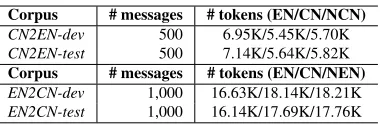
Chinese-English corpusWe crawled 1,000 mes-sages from Weibo which were first normalized into formal Chinese and then translated into formal En-glish. The first half of the corpus serves as our de-velopment set to tune our text normalization decoder for Chinese, while the second half serves as the test set to evaluate text normalization for Chinese and Chinese-English MT.
Corpus # messages # tokens (EN/CN/NCN)
CN2EN-dev 500 6.95K/5.45K/5.70K
CN2EN-test 500 7.14K/5.64K/5.82K
Corpus # messages # tokens (EN/CN/NEN)
EN2CN-dev 1,000 16.63K/18.14K/18.21K
[image:7.612.92.282.55.117.2]EN2CN-test 1,000 16.14K/17.69K/17.76K
Table 3: Statistics of the corpora. CN2EN-dev/ CN2EN-test is the development/test set in our Chinese-English experiments. EN2CN-dev/EN2CN-test is the development/test set in our English-Chinese experi-ments. NEN/NCN denotes manually normalized En-glish/Chinese texts.
The formal corpus used (as described in Section 4) is the concatenation of two Chinese-English spo-ken parallel corpora: the IWSLT 2009 corpus (Paul, 2009) and another spoken text corpus collected at the Harbin Institute of Technology3. The language model used for Chinese (English) text normalization is the Chinese (English) side of the formal corpus and the LDC Chinese (English) Gigaword corpus.
To evaluate the effect of text normalization on MT, we build phrase-based MT systems using Moses (Koehn et al., 2007), with word alignments generated by GIZA++ (Och and Ney, 2003). The MT training data contains the above formal corpus and some LDC4 par-allel corpora (LDC2000T46, LDC2002E18, LDC2003E14, LDC2004E12, LDC2005T06, LDC2005T10, LDC2007T23, LDC2008T06, LDC2008T08, LDC2008T18, LDC2009T02, LDC2009T06, LDC2009T15, LDC2010T03). In total, 214M/192M English/Chinese tokens are used to train our MT systems. The language model of the Chinese-English (English-Chinese) MT system is the English (Chinese) side of the FBIS corpus (LDC2003E14) and the English (Chinese) Gigaword corpus. Our MT systems are tuned on the manually normalized messages of our development sets.
Following (Aw et al., 2006; Oliva et al., 2013), we use BLEU scores (Papineni et al., 2002) to eval-uate text normalization. We also use BLEU scores to evaluate MT quality. We use the sign test to de-termine statistical significance, for both text normal-ization and translation.
3
http://mitlab.hit.edu.cn/
4http://www.ldc.upenn.edu/Catalog/
5.2 Baselines
We compare our text normalization decoder against three baseline methods for performing text normal-ization. We then send the respective normalized texts to the same MT system to evaluate the effect of text normalization on MT.
The simplest baseline for text normalization is one that does no text normalization. The raw text (un-normalized) is simply passed on to the MT sys-tem for translation. We call this baseline ORIGINAL. The second baseline, LATTICE, is to use a lattice to normalize text. For each input message, a lattice is generated in which each informal word is aug-mented with its formal candidates taken from the same normalization dictionary (downloaded from Internet) used in our text normalization decoder. The lattice is then decoded by the same language model used in our text normalization decoder to generate the normalized text (Stolcke, 2002). Another pos-sible way of using lattice is to directly feed the lat-tice to the MT system (Eidelman et al., 2011), but since in this paper, we assume that the MT system can only translate plain text, we leave this as future work.
The third baseline, PBMT, is a competitive base-line that performs text normalization via phrase-based MT, as proposed in Aw et al. (2006). Moses (Koehn et al., 2007) is used to perform text normal-ization, by “translating” un-normalized text to nor-malized text. The training data used is the same development set used in our text normalization de-coder. The normalized text is then sent to our MT system for translation. This method was also used in the SMS translation task of WMT 2011 by (Stymne, 2011).
In the tables showing experimental results, nor-malization and translation BLEU scores that are sig-nificantly higher than (p < 0.01) the LATTICE or PBMT baseline are in bold or underlined, respec-tively.
5.3 Chinese-English Experimental Results
normaliza-BLEU scores (%) System Normalization MT
ORIGINALbaseline 61.01 9.06 LATTICEbaseline 74.52 11.50 PBMTbaseline 76.77 12.65 ORACLE 100.00 15.04 Dictionary 77.80 12.35 Punctuation 65.95 9.63 Pronunciation 61.30 9.13 Pronoun 61.11 9.01 Interjection 61.05 9.14 Resegmentation 60.98 9.03 Dictionary 77.80 12.35 +Punctuation 84.69 13.37
+Pronunciation 84.69 13.40
+Pronoun 84.96 13.50
+Interjection 85.33 13.68
[image:8.612.101.271.55.232.2]+Resegmentation 86.75 14.03
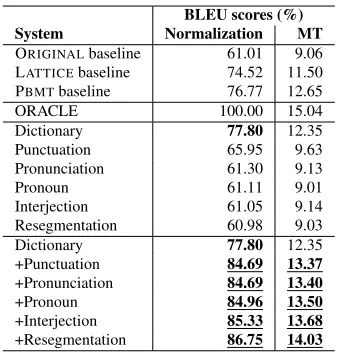
Table 4: Chinese-English experimental results.
tion which indicates the theoretical upper bounds of perfect normalization. In the normalization experi-ments, the ORIGINAL baseline gets a BLEU score of 61.01%, and the LATTICE baseline greatly im-proves the ORIGINAL baseline by 13.51%, which shows that the dictionary collected from the Inter-net is highly effective in text normalization. The PBMTbaseline further improves the BLEU score by 2.25%. In the corresponding MT experiments, as the normalization BLEU scores increase, the MT BLEU scores also increase.
The third group is the isolated experiments, i.e., each experiment only uses one hypothesis producer. As expected, the individual hypothesis producers alone do not work well except the Dictionary hy-pothesis producer. One interesting discovery is that the Dictionary hypothesis producer outperforms the LATTICEbaseline, which shows that our normaliza-tion decoder can utilize the dicnormaliza-tionary more effec-tively, probably because of the additional features used in our normalization decoder such as the infor-mal word penalty. The Resegmentation hypothesis producer alone worsens the BLEU scores, since it can only split informal words, and is designed to work together with other hypothesis producers to normalize words.
The last group is the combined experiments. We add each hypothesis producer in the order of its nor-malization effectiveness in the isolated experiments. Adding the Punctuation hypothesis producer greatly improves the BLEU scores of both normalization
and translation, which confirms the importance of punctuation correction. The Pronoun and Inter-jection hypothesis producers also contribute some improvements. Finally, Resegmentation signifi-cantly improves the normalization/translation BLEU scores by 1.42%/0.35%. Compared with the isolated experiments, the combined experiments show that our normalization decoder can effectively integrate different hypothesis producers to achieve better per-formance for both text normalization and transla-tion.
Overall, in the Chinese text normalization exper-iments, our normalization decoder outperforms the best baseline PBMT by 9.98% in BLEU score. In the Chinese-English MT experiments, the normal-ized texts output by our normalization decoder lead to improved translation quality compared to normal-ization by the PBMT baseline, by 1.38% in BLEU score.
5.4 English-Chinese Experimental Results
The English-Chinese normalization and translation results are shown in Table 5, with the same experi-mental setup as in the Chinese-English experiments. The text normalization BLEU score of the ORIG -INAL baseline is much lower in English compared to Chinese, since the English texts contain more in-formal words. Again, the individual hypothesis pro-ducers alone do not work well, except the Dictio-nary hypothesis producer. The Retokenization hy-pothesis producer greatly improves the normaliza-tion/translation BLEU scores by 2.37%/0.86%. The Punctuation hypothesis producer helps less for En-glish compared to Chinese, suggesting that our Chi-nese texts contain noisier punctuation.
Overall, we achieved similar improvements in En-glish text normalization and EnEn-glish-Chinese trans-lation, and the improvements in BLEU scores are 7.35% and 1.35% respectively.
5.5 Further Analysis
ob-BLEU scores (%) System Normalization MT
ORIGINALbaseline 37.38 13.63 LATTICEbaseline 56.98 20.56 PBMTbaseline 59.19 21.46 ORACLE 100.00 28.48 Dictionary 59.90 20.84
Retokenization 38.79 14.06 Prefix 38.68 13.90 Interjection 38.37 13.92 Quotation 38.04 13.65 Abbreviation 37.94 13.74
Time 37.65 13.66
Pronunciation 37.62 13.80 Punctuation 37.62 13.79
Be 37.47 13.59
Dictionary 59.90 20.84
+Retokenization 62.27 21.70
+Prefix 63.22 21.88
+Interjection 64.85 22.30
+Quotation 65.24 22.31
+Abbreviation 65.35 22.34
+Time 65.59 22.38
+Pronunciation 65.64 22.38
+Punctuation 66.38 22.74
[image:9.612.100.271.54.307.2]+Be 66.54 22.81
Table 5: English-Chinese experimental results.
tained with contextual filtering. This shows the ben-eficial effect of contextual filtering.
Decoding speed. The decoding speed of our text normalization decoder was 0.2 seconds per message on our test sets, using a 2.27 GHz Intel Xeon CPU with 32 GB memory.
The effect of text normalization decoder on MT. We manually analyzed the effect of our text normalization decoder on MT. For example, given the un-normalized English test message “yeah must sign up , im in lt25”, our English-Chinese MT system translated it into “对[yeah]必须[must] 签
署[sign up] , im在[in] lt25” On the other hand, our normalization decoder normalized it into “yeah must sign up , i ’m in lt25 .” which was then trans-lated into “对必须签署,我在lt25。” by our MT system. This example shows that our text normal-ization decoder uses word normalnormal-ization and punc-tuation correction to improve translation.
6 Conclusion
This paper presents a novel beam-search decoder for normalization of social media text. Our de-coder for text normalization effectively integrates multiple normalization operations. In our experi-ments, we achieved statistically significant
improve-ments over two strong baselines: an improvement of 9.98%/7.35% in BLEU scores for normalization of Chinese/English social media text, and an improve-ment of 1.38%/1.35% in BLEU scores for transla-tion of Chinese/English social media text. Future work can investigate how to more tightly integrate our beam-search decoder for text normalization with a standard MT decoder, e.g., by using a lattice or an n-best list.
Acknowledgments
We thank all the anonymous reviewers for their com-ments which have helped us improve this paper. This research is supported by the Singapore Na-tional Research Foundation under its InternaNa-tional Research Centre @ Singapore Funding Initiative and administered by the IDM Programme Office.
References
AiTi Aw, Min Zhang, PohKhim Yeo, ZhenZhen Fan, and Jian Su. 2005. Input normalization for an English-to-Chinese SMS translation system. InProceedings of the Tenth MT Summit.
AiTi Aw, Min Zhang, Juan Xiao, and Jian Su. 2006. A phrase-based statistical model for SMS text normaliza-tion. InProceedings of ACL-COLING.
Richard Beaufort, Sophie Roekhaut, Louise-Am´elie Cougnon, and C´edrick Fairon. 2010. A hybrid rule/model-based finite-state framework for normaliz-ing SMS messages. InProceedings of ACL.
Chris Callison-Burch, Philipp Koehn, Christof Monz, and Omar Zaidan. 2011. Findings of the 2011 work-shop on statistical machine translation. InProceedings of WMT.
Monojit Choudhury, Rahul Saraf, Vijit Jain, Animesh Mukherjee, Sudeshna Sarkar, and Anupam Basu. 2007. Investigation and modeling of the structure of texting language. International Journal on Document Analysis and Recognition, 10(3-4):157–174.
Paul Cook and Suzanne Stevenson. 2009. An unsu-pervised model for text message normalization. In
Proceedings of the Workshop on Computational Ap-proaches to Linguistic Creativity.
Marta R. Costa-juss`a and Rafael E. Banchs. 2011. The BM-I2R Haitian-Cr´eole-to-English translation system description for the WMT 2011 evaluation campaign. InProceedings of WMT.
Daniel Dahlmeier and Hwee Tou Ng. 2012. A beam-search decoder for grammatical error correction. In
Vladimir Eidelman, Kristy Hollingshead, and Philip Resnik. 2011. Noisy SMS machine translation in low-density languages. InProceedings of WMT.
Jennifer Foster, Ozlem C¨ ¸ etinoglu, Joachim Wagner, Joseph Le Roux, Stephen Hogan, Joakim Nivre, Deirdre Hogan, and Josef Van Genabith. 2011. # hardtoparse: POS tagging and parsing the twitterverse. In Proceedings of the AAAI Workshop On Analyzing Microtext.
Stephan Gouws, Dirk Hovy, and Donald Metzler. 2011. Unsupervised mining of lexical variants from noisy text. InProceedings of the First Workshop on Unsu-pervised Learning in NLP.
Bo Han and Timothy Baldwin. 2011. Lexical normalisa-tion of short text messages: Makn sens a #twitter. In
Proceedings of ACL-HLT.
Mark Hopkins and Jonathan May. 2011. Tuning as rank-ing. InProceedings of EMNLP.
Yijue How and Min-Yen Kan. 2005. Optimizing pre-dictive text entry for short message service on mobile phones. In Proceedings of Human Computer Inter-faces International.
Jing Huang and Geoffrey Zweig. 2002. Maximum en-tropy model for punctuation annotation from speech. InProceedings of ICSLP.
Ji Hwan Kim and P. C. Woodland. 2001. The use of prosody in a combined system for punctuation gener-ation and speech recognition. In Proceedings of Eu-rospeech.
Catherine Kobus, Franc¸ois Yvon, and G´eraldine Damnati. 2008. Normalizing SMS: are two metaphors better than one? InProceedings of COLING.
Philipp Koehn, Hieu Hoang, Alexandra Birch, Chris Callison-Burch, Marcello Federico, Nicola Bertoldi, Brooke Cowan, Wade Shen, Christine Moran, Richard Zens, Chris Dyer, Ondrej Bojar, Alexandra Con-stantin, and Evan Herbst. 2007. Moses: Open source toolkit for statistical machine translation. In Proceed-ings of ACL Demo and Poster Sessions.
John D. Lafferty, Andrew McCallum, and Fernando C. N. Pereira. 2001. Conditional random fields: Probabilis-tic models for segmenting and labeling sequence data. In Proceedings of the Eighteenth International Con-ference on Machine Learning.
Zhifei Li and David Yarowsky. 2008. Mining and mod-eling relations between formal and informal Chinese phrases from web corpora. InProceedings of EMNLP. Xiaohua Liu, Shaodian Zhang, Furu Wei, and Ming Zhou. 2011. Recognizing named entities in tweets. InProceedings of ACL-HLT.
Fei Liu, Fuliang Weng, and Xiao Jiang. 2012. A broad-coverage normalization system for social media lan-guage. InProceedings of ACL.
Wei Lu and Hwee Tou Ng. 2010. Better punctuation prediction with dynamic conditional random fields. In
Proceedings of EMNLP.
Preslav Nakov, Chang Liu, Wei Lu, and Hwee Tou Ng. 2009. The NUS statistical machine translation system for IWSLT 2009. InProceedings of the International Workshop on Spoken Language Translation.
Franz Josef Och and Hermann Ney. 2003. A system-atic comparison of various statistical alignment mod-els. Computational Linguistics, 29(1):19–51.
J. Oliva, J. I. Serrano, M. D. Del Castillo, and ´A. Igesias. 2013. A SMS normalization system integrating mul-tiple grammatical resources. Natural Language Engi-neering, 19(1):121–141.
Kishore Papineni, Salim Roukos, Todd Ward, and Wei-Jing Zhu. 2002. BLEU: a method for automatic eval-uation of machine translation. InProceedings of ACL. Michael Paul. 2009. Overview of the IWSLT 2009 eval-uation campaign. InProceedings of the International Workshop on Spoken Language Translation.
Deana L. Pennell and Yang Liu. 2011. A character-level machine translation approach for normalization of SMS abbreviations. InProceedings of IJCNLP. Alan Ritter, Sam Clark, Mausam, and Oren Etzioni.
2011. Named entity recognition in tweets: An experi-mental study. InProceedings of EMNLP.
Andreas Stolcke. 2002. SRILM – An extensible lan-guage modeling toolkit. In Proceedings of the Inter-national Conference on Spoken Language Processing. Sara Stymne. 2011. Spell checking techniques for re-placement of unknown words and data cleaning for Haitian Creole SMS translation. In Proceedings of WMT.
Charles Sutton, Khashayar Rohanimanesh, and Andrew McCallum. 2004. Dynamic conditional random fields: Factorized probabilistic models for labeling and segmenting sequence data. InProceedings of the 21st International Conference on Machine Learning. Robert L. Weide. 1998. The CMU pronouncing
dictionary. URL: http://www.speech.cs.cmu.edu/cgi-bin/cmudict.
Yunqing Xia, Kam-Fai Wong, and Wei Gao. 2005. NIL is not nothing: Recognition of Chinese network infor-mal language expressions. In4th SIGHAN Workshop on Chinese Language Processing.
Zhenzhen Xue, Dawei Yin, and Brian D. Davison. 2011. Normalizing microtext. In Proceedings of the AAAI Workshop on Analyzing Microtext.