Relation Extraction with Matrix Factorization and Universal Schemas
Sebastian Riedel
Department of Computer Science University College London
Limin Yao, Andrew McCallum, Benjamin M. Marlin
Department of Computer Science University of Massachusetts at Amherst
{lmyao,mccallum,marlin}@cs.umass.edu
Abstract
Traditional relation extraction predicts rela-tions within some fixed and finite target schema. Machine learning approaches to this task require either manual annotation or, in the case of distant supervision, existing struc-tured sources of the same schema. The need for existing datasets can be avoided by us-ing a universal schema: the union of all in-volved schemas (surface form predicates as in OpenIE, and relations in the schemas of pre-existing databases). This schema has an al-most unlimited set of relations (due to surface forms), and supports integration with existing structured data (through the relation types of existing databases). To populate a database of such schema we present matrix factorization models that learn latent feature vectors for en-tity tuples and relations. We show that such latent models achieve substantially higher ac-curacy than a traditional classification ap-proach. More importantly, by operating simul-taneously on relations observed in text and in pre-existing structured DBs such as Freebase, we are able to reason about unstructured and structured data in mutually-supporting ways. By doing so our approach outperforms state-of-the-art distant supervision.
1 Introduction
Most previous work in relation extraction uses a pre-defined, finite and fixed schema of relation types (such asborn-inoremployed-by). Usually some tex-tual data is labeled according to this schema, and this labeling is then used in supervised training of an automated relation extractor, e.g. Culotta and Sorensen (2004). However, labeling textual
rela-tions is time-consuming and difficult, leading to sig-nificant recent interest in distantly-supervised learn-ing. Here one aligns existing database records with the sentences in which these records have been “ren-dered”––effectively labeling the text—and from this labeling we can train a machine learning system as before (Craven and Kumlien, 1999; Mintz et al., 2009; Bunescu and Mooney, 2007; Riedel et al., 2010). However, this method relies on the availabil-ity of a large database that has the desired schema.
The need for pre-existing datasets can be avoided by using language itself as the source of the schema. This is the approach taken by OpenIE (Etzioni et al., 2008). Here surface patterns between mentions of concepts serve as relations. This approach requires no supervision and has tremendous flexibility, but lacks the ability to generalize. For example, Ope-nIE may find FERGUSON–historian-at–HARVARD
but does not know FERGUSON–is-a-professor-at– HARVARD. OpenIE has traditionally relied on a
large diversity of textual expressions to provide good coverage. But this diversity is not always available, and, in any case, the lack of generalization greatly inhibits the ability to support reasoning.
One way to gain generalization is to cluster tex-tual surface forms that have similar meaning (Lin and Pantel, 2001; Pantel et al., 2007; Yates and Etzioni, 2009; Yao et al., 2011). While the clus-ters discovered by all these methods usually contain semantically related items, closer inspection invari-ably shows that they do not provide reliable impli-cature. For example, a typical representative clus-ter may includehistorian-at,professor-at, scientist-at,worked-at. Although these relation types are in-deed semantically related, note thatscientist-atdoes not necessarily imply professor-at, and worked-at
certainly does not imply scientist-at. In fact, we contend that any relational schema would inherently be brittle and ill-defined––having ambiguities, prob-lematic boundary cases, and incompleteness.1 For example, Freebase, in spite of its extensive effort to-wards high coverage, has nocritizednorscientist-at
relation.
In response to this problem, we present a new ap-proach: implicature with universal schemas. Here we embrace the diversity and ambiguity of original inputs; we avoid forcing textual meaning into pre-defined boxes. This is accomplished by defining our schema to be the union of all source schemas: original input forms, e.g. variants of surface pat-terns similarly to OpenIE, as well as relations in the schemas of many available pre-existing struc-tured databases. But then, unlike OpenIE, our fo-cus lies on learning asymmetric implicature among relations. This allows us to probabilistically “fill in” inferred unobserved entity-entity relations in this union. For example, after observing FERGU
-SON–historian-at–HARVARDour system infers that FERGUSON–professor-at–HARVARD, but not vice versa.
At the heart of our approach is the hypothesis that we should concentrate on predicting source data––a relatively well defined task that can be evaluated and optimized––as opposed to modeling semantic equiv-alence, which we believe will always be illusive.
Note that by operating simultaneously on rela-tions observed in text and in pre-existing structured databases such as Freebase, we are able to reason about unstructured and structured data in mutually-supporting ways. For example, we can predict sur-face pattern relations that effectively serve as addi-tional features when predicting Freebase relations, hence improving generalization. Also notice that users of our system will not have to study and un-derstand the complexities of a particular schema in order to issue queries; they can ask in whatever form naturally occurs to them, and our system will likely already have that relation in our universal schema.
Our technical approach is based on extensions to probabilistic models of matrix factorization and
1
At NAACL 2012 Lucy Vanderwende asked “Where do the relation types come from?” There was no satisfying answer. At the same meeting, and in line with Brachman (1983), Ed Hovy stated “We don’t even know what is-a means.”
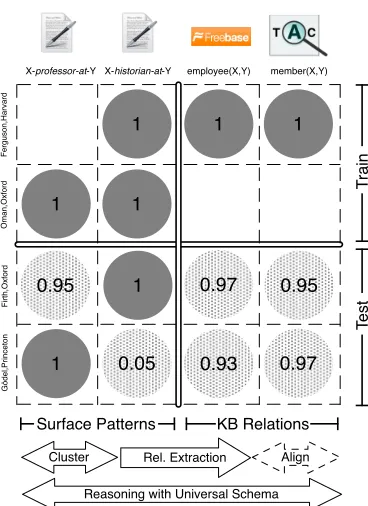
collaborative filtering (Collins et al., 2001; Koren, 2008; Rendle et al., 2009). We represent the prob-abilistic knowledge base as a matrix with entity-entity pairs in the rows and relations in the columns (see figure 1). The rows come from running cross-document entity resolution across pre-existing struc-tured databases and textual corpora. The columns come from the union of surface forms and DB rela-tions. We present a series of models that learn lower dimensional manifolds for tuples, relations and enti-ties, and a set of weights that capture direct correla-tions between relacorrela-tions. Weights and lower dimen-sional representations act, through dot products, as the natural parameters of a single log-linear model to derive per-cell probabilities.
In experiments we show that our models can ac-curately predict surface patterns relationships which do not appear explicitly in text, and that learning la-tent representations of entities, tuples and relations substantially improves results over a traditional clas-sifier approach. Moreover, we can improve accu-racy by simultaneously operating on relations ob-served in the New York Times corpus and in Free-base. In particular, our model outperforms the cur-rent state-of-the-art distant supervision method (Sur-deanu et al., 2012) by 10% points Mean Average Precision through joint implicature among surface patterns and Freebase relations.
2 Model
Before we present our approach in more detail, we briefly introduce some notation. We use Rto de-note the set of relations we seek to predict (such as
works-writtenin Freebase, or the X–historian-at–Y pattern), andT to denote the set of input tuples. For simplicity we assume each relation to be binary, al-though our approach can be easily generalized to the n-ary case. Given a relationr∈ Rand a tuplet∈ T
the pairhr, tiis afact, or relation instance. The in-put to our model is a set of observed facts O, and the observed facts for a given tuple is denoted by
Ot:={hr, ti ∈ O}.
Our goal is a model that can estimate, for a given relation r (such as X–historian-at–Y) and a given tuple t (such as <FERGUSON,HARVARD>),
the probability p(yr,t= 1) where yr,t is a binary
T
ra
in
0.95
T
e
st
Surface Patterns KB Relations
X-professor-at-Y
1
1
0.05
X-historian-at-Y employee(X,Y) member(X,Y)
1 1
1
1 0.97
Rel. Extraction
1 0.93 0.97
Cluster Align
Reasoning with Universal Schema
F
e
rg
u
so
n
,H
a
rva
rd
O
ma
n
,O
xf
o
rd
F
irt
h
,O
xf
o
rd
G
ö
d
e
l,
Pri
n
ce
to
n
[image:3.612.91.275.58.311.2]0.95
Figure 1: Filling up a database of universal schema. Dark circles are observed facts, shaded circles are in-ferred facts. Relation Extraction (RE) maps surface pat-tern relations (and other features) to structured relations. Surface form clustering models correlations between pat-terns, and can be fed into RE (Yao et al., 2011). Database alignment and integration models correlations between structured relations (not done in this work). Reasoning with the universal schema incorporates these tasks in a joint fashion.
introduce a series of exponential family models that estimate this probability using anatural parameter
θr,tand the logistic function:
p(yr,t= 1|θr,t) :=σ(θr,t) =
1
1 + exp (−θr,t)
.
We will first describe our models through differ-ent definitions of the natural parameterθr,t. In each
caseθr,twill be a function ofr,tand a set of weights
and/or latent feature vectors. In section 2.5 we will then show how these weights and vectors can be es-timated based on the observed factsO.
Notice that we can interpret p(yr,t = 1) as the
probability that a customer t likes product r. This analogy allows us to draw from a large body of work in collaborative filtering, such as work in probabilis-tic matrix factorization and implicit feedback.
2.1 Latent Feature Model
One way to define θr,t is through a latent feature
model F. Here we measure compatibility between relation r and tuple t as dot product of two latent feature representations of sizeKF:arfor relationr,
andvtfor tuplet. This gives:
θFr,t:=
KF
X
k
ar,kvt,k.
This corresponds to generalized PCA (Collins et al., 2001), a model were the matrixΘ = (θr,t)of natural
parameters is defined as the low rank factorization
AV.
Notice that we intentionally omit any per-relation bias-terms. In section 4 we evaluate ranked answers to queries on a per-relation basis, and a per-relation bias term will have no effect on ranking facts of the same relation. Also consider that such latent feature models can capture asymmetry by assigning more peaked vectors to specific relations, and more uni-form vectors to general relations.
2.2 Neighborhood Model
We can interpolate the confidence for a given tuple and relation based on the trueness of other similar relations for the same tuple. In collaborative filter-ing this is referred to as aneighborhood-based ap-proach (Koren, 2008). In terms of our natural pa-rameter, we implement a neighborhood model N via a set ofweightswr,r0, where each corresponds to a
directed association strength between relationsrand r0. For a given tuplet and relationr we then sum up the weights corresponding to all relationsr0that have been observed for tuplet:
θr,tN := X
(r0,t)∈O\{(r,t)}
wr,r0.
Notice that the neighborhood model amounts to a collection of local log-linear classifiers, one for each relation r with feature functions fr,r0(t) =
I[r0 6=r∧(r0, t)∈ O]and weightswr. This means
2.3 Entity Model
Relations have selectional preferences: they allow only certain types in their argument slots. While knowledge bases such as Freebase or DBPedia have extensive ontologies of types of entities, these are of-ten not sufficiently fine to allow relations to discrim-inate (Yao et al., 2012b). Hence, instead of using a predetermined set of entity types, in ourentity model
E we learn a latent entity representation from data. More concretely, for each entityewe introduce a la-tent feature vectorteof dimensionKE. In addition,
for each relationrand argument slotiwe introduce a feature vectordi of the same dimension. For
ex-ample, binary relations have feature representations
d1 for argument 1, andd2 for argument 2. Mea-suring compatibility of an entity tuple and relation amounts to measuring, and summing up, compati-bility between each argument slot representation and the corresponding entity representation. This leads to:
θEr,t:=
arity(r)
X
i=1
KE
X
k
di,ktti,k.
Note that due to entity resolution, tuples may share entities, and hence parameters are shared across rows.
2.4 Combined Model
In practice all the above models can capture impor-tant aspects of the data. Hence we also use various combinations, such as:
θNFEr,t :=θNr,t+θr,tF +θr,tE .
2.5 Parameter Estimation
Our models are parametrized through weights and latent component vectors. We could estimate these parameters by maximizing the loglikelihood of the observed data akin to Collins et al. (2001). How-ever, as we do not have access to negative facts, the model would simply learn to predict all facts to be true. In our initial attempt to overcome this issue we sampled a set of unobserved facts as designated negative facts, as is done in related distant supervi-sion approaches. However, we found that (a) our results were sensitive to the choice of negative data and (b) runtime was increased substantially because of a large number of required negative facts.
In collaborative filtering positive-only data is also known asimplicit feedback. This type of feedback arises, for example, when users buy but not rate items. One successful approach to learning with im-plicit feedback is based on the observation that the actual task is not necessarily one of prediction (here: to predict a number between 0 and 1) but one of (generally simpler) ranking: to give true “user-item” cells higher scores than false ones.Bayesian Person-alized Ranking(BPR) uses a variant of this ranking: giving observed true facts higher scores than unob-served (true or false) facts (Rendle et al., 2009). This relaxed constraint is to be contrasted with the log-likelihood setting that essentially requires (randomly sampled) negative facts to score below a globally de-fined threshold.
2.5.1 Objective
We first create a dataset ofranked pairs: for each relationrand each observed factf+:=hr, t+i ∈ O
we choose all tuplest− such thatf− := hr, t−i ∈/
O—that is, tuples we have not observed to be in relation r. For each pair of facts f+ and f− we wantp(f+) > p(f−) and henceθf+ > θf−. In
BPR this is achieved by maximizing a sum terms of the form Objf+,f−:= log σ θf+−θf−, one for
each ranked pair:
Obj:= X
hr,t+i∈O
X
hr,t−i∈O/
Objhr,t+i,hr,t−i. (1)
Notice that this objective differs slightly from the one used by Rendle et al. (2009). Consider tuples as users and items as relations. We rank different users with respect to the same item, while BPR ranks items with respect to the same user. Also notice that the BPR objective is an approximation to the per-relation AUC (area under the ROC curve), and hence directly correlated to what we want to achieve: well-ranked tuples per relation.
Note that all parameters are regularized with quadratic penalty which we omit here for brevity.
2.5.2 Optimization
To maximize the objective2 in equation 1 we fol-low Rendle et al. (2009) and employ Stochastic Gra-dient Descent (SGD). In particular, in each epoch
2
we sample|O|facts with replacement fromO. For each sampled fact hr, t+i we then sample a tuple t− ∈ T such that hr, t−i ∈ O/ is not an observed fact. This gives us|O|fact pairshf+, f−i, and for each pair we do an SGD update using the corre-sponding gradients of Objf+,f−. For the F model
the gradients correspond to those presented by Ren-dle et al. (2009). The remaining gradients are easy to derive; we omit details for brevity.
3 Related Work
This work extends a previous workshop paper (Yao et al., 2012a) by introducing the neighborhood and entity model, by working with the BPR objective, and by more extensive experiments.
Relational Clustering There is a large body of work aiming to discover latent relations by clus-tering surface patterns (Hasegawa et al., 2004; Shinyama and Sekine, 2006; Kok and Domingos, 2008; Yao et al., 2011; Takamatsu et al., 2011), or by inducing synonymy relationships between pat-terns independently of the entities (Yates and Et-zioni, 2009; Pantel et al., 2007; Lin and Pantel, 2001). Our approach has a fundamentally different objective: we are not (primarily) interested in clus-ters of patterns or their semantic representation, but in predicting patterns where they are not observed. Moreover, these related methods rely on asymmetric
notion of synonymy in which clustered patterns are assumed to have the same meaning. Our approach rejects this assumption in favor of a model which learns that certain patterns, or combinations thereof,
entailothers in one direction, but not necessarily the other. This is similar in spirit to work on learning entailment rules (Szpektor et al., 2004; Zanzotto et al., 2006; Szpektor and Dagan, 2008). However, for us even entailment rules are just a by-product of our goal to improve prediction, and it is this goal we di-rectly optimize for and evaluate.
Matrix Factorization Our approach is also re-lated to work on factorizing YAGO to predict new links (Nickel et al., 2012). The primary differences are that we include surface patterns in our schema, use a ranking objective, and learn latent vectors for entities and tuples. Likewise, matrix factorization in various flavors has received significant attention in
the lexical semantics community, from LSA to re-cent work on non-negative sparse embeddings (Mur-phy et al., 2012). In our problem columns corre-spond to relations, and rows correcorre-spond to entity tu-ples. By contrast, there columns are words, and rows are contextual features such as “words in a local win-dow.” Consequently, our objective is to complete
the matrix, whereas their objective is to learn better latent embeddings of words (which by themselves again cannot capture any sense of asymmetry).
OpenIE Open IE (Etzioni et al., 2008) extracts facts mentioned in text, but does not predict poten-tial facts not mentioned in text. Finding answers requires explicit mentions, and hence suffers from lower recall for not-so-frequently mentioned facts. Methods that learn rules between textual patterns in OpenIE aim at a similar goal as our proposed ap-proach (Schoenmackers et al., 2008; Schoenmack-ers et al., 2010). However, their approach is sub-stantially more complex, requires a categorization of entities into fine grained entity types, and needs inference in high tree-width Markov Networks. By contrast, our approach is based on a single unified model, requires no entity types, and for us inferring a fact amounts to not more than a few dot products. In addition, in our Universal Schema approach Ope-nIE surface patterns are just one kind of relations, and our aim is populate relations of all kinds. In the future we may even include relations between enti-ties and continuous attributes (say, gene expression measurements).
Never-Ending Learning and Bootstrapping Our latent feature models are capable of never-ending learning (Carlson et al., 2010). That is, we can con-tinue to train these models with incoming data, even if no structured annotation is available. In bootstrap-ping approaches the current model is used to predict new relations, and these hypothesized relations are used as new supervision targets (i.e. self-training). By contrast, our model only strengthens the correla-tions between incoming co-occurring observacorrela-tions. This has the advantage that wrong predictions are less likely be reinforced, hence reducing the risk of semantic drift.
4 Experiments
How accurately can we fill a database of Universal Schema, and does reasoning jointly across a uni-versal schema help to improve over more isolated approaches? In the following we seek to answer this question empirically. To this end we train our models on observed facts in a newswire corpus and Freebase, and then manually evaluate ranked predic-tions: first for structured relations and then for sur-face form relations.
4.1 Data
Following previous work (Riedel et al., 2010), our documents are taken from the NYTimes cor-pus (Sandhaus, 2008). Articles after 2000 are used as training corpus, articles from 1990 to 1999 as test corpus. We also split Freebase facts 50/50 into train and test facts, and their corresponding tuples into train and test tuples. Then we align training tu-ples with the training corpus, and test tutu-ples with the test corpus. This alignment relies on a preprocessing step that links NER mentions in text with entities in Freebase. In our case we use a simple string-match heuristic to find this linking. Now we align an entity tuple ht1, t2i with a pair of mentions hm1, m2i in the same sentence ifm1is linked tot1andm2tot2. Based on this alignment we filter out all relations for which we find fewer than 10 tuples with mentions in text.
The above alignment and filtering process reduces the total number of tuples related according to Free-base to 16k: approximately 8k tuples with facts mentioned in the training set, and approximately 8k
such tuples for the test set. In addition we have a set of approximately 200k training tuples for which both arguments appear in the same sentence and both can be linked to Freebase entities, but for which no Freebase fact is recorded. This can either be be-cause they are not related, or simply bebe-cause Free-base does not contain the relationship yet. We also have about 200k such tuples in the test set. To sim-plify evaluation, we create asubsampled test setby randomly choosing 10k of the original test set tuples. The above alignment allows us to determine, for each tuple t, the observed facts Ot as follows. To find the surface pattern factsOPAT
t for the tuplet=
ht1, t2iwe extract, for each mentionm=hm1, m2i oft, thelexicalized dependency pathpbetweenm1 andm2. Then we addhp, titoOPAT
t . For example,
we get “<-subj<-head->obj->” for “M1 heads M2.” Filtering out patterns with fewer than 10 mentions in text yields approximately 4k patterns. For train-ing tuples we add as Freebase facts OFB
t all facts
hr, ti that appear in Freebase, and for which r has not been filtered out beforehand. For the test setOFB t
remains empty. The total set of observed factsOtis
OFB
t ∪OPATt , and their union over all tuples forms the
set of observed factsO.
4.2 Evaluation
re-Relation # MI09 YA11 SU12 N F NF NFE
person/company 103 0.67 0.64 0.70 0.73 0.75 0.76 0.79
location/containedby 74 0.48 0.51 0.54 0.43 0.68 0.67 0.69
author/works_written 29 0.50 0.51 0.52 0.45 0.61 0.63 0.69
person/nationality 28 0.14 0.40 0.13 0.13 0.19 0.18 0.21
parent/child 19 0.14 0.25 0.62 0.46 0.76 0.78 0.76
person/place_of_death 19 0.79 0.79 0.86 0.89 0.83 0.85 0.86
person/place_of_birth 18 0.78 0.75 0.82 0.50 0.83 0.81 0.89
neighborhood/neighborhood_of 12 0.00 0.00 0.08 0.43 0.65 0.66 0.72
person/parents 7 0.24 0.27 0.58 0.56 0.53 0.58 0.39
company/founders 4 0.25 0.25 0.53 0.24 0.77 0.80 0.68
film/directed_by 4 0.06 0.15 0.25 0.09 0.26 0.26 0.30
sports_team/league 4 0.00 0.43 0.18 0.21 0.59 0.70 0.63
team/arena_stadium 3 0.00 0.06 0.06 0.03 0.08 0.09 0.08
team_owner/teams_owned 2 0.00 0.50 0.70 0.55 0.38 0.61 0.75
roadcast/area_served 2 1.00 0.50 1.00 0.58 0.58 0.83 1.00
structure/architect 2 0.00 0.00 1.00 0.27 1.00 1.00 1.00
composer/compositions 2 0.00 0.00 0.00 0.50 0.67 0.83 0.12
person/religion 1 0.00 1.00 1.00 0.50 1.00 1.00 1.00
film/produced_by 1 1.00 1.00 1.00 1.00 0.50 0.50 0.33
MAP 0.32 0.42 0.56 0.45 0.61 0.66 0.63
[image:7.612.100.514.61.363.2]Weighted MAP 0.48 0.52 0.57 0.52 0.66 0.67 0.69
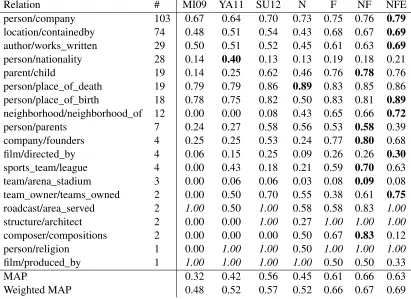
Table 1: Average and (weighted) Mean Average Precisions for Freebase relations based on pooled results. The # column shows the number of true facts in the pool. NFE is statistically different to all but NF and F according to the sign test. Bold faced are winners per relation, italics indicate ties.
lation is weighted by the relation’s number of true facts.
Notice that we deviate from previous work in dis-tant supervision that (a) combines the results from several relations in a single precision recall curve, and (b) uses held-out evaluation to measure how well the predictions match existing Freebase facts. This has several benefits. First, when aggregating across relations results are often dominated by a few very frequent relations, such ascontainedby, provid-ing little information about how the models perform across the board. Second, evaluating with Freebase held-out data is biased. For example, we find that frequently mentioned entity pairs are more likely to have relations in Freebase. Systems that rank such tuples higher receives higher precision than those that do not have such bias, regardless of how cor-rect their predictions are. Third, we can aggregate per-relation comparisons to establish statistical sig-nificance, for example via the sign test.
Also note that while we run our models on the complete training and test set, evaluation is re-stricted to the subsampled test set.
4.3 Predicting Freebase Relations
Table 1 shows our results for Freebase relations, omitting those for which none of the systems can find any relevant facts. Our first baseline is MI09, a distantly supervised classifier based on the work of Mintz et al. (2009). This classifier only learns from observed pattern-relation pairs in the training set (of which we only have about 8k). By contrast, our latent feature models can learn pattern-pattern correlations both on the unlabeled training and test set (comparable to bootstrapping). We hence also compare against YA11, a version of MI09 that uses preprocessed cluster features according to Yao et al. (2011). The third baseline is SU12, the state-of-the-art Multi-Instance Multi-Label system by Surdeanu et al. (2012).
[image:7.612.101.512.65.364.2]0.1 0.2 0.3 0.4 0.5 0.6 0.7 0.8 0.9 1
0 0.2 0.4 0.6 0.8 1
Precision
Recall Averaged 11-point Precision/Recall
[image:8.612.318.532.66.192.2]MI09 YA11 SU12 N F NF NFE
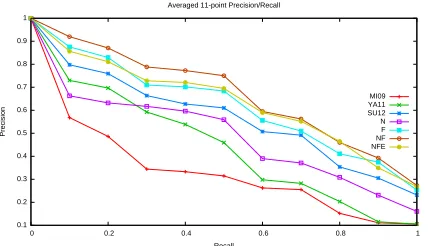
Figure 2: Averaged 11-point precision recall curve for Freebase relations in table 1.
model (N), the factorized model (F), their combi-nation (NF) and the combined model with a latent entity representation (NFE). For all our models we use the same number of components when applica-ble (KF = KE = 100), 1000 epochs, and 0.01 as regularizer for component weights and 0.1 for neigh-borhood weights.
Table 1 shows that adding pattern cluster features (and hence incorporating more data) helps YA11 to improve over MI09. Likewise, we see that the factorized model F improves over N, again learn-ing from unlabeled data. This improvement is big-ger than the corresponding change between MI09 and YA11, possibly indicating that our latent rep-resentations are optimized directly towards improv-ing prediction performance. The combination of N, F and E outperforms all other models in terms of weighted MAP, indicating the power of selectional preferences learned from data. Note that NFE is significantly different (p 0.05in sign test) to all but the NF and F models. In terms of MAP the NF model outperforms NFE, indicating that it does not do as well for frequent relations, but better for infre-quent ones.
Figure 2 shows an averaged 11-point precision call graph (Manning et al., 2008) for Freebase re-lations. We notice that our latent models outper-form all remaining models across all recall levels, and that combining neighborhood and latent models is helpful. This finding is consistent with our MAP results. Figure 3 shows the recall-precision curve for theworks_writtenrelation with respect to our three baselines and the NFE model. Observe how
0 0.2 0.4 0.6 0.8 1
0 0.1 0.2 0.3 0.4 0.5 0.6 0.7 0.8 0.9 1
Precision
Recall Recall/Precision
[image:8.612.79.293.67.190.2]MI09 YA11 SU12 NFE
Figure 3: Precision and recall forworks_written(X,Y).
Relation # N F NF NFE
visit 80 0.19 0.68 0.49 0.42
attend 69 0.23 0.10 0.07 0.10
base 61 0.46 0.87 0.81 0.68
head 38 0.47 0.67 0.70 0.68
scientist 36 0.25 0.84 0.79 0.73
support 18 0.16 0.29 0.32 0.38
adviser 11 0.19 0.15 0.19 0.28
criticize 9 0.09 0.60 0.67 0.64
praise 4 0.01 0.03 0.05 0.10
vote 3 0.18 0.18 0.34 0.34
MAP 0.22 0.44 0.44 0.43
Weighted MAP 0.28 0.56 0.50 0.46
Table 2: Average and (weighted) Mean Average Preci-sions for surface patterns.2
sion drops for both MI09 and SU12 at about 50% recall. At this point the remaining unretrieved facts have patterns that have not been seen together with
works_writtenin the training set. By using cluster features, YA11 can overcome this problem partly, but not as dramatically as NFE—a pattern we ob-serve for many relations.
All our models are fast to train. The slowest model trains in just 45 minutes. By contrast, training the topic model in YA11 alone takes 4 hours. Train-ing SU12 takes two hours (on less data). Also notice that our models not only learn to predict Freebase relations, but also approximately 4k surface pattern relations.
4.4 Predicting Surface Patterns
0 0.1 0.2 0.3 0.4 0.5 0.6 0.7 0.8 0.9 1
0 0.2 0.4 0.6 0.8 1
Precision
Recall Averaged 11-point Precision/Recall
[image:9.612.80.291.66.191.2]N F NF NFE
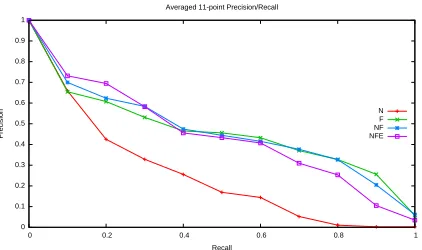
Figure 4: Averaged 11-point precision recall curve for surface pattern relations in table 2.
were chosen according to what we believe are inter-esting questions not currently captured in Freebase. We again see that learning a latent representation (F, NF and NFE) from additional data helps quite sub-stantially over the N model. For in the weighted MAP metric we note that incorporating entity rep-resentations (in the NFE model) in fact hurts total performance.3One reason may be the fact that Free-base relations are typed—they require very specific types of entities as arguments. By contrast, for a surface pattern like “X visits Y” X could be a person or organization, and Y could be a location, organi-zation or person. However, in terms of MAP score this time there is no obvious winner among the la-tent models. This is also confirmed by the averaged 11-point precision recall curve in figure 4.
Notice that we can accurately predict the X–
scientist-at–Y surface pattern relation in table 2, as well as the more general person/company (em-ployedBy) relation in table 1. This indicates that our models can capture asymmetry—a symmetric model would either over-predict X–scientist-at–Y or under-predictperson/company.
5 Conclusion
We present relation extraction into universal schemas. Such schemas contain surface patterns as relations, as well as relations from structured sources. By predicting missing tuples for surface pattern relations we can populate a database with-out any labelled data, and answer questions not
sup-3
Due to the small set of relations only N is significantly dif-ferent to F, NF and NFE (p0.05in sign test).
ported by the structured schema alone. By predict-ing misspredict-ing tuples in the structured schema we can expand a knowledge base of fixed schema, and only require a set of existing facts from this schema. Cru-cially, by predicting and modeling both surface pat-terns and structured relationssimultaneouslywe can improve performance. We show this experimentally by contrasting a series of the popular weakly super-vised models to our collaborative filtering models that learn latent feature representations across sur-face patterns and structured relations. Moreover, our models are computationally efficient, requiring less time than comparable methods, while learning more relations.
Reasoning with universal schemas is not merely a tool for information extraction. It can also serve as a framework for various data integration tasks. For example, we could integrate facts from one schema (say, Freebase) into another (say, the TAC KBP schema) by adding both sets of relations to the set of surface patterns. Reasoning with this schema will mean populating each database with facts from the other, and would leverage information in surface patterns to improve integration. In future work we also plan to integrate universal entity types and at-tributes into the model.
The source code of our system, its output, and all data annotations are available athttp://www.
riedelcastro.org/uschema.
Acknowledgments
We thank the reviewers for very helpful comments. This work was supported in part by the Center for In-telligent Information Retrieval and the University of Massachusetts, in part by UPenn NSF medium IIS-0803847, in part by DARPA under agreement num-ber FA8750-13-2-0020 and FA8750-09-C-0181, and in part by an award from Google. Any opinions, findings, and conclusion or recommendations ex-pressed in this material are those of the authors and do not necessarily reflect the view of DARPA, AFRL, or the US government.
References
Razvan C. Bunescu and Raymond J. Mooney. 2007. Learning to extract relations from the web using min-imal supervision. InProceedings of the 45th Annual Meeting of the Association for Computational Linguis-tics (ACL ’07).
Andrew Carlson, Justin Betteridge, Bryan Kisiel, Burr Settles, Estevam R. Hruschka, and Tom M. Mitchell. 2010. Toward an architecture for never-ending lan-guage learning. InProceedings of the 25th AAAI Con-ference on Artificial Intelligence (AAAI ’10).
Michael Collins, Sanjoy Dasgupta, and Robert E. Schapire. 2001. A generalization of principal com-ponent analysis to the excom-ponential family. In Proceed-ings of NIPS.
M. Craven and J. Kumlien. 1999. Constructing biolog-ical knowledge-bases by extracting information from text sources. InProceedings of the Seventh Interna-tional Conference on Intelligent Systems for Molecular Biology, pages 77–86, Germany.
Aron Culotta and Jeffery Sorensen. 2004. Dependency tree kernels for relation extraction. InProceedings of ACL, Barcelona, Spain.
Oren Etzioni, Michele Banko, Stephen Soderland, and Daniel S. Weld. 2008. Open information extraction from the web.Commun. ACM, 51(12):68–74. T. Hasegawa, S. Sekine, and R. Grishman. 2004.
Dis-covering Relations among Named Entities from Large Corpora. Proceedings of the 42nd Annual Meeting of the Association for Computational Linguistics (ACL ’04), pages 415–422.
Raphael Hoffmann, Congle Zhang, Xiao Ling, Luke Zettlemoyer, and Daniel S. Weld. 2011. Knowledge-based weak supervision for information extraction of overlapping relations. InProceedings of ACL. Stanley Kok and Pedro Domingos. 2008. Extracting
Se-mantic Networks from Text Via Relational Clustering. InECML.
Yehuda Koren. 2008. Factorization meets the neighbor-hood: a multifaceted collaborative filtering model. In Proceedings of the 14th ACM SIGKDD international conference on Knowledge discovery and data min-ing, KDD ’08, pages 426–434, New York, NY, USA. ACM.
Dekang Lin and Patrick Pantel. 2001. DIRT - discovery of inference rules from text. InKnowledge Discovery and Data Mining, pages 323–328.
Christopher D. Manning, Prabhakar Raghavan, and Hin-rich Schütze. 2008. Introduction to Information Re-trieval. Cambridge University Press, Cambridge, UK. Mike Mintz, Steven Bills, Rion Snow, and Daniel Juraf-sky. 2009. Distant supervision for relation extrac-tion without labeled data. InProceedings of the Joint Conference of the 47th Annual Meeting of the ACL
and the 4th International Joint Conference on Natu-ral Language Processing of the AFNLP (ACL ’09), pages 1003–1011. Association for Computational Lin-guistics.
Brian Murphy, Partha Pratim Talukdar, and Tom Mitchell. 2012. Learning effective and interpretable semantic models using non-negative sparse embed-ding. InCOLING, pages 1933–1950.
Maximilian Nickel, Volker Tresp, and Hans-Peter Kriegel. 2012. Factorizing yago: scalable machine learning for linked data. InProceedings of the 21st international conference on World Wide Web, WWW ’12, pages 271–280, New York, NY, USA. ACM. Patrick Pantel, Rahul Bhagat, Bonaventura Coppola,
Timothy Chklovski, and Eduard Hovy. 2007. ISP: Learning Inferential Selectional Preferences. In Pro-ceedings of NAACL HLT.
Steffen Rendle, Christoph Freudenthaler, Zeno Gantner, and Lars Schmidt-Thieme. 2009. Bpr: Bayesian per-sonalized ranking from implicit feedback. In Proceed-ings of the Twenty-Fifth Conference on Uncertainty in Artificial Intelligence, UAI ’09, pages 452–461, Ar-lington, Virginia, United States. AUAI Press.
Sebastian Riedel, Limin Yao, and Andrew McCallum. 2010. Modeling relations and their mentions without labeled text. InProceedings of the European Confer-ence on Machine Learning and Knowledge Discovery in Databases (ECML PKDD ’10).
Evan Sandhaus, 2008. The New York Times Annotated Corpus. Linguistic Data Consortium, Philadelphia. Stefan Schoenmackers, Oren Etzioni, and Daniel S.
Weld. 2008. Scaling textual inference to the web. In EMNLP ’08: Proceedings of the Conference on Empirical Methods in Natural Language Processing, pages 79–88, Morristown, NJ, USA. Association for Computational Linguistics.
Stefan Schoenmackers, Oren Etzioni, Daniel S. Weld, and Jesse Davis. 2010. Learning first-order horn clauses from web text. In Proceedings of the 2010 Conference on Empirical Methods in Natural Lan-guage Processing, EMNLP ’10, pages 1088–1098, Stroudsburg, PA, USA. Association for Computational Linguistics.
Yusuke Shinyama and Satoshi Sekine. 2006. Preemp-tive information extraction using unrestricted relation discovery. In Proceedings of the main conference on Human Language Technology Conference of the North American Chapter of the Association of Com-putational Linguistics, HLT-NAACL ’06, pages 304– 311, Stroudsburg, PA, USA. Association for Compu-tational Linguistics.
of the Conference on Empirical methods in natural language processing (EMNLP ’12), pages 455–465. Idan Szpektor and Ido Dagan. 2008. Learning
entail-ment rules for unary templates. In Proceedings of the 22nd International Conference on Computational Linguistics - Volume 1, COLING ’08, pages 849–856, Stroudsburg, PA, USA. Association for Computational Linguistics.
Idan Szpektor, Hristo Tanev, Ido Dagan, and Bonaven-tura Coppola. 2004. Scaling web-based acquisition of entailment relations. InProceedings of EMNLP. Shingo Takamatsu, Issei Sato, and Hiroshi Nakagawa.
2011. Probabilistic matrix factorization leveraging contexts for unsupervised relation discovery. In Pro-ceedings of PAKDD.
Limin Yao, Aria Haghighi, Sebastian Riedel, and Andrew McCallum. 2011. Structured relation discovery using generative models. InProceedings of the Conference on Empirical methods in natural language processing (EMNLP ’11), July.
Limin Yao, Sebastian Riedel, and Andrew McCallum. 2012a. Probabilistic databases of universal schema. In Proceedings of the AKBC-WEKEX Workshop at NAACL 2012, June.
Limin Yao, Sebastian Riedel, and Andrew McCallum. 2012b. Unsupervised relation discovery with sense disambiguation. In Proceedings of the 50th Annual Meeting of the Association for Computational Linguis-tics (ACL ’12), July.
Alexander Yates and Oren Etzioni. 2009. Unsupervised methods for determining object and relation synonyms on the web. Journal of Artificial Intelligence Research, 34:255–296.