Proceedings of NAACL-HLT 2015, pages 76–80,
An Open-source Framework for
Multi-level Semantic Similarity Measurement
Mohammad Taher Pilehvar and Roberto Navigli
Department of Computer Science Sapienza University of Rome
{pilehvar,navigli}@di.uniroma1.it
Abstract
We present an open source, freely available Java implementation ofAlign, Disambiguate, and Walk(ADW), a state-of-the-art approach for measuring semantic similarity based on the Personalized PageRank algorithm. A pair of linguistic items, such as phrases or sentences, are first disambiguated using an alignment-based disambiguation technique and then modeled using random walks on the WordNet graph. ADW provides three main advantages: (1) it is applicable to all types of linguistic items, from word senses to texts; (2) it is all-in-one, i.e., it does not need any additional resource, training or tuning; and (3) it has proven to be highly reliable at dif-ferent lexical levels and multiple evaluation benchmarks. We are releasing the source code at https://github.com/pilehvar/adw/. We also provide at http://lcl.uniroma1.it/adw/ a Web interface and a Java API that can be seam-lessly integrated into other NLP systems re-quiring semantic similarity measurement.
1 Introduction
Semantic similarity quantifies the extent of shared semantics between two linguistics items, e.g., be-tween deer and moose or cat and a feline mam-mal. Lying at the core of many Natural Language Processing systems, semantic similarity measure-ment plays an important role in their overall per-formance and effectiveness. Example applications of semantic similarity include Information Retrieval (Hliaoutakis et al., 2006), Word Sense Disambigua-tion (Patwardhan et al., 2003), paraphrase
recogni-tion (Glickman and Dagan, 2003), lexical substi-tution (McCarthy and Navigli, 2009) or simplifica-tion (Biran et al., 2011), machine translasimplifica-tion eval-uation (Lavie and Denkowski, 2009), tweet search (Sriram et al., 2010), question answering (Mohler et al., 2011), and lexical resource alignment (Pilehvar and Navigli, 2014).
Owing to its crucial importance a large body of research has been dedicated to semantic sim-ilarity. This has resulted in a diversity of simi-larity measures, ranging from corpus-based meth-ods that leverage the statistics obtained from mas-sive corpora, to knowledge-based techniques that exploit the knowledge encoded in various semantic networks. Align, Disambiguate, and Walk (ADW) is a knowledge-based semantic similarity approach which was originally proposed by Pilehvar et al. (2013). The measure is based on the Personal-ized PageRank (PPR) algorithm (Haveliwala et al., 2002) applied on the WordNet graph (Miller et al., 1990), and can be used to compute the similarity between arbitrary linguistic items, all the way from word senses to texts. Pilehvar et al. (2013) reported state-of-the-art performance on multiple evaluation benchmarks belonging to different lexical levels: senses, words, and sentences.
In this demonstration we present an open-source implementation of our system together with a Java API and a Web interface for online measurement of semantic similarity. We also introduce a method for offline calculation of the PPR stationary distribution for multiple starting nodes. Moreover, we release the compressed semantic signatures for all the 118K synsets and 155K words of WordNet 3.0.
2 Align, Disambiguate, and Walk (ADW)
ADW uses a two-phase procedure to model a given pair of linguistic items:
1. The pair is first disambiguated using an alignment-based disambiguation technique. Letaandbbe two linguistic items to be com-pared, and Sw be the set of senses of a word win the itemawhich is to be disambiguated. The alignment-based disambiguation measures the semantic similarity of each sense in Sw to all the senses of all the words in the compared item, i.e., b. The sense of w that produces the maximal similarity is taken as its intended sense. The procedure is repeated for all the other words in a and also in the opposite direction for all the words inb.
2. By using the PPR algorithm on the WordNet network, the two disambiguated items are mod-eled as high-dimensional vectors, called se-mantic signatures. To this end, ADW initial-izes the PPR algorithm from all the nodes in the semantic network that correspond to the dis-ambiguated senses of the linguistic item being modeled. The resulting stationary distribution, which has WordNet synsets as its individual di-mensions, is taken as the semantic signature of that item.
Finally, the similarity of the two linguistic items is computed as the similarity of their corresponding semantic signatures. We describe in Section 2.2 the four different signature comparison techniques that are implemented and offered in the package. Note that the two phases of ADW are inter-connected, as the alignment-based disambiguation in the first phase requires the generation of the semantic signa-tures for individual senses of each word in an item, i.e., the second phase.
2.1 Pre-computed semantic signatures
For each measurement of the semantic similarity be-tween two linguistic items, ADW requires the se-mantic signatures for the two items to be calculated. Moreover, the alignment-based disambiguation of a pair of textual items requires the computation of all the semantic signatures of all their content words.
Therefore, a comparison of two items which con-tain an average of n words involves aroundn×p times the calculation of the PPR, wherepis the av-erage polysemy of thenwords. This can be time-consuming and computationally expensive, partic-ularly for larger textual items such as paragraphs. In order to speed up ADW we pre-computed the semantic signatures for individual WordNet synsets and words. We also provide a procedure for offline computation of semantic signatures for textual items comprising of multiple words, i.e., corresponding to multiple WordNet synsets, boosting the speed of sig-nature generation for these items.
The WordNet graph is constructed by includ-ing all types of WordNet relations, and further en-riched by means of relations obtained from Prince-ton Annotated Gloss Corpus1. The graph consists of 117,522 nodes (WordNet synsets) which are con-nected by means of more than half a million non-directed edges.
Individual synsets. We used the UKB package2 to generate the semantic signatures for all the 118K synsets in WordNet 3.0. Each signature is trun-cated to the top 5000 most significant dimensions and compressed for better space utilization.
Words. We also generated semantic signatures for around 155K WordNet 3.0 words. To this end, for each word we initialized the PPR algorithm from all the synsets that contained its different senses. The word signatures can be used for faster compu-tation of similarity, if it is not intended to perform alignment-based disambiguation on the items.
Other textual items. ADW computes the seman-tic signature of a textual item by initializing the PPR algorithm from all the nodes associated with its dis-ambiguated content words. Given that it is simply unfeasible to pre-compute semantic signatures for all possible linguistic items, we put forward an ap-proach which, given the pre-computed signatures for all WordNet synsets, can generate the semantic sig-nature for an arbitrary linguistic item without the need to resort to the PPR algorithm. LetSbe the set of synsetsscorresponding to all the disambiguated
//the two linguistic items to be compared
String t1 = "fire#v#4";
ItemType t1Type = ItemType.WORD_SENSE;
String t2 = "terminating the employment of a worker"; ItemType t2Type = ItemType.SURFACE;
//method for comparing semantic signatures
SignatureComparison compMethod = new WeightedOverlap();
double similarity = ADW.getInstance().getPairSimilarity(t1, t2,
DisambiguationMethod.ALIGNMENT_BASED, compMethod, t1Type, t2Type);
System.out.println(similarity);
Figure 1: Sample ADW API usage for similarity measurement between a word sense and a phrase.
content words of a given linguistic itemT. Consid-ering each normalized semantic signature as a multi-nomial distribution, the semantic signature of the item T can be alternatively computed as the mean multinomial distribution of the signatures for indi-vidual synsets s ∈ S. It can be shown mathemati-cally that the resulting mean distribution is equal to the same stationary distribution obtained by initial-izing the PPR algorithm from all the nodes corre-sponding to synsetss∈S.
2.2 Signature comparison
Four different methods are included in the pack-age for comparing pairs of semantic signatures: Jensen-Shannon and Kullback-Leibler divergence, cosine, and Weighted Overlap (Pilehvar et al., 2013). Weighted Overlap is a rank similarity measure that computes the similarity of a pair of ranked lists in a harmonic manner, attributing more importance to the top elements than to the bottom ones. Pilehvar et al. (2013) reported improvements over the conven-tional cosine measure when using Weighted Overlap in multiple tasks and frameworks.
3 Availability
The Java source code can be obtained from ADW’s github repository at https://github.com/pilehvar/adw/. We also provide a Java API, an online demo and the set of pre-computed semantic signatures for all the synsets and words in WordNet 3.0 at http://lcl. uniroma1.it/adw/.
4 Using ADW
Figure 1 shows a sample usage of the ADW API. The getPairSimilarity method in the ADW class receives six parameters: the two linguistic items, the disambiguation method (ALIGNMENT BASED or NONE), the signature comparison method, and the types of the two inputs. ADW supports five different types of input:3
• SURFACE: Raw text (e.g.,A baby plays with a dog).
• SURFACE TAGGED: Lemmas with part of speech
tags (e.g.,baby#n play#v dog#n). We support only the four open-class parts of speech: nouns (n), verbs (v), adjectives (a), and adverbs (r).
• SENSE KEYS: WordNet 3.0 sense keys (e.g., baby%1:18:00:: play%2:33:00:: dog%1:05:00::).
• SENSE OFFSETS: WordNet 3.0 synset offsets
(e.g.,09827683-n 01072949-v 02084071-n).
• WORD SENSE: Word senses in the form of
lemma[#.]tag[#.]sense number (e.g., baby#n#1 play#v#1 dog#n#1orbaby.n.1 play.v.1 dog.n.1).
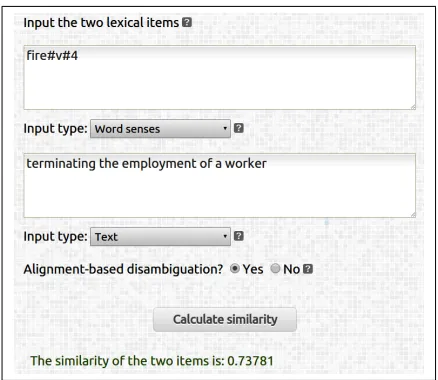
Figure 2 provides a snapshot of ADW’s online demo. Two items from two different linguistic lev-els are being compared: the fourth sense of the verb
fire4and the phrase “terminating the employment of a worker.” The user can either choose the input type for each item from the drop-down menu or leave it to be automatically detected by the interface (the “de-tect automatically” option). The online demo also
3All word senses, sense keys and offsets are defined accord-ing to WordNet 3.0.
Figure 2: A screenshot of ADW Web interface.
provides users with the possibility to test similar-ity measurement with no involvement of the disam-biguation step.
5 Evaluation
We assessed the implementation of ADW on two evaluation benchmarks: similarity judgement cor-relation on the RG-65 dataset (Rubenstein and Goodenough, 1965) and synonym recognition on the TOEFL dataset (Landauer and Dumais, 1997). Given a set of word pairs, the task in judgement cor-relation is to automatically compute the similarity between each pair and judgements are ideally ex-pected to be as close as possible to those assigned by humans. The closeness is usually measured in terms of correlation statistics. In the synonym recog-nition task, a target word is paired with a set of can-didate words from which the most semantically sim-ilar word (to the target word) is to be selected.
Table 1 shows the results according to the Spear-manρand Pearsonrcorrelations on RG-65 and ac-curacy, i.e., the number of correctly identified syn-onyms, on TOEFL. We show results for two sets of vectors: full vectors of size 118K and truncated vectors of size 5000 which are provided as a part of the package. As can be seen, despite reducing the space requirement by more than 15 times, our com-pressed vectors obtain high performance on both the datasets, matching those of the full vectors on the TOEFL dataset and also the cosine measure.
Dataset Full vector Truncated (top 5000) Cosine WO Cosine WO
RG-65 rρ 0.650.82 0.810.86 0.650.82 0.800.85
[image:4.612.76.295.69.259.2]TOEFL % 96.3 95.0 96.3 95.0
Table 1: Performance of ADW on two different word similarity datasets, i.e., RG-65 (according to Spearman
ρand Pearsonrcorrelations) and TOEFL (accuracy per-centage), for two different vector comparison methods, i.e., cosine and Weighted Overlap (WO). We show results for two sets of vectors: full vectors with 118K dimensions and truncated vectors of size 5000 which are provided as a part of the package.
6 Related Work
As the de facto standard lexical database, Word-Net has been used widely in measuring seman-tic similarity. Budanitsky and Hirst (2006) pro-vide an overview of WordNet-based similarity mea-sures. WordNet::Similarity, a software developed by Pedersen et al. (2004), provides a Perl implemen-tation of a number of these WordNet-based mea-sures. UMLS::Similarity is an adaptation of Word-Net::Similarity to the Unified Medical Language System (UMLS) which can be used for measur-ing the similarity and relatedness of terms in the biomedical domain (McInnes et al., 2009). Most of these WordNet-based measures suffer from two major drawbacks: (1) they usually exploit only the subsumption relations in WordNet; and (2) they are limited to measuring the semantic similarity of pairs of synsets with the same part of speech. ADW im-proves both issues by obtaining rich and unified rep-resentations for individual synsets, enabling effec-tive comparison of arbitrary word senses or con-cepts, irrespective of their part of speech.
textual items. DKProSimilarity provides an open-source implementation of several semantic simi-larity techniques, from simple string-based mea-sures such as charactern-gram overlap, to more so-phisticated vector-based measures such as Explicit Semantic Analysis (Gabrilovich and Markovitch, 2007). ADW was shown to improve the perfor-mance of DKProSimilarity (Pilehvar et al., 2013) on the task of semantic textual similarity (Agirre et al., 2012).
Acknowledgments
The authors gratefully acknowledge the support of the ERC Starting Grant MultiJEDI No. 259234.
References
Eneko Agirre, Daniel Cer, Mona Diab, and Aitor Gonzalez-Agirre. 2012. SemEval-2012 task 6: A pi-lot on semantic textual similarity. InProceedings of SemEval-2012, pages 385–393, Montreal, Canada. Daniel B¨ar, Torsten Zesch, and Iryna Gurevych. 2013.
DKPro Similarity: An open source framework for text similarity. InProceedings of ACL: System Demonstra-tions, pages 121–126, Sofia, Bulgaria.
Or Biran, Samuel Brody, and No´emie Elhadad. 2011. Putting it simply: a context-aware approach to lexi-cal simplification. InProceedings of ACL, pages 496– 501, Portland, Oregon.
Alexander Budanitsky and Graeme Hirst. 2006. Eval-uating WordNet-based measures of Lexical Semantic Relatedness. Computational Linguistics, 32(1):13–47. Evgeniy Gabrilovich and Shaul Markovitch. 2007. Com-puting semantic relatedness using Wikipedia-based explicit semantic analysis. In Proceedings of IJCAI, pages 1606–1611, Hyderabad, India.
Oren Glickman and Ido Dagan. 2003. Acquiring lexical paraphrases from a single corpus. InProceedings of RANLP, pages 81–90, Borovets, Bulgaria.
Taher Haveliwala, A. Gionis Dan Klein, and P. Indyk. 2002. Evaluating strategies for similarity search on the web. In Proceedings of WWW, pages 432–442, Honolulu, Hawaii.
Angelos Hliaoutakis, Giannis Varelas, Epimenidis Vout-sakis, Euripides GM Petrakis, and Evangelos Milios. 2006. Information retrieval by semantic similarity. In-ternational Journal on Semantic Web and Information Systems, 2(3):55–73.
David Jurgens and Keith Stevens. 2010. The S-Space package: An open source package for word space models. InProceedings of the ACL: System Demon-strations, pages 30–35, Uppsala, Sweden.
Thomas K. Landauer and Susan T. Dumais. 1997. A so-lution to Plato’s problem: The latent semantic analysis theory of acquisition, induction, and representation of knowledge.Psychological Review, 104(2):211. Alon Lavie and Michael J. Denkowski. 2009. The
Me-teor metric for automatic evaluation of Machine Trans-lation.Machine Translation, 23(2-3):105–115. Diana McCarthy and Roberto Navigli. 2009. The
En-glish lexical substitution task. Language Resources and Evaluation, 43(2):139–159.
Bridget T. McInnes, Pedersen Ted, and Serguei V.S. Pakhomov. 2009. interface and UMLS-similarity: open source software for measuring paths and semantic similarity. In Proceedings of AMIA, pages 431–435, San Fransico, CA.
George A. Miller, R.T. Beckwith, Christiane D. Fell-baum, D. Gross, and K. Miller. 1990. WordNet: an online lexical database. International Journal of Lexi-cography, 3(4):235–244.
Michael Mohler, Razvan Bunescu, and Rada Mihalcea. 2011. Learning to grade short answer questions using semantic similarity measures and dependency graph alignments. InProceedings of ACL, pages 752–762, Portland, Oregon.
Siddharth Patwardhan, Satanjeev Banerjee, and Ted Ped-ersen. 2003. Using measures of semantic relatedness for Word Sense Disambiguation. In Proceedings of CICLing, pages 241–257.
Ted Pedersen, Siddharth Patwardhan, and Jason Miche-lizzi. 2004. WordNet::Similarity: Measuring the re-latedness of concepts. InProceedings of HLT-NAACL 2004: Demonstration Papers, pages 38–41, Boston, Massachusetts.
Mohammad Taher Pilehvar and Roberto Navigli. 2014. A robust approach to aligning heterogeneous lexical resources. In Proceedings of ACL, pages 468–478, Baltimore, USA.
Mohammad Taher Pilehvar, David Jurgens, and Roberto Navigli. 2013. Align, Disambiguate and Walk: a Unified Approach for Measuring Semantic Similarity. InProceedings of ACL, pages 1341–1351, Sofia, Bul-garia.
Herbert Rubenstein and John B. Goodenough. 1965. Contextual correlates of synonymy. Communications of the ACM, 8(10):627–633.