Unsupervised Learning Summarization Templates from Concise Summaries
Horacio Saggion∗
Universitat Pompeu Fabra
Department of Information and Communication Technologies TALN Group
C/Tanger 122 - Campus de la Comunicaci´on Barcelona - 08018
Spain
http://www.dtic.upf.edu/˜hsaggion/
Abstract
We here present and compare two unsuper-vised approaches for inducing the main con-ceptual information in rather stereotypical summaries in two different languages. We evaluate the two approaches in two differ-ent information extraction settings: mono-lingual and cross-mono-lingual information extrac-tion. The extraction systems are trained on auto-annotated summaries (containing the in-duced concepts) and evaluated on human-annotated documents. Extraction results are promising, being close in performance to those achieved when the system is trained on human-annotated summaries.
1 Introduction
Information Extraction (Piskorski and Yangarber, 2013) and Automatic Text Summarization (Saggion and Poibeau, 2013) are two Natural Language Pro-cessing tasks which require domain and language adaptation. For over two decades (Riloff, 1993; Riloff, 1996) the natural language processing com-munity has been interested in automatic or semi-automatic methods which could be used to port sys-tems from one domain or task to another, aiming at reducing at least in part the cost associated with the creation of human annotated datasets. Automatic system adaptation can take different forms: if high
∗
This work is partially supported by Ministerio de Econom´ıa y Competitividad, Secretar´ıa de Estado de Investigaci´on, De-sarrollo e Innovaci´on, Spain under project number TIN2012-38584-C06-03 and Advanced Research Fellowship RYC-2009-04291. We thank Biljana Drndarevi´c for proofreading the paper.
quality human annotated data is available, then rule-based or statistical systems can be trained on this data (Brill, 1994), reducing the efforts of writing rules and handcrafting dictionaries. If high quality human annotated data is unavailable, a large non-annotated corpus and a bootstrapping procedure can be used to produce annotated data (Ciravegna and Wilks, 2003; Yangarber, 2003). Here, we concen-trate on developing and evaluating automatic proce-dures to learn the main concepts of a domain and at the same timeauto-annotate textsso that they be-come available for training information extraction or text summarization applications. However, it would be naive to think that in the current state of the art we would be able to learn all knowledge from text au-tomatically (Poon and Domingos, 2010; Biemann, 2005; Buitelaar and Magnini, 2005). We therefore here concentrate on learning template-like represen-tations from concise event summaries which should contain the key information of an event.
18 de julio de 1994DateOfAttack . Un atentado contra la sede de la Asociaci´on Mutual Israelita ArgentinaTargetdeBuenos AiresPlaceOfAttack causa la muerte de86NumberOfVictimspersonas.
(18th July 1994. An attack against the headquarters of the Jewish Mutual Association in Buenos Aires, Ar-gentina, kills 86 people.)
Figure 1: Sample of Human Annotated Summary in Spanish
An example of the summaries we want to learn from is presented in Figure 1. It is a summary in the terrorist attack domain in Spanish. It has been
manually annotated with concepts such as DateO-fAttack, Target, PlaceODateO-fAttack, and NumberOfVic-tims, which are key in the domain. Our task is to discover from this kind of summary what the con-cepts are and how to recognise them automatically. As will be shown in this paper and unlike current approaches (Chambers and Jurafsky, 2011; Leung et al., 2011), the methods to be presented here do not require parsing or semantic dictionaries to work or specification of the underlying number of concepts in the domain to be learn. The approach we take learns concepts in the set of domain summaries, re-lying on noun phrase contextual information. They are able to generate reasonable domain conceptual-izations from relatively small datasets and in differ-ent languages.
The rest of the paper is structured as follows: In Section 2 we overview related work in the area of concept induction from text. Next, in Section 3 we describe the dataset used and how we have processed it while in Section 4 we outline the two unsuper-vised learning algorithms we compare in this paper for template induction from text. Then, in Section 5, we describe the experiments on template induction indicating how we have instantiated the algorithms and in Section 6 we explain how we have extrinsi-cally evaluated the induction process. In Section 7 we discuss the obtained results and in Section 8 we summarize our findings and close the paper.
2 Related Work
A long standing issue in natural language process-ing is how to learn conceptualizations from text in automatic or semi-automatic ways. The availabil-ity of redundant data has been used, for example, to discover template-like representations (Barzilay and Lee, 2003) or sentence-level paraphrases which could be used for extraction or generation. Vari-ous approaches to concept learning use clustering techniques. (Leung et al., 2011) apply various clus-tering procedures to learn a small number of slots in three typical information extraction domains, us-ing manually annotated data and fixus-ing the num-ber of concepts to be learnt. (Li et al., 2010) gen-erate templates and extraction patterns for specific entity types (actors, companies, etc.). (Chambers and Jurafsky, 2011) learn the structure of MUC
tem-plates from raw data in English, an approach that needs both full parsing and semantic interpretation using WordNet (Fellbaum, 1998) in order to extract verb arguments and measure the similarity betweern verbs. In (Saggion, 2012) an iterative learning pro-cedure is used to discover core domain conceptual information from short summaries in two languages. However, the obtained results were not assessed in a real information extraction scenario. There are ap-proaches which do not need any human interven-tion or sophisticated text processing, but learn based on redundancy of the input dataset and some well grounded linguistic intuitions (Banko and Etzioni, 2008; Etzioni et al., 2004). Related to the work pre-sented here are approaches that aim at generating short stereotypical summaries (DeJong, 1982; Paice and Jones, 1993; Ratnaparkhi, 2000; Saggion and Lapalme, 2002; Konstas and Lapata, 2012).
3 Dataset and Text Processing Steps
For the experiments reported here we rely on the CONCISUS corpus1 (Saggion and Szasz, 2012) which is distributed free of charge. It is a corpus of Web summaries in Spanish and English in four different application domains: Aviation Accidents (32 English, 32 Spanish), Earthquakes (44 English, 56 Spanish), Train Accidents (36 English, 43 Span-ish), and Terrorist Attacks (42 English, 53 Spanish). The dataset contains original and comparable mary pairs, automatic translations of Spanish sum-maries into English, automatic translation of English summaries into Spanish, and associated original full documents in Spanish and English for two of the do-mains (Aviation Accidents and Earthquakes). The dataset comes with human annotations representing the key information in each domain. In Table 1 we detail the concepts used in each of the domains. Note that not all concepts are represented in each of the summaries. Creation of such a dataset can take up to 500 hours for a human annotator, con-sidering data collection, cleansing, and annotation proper. Only one human annotator and one curator were responsible for the annotation process.
Aviation Accident Airline, Cause, DateOfAccident, Destination, FlightNumber, NumberOfVictims, Origin, Passengers, Place, Sur-vivors, Crew, TypeOfAccident, TypeOfAircraft, Year
Earthquake City, Country, DateOfEarthquake, Depth, Duration, Epicentre, Fatalities, Homeless, Injured, Magnitude, Other-PlacesAffected, Province, Region, Survivors, TimeOfEarthquake
Terrorist Attack City, Country, DateOfAccident, Fatalities, Injured, Target, Perpetrator, Place, NumberOfVictims, TypeOfAttack Train Accident Cause, DateOfAccident, Destination, NumberOfVictims, Origin, Passenger, Place, Survivors, TypeOfAccident,
TypeOfTrain
Table 1:Conceptual Information in Summaries
3.1 Text Processing
In order to carry out experimentation we adopt the GATE infrastructure for document representation and annotation (Maynard et al., 2002). All doc-uments in the dataset are processed with available natural language processors to compute shallow lin-gustic information. Documents in English are pro-cessed with the ANNIE system, a morphological an-alyzer, and a noun chunker, all three from GATE. The documents in Spanish are analyzed with Tree-Tagger (Schmid, 1995), a rule-base noun chunker, and an SVM-based named entity recognition and classification system.
4 Concept Induction Algorithms
Two algorithms are used to induce conceptual in-formation in a domain from a set of textual sum-maries. The algorithms form concepts based on tar-get strings (or chunks) in the set of summaries us-ing token-level lus-inguistic information. The chunks are represented with different features which are ex-plained later in Section 5.1. One algorithm we use is based onclustering, while the other is based on
iterative learning.
4.1 Clustering-based Induction
The procedure for learning conceptual information by clustering is straithforward: the chunks in the set of summaries are represented as instances consider-ing both internal and sourroundconsider-ing lconsider-inguistic infor-mation. These instances are the input to a clustering procedure which returns a list of clusters each con-taining a set of chunks. We consider each cluster as a key concept in the set of domain summaries and the chunks in each cluster as the concept extension.
4.2 Iterative Induction
We use the iterative learning algorithm described in (Saggion, 2012) which learns from a set of
sum-maries S, also annotated with target strings (e.g. chunks) and shallow linguistic information. In a nut-shell the algorithm is as follows:
(1) Choose a documentDfrom the set of summariesS
and add it to a training set TRAIN. Set REST to
S−TRAIN.
(2) Choose an available target conceptTfromD, i.e. a target concept not tried before by the algorithm.
(3) Train a classifier on TRAIN to learn instances of the target concept using the available linguistic fea-tures; the classifier uses the linguistic information provided.
(4) Apply the classifier to REST (all summaries minus those in TRAIN) to annotate all instances of the tar-get conceptT.
(5) Select a document BEST in REST, where there is an instance of the concept recognised with the highest probability in the REST set.
(6) Remove BEST from REST and add BEST to the training set, remove all identified instances of T
from REST, and go to step 3.
The algorithm is executed a number of times (see Section 5.1 for parametrization of the algorithms) to learn all concepts in the set of summaries, and at each iteration a single concept is formed. There are two circumstances when a concept being formed is discarded and their associated initial target con-cept removed from the learning process: one case is when there are not enough occurrences of the con-cept across a set of summaries; another case is when too many identical strings are proposed as instances for the concept in the set of summaries. This latter restriction is only valid if we consider sets of non-redundant documents, which is the case to which we restrict our experiments.
4.3 Text Chunks
we are interested in assessing how the type of chunk influences the learning process. Also, given that our objective is to test methods which learn with mini-mal human intervention, we are interested in inves-tigating differences between the use of manual and automatic chunks. We therefore use the following chunk types in this work:gold chunks (gold)are the human produced annotations (as in Figure 1);named entity chunks (ne)are named entities computed by an off-the-shelf named entity recognizer; noun chunks (nc)are text chunks identified by rule-based off-the-shelf NP chunkers and finally,wiki chunks (wiki)are strings of text in the summaries which happen to be Wikipedia titles.
In order to automatically compute these chunk types, different levels of knowledge are needed. For example, NP chunks require syntactic infor-mation, while named entities and wiki chunks re-quire some external form of knowledge, such as precompiled gazetteer lists or access to an ency-clopædia or a semantic dictionary. Named enti-ties and noun chunks are computed as described in Section 3, while wiki chunks are computed as fol-lows: string n-grams w1w2...wn are computed in
each summary and stringsw1 w2 ... wnare checked
against the Wikipedia on-line encyclopædia, if a hit occurs (i.e. if for an English n-gram the page en.wikipedia.org/wiki/w1... wnexists or for a
Span-ish n-gram the page es.wikipedia.org/wiki/w1... wn
exists), the n-gram is annotated in the summary as a wiki chunk. Wiki chunks are cached to speed up the automatic annotation process.
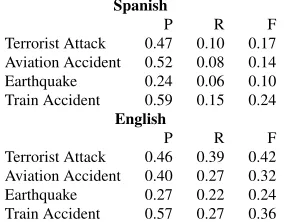
Spanish
P R F
Terrorist Attack 0.47 0.10 0.17 Aviation Accident 0.52 0.08 0.14 Earthquake 0.24 0.06 0.10 Train Accident 0.59 0.15 0.24
English
P R F
[image:4.612.115.257.543.654.2]Terrorist Attack 0.46 0.39 0.42 Aviation Accident 0.40 0.27 0.32 Earthquake 0.27 0.22 0.24 Train Accident 0.57 0.27 0.36
Table 2:Baseline Induction Performance
4.4 Mapping the Induced Concepts onto Human Concepts
For evaluation purposes, each induced concept is mapped onto one human concept applying the fol-lowing procedure: let HCi be the set of summary
offsets where human conceptioccurs, and let ICibe
the set of summary offsets where automatic concept
ioccurs, then the induced conceptjis mapped onto conceptk such that: k = arg maxi(|HCi ∩ICj|),
where |X| is the size of set X. That is, the in-duced concept is mapped onto the label it gives it a best match. As an example, one induced concept in the terrorist attack domain containing the follow-ing strfollow-ing instances: two bombs,car bomb, pair of bombs, 10 coordinated shooting and bombing, two car bombs,suicide bomb,the attack,guerrilla war-fare, the coca-growing regions, etc. This induced concept is mapped onto the TypeOfAttack human concept in that domain.
4.5 Baseline Concept Induction
A baseline induction mechanism is designed for comparison with the two learning procedures pro-posed here. It is based on the mapping of named en-tity chunks onto concepts in a straightforward way: each named entity type is considered a different con-cept and therefore mapped onto human concon-cepts as in Section 4.4. For example, in the terrorist attack domain,Organization named entity type is mapped by this procedure onto the human concept Target (i.e. churches, government buildings, etc., are com-mon targets in terrorist attacks) while in the Avia-tion Accident domain the Organizationnamed en-tity type is mapped onto TypeOfAircraft (i.e. Boe-ing, Airbus, etc. are names of organizations).
5 Experimental Setting and Results of the Induction Process
In this section we detail the different parameters used by the algorithms and report the performance of the induction process with different inputs.
5.1 Settings
Spanish
Iterative Clustering
P R F P R F
Terrorist Attack 0.25 0.59 0.35 0.59 0.59 0.59† Aviation Accident 0.50 0.62 0.55 0.66 0.66 0.66† Earthquake 0.34 0.51 0.41 0.56 0.53 0.55† Train Accident 0.41 0.69 0.52 0.58 0.58 0.58
English
Iterative Clustering
P R F P R F
[image:5.612.335.515.56.325.2]Terrorist Attack 0.23 0.39 0.29 0.50 0.50 0.50† Aviation Accident 0.57 0.68 0.62 0.79 0.79 0.79† Earthquake 0.26 0.53 0.34 0.39 0.39 0.39 Train Accident 0.50 0.59 0.54 0.61 0.61 0.61†
Table 3: Conceptual induction (Spanish and English) Using Gold Chunks for Learning
implementation from the Weka machine learning li-brary (Witten and Frank, 1999). We instruct the al-gorithm to decide on the number of clusters based on the data, instead of setting the number of clusters by hand. The instances to cluster are representations of the input chunks; these representations contain the internal features of the chunks, as well as the infor-mation of 5 tokens to the left of the beginning of the chunk and 5 tokens to the right of the end of the chunk. The transformation from GATE documents into arff Weka files and the mapping from Weka onto the GATE documents, is carried out using specific programs. The classification algorithm used for the iterative learning process is an SVM classifier dis-tributed with the GATE system and tuned to per-form chunk learning using the same features as the clustering procedure (Li et al., 2004). This classifier outputs a probability which we use for selecting the best document at step (5) of the iterative procedure. The document selected to start the process is the one with more target strings, and the target string chosen is the next available in textual order. The iterative learning procedure is set to stop when the number of concepts induced reaches the average number of chunks in the corpus. Induced concepts not covering at least 10% of the number of documents are dis-carded, as are concepts with strings repeated at least 10% of the concept extension.
5.2 Experiments and Results
We carry out a number of experiments per domain where we run the algorithms using as input the sum-maries annotated with a different chunk type each time. After each experiment all concepts induced are
Terrorist Attacks Iterative Clustering
P R F P R F
nc 0.22 0.53 0.31† 0.15 0.51 0.23 ne 0.27 0.14 0.18 0.12 0.42 0.18 wiki 0.15 0.26 0.19 0.22 0.18 0.20 all 0.25 0.53 0.34† 0.12 0.51 0.20
Aviation Accidents Iterative Clustering
P R F P R F
nc 0.30 0.50 0.38† 0.21 0.51 0.30 ne 0.84 0.07 0.14 0.57 0.07 0.13 wiki 0.29 0.28 0.28† 0.27 0.17 0.21 all 0.39 0.62 0.48† 0.16 0.31 0.21
Earthquakes
Iterative Clustering
P R F P R F
nc 0.29 0.42 0.34† 0.14 0.42 0.21 ne 0.20 0.19 0.20† 0.38 0.02 0.05 wiki 0.16 0.16 0.16 0.24 0.11 0.15 all 0.28 0.50 0.36† 0.12 0.46 0.19
Train Accidents Iterative Clustering
P R F P R F
nc 0.36 0.66 0.47† 0.23 0.51 0.32 ne 0.33 0.66 0.44† 0.65 0.12 0.20 wiki 0.25 0.25 0.25 0.51 0.13 0.21 all 0.33 0.62 0.44† 0.16 0.50 0.24
Table 4:Comparison of conceptual induction in Spanish
mapped onto the human concepts (see Section 4.4) producing auto-annotated summaries. The auto-matic annotations are then compared with the gold annotations, and precision, recall, and f-score fig-ures are computed to observe the performance of the two algorithms, the baseline, and the effect of type of chunk on the learning process.
[image:5.612.76.299.57.191.2]sta-Terrorist Attacks Iterative Clustering
P R F P R F
nc 0.43 0.50 0.46† 0.23 0.42 0.30 ne 0.28 0.44 0.34 0.42 0.29 0.34 wiki 0.24 0.33 0.28† 0.15 0.25 0.19 all 0.31 0.49 0.38† 0.09 0.39 0.15
Aviation Accidents Iterative Clustering
P R F P R F
nc 0.48 0.31 0.38 0.33 0.34 0.34 ne 0.53 0.38 0.44† 0.63 0.27 0.38 wiki 0.31 0.44 0.36† 0.28 0.37 0.32 all 0.50 0.67 0.58† 0.15 0.47 0.23
Earthquakes
Iterative Clustering
P R F P R F
nc 0.29 0.48 0.36† 0.06 0.40 0.10 ne 0.28 0.34 0.30 0.30 0.25 0.28 wiki 0.21 0.30 0.25† 0.16 0.23 0.19 all 0.31 0.44 0.37† 0.08 0.40 0.13
Train Accidents Iterative Clustering
P R F P R F
[image:6.612.97.274.54.324.2]nc 0.45 0.54 0.49† 0.32 0.50 0.39 ne 0.47 0.29 0.36 0.58 0.27 0.36 wiki 0.51 0.32 0.39† 0.30 0.29 0.29 all 0.50 0.58 0.53† 0.16 0.49 0.24
Table 5:Comparison of conceptual induction in English
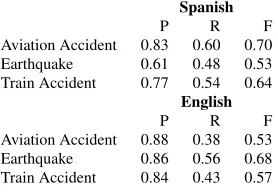
Spanish
P R F
Aviation Accident 0.83 0.60 0.70 Earthquake 0.61 0.48 0.53 Train Accident 0.77 0.54 0.64
English
P R F
[image:6.612.336.516.54.228.2]Aviation Accident 0.88 0.38 0.53 Earthquake 0.86 0.56 0.68 Train Accident 0.84 0.43 0.57
Table 6:Cross-lingual Information Extraction. System Trained with Gold Summaries.
tistically significant differences between the cluster-ing procedure and the iterative learncluster-ing procedure (p = 0.01). In all tested domains in English, except for the Earthquake domain, there are statistically significant differences between the performance of clustering and iterative learning (p= 0.01).
Now we turn to the results of both algorithms when automatic chunks are used, that is, when no human annotation is provided to the learners. Re-sults are reported in Tables 4 (Spanish) and 5 (En-glish). The results are presented by the chunk type used during the learning procedure. In addition to the chunk types specified above, we include a type all, which represents the use of all
automat-Aviation Accidents Iterative Clustering
P R F P R F
gold 0.85 0.52 0.65† 0.84 0.41 0.55 all 0.88 0.49 0.63† 0.87 0.19 0.32 nc 0.87 0.46 0.60 0.88 0.46 0.60
Earthquakes
Iterative Clustering
P R F P R F
gold 0.65 0.41 0.50† 0.66 0.31 0.43 all 0.64 0.36 0.46 0.62 0.40 0.49 nc 0.63 0.33 0.43 0.67 0.38 0.49
Train Accidents Iterative Clustering
P R F P R F
[image:6.612.337.514.286.458.2]gold 0.81 0.54 0.65 0.82 0.52 0.64 all 0.81 0.52 0.64† 0.72 0.31 0.43 nc 0.79 0.54 0.64† 0.79 0.42 0.55
Table 7: Cross-lingual Information Extraction Results in Spanish Translations. System trained with auto-annotated summaries in Span-ish.
Aviation Accidents Iterative Clustering
P R F P R F
gold 0.87 0.35 0.50 0.87 0.37 0.52 all 0.87 0.37 0.52† 0.82 0.18 0.29 nc 0.90 0.21 0.34† 0.90 0.17 0.29
Earthquakes
Iterative Clustering
P R F P R F
gold 0.87 0.53 0.66† 0.87 0.36 0.51 all 0.88 0.51 0.64† 0.87 0.30 0.45 nc 0.88 0.51 0.65† 0.93 0.43 0.59
Train Accidents Iterative Clustering
P R F P R F
gold 0.82 0.30 0.44 0.87 0.32 0.47 all 0.84 0.39 0.53† 0.91 0.24 0.38 nc 0.89 0.36 0.51† 0.46 0.25 0.32
Table 8: Cross-lingual Information Extraction Results in English Translations. System trained with auto-annotated summaries in English.
[image:6.612.117.256.365.461.2]Spanish
P R F
Aviation Accident 0.56 0.47 0.51 Earthquake 0.64 0.41 0.50
English
P R F
[image:7.612.337.516.56.170.2]Aviation Accident 0.61 0.35 0.44 Earthquake 0.78 0.41 0.54
Table 9: Extraction from Full Documents. System Trained on Gold Summaries.
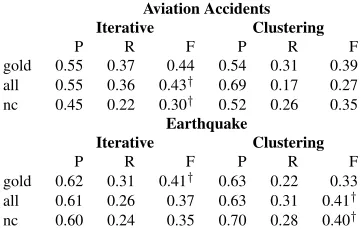
Aviation Accidents Iterative Clustering
P R F P R F
gold 0.55 0.37 0.44 0.54 0.31 0.39 all 0.55 0.36 0.43† 0.69 0.17 0.27 nc 0.45 0.22 0.30† 0.52 0.26 0.35
Earthquake
Iterative Clustering
P R F P R F
[image:7.612.119.255.66.141.2]gold 0.62 0.31 0.41† 0.63 0.22 0.33 all 0.61 0.26 0.37 0.63 0.31 0.41† nc 0.60 0.24 0.35 0.70 0.28 0.40†
Table 10: Full-text Information Extraction Results in Spanish. Sys-tem trained with auto-annotated summaries in Spanish.
not an unexpected result since named entities, for example, cover much fewer strings which may form part of a concept extension. Additionally, off-the-shelf entity recogizers only identify a limited num-ber of entity types.
6 Information Extraction Evaluation
Framework
The numbers above are interesting because they pro-vide intrinsic evaluation of the concept induction procedure, but they do not tell us much about their usability. Therefore, and in order to better assess the value of the discovered concepts, we decided to carry out two extrinsic evaluations using an informa-tion extracinforma-tion task. Once the conceps are induced and, as a result, the summaries are auto-annotated with domain specific concepts, we decide to train an off-the-shelf SVM token classification procedure and apply it to unseen human annotated documents. The SVM classifier uses the same linguistic infor-mation as the induction procedures: token level in-formation and a window size of 5 around each token to be classified.
Aviation Accidents Iterative Clustering
P R F P R F
gold 0.60 0.28 0.39 0.62 0.31 0.41† all 0.62 0.30 0.41† 0.54 0.14 0.23 nc 0.53 0.15 0.23† 0.46 0.10 0.16
Earthquake
Iterative Clustering
P R F P R F
gold 0.70 0.35 0.47† 0.72 0.32 0.44 all 0.74 0.37 0.49 0.70 0.22 0.34 nc 0.73 0.36 0.48† 0.73 0.30 0.42
Table 11:Full-text Information Extraction Results in English. Sys-tem trained with auto-annotated summaries in English.
6.1 Extraction from Automatic Translations
The first task we carry out is cross-lingual informa-tion extracinforma-tion where the input documents are auto-matic translations of summaries in Spanish and En-glish2. Note that the expriment is performed in three domains for which such translations are manually annotated. We first run an experiment to assess the extraction performance of the SVM when trained on human annotated data. Results of the experiment are reported in Table 6 and they should be taken as an upperbound of the performance of a system trained on auto-annotated summaries. We then train the SVM on the different auto-annotated datasets, but note that due to space restrictions, we here only report the three most revealing experiments per lan-guage: concepts induced with gold chunks, noun chunks, and all automatic chunks. Results are re-ported in Table 7 (Spanish) and in Table 8 (English). In most cases the SVM trained with auto-annotated summaries produced by the iterative learning proce-dure outperforms the clustering-based method with statistically significant differences († shown in the tables) (p= 0.01).
6.2 Extraction from Full Documents
The second and the last evaluation consists in the ap-plication of the SVM extraction system to full doc-uments. In this case, the experiment can be run only in two domains for which full documents have been provided and manually annotated. We first test the performance of the system when trained on human annotated summaries and present the results in Ta-ble 9. Results of the experiments when the system is trained on auto-annotated datasets are shown in
[image:7.612.95.276.192.307.2]Tables 10 (Spanish) and 11 (English). Results are lower than when training on clean human annotated summaries. It is unclear which approach is more competitive when training with auto-annotated sum-maries. What is clear is that the performance of the iterative learning algorithm when training with concepts induced from gold chunks is not statisti-cally different (according to at-test andp = 0.01) from the performance of the algorithm when training with concepts induced from automatically computed chunks. We consider this to be a positive outcome of the experiments.
7 Discussion
The two methods presented here are able to produce partial domain conceptualizations from a relatively small set of domain summaries3. We have found that the clustering-based procedure is very competi-tive when presented with gold chunks. On the other hand, the iterative learning procedure performs very well when presented with automatic chunks in all tested domains and the two languages. We have also found that the performance of the iterative induction system is not much affected by the use of automati-cally computed chunks. We have run at-test to ver-ify the differences in induction performance when learning with gold and automatic chunks (all con-dition) and have found statistically significant dif-ferences in only one domain out of four in Spanish (Terrorist Attack) and in two domains out of four in English (Aviation Accident and Train Accident) (p = 0.01). The applicability of the induction pro-cess, that is, if the auto-annotated data could be used for specific tasks, has been tested in two information extraction experiments. In a cross-lingual informa-tion extracinforma-tion setting (Riloff et al., 2002; Saggion and Szasz, 2011) we have observed that a system trained on automatically computed chunks has a per-formance close to one trained on concepts induced from gold chunks. No statistically significant differ-ences exist (p= 0.01) between the use of automatic chunks and gold chunks, except for the Train Acci-dent domain in English, where the system trained on fully automatically annotated summaries has a better performance. In a full document information
3
Depending on the language and domain, between 50% and 77% of all concepts are generated.
extraction task, although the best system trained on auto-annotated summaries in Spanish has a big dif-ference with respect to a system trained on human-annotated summaries, in English the differences are slight. We belive that this is due to the differences in performance between the underlying text process-ing components. Our methods work by groupprocess-ing to-gether sets of chunks, unlike (Chambers and Juraf-sky, 2011), whose approach is centered around verb arguments and clustering, and relies on the avail-ability of considerable amounts of data. Ontology learning approaches such as OntoUSP (Poon and Domingos, 2010) are also clustering-based but fo-cus on learning is-a relations only. Unlike (Leung et al., 2011) whose approach is based on gold-standard humman annotations, we here test the performance of the induction process using automatically com-puted candidate strings, and we additionally learn the number of concepts automatically.
8 Conclusions and Future Work
In this paper we have concentrated on the prob-lem of knowledge induction from text summaries. The approaches we have presented are fully unsu-pervised and are able to produce reasonable con-ceptualizations (close to human concepts) without relying on annotated data. Unlike previous work, our approach does not require full syntactic parsing or a semantic dictionary. In fact, it only requires a process of text chunking and named entity recog-nition, which we have carefully assessed here. We believe our work contributes with a viable method-ology to induce conceptual information from texts, and at the same time with an auto-annotation mech-anism which could be used to train information ex-traction systems. Since our procedure requires very little linguistic information, we believe it can be suc-cessfully applied to a number of languages. We also believe that there is much work to be carried out and that induction from summaries should be comple-mented with a process that explores full event re-ports, in order to reinforce some induced concepts, discard others, and discover additional ones.
References
Proceedings of ACL-08, pages 28–36. Association for Computational Linguistics, June.
R. Barzilay and L. Lee. 2003. Learning to paraphrase: an unsupervised approach using multiple-sequence align-ment. InProceedings of the 2003 Conference of the North American Chapter of the Association for Com-putational Linguistics on Human Language Technol-ogy - Volume 1, NAACL ’03, pages 16–23, Strouds-burg, PA, USA. Association for Computational Lin-guistics.
Chris Biemann. 2005. Ontology Learning from Text: A Survey of Methods.LDV Forum, 20(2):75–93. E. Brill. 1994. Some Advances in Transformation-Based
Part of Speech Tagging. InProceedings of the Twelfth National Conference on AI (AAAI-94), Seattle, Wash-ington.
P. Buitelaar and B. Magnini. 2005. Ontology learning from text: An overview. InIn Paul Buitelaar, P., Cimi-ano, P., Magnini B. (Eds.), Ontology Learning from Text: Methods, Applications and Evaluation, pages 3– 12. IOS Press.
N. Chambers and D. Jurafsky. 2011. Template-Based In-formation Extraction without the Templates. InACL, pages 976–986.
Fabio Ciravegna and Yorick Wilks. 2003. Designing adaptive information extraction for the semantic web in amilcare. In Annotation for the Semantic Web, Frontiers in Artificial Intelligence and Applications. IOS. Press.
Gerald DeJong. 1982. An Overview of the FRUMP Sys-tem. In W.G. Lehnert and M.H. Ringle, editors, Strate-gies for Natural Language Processing, pages 149– 176. Lawrence Erlbaum Associates, Publishers. O. Etzioni, M. Cafarella, D. Downey, A. Popescu,
T. Shaked, S. Soderland, D. S. Weld, and A. Yates. 2004. Methods for Domain-Indepedent Information Extraction from the Web: An Experimental Compari-son. InProceedings of AAAI-2004.
Christiane Fellbaum, editor. 1998. WordNet - An Elec-tronic Lexical Database. MIT Press.
I. Konstas and M. Lapata. 2012. Concept-to-text gener-ation via discriminative reranking. InProceedings of the 50th Annual Meeting of the Association for Com-putational Linguistics, pages 369–378, Jeju Island, Korea, July. Association for Computational Linguis-tics.
Cane Wing-ki Leung, Jing Jiang, Kian Ming A. Chai, Hai Leong Chieu, and Loo-Nin Teow. 2011. Unsuper-vised information extraction with distributional prior knowledge. In Proceedings of the 2011 Conference on Empirical Methods in Natural Language Process-ing, pages 814–824, Edinburgh, Scotland, UK., July. Association for Computational Linguistics.
Y. Li, K. Bontcheva, and H. Cunningham. 2004. An SVM Based Learning Algorithm for Information Ex-traction. Machine Learning Workshop, Sheffield. P. Li, J. Jiang, and Y. Wang. 2010. Generating Templates
of Entity Summaries with an Entity-Aspect Model and Pattern Mining. In Proceedings of ACL, Uppsala. ACL.
D. Maynard, V. Tablan, H. Cunningham, C. Ursu, H. Sag-gion, K. Bontcheva, and Y. Wilks. 2002. Architectural Elements of Language Engineering Robustness. Jour-nal of Natural Language Engineering – Special Issue on Robust Methods in Analysis of Natural Language Data, 8(2/3):257–274.
Chris D. Paice and Paul A. Jones. 1993. The Identi-fication of Important Concepts in Highly Structured Technical Papers. In R. Korfhage, E. Rasmussen, and P. Willett, editors,Proc. of the 16th ACM-SIGIR Con-ference, pages 69–78.
J. Piskorski and R. Yangarber. 2013. Information ex-traction: Past, present and future. In Thierry Poibeau, Horacio Saggion, Jakub Piskorski, and Roman Yan-garber, editors, Multi-source, Multilingual Informa-tion ExtracInforma-tion and SummarizaInforma-tion, Theory and Ap-plications of Natural Language Processing, pages 23– 49. Springer Berlin Heidelberg.
H. Poon and P. Domingos. 2010. Unsupervised ontology induction from text. InProceedings of the 48th Annual Meeting of the Association for Computational Linguis-tics, ACL ’10, pages 296–305, Stroudsburg, PA, USA. Association for Computational Linguistics.
Adwait Ratnaparkhi. 2000. Trainable methods for sur-face natural language generation. In Proceedings of the 1st North American chapter of the Association for Computational Linguistics conference, NAACL 2000, pages 194–201, Stroudsburg, PA, USA. Association for Computational Linguistics.
E. Riloff, C. Schafer, and D. Yarowsky. 2002. Induc-ing information extraction systems for new languages via cross-language projection. InProceedings of the 19th international conference on Computational lin-guistics, pages 1–7, Morristown, NJ, USA. Associa-tion for ComputaAssocia-tional Linguistics.
E. Riloff. 1993. Automatically constructing a dictionary for information extraction tasks. Proceedings of the Eleventh Annual Conference on Artificial Intelligence, pages 811–816.
E. Riloff. 1996. Automatically generating extraction pat-terns from untagged text. Proceedings of the Thir-teenth Annual Conference on Artificial Intelligence, pages 1044–1049.
H. Saggion and G. Lapalme. 2002. Generat-ing Indicative-Informative Summaries with SumUM.
H. Saggion and T. Poibeau. 2013. Automatic text summarization: Past, present and future. In Thierry Poibeau, Horacio Saggion, Jakub Piskorski, and Ro-man Yangarber, editors,Multi-source, Multilingual In-formation Extraction and Summarization, Theory and Applications of Natural Language Processing, pages 3–21. Springer Berlin Heidelberg.
H. Saggion and S. Szasz. 2011. Multi-domain Cross-lingual Information Extraction from Clean and Noisy Texts. In Proceedings of the 8th Brazilian Sympo-sium in Information and Human Language Technol-ogy, Cuiab´a, Brazil. BCS.
H. Saggion and S. Szasz. 2012. The CONCISUS Corpus of Event Summaries. InProceedings of the 8th Lan-guage Resources and Evaluation Conference (LREC), Istanbul, Turkey. ELDA.
H. Saggion. 2012. Unsupervised content discovery from concise summaries. InProceedings of the Joint Workshop on Automatic Knowledge Base Construc-tion and Web-scale Knowledge ExtracConstruc-tion, AKBC-WEKEX ’12, pages 13–18, Stroudsburg, PA, USA. Association for Computational Linguistics.
H. Schmid. 1995. Improvements In Part-of-Speech Tag-ging With an Application To German. InIn Proceed-ings of the ACL SIGDAT-Workshop, pages 47–50. I. H. Witten and E. Frank. 1999. Data Mining:
Practi-cal Machine Learning Tools and Techniques with Java Implementations. Morgan Kaufmann.