Higher-order Lexical Semantic Models for Non-factoid Answer Reranking
Daniel Fried1, Peter Jansen1, Gustave Hahn-Powell1, Mihai Surdeanu1,andPeter Clark2 1University of Arizona, Tucson, AZ, USA
2Allen Institute for Artificial Intelligence, Seattle, WA, USA
{dfried,pajansen,hahnpowell,msurdeanu}@email.arizona.edu
Abstract
Lexical semantic models provide robust performance for question answering, but, in general, can only capitalize on direct ev-idence seen during training. For example, monolingual alignment models acquire term alignment probabilities from semi-structured data such as question-answer pairs; neural network language models learn term embeddings from unstructured text. All this knowledge is then used to estimate the semantic similarity between question and answer candidates. We in-troduce a higher-order formalism that al-lows all these lexical semantic models to chain direct evidence to construct indirect associations between question and answer texts, by casting the task as the traversal of graphs that encode direct term associa-tions. Using a corpus of 10,000 questions from Yahoo! Answers, we experimentally demonstrate that higher-order methods are broadly applicable to alignment and lan-guage models, across both word and syn-tactic representations. We show that an important criterion for success is control-ling for the semantic drift that accumu-lates during graph traversal. All in all, the proposed higher-order approach improves five out of the six lexical semantic mod-els investigated, with relative gains of up to +13% over their first-order variants.
1 Introduction
Open-domain question answering (QA), which finds short textual answers to natural language questions, is often viewed as the successor to key-word search (Etzioni, 2011) and one of the most difficult and widely applicable end-user applica-tions of natural language processing (NLP). From
syntactic parsing, discourse processing, and lex-ical semantics, QA necessitates a level of func-tionality across a variety of topics that make it a natural, yet challenging, proving ground for many aspects of NLP. Here, we address a partic-ularly challenging QA subtask: open-domain non-factoid QA, where queries take the form of com-plex questions (e.g., manner orHow questions), and answers range from single sentences to en-tire paragraphs. Because this task is so complex and large in scope, current state-of-the-art open-domain systems perform at only about 30% P@1, or answering roughly one out of three questions correctly (Jansen et al., 2014).
In this paper we focus on answer ranking (AR), a key component of non-factoid QA that focuses on ordering candidate answers based on the like-lihood that they capture the information needed to answer a question. Unlike keyword search, Berger (2000) observed that lexical matching methods are generally insufficient for QA, where questions and answers often have little to no lexical overlap (as in the case ofWhere should we go for breakfast? and Zoe’s Diner has great pancakes). Previous work has shown that lexical semantics (LS) mod-els are well suited to bridging this “lexical chasm”, and at least two flavors of lexical semantics have been successfully applied to QA. The first treats QA as a monolingual alignment problem, learning associations between words (or other structures) that appear in question-answer pairs (Surdeanu et al., 2011; Yao et al., 2013). The second computes the semantic similarity between question and an-swer using language models acquired from rele-vant texts (Yih et al., 2013; Jansen et al., 2014).
Here we argue that while these models begin to bridge the “lexical chasm”, many still suffer from sparsity and only capitalize on direct evi-dence. Returning to our example question, if we also train on the QA pairWhat goes well with pan-cakes?andhashbrowns and toast, we can use the
197
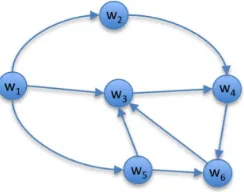
Figure 1: A hypothetical graph derived from a lexical se-mantic alignment model.
indirect association betweenbreakfast – pancakes and pancakes – hashbrowns to locate additional answers for where to visit for breakfast, including Regee’s has the best hashbrowns in town.
We can represent LS models as a graph, as in Figure 1. For a word-based alignment model, the graph nodes represent individual words, and the (directed) edges capture the likelihood of a word wa appearing in a gold answer given word wq
in the question. Grounding this in our example, w1may representbreakfast,w2pancakes, andw4
hashbrowns. For a language model, the edges cap-ture the similarity of contexts between the words in the nodes. For both alignment and language model graphs, we observe that semantic associa-tion between two words (or structures) stored in the nodes can be determined by investigating the different paths that connect these two nodes, even when they are not directly connected.
We call this class of modelshigher-order lexical models, in contrast to thefirst-order lexical mod-elsintroduced in previous work, which rely only on direct evidence to estimate association strength. For example, all alignment models in previous work can estimate P(wq|wa), i.e., the
probabil-ity of generating the question wordwq if the
an-swer contains the wordwa, only if this pair has
been seen at least once in training. On the other hand, our approach can estimateP(wq|wa)from
indirect evidence, e.g., from chaining two distinct question/answer pairs that contain the words (wq,
wi) and (wi,wa), respectively.
The contributions of this work are:
1. This is the first work to our knowledge that proposes higher-order LS models for QA. We show that an important criterion for success is controlling for the semantic drift that ac-cumulates in the graph traversal paths, which plagues traditional random walk algorithms. For example, we empirically demonstrate
that paths up to a length of three are gener-ally beneficial, but longer paths hurt or do not improve performance.
2. We show that a variety of LS models and representations, including alignment and lan-guage models, over both words and syntac-tic structures, can be adapted to the proposed higher-order formalism. In this latter respect we introduce a novel syntax-based variant of the neural network language model (NNLM) of Mikolov et al. (2013) that models syntac-tic dependencies rather than words, which al-lows it to capture knowledge that is comple-mentary to that of word-based NNLMs. 3. The training process for alignment models
requires a large corpus of QA pairs. Due to these resource requirements, we evaluate our higher-order LS models on a commu-nity question answering (CQA) task (Wang et al., 2009; Jansen et al., 2014) across thousands of how questions, and show that most higher-order models perform signifi-cantly better than their first-order variants. 4. We demonstrate that language models and
alignment models capture complementary in-formation, and can be combined to improve the performance of the CQA system for man-ner questions.
2 Related Work
We focus on statistical LS methods for open-domain QA, in particular CQA tasks, such as the ones driven by Yahoo! Answers datasets (Wang et al., 2009; Jansen et al., 2014).
Second-order lexical models have recently been brought to bear on a variety of other NLP tasks. Zapirain et al. (2013) use a second-order model based on distributional similarity (Lin, 1998) to improve a selectional preference model, and Lee et al. (2012) use a similar approach for coreference resolution. Our work expands on these ideas with models of arbitrary order, an approach to control semantic drift, and an application to QA.
This work falls under the larger umbrella of algorithms for graph-based inference, which have been successfully applied to other NLP and information retrieval problems, such as rela-tion extracrela-tion (Chakrabarti and Agarwal, 2006; Chakrabarti, 2007; Lao and Cohen, 2010), in-ference over knowledge bases (Lao et al., 2011), name disambiguation (Minkov et al., 2006), and search (Bhalotia et al., 2002; Tong et al., 2006). While many of these approaches use random walk algorithms, in pilot experiments we observed that random walks, such as PageRank (PR) (Page et al., 1999), tend to accumulate semantic drift from the originating node because they consider all possi-ble paths in the graph. This semantic drift reduces the quality of the higher-order associations, which impacts QA performance. Here we implement a conservativegraph traversal algorithm, similar in spirit to the “cautious bootstrapping” algorithm of Yarowsky (Whitney and Sarkar, 2012; Yarowsky, 1995). By constraining the traversal paths, our al-gorithm runs two orders of magnitude faster than PR, while controlling for semantic drift.
3 Approach
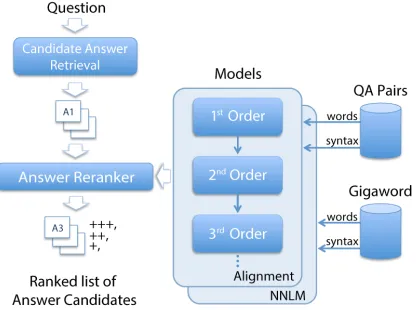
The architecture of our proposed QA framework is illustrated in Figure 2. Here we evaluate both first-order and higher-first-order LS models in the context of community question answering (CQA), using a large dataset of QA pairs from Yahoo! Answers1. We use a standard CQA evaluation task (Jansen et al., 2014), where one must rank a set of user-generated answers to a given question, such that the community-selected best answer appears in the top position. More specifically, for a given question, the candidate retrieval (CR) component fetches all its community-generated answers from the answer collection, and gives each answer can-didate an initial ranking using shallow
[image:3.612.317.525.44.199.2]informa-1http://answers.yahoo.com
Figure 2:Architecture of the reranking framework for QA, showing a reranking component that incorporates two classes of lexical semantic models (alignment and neural network language models), implemented over two representations of content (words and syntax).
tion retrieval scoring.2 These answer candidates are then passed on to the answer reranking com-ponent, the focus of this work.
The answer reranking (AR) component ana-lyzes the answer candidates using more expensive techniques to extract first-order and higher-order LS features, and these features are then used in concert with a learning framework to rerank the candidates and elevate correct answers to higher positions. For the learning framework, we use SVMrank, a variant of Support Vector Machines
for structured output adapted to ranking prob-lems.3In addition to these features, each reranker also includes a single feature containing the score of each candidate, as computed by the above can-didate retrieval component.4
4 First-Order Lexical Models
We next introduce a series of first-order LS mod-els, which serve as the foundation for the higher-order models discussed in the next section. 4.1 Neural Network Language Models Inspired by previous work (Yih et al., 2013; Jansen et al., 2014), we adapt theword2vecNNLM of 2We used the same scoring as Jansen et al. (2014):
co-sine similarity between the question and candidate answer’s lemma vector representations, with lemmas weighted using
tf.idf(Ch. 6, (Manning et al., 2008)).
3 http://www.cs.cornell.edu/people/tj/
svm_light/svm_rank.html
4Including these scores as features in the reranker model
Mikolov et al. (2013) to this QA task. In particu-lar, we use their skip-gram model with hierarchi-cal sampling. This model predicts the context of a word given the word itself, and through this pro-cess embeds words into a latent conceptual space with a fixed number of dimensions. Consequently, related words tend to have vector representations that are close to each other in this space. This type of predictive algorithm has been found to perform considerably better than count-based approaches to distributional similarity on a variety of seman-tic tasks (Baroni et al., 2014).
We derive four LS measures from these vec-tors, which are then are included as features in the reranker. The first is a measure of the over-all similarity of the question and answer candi-date, which is computed as the cosine similarity between two composite vectors. These composite vectors are assembled by summing the vectors for individual question (or answer candidate) words, and re-normalizing this composite vector to unit length.5In addition to this overall similarity score, we compute the pairwise similarities between each word in the question and answer candidates, and include as features theaverage, minimum, and maximum pairwise similarities.
4.2 Alignment Models
Berger et al. (2000) showed that learning question-to-answer transformations using a statistical ma-chine translation (SMT) model begins to “bridge the lexical chasm” between questions and an-swers. We build upon this observation, using the IBM Model 1 (Brown et al., 1993) variant of Sur-deanu et al. (2011) to determine the probability that a questionQis a translation of an answerA, P(Q|A):
P(Q|A) = Y
q∈Q
P(q|A) (1)
P(q|A) = (1−λ)Pml(q|A) +λPml(q|C) (2)
Pml(q|A) = X
a∈A
(T(q|a)Pml(a|A)) (3)
where the probability that the question termq is generated from answerA, P(q|A), is smoothed
using the prior probability that the termqis gen-erated from the entire collection of answers C,
Pml(q|C). Pml(q|A) is computed as the sum of
5We also tried the multiplicative strategy for word-vector
combination of Levy and Goldberg (2014b), but it did not improve our results.
the probabilities that the question termqis a trans-lation of any answer term a, T(q|a), weighted
by the probability that a is generated from A. The translation table forT(q|a) is computed us-ing GIZA++ (Och and Ney, 2003).
Similar to Surdeanu et al. (2011) we: (a) set Pml(q|C)to a small value for out-of-vocabulary
words; (b) modify theT(.|.)distributions to
guar-antee that the probability of translating a word to itself, i.e.,T(w|w), is highest (Murdock and Croft,
2005); and (c) tune the smoothing parameterλon a development corpus.
QA systems generally use the above model to determine theglobal alignment probability be-tween a given question and answer candidate, P(Q|A). A novel contribution of our work is
that we also use the alignment model’s proba-bility distributions (from a source word to des-tination words) as distributed representations for source words, based on the observation that words with similar alignment distributions are likely to have a similar meaning. Formally, we denote the alignment vector representation for the ith word in the vocabulary asw(i), and define thejth en-try in the vector as w(i)j = T(wordj|wordi),
whereT(.|.) is the translation probability
distri-bution from Eq. 3. That is, thejth entry of the vector for wordiis the conditional probability of seeingwordj in a question, given thatwordiwas
seen in a corresponding answer. The vector for each word then represents a discrete (conditional) probability distribution. To compare two words, we use the square root of the Jensen-Shannon di-vergence (JSD) between their conditional distri-butions.6 Letm(i, j) be the element-wise aver-age of the vectorsw(i)andw(j), that is(w(i) +
w(j))/2, and letK(w,v)be the Kullback-Leibler divergence between distributions (represented as vectors)wandv:
K(w,v) =
|V|
X
i=0
wiln wi
vi (4)
where|V|is the vocabulary size (and the dimen-sionality ofw). Then the distance between words
iandjis
J(w(i),w(j)) = r
K(w(i),m(i, j)) +K(w(j),m(i, j)) 2
(5)
6We use the square root of the Jensen-Shannon
We derive four additional LS features from these alignment vector representations, which par-allel the features derived from the NNLM vec-tor representations (§4.1). The first is the JSD between the composite alignment vectors for the question and the answer candidate, where the composite is constructed by summing the vec-tors for individual question (or answer candidate) words, and dividing by the number of vectors summed. We also generate features from the av-erage, minimum, and maximum pairwise JSD between wordsin the question and words in the answer candidate. In practice, we have found that the addition of these four features considerably improves the performance of all alignment mod-els investigated for the QA task.
4.3 Modeling Syntactic Structures
Surdeanu et al. (2011) demonstrated that align-ment models can readily capitalize on represen-tations other than words, including representa-tions of syntax. Here we expand on their work and explore three syntactic variations of the align-ment and NNLM models. For these models we make use of collapsed syntactic dependencies with processed CC complements (de Marneffe et al., 2006), extracted from the Annotated English Gi-gaword (Napoles et al., 2012).
The first model is a straightforward adaptation of the alignment model in§4.2, where the repre-sentations of questions and answers are changed from bags of words to “bags of syntactic depen-dencies” (Surdeanu et al., 2011). That is, the terms to be aligned (q and a in Eq. 1 to 3) become hhead, label, dependenti dependencies, such as heat, dobj, pancakesi, rather than words. The motivation behind this change is that it allows the model to align simple propositions rather than words, which are a more accurate representation of the information encoded in the question. While tuning on the development set of questions we found that unlabeled dependencies, which ignore the middle term in the above tuples, performed better than labeled dependencies, possibly due to the sparsity of the labeled dependencies. As such, all our dependency alignment models use unla-beled dependencies.
The second model adapts the idea of working with bags of syntactic dependencies, instead of bags of words, to NNLMs, and builds an LM over dependencies rather than words. However,
be-cause the NNLM embeddings are generated from context, we must find a consistent ordering of de-pendencies that maintains contextual information. Here we order dependencies using a depth-first, left-to-right traversal of the dependency graph originating at the predicate or root node.7 Fig-ure 3 shows an example of such a traversal, which results in the following ordering (using unlabeled dependencies):
(6) be time time the time same be country country no be should be business business the
business concealing concealing history history its
Figure 3: DFS L→R ordering of word pairs starting from the sentential root. The sentence is taken from LTW ENG 20081201.0002of the English Gigaword.
The model uses the default word2vec imple-mentation to compute the term embeddings. To our knowledge, this syntax-driven extension of NNLMs is novel.
During tuning we compared the labeled and unlabeled dependency representations against an NNLM model using traditional bigrams (where words are paired based on their linear order, i.e., without any syntactic motivation). Again, we found that unlabeled dependencies outperformed surface bigrams and labeled dependencies.
Lastly, we also evaluate the recent NNLM model proposed by Levy and Goldberg (2014a), who modified theword2vec embedding proce-dure to include context derived from dependen-cies, arguing that this embedding model encodes functional similarity better than Mikolov et al.’s unigram surface structure model. It is important to note that while in our syntactic NNLM model the LM terms are (lexicalized unlabeled) syntactic dependency tuples, in Levy and Goldberg’s model the LM terms are still words, but the context is driven by syntax instead of surface structure.
5 Higher-order lexical models
The first-order models we have just described make use of the direct evidence seen in training data to create associations between words (or de-pendencies). Unfortunately this training data is often quite sparse, and while it may be possi-ble to exhaustively create training data with broad 7Other ordering schemes were tested during development,
coverage for artificially narrow domains such as things to eat for breakfast, this quickly becomes intractable for larger domains. To mitigate this sparsity, here we propose a method that identifies associations that were not explicitly seen during training. Returning to our example in§1, had an alignment model learned the associations break-fast – pancakesandpancakes – hashbrowns, the model should be able to make use of the indi-rect association betweenbreakfast – hashbrowns to further “bridge the lexical chasm”, and iden-tify answer candidates containing the word hash-brownsto the question Where is a good place to eat breakfast?
At first glance, algorithms such as PageR-ank (Page et al., 1999) appear to offer an attractive and intuitive method to determine the association between arbitrary nodes in a weighted graph by modeling a random walk to convergence (from any given starting node). As we show in Section 6, we have found that these methods quickly accumulate semantic drift (McIntosh, 2010), because: (a) they run to convergence, i.e., they traverse paths of ar-bitrary length, and (b) they explore the entire asso-ciation space encoded in the neighborhood graph, both of which introduce considerable noise. For example, by chaining even small numbers of di-rect associations, such as breakfast – pancakes, pancakes – hashbrowns,hashbrowns – potato, and potato – field, a model that does not control for se-mantic drift may be tempted to answer questions about breakfast venues with answers that discuss wheat fieldsorsoccer fields. Thus, keeping these indirect associations short and on-context is criti-cal for QA.
Based on the above observations, here we out-line a general method for creating higher-order lexical semantic models that incorporate simple measures to control for semantic drift, and demon-strate how to apply it to both alignment graph rep-resentations and the distributed vector space repre-sentations of a NNLM. Our method relies on two general properties of the first-order LS models: (a) all models include adistributed representation for each term8 that is encoded as a vector (e.g., for NNLMs this is a term’s embedding in vector space, and for alignment models this is a vector of alignment probabilities from a given answer term to all possible question terms), and (b) models de-8Henceforth we use “term” to indicate either a word or a
dependency in a lexical semantics model.
fine a pairwise function that assigns alexical sim-ilarityscore between pairs of directly connected terms (e.g., for NNLMs this is the cosine similar-ity of the corresponding term embeddings, and for alignment models this is given directly byT(q|a), from Equation 3).
Intuitively, we incorporate indirect evidence in our models by averaging the distributed represen-tation of a termtwith the distributed representa-tions of its neighbors, i.e., those terms with high-est lexical similarity tot. To control for seman-tic drift we consider: (a) only thek most similar neighbors to the current term, and (b) short paths in the association graph, e.g., neighbors of neigh-bors but no further. For example, for a second-order model, we construct this new vector repre-sentation for each node in the graph by averaging the vector of the node itself and the vectors of itsk closest neighbors (weighted by each pair’s similar-ity), so that the vector representation ofbreakfast becomes a weighted sum of breakfast, morning, food, cereal,and so forth. By using only the clos-est neighbors, we exclude low associates of break-fast, such as spoon or vacation, which are only marginally related and therefore likely to generate semantic drift.
Formally, letwbe the vector representation
(ei-ther from an NNLM or alignment model) of a given term. We construct ahigher-order represen-tationwˆ by linearly interpolatingw with its top
associates, those vectors with highest value of a pairwise scoring functions:
ˆ
w(i) = X
j∈Nk(w(i))
s(w(i),w(j))w(j) (7)
where s is the function that measures the lexi-cal similarity between terms, and depends on the representations used (salign or scos, see below).
Nk(w(i)), the neighborhood of the vectorw(i),
denotes the indices of the k term vectors with highest values of s(w(i),·), and k is a hyperpa-rameter that controls how many vectors are inter-polated. The resulting vectors are renormalized, as discussed later.9
It is important to note that this process of creating higher-order vectors can be trivially
9N
k(w)includesw, because in all LS models proposed
iterated arbitrarily, constructing a second-order model from a first-order model, then a third-order model from a second, etc. Intuitively, this models paths of increasing length in the association graph over terms. We now describe the concrete implementations of the procedure in the alignment and the NNLM settings.
Higher-order Alignment: In the alignment set-ting, where the vector w(i) for term i contains the probabilities that the source (answer) termiis aligned with the destination (question) termj, we use
salign(w(i),w(j)) =T(termj|termi) (8)
whereT is the translation probability from Equa-tion (3). We normalize the wˆ vectors of Equa-tion (7) using theL1 norm, so that each
contin-ues to represent a probability distribution. In-tuitively, the second-order alignment distribution
ˆ
w(i)for source termiis a linear combination of term i’s most probable destination terms’ distri-butions, weighted by the destination probabilities fromw(i).
The higher-order models greatly reduce the sparsity of the first-order alignment graph. In a first-order word alignment model (i.e., using only direct evidence) trained on approximately 70,000 question/answer pairs (see §6.1), source words align with an average of 31 destination words with non-zero probability, out of a 103,797 word vocabulary. The second-order model aligns 1,535 destination words to each source word on average; the third-order model, 8,287; and the fourth-order model, 15,736. In the results section, we observe that this sparsity reduction is only helpful up to a certain point; having too many associates for each word reduces performance on the QA task.
Higher-order NNLM:In the NNLM setting, we use the cosine similarity of vectors as interpolation weights and to choose the nearest neighbors:
scos(w(i),w(j)) =
w(i)·w(j)
||w(i)|| ||w(j)|| (9)
We found that applying the softmax function to each term’s vector ofk-highest scos similarities,
to ensure all interpolation weights are positive and have a consistent range across terms, improved performance. As such, all higher-order NNLM models use this softmax normalization.
The resulting interpolation can be conceptual-ized in several ways. Viewing cosine similarity as a representation of entailment (Beltagy et al., 2013), the higher-order NNLM model reflects multiple-hop inference on top of the correspond-ing association graph, similar to the higher-order alignment model. The interpolation could also be viewed as smoothing term representations in vector space, averaging each term’s vector with its nearest neighbors according to their cosine similarity.
Higher-order Hybrid Model: We also imple-ment ahybrid model, which interpolates the align-ment distribution vectors, but using the pairwise cosine similarities from the NNLM setting:
ˆ wA(i) =
X
j∈Nk(wN(i))
scos(wN(i),wN(j))wA(j)
where wN(i) and wA(i) are respectively the
NNLM vector and alignment vector representa-tions for termi, andscos is cosine similarity. In
addition, we experimented with the opposite hy-brid model: interpolating the NNLM vectors us-ing alignment associate probabilities as weights, but found that it did not perform as well as using NNLM similarities to interpolate alignment vec-tors. Our conjecture is that the higher order tech-nique can be viewed as a method of reducing spar-sity (either in the vectors or in the context used to create them), and since the NNLM vectors trained on words (as opposed to dependencies) are less sparse, they benefit less from this technique.
6 Experiments
6.1 Data
To test the utility of our approach, we experi-mented with the QA scenario introduced in §3 using the subset of Yahoo! Answers Corpus in-troduced by Jansen et al. (2014)10. Yahoo! An-swers11 is an open domain community-generated QA site, with questions and answers that span for-mal and precise to inforfor-mal and ambiguous lan-guage. This corpus contains 10,000 QA pairs from a corpus ofhowquestions. Each question contains at least four community-generated answers, one of which was voted as the top answer. The number of answers to each question ranged from 4 to over 50,
10http://nlp.sista.arizona.edu/
releases/acl2014
with the average 9. 50% of QA pairs were used for training, 25% for development, and 25% for test.
The following additional resources were used: NNLM Corpus: We generated vector represen-tations for words using the word2vec model of Mikolov et al. (2013), using the skip-gram architecture with hierarchical sampling. Vec-tors are trained using the entire Gigaword cor-pus of approximately 4G words.12 We used 200-dimensional vectors (Jansen et al., 2014).
Alignment Corpus: We use a separate partition of QA pairs to train an alignment model between questions and top answers. This corpus of 67,972 QA pairs does not overlap with the collection of 10,000 pairs used for the training, development, and testing partitions, but was chosen according to the same criteria. The alignment model was trained using GIZA++ over five iterations of IBM Model 1.
6.2 Tuning
The following hyperparameters were tuned inde-pendently to maximize P@1 on the development partition of the Yahoo! Answers dataset:
Number of Vectors Interpolated: We investi-gated the effects of varyingk in Eq. 7, i.e., the number of most-similar neighbor vectors interpo-lated when constructing a higher-order model. We experimented with values ofk ranging from 1 to 100 and found that the value does not substantially affect results across the second-order word align-ment models. Since vectors used in the higher-order interpolation are weighted by their similar-ity to a vectorw, this is likely due to a swift
de-crease in values of the pairwise similarity function, s(w,·), beyond the vectors closest tow. We chose
to usek = 20 because it comes from a stabler
maximum, and it is sufficiently small to make con-struction of higher-order models feasible in terms of time and memory usage.
Base Representation Type: We compared the effects of using either words or lemmas as the base lexical unit for the LS models, and found that words achieved higher P@1 scores in both the alignment and NNLM models on the develop-ment dataset. As such, all results reported here use words for the syntax-independent models, and tu-ples of words for the syntax-driven models. Content Filtering: We investigated using part-of-speech (POS) tags to filter the content
consid-12LDC catalog number LDC2012T21
ered by the lexical similarity models, by excluding certain non-informative classes of words such as determiners. Using POS tags generated by Stan-ford’s CoreNLP (Manning et al., 2014), we fil-tered content to only include nouns, adjectives, verbs, and adverbs for the word-based models, and tuples where both words have one of these four POS tags for the syntax-based models. We found that this increased P@1 scores for all word-based alignment and NNLM models (including the Levy-Goldberg (L-G) model13), but did not improve performance for models that used depen-dency representations.14 Results reported in the remainder of this paper use this POS filtering for all word-based alignment and NNLM models (in-cluding L-G’s) as well as the dependency align-ment model, but not for our dependency NNLM model.15
6.3 Baselines
We compare against five baseline models: Random: selects an answer randomly;
CR: uses the ranking provided by our shallow an-swer Candidate Retrieval (CR) component; Jansen et al. (2014): the best-performing lexi-cal semantic model reported in Jansen et al. (2014) (row 6 in their Table 1).16
PRU: PageRank (Page et al., 1999) with uni-form teleportation probabilities, constructed over the word alignment graph. Let A be the row-stochastic transition matrix of this graph, where theith row ofAis the vectorw(i)(see§4.2).
Fol-lowing the PR algorithm, we add small “teleporta-tion” probabilities from a teleportation matrixT17 to the alignment matrix, producing a PageRank 13We modified the L-G algorithm to ignore any
dependen-cies not matching this filtering criterion when building the context for a word.
14We hypothesize that our filtering criterion for
dependen-cies, which requires both head and modifiers to have one of the four POS tags, was too aggressive. We will explore other filtering criteria in future work.
15Although filtered dependencies yielded slightly lower
re-sults in our tuning experiments, we use them in the depen-dency alignment experiments because the unfiltered third-order dependency alignment model was too large to fit into memory.
16We do not report the performance of their
discourse-based models, because these models use additional resources making them incompatible with the work shown here.
17We construct the teleportation matrixTby setting each
matrixP =α∗A+ (1−α)∗T. Following pre-vious work (Page et al., 1999), we usedα= 0.15.
Then, we compute the matrix productsP2, P3, ...,
using rows in these products as vector representa-tions for terms. Thus, theith row ofPk gives the
conditional probabilities of arriving at each term in the graph afterktransitions beginning at termi. PRP: Personalized PageRank (Agirre and Soroa, 2009). This method follows the same algorithm as PRU, but uses NNLM similarities of terms to de-fine non-uniform teleportation probabilities (fol-lowing the intuition that teleportation likelihood should be correlated with semantic similarity of terms). In particular, we obtain the ith row of T by computing the pairwise cosine similarities of termi’s NNLM vector with every other term’s vector, and taking the softmax of these similarities to produce a probability distribution,v(i). To
ac-count for missing terms (due to the difference in the alignment and NNLM corpora) we smooth all teleportation probabilities by adding a small value, , to each entry ofv(i). The renormalized v(i)
then becomes theith row ofT. 6.4 Results
Analysis of higher-order models
Table 1 shows the performance offirst-orderand higher-orderalignment and NNLM models across representation type. Rows in the table are labeled with the orders of the representations used. W in-dicates a model where the base units are words, while D indicates a model where the base units are dependencies; A denotes an alignment model, while N denotes an NNLM model. Distinct fea-tures are generated for each order representation (§§4.1, 4.2, 5) and used in the SVM model. For example, WN(1-3) uses features constructed from the 1st, 2nd, and 3rd order representations of the word-based NNLM. Combining multiple orders into a single feature space is important, as each or-der captures different information. For example, the top five closest associates for the termdog un-der WN(1) are:puppy,cat,dogs,dachshund, and pooch, whereas the top associates under WN(2) are: mixedbreed, hound, puppy, rottweiler, and groomer. Aggregating features from all orders into a single ranking model guarantees that all this information is jointly modeled.
We use the standard implementations for pre-cision at 1 (P@1) and mean reciprocal rank (MRR) (Manning et al., 2008).
dependency-P@1 MRR
# Model P@1 Impr. MRR Impr.
Baselines
1 Random 14.29 26.12
2 CR 19.57 – 43.15 –
3 Jansen et al. (2014) 26.57 – 49.31 –
Word Alignment (WA)
4 CR + WA(1) 27.33 +40% 49.20 +14% 5 CR + WA(1-2) 29.01* +48% 50.87* +18% 6 CR + WA(1-3) 30.49* +56% 51.92* +20%
7 CR + WA(1-4) 29.65* +52% 51.38* +19%
Word NNLM (WN)
8 CR + WN(1) 30.69 +57% 52.02 +21%
9 CR + WN(1-2) 29.57 +51% 51.29 +19% 10 CR + WN(1-3) 30.21 +54% 51.75 +20% 11 CR + WN(1-4) 30.41 +55% 51.91 +20% 12 CR + WN(1-5) 30.05 +54% 51.87 +20%
Dependency Alignment (DA)
13 CR + DA(1) 25.89 +32% 48.24 +12% 14 CR + DA(1-2) 28.81* +47% 50.50* +17% 15 CR + DA(1-3) 29.41* +50% 51.14* +19%
Our Dependency NNLM (DNO)
16 CR + DNO(1) 30.85 +58% 51.93 +20%
17 CR + DNO(1-2) 31.69* +62% 52.35* +21%
18 CR + DNO(1-3) 31.89* +63% 52.43* +22%
Levy-Goldberg Dependency NNLM (DNL-G)
19 CR + DNL-G(1) 31.25 +60% 52.60 +22%
20 CR + DNL-G(1-2) 31.57 +61% 52.76 +22%
21 CR + DNL-G(1-3) 31.69 +62% 52.73 +22%
Hybrid Model: Word Alignment with NNLM Similarity (WAN)
22 CR + WAN(1-2) 29.37 +50% 51.05 +18%
23 CR + WAN(1-3) 30.45* +56% 51.84* +20%
PageRank Model: Uniform Teleportation (PRU)
24 CR + PRU(1) 27.29 +39% 49.21 +14%
25 CR + PRU(1-2) 30.33* +55% 51.74* +20%
26 CR + PRU(1-3) 30.17* +54% 51.87* +20%
PageRank Model: Personalized Teleportation (PRP)
27 CR + PRP(1) 27.09 +38% 49.10 +14%
28 CR + PRP(1-2) 31.01* +58% 52.25* +21%
[image:10.612.176.439.42.505.2]29 CR + PRP(1-3) 29.89* +53% 51.70* +20%
Table 1: Overall results on the Yahoo! Answers dataset using first-order representations (1) and first-order in combination with higher-order representations (1-n). Bold font indicates the best score in a given column for each model group. An asterisk indicates that a score is significantly better(p <0.05)than the first-order version of that model. All significance tests were implemented using one-tailed non-parametric bootstrap resampling using 10,000 iterations.
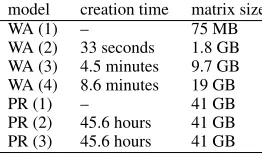
model creation time matrix size
WA (1) – 75 MB
WA (2) 33 seconds 1.8 GB WA (3) 4.5 minutes 9.7 GB WA (4) 8.6 minutes 19 GB
PR (1) – 41 GB
PR (2) 45.6 hours 41 GB PR (3) 45.6 hours 41 GB
Table 2:Runtime and memory requirements for creation of matrices, for the original PageRank and our cautious random walk algorithms. Creation of both higher-order WA and PR models is trivially parallelizable, and we report runtimes on a 2.7 GHz processor with parallel execution on 10 cores.
based NNLM (DNO) is the best higher-order model. This is an encouraging result for DNO, considering its simplicity. In general, NNLMs perform better than alignment models for answer reranking, which is not surprising considering the difference in size of the training datasets. To our knowledge, this is the first time this type of analy-sis has been performed for QA.
[image:10.612.128.259.572.650.2]P@1 MRR
# Model/Features P@1 Impr. MRR Impr.
Baselines
1 Random 14.29 26.12
2 CR 19.57 – 43.15 –
3 Jansen et al. (2014) 26.57 – 49.31 –
Words
4 CR + WA(1) + WN(1) 30.85 +58% 52.24
5 CR + WA(1-2) + WN(1-2) 31.85* +63% 52.86* +23%
6 CR + WA(1-3) + WN(1-3) 32.09* +64% 52.97* +23%
7 CR + WA(1-4) + WN(1-4) 31.69 +62% 52.75 +22%
Dependencies
8 CR + DA(1) + DNO(1) + DNL-G(1) 31.49 +61% 52.93 +23%
9 CR + DA(1-2) + DNO(1-2) + DNL-G(1-2) 32.85* +68% 53.73* +25%
10 CR + DA(1-3) + DNO(1-3) + DNL-G(1-3) 32.77* +67% 53.71* +24%
Words and Dependencies
11 CR + WA(1) + WN(1) + DA(1) + DNO(1) + DNL-G(1) 31.85 +63% 53.03 +23%
12 CR + WA(1-2) + WN(1-2) + DA(1-2) + DNO(1-2) + DNL-G(1-2) 32.89† +68% 53.69† +24%
[image:11.612.94.523.47.254.2]13 CR + WA(1-3) + WN(1-3) + DA(1-3) + DNO(1-3) + DNL-G(1-3) 33.01† +69% 53.96† +25%
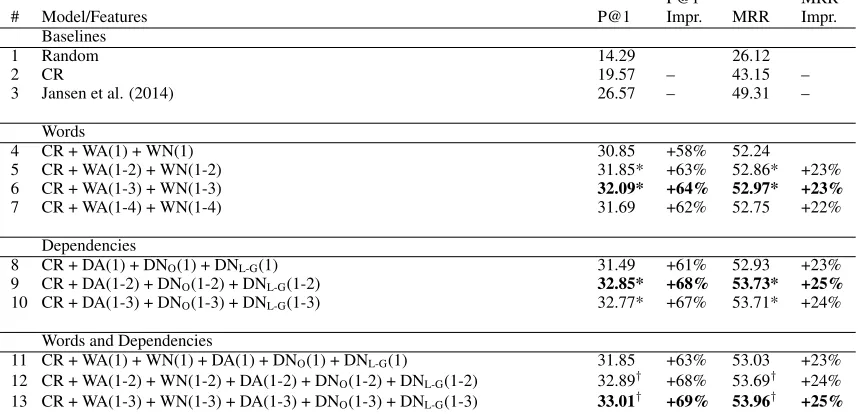
Table 3: Performance on the Yahoo! Answers dataset for word, dependency, and models that combine the word and de-pendency representations. Bold font indicates the best score in a given column for each model group. An asterisk indicates that a score is significantly better(p <0.05)than the first-order version of that model group (1), and†indicates that a score approaches significance(p <0.10).
P@1 MRR
Model P@1 Delta MRR Delta
CR + WA(1)
all features 27.33 – 49.20 – −P(Q|A) 25.69 -6% 48.35 -2% −max JSD 27.33 0% 49.10 0% −min JSD 23.57 -14% 46.64 -5% −composite JSD 27.17 -1% 49.02 0% −average JSD 25.41 -7% 47.70 -3%
CR + WN(1)
all features 30.69 – 52.02 – −max cosine sim. 29.65 -3% 51.49 -1% −min cosine sim. 29.69 -3% 51.43 -1% −composite cosine sim. 27.01 -12% 49.13 -6% −average cosine sim. 26.49 -14% 49.04 -6%
Table 4:Ablation experiments for first-order word models. Each row removes a single feature from the corresponding complete model (“all features”).
word-based second-order models (WA and WN). As expected, the personalized PR algorithm per-forms better than PRU. However, their perfor-mance drops for the third-order models (rows 26 and 29), whereas our models continue to improve in their order configuration. All our third-order models perform better than all third-third-order PR models. This is caused by our “cautious” traversal strategy that considers only the closest neighbors during random walks, which controls for semantic drift better than the PR methods. Fur-thermore, the resources required for PR are con-siderably larger than the ones needed to imple-ment our methods. Table 2 summarizes the
re-quirements of the PR algorithm compared to our closest method (WA). As the table shows, PR has a runtime that is two orders of magnitude larger than WA’s, and requires four times as much mem-ory to store the generated higher-order matrices. Combining NNLMs and alignment models We explore combinations of NNLMs and align-ment models in Table 3, which lists results when higher-order NNLMs and alignment models are combined for a given representation type. Each line in the table corresponds to a single an-swer reranking model, which incorporates features from multiple LS models. These experiments re-inforce our previous observations: higher-order models perform better than their first-order vari-ants regardless of representation type, but perfor-mance increases only for relatively low orders, e.g., 3 orders for words and words combined with dependencies, or 2 orders for dependencies.
[image:11.612.95.305.322.473.2]highest performance reported on this Yahoo! An-swers corpus, surpassing the best model of Jansen et. al (2014), which incorporates both shallow and deep discourse information, and achieves 32.9 P@1.
Feature ablation experiments
Although the main focus of this work is on higher-order LS models, Table 1 shows that even our first-order models perform better than the previous state of the art. This is caused by the novel features proposed over alignment models and NNLMs. To understand the contribution of each of these fea-tures, we performed an ablation experiment, sum-marized in Table 4, for two models: one alignment model (WA), and one NNLM (WN). This analysis indicates that many of the features proposed are important. For example, two of the novel JSD fea-tures for WA have a higher contribution to over-all QA performance than the alignment probability (P(Q|A)) proposed in previous work (Surdeanu
et al., 2011). For WN, the two new features pro-posed here (maximum and minimum cosine sim-ilarity between embedding vectors) also have a positive contribution to overall performance, but less than the other two features proposed in previ-ous work (Yih et al., 2013; Jansen et al., 2014). 6.5 Discussion
One important observation yielded by the previ-ous empirical analysis is that higher-order models perform well for sparse first-order variants (e.g., DA), but not for first-order models that rely on already dense association graphs (e.g., WN). We suspect that in densely populated graphs, model-ing context becomes critical for successful higher-order models. Returning to our example from §1, a densely populated graph may already have the associations breakfast – pancakes and pancakes – hashbrownsthat allow it to identify restaurants with favorable breakfast foods. Exploring higher-order associations in this situation is only ben-eficial if context is carefully maintained, other-wise an answer reranking system may erroneously select answer candidates with different contexts due to accumulated semantic drift (e.g., answers that discuss films, using associations from texts reviewing Breakfast at Tiffany’s). Incorporating word-sense disambiguation or topic modeling into alignment or NNLM models may begin to address these contextual issues by preferentially associat-ing terms within a given topic (such as
restau-rantsorfilms), ultimately reducing semantic drift, and extending these higher-order methods beyond a few hops in the graph. Our analysis suggests that the extra sparsity that contextually-dependent representations introduce may make those models even more amenable to the higher-order methods discussed here.
More generally, we believe that graph-based in-ference provides a robust but approximate middle-ground to inference for QA. Where inference us-ing first-order logic offers provably-correct an-swers but is relatively brittle (see Ch. 1 in Mac-Cartney (2009)), LS methods offer robustness, but have lacked explanatory power and the ability to connect knowledge into short inference chains. Here we have demonstrated that higher-order methods capitalize on indirect evidence gathered by connecting multiple direct associations, and in doing so significantly increase performance over LS approaches that use direct evidence alone. By incorporating contextual information and making use of the short inference chains generated by traversing these graphical models, we hypothe-size that graph-based systems will soon be able to construct simple justifications for their answer se-lection (e.g.,pancakes are a breakfast food, and hashbrowns go well with pancakes). We hope it will soon be possible to fill this gap in inference methods for QA with higher-order LS models for robust but approximate inference.
7 Conclusions
We introduce a higher-order formalism that al-lows lexical semantic models to capitalize on both direct and indirect evidence. We demon-strate that many lexical semantic models, includ-ing monolinclud-ingual alignment and neural network language models, working over surface or syntac-tic representations, can be trivially adapted to this higher-order formalism. Using a corpus of thou-sands of non-factoid how questions, we experi-mentally demonstrate that higher-order methods perform better than their first-order variants for most lexical semantic models investigated, with statistically-significant relative gains of up to 13% over the corresponding first order models.
Acknowledgements
References
Eneko Agirre and Aitor Soroa. 2009. Personalizing PageRank for word sense disambiguation. In Pro-ceedings of the 12th Conference of the European Chapter of the Association for Computational Lin-guistics.
Marco Baroni, Georgiana Dinu, and Germ´an Kruszewski. 2014. Don’t count, predict! A systematic comparison of context-counting vs. context-predicting semantic vectors. InProceedings of the 52nd Annual Meeting of the Association for Computational Linguistics.
Islam Beltagy, Cuong Chau, Gemma Boleda, Dan Gar-rette, Katrin Erk, and Raymond Mooney. 2013. Montague meets Markov: Deep semantics with probabilistic logical form. In Proceedings of the Second Joint Conference on Lexical and Computa-tional Semantics.
Adam Berger, Rich Caruana, David Cohn, Dayne Frey-tag, and Vibhu Mittal. 2000. Bridging the lexical chasm: Statistical approaches to answer finding. In
Proceedings of the 23rd Annual International ACM SIGIR Conference on Research & Development on Information Retrieval.
Gaurav Bhalotia, Arvind Hulgeri, Charuta Nakhe, Soumen Chakrabarti, and Shashank Sudarshan. 2002. Keyword searching and browsing in databases using BANKS. In Proceedings of 18th International Conference on Data Engineering (ICDE).
Peter F. Brown, Stephen A. Della Pietra, Vincent J. Della Pietra, and Robert L. Mercer. 1993. The mathematics of statistical machine translation: Parameter estimation. Computational Linguistics, 19(2):263–311.
Soumen Chakrabarti and Alekh Agarwal. 2006. Learning parameters in entity relationship graphs from ranking preferences. In Proceedings of 10th European Conference on Principle and Practice of Knowledge Discovery in Databases (PKDD). Soumen Chakrabarti. 2007. Dynamic personalized
PageRank in entity-relation graphs. InProceedings of the 16th International World Wide Web Confer-ence (WWW).
Marie-Catherine de Marneffe, Bill MacCartney, and Christopher D. Manning. 2006. Generating typed dependency parses from phrase structure parses. InProceedings of the International Conference on Language Resources and Evaluation (LREC). Abdessamad Echihabi and Daniel Marcu. 2003. A
noisy-channel approach to question answering. In
Proceedings of the 41st Annual Meeting of the Asso-ciation for Computational Linguistics (ACL). Oren Etzioni. 2011. Search needs a shake-up. Nature,
476(7358):25–26.
Peter Jansen, Mihai Surdeanu, and Peter Clark. 2014. Discourse complements lexical semantics for non-factoid answer reranking. In Proceedings of the 52nd Annual Meeting of the Association for Com-putational Linguistics (ACL).
Ni Lao and William W. Cohen. 2010. Relational re-trieval using a combination of path-constrained ran-dom walks.Machine Learning, 81(1):53–67. Ni Lao, Tom Mitchell, and William W. Cohen. 2011.
Random walk inference and learning in a large scale knowledge base. InProceedings of the Conference on Empirical Methods in Natural Language Pro-cessing (EMNLP).
Heeyoung Lee, Marta Recasens, Angel Chang, Mi-hai Surdeanu, and Dan Jurafsky. 2012. Joint en-tity and event coreference resolution across docu-ments. InProceedings of the Joint Conference on Empirical Methods in Natural Language Process-ing and Computational Natural Language LearnProcess-ing (EMNLP-CoNLL).
Omer Levy and Yoav Goldberg. 2014a. Dependency-based word embeddings. InProceedings of the 52nd Annual Meeting of the Association for Computa-tional Linguistics (ACL).
Omer Levy and Yoav Goldberg. 2014b. Linguistic reg-ularities in sparse and explicit word representations. InProceedings of the Conference on Computational Natural Language Learning (CoNLL).
Dekang Lin. 1998. Automatic retrieval and clustering of similar words. InProceedings of the 36th Annual Meeting of the Association for Computational Lin-guistics and the 17th International Conference on Computational Linguistics (COLING-ACL-1998). Bill MacCartney. 2009. Natural Language Inference.
Ph.D. thesis, Stanford University.
Christopher D. Manning, Prabhakar Raghavan, and Hinrich Sch¨utze. 2008.Introduction to Information Retrieval. Cambridge University Press.
Christopher D. Manning, Mihai Surdeanu, John Bauer, Jenny Finkel, Steven J. Bethard, and David Mc-Closky. 2014. The Stanford CoreNLP natural lan-guage processing toolkit. In Proceedings of the 52nd Annual Meeting of the Association for Com-putational Linguistics (ACL).
Tara McIntosh. 2010. Reducing Semantic Drift in Biomedical Lexicon Bootstrapping. Ph.D. thesis, University of Sydney.
Tomas Mikolov, Kai Chen, Greg Corrado, and Jeffrey Dean. 2013. Efficient estimation of word repre-sentations in vector space. InProceedings of the International Conference on Learning Representa-tions (ICLR).
Vanessa Murdock and W. Bruce Croft. 2005. A trans-lation model for sentence retrieval. InProceedings of the Conference on Human Language Technology and Empirical Methods in Natural Language Pro-cessing, pages 684–691.
Courtney Napoles, Matthew Gormley, and Benjamin Van Durme. 2012. Annotated Gigaword. In Pro-ceedings of the Joint Workshop on Automatic Knowl-edge Base Construction and Web-scale KnowlKnowl-edge Extraction, pages 95–100. Association for Compu-tational Linguistics.
Franz Josef Och and Hermann Ney. 2003. A sys-tematic comparison of various statistical alignment models.Computational Linguistics, 29(1):19–51. Lawrence Page, Sergey Brin, Rajeev Motwani, and
Terry Winograd. 1999. The PageRank citation ranking: Bringing order to the web. Technical Re-port 1999-66, Stanford InfoLab, November. Stefan Riezler, Alexander Vasserman, Ioannis
Tsochantaridis, Vibhu Mittal, and Yi Liu. 2007. Statistical machine translation for query expansion in answer retrieval. InProceedings of the 45th An-nual Meeting of the Association for Computational Linguistics (ACL).
Radu Soricut and Eric Brill. 2006. Automatic question answering using the web: Beyond the factoid. Jour-nal of Information Retrieval - Special Issue on Web Information Retrieval, 9(2):191–206.
Md. Arafat Sultan, Steven Bethard, and Tamara Sum-ner. 2014. Back to basics for monolingual align-ment: Exploiting word similarity and contextual ev-idence. Transactions of the Association for Compu-tational Linguistics, 2:219–230.
Mihai Surdeanu, Massimiliano Ciaramita, and Hugo Zaragoza. 2011. Learning to rank answers to non-factoid questions from web collections. Computa-tional Linguistics, 37(2):351–383.
Hanghang Tong, Christos Faloutsos, and Jia-Yu Pan. 2006. Fast random walk with restart and its applica-tions. InProceedings of the 6th International Con-ference on Data Mining (ICDM).
Xin-Jing Wang, Xudong Tu, Dan Feng, and Lei Zhang. 2009. Ranking community answers by modeling question-answer relationships via analogical reason-ing. InProceedings of the Annual ACM SIGIR Con-ference.
Max Whitney and Anoop Sarkar. 2012. Bootstrap-ping via graph propagation. InProceedings of the 50th Annual Meeting of the Association for Compu-tational Linguistics.
Xuchen Yao, Benjamin Van Durme, Chris Callison-Burch, and Peter Clark. 2013. Semi-Markov phrase-based monolingual alignment. In Proceed-ings of the Conference on Empirical Methods in Nat-ural Language Processing (EMNLP).
David Yarowsky. 1995. Unsupervised word sense dis-ambiguation rivaling supervised methods. In Pro-ceedings of the 33rd Annual Meeting of the Associa-tion for ComputaAssocia-tional Linguistics (ACL).
Wen-tau Yih, Ming-Wei Chang, Christopher Meek, and Andrzej Pastusiak. 2013. Question answering using enhanced lexical semantic models. InProceedings of the 51st Annual Meeting of the Association for Computational Linguistics (ACL).