24
Rethinking Text Attribute Transfer: A Lexical Analysis
Yao Fu∗1, Hao Zhou2, Jiaze Chen2, Lei Li2 1Columbia University
2Bytedance AI Lab
[email protected], [email protected] [email protected], [email protected]
Abstract
Text attribute transfer is modifying certain lin-guistic attributes (e.g. sentiment, style, author-ship, etc.) of a sentence and transforming them from one type to another. In this paper, we aim to analyze and interpret what is changed during the transfer process. We start from the observation that in many existing models and datasets, certain words within a sentence play important roles in determining the sentence at-tribute class. These words are referred to as the Pivot Words. Based on these pivot words, we propose a lexical analysis framework,the Pivot Analysis, to quantitatively analyze the effects of these words in text attribute classi-fication and transfer. We apply this framework to existing datasets and models, and show that: (1) the pivot words are strong features for the classification of sentence attributes; (2) to change the attribute of a sentence, many datasets only requires to change certain pivot words; (3) consequently, many transfer mod-els only perform the lexical-level modification, while leaving higher-level sentence structures unchanged. Our work provides an in-depth un-derstanding of linguistic attribute transfer and further identifies the future requirements and challenges of this task1.
1 Introduction
The task of text attribute transfer (or text style transfer 2) is to transform certain linguistic
at-tributes (sentiment, style, authorship, rhetorical devices, etc.) from one type to another (Ficler and Goldberg,2017;Fu et al.,2018;Hu et al.,2017;Li et al.,2018;Shen et al.,2017). The state-of-the-art
∗
Work done when Yao was an intern at Bytedance AI Lab.
1Our code can be found at
https://github.com/FranxYao/pivot analysis
2Many existing works also call this task style transfer(Fu
[image:1.595.309.524.219.282.2]et al.,2018), our work view style as one of the linguistic at-tributes, and use the term style or attribute according to the context.
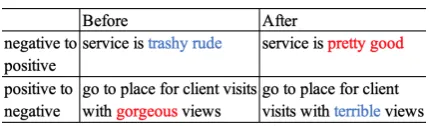
Figure 1: Examples of pivot words in sentiment trans-fer. Certain words are strongly correlated with the sen-timent such that a transfer model only need to modify these words to accomplish the transfer task while leav-ing the higher level sentence structure unchanged.
(SOTA) models have achieved inspiring transfer success rates (Zhao et al.,2018;Zhang et al.,2018;
Prabhumoye et al.,2018;Yang et al.,2018). How-ever, it is still unclear in current literature about what is transferred and what remains to be un-changed during the transfer process. To answer this question, we perform an in-depth investiga-tion of the linguistic attribute transfer datasets and models.
Our investigation starts from a simple observa-tion: in many transfer datasets and models, certain class-related words play very important roles in at-tribute transfer (Li et al.,2018;Prabhumoye et al.,
2018). Figure1gives a sentiment transfer example from the controllable generation (CG) model (Hu et al.,2017) on the Yelp dataset. In this example, rudeis strongly related to the negativesentiment andgoodis strongly related to thepositive senti-ment, thus simply substitutingrudewithgoodwill transfer the sentence from negative to positive. In this work, We name these words the pivot words for a class. We use the termthe pivot effectto re-fer the effect that certain strong words may be able to determine the class of a sentence.
per-form the attribute transfer or it may change higher-level sentence composationality like syntax?
To answer question (1), we propose the pivot analysis, a series of simple yet effective text min-ing algorithms, to quantitatively examine the pivot effects in different datasets. The basics of the datasets we investigate are listed in Table1. We first give the algorithm to extract pivot words (Sec 3). We statistically show the stronger the pivot effect is on a dataset, the easier for a model to transfer its sentences. To further analyze the fine-grained distributional structure of these pivot words, we propose theprecision-recall histogram to show to what extent the datasets may be influ-enced by their pivot words (Sec4.2).
To answer question (2) and discover what is changed during the transfer process, we use the pivot words to analyze the transfer results of two SOTA models: the Controllable Generation (CG) model(Hu et al.,2017) and the Cross Alignment (CA) model (Shen et al., 2017). We show that although equipped with sophisticated modeling techniques, in many datasets, these models tend to change only a few words and most of these modi-fied words are pivot words. When we mask out the modified words (to eliminate the lexical changes) and compare the Levenshtein string edit distance (Levenshtein,1966) of the sentence stems before and after the transfer, we find out many of the sentence stems are the same (the distance of the masked sentences equals to 0). This means that in transfer, the model only modifies few pivot words while leaving the syntactical structure of the sen-tence unchanged (Sec5).
To sum up, we show that: (1) in many datasets, words are important features in classification and transfer. But still, certain hard cases require a higher level of understanding of the sentence structures. (2) SOTA models tend to perform the transfer at the lexical level, the syntax of a sen-tence is generally unchanged. The understanding and modification of higher-level sentence compo-sitionality (syntax trees and dependency graphs) is still a challenging problem.
2 Background
Inspired by the image style transfer task (Gatys et al., 2016; Zhu et al., 2017), the goal of text attribute(style) transfer is to transfer the stylistic attributes of the sentence from one class to an-other while maintaining the content of the
sen-tence unchanged (Fu et al.,2018;Ficler and Gold-berg,2017;Hu et al.,2017). Because of the lack of parallel datasets, most models focus on the un-paired transfer. Although plenty of sophisticated techniques are used in this task, such as adversar-ial learning (Zhao et al.,2018;Chen et al.,2018), latent representations (Li and Mandt, 2018; Dai et al., 2019;Liu et al., 2019), and reinforcement learning (Luo et al.,2019;Gong et al., 2019;Xu et al.,2018), there is little discussion about what is changed and what remains unchanged.
Because of the lack of transparency and in-terpretability, there is some retrospection on this topic. Such as the definition of text style (Tikhonov and Yamshchikov,2018), and the eval-uation metrics (Li et al., 2018;Mir et al., 2019). Our proposed pivot analysis aligns with these works and provides a new tool to probe the transfer datasets and models. The de facto metrics is to use a pretrained classifier to classify if the transferred sentence is in the target class. So our pivot analy-sis starts from the classification task and mines the words with strong predictive performance.
While many previous works focus on one-to-one transfer, many recent works extend this task to one-to-many transfer (Logeswaran et al.,2018;
Liao et al.,2018;Subramanian et al.,2019). For simplicity, we focus on the one-to-one setting. But it is also easy to extend the pivot analysis into one-to-many transfer settings.
3 Pivot Words Discovery
To study the factors influencing attribute transfer, we start from mining words strongly correlated with the attribute class i.e. pivot words. Algorithm
Yelp Amazon Caption Paper Gender Politics Reddit Twitter Source Hu et al.
(2017)
Li et al.
(2018)
Li et al.
(2018)
Fu et al.
(2018)
Prabhumoye et al.(2018)
Prabhumoye et al.(2018)
dos Santos et al.(2018)
dos Santos et al.(2018)
Class Positive Positive Romantic Academic Male Democratic Polite Polite Negative Negative Humorous Journalism Female Republican Impolite Impolite Size(train/
dev/test)
444K/ 63K/126K
554K/ 2K/1K
12K/ -/1K
392K/ 20K/20K
2M/ 4K/534K
537K/ 4K/56K
10M/ 19K/47K
3M/ 18K/18K
Table 1: The text attribute transfer datasets we investigate.
Figure 2: The pivot words and sentence examples in three example datasets. The vocabulary of pivot words is large so we only list typical words. Sentences without pivot words are intuitively harder to classify and transfer.
calculates the precision for each word-class pair, and choose pivot words with a predefined thresh-oldp0.
For simplicity, we only consider binary classifi-cation in Algorithm1, but one could easily extend it to multi-class settings. Also, we only consider unigrams(words), while it is also straightforward to extend it to ngrams. In practice, we find the un-igram version performs quite good, as is shown in Table 2. As for the parameters in the algorithm, the precision thresholdp0 controls the confidence
of a word to be a pivot, and the occurrence thresh-oldf0prevents overfitting. We tune these
parame-ters based on the classification performance on the validation set. Specifically, to get better classifi-cation performance,f0 andp0 should be lower to
allow more vote (e.g.f0 ≤10, p0∈[0.5,0.7]). To
get more confidence and filter out stronger pivot
Algorithm 1Pivot Words Discovery
Input:The vocabularyV, the sentencesSand the labelsY, the frequency thresholdf0, the precision thresholdp0
Output:The pivot wordsΩyfor each classy∈ {0,1}. The word-class precision matrixp(x, y)
1: procedurePIVOTWORDSDISCOVERY
2: Balance the dataset by down-sampling the majority class.
3: foreach sentences, each classy, and each wordxin the vocabularyVwith frequency higher thanf0do
4: Consider the class ofsisyor1−y
5: Usethe existence ofxto classify: 6: ifxis insthen
7: Classifysto bey
8: else
9: Classifysto be1−y
10: Calculate the classification precisionp(x, y)of word
xfor labelyover all sentencesS. 11: ifp(x, y)> p0then
Algorithm 2The Pivot Classifier
Input:sentences, the pivot wordsΩyfor classy∈ {0,1}
Output:The classy(s)of sentences
1: procedurePIVOTCLASSIFICATION 2: Viewsas bag of words
3: For eachy∈ {0,1}, calculatesy=||s∩Ωy|| 4: Predict the class ofs to be y(s) = argmaxy{sy}.
Break tie randomly. 5: returny(s)
words, f0 and p0 should be higher (e.g. f0 ≥
100, p0 ≥0.7).
Figure 2 shows the mined pivot words in dif-ferent datasets. For sentences that contain pivot words, it is clear that these words are strong fea-tures for classification. Intuitively, to transfer the class of these sentences, one could directly modify these words. But there are also cases that contain no pivot words, e.g. i will be back in the Yelp dataset. To modify the sentiment of these sen-tences, a model needs to understand a broader con-text and common sense. In general, the existence of pivot words gives us a method to understand in attribute transfer, what cases are easier and what cases are more difficult.
The intuition that the existence of single words is enough to determine the linguistic attribute does not necessarily hold on all datasets. But empir-ically, we find out many transfer datasets tend to contain strong pivot words (Figure 5). One could compare our pivot analysis with other meth-ods that mine the word importance, such as the weights of a logistic classifier, or more sophis-ticated Bayesian methods like the log-odds ratio informative Dirichlet prior (Monroe et al.,2008). Our method is more straightforward and inter-pretable. We further develop this method as a sim-ple yet strong classification baseline to indicate the transfer difficulty of different datasets and use the pivot words as a tool to analyze, interpret, and vi-sualize the text attribute transfer models.
4 Analysing Datasets with Pivot Analysis
[image:4.595.308.527.63.170.2]In this section, we use the pivot words to analyze the transfer datasets. We first reveal the mecha-nisms of how pivot words affect classification and transfer by using the pivot words as the classifica-tion boundary. Then we use the precision-recall histogram to demonstrate the distributional struc-ture of the pivot words in different portions of the datasets.
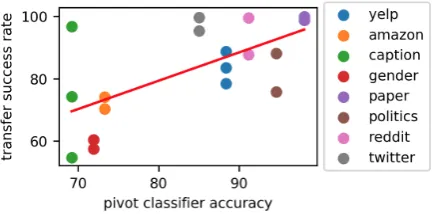
Figure 3: Pivot classification accuracy v.s. transfer success rate (correlation = 0.64, p-value = 0.003). The stronger the pivot effect is, the easier to transfer.
Figure 4: The mechanism of the pivot effect on classi-fication and transfer.
4.1 The Pivot Classifier
Algorithm 2 gives a simple method to classify a sentence based on the pivot words output from Al-gorithm1. This is essentially a voting based clas-sifier. This classifier holds strong independence assumption that the label of a sentence is only re-lated to the bag of words, but ignore the word or-ders. This is to say, the decision boundary only stays at the lexical level, and does not go to the syntax level. Then it counts the pivot words of different classes contained by the sentence and predicts the label to be one of the largest pivot words overlap. Intuitively, this algorithm classifies a sentence only based on the existence of strong attribute-related words.
The pivot classifier is a simple yet strong clas-sification baseline, as is shown in Table2. We use it to study different datasets and compare it with (1) a logistic classifier, (2) a SOTA CNN classifier (Kim,2014). We have balanced the test sets so the random baseline is 50%. This voting based clas-sifier achieves comparable performance with the two models in 4 datasets (Amazon, Gender, Pa-per, Politics), and only loses small margins in 2 datasets (Yelp, Caption). Although the indepen-dence assumption from our pivot classifier does not necessarily hold for all datasets, empirically it performs very well. This means that these pivot words are a meaningful approximation of the true decision boundary.
[image:4.595.305.526.227.269.2]Validation Yelp Amazon Caption Gender Paper Politics Reddit Twitter Pivot 88.00 75.85 - 72.02 97.82 98.32 90.00 85.25 Logistic 91.83 76.75 - 72.77 98.39 99.82 98.05 98.20 CNN 92.87 77.93 - 74.20 98.36 98.85 99.45 99.55 Test Yelp Amazon Caption Gender Paper Politics Reddit Twitter Pivot 88.35 73.30 69.20 71.91 98.07 94.60 91.15 85.05 Logistic 91.97 73.80 75.20 72.91 98.67 96.83 98.05 98.05 CNN 92.96 75.80 76.10 74.29 98.66 87.91 99.65 99.45
Table 2: Classification accuracy. The voting based pivot classifier is a strong classification baseline compared with the state of art CNN classifier, indicating that in many datasets, words are strong features for class labels.
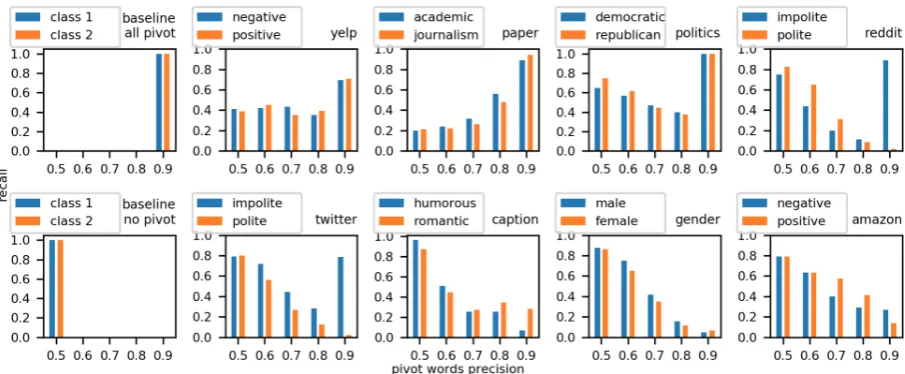
Figure 5: The precision-recall histogram. The high right bars in Yelp, Paper, Politics, Reddit, and Twitter datasets reveal the existence of strong pivot words, Each bar at location(x, y)should be interpreted as: if use pivot words with precisionxto classify the sentence, the recall will bey. The higher the right bars are, the more sentences can be classified by words accurately, the stronger the pivot effect is, the easier to transfer. The baseline cases where the dataset is full of/ has no pivot words are show on the left.
boundary by simply substituting the pivot words of one class to another, thus achieving text class transfer. Intuitively, the more pivot words a dataset contains, the stronger the pivot effect is, the easier for the pivot classifier to classify, and the easier to transfer the attribute. This intuition is demon-strated in Figure 3. The pivot effect (shown by pivot classification accuracy) and the transfer dif-ficulty (shown by the transfer success rate reported from previous models) has a strong positive corre-lation and is statistically significant. This mecha-nism is demonstrated in Figure4. The stronger the pivot effect is, the easier to transfer.
4.2 The Precision-Recall Histogram
Now we go one step further to reveal how the pivot effect distributes in different portions of the datasets. We propose a new tool, the precision-recallhistogram based on the results from Algo-rithm1and2. As is shown in Algorithm3, essen-tially, this algorithm use pivot words with
differ-ent level of confidence (precision) to classify the dataset, and output the recall. For better visualiza-tion, we set the precision interval gap to be 0.1, but it is also possible to use smaller or larger gaps. It is also important to balance the dataset in Algorithm
1to make the baseline precision 0.5.
The histogram for all datasets gives a fine-grained illustration of the pivot effect (Figure 5). We first look at the two baseline cases: a dataset with no pivot words, and a dataset full of pivots. If a dataset is full of pivots, i.e. the vocabulary of the two classes have no overlap, then all words should have precision 1.0 and they should achieve 1.0 recall, so the right-most bars are the highest. If a dataset has no pivot words, i.e. all words are dis-tributed evenly in two classes, then all words have precision 0.5 and they should achieve 1.0 recall, so the left-most bars are the highest. The higher the right bars are, the stronger the pivot effect is.
Algorithm 3The Precision-Recall Histogram
Input: The sentencesS, the labelsY, the pivot words for each classΩy, y ∈ Y, the precision matrix p(x, y), x ∈ V, y∈ Y
Output:The precision-recall histogram
1: procedureTHEPRECISION-RECALLHISTOGRAM 2: for The precision range pair (pi, pi+1) ∈
[(0.5,0.6),(0.6,0.7)...(0.9,1.0)]do
3: For each classy, gather all pivot words of the pre-cision in the given range:Ω(yi)=x:p(x, y)∈[pi, pi+1]
4: UseΩ(yi)to form a pivot classifier and classify the datasetS. Calculate the recallri.
5: Store (pi, ri) 6: returnThe list of(pi, ri)
see two different shape distributions. In the Yelp, Paper, Politics, Reddit, and Twitter datasets, the right-most bars are the highest, meaning that in these datasets, strong pivot words exist in a large portion of the dataset. These are close to the all-pivot baseline. Specially, we see that in the Reddit and Twitter dataset, the pivot effect only exists in theimpoliteclass, while in other datasets, the pivot effect exists in both classes. Note that this phe-nomenon cannot be discovered simply from the overall classification accuracy. After manual in-spection, we find out since the attribute of these two datasets is politeness, the pivot words for the impolite class are the common swearwords in En-glish. These words dominate the impolite sen-tences.
In the Caption, Gender, and Amazon dataset, we see a decreasing height from left to right, indi-cating a weaker pivot effect. Highest bars exist in the 0.5 precision bars, meaning that for each class, most of them can be classified by 0.5 precision (= random guessing). This is close to the no-pivot baseline. The high-precision words still exist, but they cannot dominate the whole class. In conclu-sion, the precision-recall histograms give a struc-tural examination for each class. The existence of pivots and the determination power of pivots differ from class to class, and from datasets to datasets.
5 Analysing Transfer Models with Pivot Analysis
In this section, we aim to analyze what is changed and what remains in linguistic attribute transfer systems. We perform our experiments from two perspectives: the lexical structures, and the syntac-tical structures. For the lexical structures, we show what words are modified by the transfer model. For the syntactical structures, we mask out the
Yelp Amazon Gender CG - # modified 1.66 0.56 0.79
- percentage 18% 4% 5% CA - # modified 1.61 3.54 5.60
[image:6.595.326.506.61.125.2]- percentage 18% 23% 33% sentence length 8.89 14.82 17.01
Table 3: Average number of modified words and their percentage in the sentence length. The transfer models tend to modify only a few attribute-related words.
Yelp Amazon Gender CG 91.25 94.77 94.17 CA 72.33 74.04 56.09
Table 4: Percentage of modified words that are pivot words. A large portion of the modified words are piv-ots.
modified pivot words and compare the resulting sentence stems.
We use the two most common SOTA mod-els, the Controllable Generation (CG) model from
Hu et al.(2017), and the Cross Aligned Autoen-coder (CA) model from Shen et al. (2017). The CG model uses a conditional VAE with style-discriminator and trained with a wake-sleep al-gorithm. The CA model uses a cross-alignment mechanism to guide the transfer process. These are two strong models in many datasets compared to many other models. We direct the readers to the original papers for more details.
We test the models on three datasets: Yelp, Amazon, and Gender. The Yelp dataset is the most widely used benchmark in the text style transfer task. As is shown in the previous sections, it ex-ists strong pivot effects. There are many senti-ment words in this dataset. For the Amazon and the Gender dataset, there is less pivot effect. So our experiments give a minimum cover of different types of datasets. We use the released implemen-tation for our experiments3. All hyper-parameters are followed by their official instructions. Both models are trained until the simultaneous conver-gence of the reconstruction loss and the adversar-ial loss. We refer the readers to the implementation repositories for more details.
3
The CG model: https://github.com/asyml/ texar/tree/master/examples/text_style_ transfer
[image:6.595.346.485.194.226.2]CG 0 1 2 3 4 5 6 >6 Yelp 74.65 5.05 10.68 5.71 1.84 0.72 0.66 0.69 Amazon 94.20 0.00 0.90 4.00 0.80 0.10 0.00 0.00 Gender 90.96 0.04 6.60 0.45 0.89 0.43 0.16 0.48
CA 0 1 2 3 4 5 6 >6
Yelp 41.30 1.98 13.63 10.01 8.76 7.49 6.17 10.66 Amazon 37.60 1.85 9.95 9.25 6.15 6.15 4.65 24.40 Gender 37.89 0.27 2.27 3.36 1.60 1.40 2.03 51.18
Table 5: Masked edit distance percentage distributions. For the CG model, in most of the cases(> 74%), the masked edit distance is 0, meaning that only few words are changed while the sentence structures are exactly the same. For the CA model, still a large portion of the sentence structures are unchanged (>37%)
[image:7.595.158.440.60.145.2]Figure 6: The transfer cases. Many of the transfered words are pivot words. The model tend to transfer only a few words while leaving the higher level sentence structure unchanged.
Figure 7: An example of the masked sentences. Edit distance = 0 after masking.
Yelp Amazon Gender CG - distance 0.65 0.17 0.26
- percentage 7.3% 1.4% 1.5% CA - distance 2.63 4.56 9.95
- percentage 29% 31% 58% sentence length 8.89 14.82 17.01
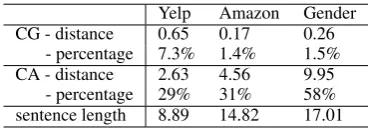
Table 6: Edit distance after masking out the pivot words. In the CG model, only words are modified, while the higher-level sentence structures remain to be the same. For the CA model, it tries to modify more sentence structures.
5.1 Lexical Structures
We show that the two models tend to modify only a few words in a given sentence, and a large por-tion of these words are pivot words. The results are shown in Table3and4. On the Yelp dataset, the CG model and the CA model only modify 1.66 and 1.61 words on average. The portion of pivot
words is 91% and 72% respectively. This means on this dataset, both two models focus on word substitutions to change the sentence style. On the Amazon and the Gender dataset, the models take different transfer strategies. For the CG model, it concentrates on fewer words to modify (0.56 on Amazon and 0.79 on Gender). For the CA model, it tends to modify more words (3.54 on Amazon and 5.60 on Gender). Still, both models tend to modify the pivot words for class transfer. In gen-eral, a small portion of the sentences are modi-fied (< 30% approximately), and a large portion of the modified words are pivots (>60% approxi-mately).
5.2 Syntactic Structures
[image:7.595.151.448.208.370.2] [image:7.595.88.274.504.569.2]with parsing trees (Shen et al., 2018;Zhang and Shasha,1989). Here we use the string edit distance for simplicity. In practice, it is informative enough to demonstrate the change of sentence structures.
Table 6 shows the edit distances after mask-ing the pivot words. We see clear differences be-tween the two models. For the CG model, it barely changes the sentence structures (0.1+ distances). This indicates that it takes the strategy to focus more on the substitution of pivot words. For the CA model, it takes the strategy that not only to modify the words, but also a portion of the sen-tence structures. We see a moderate percentage of the sentence structure modified on the Yelp and Amazon dataset (about 30%), and a large syntactic modification (58%) on the Gender dataset. Com-pared with the CG model, the CA model tries to modify the sentences more radically.
To show a fine-grained distribution of the dis-tances among different cases, we list the distribu-tion statistics in Table 5. We see that for the CG model, most of the cases> 74%) sentence stems are unchanged. For the CA model, although its average edit distance is larger, in a large portion of the cases (> 37%), the distance is still 0. In con-clusion, both models tend to retain the sentence structures in a large portion of the datasets.
5.3 Qualitative Analysis
Now we examine the transfer cases qualitatively in Figure6. These are cases from the CG model on the three datasets. The pivot words are high-lighted. When the model tries to change the class of a sentence, it first identifies the pivot words, then substitutes them with the pivots from another class. If we mask out the highlighted pivot words, the resulting sentence stems are the same, indicat-ing that the syntactic structures remain unchanged. Although this is not all the case, the models tend to focus on words in a large portion of the datasets.
6 Discussion
Implications: Our pivot classifier reveals that to a certain extent, in many transfer datasets, the de-cision boundary stays at the lexical level. Con-sequently, to cross the boundary and transfer the text class, many instances in the dataset only re-quires to modify certain pivot words. But still, there are cases with no pivot words. The decision boundary in such cases is higher than the word level. To transfer these cases, the model needs a
deeper understanding of the sentence structures, which may include syntax, semantics, and com-mon sense (Figure2).
Considerations: In our experiments, we find
out the two models are both quite unstable dur-ing traindur-ing. The balance between the reconstruc-tion loss and the adversarial loss will significantly influence the convergence point. Our pivot anal-ysis framework requires the model to converge to a meaningful local optimum with reasonable con-tent preservation and transfer strength at the same time(Fu et al., 2018). For our pivot algorithms, it is important to balance the datasets (both train-ing and testtrain-ing) for a reasonable precision base-line(0.5). Our algorithm is mostly sensitive to the precision thresholdp0 i.e. the confidence of how
pivota word is. We tune this parameter based on the development set performance.
Limitations: All of our pivot algorithms stays
atthe lexical level. These algorithms hold strong Independence assumption that the class of a sen-tence is independent of the order of words. So this method may not be able to capture certain lin-guistical phenomenons, such as anastrophe4. One could also consider an extreme example where the pivot analysisdoes not work: suppose we have a corpus of sentences, we label all of them to be 0, then we reverse all sentences, and label the re-versed sentences to be 1. In this dataset, both classes share the same vocabulary, and the pre-cision of any word will be 0.5. This is an ex-ample where only the order determines the class. Further, in our work, we only consider lexical changes, and do not consider other issues with regard to more rigorous definition of linguistic style(Tikhonov and Yamshchikov,2018), the eval-uation metrics (Mir et al.,2019), and the causality in text classification(Wood-Doughty et al.,2018). These topics will be the future directions.
7 Conclusion
In this work, we presentthe Pivot Analysis, a lex-ical analysis framework for the examination and inspection of text style transfer datasets and mod-els. This analysis framework consists of three text mining algorithms, pivot words discovery, the pivot classifier, and the precision-recall his-tograms. With these algorithms, we reveal what are the important words that influence the class
of a sentence, how these words are distributed in a dataset, the mechanisms through which these words interact with a transfer model, and how the models perform the transfer. Our method serves as a probe for the transparency and the interpretabil-ity of the datasets and the transfer models. We show that a large portion of the transfer cases stays at the lexical level, while the syntactic structures are unchanged.
Since our methods stay at the lexical level, it has its own limitations in understanding higher-level sentence compositionality. These limitations are also shared by the SOTA transfer models: to un-derstand the syntax and semantics (i.e. the struc-tures of the sentence), and the common sense (i.e. the background and implications of the surface words). These limitations are also directions for future challenges. In the future, we need to use better inductive bias and use more powerful mod-els towards higher-level sentence compositional-ity.
Acknowledgments
We thank the reviewers for their informative re-views. We thank Yansong Feng, Bingfeng Luo, and Zhenxin Fu for the helpful discussions. This work is supported by the China Scholarship Coun-cil.
References
Liqun Chen, Shuyang Dai, Chenyang Tao, Haichao Zhang, Zhe Gan, Dinghan Shen, Yizhe Zhang, Guoyin Wang, Ruiyi Zhang, and Lawrence Carin. 2018. Adversarial text generation via feature-mover’s distance. InNeurIPS.
Ning Dai, Jianze Liang, Xipeng Qiu, and Xuanjing Huang. 2019.Style transformer: Unpaired text style transfer without disentangled latent representation. In Proceedings of the 57th Annual Meeting of the Association for Computational Linguistics, pages 5997–6007, Florence, Italy. Association for Compu-tational Linguistics.
Jessica Ficler and Yoav Goldberg. 2017. Controlling linguistic style aspects in neural language genera-tion. In Proceedings of the Workshop on Stylis-tic Variation, pages 94–104, Copenhagen, Denmark. Association for Computational Linguistics.
Zhenxin Fu, Xiaoye Tan, Nanyun Peng, Dongyan Zhao, and Rui Yan. 2018. Style transfer in text: Ex-ploration and evaluation. InAAAI.
Leon A. Gatys, Alexander S. Ecker, and Matthias Bethge. 2016. Image style transfer using
convolu-tional neural networks. 2016 IEEE Conference on Computer Vision and Pattern Recognition (CVPR), pages 2414–2423.
Hongyu Gong, Suma Bhat, Lingfei Wu, Jinjun Xiong, and Wen mei W. Hwu. 2019. Reinforcement learn-ing based text style transfer without parallel trainlearn-ing corpus. InNAACL-HLT.
Zhiting Hu, Zichao Yang, Xiaodan Liang, Ruslan Salakhutdinov, and Eric P. Xing. 2017.Toward con-trolled generation of text. InProceedings of the 34th International Conference on Machine Learning, vol-ume 70 of Proceedings of Machine Learning Re-search, pages 1587–1596, International Convention Centre, Sydney, Australia. PMLR.
Yoon Kim. 2014. Convolutional neural networks for sentence classification. InEMNLP.
Vladimir I Levenshtein. 1966. Binary codes capable of correcting deletions, insertions, and reversals. So-viet physics doklady, 10(8):707–710.
Juncen Li, Robin Jia, Hua He, and Percy S. Liang. 2018. Delete, retrieve, generate: A simple approach to sentiment and style transfer. InNAACL-HLT.
Yingzhen Li and Stephan Mandt. 2018. Disentangled sequential autoencoder. InICML.
Yi Liao, Lidong Bing, Piji Li, Shuming Shi, Wai Lam, and Tong Zhang. 2018. Quase: Sequence editing under quantifiable guidance. InEMNLP.
Dayiheng Liu, Jie Fu, Yidan Zhang, Chris Pal, and Jiancheng Lv. 2019. Revision in continuous space: Fine-grained control of text style transfer. ArXiv, abs/1905.12304.
Lajanugen Logeswaran, Honglak Lee, and Samy Ben-gio. 2018. Content preserving text generation with attribute controls. InAdvances in Neural Informa-tion Processing Systems, pages 5103–5113.
Fuli Luo, Peng Li, Jie Zhou, Pengcheng Yang, Baobao Chang, Zhifang Sui, and Xu Rui Sun. 2019. A dual reinforcement learning framework for unsupervised text style transfer. InIJCAI.
Remi Mir, Bjarke Felbo, Nick Obradovich, and Iyad Rahwan. 2019. Evaluating style transfer for text. In NAACL-HLT.
Burt L. Monroe, Michael Colaresi, and Kevin M. Quinn. 2008. Fightin’ words: Lexical feature se-lection and evaluation for identifying the content of political conflict. Political Analysis, 16(4):372–403.
Shrimai Prabhumoye, Yulia Tsvetkov, Ruslan R. Salakhutdinov, and Alan W. Black. 2018. Style transfer through back-translation. InACL.
Tianxiao Shen, Tao Lei, Regina Barzilay, and Tommi S. Jaakkola. 2017. Style transfer from non-parallel text by cross-alignment. InNIPS.
Yikang Shen, Zhouhan Lin, Athul Paul Jacob, Alessan-dro Sordoni, Aaron Courville, and Yoshua Bengio. 2018. Straight to the tree: Constituency parsing with neural syntactic distance. InACL.
Sandeep Subramanian, Guillaume Lample,
Eric Michael Smith, Ludovic Denoyer,
Marc’Aurelio Ranzato, and Y-Lan Boureau. 2019. Multiple-attribute text style transfer. In ICLR.
Alexey Tikhonov and Ivan P. Yamshchikov. 2018. What is wrong with style transfer for texts? ArXiv, abs/1808.04365.
Zach Wood-Doughty, Ilya Shpitser, and Mark Dredze. 2018. Challenges of using text classifiers for causal inference. arXiv preprint arXiv:1810.00956.
Jingjing Xu, Xu Sun, Qi Zeng, Xuancheng Ren, Xi-aodong Zhang, Houfeng Wang, and Wenjie Li. 2018. Unpaired sentiment-to-sentiment translation: A cy-cled reinforcement learning approach. InACL.
Zichao Yang, Zhiting Hu, Chris Dyer, Eric P. Xing, and Taylor Berg-Kirkpatrick. 2018. Unsupervised text style transfer using language models as discrimina-tors. InNeurIPS.
Kaizhong Zhang and Dennis Shasha. 1989. Simple fast algorithms for the editing distance between trees and related problems. SIAM journal on computing, 18(6):1245–1262.
Ye Zhang, Nan Ding, and Radu Soricut. 2018. Shaped: Shared-private encoder-decoder for text style adap-tation. InNAACL-HLT.
Junbo Jake Zhao, Yoon Kim, Kelly Zhang, Alexan-der M. Rush, and Yann LeCun. 2018. Adversarially regularized autoencoders. InICML.