Office of the Director of Corporate Enforcement,
© Government of Ireland, 2010 ISBN 978-1-4064-2503-1
Price: €10.00
For further information contact:
16 Parnell Square, Dublin 1. Tel: 01 858 5800 Lo-call: 1890 315 015
Fax: 01 858 5801 Email: [email protected]
Web: www.odce.ie
DUBLIN:
PRINTED BY THE STATIONERY OFFICE.
To be purchased directly from the
GOVERNMENT PUBLICATIONS SALE OFFICE, SUN ALLIANCE HOUSE,
MOLESWORTH STREET, DUBLIN 2,
or by mail order from GOVERNMENT PUBLICATIONS,
POSTAL TRADE SECTION, 51 ST. STEPHEN’S GREEN,
DUBLIN 2.
(Tel: 01 647 6834/35/36/37; Fax: 01 672 5449) or through any bookseller.
O
ff
ic
e
of
t
h
e
D
ir
ec
to
r o
f C
or
p
or
at
e
En
fo
rc
em
en
t A
n
n
u
al
R
ep
or
t 2
0
0
9
Contents
Foreword by the Director of Corporate Enforcement
3
Introduction
4
Goal 1 – Improving Public Understanding of Company Law Rights/Duties
5
Goal 2 – Confronting Unlawful Company Law Behaviour
13
Goal 3 – Providing Quality Services to Internal and External Customers
27
Outlook
31
O
ff
ic
e
of
t
h
e
D
ir
ec
to
r
of
C
or
p
or
at
e
En
fo
rc
em
en
t
A
n
n
u
al
R
ep
or
t
2
0
0
9
2
Copyright and Disclaimer Statement
The contents of this document are the copyright of the Director of Corporate Enforcement. All or part of this publication may be reproduced without further permission provided:
• the reproduced information is accurate; • it is used for a lawful or proper purpose;
• the source of the information and copyright is clearly acknowledged and
• the information is not used for the principal purpose of advertising or promoting a particular product or service.
Nothing herein should be construed as a representation by, or on behalf of, the Director of Corporate Enforcement as to his understanding or interpretation of any of the provisions of the Companies Acts 1963 to 2009 or as to the interpretation of any law. Independent legal advice should be sought in relation to the effects of any legal provision. The Director of Corporate Enforcement accepts no responsibility or liability howsoever arising from the contents of this publication or any errors, inaccuracies or omissions in the contents of this document. The Director reserves the right to take action, which may or may not be in accordance with the provisions of this document.
O
ff
ic
e
of
t
h
e
D
ir
ec
to
r o
f C
or
p
or
at
e
En
fo
rc
em
en
t A
n
n
u
al
R
ep
or
t 2
0
0
9
Foreword
Pursuant to Section 16(1) of the Company Law Enforcement Act 2001, I am pleased to present Mr Batt O’Keeffe, T.D., Minister for Enterprise Trade and Innovation, with my Office’s Annual Report for 2009.
The Companies Acts 1963 to 2009 establish a framework of duties, obligations and rights which sets out the manner in which companies, company directors, shareholders, creditors, auditors and other stakeholders interact with one another on a fair basis. It is a task of the ODCE to ensure as far as possible that the balance of responsibilities and rights distributed among company stakeholders operates as the law intends. We see ourselves:
n helping those who want to comply with their legal obligations to do so;
n discouraging misconduct by those who may be tempted not to comply and
n pursuing those who may have breached their duties and obligations under the law.
2009 has been a particularly challenging and demanding year for the ODCE. In particular, significant resources were deployed in investigating certain matters at Anglo Irish Bank Corporation Ltd, the most extensive ever undertaken by the Office. The Office has also had to deal with a dramatic increase in corporate insolvency rates over the last year. These
exceptional demands have placed a considerable strain on Office resources and forced us to re-evaluate and re-prioritise the work being undertaken. The steps taken as a result have helped us overcome some of these difficulties and make further progress last year.
With this as background, I wish to highlight the following key pieces of work and achievements of the Office during the course of 2009:
n the extensive work undertaken on the Anglo investigation which included the exercise of our search and seizure powers under the Companies Acts;
n the conclusion by the High Court Inspector to DCC plc, S&L Investments Ltd. and Lotus Green Ltd. of his Inquiry into aspects of various purchases and sales of shares in Fyffes plc in 1995 and 2000;
n a 47% increase from 1,036 to 1,519 in the number of new reports and complaints received by the Office in 2009. Unfortunately, most of this increase was attributable to the growth in newly insolvent companies and a consequent surge in initial reports from liquidators;
n a 22% increase from 1,184 to 1,446 in the number of cases concluded in 2009. This increase was primarily due to our additional work in evaluating liquidator reports;
n the issue of 14 separate company law publications in 2009, including a new suite of eight ‘quick guides’ on company law responsibilities. Some 23,500 copies of various Office publications were distributed during the year;
n the delivery of 67 presentations to over 3,700 people and attendance at eleven exhibitions and seminars in 2009. The primary purpose of this activity was to inform business and professional interests and the general public of their rights and responsibilities under the Companies Acts;
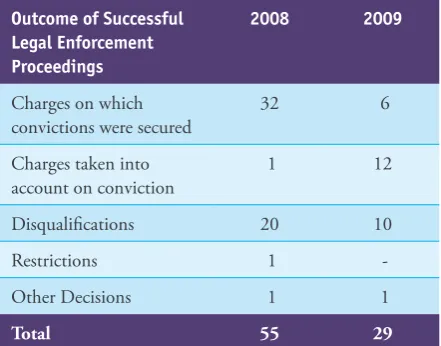
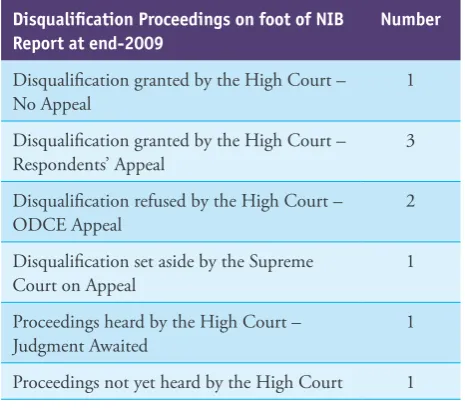
n a total of ten disqualifications and six convictions (with a further twelve charges taken into account) for various breaches of company law and duty. ODCE convictions were confirmed in two appeals taken by defendants to the Circuit Criminal Court. Also in 2009, one disqualification decision made in 2008 was set aside on appeal in the Supreme Court;
n financial expenditure of just over €5.8 million, a 34% increase on the outturn of €4.34 million in 2008. The increase was primarily due to the cost of the DCC Inquiry which is now completed;
n an increase of about five in Office staff numbers during 2009. These extra staff were deployed to support the Anglo investigation and the large increase in the Office’s corporate insolvency work.
Particular thanks are due to the Ministers and staff of the Department of Enterprise Trade and Employment in 2009 for their financial and staffing support of the Office at a difficult economic time.
I want to thank all of the Office’s dedicated and hard working staff for their continuing commitment to our important work. Notwithstanding the fact that the Anglo investigation is absorbing about one-third of ODCE staff on a full-time basis, the remaining staff successfully delivered increased throughput in many areas of the Office’s remit.
I also want to acknowledge the continuing support given to the Office in 2009 by the Oireachtas, the Government, the Courts and those professionals engaged by us. The enactment and implementation of the Companies (Amendment) Act 2009 to which many of these parties contributed is making a valuable contribution to our investigative work.
I hope that this support and the wider support of the public and of business and professional interests will continue for 2010 and that we will continue to make a positive difference to upholding corporate standards in the overall public interest. Our collective efforts are helping business people, community interests and the general public to engage fairly and equitably with one another through Irish companies.
Paul Appleby
O
ff
ic
e
of
t
h
e
D
ir
ec
to
r
of
C
or
p
or
at
e
En
fo
rc
em
en
t
A
n
n
u
al
R
ep
or
t
2
0
0
9
Introduction
The three main functions of the Director of Corporate Enforcement, as set out in the Company Law Enforcement Act 2001, are:
n to encourage compliance with the Companies Acts;
n to investigate instances of suspected offences under the Acts and
n to take enforcement proceedings for breaches of company law or duty.
Consistent with this statutory framework, the present strategy of the Director comprises the primary goals and related sub-goals outlined in the following table.
Strategic Goals and Sub-Goals of the Director of Corporate Enforcement
Goal : Improving Public Understanding of Company Law Rights and Duties
n Sub-Goal 1.1: Raising Standards of Compliance
n Sub-Goal 1.2: Deepening our Relationship with Stakeholders
n Sub-Goal 1.3: Influencing Policy Development
Goal 2: Confronting Unlawful Company Law Behaviour
n Sub-Goal 2.1: Identifying Suspected Misconduct
n Sub-Goal 2.2: Enforcing Serious Breaches under the Companies Acts
Goal : Providing Quality Services to Internal and External Customers
n Sub-Goal 3.1: Securing and Prudently Managing our Resources
n Sub-Goal 3.2: Developing our Staff
n Sub-Goal 3.3: Improving our Customer Services
O
ff
ic
e
of
t
h
e
D
ir
ec
to
r o
f C
or
p
or
at
e
En
fo
rc
em
en
t A
n
n
u
al
R
ep
or
t 2
0
0
9
Goal :
Improving Public Understanding of
Company Law Rights and Duties
Introduction
ODCE staff carry out a significant amount of advocacy work with the aim of enhancing the knowledge and awareness of company directors, officers and other stakeholders to their powers and responsibilities under company law.
2009 presented significant challenges in this area given the reduced budget available to publicise ODCE work and the significant workload of the Office in investigating suspected unlawful behaviour in the banking sector. Notwithstanding these challenges, the Office continued its successful communications policies and searched out new ways of improving public awareness of company law rights and duties.
Sub-Goal .:
Raising Standards of
Compliance
Publications - Overview
The Office issued 14 separate company law publications during 2009 (nine in 2008) of which the more significant are discussed below. The full list is at Appendix 1.1.1.
The Office issued some 23,500 copies of its various publications in 2009 (24,000 in 2008). All publications are available on the ODCE website at www.odce.ie.
Quick Guides
During late 2008 and early 2009, the Office developed a new suite of guidance booklets for company stakeholders. The new booklets present in a summary form the key information on the roles of companies, directors, secretaries, auditors, creditors, members/shareholders and liquidators, receivers and examiners. They complement the longstanding Information Books1 which discuss these same topics in more detail.
1 Decision Notice D/2002/1.
The ODCE Quick Guides
In developing the Quick Guides, the Office worked closely with the National Adult Literacy Agency and successfully secured the Plain English mark in recognition of their accessibility and readability. Office staff have been gratified by the positive response to the style and value of these Quick Guides and will pursue similar initiatives in future.
Information Notices
The Office published four Information Notices during 2009.
Reduced Liquidator Reporting
Further to the reporting regime established for the liquidators of insolvent companies2, liquidators have been making a series of initial, further and final reports to the ODCE during the life cycle of a company’s liquidation. Following a review of their utility, the Office published in early 2009 an Information Notice which detailed the revised liquidator reporting arrangements which would apply from 1 February 20093.
From that date, liquidators would not be generally required to submit further or final reports to the Office in cases where the Office had decided to definitively relieve, or definitively not relieve, liquidators of their statutory obligation to take High Court restriction proceedings against a company’s directors. This decision will alleviate the workload on liquidators as well as allowing the Office to focus its attention on the growing volume of initial liquidator reports for newly insolvent companies.
2 Under Section 56 of the Company Law Enforcement Act 2001 (the 2001 Act).
O
ff
ic
e
of
t
h
e
D
ir
ec
to
r
of
C
or
p
or
at
e
En
fo
rc
em
en
t
A
n
n
u
al
R
ep
or
t
2
0
0
9
Relief Decisions on Liquidator Reports
The second Information Notice4 detailed the insolvent companies in liquidation whose liquidators were relieved by the ODCE in 2008, either permanently or temporarily, from their statutory obligation to take restriction proceedings against the directors of those insolvent companies. The purpose of this annual Notice is to inform creditors and other stakeholders that the directors are no longer facing High Court proceedings for suspected irresponsible conduct. This enables all concerned to make informed future business decisions. Where relief is not granted, the Office publishes in its Annual Reports for similar market information reasons the results of High Court proceedings determining if the restriction of individual company directors was merited.
Companies (Amendment) Act 2009
The third Information Notice5 dealt in detail with the Companies (Amendment) Act 2009 which was enacted on 12 July 2009 with immediate applicability. The Act extended the Director’s investigative powers in certain areas including by granting:
n a right under District Court search warrant (subject to conditions and safeguards) to seize something that: – is believed to be or contain information of an
offence where a determination of relevance is not practicable on the premises, or
– includes seizable and non-seizable information where their separation is not practicable on the premises, and
n a right to take legally privileged material on a sealed basis subject to making an application to the High Court within seven days for a determination.
Among other measures, the 2009 Act modified the law as it relates to directors using company assets for their own purposes. The burden of proof of ‘knowing and wilful default’ has been lowered to one of ‘strict liability’ where breaches occur. The Act also extended the disclosure obligations of licensed banks in respect of transactions with their directors or with persons connected with those directors.
4 Information Notice I/2009/2 – List of “Relief” Decisions issued in 2008 for Insolvent Companies in Liquidation.
5 Information Notice I/2009/3 – Companies (Amendment) Act 2009.
Auditor Reporting of Suspected Indictable Company Law Offences
The fourth Information Notice6 provided additional guidance to auditors on their obligations to report suspected indictable offences under the Companies Acts to the ODCE7. This complements the current main guidance which dates from 20068. Both documents were developed in conjunction with the recognised accountancy bodies.
The purpose of the Information Notice was to help broaden the scope of the reported offences which were dominated by only two or three offence types notwithstanding the wide range of potentially reportable offences9. The new guidance lists 13 offences which, once committed, should be detectable during the course of an audit. These include the following rarely reported offences:
n fraudulent trading;
n wilfully providing false information to auditors and
n the destruction, mutilation or falsification of documents.
The Information Notice also includes a useful flowchart of the decision making process that auditors must go through in deciding whether a report is necessary, as well as discussing the impact of qualified audit reports and other reporting obligations. All auditors were made aware of the Notice by their professional bodies following its publication in September 2009.
Communications
In 2009, the Office positively responded to the Government’s request that non-essential expenditure be curtailed as much as possible. This inevitably reduced the amount of advertising and promotional work which the Office undertook during the year and restricted its ability to communicate its core message of compliance.
6 Information Notice I/2009/4 – Reporting Company Law Offences: Information for Auditors.
7 Under Section 194(5) of the Companies Act 1990 (the 1990 Act) as inserted by Section 74 of the 2001 Act and subsequently amended by Section 37 of the Companies (Auditing and Accounting) Act 2003 and Section 73 of the Investment Funds, Companies and Miscellaneous Provisions Act 2005.
8 Decision Notice D/2006/2 – Revised Guidance on the Duty of Auditors to report Suspected Indictable Offences to the Director of Corporate Enforcement.
O
ff
ic
e
of
t
h
e
D
ir
ec
to
r o
f C
or
p
or
at
e
En
fo
rc
em
en
t A
n
n
u
al
R
ep
or
t 2
0
0
9
Syndicated Articles
In lieu of media advertising, the Office set about finding alternative and cost-effective ways of communicating its compliance message to company stakeholders. During 2009, a series of six articles on company law were drafted and submitted to local newspapers throughout the country. These articles covered various topics including choosing to incorporate, keeping proper books of account, the restrictions on directors using company assets for personal purposes, insolvency and corporate governance.
To date, the series of articles have run in five local papers, and several more have expressed an interest in running them at a future date.
Presentations, Events and Exhibitions
Notwithstanding the innovative step of syndicated articles, the Office continued to implement other cost-effective elements of its communications policy. This included in particular the delivery of presentations at public and professional gatherings around the country and attendance at relevant conferences, seminars and exhibitions.
Office staff delivered 67 presentations to over 3,700 people (65 presentations to 3,100 in 2008). A list of these presentations is included in Appendix 1.1.2. Key target groups included business professionals and the voluntary and community sector. Business professionals are vitally important in helping to develop good compliance habits among their clients. The voluntary and community sector is also significant, because it comprises a large number of companies and company directors in the State. Many directors in the sector have limited business experience, training or professional assistance, and the Office accordingly makes special efforts to provide it with information and support.
The Office also attended eleven exhibitions and seminars in 2009, the details of which are outlined in Appendix 1.1.3. At these events, staff distributed copies of its wide range of publications and guidance, answered questions on company law issues and dealt with complaints of suspected breaches where relevant. A primary reason for the decline from 16 similar events in 2008 was a fall-off in such events due to the general economic downturn. However, the Office was also selective in only attending events which offered good value or engaged sufficiently with its target markets.
Media
The Office issued one formal press release during 2009 to coincide with the launch of its Annual Report for 2008. While the Office sees the media as an important conduit for highlighting the value of company law compliance, there are severe legal restrictions on the disclosure of confidential information in relation to its civil and criminal investigative and enforcement work. Accordingly, the Office must employ a high degree of discretion in its dealings with the media, and it must very often refrain from commenting publicly on investigative or enforcement developments for fear of prejudicing any investigation or subsequent court proceedings.
The Office has systems in place for dealing with and recording media queries, and ordinarily all media queries are dealt with by a senior staff member. In 2009, the Office dealt with several hundred media queries, and these were in the main related to its more high profile investigation and enforcement work. Over press, internet and radio/TV, the ODCE was mentioned some 1,560 times in 2009, a sharp increase on the equivalent figure of 513 in 2008.
Public Enquiries
The Office receives many hundreds of phone calls, e-mails and letters every year from members of the public. The great majority of these are dealt with routinely by Office reception staff either by issuing relevant copies of publications, referring callers to the ODCE website, answering standard or routine questions themselves or occasionally by clarifying that the matters of concern to them are not within the Office’s remit.
O
ff
ic
e
of
t
h
e
D
ir
ec
to
r
of
C
or
p
or
at
e
En
fo
rc
em
en
t
A
n
n
u
al
R
ep
or
t
2
0
0
9
Illustration ..: Sample of Public Enquiries dealt with by the Office in 2009
Nature of Query Response Given
A director of an unlimited company enquired about the general prohibition in relation to the use by directors of company assets for personal use and enquired whether it applied to unlimited companies.
The prohibition under Section 31 of the Companies Act 1990 (the 1990 Act) applies to all companies including unlimited companies.
A caller asked if it was possible for a company to hold its annual general meeting (AGM) online using conference call software rather than physically meeting up.10
The law is silent on the matter, but Section 140 of the Companies Act 1963 (the 1963 Act) states that an AGM must be held at a place in the State, unless all of the company’s members agree that it can be held elsewhere and provided that the company’s Articles of Association permit it.
There is English legal precedent for the proposition that all members must be capable of being both seen and heard at an AGM. This dealt with a case where an overflow room was used, but the principle may apply more generally. Accordingly, it is uncertain if an AGM held in the manner described would be valid. It might therefore be possible to legally challenge any decisions made at such an AGM and have them declared void.
The caller was accordingly encouraged to seek independent legal advice on the question.
A caller, a member of an apartment management company, asked about when financial statements should be signed. One member insisted it should occur at the Annual General Meeting.
The caller was told that the financial statements should be approved and signed by the directors before they are circulated to members in advance of the AGM. Section 156, Companies Act 1963 sets out the requirement.
As can be seen, the Office is not in a position to answer definitively all of the questions received. Office staff always encourage callers to obtain independent legal advice in case of any doubt.10
Sub-Goal .2:
Deepening our
Relationship with Stakeholders
In aid of its statutory compliance remit, the Office regularly interacts with its many stakeholders in order to help secure their support for the ODCE’s compliance and enforcement work. These stakeholders include statutory authorities, professional bodies, interest groups, auditors and liquidators and the public at large.10 Note: This query was received prior to the commencement of the Shareholders’ Rights (Directive 2007/36/EC) Regulations 2009 (S.I. 316 of 2009) which allowed this facility for companies trading on a regulated market.
Department of Enterprise Trade and
Employment (DETE)
Critical to the effective performance of the ODCE’s functions is the maintenance of a positive and effective relationship with DETE which resources the Office. The following events particularly evidenced the Department’s support of the Office’s work in 2009:
n the provision of additional funding and staffing to the Office to meet its increasing investigative and enforcement commitments notwithstanding the very difficult circumstances faced by the Department itself;
n the prompt support given to ODCE legislative proposals which resulted in the enactment of a new Companies (Amendment) Act 2009 to address specific issues arising from the Office’s investigation of Anglo Irish Bank Ltd.
O
ff
ic
e
of
t
h
e
D
ir
ec
to
r o
f C
or
p
or
at
e
En
fo
rc
em
en
t A
n
n
u
al
R
ep
or
t 2
0
0
9
9
DETE Working Group on reducing
Administrative Burdens for Business
The ODCE participated in this work which is part of the Government’s commitment to reduce administrative burdens by 25% by 2012. The Group’s immediate focus is on measuring the current burdens and identifying where reductions may be possible. The Working Group considered its draft measurement report towards the end of 2009, and is expected to commence work on identifying potential reductions to the burden in mid-2010.DETE Risk-Based Enforcement and
Inspections Discussion Group
The Office also contributed to the work of this Discussion Group during 2009. Areas being discussed by the participating inspection and enforcement agencies to help reduce administrative burdens on business include:
n information sharing including the associated data protection issues and
n e-government including the possible development of a unique business identifier.
It is expected that the Group will finalise its report in 2010.
Company Law Review Group (CLRG)
The Director is a statutory member of the CLRG. Members of his staff attended a number of meetings in 2009 during which the Group continued to make good progress on its work programme for the two-year period 2008 and 2009. These issues included a proposed extension of audit exemption to companies limited by guarantee and certain other categories of company, the implementation of the UNCITRAL Model Law on Cross-Border Insolvency and the transposition into Irish company law of certain elements of the revised EU Directive on Capital
Maintenance11. The Group hopes to publish the results of its deliberations early in 2010, and its report will be made available on www.clrg.org.
Irish Auditing and Accounting Supervisory
Authority (IAASA)
The Director is a director of IAASA, and he continued with his fellow directors to develop the remit of the Authority. He also served in 2009 on the board’s Remuneration Committee and on an Enquiry Committee which is investigating alleged improper practice by Chartered Accountants Ireland in its handling of a complaint against a member firm some time ago. A copy of IAASA’s Annual Report will be available from its website at www.iaasa.ie in mid-2010.
11 Directive 2006/68/EC.
In addition, the ODCE and IAASA consulted regularly in 2009 at an operational level to discuss issues of mutual interest. These contacts included a formal meeting and occasional exchanges of confidential information on matters such as suspected unqualified auditors and deficient auditing and accounting practice.
Companies Registration Office (CRO)
Overall, CRO/ODCE working relationships continue to be excellent. During the year, the CRO regularly provided valuable information to the ODCE in support of its many investigations. CRO staff also supported ODCE
enforcement proceedings by swearing affidavits and certifying documents for evidential purposes as required.
Following discussions between the ODCE and the CRO regarding unqualified auditors, the CRO introduced in 2009 a more rigorous checking procedure on audited accounts to ensure that the named auditor is on the CRO’s Register of Auditors. This has complemented the ODCE’s own dissuasive efforts to eliminate the phenomenon of unqualified persons auditing company accounts.
Garda Bureau of Fraud Investigation (GBFI)
In 2009, Office staff regularly consulted with their counterparts in the GBFI and in the wider force on matters of mutual interest. In particular, GBFI staff provided valuable professional expertise with respect to the important investigation of certain events in Anglo Irish BankCorporation Ltd.
ODCE staff also outlined its work to a visiting delegation from the Swedish Economic Crime Bureau during the year. This visit was facilitated by the GBFI.
Financial Regulator (FR)
In 2009, the incidence of ODCE contacts with the FR was the highest of any year of ODCE operations to date. This was substantially due to our respective investigations into certain events at Anglo Irish Bank Corporation Ltd (“Anglo”) which warranted the sharing of confidential information with one another. However, a number of other matters also featured in the ODCE/FR information exchanges.
Revenue Commissioners
O
ff
ic
e
of
t
h
e
D
ir
ec
to
r
of
C
or
p
or
at
e
En
fo
rc
em
en
t
A
n
n
u
al
R
ep
or
t
2
0
0
9
0
Pensions Ombudsman
During the year, the Director signed a Memorandum of Understanding on information-sharing with the Pensions Ombudsman which, it is hoped, will assist both authorities in dealing with cases of suspected misconduct by companies and company directors with respect to deducted employee pension contributions.
Accountancy Bodies
In 2009, the Director and his staff twice met with the chief executives and staff of the major accountancy bodies to discuss matters of mutual interest. Their discussions included the Companies (Amendment) Act 2009, the Office’s compliance and enforcement activity and relevant accounting and auditing issues.
A Technical Liaison Group also met on a number of occasions during the year, and work was successfully completed on Information Notice I/2009/4 (discussed above). At year-end, preliminary discussions had started on the possible development of a document which would define the expectations of both the Office and auditors on their interactions with respect to reported suspected breaches of company law.
International Association of Insolvency
Regulators (IAIR)
The ODCE is an IAIR member, and a senior staff member attended the IAIR’s Annual Conference in South Africa in October 2009. The issues discussed included:
n the impact of the global financial crisis. All IAIR members reported increased insolvency activity although the growth in Ireland seemed to be at the extreme end of experience elsewhere. The UK reported some influx of foreign individuals seeking to avail of its more favourable bankruptcy regime;
n the effect of the UNCITRAL Model Law. This was reported to be reasonably effective in dealing with large multinational insolvencies at present;
n fraud in insolvencies with particular reference to the behaviour of insolvency practitioners (excessive fee-taking, etc.) and creditors (exaggerated claims, etc.). The meeting generally agreed that this area warranted further study;
n the regulation of the insolvency profession. While enhanced registration and regulation systems were advocated, it was clear that account had to be taken of any adverse consequences for insolvency costs in developing such systems.
It was confirmed that the IAIR’s 2010 Annual Conference would be held in Dublin.
Visit by the Bankruptcy Ombudsman’s
Office, Finland
The ODCE facilitated a visit to Dublin by the Finnish Bankruptcy Ombudsman’s Office in late March 2009. Office and Courts Service staff and a prominent liquidator provided briefings on corporate insolvency and personal bankruptcy legislation in Ireland and on recent developments in both areas.
IBEC Corporate Rescue and
Restructuring Guidelines
In the light of the difficult economic circumstances, IBEC decided to prepare a set of guidelines for their members on the rescue and restructuring of businesses. At IBEC’s invitation, the ODCE contributed material on its regulatory role in dealing with insolvent companies. The IBEC Guidelines are to be published in the first half of 2010.
New Corporate Governance Guidelines
The Office agreed in 2009 to participate in a corporate governance initiative at the invitation of the National Standards Authority of Ireland (NSAI) and the Institute of Directors. Professional bodies and other persons from the private and public sectors were also involved. The group met on a number of occasions in late 2009 and agreed to develop a methodology by which companies could assess their corporate governance standards. The work also identified suitable qualifications for potential assessors. It is hoped that the agreed Guidelines will serve as a catalyst to improve corporate governance standards in the future as well as establishing Ireland as an innovator in developing corporate governance tools. The final document was published early in 201012.NSAI – ISO Work on Corporate Social
Responsibility
In 2009, the ODCE continued to contribute to the deliberations of the NSAI-led ‘Mirror Committee’ which is contributing comments to a new draft International Standard on Corporate Social Responsibility being drafted by the International Standards Organisation. The Standard is scheduled for completion in 201013.
12 The Guidelines can be purchased from the NSAI online at www.nsai.ie. 13 More information on the draft Standard is available at http://isotc.iso.org/
O
ff
ic
e
of
t
h
e
D
ir
ec
to
r o
f C
or
p
or
at
e
En
fo
rc
em
en
t A
n
n
u
al
R
ep
or
t 2
0
0
9
Council of Europe GRECO Evaluation
The Group of States against Corruption (GRECO) was established in 1999 by the Council of Europe to monitor States’ compliance with its anti-corruption standards. GRECO launched its Third Evaluation Round in 2007.At the request of the Department of Justice Equality and Law Reform in early 2009, the ODCE provided
information in response to GRECO’s questionnaire which wished to establish Ireland’s compliance with its obligations on domestic and international bribery. The Office also attended meetings with a GRECO Evaluation Team in Dublin on 8/9 June 2009. GRECO’s subsequent report was broadly positive14. GRECO plans to assess the
implementation of its recommendations in late 2011.
Sub-Goal .:
Influencing Policy
Development
The Office welcomes the opportunity to engage with those developing law, regulations and policy which may impact on company law or the work of the Office. The Office contributed on a number of these appropriate occasions in 2009.
Companies (Amendment) Act 2009
The Office made a number of legislative proposals to DETE in early 2009 which subsequently resulted in the enactment of this Act. The Director is grateful for the prompt and sympathetic consideration which was given to these proposals by Government and by the Department. Some provisions of this Act are outlined above.
Companies (Miscellaneous Provisions)
Act 2009
Shortly before year-end, the Companies (Miscellaneous Provisions) Act 2009 was enacted. The Office engaged constructively with the Department in advance on certain elements of the Bill, in particular those relating to the recognition of US Generally Accepted Accounting Principles in preparing the financial statements of newly incorporated companies migrating to Ireland up to 31 December 2015. The ODCE intends to publish an Information Notice on this Act early in 2010.
14 Evaluation Report on Ireland - Incriminations (ETS 173 and 191, GPC 2) (Theme 1) (January 2010). Further details of this Report are available via the GRECO homepage at www.coe.int/greco.
Companies Consolidation and Reform Bill
In response to an invitation from DETE, the ODCE provided extensive comments during 2009 on draft Part 14 of the Bill (Compliance and Enforcement) and draft Chapter 4 (Director of Corporate Enforcement) of Part 15 (Persons with Company Regulatory Functions). It is understood that the Bill may be published by end-2010.DETE Consultation Paper on External Quality
Assurance for Auditors
Following the EU Commission Recommendation on external quality assurance for auditors auditing public interest entities15, DETE published a Consultation Paper16 which invited respondents to consider the following three alternative options for the implementation of such a quality assurance regime in Ireland:
n regulatory responsibility remaining with the recognised accountancy bodies;
n regulatory responsibility transferring to IAASA and
n regulatory responsibility remaining with the recognised accountancy bodies subject to oversight by IAASA.
The Office in its response expressed a clear preference for the second option (IAASA) on the basis that this represents international best practice as evident in jurisdictions like the UK, the US and Japan. This could, it was suggested, be achieved on a cost-neutral basis. While recognising that IAASA had faced difficulties in recruiting persons of appropriate calibre in the past, current market conditions would indicate that the same difficulties would be less prevalent for the foreseeable future.
The Office also advocated that the term ‘public interest entities’ include all companies with a turnover in excess of €50 million and a balance sheet total over €25 million.
Revised Eighth Company Law Directive
This revised Directive, when transposed, will put in place a comprehensive structure for the training, qualification, registration and oversight of auditors across the EU. It will also specify appropriate ethical standards and independence requirements for auditors and will require that public interest entities have an audit committee.Although the Directive only marginally affects the remit of the ODCE, the Office offered constructive comments to DETE on the draft implementing S.I. throughout 2009. The Department intends to implement this Directive early in 2010.
15 EU Commission Recommendation 2008/362/EC.
O
ff
ic
e
of
t
h
e
D
ir
ec
to
r
of
C
or
p
or
at
e
En
fo
rc
em
en
t
A
n
n
u
al
R
ep
or
t
2
0
0
9
2
Consultation Paper on the Industrial and
Provident Societies Acts 9-200
In response to DETE’s Consultation Paper on this legislation (the IPS Acts), the Office acknowledged the contribution, value and role which cooperatives play in Irish society. The ODCE noted that many cooperative-type activities are discharged equally well by companies limited by guarantee or by other forms of company. The Office suggested accordingly that the merits of the cooperative structure need to be distinguished from the specific utility of the IPS Acts.In noting that there were many similarities between the IPS Acts and the Companies Acts, the ODCE suggested that consideration should be given to the future need for a code of IPS law and that cooperatives could continue to exist as a form of company under the planned Companies
Consolidation Bill. The benefits of the latter approach would include a modern, sophisticated and regularly updated legal framework for cooperatives in the future.
Spent Convictions Bill
The Office responded to a DETE request for observations on certain aspects of this Bill17 which is intended to give certain convicted offenders a ‘fresh start’ by removing their conviction from the public record after a certain period. While appreciating the basis for the Bill, the ODCE expressed concern at any reduction of the planned five-year rehabilitation period for non-custodial sentences. Where, for example, a person was disqualified for five years on foot of a criminal conviction, an elimination of their conviction record prior to completing their disqualification period would create a somewhat anomalous position.
Other ODCE observations made included the difficulty in expunging all records of an offence in situations where such information was recorded in Annual Reports, etc. Account, it was suggested, would have to be taken of these difficulties in the Bill.
LRC Consultation Paper on Search Warrants
and Bench Warrants
In late 2009, the Law Reform Commission (LRC) published a lengthy consultation paper on the law and procedure as it applies to search warrants and bench warrants18. Prior to its issue, the Office engaged with the LRC at their request to give an overview of the operation of search warrants under the Companies Acts and the ODCE’s practical experience in these matters.
17 A copy of the Bill is available at www.oireachtas.ie/documents/bills28/ bills/2007/4807/b4807d.pdf.
18 LRC CP 58 – 2009 is available at www.lawreform.ie/publications/ cpSearchWarrantsandBenchWarrants.pdf.
Oireachtas Public Accounts Committee
Proposal in Relation to Fiduciary Taxes
In responding to a proposal by the Public Accounts Committee (PAC) that company directors be made personally liable for outstanding fiduciary taxes (e.g., PAYE, PRSI, VAT and RCT) in certain circumstances, the ODCE pointed out the measures already in place to deal with insolvency and corporate misbehaviour (notably restriction and disqualification) and the relative success of the ODCE in these areas in recent years. It also highlighted the substantial powers available to the Revenue in this area.In expressing caution about the proposal, it was suggested that there was need to be certain that the existing law was inadequate and needed change. The imposition of personal liability could result in directors liquidating potentially viable companies in order to avoid liability. Any such trend could significantly increase liquidations and overwhelm liquidators, the ODCE and the Courts in the discharge of their duties.
Following a PAC hearing in late 2009 at which the ODCE participated, the Committee published its report in February 201019 and recommended that company law be changed to provide that company directors who wilfully try to evade the payment of fiduciary taxes and who do not engage with Revenue can in certain circumstances be made personally liable for unpaid PRSI.
Conclusion
The Office’s work in pursuit of its compliance remit is wide-ranging and comprehensive as evidenced by this Report. The Director believes that it is valuable in a compliance context that the Office contributes to policy development, engages with its stakeholders and actively communicates information with the public at large.
Of equal importance is a clear and consistent strategy for dealing with suspected corporate misbehaviour. The following section of the Report addresses this element of the Office’s work which can have important demonstrative benefits in encouraging compliant behaviours.
O
ff
ic
e
of
t
h
e
D
ir
ec
to
r o
f C
or
p
or
at
e
En
fo
rc
em
en
t A
n
n
u
al
R
ep
or
t 2
0
0
9
Goal 2:
Confronting Unlawful Company
Law Behaviour
Introduction
The financial health of economic and social enterprises in the State is reflected to some extent in the quantity of insolvent liquidations. Accordingly, the number of liquidator reports received annually by the ODCE in respect of insolvent companies which have been placed in liquidation in the preceding six months offer an overall indication of enterprise performance.
Similarly, the numbers of public complaints and auditor reports sent annually to the Office relating to alleged breaches of company law provide some insight into the ongoing standard of corporate governance in the State.
Statistical Overview of Reports and
Complaints Received
In 2009, some 1,519 new report and complaint cases were opened, a 47% increase on the 1,036 cases of 2008. Most of this increase was attributable to a doubling in the number of initial liquidator reports on recently liquidated companies, an increase which reflected the decline in the national economy. Auditor reports also grew by 13.5% from 207 in 2008 to 235 in 2009. Appendix 2.1 provides further details on these input figures.
Appendix 2.2 provides details of case throughput. The Office handled some 2,284 cases in 2009, a 17% increase on 2008. The number of concluded cases grew by 22% from 1,184 in 2008 to 1,446 in 2009, and cases on hands at end-2009 increased to 838 from 765 at end-2008. The substantial factor underlying these increases was the contribution attributable to the growth in the number of liquidator reports.
Appendix 2.3 provides information on the manner of disposal of the 1,446 concluded cases:
n almost half (715) was accounted for by the making of definitive relief decisions on liquidator reports;
n almost a quarter (351) resulted in the rectification of company law defaults and/or the issue of warnings as to future conduct in instances of detected default;
n there was insufficient evidence of default in 15% of cases (222) to warrant the taking of any definitive action;
n 10% of cases (147) were closed on the basis that it was either not a company law matter or that it was a company law matter that was appropriate for legal action by other company law stakeholders (e.g., company shareholders or creditors or the Registrar of Companies);
n less than 1% of cases (11) in 2009 were closed following the completion by the ODCE of criminal or civil proceedings.
Sectoral Distribution of New
Reports and Complaints in 2009
As evidenced by Appendix 2.4, the construction, real estate and renting, wholesale and retail and manufacturing sectors constituted almost two-thirds of the 1,500 new reports and complaints made to the ODCE in 2009.A breakdown by economic sector of insolvent companies in liquidation by reference to the 876 initial reports received from liquidators in 2009 is provided in Appendix 2.5. Unsurprisingly, construction accounted for close to a third of all reported insolvent liquidations. However, businesses in three other sectors (wholesale and retail, hotel, bar and catering and manufacturing) constituted a further 45% of all insolvent liquidations in 2009. Clearly, these sectors are being hit hardest by the present difficult economic environment.
By contrast, comparatively few real estate and renting companies are going into liquidation, but yet as a sector, they dominate the other issues being reported to the Office (including from auditors and the general public) as indicated in Appendix 2.6.
O
ff
ic
e
of
t
h
e
D
ir
ec
to
r
of
C
or
p
or
at
e
En
fo
rc
em
en
t
A
n
n
u
al
R
ep
or
t
2
0
0
9
Liquidations 200 200 200 200 2009
Creditors’ Liquidations 300 323 308 530 1,124
Court Liquidations 49 31 36 83 121
Total Insolvent Companies 349 354 344 613 1,243
Members’ Liquidations 868 930 1,057 1,051 1,158
All Liquidations 1,217 1,284 1,401 1,664 2,403
Unliquidated/Dissolved Insolvent
Companies
The 1,243 insolvent companies liquidated in 2009 which are identified in the table above constitute the visible consequences of the economic downturn. In addition, there may be several hundred or thousand unidentified insolvent companies on the Register of Companies at any one time which have ceased to trade but which have not been put into liquidation. Many of these will come to be struck off the Register eventually.
While there are no definitive figures that capture the entire population of insolvent companies (both liquidated and
unliquidated), CRO annual figures are available for the number of solvent and insolvent dissolved companies. In interpreting the figures in the following table for the number of struck-off/dissolved companies for the years 2005 to 2009, the following must be borne in mind:
n strike-off figures, particularly for insolvent companies, will lag the economic cycle. It may be two years or so before a dormant insolvent company (as evidenced by a failure to file its annual returns with the CRO) is struck off the Register of Companies;
n the number of strike-offs in any year will be influenced by the activity of the CRO, Revenue and company directors in pursuing the strike-off option.
Type of Dissolved Company 200 200 200 200 2009
‘CRO Strike-off’ 20 9,514 5,255 4,085 5,804 5,729
‘Revenue Strike-Off’ 21 794 444 149 223 142
‘Voluntary Strike-Off’ 20 3,316 3,757 3,975 4,542 5,428
Total 13,624 9,456 8,209 10,569 11,299
These factors probably serve to explain why the same dramatic increases in company insolvent liquidations are not yet evident in this table’s figures for recent years.2021
Sub-Goal 2.:
Identifying Suspected
Misconduct
The work of the Office in 2009 was dominated in particular by the growing number of insolvent companies and by one large investigation, namely that related to Anglo Irish Bank Corporation Ltd. (“Anglo”).
The Anglo Investigation
This investigation is the largest and most complex that has been undertaken by the ODCE since it was established in late 2001. In close cooperation with the Garda Bureau of Fraud Investigation (GBFI), various matters are being examined including:
20 Section 311 of the Companies Act 1963 (as amended) and section 12 of the Companies (Amendment) Act 1982 (as amended).
21 Section 882 of the Taxes Consolidation Act 1997.
n the provision by Anglo in 2008 of financial assistance for the purchase of its shares;
n matters associated with the loans made by Anglo to its directors over a number of years and
n matters relating to the declared level of customer deposits at Anglo in 2008.
The ODCE’s involvement is limited to those aspects of the investigation falling within its company law remit.
Acquisition of Relevant Documents
In early January 2009, the ODCE made formal demands of Anglo for certain books and documents under Section 19 of the Companies Act 1990 (as amended). Relevant
O
ff
ic
e
of
t
h
e
D
ir
ec
to
r o
f C
or
p
or
at
e
En
fo
rc
em
en
t A
n
n
u
al
R
ep
or
t 2
0
0
9
In late February 2009, three Garda officers seconded to the ODCE obtained search warrants from Dublin District Court under Section 20 of the 1990 Act (as amended) in respect of three business premises of Anglo. In undertaking these searches, the Gardaí and other ODCE staff were supported by officers from the GBFI. Three other search warrants and a number of further orders were secured and executed later in 2009. The Office only employed the new extended power of seizure22 on one occasion during the year, and this arose in its execution of one of these search warrants.
During the year, the ODCE also sourced documentation and information from the Financial Regulator, the Irish Auditing and Accounting Supervisory Authority and various other parties. Additional material continues to be gathered as necessary.
In all, the ODCE acquired in 2009 several million hard copy and electronic documents which have presented challenges in preserving, evaluating and managing the material. Enhanced IT tools have been acquired as
necessary. The Computer Crime Unit in the GBFI, together with the ODCE’s own IT experts, have been a substantial support in overcoming these challenges.
Certain aspects of this process of acquiring relevant documentation are being supervised by the High Court. When last before the Court in December 2009, the ODCE referred to the fact that its evaluation of several million electronic documents from Anglo was ongoing. The Court proceeded to approve the Office’s retention of certain computer media for a further six months under Section 20(2G)(a) of the 1990 Act23 so as to permit a
determination to be made as to whether what had been seized was ‘material information’ within the meaning of Section 20. The Court acknowledged that this evaluation constituted a ‘daunting task’.
In consequence of the fact that certain of the
documentation seized from Anglo was subject to claims of legal professional privilege (LPP), the ODCE had cause in both March and October 200924 to address the High Court on this issue. With the acquiescence of the Court,
arrangements were made by the ODCE and Anglo to appoint an Independent Assessor to adjudicate on a discrete number of LPP documents which the ODCE did not accept to be privileged. The High Court indicated that there would be no need to revert to it if the parties were satisfied with the Assessor’s report. At year-end, confirmation of the Assessor’s findings was awaited.
22 Permitted by Section 20 of the 1990 Act (as amended by Section 5 of the Companies (Amendment) Act 2009).
23 As inserted by Section 5(b) of the Companies (Amendment) Act 2009. 24 The March and October applications were made under Section 23(1) of the
Companies Act 1990 and Section 23(1C) of the 1990 Act (as inserted by Section 6 of the Companies (Amendment) Act 2009) respectively.
Interviews
Interviews of Anglo staff and other relevant persons by ODCE officers commenced in 2009 and were continuing at the end of the year.
Staffing Resources
Significant staffing resources were assigned during the year to meet the challenges posed by the Anglo investigations. This entailed firstly some reorganisation of the Office’s own work programme. In early 2009, some Departmental staff were temporarily assigned to the ODCE to help with its management of the seized Anglo documentation. The Department of Enterprise Trade and Employment later made available an additional four administrative staff to support the Anglo work.
For much of 2009, some 16 full-time equivalent staff (or one-third of available personnel) were permanently deployed on the Anglo investigations within the ODCE. These staff included Gardaí and staff with accounting, administrative, IT and legal expertise. In addition, the Garda Commissioner has made available a further five Gardaí to support the related Garda and ODCE enquiries.
Overall, the investigations were progressing well at year-end. Ultimately, the Director of Public Prosecutions will decide in due course if there is a basis for launching criminal proceedings.