Behind the Scenes of an Evolving Event Cloze Test
Nathanael Chambers
Department of Computer Science United States Naval Academy
Abstract
This paper analyzes the narrative event cloze test and its recent evolution. The test removes one event from a docu-ment’s chain of events, and systems pre-dict the missing event. Originally pro-posed to evaluate learned knowledge of event scenarios (e.g., scripts and frames), most recent work now builds ngram-like language models (LM) to beat the test. This paper argues that the test has slowly/unknowingly been altered to ac-commodate LMs. Most notably, tests are auto-generated rather than by hand, and no effort is taken to include core script events. Recent work is not clear on evalu-ation goals and contains contradictory re-sults. We implement several models, and show that the test’s bias to high-frequency events explains the inconsistencies. We conclude with recommendations on how to return to the test’s original intent, and offer brief suggestions on a path forward.
1 Introduction
A small but growing body of work is looking at learning real-world event knowledge. One partic-ular area is how to induce event structures called schemas, scripts, or frames. This is a wide field, but variations on the narrative cloze test are of-ten used to evaluate learned models. However, their current form has evolved beyond the cloze’s original purpose. It has evolved into a language modeling (LM) task rather than an evaluation of knowledge. One proposal suggested avoiding the cloze test absent other options (Rudinger et al., 2015), but we argue that it can be useful if
care-fully formulated. This is the first paper to evalu-atewhyLMs can seemingly succeed on the event cloze. This is also the first paper to reconcile con-tradictory results across recent papers. We repro-duce several models for cloze prediction, include a new instance-based learning model, and show how high-frequency events pollute the test. We conclude by discussing the future of the cloze in regards to new corpus developments.
2 Previous Work
2.1 The Original Narrative Event Cloze The narrative event cloze task was first proposed in Chambers and Jurafsky (2008). These papers introduced the first models that automatically in-duced event structures like Schankian scripts from unlabeled text. They learned chains of events that form common-sense structures. An event was de-fined as a verb/dependency tuple where the main entity in a story (the protagonist) filled the typed dependency of the verb. The following is an ex-ample with its corresponding event chain:
Text
The police arrested Jon but he escaped. Jon fled the country.
Chain
(arrested, object), (escaped, subj), (fled, subj) This is one instance of a chain. Research fo-cuses on generalizing this knowledge to a stereo-typical script of when a suspect escapes. In order to evaluate this generalized knowledge, the narra-tive cloze was proposed as one possible test. Given a set of known events, the test removes one, and a system must predict which was removed. Using the same short example:
(arrested, object), (escaped, subject), ( , )
A model of scripts can produce a ranked list of likely events to fill the hole. The test eval-uates where in the ranking the correct event is found. Critically, these event tests weremanually
extracted fromhand-selecteddocuments.
2.2 Language Modeling Event Cloze
Jans et al. (2012) focused solely on the narrative cloze test as an end goal. They cited the cloze evaluation from Chambers and Jurafsky (2008), but made several cloze modifications that we ar-gue make it more amenable to language modeling. Since then, subsequent work has adopted the Jans evoluation of the cloze test. There are three main changes to the originalNarrative clozethat turned it into anLM cloze.
Automatic Tests: First, the LM cloze tests are
automatically generated with all the mistakes of parsers and coreference. The original narrative cloze was manually created by human annotators who interpreted documents and extracted sets of events by hand. Accuracy was “true accuracy”, and it tested only one central chain in each docu-ment. It is not clear why everyone switched to LM cloze, but Jans et al. (2012) is revealing,“Rather than manually constructing a set of scripts on which to run the cloze test, we ... use the event chains from that section as the scripts for which the system must predict events.” Their version is not the narrative cloze from Chambers and Juraf-sky. This change created what is often desired: a quick automated test with instant results.
Text Order: The LM cloze is an evaluation where events areorderedto know the text position of the missing event. The original narrative cloze did not require ordering information because document order does not imply real-world order, and scripts focused on real-world structure. This change nat-urally benefits text language models.
All Chains: Instead of selecting the central entity in a document and testing that scenario’s chain, they included all entity chains. Different papers vary on this detail, but all appear to auto-extract multiple chains per document. Some include min-imum chain length requirements.
All Events: Fourth, the LM cloze includes all re-peated events in a chain. If an event chain contains 5 ’said’ events, 5 cloze tests with the same answer ‘said’ are in the evaluation. Critically, variants of
‘said’ make up 20% of the data. The original cloze only included unique events without repetition. It also intentionally omitted all ‘be’ events, avoiding another frequent/uninformative event in the tests (Chambers and Jurafsky, 2008). To clearly illus-trate the problem, below is one such LM cloze test: X criticized, X said, X distributed, X asking, X said, X said, X said, X said, X admitted, X asked
The narrative cloze would only test oneX said
instead of five. This seemingly small evaluation detail drops a unigram model’s ‘said’ prediction from 50% (5 of 10) to 17% (1 of 6) accuracy.
Subsequent work adopted these changes. Pi-chotta and Mooney (2014) proposed a multi-argument language model. They showed that bi-grams which take into account all entity arguments can outperform bigrams that only use a single ar-gument. Rudinger et al. (2015) showed that a log-bilinear language model outperforms bigram mod-els on the same LM cloze. Several have proposed neural network LMs (Pichotta and Mooney, 2016; Modi, 2016). Granroth-Wilding and Clark (2016) made the cloze a multiple choice prediction rather than a ranking. Curiously, they auto-generatedone
chain per document instead of all chains, and re-quired that chain to be at least 9 events in length. Ahrendt and Demberg (2016) build on the n-gram models with argument typing and use the cloze test on a non-news corpus.
Notably with these variations, results across pa-pers contradict. A frequency baseline is the best in some, but not in others. A PMI-based counting approach is poor in some, but close to state-of-the-art in others. Rudinger et al.’s best LM leads them to conclude that either (1) script induction should use LMs, or (2) the cloze should be abandoned. We argue instead for a third option: the LM cloze should find its way back to the original intent.
3 Data Processing
are ignored, and all chains of length 2 or above are extracted as in these recent works.
4 Models
In order to ground our argument in the correct context, we implemented the main models from Chambers and Jurafsky (Chambers and Jurafsky, 2008), Jans et al. (2012), and Pichotta and Mooney (2014). Others have been proposed, but these core models are sufficient to illustrate the idiosyn-crasies shared by LMs on event cloze prediction. 4.1 Unigrams
The unigram model is based on frequency counts from training. We define a similarity score for an eventein a chain of eventscat insertion index k:
simu(e, c, k) =C(e)/N (1)
where C(e) is the count of event eandN is the number of events seen in training.
4.2 Bigrams
The bigram model is formulated as an ordered text equation as in Jans et al. (2012):
simb(e, c, k) = k
Y
i=0
P(e|ci)∗ n
Y
i=k+1
P(ci|e) (2)
where the conditional probability is defined:
P(x|y) = CC(y() +x, y|E| ∗) +λλ (3)
whereC(x, y)is the text ordered bigram count,E is the set of events, andλa smoothing parameter. 4.3 PMI
Pointwise mutual information was the central component of Chambers and Jurafsky (2008). They learned a variety of script/event knowledge including argument type information that is not necessarily evaluated in the LM cloze. However, for consistency, previous work tends to duplicate their prediction model as follows:
simp(e, c, k) = n
X
i=0
log P(ci, e)
P(ci)P(e) (4)
where the joint probability is defined:
P(x, y) = CP(x, y) +C(y, x)
i
P
jC(ei, ej) (5)
Jans et al. (2012) propose anorderedPMI that we omit for simplicity. They found that ordering doesn’t affect PMI (but is required for bigrams).
4.4 Multi-Argument N-Gram Models
The above models use a single entity in a chain (ar-rested X, X escaped, X fled). Pichotta and Mooney (2014) explored richer models that consider all ar-guments with the events. The single chain now becomes (Y arrested X, X escaped, X fled Z). If other entities are repeated across events, it uses the same variable/ID so that coreference can be mod-eled beyond the main entity. The n-gram models are slightly more complicated now that arguments need to be normalized, particularly in how events are counted and how the conditional probability is computed. We refer the reader to their paper for a complete formulation.
This richer formulation has not been adopted by later work, possibly due to its complexity, but we duplicated their models for completeness.
4.5 Instance-Based N-Grams
We also propose a novel extension to previous work in an attempt to not just duplicate perfor-mance, but maximize its results. Instead of train-ing on all documents, we train on-the-flywith an instance-based learning approach. Given a chain of events, the algorithm retrieves documents in Gi-gaword that contain all the events, and computes counts C(x) and C(x, y) only from that subset of documents. A parameter can be tuned to re-quire X% of the chain events to match in a docu-ment. We duplicated both unigrams and bigrams (as above) with this on-the-fly training method.
5 Experiment Setup
There are two ways to evaluate event prediction with scripts. The first is to follow a single actor through a chain of events, and predict the miss-ing link in the chain. This prediction ignores other event arguments and only evaluates whether the system predicts the predicate and the correct syn-tactic position of the entity. This was part of the originalnarrative clozefrom Chambers and Juraf-sky (2008). The example in Section 2 illustrates such a chain. Pichotta and Mooney (Pichotta and Mooney, 2014) proposed a richer test that requires all arguments of the missing event. A single ac-tor is still tracked through a chain of events, but correct prediction requires the complete event.
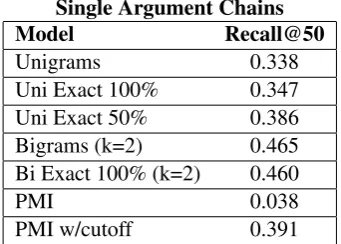
Single Argument Chains
Model Recall@50
Unigrams 0.338
Uni Exact 100% 0.347 Uni Exact 50% 0.386 Bigrams (k=2) 0.465 Bi Exact 100% (k=2) 0.460
PMI 0.038
[image:4.595.308.525.59.193.2]PMI w/cutoff 0.391
Table 1: Single entity event chain results. Multiple Argument Chains
Model Recall@50
Unigrams 0.322
Uni Exact 100% 0.332 Uni Exact 50% 0.368 Bigrams (k=5) 0.408 Bi Exact 100% (k=5) 0.396
PMI 0.068
[image:4.595.96.267.63.185.2]PMI w/cutoff 0.364
Table 2: Multiple argument event chain results.
6 Results
Table 1 shows model performance. The best un-igram model used our new instance-based learn-ing, but bigrams gain by 8% absolute. Notably, PMIperforms poorly as in Jans et al. (2012) and Rudinger et al. (2015). However, by adding a fre-quency cutoff,the poor result is reversed. Figure 1 shows the cutoff recall curve. Both papers con-cluded that PMI was the problem, but we found it is simply theover-evaluation of frequent events.
PMI is known to prefer infrequent events, and this is evident by looking at theinformation con-tent (IC) of model predictions. The information content of an event is its log probability in the Gi-gaword Corpus. What types of events do language models predict? Table 3 shows that the average LM prediction contains far less information. Per-haps more clear, Table 4 shows an actual list of predictions for one cloze test. The n-gram mod-els predict frequent events, but PMI predicts seem-ingly more meaningful events. We are not arguing in favor of PMI as a model, but simply illustrating how frequency explains almost all of the contra-dictions in previous work.
Finally, Table 2 mirrors the relative results of single arguments in the multi-argument setting. Once again, a simple cutoff parameter in the PMI
PMI Recall@50 with Frequency Cutoffs
Figure 1: Frequency cutoffs. Events seen less than the cutoff are not included in the PMI ranking.
Unigrams Bigrams PMI
5.8 6.7 9.4
Table 3: Avg. information content of predictions.
setting drastically changes the results. It is difficult to always know what settings were used in each at-tempt at this task, but the normalized experiments in this paper illustrate that the new cloze exper-iments have a heavy bias to the high-frequency events, regardless of how the events themselves are formalized (e.g., single argument or multi ar-gument).
7 Conclusion and Recommendations Automaticallygenerating event chains for evalua-tion does not testrelevantscript knowledge. The information content scores illustrate the huge ex-tent to which common events (said, tell, went) dominate. More concerning, we can simply adjust the frequency cutoff in PMI learning, and it elim-inates “poor results” from multiple previous pa-pers. Language modeling approaches tend to cap-ture frequent event patterns, not script knowledge.
Cloze Test Unigram Bigram PMI
X scored X said X made X scored X set up X have X said X beat X headed X had X scored X played X challenged told X X accused X missed
?? X told X had X hit
X is told X X led X was X told X joined
said X X is X went
[image:4.595.96.267.219.347.2]X has X was X finished killed X said X X opened
[image:4.595.312.519.612.723.2]This is revealed in our frequency-based results, as well as in subjective error analysis like Table 4.
The core problem is that auto-generation does not evaluate script knowledge. We can’t include all coreference chains from all documents and hope that this somehow measures script knowl-edge. The contradictory results from frequent events is just a symptom of the larger problem. We believe a human annotator should be in the loop for a meaningful evaluation. The test should include meaningful core events, and avoid oth-ers that are not script-relevant, such as discourse-related events (e.g., reporting verbs). Further, the test must not include events brought in through parser and coreference errors. By evaluating on parser output as gold data, we evaluate how well our models match our flawed text pre-processing tools. We acknowledge that human involvement is expensive, but the current trend to automate eval-uations does not appear to be evaluating common-sense knowledge.
Finally, although this paper focuses on the narrative event cloze, we recognize that differ-ent evaluations are also possible. However, the traits of human-annotationand core-eventsseem to be required. One interesting task this year is Mostafazadeh et al. (2016) and the Story Cloze
(manually created). Different from event chains, it still meets the requirements and provides a very large common corpus with 100k short stories. An-other recent proposal is the InScript Corpus from Modi et al. (2016). They used Amazon Turk to create 1000 stories covering 10 predefined scenar-ios. While not as large and diverse as the Story Cloze, the entire corpus was annotated for gold events, coreference, and entities. This is an in-teresting new resource that avoids many of the problems discussed above, although issues of an event’scorenessto a narrative may still need to be addressed.
We ultimately hope this short paper helps clar-ify recent results, inspires future evaluation, and most of all encourages discussion.
Acknowledgments
This work was supported by a grant from the Of-fice of Naval Research.
References
Simon Ahrendt and Vera Demberg. 2016. Improving event prediction by representing script participants. In Proceedings of North American Chapter of the Association for Computational Linguistics.
Nathanael Chambers and Dan Jurafsky. 2008. Unsu-pervised learning of narrative event chains. In Pro-ceedings of the Association for Computational Lin-guistics (ACL), Hawaii, USA.
Mark Granroth-Wilding and Stephen Clark. 2016. What happens next? event prediction using a com-positional neural network model. InProceedings of the 13th AAAI Conference on Artificial Intelligence. Bram Jans, Steven Bethard, Ivan Vuli´c, and Marie Francine Moens. 2012. Skip n-grams and ranking functions for predicting script events. In Proceedings of the 13th Conference of the European Chapter of the Association for Computa-tional Linguistics, pages 336–344. Association for Computational Linguistics.
Ashutosh Modi, Tatjana Anikina, Simon Ostermann, and Manfred Pinkal. 2016. Inscript: Narrative texts annotated with script information. InProceedings of the 10th International Conference on Language Re-sources and Evaluation (LREC 16), Portoroz, Slove-nia, pages 3485–3493.
Ashutosh Modi. 2016. Event embeddings for semantic script modeling. InProceedings of the the SIGNLL Conference on Computational Natural Language Learning (CoNLL).
Nasrin Mostafazadeh, Nathanael Chambers, Xiaodong He, Devi Parikh, Dhruv Batra, Lucy Vanderwende, Pushmeet Kohli, and James Allen. 2016. A cor-pus and cloze evaluation for deeper understanding of commonsense stories. In Proceedings of North American Chapter of the Association for Computa-tional Linguistics.
Karl Pichotta and Raymond J. Mooney. 2014. Statis-tical script learning with multi-argument events. In
Proceedings of the 14th Conference of the European Chapter of the Association for Computational Lin-guistics (EACL 2014), Gothenburg, Sweden, April. Karl Pichotta and Raymond J. Mooney. 2016.
Learn-ing statistical scripts with LSTM recurrent neural networks. InProceedings of the 30th AAAI Confer-ence on Artificial IntelligConfer-ence (AAAI-16), Phoenix, Arizona.