Evolution of Mobile Communication Based for
Existing and Future Cellular Technologies
Sandeep Singh1, Manoj Kumar Pandey2, Prof. (Dr.) Janak Kumar B. Patel3 1
M. Tech. Student, Department of Electronics and Communication Engineering, Amity University Haryana,Gurugram, India
2
Assistant Professor, Department of Electronics and Communication Engineering, Amity University Haryana, Gurugram, India
3
Professor & H.O.D., Department of Electronics and Communication Engineering, Amity University Haryana, Gurugram, India
Abstract: As telecommunication is communicating over a long distance so and this telecommunication like we have wireless, over a long distance we could have wired but requires a dedicated connection between the two things so we prefer wireless communication, over a long distance we call it as the telecommunication so as per the wireless technologies we have various generations. The mobile radio channel places fundamental limitations on the performance of wireless communication system. This is a very important point Wireless by definition is a very hostile environment. The mobile communication do not have a fixed line copper or the luxury of a large bandwidth like fiber so radio communication with the uncertainties of the channel, coupled with multipath propagation, attenuation, scattering and host of other problems. Now the various transmitted path may either be line-of-sight; a direct line of sight from the transmitter to the receiver or I can have a non line-of-sight in which case my signal is actually, obstructed either by building or foliage or Hills even cars on the streets. In general we deal with the non line-of-sight situations in our cellular mobile systems.
Keywords: Cellular Communication, 1G, 2G, 3G, 4G, and 5G
I. INTRODUCTION
These are different cellular networks have evolved from the first generation to the proposed fifth generation that's likely to happen so starting from 1980s so as per fig.1 dotted lines indicate research and standardization that's when there's a lot of work that's happening on some kind of research on that particular technology and standardization, so once it is standardized gets commercialized and is used. The first generation was started off early 1980s but it was commercialized around 1990. Second generation up to 2000 it was still under research and standardization 2000 it has been standardized. Then 3G started this time when 2G was standardized so at that time the research 3G has almost started and around 2010 3G has been even before that trail it's been standardized and 4G for instance has been standardized starting from 2012-13 and already work on 5G has been has started and hope is that by 2020 we will be having 5G standards and probably go on for another 10 years at least.
A. 1G, 2G, 3G, 4G, and 5G of Cellular Communications
It started from the very fast as 1G which is the first generation of wireless technologies we call it as telecom or telecommunications. 1G has started from wireless communication between one ends to another end. First generation has technologies like
1) NMT which is Nordic Mobile Telephony.
2) TACS which is Total Access Communication System.
3) ETACS which is here Extended Total Access Communication System.
They started wireless communication between two ends; this is the first generation of a wireless technology. The 1 G put the preference analog signals that mean all processing of analog signal. As we know the disadvantage of analog signal that means they are not able to cover up the long distance so move to the digital area so started second generation that means 2 G is digital technology. The signal uses us digital that means they have converted analog signals to the digital one and digital to analog one so because digital signals are able to cover up a long distance that's why used digital signal in a second generation. Hire is shown the journey of cellular technology Innovation in fig.2.
Fig.2 Journey of cellular Technology Innovation
In second generation use the technology as GSM, it is bones discovered, its name is group a special module and after that when he was globally accepted so its name changed to Global System for Mobile Communication because it became a global standard it become a global system and globalized, so name is Global System for Mobile Communication and it is the very successful technology in the second generation for having voice communication. So, our dream to communicate over a long distance, it is possible because of the GSM technology it is globally accepted for wireless voice communication. GSM is the very first technology in the second generation now after that voice; our main aim is data access. So moved to another technology it is on 2.5G GPRS, so GPRS stands for General Packet Radio Service. In GPRS have radio service, radio means packet transmission through air interface so able to access internet through air. 2.5G is a general packet radio service but the data laid here in this GPRS is very less so require to more data rate and comes new technology it called as 2.75 EDGE, the name EDGE Enhanced Data Rate for GSM Evolution, that means able to increased the data rate from GPRS to EDGE technology. These are the technologies under second generation but data rate here in the also not much good. Here is shown on fig.3 Evolution Phases of Mobile Network Technology.
After GSM, main evolution of increase the data rates so developed new technology its name is 3G. The 3G with the name of units stands for Universal Mobile Telecommunications System UMTS give us a data rate of 384 kbps where EDGE is around 170 kbps and for GPRS 56 to 64 kbps. Now we can see that there is an increase in data rate. Basically, UMTS which is a 3G and this is also having a feature of video calling. But require more data so set up a target for next generation it is One Gigabit per Second (1Gbps) for stationary users and 100 Mbps for high mobility users for 4G. This data rate is required for planes whenever moving with high mobility, require huge data rate so in order to meet these requirement of the high mobility services trains, bullet trains and planes these are targets of fourth-generation.
But after third generation move ahead in 3.5 G and it called as HSDPA which stands for High-Speed Downlink Packet Access, that means focused on the downloading speed because most of the users are downloading so after that we have an area of cloud computing that means we have to work with upload speed also so we have HSUPA, It is High Speed Uplink Packet Access. So HSUPA and HSDPA technology comes under 3.5 G. After that comes, new technology 3.75G HSPA+, so with the name of HSPA+ where plus will represent increased, this is High Speed Packet Access.
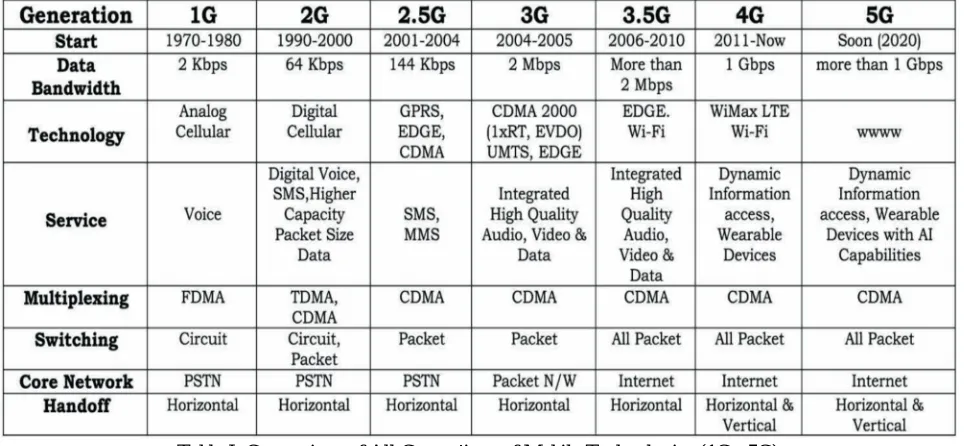
[image:3.612.66.548.304.527.2]After that required fourth generation from this, we expected that now will get four generation but we have 3.9G we call it as LTE, here LTE stands for Long Term Evolution that means evolution for a long term up. So that we achieve high speed data rate so, they launched 3.9G LTE with name of 4G LTE. So that we can under revenue and we can further use for the development or research of revolution, now we have achieved the 4G targets that means 4G successfully launched we have achieved one gigabit per second and 100 Mbps, here table 1 is showing Comparison of All Generations.
Table I: Comparison of All Generations of Mobile Technologies (1G - 5G).
After that set a target for 5G, now this is to be commercial in 2020 the target of Five Gigabit per Second (5Gbps). Now scientist is working on 5G technology and it is under research and development for the Fifth Generation, many companies are working so that we can achieve this data rate and in 2020 on 5G networks. So right now, the scenario is research and development in fifth generation.
In telecom technologies which will have now parallel, that means in second generation another technology also which is CDMA. CDMA is Code Division Multiple Access, this technology is prominent in some countries like US, some countries are using GSM, but CDMA is also there in the second generation, after that 2G; new technology comes in WCDMA, it is under in 3G. We call it as Wideband Code Division Multiple Access that means we have used the concept of CDMA in on 3G networks.
B. GSM Bands
Fig.4 GSM 900 Band
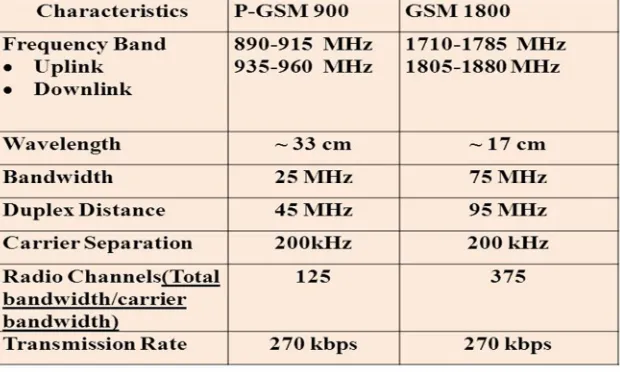
First band is 900 MHz it is lesser frequency band so it cover up the long distance and this band will be preferred most, after that comes 1800 MHz and 1900 MHz but each and every band has some specific capacity and specific range of frequencies. In very first band which is 900 megahertz to divide by in two sub bands so 900 megahertz as per its division it is uplink band from 890 to 915 megahertz and down link band from 935 to 960 megahertz. Uplink frequency 890 to 915-megahertz use for mobile device for sending the data, it requires to cover up the long distance in the network and need lower power. So, let's say if more distance to cover more less frequency required so in mobile station always kept the lower frequency but the down link power of the network or Mobil tower is more frequency as compared to mobile station so use high frequency for downlink as compare to the uplink. In all band frequency channel spacing is required between the uplink and downing frequency, so that uplink frequencies will not interfere with the downlink frequencies. Here shows the comparison between two bands
Table II: Comparison of 900 and 1800 frequency band
C. The principle of 2G Cellular Network
[image:4.612.153.463.381.567.2]Fig.5 Cellular frequency reuses patterns
As per shown fig. no 5 use three adjacent frequencies F1, F2 & F3, each adjacent cell use different frequency so that it cannot interference with each others. In every cells control by central base station, the mobile device talk to that base station using a wireless network. The base station connected to a mobile and telephone switching center, which is called the MSC. There is some informational is maintained at these switching centers so which is called as the HLR and VLR an HLR stands for the Home Location Register, VLR stands for Visitor Location Register. The home location register keeps tracking of the different details about the subscribers. VLR keeps tracking of those nodes or those users who are visiting particular location during roaming. Cellular network support mobility so that users can move from one area to another, when users moving from one MSC to another MSC the details of those users are kept in the visitor location register. The PSTN network which is connected to the rest of the different other networks through the MSC so that users able to make calls to other telephone networks. The very important aspects of cellular network are reusing the frequency. There for each cell and the same set of frequencies can be reused by another cell. The adjacent cannot reuse the same frequency. The advantage of reuse same frequency because to make better utilization of available bandwidth and increase the number of users.
Then another very important aspect is support multiple axes because many users are in a given area so need wide area of coverage and traffic management, all these things to be done with multiple access technique.
The multiple access techniques there are a few commonly technique use; time division multiplexing, frequency division multiplexing & code division multiplexing. In frequency division multiplexing the entire channel is divided into different-different frequencies so they use particular frequency for the entire duration of time. The entire duration of time same frequency will be used by a particular user or a channel. In time division multiplexing entire channel is divided by time with particular frequency. CDMA which is code division multiplexing so in CDMA all users can use all the frequencies and all the time, which means all sessions they share the frequency, it is shown in fig.
D. 2G Network Architecture
It has multiple base stations and these base stations are connected to as a base station controller. One BSC, controlling many base stations and base station controllers our mobile. The mobile station connected with mobile switching center MSC throw BSC and base station controller. The MSC is normally connected to a telephone network and the public telephone network by means MSC is called as a gateway. So this is the overall structure for transmitting voice. The base station is at the center of each cell so it has antenna, controller and transceivers. It handles the entire call process so number of mobile units handled by the controller.
Fig.7 Architecture of GSM
The BS connected to the MSC and one MSC can serve multiple BS as per shown in fig.7. The mobile switching center is also responsible for assigning voice channels, performing handoffs & monitoring calls billing. All handled by the mobile switching center. So there are normally two channels which are used one called the control channel and second call the traffic channel. The traffic channel is used to carry voice and some data. The control channels are used to set up the call and for maintaining calls. So they basically establish a relationship between the mobile units. So when users switch on the mobile, the control channel is on and through the control channel our device will be talking to the base station. At the network we normally use certain terms. The home network is registered in home location register HLR in MSC. Which has all information about our calls rate, network and permanent cell phone number, user profile information, services billing details, current location and some other information also, these all Information stored in home location register. At every Network a visitor location register VLR, which is keeps track the users currently in that particular network in roaming. So when user coming in roaming; user all information will be store in the VLR. So the VLR has complete details about all the people who are in that particular area and who are visiting.
E. The Routing
Let's one example; one user calling from some other network and other is calling through the public switch telephone network PSTN. The user actually belongs to particular network on a home network but now he is visiting some other network, so first the call will be based on his number will be located will be routed to his home mobile switching center MSC but the mobile switching center will have information that this person is actually roaming in a different area. So now consult at the HLR find the roaming information of the mobile visited network and transfer the call to that other mobile switching center MSC. This switching center is knows where this person is currently located through that particular base station. Then MSC route the call to that particular person as per shown in fig.8 & 9.
User is moving from one network to another that needs to be done handoff, the call from one base station to another or from one MSC to another MSC so handoff processing will do. So when user move from one base station to another base station the old base station will realize that its signal strength is reducing. It can initiate a handoff to another BS to which this particular user is currently moving so this process controls by mobile switching center controlling MSC.
Fig.9 Call routing management during Handoff
II. CONCLUSION
The mobile network that's used around the world to make calls, send messages and surf the web. Now there are plans for 4G to be replaced by, 5G - a new, faster network that has the potential to transform the internet. It will have a much better capacity than 4G which will dramatically improve internet speeds. Response times will also be much faster. The 4G network responds to our commands in just under 50 milliseconds. With 5G it will take around one millisecond - 400 times faster than a blink of the eye. 5G will also provide a much more personalized web experience using a technique called network slicing. It’s a way of creating separate wireless networks on the cloud. 5G to work properly however, it needs a frequency with much bigger bandwidth which would require brand new infrastructure.
REFERENCES
[1] Jyotsna Agrawal1,Rakesh Patel, P.Mor3, P.Dubey4 and J.M.keller5.”Evolution of Mobile Communication Network: from 1G to 4G”.
[2] Sunil Kumar and Rajeev Kumar. “5G - A Novel era in Wireless Technologies (Still 4G is not Properly Implementedinthe Market, but Time to Start Talking 5G)”.
[3] Prinima, and JyotiPruthi.“Evolution of Mobile Communication Network: from 1G to 5G,” International Journal of Innovative Research in Computer and Communication Engineering (An ISO 3297: 2007 Certified Organization) Vol. 4, Special Issue 4, August 2016.
[4] Manjurul H. KhanandP.C. Barman. “5G- Future Generation Technologies of Wireless Communication “REVOLUTION 2020,”American Journal of Engineering Research (AJER) e-ISSN: 2320-0847 p-ISSN: 2320-0936 Volume-4, Issue-5, pp-206-215.
[5] Usha. “5G: A Future Wireless Mobile Technology Vision,” International Journal of Electrical and Electronics Engineer Vol.No.7 Issue 02,July-December 2015.
[6] ReshmaS.Sapakal andSonali.Kadam. “5G Mobile Technology,” International Journal of Advanced Research in Computer Engineering & Technology (IJARCET) Volume 2, Issue 2, February 2013.
[7] Krunal N. Chandewar, Amit N. SangoleandShailesh S. Shekapure .“3G/4G Network Evolution”.
[8] Ganesh R. Patil and PrashantS.Wankhade.“5G Wireless Technology,”International Journal of Computer Science and Mobile Computing (IJCSMC), Vol. 3, Issue.10, October 2014, pg.203 – 207.
[9] DheerajGandla. “Study of RecentDevelopmentsin 5G WirelessTechnologies”
[10] Pavandeep Kaur1 andAmit Sharma.“Evolution of 4G Technology Demonstration of 4G Wireless Technologyand its Standards”.
[11] Aashna Vijay, MamtaRawatand DeepaYadav. “4G Networks in Cellular Communication: A Survey,”International Journal of Innovations & Advancement in Computer Science (IJIACS), Volume 4, Special Issue March 2015