259
ROTATION EXPERIMENTS WITH BLIND GOLDFISH
BY F. R. HARDEN JONES Fisheries Laboratory, Lowestoft
(Received 13 March 1957)
INTRODUCTION
Fish can maintain their orientation when rotated at constant velocity on a turntable (Steinmann, 1914; Schiemenz, 1927) in the absence of a moving visual field and when there is no relative motion between the water and the sides of the tank in which they are swimming. The response is not affected if the lateral lines are cut (Dijkgraaf, 1934), and it seems most likely that the stimulus to which the fish reacts is labyrinthine in origin. Gray (1937) suggested that the semicircular canals are the sensory channels through which a fish detects a rotation at constant velocity, and if this is so the mechanical stimulus must be an angular acceleration. But it has not been shown how a fish can be subjected to an angular acceleration during rotation at constant velocity, neither is there any experimental evidence to rule out the possibility that the centrifugal force developed during rotation, which would be detected by the otoliths, is the stimulus to which the fish responds. The behaviour of blind goldfish on the turntable was therefore re-examined.
MATERIAL
The experimental work was carried out over a period of 18 months with six small goldfish, Carassius auratus, 4-6 cm. in length, which were blinded by removal of their eyes while under anaesthesia. All survived the operation and subsequently grew faster and appeared to be in slightly better condition than the stock of normal fish from which they were taken. In the middle of the experiments one fish leapt from its dish on to the floor, while being returned to the aquarium and had to be killed. There were no other losses.
The reactions of blind goldfish to light. The possible sensitivity of blind goldfish to light was investigated by comparing their locomotory activity under low red light with that observed when a tungsten filament lamp giving an intensity of 1400 m.c. was switched on. As no change in activity was observed, it was con-cluded that blind goldfish are probably insensitive to light.
260 F. R. HARDEN JONES
90 cm. in diameter. Spencer (1939) noticed this tendency to swim in one direction in normal unblinded goldfish and it could, unless allowed for, be a source of error when working at rotational speeds close to the threshold level.
APPARATUS
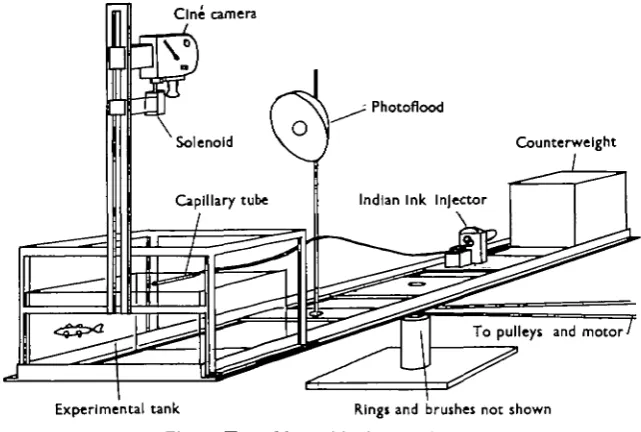
The turntable used was mounted on ball and thrust races and driven by a 0-3 h.p. high-speed motor rated at 1420 rev./min., final rotational speeds being obtained with the use of a 95-1 worm reduction gear and a series of pulleys. For most of the experiments two T bars were bolted to the turntable top, as shown in Fig. 1. The
Counterweight
[image:2.451.64.385.210.426.2]Experimental tank Kings and brushes not shown Fig. 1. Turntable used in the experiments.
T bars provided an extension of the turntable 2-4 m. in diameter and allowed the Perspex tank to be mounted either at the centre of rotation or at the periphery where the angular velocity would be the same but the centrifugal force about 8 times as great. Cinematographic records of the fish's movements during rotation were taken by a 16 mm. Bolex Paillard camera mounted above the tank as shown in Fig. 1. The camera was clockwork-driven and operated by a solenoid, and its frame speed at various settings checked against a disk turning at a known rate. When cin6 films were taken a uniform field of illumination was provided by a photoflood mounted on the turntable. The electric supply to the photoflood and solenoid was led on to the table by means of rings and carbon brushes not shown in the figure.
Rotation experiments with blind goldfish 261
so arranged as to press home the plunger of a hypodermic syringe, which was connected by tubing to an ink-filled capillary tube projecting into the experimental tank. At an angular velocity of 6o.7sec. it was found that all relative movement between the water and the tank ceased within 4 min. of the start of rotation. A drop of indian ink injected into the tank then sank to the bottom with no indication of a swirl. To be sure that all swirls and eddies had gone, no photographic records were taken during the first 5 min. of rotation and to avoid the possibility of fatiguing the fish none were taken more than 10 min. after the start of an experiment. At lower angular velocities, down to i-5°/8ec, circular tanks or baths were used in place of the small Perspex tank, and in such experiments every precaution was taken to ensure that all relative motion between the water and the sides of the tank had ceased before observations were made. At the lower speeds 15 min. were allowed for the water to gain the speed of the tank.
The angular velocity of the turntable was found with a stop-watch but when a more accurate result was needed the data were extracted from cine" films. These showed that the speed of rotation was reasonably steady and usually did not vary by more than 0-5° in fa sec. Occasional variations as great as 1-5° in fa sec. were observed but it is difficult to say to what extent these were due to errors of tracing and measurement. It could be argued that the accelerations and decelerations accompanying these velocity changes provide the fish with information about the speed and direction of rotation and that there is no need to look for any other stimulus. This point will be dealt with later when considering the magnitude of the accelerations involved and the probable threshold level for the fish, and it will be shown that it is unlikely that any information would have been gained from the turntable itself.
PRELIMINARY OBSERVATIONS
direction of rotation. When the turntable was stopped, the water continued in the direction of rotation and would at times carry the fish round with it. Here again there was a marked change in behaviour if the fish happened to touch the sides of the tank. The fish then swam strongly into the swirl, maintaining its position relative to the side of the tank, until the water slowed down.
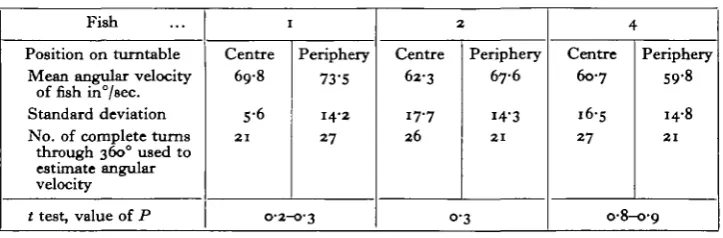
[image:4.451.46.408.350.469.2]These observations are similar to those made by Dijkgraaf (1934) on the reactions of blinded minnows to rotations at constant velocity. There can be little doubt that the behaviour of the fish observed at the beginning and end of the experiment is stimulated by contact with the sides, the movements of the fish being such as to maintain its position relative to the surrounding tank. It is only when the water has gained the speed of the tank that the response to rotation is observed. The fish then reacts by making well-defined turning movements which enable it to maintain more or less the same geographical bearing, and it will, at an angular velocity of 69°/sec, keep this up for 1-2 min. at a time. An analysis of cinematographic records taken at this speed of rotation showed that there was no significant quantitative difference in the response of the fish, as measured by its own average angular velocity, when the experimental tank was at the centre or the periphery of the turntable. These results are summarized in Table 1.
Table 1. Angular velocity of blind goldfish swimming in the direction opposite to that of rotation at 69°/sec. in the two positions on the turntable
Fish
Position on turntable Mean angular velocity
of fish in7sec. Standard deviation No. of complete turns
through 3600 used to estimate angular velocity
t test, value of P
1
Centre 69-8
5-6 2 1
Periphery 73-S
14-2
27
O-2-O-3
2
Centre 62-3
17-7 26
Periphery 67-6
14-3
2 1
0-3
4
Centre 6o-7
i6-s
27
Periphery 59-8
14-8
2 1
0-8-0-9
Rotation experiments with blind goldfish 263
and avoided any errors that might arise from the fish having a bias to swim in one particular direction.
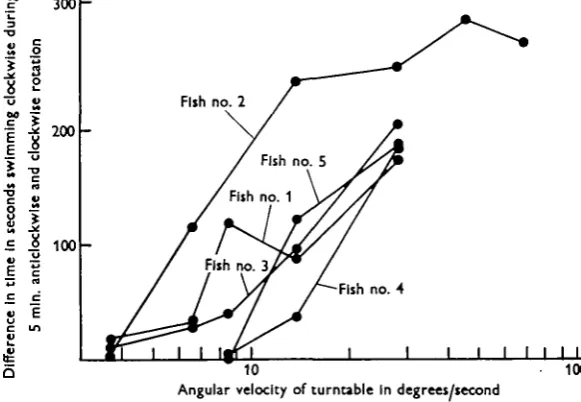
The results of these observations are summarized in Fig. 2, where it will be seen that, for the best performers, the threshold angular velocity to induce a response appears to be about 3°/sec. At low angular velocities the fish did not always respond, and for some time there might be no apparent response at all, the fish swimming quietly in the tank, either at random, or, in the case of those with a bias, mainly in one direction. When a response did occur, their behaviour was markedly different.
[image:5.451.79.370.200.401.2]Angular velocity of turntable In degrees/tecond
Fig. 2. Results of experiments made to determine the lowest angular velocity to which fish respond.
A fish would remain more or less poised in midwater, turning in a small circle against the direction of rotation, making distinct compensatory movements with the tail between which it appeared to lose way and was carried round with the turntable relative to the ground. A second series of observations was made in which subjective estimates were made of a fish's response to low angular velocities, with results that are summarized in Table 2. At 8-8°/sec. the best fish could maintain the same orientation for up to 30 sec, but in general a response at low angular velocities was marked by over-compensation. At the lowest angular velocity used, i-7°/sec., a fish would sometimes appear to be 'aware' of a sensation of rotation, although frequent 'mistakes' were made in turning and the fish could never be said to show a clear positive response. While subjective judgements of this sort are always open to criticism, it will be seen that the results of the two series of experi-ments are in good agreement one with another.
Table 2. Subjective estimates of response of blind goldfish to rotation at constant velocity in five experiments ( + — clear positive response, ?—possible response, — —no response.)
Angular velocity of turntable in degrees per second
Fish i-7°
i
i — r r r r 2 — — — — ?
3 - - - -
-1
! :
3-6°
t t
XX
I
8-8° 12-8°
+ lost in accident
THE STIMULUS TO WHICH THE FISH RESPONDS
An attempt was made to check up on the various stimuli to which the fish might react. It was observed that the response does not develop suddenly in the early stages of rotation and only becomes clearly defined as the initial water swirl dies away. The water swirl and vibration of the motor accompanying rotation might provide the fish with some clue as to what is going on.
(1) Water stoirl and vibration of motor. A fish was given the vibrational stimuli accompanying rotation and the water swirl appropriate to clockwise or anticlock-wise movement. This was done by modifying the turntable so that the rotation of the tank about a vertical axis was changed to a curvilinear translation. The centre spindle of the turntable was drilled to clear a | in. steel rod firmly attached to the base plate. At its upper free end it was connected by a chain and two sprocket wheels of equal diameter to a second turntable mounted on the T bars towards the periphery of the main one. When the latter rotated, the secondary turntable, carrying the experimental tank, turned at the same angular velocity but in the opposite direction so that the tank, water and fish were carried round along a curvilinear path without rotation. There was, of course, no water swirl due to this movement. Under these conditions of curvilinear translation no response was ever made by the fish. However, if sprocket wheels of unequal diameter were used, so that the second turntable rotated relative to the ground, the fish reacted well. A number of experiments were made in which a curvilinear translation was immediately pre-ceded by a hand-made water swirl to simulate the conditions at the onset of normal rotation. No reaction was ever seen to suggest that the fish gained any information from the swirl or vibrations accompanying the movement of the turntable.
(2) Accelerations due to the movement of the turntable. The fish might react to the impulsive jerk or acceleration which occurs when the turntable gets under way and small variations in turntable speed might provide information about the velocity and direction of rotation. The first point to consider is the threshold level for the perception of an angular acceleration and the best that can be done is to assume, not unreasonably, that the fish labyrinth is at least as sensitive as that of man. With a very sensitive human subject the minimum sustained angular acceleration which
Rotation experiments with, blind goldfish 265
and it will be assumed that the threshold for a fish is similar. Now the product of the time t in seconds and the angular acceleration a in degrees/sec.2 required to reach the threshold for a sense of rotation is, according to Mulder's Law, constant, and Groen & Jongkees go on to show that for man its value lies between 2 and 3. Furthermore, the Mulder Product at, as it is called, should be numerically equal to the minimal detectable impulse, which is most easily measured by determining the lowest angular velocity, in degrees per second, from which a sudden deceleration gives rise to a sense of rotation. Experiments (Dodge, 1923; Groen & Jongkees, 1948; Hulk & Jongkees, 1948) show that this minimal angular velocity is, as expected, of the order of 2-3°/sec. So it seems reasonable to conclude that an angular acceleration or deceleration of c-2/sec.2 or more could be detected by a fish if the otf product is not less than 2, and that the threshold level for an impulsive stimulation is about 2-3°/sec.
To test the possible orientating effect of the initial acceleration which occurs when the turntable gets under way a constant angular velocity was reached after a period of controlled subliminal acceleration. A quantitative estimate of the fish's response was made after 5 or 10 min. rotation at the final speed. This experiment could not be carried out with the turntable described here, and I am very grateful to Dr C. S. Hallpike, F.R.S., Director of the Medical Research Council's Otological Research Unit for allowing me to use his special revolving chair (Byford, Hallpike & Hood, 1952) at the National Hospital, Queens Square, London. On this chair fish were accelerated at a little less than o-2°/sec.2 to an angular velocity of 25°/sec. As the fish clearly responded at the final speed after the subliminal acceleration, the initial jerk at the start of rotation cannot be the sensory clue to which it reacts.
At an angular velocity of 69°/sec. the variations in the speed of the Lowestoft turntable were normally not greater than 0-5° in ^ sec. but occasional variations of 1-5° in yffsec. were observed. The angular accelerations, 130 and 39°/9ec.2 respectively, are well above threshold, but the <x.t products 0-5 and 1-5 are below although close to the critical value. Analysis of cinematographic records failed to show any correlation between movements of the fish and variations in turntable velocity. Such variations in turntable velocity are bound to be considerably if not completely smoothed out by the inertia of the water. I have myself sat on the Lowestoft turntable and, once the sensation due to the initial acceleration had died away, never experienced any feeling of rotation. Furthermore, the fish responded well on the Medical Research Council's chair which is a good deal steadier than the turntable used in Lowestoft. It does, therefore, seem most unlikely that the reactions of the fish can be due to variations in turntable velocity.
266 F. R. HARDEN JONES
strength of the response of the fish when at the centre or periphery of the turntable at three different angular velocities.
The results of these experiments should show whether the response varies with centrifugal force or angular velocity, the method being essentially similar to that used by Maxwell (1923) to determine whether the turning movements of the horned lizard Phrynosoma were made in response to angular acceleration or centrifugal force. As in the threshold experiments, an objective measure of the response was obtained by recording the difference in the time spent swimming clockwise during anticlockwise and clockwise rotations.
Results. The results of these experiments are summarized in Table 3. Whether the fish is at the centre or periphery of the turntable there is, at any particular angular velocity, no significant difference in the strength of the response despite an almost eightfold difference in centrifugal force. Furthermore, a greater centri-fugal force does not by itself lead to a stronger response. This is evident when comparing the results obtained at 260 (centre) with those at 13° (periphery) and 130 (centre) with 6-5° (periphery). There can be little doubt that the response of the fish, as measured here, is related in some way to the velocity of rotation and not to centrifugal force.
(4) Angular accelerations. The results of the previous experiments show that the fish are not responding to the initial water swirl, variations in turntable velocity or centrifugal force. The possibility must now be examined that they are reacting to an angular acceleration, and the first problem to consider is how this could occur during rotation at constant velocity.
So long as a fish swims at an angular velocity equal and opposite to that of the rotation it is not subjected to any turning movement about its vertical axis, although it may be carried along a curvilinear path relative to the ground. Furthermore, provided the fish swims at a steady speed without rolling or pitching it is not sub-jected to an angular acceleration even if its own angular velocity is greater or less than that of the turntable. Under conditions of complete stability angular accelera-tions can only arise through variaaccelera-tions in the fish's own angular velocity and if these occur, the fish will yaw about its vertical axis relative to the ground. This is shown diagrammatically in Fig. 3. The turntable is rotating in an anticlockwise direction at a velocity of 6o°/sec. In A the fish is swimming at a constant angular velocity equal and opposite to that of the rotation. Relative to the ground the fish is carried without rotation, along a curvilinear path whose radius is equal to the difference between that of the turntable and the circle in which the fish swims relative to the water. The effect of a change in the angular velocity of the fish is shown in B. As the fish slows up it is carried backwards relative to the ground and yaws about its vertical axis in the direction of the turntable's rotation, and is thus subjected to an angular acceleration.
Table 3.
Results
of experiments to test the possibk reactions of fish to centrifugal force Angular velocity of rotation in O/sec....
Position of fish on turntable R in an. Centrifugal force &, Number of experiments Difference in seconds between the time that the 6sh was seen swimming clockwise during five minute periods of anti- clockwise and dockwise rotation Standard deviation t test, value of t D.P. = 18, value of P Centre/
Periphery Fish no. ICentre '5
1'07
I0
112'0 36.3
Periphery I20
8.56
I0
121.1 37'7
Centre 15
0.19
I0 52.6 48.9 Periphery I
ZO 1-52 I0 53'5 49'8
Centre Peripheq 15 IZO 2.8 22.4 I0 I0 190.9 181.3 Fish no. 2
Centre 15
I
'07
I0
Iog.0 53'4 Periphery I20
8.66
I0
19.0 37.1 Centre 15
0.19
I0 74'1 38'9 Peripheq I20
1.52
268 F. R. HARDEN JONES
Dr J. D. Hood (Medical Research Council's Otological Research Unit) has drawn my attention to another way in which a fish could be subjected to an angular acceleration during rotation at constant velocity. When a man is rotated on the revolving chair no sensation of turning is felt once the effect of the initial accelera-tion has died away as so long as the head is held still. However, if one rapidly nods or tilts the head there is an immediate sensation of turning and a clear indication of the direction in which the chair is moving. The explanation of this is that movement of the head in a plane other than the horizontal could alter the position of all three pairs of canals relative to the plane of rotation and that they therefore receive an impulsive stimulation whose strength depends on the angular velocity of the chair
Fig. 3. A diagram to show the movements of a fish relative to the tank and ground during rotation at constant angular velocity of 6o°/sec. In A(i) the fish swims at an angular velocity equal and opposite to that of the rotation and its path relative to the ground is shown in A(2). In B(i) the angular velocity of the fish decreases after 2 gee; in B(2) it can be seen that the fish is then rotated about its vertical axis relative to the ground.
and the extent of the movement of the head. If the head is held still in the new position the sensation of turning dies away in a manner similar to that experienced when the chair starts to turn. This means that if the fish is not completely stable and rolls or pitches about its longitudinal or transverse axis when swimming at an angular velocity differing from that of the turntable, the semicircular canals will be subjected to accelerations from which the fish might be able to tell the direction of rotation.
Rotation experiments with blind goldfish
269
(a) Variations in the angular velocity of the fish
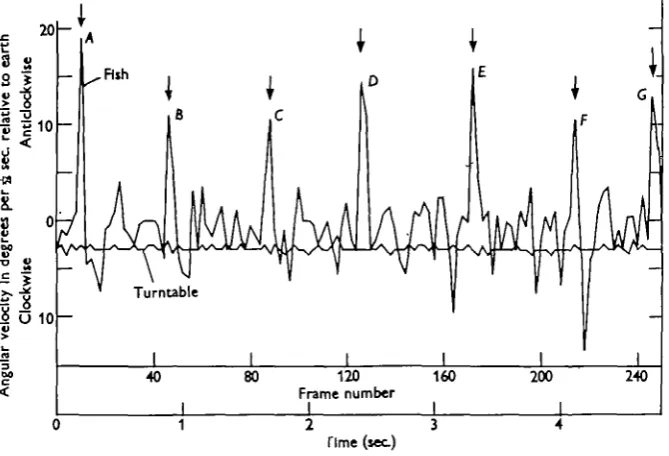
The T bars were removed from the turntable and the Perspex tank placed at its centre. Pointers attached to the spindle of the turntable and moving over a large degree scale made possible an accurate determination of angular velocity. The camera was mounted over the centre of the tank but did not rotate with it. In working up the films the negatives, or positives when printed, were projected vertically on to paper and careful tracings made of the position of the fish and the tank. From these tracings the angular velocity of the fish and tank could be found. Results. A study of the slow motion films and a frame by frame analysis of those selected for working up showed that the fish do not swim continuously against the direction of rotation. This is evident from Fig. 4 in which the angular velocity of
•I 8 s -PS
2
P
v0 1 2 3
[image:11.451.60.395.240.468.2]Time (sec)
Fig. 4. Analysis of a cin6 film to show angular velocity of fish and turntable relative to earth. Turning movements are indicated by arrows.
the fish and the turntable relative to earth are shown at intervals of -£$ sec. The angular velocity of the fish varied considerably. The sudden compensatory move-ments of 15-20° were always associated with active turning movemove-ments against the direction of rotation. The angular velocity of the fish rarely, if ever, fell away smoothly between compensatory turns. The reason for this appeared to be that the fish was using its tail, intermittently, as a rudder to compensate for the decrease in its angular velocity. In Fig. 5, the data used in Fig. 4 are presented to show the degrees turned through by the turntable and fish, after successive intervals of -fa sec. During this particular revolution of the turntable the fish just failed to maintain its orientation, and inspection of the cine" film shows that it is losing way and being carried backwards relative to the ground.
270
- 300
1
200
100
40
_L
Turntable D
Fish
80 120 160 Frame number I I
200 240
I
0 1 2 3 4 3
[image:12.451.68.400.63.304.2]Time (tec)
Fig. 5. Anfllysis of a cin£ film to show the degrees turned through, irrespective of direction, at ^y sec. intervals. Turning movements are indicated by arrows.
X
6
X
X
X
X
X
X
X
X
X
8
13
X
X
X
9
14
X
X
10
15
X
Rotation experiments with blind goldfish
271s
-"8
I I I I I I I I I I I I I I I I 10 15
Frame number
J I
20" 25
025 0-5
Time (sec)
[image:13.451.89.365.88.327.2]0-75
Fig. 7. Graphical presentation of the movements of the fish shown in Fig. 6. Full explanation in text.
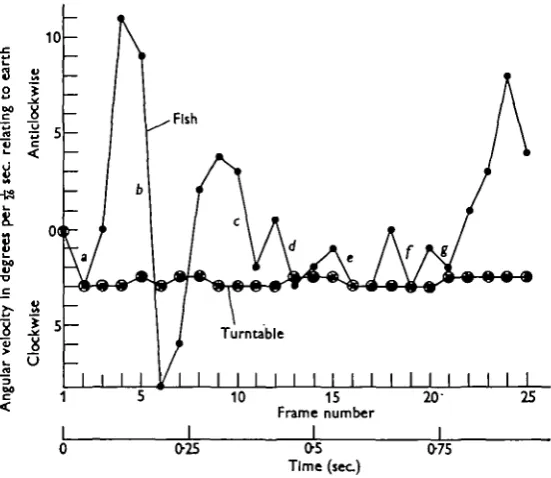
A more detailed analysis of the movements and orientation of a fish between two turning movements is shown in Figs. 6 and 7. The film was taken when the fish was being rotated clockwise at a speed of 73°/sec. The camera was running at 52 frames/sec, and tracings of the fish were made from every other frame. In Fig. 6 the point through which the vertical axis of the fish was judged to pass has been lined up over the centre of each square so that the orientation of the fish relative to the ground can be seen easily. The velocity of the turntable is also given in Fig. 7. Taking the two figures together, the following points can be noted:
Frames 1-2 2-3
3-5 5-7
7-10
10—11 11-12 12-13
13-15
15-17 17-18
18-19 IO-2I 21-25 18
Remarks Fish carried passively clockwise with turntable
Tail coming over at start of turn; fish holding its own relative to ground Anticlockwise turn of 200
Fish turns clockwise during recovery of tail
Much of the lost ground regained as the tail comes over to the left, with a rudder-like action
Fish carried clockwise with tank
Clockwise rotation checked, presumably by tail
Fish carried passively clockwise with tank, the extra 0-5° may be a drawing error
Clockwise rotation partially checked; presumably by tail although this cannot be seen on the film
Fish carried passively clockwise with tank
Clockwise rotation partially checked; slight indication of tail coming over to the left
Fish carried passively clockwise with tank
Clockwise rotation partially checked; tail coming over to the left Fish makes an anticlockwise turn of 160, re-gaining all the lost ground
272 F. R. HARDEN JONES
In this sequence it will be seen that between frames 10 and 21, after which the next turn develops, the fish does not make any ground against the clockwise rotation and only succeeds in checking, from time to time, its movement with the turntable. So far as the fish's own movements are concerned, it is evident that rotation proceeds in a series of angular accelerations and decelerations, and the question now arises as to whether they can give any information about the speed and direction in which the turntable is moving.
Although calculations, summarized in Table 4, show that all but one of the decelerations occurring in the cycle analysed in Figs. 6 and 7 could probably have been detected, it is difficult to see what useful information they could give to the fish. The mechanical stimuli it receives will be identical to that which it would get if it were swimming anticlockwise at a variable angular velocity when the tank was still. Table 4 Deceleration a b c d e / g Duration
t in sec.
0-031 0-031 0-031 0-031 0-031 0-031 0-031 Changes in degrees 3 17 5 3-S 2 3 1 a degrees/sec.1 78 441 130 9 i 5» 78 26 at (impulse) 3 17 5 3'S 2 3 1
If it slows up, there will be an increase in the resting discharge from the right semi-circular canal, but these re-afferent stimuli must be ignored (cf. von Hoist, 1954) otherwise the fish would circle for ever. The fact that the fish may be swimming at a variable angular velocity in a rotating tank cannot alter the mechanical stimuli received in the horizontal canals, although the fish may be accelerated backwards relative to earth as it slows down. As Lowenstein & Sand (1936) remark: 'the arrest of rotation is physically equivalent to acceleration in the opposite direction'. So although variations in the angular velocity of the fish do occur, and although it seems probable that accelerations introduced in this way could be perceived by the fish, it seems that they cannot provide any information about the rotation of the turntable.
(b) The detection of rotation by rolling or pitching
Rotation experiments with blind goldfish 273
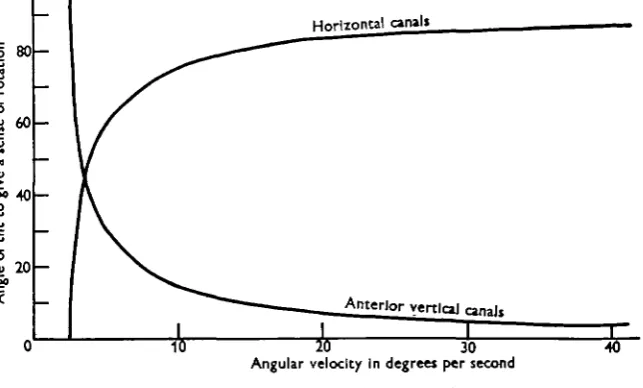
I angular velocities. During a roll or tilt, the force acting on the anterior vertical canal will be proportional to the product of the sine of the angle of tilt and the angular velocity, while that of the horizontal canal will be proportional to the product of the cosine of the angle of tilt and the angular velocity. According to Egmond, Groen & Jongkees (1949) the minimal detectable cupula deflexion is about 0-25° and the magnitude of the cupula deflexion obtained during impulsive stimulation is of the order of one-tenth of the angular velocity from which the subject or preparation is brought to rest. So considering each canal separately, the minimal angle of tilt required to give a sense of rotation at constant velocity will be sin 6 = (0-25 x 10)/ V for the anterior vertical canals, and cos # = (0-25 x io)/F for the horizontal canals,
80
S 60
40
v 20
Horizontal canals
•fu 20 30
Angular velocity In degrees per second
[image:15.451.67.389.221.415.2]40
Fig. 8. The angle of tilt required to give a sensation of turning during rotation at different angular velocities.
where V is the angular velocity of rotation in degrees per second. The values obtained by calculation from these equations are shown in Fig. 8. The critical angles for pitching would of course be similar. If the sensitivity of the fish labyrinth is of the same order as that of man, and rolling or pitching is the means by which they are able to detect and respond to rotations at constant velocity, it should be possible to observe movements of the order given in Fig. 8 at different angular velocities.
Attempts to measure the roll of a fish while it was responding to rotation at constant velocity have not been successful. The cine' camera was mounted vertically above the tank, and a mirror placed so as to give an end on picture of the fish on half of the field of view. At rotations below 2O°/sec. the fish headed into the mirror for only a few seconds at a time and inspection of films taken at this and higher angular velocities failed to reveal any sign of rolling. The rolling should, of course, be greatest at lower angular velocities but, if confined in a small tank, the fish then spends most of its time swimming along the sides, and in a larger tank the fish is
274 F- R- HARDEN JONES
hardly ever in the field of view of the camera. Some head on shots were made of fish swimming in a stationary tank but no rolling movements could be detected. The fish appeared to be quite stable. Careful observations on fish in large circular tanks being rotated at low angular velocities did not give any indication of any rolling or pitching. Negative results do not, of course, exclude the possibility that the fish becomes aware of the rotation by rolling or pitching. Small movements of this sort are difficult to detect, and if the threshold for perception of impulsive stimuli is lower than has been supposed their observation and measurement will not be easy.
DISCUSSION
It seems clear enough that the reaction of blind fish to rotation at constant velocity is a real one and that the stimulus to which the fish responds is neither one of contact, a water current, centrifugal force nor the initial acceleration when the turntable gets under way. It does, however, seem most likely that the semicircular canals are the sensory channels involved. While the decelerations to which the fish is subjected between compensatory swimming movements are of such a magnitude and duration which makes it reasonable to suppose that the fish could detect them, it is very difficult to see how they can provide any useful information as to the direction or speed of rotation. Hood's suggestion that the fish detects the rotation as it rolls or pitches slightly during swimming is the more attractive hypothesis as it has a foundation in human experience: it is certainly possible. But at the moment the experimental evidence is not sufficient to decide between these two. The next line of approach must inevitably involve some operations on the labyrinth and perhaps an electrophysiological investigation into the sensitivity of the canals of the fish labyrinth to tilting or pitching during rotation at constant velocity.
It remains to be seen how far a fish's ability to maintain its orientation when subjected to rotation at constant velocity about a vertical axis might enable it to main-tain a steady course in natural conditions. If it is assumed that the threshold rotation is about 3°/sec. the diameter of the swirl in which a fish could maintain a bearing or 'head into the stream' could be calculated for different current velocities. But the worth of such calculations depends on a detailed knowledge of small scale water movements in the sea and at the moment the necessary data do not seem to be available. At all events an orientation of this nature would depend on local hydro-graphic conditions, and it does seem unlikely that the response could be of any value for navigation over long distances in open water.
SUMMARY
1. Blind goldfish react to rotation at constant angular velocity by swimming against the direction of rotation so as to maintain, on the whole, the same orientation or bearing relative to earth.
Rotation experiments with blind goldfish 27$
3. The stimulus to which the fish responds is not one of contact, initial swirl or water current (when the turntable gets under way), variation in turntable velocity or centrifugal force.
4. The semicircular canals are probably the sensory channels through which a fish is able to detect rotation at constant velocity and the mechanical stimulus to which it responds is probably an angular acceleration. How the fish becomes aware of angular accelerations during rotation at constant velocity is not yet understood.
I am very grateful to Mr H. W. Lissmann, F.R.S., and Prof. O. E. Lowenstein, F.R.S., for their advice and criticism while I was doing this work.
REFERENCES
BYFORD, G. H., HALLPIKE, C. S. & HOOD, J. D. (1952). The design, construction and performance
of a new type of revolving chair. Acta otolaryng., Stockh., 43, 511-38.
DIJKGRAAF, S. (1934). Untersuchungen tiber die Funktion der Seitenorgane an Fischen. Z. vergl. Physiol. 30, 162-215.
DODGE, R. (1923). Thresholds of rotation. J. Exp. Psychol, 6, 107-37.
EOMOND, A. A. J. VAN, GROEN, J. J. & JONGKEES, L. B. W. (1949). The mechanisms of the
semi-circular canal. J. Phytiol. n o , i—17.
GRAY, J. (1937). Pseudo-rheotrophism in fishes. J. Exp. Biol. 14, 95-103.
GROEN, J. J. & JONGKEES, L. B. W. (1948). The threshold of angular acceleration perception. J. Physiol. 107, 1-7.
HOLST, E. VON (1954). Relations between the central nervous system and the peripheral organs. Brit. J. Anim. Behaviour, 2, 89-94.
HULK, J. & JONGKEES, L. B. W. (1948). The turning test with small regulable stimuli. II. The normal cupulogram. J. Laryngol. 63, 70—75.
LOWENSTEIN, O. & SAND, A. (1936). The activity of the horizontal semicircular canal of the dogfish, Scyllium camcula. J. Exp. Biol. 13, 416-28.
MAXWELL, S. S. (1923). Labyrinth and Equilibrium, pp. 163. Philadelphia and London: Lippincott. SCHIEMENZ, F. (1927). Das Verhalten der Fische in KreisstrOmungen und in geraden StrOmungen,
als beitrag zur Orientierung der Fische in der freien natllrlichen Wasserstromung. Z. vergl. Physiol. 6, 731-50.
SPENCER, W. P. (1939). Diurnal activity rhythms in fresh-water fishes. Ohio J. Sci. 39, 119—32. STErNMANN, P. (1914). Uber die Bedeutung des Labyrinthes unter der Seitenorgane filr die