A Particle Swarm Optimization Algorithm for Test
Scheduling in Agile Testing
Bhuvneshwari1, Ruchika Sharma2 1
Research Scholar, 2Associate Professor 12
Baddi University of Emerging Science and Technology, Solan, India
Abstract: The testing is the technique which is used to test the software. The various types of testing are proposed which will test the software and test number of faults. In this work, agile testing is discussed which contains the multiple testing’s. These testing are black box testing, white box testing, mutation testing and model based testing. There are various type of testing’s can be applied in the agile testing. To execute agile testing in the efficient manner, the testing’s need to be scheduled . When the testing’s of the agile testing is not scheduled in the efficient manner, it leads to detection of fault in incorrect manner. In this work, improvement is been proposed in the agile testing which can schedule the testing’. To schedule the testing’s technique of PSO technique is applied which will schedule the testing’s. The proposed and existing technique is implemented in MATLAB and it is been analyzed that proposed technique performs well in terms of fault detection rate.
Keywords: Software Engineering, Testing, Agile Testing, Particle Swarm Optimization algorithm, Scheduling
I. INTRODUCTION
Black-box testing is also known as functional testing. This testing ignores the internal mechanism of the system. It is a testing which is based upon the output and having no knowledge of internal code. It is a type of white-box testing. It is a testing for low-level design code. It is done within a class and starts from a individual module. It has testing the smallest unit of elements of software which module or component or unit .It is basically done by programmer not tester and requires detail of structure of code. Regression testing is used to retest the component of a system that verifies that after modifications defects are removed from the in effected software. Automation tools are required for these types of testing. The process of verifying the modified software in the maintenance phase is known as Regression testing. Time and budget constraints are its major disadvantage due to complex process [7]. Agile Testing is a testing which follows the rules of the agile software development. Agile is an iterative development methodology, where requirements evolve through collaboration between the customer and self-organizing teams and agile aligns development with customer needs. Agile ordinarily alludes to an expert tester who embraces changes, works together well with the business technical team and comprehends the idea of software document requirement and to infer them. They will find out about the customer so they can recognize what they can do as per the customer needs according to the software requirements.
II. RESEARCH METHODOLOGY
In this case study various modules of the website are considered and their test cases. The agile testing will be applied on each module of the website with their developed modules. To select best value, technique of PSO will be applied which select value on the basis of type of software for which test cases are going to generate. The Particle Swarm Optimization is the algorithm utilized as the optimize solution using which difficult problems are solved. The development of PSO is modeled by the bird flocks and schools of fish. It is considered as the evolutionary computation technique but in some manner it differs from other algorithms such as genetic algorithms. In the initial state, there is initialization of the swarm of particles in the PSO that proceed with a random solution to the problem. In the given velocity around the search space particles moved. A potential solution is represented by the location of a particle at a given point in which the fitness function is used to evaluate fitness. The previous generations has been utilized in order to govern and generate subsequent generations. Therefore, in order to find out the optimal solution for the given problem, the particles moved around the search space to produce new generations. Until the generation limit reached or the optimal particle in the population cannot be improved this process continues. The behavior of the swarm is given by the following equations:
ν( + 1)= ν (t) + ∅ . − + ∅ . ( − )
x(t+1) = x(t) + ν( + 1)
A. Proposed Algorithm
1) Input: training examples, list of predictor attributes 2) Output: Detected faults
3) nitialisePheromones(
4) . ComputeHeuristicInformation(
5) ← ∅
6) m←0
7) while m < maximum iterations and not CheckConvergence() d
8) . ←
9) . for ←1 to colony size do
10) ← ( , ,−)
11) ( )
12) if ( ) > then
13) . ←
14) end if 15) end for
16) ℎ ( );
17) . if ( ) > then
18) . ←
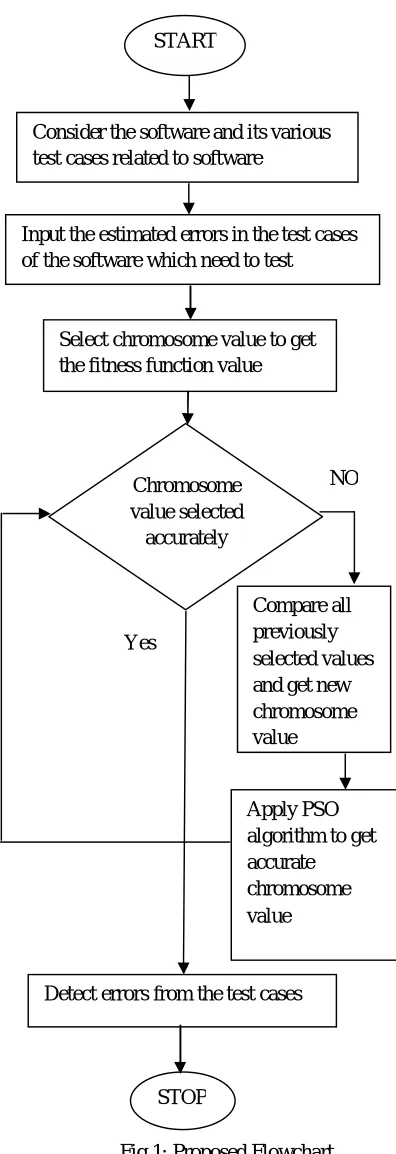
Fig 1: Proposed Flowchart
III. EXPERIMENTAL RESULTS
The proposed algorithm will schedule the testing’s of agile testing for the detection of maximum faults from the software. The proposed algorithm is implemented in MATLAB by taking five type of testing’s as input
START
Consider the software and its various test cases related to software
Input the estimated errors in the test cases of the software which need to test
Select chromosome value to get the fitness function value
Chromosome value selected accurately
Compare all previously selected values and get new chromosome value
Apply PSO algorithm to get accurate chromosome value
Detect errors from the test cases
STOP
NO
Fig 2: Display value of faults using white box testing with PSO
As shown in figure 2, the algorithm is PSO is applied on white box testing. The white box testing fault value is taken as input and on that value PSO algorithm is applied which will detect maximum number of faults from the project
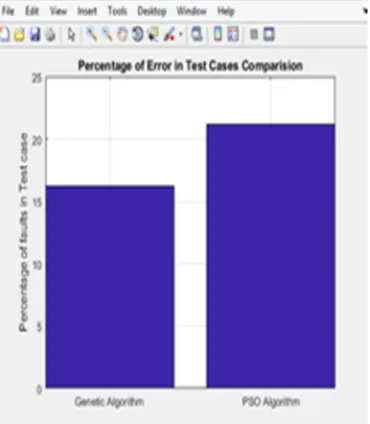
Fig 3: Comparison of results
As shown in figure 3, the results are compared of two algorithms, the existing algorithm is the genetic algorithm, proposed algorithm is PSO algorithm for the fault detection using agile testing. It is analyzed that proposed algorithm detect maximum faults as compared to existing technique
IV. CONCLUSION
[image:4.612.208.393.364.576.2]REFERENCES
[1] Finkelstein, B. Nuseibeh, L. Finkelstein and J. Huang,” Technology transfer: software engineering and engineering design”, 1992, COMPUTING & CONTROL ENGINEERING JOURNA
[2] Nazim H. Madhavji,” The process cycle”, 1991, Software Engineering Journa
[3] H. D. Mills,” The management of software engineering Part I: Principles of software engineering”, 1980, IBM SYST J, Vol 19, No [4] Mary Shaw,” Prospects for an Engineering Discipline of Software”, 1990, IEEE, 0740-7459/90/1100/0015
[5] William Everett, Samuel Keene, Allen Nikora,” Applying Software Reliability Engineering in the 1990s”, 1998, IEEE TRANSACTIONS ON RELIABILITY, Vol. 47, No. 3-S
[6] VICTOR R. BASILI, RICHARD W. SELBY,” Comparnng the Effectiveness of Software Testing Strategies”, 1987, IEEE TRANSACTIONS ON SOFTWARE ENGINEERING, VOL. SE-13, NO. 1
[7] Junpeng Lv, Hai Hu, Kai-Yuan Cai, and Tsong Yueh Chen,” Adaptive and Random Partition Software Testing”, 2014, IEEE TRANSACTIONS ON SYSTEMS, MAN, AND CYBERNETICS: SYSTEMS, VOL. 44, NO. 1
[8] Lipika Bose and Sanjeev Thakur, “GRAFT: Generic & Reusable Automation Framework for Agile Testing” , IEEE, 201
[9] Srinivas Nidhra and Jagruthi Dondeti, “ Blackbox and Whitebox Testing techniques”, International Journal of Embedded Systems and Applications (IJESA) Vol.2, No.2, June 201
[10] Chandana Bharati1, Shradha Verma, “Analysis of Different Regression Testing Approaches”, International Journal of Advanced Research in Computer and Communication Engineering Vol. 2, Issue 5, May 201
[11] Xiaobo Han, Hongwei Zeng and Honghao gao, “A Heuristic Model Based Test Prioritization Method For Regression Testing” International Symposium on Computer,Consumer and Contro, 2012
[12] Junpeng Lv, Hai Hu, Kai-Yuan Cai, and Tsong Yueh Chen,” Adaptive and Random Partition Software Testing”, 2014, IEEE TRANSACTIONS ON SYSTEMS, MAN, AND CYBERNETICS: SYSTEMS, Vol. 44, N0. 1