A Study on the Effects of Uncertainties in
Construction Management
Sakthi Shree A1
1M.E in Construction Engineering and Management, Department of Civil Engineering, R V S Technical Campus
Coimbatore-641402, India
Abstract: Construction industry is one of the massive sectors contributing to global infrastructure and economic development at a large scale. It is one of the heaviest polluting sectors causing damage to the environment throughout the life cycle of the project. This pollution includes occupational pollution causing harmful effect to the workers such as asbestosis, noise pollution by using explosives and environmental pollution caused by inefficient disposal of waste and radioactive materials. This paper presents a systematic approach to environmental management of pollution and hazards caused by construction projects. It will proposes a qualitative approach to assess and control the problem and a method to calculate the Construction Pollution Index (CPI) which will provides a quantitative measurement of pollution and hazards caused by the construction projects.
Keywords: Construction Pollution, Air pollution, Noise pollution, Causes, Effects, Remedies.
I. INTRODUCTION
The construction process and buildings are not only consume the most energy of all sectors in India and also creates the most CO2
emission, and they also creates the most waste, uses most non-energy related resources, and are responsible for the most of the
pollution.Finally the environmental impact of construction is also felt in terms of pollution. This is not in the extraction but in the
processing of materials for construction and also the construction industry has the biggest effect of all sectors because of the quantity of materials used in construction. Careful planning can reduce the risk of pollution. Most of the measures needed to prevent pollution and it costs very little if they are included at the planning stage. Pollution prevention and waste minimization measures may offer substantial economic benefits. These include reducing the need for expensive raw materials and a reduced risk of prosecution for environmental offences. Noise pollution refers to sounds in the environment that are caused by humans and that threaten the health or welfare of human or animal inhabitants.
II. POLLUTION
Pollution is defined as an act or a process of polluting or the state of being polluted, especially the contamination of soil, water, or
the atmosphere by the discharge of harmful substances.The contamination of air, water, or soil by substances those are harmful to
living organisms. Pollution is the introduction of contaminants into a natural environment that causes instability, disorder, harm or discomfort to the ecosystem.
Pollution can take the form of chemical substances or energy, such as noise, heat or light. Pollutants, the elements of pollution, can be either foreign substances/energies or naturally occurring contaminants.
Pollution is often classed as point source or nonpoint source pollution. It occurs when the human activity or natural disasters cause the environment to become contaminated or dirty. There are different kinds of pollution, including air pollution, water pollution, noise pollution and radioactive pollution.
III. CONSTRUCTION POLLUTION
Pollution is the main reason for global warming, so we integrate the environmental management with construction management through the environmental policies. Sources of pollutions and hazards from construction site which includes dust, harmful gases, noise, solid and liquid wastes, ground movements, etc.
Construction Pollution control method is calculated by the construction pollution index (CPI). Causes of pollution can be determined from the various activities or works in construction projects. Construction Pollution which creates a problem to the society and it also affects the health of workers.
TYPE CAUSES
Dust
Demolition, Rock blast Excavation, Rock drilling Bulk material transportation Bulk material loading and unloading
Transportation equipment
Harmful gases
Construction machine-Pile driver Construction machine-Electric welder Construction machine-Transporting equipment
Noise
Demolition
Construction machine-Pile driver Construction machine-crane Construction machine-Rock drill Construction machine-Transporting equipment
Wastes Solid-state waste-Building material waste
Solid-state waste-Building material package
Fallen objects Solid-state waste-Building material waste
Solid-state waste-Building material package
A. Air Pollution
Air pollution in construction site is mainly due to the following reasons:
1) Construction vehicles,
2) Transportation and storage of materials,
3) Use of haul routes,
4) Demolition activities,
5) Excavations and earthworks construction,
6) Drilling, blasting and grouting works,
7) Processing and crushing rock for reuse in the works,
8) Operation of the construction site or undertaking construction activities which results in odours being generated from, for
example, smoke, fumes or gases
9) The air you breathe may be polluted due to the construction work. Apart from the noise, poor air quality is the most
immediate pollution effect you may experience from a construction site.
10) Contaminants spreading around in air can travel large distances in a short time. The main construction contaminants that
The following are the effects of air pollution to human beings
Pollutant Health effects
Nitrogen dioxide Causes irritation to airways and can increase asthma symptoms at high concentrations
Sulphur dioxide Causes coughing, irritation and narrowing of airways. Aggravates existing asthma and bronchitis
Carbon monoxide Deprives the blood of oxygen and can cause headaches, dizziness, and nausea. At very high
levels it can lead to death
Fine particulates (PM10) Can cause heart and lung diseases. Can also lead to premature death in those already ill
Voc May cause increase in risk of lung cancer, affect reproduction, irritation on skin, sensory effects
and other effects on nervous system, increase risk of cardiovascular diseases.
The following are the suggested measures to prevent air pollution in construction site
B. Noise pollution
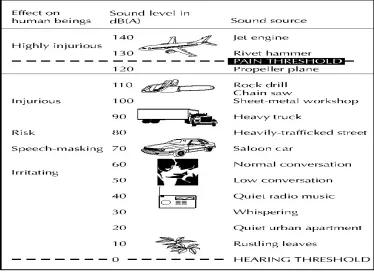
[image:3.612.121.495.314.588.2]Noise is usually associated with construction work although modern preventive measures may substantially reduce the amount of noise. Noise may adversely affect your health including effects such as stress, sleep disturbance, high blood pressure and even hearing loss. Loudness of sound is measured in decibels (dB) and the instrument used for measuring loudness of sound is sound level meter or analyzer.
Figure 1 Sound level and its effects
Data Source: Your Health and Safety at Work by International Labour Organization
The following are the sources of noise pollution in construction site
1) Earth moving equipments,
2) Materials handling equipments,
3) Stationery equipments (Pumps ,Generators, Compressors etc),
4) Impact equipment (Wrenches , Jack hammers rock drills etc),
The following are the effects of noise pollution The health effects of noise exposure depend on the level of the noise and the length of the exposure.
6) Temporary Hearing Loss: After spending a short time in a noisy workplace, you may have noticed that you cannot hear very well and you have a ringing in your ears. This condition is called temporary threshold shift. The ringing and the feeling of deafness normally wear off after you have been away from the noise for a short time. However, the longer you are exposed to the noise, the longer it takes for your hearing to return to “normal”. After leaving work, it may take several hours for a worker's ears to recover.
7) Permanent Hearing Loss: Eventually, after you have been exposed to excessive noise for too long, your ears does not recover and the hearing loss becomes permanent. Permanent hearing loss can never be repaired. This type of damage to the ear can be caused by long-term exposure to loud noise or, in some cases, by short exposures to very loud noises. When a worker begins to lose his or her hearing, he or she may first notice that normal talking or other sounds, such as warning signals, are becoming unclear. Workers often adapt themselves to hearing loss produced by harmful noises at work. For example, they may begin to read lips as people talk, but have difficulty listening to someone in a crowd or on the telephone. Hearing tests are the only reliable way to find out whether a worker is suffering from hearing loss. Unfortunately, hearing tests can be difficult to obtain and need to be performed by a trained health-care professional 8) Other Effects: In addition to hearing loss, exposure to noise in the workplace can cause a variety of other problems,
including chronic health problems. The following are some of them.
a) Exposure to noise over a long period of time decreases coordination and concentration. This increases the chance of accidents
happening.
b) Noise increases stress, which can lead to a number of health problems, including heart, stomach and nervous disorders. Noise is
suspected of being one of the causes of heart disease and stomach ulcers.
c) Workers exposed to noise may complain of nervousness, sleeping problems and fatigue (feeling tired all the time).
d) Excessive exposure to noise can also reduce job performance and may cause high rates of absenteeism.
e) The human hearing capacity varies in intensity from 10 to greater than 120 Db
f) It affects human health, comfort and efficiency
g) It leads to excessive secretion of adrenalin hormone in to blood stream, which is responsible for high blood pressure
h) It increases the rate of heart beat constriction of blood vessels and digestive spoons
i) It distracts attention and cause emotional disturbance
j) Excessive noise can lead to loss of hearing
k) Ultra sonic sound can affect the digestive, respiratory, cardio vascular system
l) Buildings are subjected to damage like cracks, broken windows, doors etc by sudden and explosive sound.
The following are the Construction Noise Levels which are in terms of Permissible Noise Exposures:
Duration per day, hours Sound Level dBA slow response
8 90
6 92
4 95
3 97
2 100
1 ½ 102
1 105
½ 110
1/4 or less 115
SL.NO. STAGES ACTIVITIES EQUIPMENT CREATING
POLLUTION POLLUTION
1. Site planning,
drawing, approval of drawing
___ ___ ___
2. Site cleaning Cleaning of bushes and
trees on site area. Dismantling of available structure if any in site. Excavation up to ground level.
Excavator
Ton wheeler for loading excavated soil
Noise and air pollution, solid waste
Noise and air pollution, solid waste Noise and air pollution, solid waste
3. Surveying Levelling according to the
nearer road level
Providing bench mark level Structural grid line marking
___ ___
4. Earthwork excavation Mass excavation
(excavation should be more than the building area for deep excavation) Rock blasting, if any
Excavators such as JCB Ton wheelers for loading excavated soil
Bombs for blasting Rock breaking machine
Noise and air pollution, solid waste
5. Levelling Levelling according to the
bench mark
Excavation up to the plinth level
___ ___
6. Marking for
foundation
Foundation marking according to the drawing for excavation
___ ___
7. Footing Excavation over marked
footing up to the required depth.
Piles are provided for loose soil, water logged areas PCC laying below footing Shuttering
Reinforcement steel Concreting
RMC(ready mix concrete) vehicle
Vibrator for concreting Mini and tower cranes Mixer machine Piling machine
Noise and air pollution, solid waste
Noise and air pollution, solid waste
Noise pollution Noise pollution Noise pollution and air pollution
8. Column Marking over footing for
column Shuttering
RMC(ready mix concrete) vehicle
Vibrator for concreting
Noise and air pollution
Concreting up to the
required level Mini and tower cranes
Mixer machine
Noise and air pollution Noise
9. Plinth Plinth beam providing
below the wall areas ____ ____
10. Back filling Filling of earth over and
sides of footing
Filling and compaction of earth up to the floor level (filling should be done by means of layer by layer of compaction)
Earth formation for flooring
____ ____
11. Flooring Anti termite treatment
below flooring Floor PCC RCC
Crane RMC Vibrator
Earth rammer above concrete
Mixer machine
Noise pollution
12. Slab and Beam Shuttering
Reinforcement steel Concreting
RMC(ready mix concrete) vehicle
Vibrator for concreting Mini and tower cranes Mixer machine
Noise pollution
Noise pollution
13. Brick work or Block
work ___ ___ ___
14. Water proofing Water proofing above roof ___ ___
15. Plastering Internal wall plastering
External plastering of walls, chejja, etc.,
___ ___
16. Tiling Tiling for walls, floors,
toilets and bathrooms ___ ___
17. Plumbing and
electrical work ___
Driller Noise pollution
IV. CONCLUSION
In construction site, the Project Managers, Contractors and the Engineers are responsible for controlling the pollution. Proper supervision also reduces the chances of pollution in construction site. The organization must provide the protective aids to the workers to protect themselves from both air and noise pollution. They should also conduct pollution awareness program to the workers. The equipments, machineries and the vehicles which are used in construction site must be periodically inspected and maintained. The organization should prefer noiseless technology for several activities. By following these things, we can eliminate pollution in the form of air and noise in construction site.
REFERENCES
[1] Dr. Davorin Kralj,, “Environmental Waste Management in Construction Industry” 1ART-K, Business Consulting, Na gricu 47, 2000 Maribor2Institut for Business Excellence, Novi trg 5, 7000 Novo mesto, Slovenia.
[2] Doc. dr. Jana Selih (2012), “Environmental Management Systems in Construction Industry”. University of Ljubljana, Faculty of Civil and Geodetic Engineering, Slovenia [email protected].
[3] Gordon F. Revey, P.E. (2006). “Managing Rock Blasting Work in Urban Environments.” Practice Periodical on Structural Design and Construction, Vol.11, 86-92.
[4] Gwen christini, Michael fetsko, and Chris Hendrickson (2004), “Environmental Management Systems and ISO 14001 Certification for Construction Firms” 130:3(330),7
[5] Issam R. Abdelraziq, Mohammed S. Ali-Shtayeh and Hassan R. Abdelraziq (2003) “Effect of Noise Pollution on Blood Pressure, Heart Rate And Hearing Threshold In School Children” journal of applies sciences, 3(10-12),770-723
[6] Liang. W. D, W. Y. Xu, C. S. Zhao, L. Ran, Z. Z. Deng, P. F. Liu, N. Ma, W. L. Lin, X. B. Xu, P. Yan, X. He, J. Yu, and L. L. Chen. (2011 ) “ Characteristics of pollutants and their correlation to meteorological conditions at a suburban site.” http/www.atoms-chem-phys.net.
[7] Neil S. Shifrin, (2005), “Pollution Management in the Twentieth Century.” Journal of Environmental Engineering, Vol.131, 676-691.
[8] Roy Morledge, Frank Jackson, (2001) “Reducing environmental pollution caused by construction plant”, Environmental Management and Health, Vol. 12 Iss: 2, 191 – 206.\
[9] S.H.Mirhossaini and H.R.pourzamani (2008) “Evaluation and Analysis of the Environmental Noise of Arak, Iran”, journal of Applied Sciences, 8(7), 133-1336 [10] S.X. Zeng, P.Tian, Jonathan J.Shi (2005) “Implementing integration of ISO 9001 and ISO 14001 for construction”, Managerial auditing, vol 20, 394-40 [11] Serpil onder, “Environmental Pollution and solution recommendations”, (2006), Applied Sciences Journal 6 (4): 864-871, 2006
[12] T.vidya sakar and G.Nageshwara Rao (2006) “Noise Pollution Levels in Visakhapatnam City (India)”, journal of environmental science and engineering, vol.48, 139-142.