Proceedings of the CoNLL 2018 Shared Task: Multilingual Parsing from Raw Text to Universal Dependencies, pages 103–112 Brussels, Belgium, October 31 – November 1, 2018. c2018 Association for Computational Linguistics
103
Universal Dependency Parsing with a
General Transition-Based DAG Parser
Daniel Hershcovich1,2 Omri Abend2
1The Edmond and Lily Safra Center for Brain Sciences 2School of Computer Science and Engineering
Hebrew University of Jerusalem
{danielh,oabend,arir}@cs.huji.ac.il
Ari Rappoport2
Abstract
This paper presents our experiments with applying TUPA to the CoNLL 2018 UD
shared task. TUPA is a general
neu-ral transition-based DAG parser, which we use to present the first experiments on recovering enhanced dependencies as part of the general parsing task. TUPA was designed for parsing UCCA, a cross-linguistic semantic annotation scheme, ex-hibiting reentrancy, discontinuity and non-terminal nodes. By converting UD trees and graphs to a UCCA-like DAG for-mat, we train TUPA almost without
mod-ification on the UD parsing task. The
generic nature of our approach lends it-self naturally to multitask learning. Our
code is available athttps://github.
com/CoNLL-UD-2018/HUJI.
1 Introduction
In this paper, we present the HUJI submission to the CoNLL 2018 shared task on Universal
Depen-dency parsing (Zeman et al.,2018). We focus only
on parsing, using the baseline system, UDPipe 1.2 (Straka et al., 2016; Straka and Straková, 2017) for tokenization, sentence splitting, part-of-speech tagging and morphological tagging.
Our system is based on TUPA (Hershcovich
et al., 2017, 2018, see §3), a transition-based UCCA parser. UCCA (Universal Conceptual
Cog-nitive Annotation; Abend and Rappoport, 2013)
is a cross-linguistic semantic annotation scheme, representing events, participants, attributes and re-lations in a directed acyclic graph (DAG)
struc-ture. UCCA allows reentrancy to support
ar-gument sharing, discontinuity (corresponding to non-projectivity in dependency formalisms) and non-terminal nodes (as opposed to dependencies,
which are bi-lexical). To parse Universal
Depen-dencies (Nivre et al.,2016) using TUPA, we
em-ploy a bidirectional conversion protocol to repre-sent UD trees and graphs in a UCCA-like unified
DAG format (§2).
Enhanced dependencies. Our method treats en-hanced dependencies1 as part of the dependency graph, providing the first approach, to our knowl-edge, for supervised learning of enhanced UD
parsing. Due to the scarcity of enhanced
de-pendencies in UD treebanks, previous approaches (Schuster and Manning,2016;Reddy et al.,2017) have attempted to recover them using
language-specific rules. Our approach attempts to learn
them from data: while only a few UD treebanks contain any enhanced dependencies, similar struc-tures are an integral part of UCCA and its anno-tated corpora (realized as reentrancy by remote
edges; see §2), and TUPA supports them as a
stan-dard feature.
As their annotation in UD is not yet widespread
and standardized, enhanced dependencies arenot
included in the evaluation metrics for UD pars-ing, and so TUPA’s ability to parse them is not re-flected in the official shared task scores. However, we believe these enhancements, representing case information, elided predicates, and shared argu-ments due to conjunction, control, raising and rel-ative clauses, provide richer information to down-stream semantic applications, making UD better suited for text understanding. We propose an eval-uation metric specific to enhanced dependencies,
enhanced LAS (§5.1), and use it to evaluate our method.
1http://universaldependencies.org/u/
We
A
were
F
made
D
to
F
feel
P
very
D
welcome
S
.
U A
A
(a) Example UCCA graph.
We were made to feel very welcome .
nsubj:pass
nsubj:xsubj nsubj:xsubj aux:pass
root
mark xcomp
advmod xcomp punct
(b) Example UD graph.
We
nsubj
were
aux
made
head
to
mark
feel
head
very
advmod
welcome
head
.
punct xcomp xcomp
head
nsubj nsubj
(c) UD graph after conversion to unified DAG format.
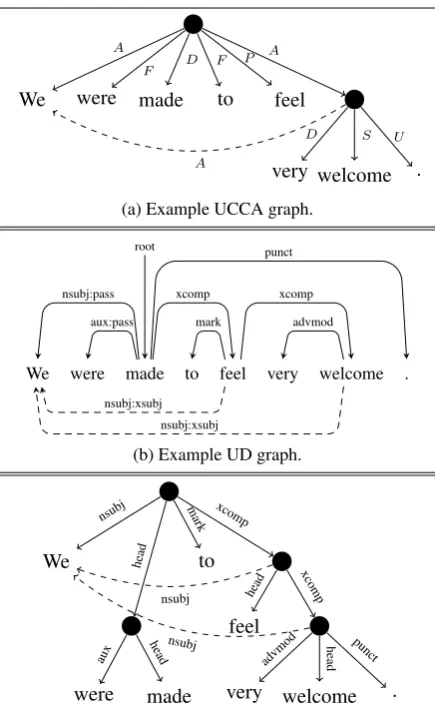
Figure 1: (a) Example UCCA annotation for the sentence “We were made to feel very welcome.”, containing a control verb,made. The dashedAedge is aremote edge. (b) Bilex-ical graph annotating the same sentence in UD (
reviews-077034-0002from UD_English-EWT). Enhanced
de-pendencies appear below the sentence. (c) The same UD graph, after conversion to the unified DAG format. Interme-diate non-terminals andheadedges are introduced, to get a UCCA-like structure.
2 Unified DAG Format
To apply TUPA to UD parsing, we convert UD
trees and graphs into a unified DAG format (
Her-shcovich et al., 2018). The format consists of a rooted DAG, where the tokens are the terminal
nodes.2 Edges are labeled (but not nodes), and are
divided intoprimaryandremoteedges, where the
primary edges form a tree (all nodes have at most one primary parent, and the root has none).
Re-mote edges (denoted as dashed edges in Figure1)
2
Our conversion code supports full conver-sion between UCCA and UD, among other rep-resentation schemes, and is publicly available at
http://github.com/danielhers/semstr/ tree/master/semstr/conversion.
enable reentrancy, and thus form a DAG together
with primary edges. Figure1 shows an example
UCCA graph, and a UD graph (containing two en-hanced dependencies) before and after conversion. Both annotate the same sentence from the English Web Treebank (Silveira et al.,2014)3.
Conversion protocol. To convert UD into the unified DAG format, we add a pre-terminal for each token, and attach the pre-terminals according to the original dependency edges: traversing the tree from the root down, for each head token we create a non-terminal parent with the edge label
head, and add the node’s dependents as children
of the created non-terminal node (see Figure1c).
This creates a constituency-like structure, which is
supported by TUPA’s transition set (see §3.1).
Although the enhanced dependency graph is not necessarily a supergraph of the basic dependency tree, the graph we convert to the unified DAG for-mat is their union: any enhanced dependnecies that are distinct from the basic dependency of a node (by having a different head or universal
de-pendency relation) are converted toremote edges
in the unified DAG format.
To convert graphs in the unified DAG format
back into dependency graphs, we collapse allhead
edges, determining for each terminal what is the highest non-terminal headed by it, and then attach-ing the terminals to each other accordattach-ing to the edges among their headed non-terminals.
Input format. Enhanced dependencies are en-coded in the 9th column of the CoNLL-U format, by an additional head index, followed by a colon and dependency relation. Multiple enhanced de-pendencies for the same node are separated by
pipes. Figure 2 demonstrates this format. Note
that if the basic dependency is repeated in the
en-hanced graph (3:nsubj:passin the example),
we do not treat it as an enhanced dependency, so that the converted graph will only contain each edge once. In addition to the UD relations defined in the basic representations, enhanced
dependen-cies may contain the relation ref, used for
rel-ative clauses. In addition, they may contain more specific relation subtypes, and optionally also case information.
Language-specific extensions and case infor-mation. Dependencies may contain
language-3https://catalog.ldc.upenn.edu/
[image:2.595.73.291.59.414.2]1 We we PRON PRP Case=Nom|Number=Plur|Person=1|PronType=Prs 3 nsubj:pass 3:nsubj:pass|5:nsubj:xsubj|7:nsubj:xsubj _
Figure 2: Example line from CoNLL-U file with two enhanced dependencies:5:nsubj:xsubjand7:nsubj:xsubj.
he went straight to work and finished the job efficiently and promptly !
nsubj
nsubj root
advmod mark advcl
cc conj
det obj
advmod
cc conj
advmod punct
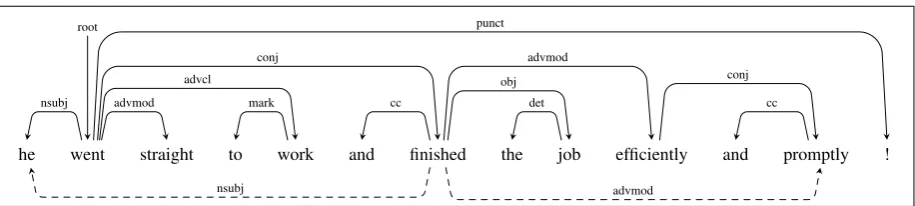
Figure 3: UD graph fromreviews-341397-0003(UD_English-EWT), containing conjoined predicates and arguments.
specific relation subtypes, encoded as a suffix separated from the universal relation by a colon. These extensions are ignored by the parsing eval-uation metrics, so for example, the subtyped rela-tion nsubj:pass(Figure 1b) is considered the
same as the universal relation nsubj for
eval-uation purposes. In the enhanced dependencies, these suffixes may also contain case information, which may be represented by the lemma of an
ad-position. For example, the “peace”→“earth”
de-pendency in Figure4 is augmented asnmod:on
in the enhanced graph (not shown in the figure be-cause it shares the universal relation with the basic dependency).
In the conversion process, we strip any
language-specific extensions from both basic and enhanced dependencies, leaving only the univer-sal relations. Consequently, case information that might be encoded in the enhanced dependencies is lost, and we do not handle it in our current system.
Ellipsis and null nodes. In addition to enhanced dependencies, the enhanced UD representation adds null nodes to represented elided predicates. These, too, are ignored in the standard
evalua-tion. An example is shown in Figure 4, where
an elided “wish” is represented by the node E9.1. The elided predicate’s dependents are attached to its argument “peace” in the basic representation,
and the argument itself is attached as anorphan.
In the enhanced representation, all arguments are attached to the null node as if the elided predicate was present.
While UCCA supports empty nodes without
surface realization in the form of implicit units,
previous work on UCCA parsing has removed these from the graphs. We do the same for UD parsing, dropping null nodes and their associated
dependencies upon conversion to the unified DAG format. We leave parsing elided predicates for fu-ture work.
Propagation of conjuncts. Enhanced depen-dencies contain dependepen-dencies between conjoined predicates and their arguments, and between pred-icates and their conjoined arguments or modifiers. While these relations can often be inferred from the basic dependencies, in many cases they require semantic knowledge to parse correctly. For
exam-ple, in Figure3, the enhanced dependencies
repre-sent the shared subject (“he”) among the conjoined predicates (“went” and “finished”), and the con-joined modifiers (“efficiently” and “promptly”) for the second predicate (“finished”). However, there are no enhanced dependencies between the first predicate and the second predicate’s
modi-fiers (e.g. “went”→“efficiently”), as semantically
only the subject is shared and not the modifiers.
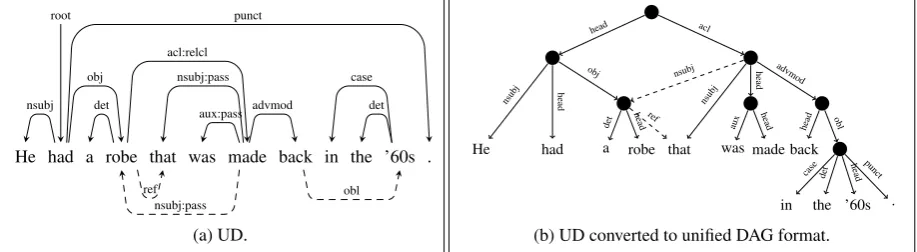
Relative clauses. Finally, enhanced graphs at-tach predicates of relative clauses directly to the antecedent modified by the relative clause, adding
arefdependency between the antecedent and the
relative pronoun. An example is shown in
Fig-ure 5a. While these graphs may contain cycles
(“robe” ↔ “made” in the example), they are
re-moved upon conversion to the unified DAG for-mat by the introduction of non-terminal nodes (see Figure5b).
3 General Transition-based DAG Parser
We now turn to describing TUPA (Hershcovich
et al., 2017, 2018), a general transition-based
parser (Nivre,2003). TUPA uses an extended set
of transitions and features that supports reentran-cies, discontinuities and non-terminal nodes. The
I wish all happy holidays , and moreso , E9.1 peace on earth .
nsubj root
iobj amod obj
punct
punct cc
cc
orphan
advmod punct
punct conj
obj
[image:4.595.74.531.60.230.2]case nmod punct
Figure 4:
newsgroup-groups.google.com_GuildWars_086f0f64ab633ab3_ENG_20041111_173500-0051(UD_English-EWT), containing a null node (E9.1) and case information (nmod:on).
He had a robe that was made back in the ’60s .
nsubj root
det obj
nsubj:pass nsubj:pass
ref
aux:pass acl:relcl
advmod
case
det
obl punct
(a) UD.
He had a
det robe
head obj
head
that was aux
made head
head
back head
in case
the det
’60s head
. punct obl advmod acl
nsubj
head
nsubj nsubj
ref
(b) UD converted to unified DAG format.
Figure 5: (a)reviews-255261-0007(UD_English-EWT), containing a relative clause, and (b) the same graph after conversion to the unified DAG format. The cycle is removed due to the non-terminal nodes introduced in the conversion.
and nodes to be processed, a stackSof nodes
cur-rently being processed, and a graphG= (V, E, `)
of constructed nodes and edges, whereV is the set
ofnodes, E is the set of edges, and` : E → L
is thelabel function, L being the set of possible
labels. Some states are marked asterminal,
mean-ing thatGis the final output. A classifier is used
at each step to select the next transition based on features encoding the parser’s current state. Dur-ing trainDur-ing, an oracle creates trainDur-ing instances for the classifier, based on gold-standard annota-tions.
3.1 Transition Set
Given a sequence of tokens w1, . . . , wn, we
pre-dict a rooted graphGwhose terminals are the
to-kens. Parsing starts with the root node on the
stack, and the input tokens in the buffer.
The TUPA transition set, shown in Figure 6,
includes the standard SHIFT and REDUCE
oper-ations, NODEX for creating a new non-terminal
node and an X-labeled edge, LEFT-EDGEX and
RIGHT-EDGEX to create a new primaryX-labeled
edge, LEFT-REMOTEX and RIGHT-REMOTEX to
create a new remote X-labeled edge, SWAP to
handle discontinuous nodes, and FINISH to mark
the state as terminal.
The REMOTEX transitions are not required for
parsing trees, but as we treat the problem as gen-eral DAG parsing due to the inclusion of enhanced dependencies, we include these transitions.
3.2 Transition Classifier
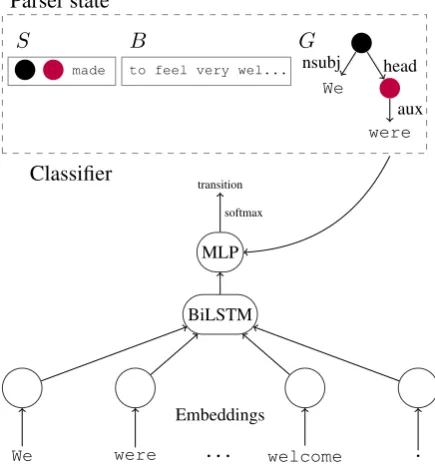
To predict the next transition at each step, TUPA uses a BiLSTM with feature embeddings as in-puts, followed by an MLP and a softmax layer for classification. The model is illustrated in
Fig-ure7. Inference is performed greedily, and
[image:4.595.74.533.272.398.2]Before Transition Transition After Transition Condition Stack Buffer Nodes Edges Stack Buffer Nodes Edges Terminal?
S x|B V E SHIFT S|x B V E −
S|x B V E REDUCE S B V E −
S|x B V E NODEX S|x y|B V∪ {y} E∪ {(y, x)X} − x6= root
S|y, x B V E LEFT-EDGEX S|y, x B V E∪ {(x, y)X} −
x6∈w1:n,
y6= root, y6;Gx
S|x, y B V E RIGHT-EDGEX S|x, y B V E∪ {(x, y)X} −
S|y, x B V E LEFT-REMOTEX S|y, x B V E∪ {(x, y)∗X} −
S|x, y B V E RIGHT-REMOTEX S|x, y B V E∪ {(x, y)∗X} −
S|x, y B V E SWAP S|y x|B V E − i(x)<i(y)
[image:5.595.72.535.63.188.2][root] ∅ V E FINISH ∅ ∅ V E +
Figure 6: The transition set of TUPA. We write the stack with its top to the right and the buffer with its head to the left.(·,·)X
denotes a primaryX-labeled edge, and(·,·)X∗ a remoteX-labeled edge.i(x)is the swap index (see §3.3). In addition to the
specified conditions, the prospective child in an EDGEtransition must not already have a primary parent.
Parser state
S
made
B
to feel very wel...
G
We
nsubj
were
aux head
Classifier
BiLSTM
Embeddings
We were . . . welcome .
MLP
transition softmax
Figure 7: Illustration of the TUPA model, adapted from Her-shcovich et al.(2018). Top: parser state (stack, buffer and intermediate graph). Bottom: BiLTSM architecture. Vector representation for the input tokens is computed by two lay-ers of bidirectional LSTMs. The vectors for specific tokens are concatenated with embedding and numeric features from the parser state (for existing edge labels, number of children, etc.), and fed into the MLP for selecting the next transition.
Features. We use vector embeddings represent-ing the words, lemmas, coarse (universal) POS tags and fine-grained POS tags, provided by UDPipe 1.2 during test. For training, we use the gold-annotated lemmas and POS tags. In addition, we use one-character prefix, three-character suf-fix, shape (capturing orthographic features, e.g., “Xxxx”) and named entity type, provided by
spaCy;4 punctuation and gap type features (Maier
and Lichte,2016), and previously predicted edge labels and parser actions. These embeddings are
4http://spacy.io
initialized randomly, except for the word embed-dings, which are initialized with the 250K most frequent word vectors from fastText for each lan-guage (Bojanowski et al.,2017),5pre-trained over Wikipedia and updated during training. We do not use word embeddings for languages without pre-trained fastText vectors (Ancient Greek, North Sami and Old French).
To the feature embeddings, we concatenate nu-meric features representing the node height, num-ber of (remote) parents and children, and the ratio between the number of terminals to total number
of nodes in the graphG.
Table 1 lists all feature used for the classifier.
Numeric features are taken as they are, whereas categorical features are mapped to real-valued em-bedding vectors. For each non-terminal node, we
select a head terminal for feature extraction, by
traversing down the graph according to a priority order on edge labels (otherwise selecting the left-most child). The priority order is:
parataxis, conj, advcl, xcomp
3.3 Constraints
During training and parsing, we apply constraints on the parser state to limit the possible transitions to valid ones.
A generic constraint implemented in TUPA is that stack nodes that have been swapped should
not be swapped again (Hershcovich et al.,2018).
To implement this constraint, we define aswap
in-dexfor each node, assigned when the node is
cre-ated. At initialization, only the root node and ter-minals exist. We assign the root a swap index of 0, and for each terminal, its position in the text (start-ing at 1). Whenever a node is created as a result
[image:5.595.71.289.255.490.2]Nodes
s0 wmtuepT#ˆ$xhqyPCIEMN
s1 wmtueT#ˆ$xhyN
s2 wmtueT#ˆ$xhy
s3 wmtueT#ˆ$xhyN
b0 wmtuT#ˆ$hPCIEMN
b1, b2, b3 wmtuT#ˆ$
s0l, s0r, s1l, s1r, s0ll, s0lr, s0rl, s0rr, s1ll, s1lr, s1rl, s1rr
wme#ˆ$
s0L, s0R, s1L, s1R, b0L, b0R
wme#ˆ$
Edges
s0→s1, s0→b0, s1→s0, b0→s0
x
s0→b0, b0→s0 e
Past actions
a0, a1 eA
[image:6.595.74.289.59.254.2]Global node ratio
Table 1: Transition classifier features. si: stack nodeifrom the top.bi: buffer nodei.
xl,xr(xL,xR): x’s leftmost and rightmost children (par-ents).w: head terminal text.m: lemma.u: coarse (universal) POS tag. t: fine-grained POS tag. h: node’s height. e: la-bel of its first incoming edge. p: any separator punctuation betweens0 ands1. q: count of any separator punctuation betweens0ands1.x: numeric value of gap type (Maier and Lichte,2016).y: sum of gap lengths.P,C,I,E, andM: num-ber of parents, children, implicit children, remote children, and remote parents. N: numeric value of the head terminal’s named entity IOB indicator. T: named entity type. #: word shape (capturing orthographic features, e.g. "Xxxx" or "dd").
ˆ: one-character prefix.$: three-character suffix.
x → yrefers to the existing edge fromxtoy. xis an in-dicator feature, taking the value of 1 if the edge exists or 0 otherwise,erefers to the edge label, andaito the transition
takeni+ 1steps ago.
Arefers to the action type (e.g. SHIFT/RIGHT-EDGE/NODE), andeto the edge label created by the action.
node ratiois the ratio between non-terminals and
termi-nals (Hershcovich et al.,2017).
of a NODE transition, its swap index is the
arith-metic mean of the swap indices of the stack top and buffer head.
In addition, we enforce UD-specific constraints, resulting from the nature of the converted DAG format: every non-terminal node must have a
sin-gle outgoinghead edge: once it has one, it may
not get another, and until it does, the node may not be reduced.
4 Training details
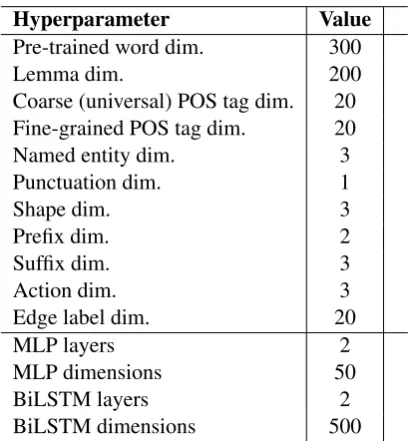
The model is implemented using DyNet v2.0.3 (Neubig et al., 2017).6 Unless otherwise noted, we use the default values provided by the pack-age. We use the same hyperparameters as used in
previous experiments on UCCA parsing (
Hersh-covich et al., 2018), without any hyperparameter
6http://dynet.io
tuning on UD treebanks.
Hyperparameter Value
Pre-trained word dim. 300
Lemma dim. 200
Coarse (universal) POS tag dim. 20
Fine-grained POS tag dim. 20
Named entity dim. 3
Punctuation dim. 1
Shape dim. 3
Prefix dim. 2
Suffix dim. 3
Action dim. 3
Edge label dim. 20
MLP layers 2
MLP dimensions 50
BiLSTM layers 2
BiLSTM dimensions 500
Table 2: Hyperparameter settings.
4.1 Hyperparameters
We use dropout (Srivastava et al., 2014)
be-tween MLP layers, and recurrent dropout (Gal and
Ghahramani,2016) between BiLSTM layers, both
withp = 0.4. We also use word, lemma,
coarse-and fine-grained POS tag dropout with α = 0.2
(Kiperwasser and Goldberg, 2016): in training,
the embedding for a feature value w is replaced
with a zero vector with a probability of #(w)+αα ,
where #(w) is the number of occurrences of w
observed. In addition, we usenode dropout(
Her-shcovich et al., 2018): with a probability of 0.1 at each step, all features associated with a single node in the parser state are replaced with zero vec-tors. For optimization we use a minibatch size
of 100, decaying all weights by10−5 at each
up-date, and train with stochastic gradient descent for
50 epochs with a learning rate of 0.1, followed
by AMSGrad (Sashank J. Reddi, 2018) for 250
epochs withα= 0.001, β1 = 0.9andβ2 = 0.999.
We found this training strategy better than using only one of the optimization methods, similar to
findings byKeskar and Socher(2017). We select
the epoch with the best LAS-F1 on the develop-ment set. Other hyperparameter settings are listed in Table2.
4.2 Small Treebanks
For corpora with less than 100 training sentences,
[image:6.595.314.519.86.307.2]For corpora with no development set, we use 10-fold cross-validation on the training set, each time splitting it to 80% training, 10% develop-ment and 10% validation. We perform the nor-mal training procedure on the training and devel-opment subsets, and then select the model from the fold with the best LAS-F1 on the correspond-ing validation set.
4.3 Multilingual Model
For the purpose of parsing languages with no training data, we use a delexicalized multilingual model, trained on the shuffled training sets from all corpora, with no word, lemma, fine-grained tag, prefix and suffix features. We train this model for two epochs using stochastic gradient descent
with a learning rate of 0.1 (we only trained this
many epochs due to time constraints).
4.4 Out-of-domain Evaluation
For test treebanks without corresponding training data, but with training data in the same language, during testing we use the model trained on the largest training treebank in the same language.
5 Results
Official evaluation was done on the TIRA
on-line platform (Potthast et al., 2014). Our system
(named “HUJI”) ranked 24th in the LAS-F1 rank-ing (with an average of 53.69 over all test tree-banks), 23rd by MLAS (average of 44.6) and 21st by BLEX (average of 48.05). Since our system only performs dependency parsing and not other pipeline tasks, we henceforth focus on LAS-F1 (Nivre and Fang,2017) for evaluation.
After the official evaluation period ended, we discovered several bugs in the conversion between the CoNLL-U format and the unified DAG format, which is used by TUPA for training and is output
by it (see §2). We did not re-train TUPA on the
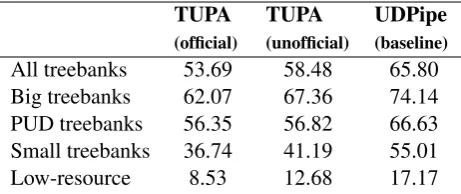
training treebanks after fixing these bugs, but we did re-evaluate the already trained models on all test treebanks, and used the fixed code for con-verting their output to CoNLL-U. This yielded an unofficial average test LAS-F1 of 58.48, an im-provement of 4.79 points over the official average
score. In particular, for two test sets, ar_padt
and gl_ctg, TUPA got a zero score in the of-ficial evaluation due to a bug with the treatment of multi-token words. These went up to 61.9 and 71.42, respectively. We also evaluated the trained
TUPA (official)
TUPA (unofficial)
UDPipe (baseline)
All treebanks 53.69 58.48 65.80
Big treebanks 62.07 67.36 74.14
PUD treebanks 56.35 56.82 66.63
Small treebanks 36.74 41.19 55.01
Low-resource 8.53 12.68 17.17
Table 3: Aggregated test LAS-F1 scores for our system (TUPA) and the baseline system (UDPipe 1.2).
TUPA models on all available development tree-banks after fixing the bugs.
Table 3 presents the averaged scores on the
shared task test sets, and Figure8the (official and unofficial) LAS-F1 scores obtained by TUPA on each of the test and development treebanks.
5.1 Evaluation on Enhanced Dependencies
Since the official evaluation ignores enhanced de-pendencies, we evaluate them separately using a modified version of the shared task evaluation
script7. We calculate theenhanced LAS, identical
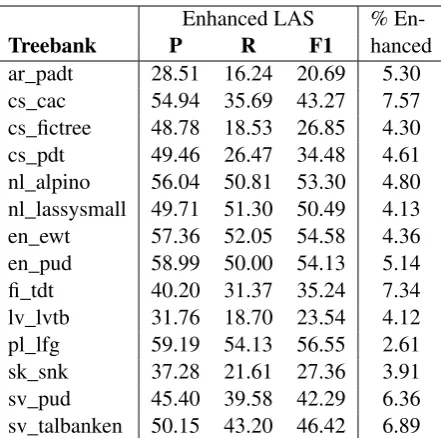
to the standard LAS except that the set of depen-dencies in both gold and predicted graphs are the enhanced dependencies instead of the basic depen-dencies: ignoring null nodes and any enhanced de-pendency sharing a head with a basic one, we align the words in the gold graph and the system’s graph as in the standard LAS, and define
P = #correct
#system, R=
#correct
#gold , F1 = 2·
P·R P+R.
Table4lists the enhanced LAS precision, recall
and F1 score on the test treebanks with any en-hanced dependencies, as well as the percentage of enhanced dependencies in each test treebank, cal-culated as100·#enhanced+#words#enhanced .
Just as remote edges in UCCA parsing are
more challenging than primary edges (
Hersh-covich et al.,2017), parsing enhanced dependen-cies is a harder task than standard UD parsing, as the scores demonstrate. However, TUPA learns them successfully, getting as much as 56.55 en-hanced LAS-F1 (on the Polish LFG test set).
5.2 Ablation Experiments
The TUPA transition classifier for some of the languages uses named entity features calculated
7https://github.com/CoNLL-UD-2018/
[image:7.595.308.539.62.159.2]af_afribooms grc_perseus grc_proiel ar_padt hy_armtdp eu_bdt br_k eb bg_btb bxr_bdt ca_ancora hr_set cs_cac cs_fictree
cs_pdt cs_pud da_ddt nl_alpino
nl_lassysmall en_e
wt
en_gum en_lines en_pud et_edt fo_oft
fi_ftb fi_pud fi_tdt fr_gsd
71 . 78 1 . 92 1 . 89 0 7 . 59 56 . 63 7 . 29 75 . 03 8 . 17 77 . 52 75 . 77 74 . 3 70 . 87 72 . 03 68 . 5 66 .
77 69.
92 66 . 2 72 66 . 05 67 . 34 74 . 12 67 . 45 15 . 44 72 . 35 68 . 47 66 . 19 74 . 97 71 . 85 52 . 97 61 . 3 61 . 9 22 . 78 56 . 82 10 . 18 75 . 05 8 . 42 77 . 53 75 . 85 73 . 92 70 . 81 71 . 87 68 . 37 66 . 84 70 . 22 67 . 45 72 . 1 66 . 05 67 . 4 74 . 4 67 . 58 23 . 39 72 . 36 68 . 47 66 . 34 74 . 98 72 . 65 52 . 31 62 . 12 62 . 33 57 . 85 75 .
14 77.
65 75 . 24 75 . 44 71 . 57 72 . 72 66 . 64 71 . 52 60 . 16 72 . 44 67 . 87 68 . 22 69 .
86 72.13
65 . 45 80 . 42 Test (official) Test (unofficial) Development fr_sequoia fr_spok en gl_ctg gl_tree gal de_gsd got_proiel
el_gdt he_htb hi_hdtb hu_sze
ged
zh_gsd id_gsd ga_idt it_isdt it_postwita
ja_gsd ja_modern
kk_ktb ko_gsd
ko_kaist kmr_mg la_ittb
la_perseus la_proiel lv_lvtb pcm_nsc sme_giella 77 . 72 60 . 65 0 58 . 66 65 . 24 57 . 69 75 . 49 54 . 02 84 . 54 50 . 62 50 . 7 70 . 74 53 . 3 85 . 89 62 . 56 57 . 36 8 . 26 7 . 95 58 . 6 69 . 15 12 . 89 73 . 85 30 . 35 52 .
96 55.19
2 . 15 6 . 69 77 . 74 60 . 66 71 . 42 48 . 58 65 . 32 57 . 71 75 . 49 54 . 04 84 . 62 50 . 67 50 . 75 70 . 85 53 . 5 85 . 92 62 . 56 59 . 56 10 .
04 12.12
58 . 72 69 . 16 13 . 01 74 . 02 30 . 62 52 .
97 55.13
8 . 99 31 . 46 77 . 95 58 . 74 71 . 79 68 . 3 57 . 84 74 . 59 56 . 94 84 . 16 53 . 01 48 . 79 70 . 35 85 . 48 62 . 15 63 . 26 53 . 83 70 . 34 69 . 17 54 . 04 56 . 92 no_bokmaal no_n ynorsk no_n
ynorsklia fro_srcmf cu_proiel fa_seraji
pl_lfg pl_sz pt_bosque ro_rrt ru_syntagrus ru_taig a
sr_set sk_snk sl_ssj sl_sst
es_ancora sv_lines sv_pud
sv_talbank en
th_pud tr_imst uk_iu hsb_uf
al
ur_udtb ug_udt vi_vtb
80 . 85 70 . 58 34 . 93 2 . 88 61 . 3 75 . 72 76 . 58 71 . 68 74 . 34 78 . 99 69 . 2 33 . 17 70 . 73 71 . 97 68 . 31 40 . 09 75 . 74 68 . 02 62 . 38 70 . 27 0 . 36 43 . 82 71 . 24 14 . 91 72 . 27 45 . 63 36 . 48 80 . 98 70 . 81 35 . 13 75 . 04 61 . 33 75 . 77 76 . 61 71 . 71 74 . 35 79 . 05 69 . 21 48 . 92 70 . 77 71 . 93 68 . 32 40 . 13 75 . 74 68 . 11 62 . 81 70 . 66 0 . 23 43 . 93 71 . 39 15 . 01 72 . 5 45 . 67 36 . 5 81 . 84 70 . 84 74 . 36 61 75 . 96 78 . 13 72 . 31 76 .
4 79.
[image:8.595.79.547.59.750.2]33 68 . 24 72 . 32 72 . 31 69 . 28 75 . 33 68 . 28 68 . 28 44 . 33 73 . 8 72 . 71 46 . 2 39 . 44
Enhanced LAS % En-hanced
Treebank P R F1
ar_padt 28.51 16.24 20.69 5.30
cs_cac 54.94 35.69 43.27 7.57
cs_fictree 48.78 18.53 26.85 4.30
cs_pdt 49.46 26.47 34.48 4.61
nl_alpino 56.04 50.81 53.30 4.80
nl_lassysmall 49.71 51.30 50.49 4.13
en_ewt 57.36 52.05 54.58 4.36
en_pud 58.99 50.00 54.13 5.14
fi_tdt 40.20 31.37 35.24 7.34
lv_lvtb 31.76 18.70 23.54 4.12
pl_lfg 59.19 54.13 56.55 2.61
sk_snk 37.28 21.61 27.36 3.91
sv_pud 45.40 39.58 42.29 6.36
[image:9.595.74.295.60.279.2]sv_talbanken 50.15 43.20 46.42 6.89
Table 4: TUPA’s enhanced LAS precision, recall and F1 per test treebank with any enhanced dependencies, and percent-age of enhanced dependencies in test treebank.
by spaCy.8 For German, Spanish, Portuguese,
French, Italian, Dutch and Russian, the spaCy named entity recognizer was trained on Wikipedia (Nothman et al., 2013). However, the English
model was trained on OntoNotes9, which is in fact
not among the additional resources allowed by the shared task organizers. To get a fair evaluation and to quantify the contribution of the NER fea-tures, we re-trained TUPA on the English EWT (en_ewt) training set with the same hyperparam-eters as in our submitted model, just without these
features. As Table 5 shows, removing the NER
features (−NER) only slightly hurts the
perfor-mance, by 0.28 LAS-F1 points on the test tree-bank, and 0.63 on the development treebank.
As further ablation experiments, we tried re-moving POS features, pre-trained word embed-dings, and remote edges (the latter enabling TUPA to parse enhanced dependencies). Removing the POS features does hurt performance to a larger de-gree, by 2.87 LAS-F1 points on the test set, while removing the pre-trained word embeddings even slightly improves the performance. Removing re-mote edges and transitions from TUPA causes a very small decrease in LAS-F1, and of course en-hanced dependencies can then no longer be pro-duced at all.
8
https://spacy.io/api/annotation
9https://catalog.ldc.upenn.edu/
LDC2013T19
LAS-F1 Enhanced LAS-F1
Model Test Dev Test Dev
Original 72.10 72.44 54.58 57.13
−NER 71.82 71.81 55.31 54.65
−POS 69.23 69.54 53.78 49.12
−Embed. 72.33 72.55 56.26 54.54
−Remote 72.08 72.32 0.00 0.00
Table 5: Ablation LAS-F1 and Enhanced LAS-F1 on the En-glish EWT development and test set. NER: named entity features. POS: part-of-speech tag features (both universal and fine-grained). Embed.: external pre-trained word em-beddings (fastText). Remote: remote edges and transitions in TUPA.
6 Conclusion
We have presented the HUJI submission to the CoNLL 2018 shared task on parsing Universal De-pendencies, based on TUPA, a general transition-based DAG parser. Using a simple conversion pro-tocol to convert UD into a unified DAG format, training TUPA as-is on the UD treebanks yields results close to the UDPipe baseline for most tree-banks in the standard evaluation. While other sys-tems ignore enhanced dependencies, TUPA learns to produce them too as part of the general de-pendency parsing process. We believe that with hyperparameter tuning and more careful handling of cross-lingual and cross-domain parsing, TUPA can be competitive on the standard metrics too.
Furthermore, the generic nature of our parser, which supports many representation schemes, as well as domains and languages, will allow
improv-ing performance by multitask learnimprov-ing (cf.
Hersh-covich et al.,2018), which we plan to explore in future work.
Acknowledgments
This work was supported by the Israel Science Foundation (grant no. 929/17) and by the HUJI Cyber Security Research Center in conjunction with the Israel National Cyber Bureau in the Prime Minister’s Office.
References
Omri Abend and Ari Rappoport. 2013.Universal Con-ceptual Cognitive Annotation (UCCA). InProc. of ACL, pages 228–238.
[image:9.595.308.514.62.159.2]Yarin Gal and Zoubin Ghahramani. 2016. A Theoreti-cally Grounded Application of Dropout in Recurrent Neural Networks. In D D Lee, M Sugiyama, U V Luxburg, I Guyon, and R Garnett, editors,Advances in Neural Information Processing Systems 29, pages 1019–1027. Curran Associates, Inc.
Daniel Hershcovich, Omri Abend, and Ari Rappoport. 2017. A transition-based directed acyclic graph parser for UCCA. In Proc. of ACL, pages 1127– 1138.
Daniel Hershcovich, Omri Abend, and Ari Rappoport. 2018.Multitask parsing across semantic representa-tions. InProc. of ACL, pages 373–385.
Nitish Shirish Keskar and Richard Socher. 2017. Im-proving generalization performance by switching from Adam to SGD.CoRR, abs/1712.07628.
Eliyahu Kiperwasser and Yoav Goldberg. 2016. Sim-ple and accurate dependency parsing using bidirec-tional LSTM feature representations. TACL, 4:313– 327.
Wolfgang Maier and Timm Lichte. 2016. Discontinu-ous parsing with continuDiscontinu-ous trees. InProc. of Work-shop on Discontinuous Structures in NLP, pages 47– 57.
Graham Neubig, Chris Dyer, Yoav Goldberg, Austin Matthews, Waleed Ammar, Antonios Anastasopou-los, Miguel Ballesteros, David Chiang, Daniel Clothiaux, Trevor Cohn, Kevin Duh, Manaal Faruqui, Cynthia Gan, Dan Garrette, Yangfeng Ji, Lingpeng Kong, Adhiguna Kuncoro, Gaurav Ku-mar, Chaitanya Malaviya, Paul Michel, Yusuke Oda, Matthew Richardson, Naomi Saphra, Swabha Swayamdipta, and Pengcheng Yin. 2017. DyNet: The dynamic neural network toolkit. CoRR, abs/1701.03980.
Joakim Nivre. 2003.An efficient algorithm for projec-tive dependency parsing. InProc. of IWPT, pages 149–160.
Joakim Nivre and Chiao-Ting Fang. 2017. Univer-sal dependency evaluation. In Proceedings of the NoDaLiDa 2017 Workshop on Universal Dependen-cies (UDW 2017), pages 86–95.
Joakim Nivre, Marie-Catherine de Marneffe, Filip Gin-ter, Yoav Goldberg, Jan Hajic, Christopher D. Man-ning, Ryan McDonald, Slav Petrov, Sampo Pyysalo, Natalia Silveira, Reut Tsarfaty, and Daniel Zeman. 2016. Universal dependencies v1: A multilingual treebank collection. InProc. of LREC.
Joel Nothman, Nicky Ringland, Will Radford, Tara Murphy, and James R Curran. 2013. Learning mul-tilingual named entity recognition from wikipedia. Artificial Intelligence, 194:151–175.
Martin Potthast, Tim Gollub, Francisco Rangel, Paolo Rosso, Efstathios Stamatatos, and Benno Stein. 2014. Improving the reproducibility of PAN’s
shared tasks: Plagiarism detection, author identi-fication, and author profiling. InInformation Ac-cess Evaluation meets Multilinguality, Multimodal-ity, and Visualization. 5th International Conference of the CLEF Initiative (CLEF 14), pages 268–299, Berlin Heidelberg New York. Springer.
Siva Reddy, Oscar Täckström, Slav Petrov, Mark Steedman, and Mirella Lapata. 2017. Universal se-mantic parsing. pages 89–101.
Sanjiv Kumar Sashank J. Reddi, Satyen Kale. 2018. On the convergence of Adam and beyond.ICLR.
Sebastian Schuster and Christopher D. Manning. 2016. Enhanced English Universal Dependencies: An im-proved representation for natural language under-standing tasks. InProc. of LREC. ELRA.
Natalia Silveira, Timothy Dozat, Marie-Catherine de Marneffe, Samuel Bowman, Miriam Connor, John Bauer, and Chris Manning. 2014. A gold standard dependency corpus for English. InProc. of LREC.
Nitish Srivastava, Geoffrey Hinton, Alex Krizhevsky, Ilya Sutskever, and Ruslan Salakhutdinov. 2014. Dropout: A simple way to prevent neural networks from overfitting. Journal of Machine Learning Re-search, 15:1929–1958.
Milan Straka, Jan Hajiˇc, and Jana Straková. 2016. UDPipe: trainable pipeline for processing CoNLL-U files performing tokenization, morphological analysis, POS tagging and parsing. InProceedings of the 10th International Conference on Language Resources and Evaluation (LREC 2016), Portoro, Slovenia. European Language Resources Associa-tion.
Milan Straka and Jana Straková. 2017. Tokenizing, pos tagging, lemmatizing and parsing ud 2.0 with udpipe. InProceedings of the CoNLL 2017 Shared Task: Multilingual Parsing from Raw Text to Univer-sal Dependencies, pages 88–99, Vancouver, Canada. Association for Computational Linguistics.