951
Reduce & Attribute: Two-Step Authorship Attribution for Large-Scale
Problems
Michael Tschuggnall Universit¨at Innsbruck [email protected]
Benjamin Murauer Universit¨at Innsbruck [email protected]
G ¨unther Specht Universit¨at Innsbruck [email protected]
Abstract
Authorship attribution is an active research area which has been actively studied for many decades. Nevertheless, the majority of ap-proaches consider problem sizes of a few can-didate authors only, making them difficult to apply to recent scenarios incorporating thou-sands of authors emerging due to the manifold means to digitally share text. In this study, we focus on such large scale problems and pro-pose to effectively reduce the number of can-didate authors before applying common attri-bution techniques. By utilizing document em-beddings, we show on a novel, comprehen-sive dataset collection that the set of candi-date authors can be reduced with high accu-racy. Moreover, we show that common author-ship attribution methods substantially benefit from a preliminary reduction if thousands of authors are involved.
1 Introduction
Correctly determining the author of an anonymous text has been researched for several decades. Un-doubtedly the most groundbreaking work in this area has been conducted in 1964 by Mosteller and Wallace, who attempted to automatically as-sign the authors of the Federalist Papers by utiliz-ing a simple, but yet efficient statistical approach operating on function words (Mosteller and Wal-lace, 1964). By showing that writers can indeed be distinguished by their writing style, many ap-proaches have been published in the following years, proposing enhancements by incorporating a variety of so-called stylometric features, methods and learning techniques (Stamatatos, 2009). By categorizing the problem of authorship attribution as a special form of text categorization (Sebas-tiani,2002), also the respective methods in terms of different machine learning algorithms are ef-fectively in use. With the advent of deep learn-ing, also several approaches have been proposed
recently which utilize comprehensive neural net-works. Nevertheless, a recent comparison of all submitted approaches to the cross-domain author-ship attribution task at PAN1 indicates that deep learning is currently not able to surpass traditional methods (Kestemont et al.,2018).
Regardless of the features and methods used, the efficacy of an approach can only be measured by using appropriate datasets. Thereby, the ma-jority of existing approaches focus only on a small number of candidate authors (up to 20, most of the times ten or less, e.g., (Stamatatos, 2009; Juola, 2012)). Only a few studies have examined the performance of authorship attribution approaches on larger amounts of possible authors, e.g., 114 (Madigan et al., 2005), 145 (Luyckx and Daele-mans,2008), 808 (Hitschler et al.,2017) or 1,000 (Shrestha et al.,2017) candidates. To the best of our knowledge, only three studies dive into the multiple thousands of authors: 10,000 (Koppel et al.,2006,2011) and even 100,000 (Narayanan et al., 2012). While both studies agree that au-thorship attribution at large scale is substantially more difficult, they still show the potential of per-forming identification with acceptable accuracy. To be precise, both approaches report good perfor-mances only in scenarios where either an“I don’t know” answer is also accepted (Koppel et al., 2011) or the attribution is not precise, i.e., the statement that the correct author is among the top
kones is sufficient (Narayanan et al.,2012). Motivated by previous findings, which showed that direct authorship attribution is not feasible in a large scale scenario, we contribute to this field by proposing a two-step approach in this study. Specifically, we propose at first to reduce the num-ber of candidate authors while keeping the correct
1PAN is an internationally renowned initiave in the field
of digital text forensics and stylometry, https://pan.
author in the reduced set with reasonable accuracy. Incorporating the promising results reported by using embedding representations ((Posadas-Dur´an et al., 2017)), we also find that a vector space based on document embeddings (Le and Mikolov, 2014) in combination with cosine similarity yields the best results for reducing candidate authors in the large scale. As authorship attribution gener-ally heavily depends on the datasets used (e.g., the text type or the number of training and test documents (Luyckx and Daelemans, 2011; Pot-thast et al., 2016)) and the datasets used in the mentioned studies are not available,2we created a collection of 179 individual, novel datasets using a large question-and-answer (Q&A) network on which we extensively test our models. Using these datasets, we finally also show that a preliminary reduction of candidates substantially improves the overall accuracy of finding the correct author in large settings.
At a glance, our contributions are as follows: (1) We evaluate document embeddings in combina-tion with cosine similarity and show that they out-perform n-grams (which have proven to be among the most discriminating features, e.g.,Stamatatos, 2013;Kestemont et al.,2018) with respect to the task of reducing the number of candidate authors in large scenarios. Thereby we show that neither n-grams used with similarity measures nor sup-port vector machines are able to keep up with doc-ument embeddings. (2) We show that eliminat-ing candidate authors useliminat-ing our approach in large settings—prior to performing direct attribution— substantially improves the accuracy of commonly used attribution methods. (3) We created a novel dataset collection based on a large Q&A network, consisting of 179 sub-datasets, each of which fea-tures six up to nearly 20,000 authors. To ensure reproducibility and to encourage further research, we make the dataset publicly available to the re-search community.
The remainder of this paper is organized as fol-lows: At first, Section2summarizes related work and subsequently Section 3 presents the dataset. The proposed approach to reduce candidates using document embeddings and its evaluation is pre-sented in Section4, while Section5shows its im-pact on direct authorship attribution. Finally, Sec-tion6concludes and discusses future work.
2The dataset used by (Koppel et al.,2011) is partly
avail-able (see Section4.2)
2 Related Work
Features and Methods
In the last decades many different features have been proposed for stylometry problems, which can basically be categorized into lexical, syntac-tic, structural and other specialized features (Sta-matatos, 2009; Stein et al., 2011). For the spe-cific task of authorship attribution, lexical metrics are predominant. Thereby, features are utilized on the character- and word-level, including charac-ter/word frequencies (Zheng et al.,2006), average word- and sentence lengths (Grieve,2007), func-tion word frequencies (Argamon et al.,2003;Zhao and Zobel,2005), bag-of-words (BOW,Agun and Yilmazel, 2017) or especially character/word n-grams (Sapkota et al., 2015; Stamatatos, 2013; Schwartz et al., 2013 and variants thereof (Sta-matatos, 2017). Moreover, derived features such as different readability measures (Tweedie and Baayen, 1998) or compression ratios (Marton et al.,2005) have also been investigated.
Syntactic features include the analysis of (n-grams of) Part-of-Speech (POS) tags (Zhao and Zobel, 2007) or the analysis of the parse tree of sentences (Luyckx and Daelemans,2008; Tschug-gnall and Specht, 2014), whereas structural fea-tures analyze indicators like the average paragraph length or the use of indentation (Zheng et al., 2006). In addition, various additional metrics have been proposed, e.g., the analysis of spelling and grammatical errors present in a text (Koppel and Schler,2003).
embeddings are also highly efficient when fed into common machine learning techniques like SVMs or logistic regression (Agun and Yilmazel,2017; Posadas-Dur´an et al.,2017).
In general, it has been shown that especially character n-grams and variants thereof are among the most discriminating features, which perform very well with common machine learning tech-niques such as out-of-the-box SVMs (e.g., Sta-matatos,2013;Kestemont et al.,2018), ensembles (e.g.,Cust´odio and Paraboni,2018) as well as with recent deep learning methods (e.g.,Shrestha et al., 2017;Rhodes, 2015). Due to this success of n-grams, we chose to rely on them as a reference as is shown in Sections4and5.
Large-Scale Authorship Attribution
As mentioned earlier, the majority of authorship attribution approaches target a relatively small number of candidate authors (up to at most 20). The few studies considering more than a hun-dred authors utilize various lexical features such as character n-grams together with syntactic fea-tures, and achieve accuracies ranging from 50-80% (Madigan et al., 2005; Luyckx and Daele-mans, 2008). For about 800 authors, Hitschler et al. (2017) achieve 13% accuracy with a CNN, andShrestha et al.(2017) also utilize a CNN to at-tribute the correct author out of 1,000 candidates with an accuracy of 36%.
Koppel et al.(2006,2011) conducted two exper-iments on blogs with 10,000 authors. First, they achieve about 35% by using inverse-document-frequencies of stylistic features, represented in a vector space and compared using cosine similar-ity. In a second study, aiming for precision rather than recall (i.e., to rather output don’t knowthan to guess), they usespace-free character 4-grams
with cosine similarity, and enhance their approach by iteratively evaluating randomized subsets of features. By doing so, they report a precision of 93% for the cases an answer is given.
Finally, the most comprehensive study with re-spect to number of candidate authors has been conducted byNarayanan et al. (2012), who eval-uate different features with several machine learn-ing techniques on a dataset consistlearn-ing of 100,000 authors of blogs. In their study, the main focus is laid on security concerns, i.e., that the correct author can be identified in an attack. The authors show that a combination of a simple nearest neigh-bor approach with a regularized least squares
clas-sifier is able to detect the correct author of a blog in 20% of the cases and that the correct author is in the top-20 ranked candidates in 35% of the cases. Moreover and along the lines of Luyckx and Daelemans(2011) orEder(2010), it is shown that the size of available training/test texts substan-tially influences the performance.
As the studies of (Koppel et al., 2011) and (Narayanan et al.,2012) are the only ones target-ing authors in the large scale, we will also use these studies as references throughout this paper (in terms of their methodology and reported re-sults). Nevertheless, a direct comparison is diffi-cult as they either target different aims and/or the underlying datasets are not or only partly avail-able. In contrast to these studies, we propose a novel two-step method in this paper and pro-vide comprehensive large scale studies alongside, which can easily be reproduced in both methods as well as data used.
3 The SE-179 Dataset Collection
For the task of authorship attribution, a suitable dataset has to consist of realistic documents where the authorship of each document can undoubtedly be attributed to a single author. In the case of single-domain or single-topic analyses, it has to additionally be assured that all candidate authors write about the same topics—such that they can-not be exposed by simply looking at specific topic-related content words. Along the lines of Keste-mont et al. (2018), who showed that data from Q&A forums can successfully be employed to an-alyze the writing style, we also used the same Q&A platform, namelyStackExchange3, to create our dataset.
The StackExchange network consists of several sites where people answer questions related to spe-cific topics (Stackoverflow being the most popu-lar site). In contrast to Kestemont et al. (2018) where only selected posts of selected StackEx-change sites were crawled, we use the provided data dump4 containing all questions and answers
of all sites. Because the posts for each site are re-lated to a single topic (e.g., photography), it al-lows us to create individual datasets from each site. Thereby the procedure for creating a dataset from a site was as follows:
3
https://stackexchange.com
4provided directly by StackExchange at https://
(1.) We collected all questions and answers by all users participating in the site. (2.) We re-moved all posts that were edited by a person dif-ferent from the original author (in the StackEx-change network, basically everyone can edit any-one’s posts). (3.) We cleaned each post, i.e., we removed code snippets, block quotes, bullet lists, embedded images and replaced links with$URL$. We then dismissed all posts containing less than ten tokens after cleaning. (4.) We combined all remaining posts of each user into a single doc-ument and removed all users with less than 500 tokens. Subsequently, we divided each document into a training and a test document. Thereby we assured that each training and test document con-tains at least 500 tokens, and in case this was not possible (because there were less than 1,000 to-kens available), we only kept the training docu-ment to increase the number of candidates. I.e., there exist several training documents where there exists no corresponding test document. Note that it is a common procedure to fix training and test documents in order to ensure reproducibility (Sta-matatos et al.,2018).
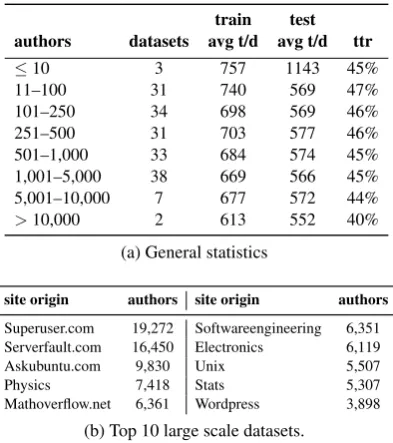
Consequently, we created a balanced, single-topic dataset from each site, containing different numbers of authors depending on the size of the community of the respective site. Table1a shows the statistics of the resulting 179 datasets5, includ-ing the average tokens per document (avg t/d) as well as the ratio between number of training to test documents (ttr). We consequently call the over-all dataset collectionSE-179. With respect to lan-guages throughout the collection, the predominant one is English, but also individual problems in dif-ferent languages are present6.
For our study, the datasets containing many au-thors as listed in Table1b are of high interest, nev-ertheless we conducted our experiments also on all other datasets as is detailed in Section4.2. By do-ing so we can avoid potential biases towards spe-cific datasets. As we are concerned about repro-ducibility, we make the SE-179 collection publicly available and encourage other researchers to uti-lize it according to their needs.7
5
We didn’t process theStackoverflowsite due to
compu-tational limitations with respect to its size.
6I.e., one for each Chinese, Esperanto, French, German,
Italian, Japanese, Korean, Polish, Portuguese, Russian, Span-ish and Ukrainian.
7The dataset is available athttps://doi.org/10.
5281/zenodo.3441861.
train test authors datasets avg t/d avg t/d ttr
≤10 3 757 1143 45%
11–100 31 740 569 47%
101–250 34 698 569 46%
251–500 31 703 577 46%
501–1,000 33 684 574 45%
1,001–5,000 38 669 566 45%
5,001–10,000 7 677 572 44%
>10,000 2 613 552 40%
(a) General statistics
site origin authors site origin authors
Superuser.com 19,272 Softwareengineering 6,351 Serverfault.com 16,450 Electronics 6,119 Askubuntu.com 9,830 Unix 5,507
Physics 7,418 Stats 5,307
Mathoverflow.net 6,361 Wordpress 3,898
[image:4.595.319.516.61.283.2](b) Top 10 large scale datasets.
Table 1: Statistics of the SE-179 dataset collection in-cluding average tokens per document (avg t/d) and the ratio between number of training and test documents (ttr).
4 Reducing Candidate Authors
In this section, we outline our approach of effec-tively reducing the number of candidate authors by utilizing document embeddings. After describ-ing the applied technique in Section4.1as well as the reference implementations used, we show the results in Section4.2.
4.1 Methods
Document Embeddings
Based on the promising results reported by Posadas-Dur´an et al. (2017), we also uti-lize document embeddings with doc2vec (Le and Mikolov, 2014). Considering the two possible representation techniques provided by doc2vec, i.e., distributed memory (DM) and distributed bag of words (DBOW), we evalu-ated the three basic models (i) DM using con-catenation (DM/concat), (ii) DM using aver-age (DM/avg), (iii) DBOW as well as the two combinations (iv) DBOW+DM/concat and (v) DBOW+DM/avg. For each model, we evaluated vector sizes (dimensions) ofd= {100,200,300}
–type: we either provide the text as is (unigram) or we computebigramsof the words
– stem: decides whether stemming should be applied or not
– windowing: if a window length (wl) is set,
we traverse the document using a sliding window containingwltokens and thereby create new
“doc-uments” for each author. The window stepws
de-fines the number of tokens the window is shifted after each iteration. Additionally, we compute models from the original documents without win-dowing.
For the final reduction of candidate authors ac-cording to a given test document, the procedure is as follows: (1.) According to the previously de-scribed settings, we learn models from all avail-able training documents of all authors. During this step, all documents are assigned a vector of dimen-siond(the model dimension), which form an ac-cording vector space. In case windowing is used, each author is represented by several vectors (one per window). (2.) For the given test document, we apply the same preprocessing steps (i.e., input type, stemming and windowing) and make use of the functionality provided by doc2vec to estimate a vector for a document that was not seen during learning. (3.) Similar toKoppel et al.(2011) we then compare the test document’s vector with all document vectors in the vector space by comput-ing the cosine similarity. Ordercomput-ing by this sim-ilarity and using the top-k authors finally allows reducing the set of candidates to an arbitrary ex-tent. In case windowing is used, i.e., when there are multiple documents by each author, we use the average of the similarities of all the author’s docu-ment vectors.
Reference Implementations
To compare the proposed approach, we re-implemented the approach described by Koppel et al. (2011). Specifically, in this approach so-calledspace-freecharacter 4-grams are computed for each document and their normalized frequen-cies form the basis for a vector space. By re-peatedly (k1 times) selecting k2% of the feature
set randomly, cosine similarity is used to compare the documents. In our reimplementation we used the optimal values as reported, i.e.,k1 = 100and
k2 = 40%. As an additional reference, we used
regular n-grams instead of the space-free variants.
authors model d stem wl ws type
≤10 DM/avg 200 yes – – unigram 11–100 DM/avg 100 yes – – unigram 101–250 DM/concat 100 yes 300 50 unigram 251–500 DM/concat 100 yes 300 50 unigram 501–1,000 DM/concat 100 yes 300 50 unigram 1,001–5,000 DM/concat 200 yes 300 50 unigram 5,001–10,000 DM/concat 100 yes – – unigram
[image:5.595.312.521.63.153.2]>10,000 DM/concat 100 yes – – unigram
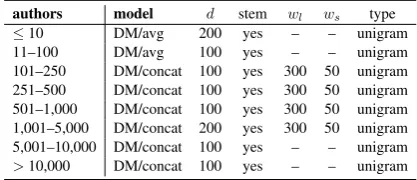
Table 2: Best doc2vec models with respect to number of authors.
4.2 Estimating Best Reduction Models
Contrary to Narayanan et al. (2012) we find it more suitable to not test whether the correct au-thor is in the top-kresults, but to evaluate how of-ten s/he is in the result set after reducing by per-centage (e.g., eliminating 90% of the candidates). This makes especially sense as we are dealing with 179 different datasets of different sizes, where a comparison of the top-k results with a fixed kis not meaningful (e.g., it makes a huge difference if the correct author is in the top-5 in a dataset con-taining 20 authors or in one concon-taining 16,000 au-thors). Thus, we experimented with the reduction rates 10-90%, 95%, and 99%, and measured the hit rate, i.e., the percentage of how often the cor-rect author is still in the reduced candidate set.
In a first preliminary step, we aimed to find the best models with respect to reduction rate and candidate author size8. We evaluated on all 179 datasets using the respective training documents for learning and the test documents for testing. For the larger datasets, we tested on 1,000 randomly selected test documents (as has been done by Kop-pel et al.(2011)).
After conducting the experiment, we found that the reduction rate doesn’t make any difference with respect to the model type and that the best performing models only depend on the number of authors. Table2shows the best settings for differ-ent number of authors, computed by using the av-erage of all corresponding datasets and regardless of the reduction rate.9It can be seen that stemmed unigrams work best in all cases and that window-ing is not the preferred option when lookwindow-ing at large (and small) candidate sizes.
Using the best models found (depending on the number of candidate authors) we evaluated their
8
E.g., what is the best doc2vec-model for reducing an 8,000 author dataset by 70%?
9Note that we cannot provide single hit rates for each
0 0.1 0.2 0.3 0.4 0.5 0.6 0.7 0.8 0.9 1
10 20 30 40 50 60 70 80 90 95 99
hi
t r
at
e
reduction rate [%]
number of authors (number of affected datasets)
[image:6.595.74.527.62.222.2]<= 10 authors (3) 11-100 authors (31) 101-250 (34) 251-500 (31) 501-1000 (33) 1001-5000 (38) 5001-10000 (7) > 10000 (2)
Figure 1: Hit rates for the doc2vec reduction models averaged over all datasets with respect to reduction rate and candidate author size.
0 0.2 0.4 0.6 0.8 1
<= 10 (3) 11-100 (31) 101-250 (34) 251-500 (31) 501-1000 (33) 1001 -5000 (38) 5001 -10000 (7) >100 00 (2
)
hi
t
ra
te
number of authors (affected datasets)
d2v-red sf (n=4) sf (n=3) r (n=4) r (n=3)
(a) reduction rate = 99%
0 0.2 0.4 0.6 0.8 1
<= 10 (3) 11-100 (31) 101-250 (34) 251-500 (31) 501-1000 (33) 1001 -5000 (38) 5001 -10000 (7) >100 00 (2
)
hi
t
ra
te
number of authors (affected datasets)
d2v-red sf (n=4) sf (n=3) r (n=4) r (n=3)
(b) reduction rate = 90%
0 0.2 0.4 0.6 0.8 1
<= 10 (3) 11-100 (31) 101 -250 (34) 251 -500 (31) 501 -1000 (33) 1001 -5000 (38) 5001 -10000 (7) >100 00 (
2)
hi
t
ra
te
number of authors (affected datasets) d2v-red sf (n=4) sf (n=3) r (n=4) r (n=3)
(c) reduction rate = 80%
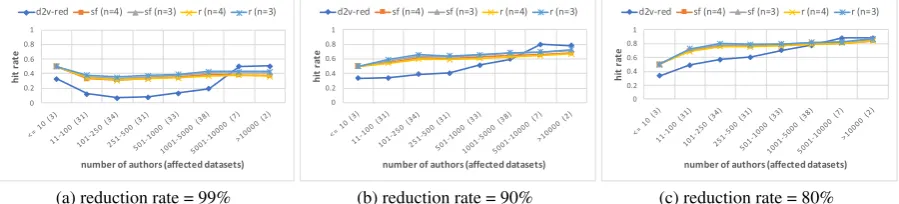
Figure 2: Comparison of the doc2vec reduction (d2v-red) with the method proposed byKoppel et al. (2011) using space-free (sf) and regular (r) n-grams. The y-axis shows the average hit rates over all datasets for different reduction rates, grouped by number of candidate authors.
performance with respect to the reduction rate. That is, we reduced the number of candidates by the respective percentage and measured—in terms of hit rate—if the correct author is still in the re-maining set. As expected and can be seen in Fig-ure1, the performance decreases as the reduction rate increases. In general, the more candidate au-thors, the better the model is able to filter out ir-relevant ones: E.g., the datasets having more than 5,000 authors could be reduced by 50% with a hit rate of 0.97, and by 80% with a hit rate of 0.88. When reducing these datasets by 99%, a hit rate of approximately 0.5 remains.
In a further experiment, we compared the re-duction results to the reference systems described in Section4.1, i.e., with regular and space-free n-grams as proposed by Koppel et al. (2011), Fig-ure2 exemplarily shows the average results over all datasets, grouped by the number of candidate authors for the reduction rates 99%, 90% and 80%, respectively. Regardless of the individual reduc-tion rate, the doc2vec model is inferior to the other models for datasets having less than 5,000 authors,
but can significantly10 exceed them when more authors are involved. For example, when reduc-ing candidates by 90% in a 5,000+ candidate au-thor setting, it is able to keep the correct auau-thor with a hit rate of 0.69 in average, whereas the best other model (regular 3-grams) achieves a hit rate of 0.60. Although the superiority of our doc2vec model decreases with lower reduction rates, it is still better than the other models for all reduction rates in scenarios having more than 5,000 candi-date authors, as is shown in Table3.
5 Attribution on Reduced Candidates
In the previous section, we have shown that the number of candidate authors in large authorship attribution problems can effectively be reduced by compiling a document embedding model based on word unigrams. As a follow-up, we wanted to assess the influence of this reduction technique for state-of-the-art authorship attribution methods. The basic idea is to apply a two-step attribution by
10We computed a McNemar’s test (Dietterich,1998) and
[image:6.595.76.526.279.381.2]red. d2v-red sf (n=4) sf (n=3) r (n=4) r (n=3) 10% 0.998 0.994 0.993 0.994 0.993 20% 0.995 0.988 0.986 0.988 0.986 30% 0.991 0.982 0.978 0.981 0.979 40% 0.984 0.973 0.969 0.973 0.971 50% 0.972 0.958 0.954 0.958 0.959 60% 0.954 0.931 0.932 0.937 0.938 70% 0.928 0.890 0.896 0.895 0.904 80% 0.881 0.812 0.827 0.811 0.834 90% 0.792 0.659 0.695 0.653 0.700 95% 0.697 0.551 0.585 0.538 0.593 99% 0.501 0.377 0.412 0.376 0.431
Table 3: Comparison of the proposed doc2vec reduc-tion (d2v-red) with the method proposed by Koppel et al. (2011) using space-free (sf) and regular (r) n-grams. The table shows the average hit rates for the respective reduction rates (red.) over all 9 datasets con-taining more than 5,000 authors.
transforming large scale problems to normal-scale problems: (1.) reduce the number of candidate au-thors, (2.) apply regular authorship attribution ap-proaches for the remaining candidates.
5.1 Direct Attribution Baseline
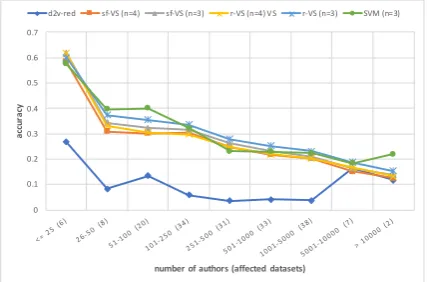
In a first step, we created a baseline by computing the accuracies achieved for direct authorship at-tribution, i.e., for finding the correct author with-out any reduction. For this, we utilized the pro-posed reduction technique, but reduced to exactly one author instead of a set of authors. Similar to Section 4.1, we again utilized the approach of Koppel et al. (2011) with space-free and regular character 3-/4-grams in combination with a vec-tor space and cosine similarity. As an additional reference for comparison, we made use of the reference implementation provided for the author identification task at the PAN 2018 event (Keste-mont et al.,2018). It computes character 3-grams and makes classifications using a standard SVM, yet achieving competitive results by applying grid search (Murauer et al., 2018). The results aver-aged over candidate author sizes are presented in Figure3, revealing that doc2vec is very imprecise for direct authorship attribution in non-large cases. The other approaches generally perform similarly, except for the largest datasets where the SVM achieved the best results (0.21 for the datasets with more than 10,000 authors).
5.2 Two-Step Attribution
To measure the influence of the reduction pro-posed in Section 4, we conducted an experiment on the largest datasets by at first reducing the
0 0.1 0.2 0.3 0.4 0.5 0.6 0.7
<= 25 (6)
26-50 (8)
51-100 (20)
101-250 (34)
251-500 (31)
501-1000 (33)
1001 -5000
(38)
5001 -10000
(7)
> 100 00 (2
)
ac
cu
rac
y
number of authors (affected datasets)
[image:7.595.81.284.63.190.2]d2v-red sf-VS (n=4) sf-VS (n=3) r-VS (n=4) VS r-VS (n=3) SVM (n=3)
Figure 3: Accuracies for direct authorship attribution averaged over different candidate author sizes. sf-VS
andr-VSrepresent space-free and regular n-grams, re-spectively, represented in a vector space as proposed by Koppel et al.(2011), and SVMrefers to the reference implementation provided by PAN-2018.
number of candidates, and subsequently perform-ing regular authorship attribution. Considerperform-ing the best results of direct attribution as presented pre-viously, we evaluated the regular 3-gram vector space approach and the SVM implementation of PAN11. For each approach, we at first reduced the authors by the respective reduction rate, applied the two approaches and compared it to the best re-sult achieved by direct attribution.
Figure4depicts the results for the 5,000-10,000 author datasets and for those having more than 10,000 authors, respectively. It can be seen that in general the accuracy–especially that of the SVM– can be improved, nevertheless, the best first-step reduction rate depends on the problem size: For datasets up to 10,000 candidates, the best option is to reduce the number of authors by 99% before performing attribution. On the contrary, the best accuracy for problems with more than 10,000 can-didates could be achieved by using a reduction rate of 60%.
As stated initially in the paper, the evaluation re-sults of authorship attribution techniques is highly dependent on the dataset (Luyckx and Daelemans, 2011;Potthast et al.,2016), and while our datasets within the SE-179 collection are highly hetero-geneous with respect to topics and author sizes and also languages, they still belong to the genre of question-answering platforms. We therefore aimed to evaluate the dataset used byKoppel et al. (2011) to gain additional insight into the
perfor-11Note that for each test document a corresponding SVM
[image:7.595.84.283.63.190.2]0.00 0.05 0.10 0.15 0.20 0.25 0.30
50% 60% 70% 80% 90% 95% 99%
ac
cu
rac
y
first-step reduction rate
best direct AA result SVM r-vs (n=3)
(a) 5k-10k authors datasets
0.00 0.05 0.10 0.15 0.20 0.25 0.30
50% 60% 70% 80% 90% 95% 99%
ac
cu
rac
y
first-step reduction rate
best direct AA result SVM r-vs (n=3)
[image:8.595.77.524.74.197.2](b)>10k authors datasets
Figure 4: Two-step attribution with preliminary candidate reduction using doc2vec and cosine similarity.
mance on a different genre, i.e., blogs. Unfortu-nately, the data is only available in a raw form, i.e., we had to reconstruct the dataset as to the best of our knowledge incorporating the facts given by the authors. Consequently, we ended up with blog entries from 10,000 authors, each containing about 2,000 words, whereby the first 1,500 words were used for training and the last 500 for testing.
Considering the superiority of the SVM with character 3-grams in the previous experiment, we compared the performance of the SVM on all datasets of the SE-179 collection with more than 5,000 authors with the performance on the recre-ated blog dataset. Figure 5 shows the relative improvements of our proposed two-step attribu-tion compared to the best direct attribuattribu-tion re-sults, which are very similar for both the SE-179 datasets and the blog dataset, i.e., 0.202 and 0.204, respectively. As can be seen, a preliminary re-duction of candidates substantially improves the performance, especially for the blog dataset for which the accuracy could be increased by more than 10%.
6 Conclusion and Future Work
In this paper, we tackled the problem of large scale authorship attribution incorporating thousands of authors by first filtering candidate authors before the actual classification step. Extensive evalua-tions on a novel, publicly available dataset collec-tion reveal that document embeddings in combina-tion with cosine similarity are able to effectively reduce the number of candidate authors for large scale problems. We also outlined that a prelimi-nary reduction increases the overall attribution ac-curacy in such cases.
As for future work, several open issues should be addressed. In this study, we relied on related
0.00 0.02 0.04 0.06 0.08 0.10 50%
60% 70% 80% 90% 95% 99%
accuracy improvement
fir
st
-st
ep
r
ed
uc
tio
n
ra
te
SE-179 (> 5k) blogs (Koppel et al.)
Figure 5: Relative performance improvements of the PAN-2018-SVM baseline implementation on SE-179 datasets with more than 5,000 authors and the repro-duced blogs dataset (Koppel et al.,2011). The chart shows the improvements in accuracy that could be gained by applying preliminary candidate reduction.
work that suggests document embeddings, never-theless other embedding techniques likeword2vec
[image:8.595.310.525.238.382.2]References
Hayri Volkan Agun and Ozgur Yilmazel. 2017. Doc-ument embedding approach for efficient authorship attribution. InKnowledge Engineering and Applica-tions (ICKEA), 2017 2nd International Conference on, pages 194–198. IEEE.
Shlomo Argamon, Marin ˇSari´c, and Sterling S Stein. 2003. Style mining of electronic messages for mul-tiple authorship discrimination: First results. In
Proceedings of the 9th International Conference on Knowledge Discovery and Data Mining (SIGKDD), pages 475–480, Washington, DC, USA. ACM.
Jos´e Eleandro Cust´odio and Ivandr´e Paraboni. 2018. Each-usp ensemble cross-domain authorship attribu-tion. Working Notes Papers of the CLEF.
Thomas G Dietterich. 1998. Approximate statistical tests for comparing supervised classification learn-ing algorithms. Neural computation, 10(7):1895– 1923.
Maciej Eder. 2010. Does size matter? authorship attri-bution, small samples, big problem. InProceedings of the Digital Humanities Conference, London, UK. ALLC.
Jack Grieve. 2007. Quantitative authorship attribution: An evaluation of techniques. Literary and Linguistic Computing, 22(3):251–270.
Julian Hitschler, Esther van den Berg, and Ines Re-hbein. 2017. Authorship attribution with convolu-tional neural networks and pos-eliding. In Proceed-ings of the Workshop on Stylistic Variation, pages 53–58.
Armand Joulin, Edouard Grave, Piotr Bojanowski, and Tomas Mikolov. 2016. Bag of tricks for efficient text classification. arXiv preprint arXiv:1607.01759.
Patrick Juola. 2012. An overview of the traditional authorship attribution subtask. InNotebook Papers of the 7th Evaluation Lab on Uncovering Plagia-rism, Authorship and Social Software Misuse (PAN), Rome, Italy.
Patrick Juola and Efstathios Stamatatos. 2013. Overview of the author identification task at pan 2013. InNotebook Papers of the 9th Evaluation Lab on Uncovering Plagiarism, Authorship and Social Software Misuse (PAN), Valencia, Spain.
Mike Kestemont, Michael Tschuggnall, Efstathios Sta-matatos, Walter Daelemans, G¨unther Specht, Benno Stein, and Martin Potthast. 2018. Overview of the author identification task at pan-2018: cross-domain authorship attribution and style change detection. In Working Notes Papers of the CLEF 2018 Eval-uation Labs. Avignon, France, September 10-14, 2018/Cappellato, Linda [edit.]; et al., pages 1–25.
Moshe Koppel and Jonathan Schler. 2003. Exploiting stylistic idiosyncrasies for authorship attribution. In
Proceedings of the 18th International Joint Confer-ence on Artificial IntelligConfer-ence, volume 69, pages 72– 80, Acapulco, Mexico.
Moshe Koppel, Jonathan Schler, and Shlomo Arga-mon. 2011. Authorship attribution in the wild. Lan-guage Resources and Evaluation, 45(1):83–94.
Moshe Koppel, Jonathan Schler, Shlomo Argamon, and Eran Messeri. 2006. Authorship attribution with thousands of candidate authors. In Proceedings of the 29th annual international ACM SIGIR confer-ence on Research and development in information retrieval, pages 659–660. ACM.
Quoc Le and Tomas Mikolov. 2014. Distributed rep-resentations of sentences and documents. In Inter-national Conference on Machine Learning, pages 1188–1196.
Kim Luyckx and Walter Daelemans. 2008. Author-ship attribution and verification with many authors and limited data. InProceedings of the 22nd Inter-national Conference on Computational Linguistics-Volume 1, pages 513–520. Association for Compu-tational Linguistics.
Kim Luyckx and Walter Daelemans. 2011. The effect of author set size and data size in authorship attribu-tion. Literary and linguistic Computing, 26(1):35– 55.
David Madigan, Alexander Genkin, David D Lewis, Shlomo Argamon, Dmitriy Fradkin, and Li Ye. 2005. Author identification on the large scale. In
Proc. of the Meeting of the Classification Society of North America, volume 13.
Yuval Marton, Ning Wu, and Lisa Hellerstein. 2005. On compression-based text classification. In Ad-vances in Information Retrieval, pages 300–314. Springer.
Tomas Mikolov, Kai Chen, Greg Corrado, and Jef-frey Dean. 2013. Efficient estimation of word representations in vector space. arXiv preprint arXiv:1301.3781.
F. Mosteller and D. Wallace. 1964. Inference and Dis-puted Authorship: The Federalist. Addison-Wesley.
Benjamin Murauer, Michael Tschuggnall, and G¨unther Specht. 2018. Dynamic parameter search for cross-domain authorship attribution. Working Notes of CLEF.
Arvind Narayanan, Hristo Paskov, Neil Zhenqiang Gong, John Bethencourt, Emil Stefanov, Eui Chul Richard Shin, and Dawn Song. 2012. On the feasibility of internet-scale author identification. In
Jeffrey Pennington, Richard Socher, and Christo-pher D. Manning. 2014. Glove: Global vectors for word representation. InEmpirical Methods in Nat-ural Language Processing (EMNLP), pages 1532– 1543.
Juan-Pablo Posadas-Dur´an, Helena G´omez-Adorno, Grigori Sidorov, Ildar Batyrshin, David Pinto, and Liliana Chanona-Hern´andez. 2017. Application of the distributed document representation in the au-thorship attribution task for small corpora. Soft Computing, 21(3):627–639.
Martin Potthast, Sarah Braun, Tolga Buz, Fabian Duffhauss, Florian Friedrich, J¨org Marvin G¨ulzow, Jakob K¨ohler, Winfried L¨otzsch, Fabian M¨uller, Maike Elisa M¨uller, et al. 2016. Who wrote the web? revisiting influential author identification re-search applicable to information retrieval. In Eu-ropean Conference on Information Retrieval, pages 393–407. Springer.
Dylan Rhodes. 2015. Author attribution with cnns.
Avaiable online: https://www. semanticscholar. org/paper/Author-Attribution-with-Cnn-s-Rhodes/ 0a904f9d6b47dfc574f681f4d3b41bd840871b6f/pdf (accessed on 22 August 2016).
Upendra Sapkota, Steven Bethard, Manuel Montes, and Thamar Solorio. 2015. Not all character n-grams are created equal: A study in authorship at-tribution. InProceedings of the 2015 conference of the North American chapter of the association for computational linguistics: Human language tech-nologies, pages 93–102.
Roy Schwartz, Oren Tsur, Ari Rappoport, and Moshe Koppel. 2013. Authorship attribution of micro-messages. InProceedings of the 2013 Conference on Empirical Methods in Natural Language Pro-cessing, pages 1880–1891.
Fabrizio Sebastiani. 2002. Machine learning in au-tomated text categorization. Computing Surveys, 34(1):1–47.
Prasha Shrestha, Sebastian Sierra, Fabio Gonzalez, Manuel Montes, Paolo Rosso, and Thamar Solorio. 2017. Convolutional neural networks for authorship attribution of short texts. InProceedings of the 15th Conference of the European Chapter of the Associa-tion for ComputaAssocia-tional Linguistics: Volume 2, Short Papers, volume 2, pages 669–674.
Efstathios Stamatatos. 2009. A Survey of Modern Au-thorship Attribution Methods.Journal of the Ameri-can Society for Information Science and Technology, 60(3):538–556.
Efstathios Stamatatos. 2013. On the robustness of au-thorship attribution based on character n-gram fea-tures. Journal of Law and Policy, 21(2):421–439.
Efstathios Stamatatos. 2017. Authorship attribution us-ing text distortion. InProceedings of the 15th Con-ference of the European Chapter of the Association
for Computational Linguistics: Volume 1, Long Pa-pers, volume 1, pages 1138–1149.
Efstathios Stamatatos, Francisco Rangel, Michael Tschuggnall, Benno Stein, Mike Kestemont, Paolo Rosso, and Martin Potthast. 2018. Overview of pan 2018. In International Conference of the Cross-Language Evaluation Forum for European Lan-guages, pages 267–285. Springer.
Benno Stein, Nedim Lipka, and Peter Prettenhofer. 2011. Intrinsic plagiarism analysis. Language Re-sources and Evaluation, 45(1):63–82.
Michael Tschuggnall and G¨unther Specht. 2014. En-hancing authorship attribution by utilizing syntax tree profiles. In Proceedings of the 14th Confer-ence of the European Chapter of the Association for Computational Linguistics (EACL), volume 2: Short Papers, pages 195–199, Gothenburg, Sweden. Asso-ciation for Computational Linguistics.
Fiona J Tweedie and R Harald Baayen. 1998. How variable may a constant be? measures of lexical rich-ness in perspective. Computers and the Humanities, 32(5):323–352.
Ying Zhao and Justin Zobel. 2005. Effective and scal-able authorship attribution using function words. In
Proceedings of the Information Retrieval Technol-ogy: Second Asia Information Retrieval Symposium (AIRS), pages 174–189. Springer.
Ying Zhao and Justin Zobel. 2007. Searching with style: Authorship attribution in classic literature. In
Proceedings of the thirtieth Australasian conference on Computer science-Volume 62, pages 59–68. Aus-tralian Computer Society, Inc.