Reducing the energy and
water consumption of
TenCate Protect
Introducing process technology tools
into the textile industry
29/05/2008
Public version
S.I.M.L. van Golde
Industrial Engineering and Management Master Thesis
Document title: Reducing the energy and water consumption of TenCate Protect Subtitle: Introducing process technology tools into the textile industry
Status: Master thesis Date: 29/05/2008
Initiator: TenCate Advanced Textiles BV (TCAT) Author: S.I.M.L. van Golde (s0044504)
Industrial Engineering and Management University Twente
Faculty School of Management and Governance (SMG) Enschede, The Netherlands
Graduation Committee: Prof. dr. ir. M.J.F. Wouters SMG Dr. ir. A.G.J. van der Ham TNW
H. Aal Bsc. TCAT
“
We moeten de achterkant meer
naar de voorkant brengen!”
Management summary
Motive
In the annual report of TenCate from 2006 it is stated that the aim of TenCate is to achieve an energy saving of 10% within 10 years. In accordance to this statement, TenCate Protect (TCP) has proposed a plan to reuse the cooling water used at TenCate Thiolon as process water at especially TCP. This plan reduces the energy consumption levels of TCP by using, due to the cooling activity, already preheated process water. However, as there has never been given much attention to the use of utilities per machine or production step before, it was not possible to give an acceptable indication about the energy savings possible. Therefore, mass and thermal energy balances per production step are created in this report. With these balances it not only becomes possible to give a good indication about the energy savings possible with the water recycling plan, also other utility saving options can be elaborated on now.
It is recommended to
• adjust the amount of water ( m3/hr) used at the heat exchanger of the ME to the amount
stated on the production specifications ( m3/hr);
• implement the water recycling plan with the piping system mentioned on page 41;
• acquire and install steam consumption measurement devices at the steamers and drying sections and water consumption measurement devices at the impregnation and washing sections, in addition to overall steam and water consumption measurement devices per machine;
• replace the current heat exchanger at the ME and the current first heat exchanger at the CVM with more efficient ones;
• conduct further research as proposed page 57. Motivation
As most utility consumption levels per production step were lacking quite some assumptions had to be made to create the mass and thermal energy balances. Therefore, TCP is recommended to install measurement devices to increase the accurateness of the input used for these balances. However, the recommended saving options based on these balances show the great potential TCP has to save on the utility consumption levels. Even more, when the future gas price will increase the way it currently does. Several of the proposed options are however already so beneficial, they should be implemented anyhow. These options are the water recycling plan, the water reduction at the ME and the heat exchanger replacements. Other options were proposed too. However, without further research into technical and/or financial details currently lacking at TCP it is not possible to determine whether or not they are beneficial to TCP.
Consequences
• By implementing the water piping system as mentioned on page 41, taking into account the capacity levels given on page 34 and a water transfer price of € per m3 to be paid by
TCP to Thiolon, TCP can save about € annually in addition to the annual savings of € by reducing the amount of water used at the ME.
• Additional savings of € annually are possible by replacing the heat exchanger at the ME and the first heat exchanger at the CVM. In total, approximately € is needed to finance the replacement of both heat exchangers.
• Other options, potentially reducing the annual utility costs with at least another € , require further research.
Index
Abbreviations & Symbols ...7
Acknowledgements...8
Chapter 1. Project outline...9
§1.1 Introduction...9
§1.2 Research problem ...10
§1.3 Research questions ...10
Chapter 2. Current production situation ...13
§2.1 General production process...13
§2.1.1 Pretreatment...13
§2.1.2 Dyeing...15
§2.1.3 Finishing ...16
§2.2 Energy and water consumption levels per machine ...18
§2.3 Selection of program to create mass and thermal energy balances...21
§2.4 Mass and thermal energy balances per machine ...22
§2.4.1 General information ...22
§2.4.2 Singeing and continuous bleaching machine ...24
§2.4.3 Mercerizing machine ...26
§2.4.4 Pre-dyeing machine with/without thermosol...27
§2.4.5 Continuous dyeing machine ...27
2.4.6 Discontinuous dyeing ...28
2.4.7 Stenter frames ...29
2.4.8 Thermex hotflue...29
2.4.9 Sanfor ...30
Chapter 3. Production situation in the near future ...31
§3.1 Integration of the flame retardant line with TCP ...31
§3.2 Effects of the water recycling plan...33
§3.2.1 Water allocation scenarios ...35
§3.2.2 Cost savings per scenario ...38
§3.2.3 Conclusions drawn from the water recycling plan analysis ...39
Chapter 4. Additional savings in utility consumption ...42
§4.1 Financial parameters used for investment decisions by TCP ...42
§4.2 Savings at washing baths ...43
§4.2.1 Singeing and continuous bleaching machine ...44
§4.2.2 Mercerizing machine ...46
§4.2.3 Continuous dyeing machine ...46
§4.2.4 Flame retardant line...47
§4.3 Savings at drying sections...47
§4.3.1 Drying cylinders...48
§4.3.2 IR-dryers ...48
§4.3.3 Hotflue + drums ...48
§4.4 Savings at steamers...49
§4.5 Savings at fixation sections...49
§4.6 Feasibility study of the proposed saving options ...50
§4.6.1 Heat exchangers at the singeing and continuous bleaching machine ...51
§4.6.2 Replacement of the current heat exchanger at the mercerizing machine ...52
§4.6.3 Replacement of the current heat exchanger at the continuous dyeing machine...52
Chapter 5. Results...55
§5.1 Conclusions...55
§5.2 Recommendations ...56
References...59
Appendix 1. TenCate Nijverdal-North...62
Appendix 2. Steam production at the TenCate location in Nijverdal-North ...63
Appendix 3. Gas price 2005-2008 ...64
Appendix 4. Created mass and energy balances...65 Appendix 4.1 ZE + CBB ...Error! Bookmark not defined. Appendix 4.2 ME...Error! Bookmark not defined. Appendix 4.3 VV/TH...Error! Bookmark not defined. Appendix 4.4 CVM...Error! Bookmark not defined. Appendix 4.5 Discontinuous dyeing ...Error! Bookmark not defined. Appendix 4.6 SR...Error! Bookmark not defined. Appendix 4.6.1 SR 6 ...Error! Bookmark not defined.
Appendix 4.6.2 SR 7 ...Error! Bookmark not defined.
Appendix 4.6.3 SR 8 ...Error! Bookmark not defined.
Appendix 4.6.4 SR 9 ...Error! Bookmark not defined.
Appendix 4.7 Thermex...Error! Bookmark not defined. Appendix 4.8 Sanfor ...Error! Bookmark not defined. Appendix 5. FRL...Error! Bookmark not defined. Appendix 6. Scenarios of the water recycling plan...Error! Bookmark not defined. Appendix 7. Utility costs per machine in the near futureError! Bookmark not defined.
Abbreviations & Symbols
Abbreviations:
B Washing bath
CBB Continuous bleaching machine
Cogen Combined generation of heat and power
CVM Continuous dyeing machine
FRL Flame Retardant Line
HEX Heat exchanger
HT High temperature
IR Infrared
K Boiler
ME Mercerizer
NPV Net Present Value
SA Sanfor
SR Stenter frame
TCAW TenCate Advanced Weaving
TCP TenCate Protect
TCTF TenCate Technical Fabrics
TH Thermosol
VV Pre-dyeing machine
ZE Singeing machine
Greek Symbols:
α Adjustment factor [%]
Acknowledgements
This research has been conducted as graduation assignment of my master Industrial Engineering and Management at the University of Twente. During the six months of work I have been accompanied and supported by many people. Here, I would like to take the opportunity to express my gratitude to all of them.
First of all I would like to thank my supervisors from TenCate Protect, Henri Aal and Bert Heesink, for given me the opportunity to conduct this research under their guidance. Furthermore, I am very thankful for the fact they were always available for answering my questions.
Next, I would like to express my gratitude to my supervisors from university, Louis van der Ham and Marc Wouters, for their guidance during this graduation assignment. Their advices for structuring the thesis are especially appreciated.
I am also indebted to Dick Rosman, Gerard Scheffer, and all the other technology experts of TenCate Protect who helped me gathering the required information for completing the research. Without their cooperation most of this report could not have been written.
A last, but certainly not least, thanks goes to my roommates Tatjana, Marijn, Charlotte, Simone, Monique, and Mike for their support and for providing an utmost pleasant atmosphere at the office. I am truly thankful to you all.
The list above is far from complete. It is however impossible to name each and everyone who help me during the past six months. Big thanks to all of you and my apologies to those I may have forgotten.
May 29th 2008,
Chapter 1. Project outline
§1.1 Introduction
TenCate has a history in the textile industry that goes back as far as 1704. By constantly adapting to changing circumstances, TenCate has developed from a craftsman driven textile manufacturer into a multinational company that combines advanced textile technology with related chemical processes. Nowadays, TenCate develops and produces specialist materials with specific properties within eight different market groups. Each market group has its own products, markets and customer base. One of these eight market groups is TenCate Protect (TCP) whose objective is to create fabrics to protect people on the job from the harmful effects of heat, flame and other related risks. The primary applications in which its products are used include fire fighting, military and many industrial areas such as chemical, petrochemical, electrical and molten metal processing. TCP has production sites in Union City in the USA and in Nijverdal in The Netherlands. This research focuses only on the production site of TCP in Nijverdal. Here, TCP shares the location in Nijverdal-North with production sites of several other market groups of TenCate (see Appendix 1).
As can be read in the annual report of 2006 of TenCate, environmental protection has become a major issue for production sites of TenCate like the one of TCP in Nijverdal [1]:
“Most Dutch production sites have been certified in accordance with ISO standard 14001. This environmental protection system is the basis on which TenCate strives to limit the use of raw materials, water and energy consumption and emissions. Working jointly with raw material suppliers and customers, the company continuously examines possible ways of reducing environmental effects. Examples include replacing chemical additives by environmentally friendly materials, improving the production process, reducing energy and water consumption, reusing hot process water and analyzing energy and waste flows.”
“Operating companies have also entered into agreements with industry associations to reduce water and energy consumption at industry level. These agreements have been set out in a covenant. The aim of this covenant is to achieve an energy saving of 10% within 10 years.”
However, at TenCate, and thus at TCP too, there has never been given much attention to the use of utilities before due to the fact that the business culture at lower management and production levels is still craftsman like: “As long as the end product meets the quality standards and it can be sold for a good price in its specific market, the way it is produced is of secondary interest.” [11]. Due to this craftsman like mentality, little is known about the consumption levels of utilities per machine at TenCate, let alone, about the consumption levels per production step on a machine and the interaction subsequent production steps have on the utility usage of each other. Therefore, it is currently not possible to give an indication about the additional savings besides the reduction in total water usage that can be made by the above mentioned plan. This seems in conflict with the statements in the annual report of 2006. Loek de Vries, CEO of TenCate, has identified this same discrepancy between the higher management levels of TenCate and the work floor in several other areas too. He captured this difference in mentality during the New Year’s speech of 2008 for the employees of TenCate in the sentence quoted on page 3.
§1.2 Research problem
The research mentioned above only looked at possibilities to reuse water between the different production sites in Nijverdal-North. However, the total savings possible with this plan could not be determined yet as information about possible savings in energy consumption levels especially at TCP due to the use of preheated water is not known. In order to give a good estimation about these savings a better understanding is needed about the energy consumption levels at TCP and the most important triggers influencing it. Furthermore, with a better understanding of the utility consumption at TCP it is possible to identify other options open for TCP to reduce the utility consumption levels in coherence with corporate strategy. So, by creating a better understanding of the utility consumption at TCP it is possible to continue to the next stage in the energy and water reduction strategy of TenCate for TCP. The resulting research problem is as follows:
How can the energy and water consumption levels be reduced optimally for TCP in addition to already existing plans affecting the use of these utilities at the location of
TenCate in Nijverdal-North?
§1.3 Research questions
Now, one problem occurs as mentioned before. As the textile industry was a craftsman driven industry for not only decades but even for centuries, there has never been given much attention to data about water and energy consumption levels until relatively recently. As long as the fabric met the standards, the way it was produced was of secondary interest [11]. This can also be concluded from the fact that for most of the machines, let alone for most of the production steps on the different machines, equipment to measure the water and energy usage is lacking. Therefore, no consumption levels during a production run are known at TCP. As a result, only the total water and energy consumption per year of TCP as a whole is known from the yearly bills. The total gas usage forms an exception. For gas, the yearly consumption levels are already measured per machine, but not per production run [8]. In the year 2000, however, TCP has conducted a first and still most recent factory wide investigation in which the yearly consumption levels of water, gas, steam, and electricity per machine were determined [9]. The results of this investigation are still to be believed quite accurate by technology experts of TCP [4,11]. Based on these results and some additional information on changes on the machines during the last seven to eight years a yearly consumption level per machine for the other three utilities, in addition to the already known gas usage per machine, can be estimated. Measuring these data during this project was not possible due to time constraints. Furthermore, certain measuring devices were lacking and some machines do not give the option to measure certain parameters. As the mass and thermal energy balances mentioned before were not present at TCP prior to the project at hand, as can be expected when most utility consumption levels are not even being measured, the estimated consumption levels are used together with process specific information, like recipes and setting parameters, as starting point for the creation of these balances. Basing the mass and energy balances solely on the process specific information is not preferred, as for too many production steps these settings are not known due to the same reasons as for the consumption levels. This would result in many assumptions completely out of the blue without support of data from TCP. To create more accurate mass and energy balance this is tried to be overcome as much as possible and so the estimated yearly consumption levels per machine and the known process specific information are used both.
To create these mass and thermal energy balances for the analysis of the current production and utility consumption at TCP the first eight research questions are being answered in Chapter 2. With this information in mind, the balances are programmed in such a matter that they are also useful for evaluating the energy and water savings proposed in latter stages of this research. The balances are presented in Appendix 4 as are the detailed calculations made in order to create these balances.
1. Which production machines are used at TCP?
2. What are the main production steps at these machines? 3. What are the energy and water sources used by TCP?
4. What is the energy and water consumption level per year of each of these machines at TCP?
5. What are the cost prices for the energy sources and the water used by TCP? 6. Which software program can be used best to create the mass and thermal energy
7. Which process specific information per machine is known by TCP?
8. Which parameters need to be estimated in order to be able to create the mass and thermal energy balances?
As several other current projects at TenCate influence the energy and water consumption levels at TCP for the coming year, Chapter 3 elaborates on these projects and gives an overview of the consequences of these projects for TCP. One of these projects is the already mentioned plan on page 9 for reusing the cooling water of one of the production sites of TenCate in Nijverdal-North at other production sites on the same location. For this plan the energy savings can now be estimated with the created balances. The information needed for this chapter results from interviews with the founders of the plans and with the different technology experts of TCP.
9. What other plan(s) exist(s) within TenCate that influence the energy and water consumption at TCP within the coming year?
10.What are the effects of these other plans on the energy and water consumption at TCP?
11.What are the consequences, especially financially, for TCP of using the water previously used as cooling water at one of the production sites at the TenCate location in Nijverdal-North?
When research questions 1 till 11 are answered, an overview and better understanding of the production processes and the energy and water consumption levels of TCP in the near future are given and the energy savings of the mentioned plan for reusing water between production sites are known. During the creation of the mass and thermal energy balances additional utility saving possibilities are being thought of. These possibilities are mentioned in Chapter 4. For all these options the potential utility cost savings are determined using the created mass and thermal energy balances. To rate the attractiveness of these options a net present value calculation [60] is done based on financial parameters, like discount rate and pay-back time, used by TenCate [63]. Due to time constraints the investment costs involved could not be determined for all options. For these options a sensitivity analysis is made to give at least an indication about the allowable investment costs.
12.What are the additional utility saving options for TCP reviewed in this research? 13.What are the potential utility cost savings of these proposed options?
14.What investments are needed for the different proposed options?
15.What are typical values used by TCP for the financial parameters needed in a net present value calculation?
16.Which of the proposed options to potentially reduce the utility consumption levels at TCP are interesting from a financial viewpoint?
Chapter 2. Current production situation
As was mentioned in Chapter 1, this chapter gives an analysis of the current production processes at TCP and the energy and water consumption levels per production step. This results in mass and energy balances for all the production machines of TCP. To create these balances, a general description of the production machines and their process steps is given in Paragraph 2.1 first. The energy and water consumption levels per machine are estimated in Paragraph 2.2. As already stated on page 11, only the gas usage per machine is known for 2007. The most recent and still quite accurate data for the other utilities resulted from an investigation in 2000 [4,11]. Combined with information about changes to the machines, the consumption levels for the other utilities in 2007 can be estimated. In Paragraph 2.3 the software program to create the mentioned mass and energy balances with for the different production steps per machine is chosen. This is mainly done on basis of the availability and accuracy of the gathered process specific information. The manner in which the balances are created and the conclusions resulting from them are given in Paragraph 2.4 and the balances themselves are presented in Appendix 4.
§2.1 General production process
TCP produces fabrics, mainly combinations of cotton and polyester, which protect people on their job from the harmful effects of heat, flame and other related risks by refining unprocessed fabrics obtained from TCAW or other weavers. In general, the production processes at TCP can be subdivided in three major stages:
• Pretreatment • Dyeing • Finishing
The unprocessed fabric goes through all of these three stages. Within each stage the processing route and recipes used for the fabric can differ depending on the composition and required quality of the fabric. In the following three sub-paragraphs the production machines and their process steps are described. Per machine a general flowchart of the fabric through the process steps is given. A more detailed flowchart per machine is created and used for the creation of the mass and energy balances in Paragraph 2.4.
§2.1.1 Pretreatment
[image:13.612.91.298.552.692.2]During the pretreatment, the unprocessed fabric is getting prepared for the dyeing and finishing section. The unprocessed fabric is first singed on the singeing machine (ZE). Here, the protruding fiber ends resulting from the weaving activity are removed by using gas burners in order to give the fabric a better look, to enhance the dye ability and to prevent the occurrence of pilling [5].
Figure 2. Steam-heated drying cylinders [12]
The following four steps during the pretreatment stage occur on the continuous bleaching machine (CBB). The desizing step is only used for woven fabrics, as starch is used as strengthener during the weaving of the fabric. The second step on the CBB is the extraction of impurities present on the raw fabric via scouring. Impurities like pectin, fat and waxes, proteins and metal salts are removed to get a pure and hydrophilic fabric. During the next step, the bleaching step, the natural color of the fabric is removed with hydrogen peroxide to improve the dyeing quality in latter stages. For fabrics that have to be dyed in dark colors, this step can sometimes be
skipped. During each of these three steps (desizing, scouring, and bleaching) the fabric is impregnated first with several chemicals and additives after which the fabric enters a steamer where the chemicals can work in onto the fabric. The three steps end with a number of washing baths in which the chemicals and impurities like the starch or pectin mentioned are washed off with water and steam. When the pretreated fabric leaves the last washing bath of the machine, it is dried first partially by mechanical means and then
[image:14.612.94.521.407.442.2]by bringing it in contact with cylinders that are steam-heated internally. The last couple of cylinders are not heated with steam, but cooled with water to reduce the temperature of the fabric again [5,6]. Figure 3 gives a general flowchart of the combined singeing and continuous bleaching machine.
Figure 3. General flowchart of the fabric on the singeing machine and continuous bleaching machine
[image:14.612.94.524.608.644.2]Before dyeing, the fabric can also undergo some additional pretreatment steps on the mercerizing machine (ME). Here, the fabric is impregnated with sodium hydroxide and directed into a stabilizer where the sodium hydroxide is given time to work in onto the fabric. The sodium hydroxide improves the fabric’s tensile strength, dimensional stability and luster (of cotton). Furthermore, the uptake of the dye during the dyeing process increases [5,6]. When the fabric leaves the stabilizer the remaining sodium hydroxide is washed off in four serial washing baths. In the third bath acetic acid is added to neutralize the fabric. At the end of the mercerizing process the fabric is again dried and cooled, as it was on the CBB.
§2.1.2 Dyeing
After the pretreatment stage, the dyeing of the fabric can take place. Dyeing can be carried out in batch or in continuous/semi-continuous mode. The choice between the two modes depends on the type of fiber, the type of dye, the equipment available and the costs involved. Both modes involve the following steps [6]:
• Preparation of the dye
• Impregnation of the fabric with the dye • Fixation of the dye onto the fabric • Washing off redundant dye • Drying of the fabric
• Cooling of the fabric
At TCP the preparation of the dye bath occurs in a special room (dye room). The recipes of the dye bath ask for soft water to be used. Soft water is normal water that has been treated to remove all the calcium and magnesium salts from it [5].
In batch dyeing all the other steps occur in the same machine. So, a certain amount of fabric is loaded into the machine and brought in equilibrium with the dye solution. Residue dye is led into the sewer. TCP has eight of these discontinuous dyeing machines. Six of them can operate under pressure to achieve a higher temperature (HT) of the bath if necessary. Furthermore, the machines can be
divided into three categories:
• Jigger (stagnant bath, moving fabric) • Boom (stationary fabric, moving bath) • Jet (moving bath, moving fabric)
The continuous dyeing mode occurs on the pre-dyeing machine with or without the thermosol part of the machine (VV or VV/TH respectively) and the continuous dyeing machine (CVM). In general, on the VV, the fabric is impregnated in a foulard with dye from
[image:15.612.320.526.358.520.2]the dye room. The pick-up of the dye is controlled through rollers. Surplus stripped dye flows back into the foulard. Hereafter, the fabric is pre-dried in an infrared zone (IR dryer). The IR dryer makes sure that the fabric can smear the guidance rollers only minimally. Also, migration (undesirable movement) of the dyestuff in the next phase, the hotflue, is overcome. In the hotflue, the fabric is dried even further to about 135°C. If the fabric consists of polyester, the fabric enters the thermosol part consisting of another hotflue and a stenter frame. In here, the dye is fixated into the fibers due
Figure 5. Discontinuous dyeing machine (jet) [12]
[image:15.612.90.264.558.684.2]to the high temperature (about 200-220°C) at which the process occurs. The last step of the thermosol process is cooling the fabric with air [5,7].
Figure 7. General flowchart of the fabric on the pre-dyeing machine with and without (red line) thermosol part
When the fabric consists of cotton, its dyeing process continues on the CVM. The first step on the CVM is the impregnation of the fabric with sodium hydroxide and sodium hydrosulfite in a foulard to reduce the dyestuff. The actual reduction takes place in a steamer, comparable to the steamers used at the continuous bleaching machine. The air inside the steamer needs to be oxygen-free to prevent an early oxidation of the reduced dyestuff. Therefore, steam is used. After the steamer, the fabric is lead through eight washing baths. In the first four baths the oxidation with hydrogen peroxide takes place. The oxidation is followed by the real washing with soda and detergents to remove the excess dyestuff and to crystallize the oxidized dyestuff. In the last two baths the fabric is made PH-neutral with acetic acid. The dyeing process ends with the drying and cooling of the fabric with cylinders, as was the case on the continuous bleaching machine [5,7].
Figure 9. General flowchart of the fabric on the continuous dyeing machine
§2.1.3 Finishing
The last stage of the production process at TCP is the finishing stage. In this stage properties of the fabric can be influenced mechanically or chemically in order to improve its usability. In this report only three kinds of finishing machines of TCP are taken into account. These machines are: Sanfor, Thermex hotflue and four stenter frames. Other machines, like the roughening machine, are excluded. As they just use electricity and for mechanical purposes only, it has no purpose to create mass and thermal energy balances for them [59].
[image:16.612.91.293.244.404.2]The Sanfor (SA) is used to pre-shrink the fabric, as to overcome shrinking after confection. Before the pre-shrinking can occur the fabric is wetted first with water and/or steam. After this, the fabric is guided over heated cylinders with the purpose to get the water to reach the centre of the fibers so they can swell. Now, the fabric is stretched in latitude direction. In this stretched form, the fabric enters the actual shrinking area of the
[image:16.612.85.519.459.493.2]machine. Here, a rubber tire is used to guide the fabric over a heated cylinder. The rubber tire itself is elastically expanded as it is pressed against this heated cylinder. At the point where this pressure is released, the rubber tire shrinks to its original form. The fabric lying on top of this rubber tire is forced to follow this shrinking. To dry the fabric and fixate the shrink, the fabric is guided over yet another steam-heated cylinder after which the fabric is cooled on water-cooled cylinders [7].
Figure 10. General flowchart of the fabric on the Sanfor
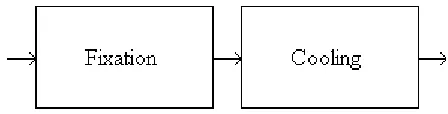
[image:17.612.93.522.235.482.2]Chemical improvements of the fabric occur on the Thermex hotflue and the stenter frames. The stenter frames (SR) are used for most of the chemical improvements made at TCP. First, the chemicals are impregnated by means of a foulard like the ones used at the VV and CVM. After the impregnation has occurred, the fabric passes an appliance for mechanically straightening the latitudinal fibers. Now, the fabric enters the drying cabinet. In here, the fabric is dried with preheated air and the chemicals are fixated. The last step of the fixation process is direct cooling with air to “freeze” the changes [7].
Figure 12. General flowchart of the fabric on a stenter frame
For fixating resins and chemicals that make the fabric water-repellent, impregnated on a stenter frame, the Thermex hotflue is used [7]. It is used as “baking oven”. The machine is composed of a large metallic box in which many rolls deviate the fabric (in full width) so that it runs a long distance inside
the machine to increase the residence time. The internal air is heated by means of direct flame and ventilated into the chambers where the fabric is. Here, the fixation takes place. When the chemicals are fixated the fabric is cooled on water-cooled cylinders.
Figure 11. Stenter frame [12]
[image:17.612.91.515.426.480.2] [image:17.612.289.513.566.623.2]§2.2 Energy and water consumption levels per machine
In the previous paragraph, a general description of the production process at TCP has been given. To do so, the different process steps and goals per machine were described. During this description the four utilities used by TCP (electricity, steam, gas, and water) are already mentioned. In this paragraph the consumption levels per machine for these utilities are determined. However, as electricity is only used for mechanical means, like the transportation of the fabric over the machines, it has no purpose to include this utility in the mass and thermal energy balances [59]. Therefore, this utility is excluded from the remainder of this study. So, only for gas, steam, and water the yearly consumption levels for TCP in total and per machine are
determined below in order to reduce the assumptions needed for the creation of the mass and energy balances for which no support exist based on data from TCP.
As was mentioned in Chapter 1, only the yearly consumption levels for TCP in total and the gas usage per machine are measured. For the pre-dyeing machine the gas consumption is even measured per part of the machine. For
2007, these levels are represented in table 1 and 2.
As the CBB is a relatively new machine (2006), its total gas, steam, and water usage is measured for 2007 unlike for the other machines of TCP (see table 3).
For the other utilities used by TCP the yearly consumption per machine is not measured like it is for gas. The main reason for this fact is already mentioned on page 11. As TCP was active in a craftsman driven industry for centuries, it never gave much attention to data about e.g. water and energy consumption levels until relatively recently. As long as the fabric met the quality standards, the way it was produced was of secondary interest [11]. The most recent information known about the consumption levels per machine of
Utility Yearly consumption
Spring water (13 °C)a m3
Thiolon water (40 °C)a m3
Saturated steam ton
[image:18.612.287.529.218.293.2]Gas m3
Table 1. Utility consumption per year at TCP for 2007 [8]
a. For water, two sources are used. This is due to the on page 9 mentioned plan to re-use used cooling water of one production site at other production sites at the TenCate location in Nijverdal-North. As a pilot of this plan, some of the used cooling water of the production site of Thiolon is already transported to TCP where it is used at the continuous bleaching machine. The CBB requires warm water in its washing baths. Therefore, the use of water of 40 °C from Thiolon instead of spring water of 13 °C results in a decreased need of steam for heating these baths.
Machine Yearly consumption
ZE CBB ME
Discontinuous dyeing CVM
VV/TH IR dryer VV/TH thermosol part SR 6a
SR 7a
SR 8a
SR 9a
SA Thermex
Not productionb
Table 2. Gas consumption per machine for 2007 [8]
a. Differences in gas use due to differences in running time and recipes run over the machines
[image:18.612.85.328.416.643.2]water and steam stems from a factory-wide investigation in 2000, as it was, due to time constraints, not possible to measure these data within the current project’s timeline. Nevertheless, technology experts of TCP have declared independently of each other that the data of 2000 is still quite accurate [4,11]. Table 4 represents this data.
Machine Yearly consumption water (m3) Yearly consumption steam (ton)
ZE
CBB a
ME
Disc. dyeingb CVM
VV/TH
SR c
[image:19.612.83.531.72.178.2]SA Thermex Not production
Table 4. Yearly water and steam consumption per machine for 2000 [4, 9]
a. The CBB used less water in 2000 as it did in 2007. There are two main reasons for this difference. First, in 2006 a new CBB was installed. This new machine has a new configuration with more, larger washing baths and therefore it needs more water. Second, due to the use of warmer Thiolon water in the cooling sections of the CBB, more water is needed to cool the fabric [39].
b. In the referred business documentation [9] the yearly water and steam consumption has been divided by the project team over the several categories (Jets, Jiggers, etc.) of discontinuous dyeing machines, as the consumption levels were measured for the machine group in total only. The distribution code was not documented or could not be retrieved from the subdivision. Therefore, the total yearly water and steam consumption for all the discontinuous dyeing machines together is mentioned here only. A new distribution code, based on the running hours and capacity of the different discontinuous dyeing machines, is used and explained in Appendix 4.5 where the mass and thermal energy balances for the discontinuous dyeing machines are created.
c. In the referred business documentation [9] the yearly water consumption of the SR, only measured for the four stenter frames in total, has been divided evenly over the four machines. This was done in 2000 as the project team then did not find another good distribution code [4]. Here, however, it is assumed another distribution code would give a better description of reality. The amount of water is divided over the stenter frames based on the running time and throughput per machine in this research. This is done, as the water on the stenter frames is only used for the impregnation section. Here, water is used for the impregnation of the fabric (throughput) and cooling of the squeegee that determines the pick-up of the impregnation bath by the fabric (running time). In Appendix 4.6 where the mass and thermal energy balances for the stenter frames are created the distribution of the total water consumption over the stenter frames is addressed in more detail. For now, the four stenter frames are taken into account as a whole, when concerning the yearly water consumption.
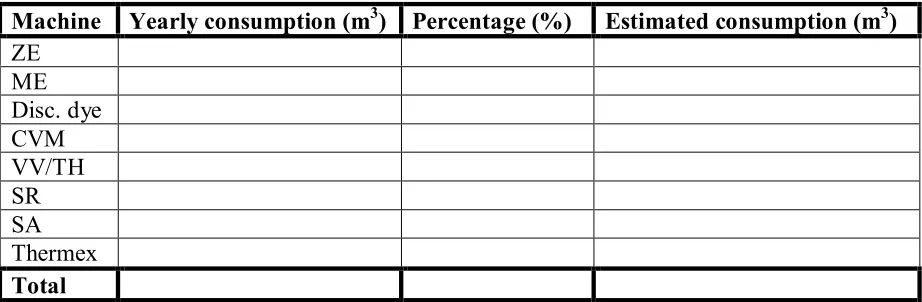
As can be concluded from table 1 and 4, the total spring water consumption has decreased from m3/yr to m3/yr. This is partly due to the re-use of cooling water of
Thiolon on the new CBB. Another m3/yr is saved on the other machines. As the
technology experts indicated that no specific savings were made on a single machine in the period 2000-2007 [13,14,15], it is assumed that the contribution per machine in the total yearly water consumption of TCP without the CBB stayed the same, as is depicted in table 5. These yearly water consumption levels are taken into account when the mass and thermal energy balances are created.
Utility Yearly consumption
Spring water (13 °C) m3
Thiolon water (40 °C) m3
Saturated steam ton
[image:19.612.87.530.194.358.2]Gas m3
For the yearly steam consumption a decrease is noticed also. Where the steam consumption was about ton/yr in 2000, in 2007 it was about ton/yr. A large part of this reduction in steam consumption is due to the new CBB. With this new machine a total of ton/yr is saved. Based on interviews with the technology experts [4,13,14,15], it is assumed that the remaining ton/yr are saved on non production activities like heating of the offices and storage halls, as no specific savings are made on the machines within the mentioned timeframe. Table 6 depicts the yearly steam consumption levels taken into account during the remainder of this research.
As the yearly consumption levels per utility per machine are “known” now, an indication of the utility costs per machine can be given to give inside in which machines and which utilities are responsible for the largest part of the total utility costs. To do so, first, the costs per unit of the three utilities (water from Thiolon is assumed to be cost-free as it is delivered from another TenCate production site) have to be determined. Based on internal business documentation [16] the costs per unit represented in table 7 are made by TCP. For spring water, the cost price consists only of
production and storage costs, as the spring water is conceived from a by TenCate owned water source. The cost price of gas consists of a contract purchase price of € per m3 and a small amount of additional
costs like maintenance to the piping system. For the cost price of a ton steam, a somewhat larger
calculation has to be made. Saturated steam is produced by TenCate self at the location in Nijverdal-North. Where theoretically 83 m3 gas and 1 m3 water would be optimally needed sec for the winning of one ton steam (32 MJ/m3 gas [29]), about m3 gas and m3
Machine Yearly consumption (m3) Percentage (%) Estimated consumption (m3)
[image:20.612.76.537.72.223.2]ZE ME Disc. dye CVM VV/TH SR SA Thermex Total
Table 5. Estimated yearly spring water consumption of TCP in 2007
Machine Yearly steam
[image:20.612.85.333.339.507.2]consumption (ton) ZE CBB ME Disc. dyeing CVM VV/TH SR SA Thermex
Table 6. Estimated yearly steam consumption of TCP in 2007
Utility Costs per unit
Gas € /m3
Spring water € /m3
Steam € /ton
water are needed at the boilers of TenCate (see Appendix 2) due to inefficiencies, like heat loss due to flue gasses and radiation and drain losses [57]. As also chemicals and several treatments are necessary to produce steam, like maintenance to the boiler and piping system, all this together results in a current net cost price for steam of: € /ton [16,45].
Based on the mentioned cost prices the total costs per machine and per utility can be derived. The results are represented in table 8.
Table 8. Total costs per utility per machine of TCP for 2007
From table 8 it can be concluded that steam has a high contribution in the total utility costs. Therefore, when in Chapter 4 reduction options for the utility consumption are proposed, especially options to reduce the consumption of steam are interesting. Another conclusion that can be drawn from table 8 is that especially those machines that use a lot of water (CVM, CBB, ME), also use a lot of steam. This is typical for the textile industry, as steam is usually used to heat the washing baths and to dry the fabric.
One last remark is made here about the gas and steam prices. As can be seen in Appendix 3, the gas price has fluctuated a lot in the past three years. However, the trend during the last 15 months is upwards again. Therefore, it is expected that the gas price, and thus also the steam price, will increase when TCP has to sign a new contract for the gas delivery in the beginning of 2009. Even a small increase in the gas price of 1 eurocent would already mean an increase of € per year in the total utility costs. Therefore, reductions in the gas and steam consumption levels proposed in Chapter 4 are likely to become even more beneficial when a contract is signed for 2009 and later.
§2.3 Selection of program to create mass and thermal energy
balances
In the previous two paragraphs a description of the production process at TCP has been given and the yearly consumption levels of the different utilities per machine are determined. Before the mass and thermal energy balances can be created, the program in which these balances are created needs to be selected first.
As was mentioned before the textile industry is a craftsman-driven industry from origin. During the 20th century, however, more and more of the production processes became
it is produced was of secondary interest [11]. Due to this mentality, even simple figures about yearly consumptions of utilities per machine and mass and thermal energy balances are lacking or not up-to-date, as mentioned in the previous paragraphs. So let alone that advanced and relatively expensive software programs, like the in the process industry well-known and widely used flow sheeting packages of ASPEN or HYSYS, are available at TCP for creating these mass and thermal energy balances. Furthermore, it is even questionable if these packages are useful for TCP at the moment, as these flow sheeting packages require more specific information about the processes than is known at TCP for above mentioned reasons. With this in mind, the already at TCP available software program Excel is used as program to create the mass and thermal energy balances for the machines of TCP.
§2.4 Mass and thermal energy balances per machine
In the previous paragraph it is explained why the software program Excel is used to program the mass and thermal energy balances for the production machines of TCP. In Chapter 1 page 10, it is explained that the balances consist of the several production steps on those machines to take into account the effect of preceding and subsequent steps on one machine. Basic input for these balances is the in paragraph 2.2 estimated yearly consumption levels, as no consumption levels during a production run are known at TCP and measuring these data in most cases is not possible, as explained on page 11. However, for some production steps e.g. temperatures and amount of water used can be set or kept within ranges on certain machines. This sort of information, available from the machine set-up specifications, is used as much as possible. However, most machines have these kinds of specifications per fabric quality. As only yearly consumption levels are known, average set-up specifications are used in the balances. These average values are determined in consultation with the technology experts from TCP. Basing the mass and thermal energy balances solely on the specifications is not preferred, as for too many production steps these settings are not known. By using the combination of the yearly consumption levels and the average process specific information, the least amount of additional assumptions without data from TCP supporting it is needed.
In the subparagraphs 2.4.2 till 2.4.9 the basic conclusions that can be drawn from the mass and thermal energy balances per machine are given. The balances themselves are represented in Appendix 4 together with the detailed calculations. In order to create these balances some general remarks and assumptions about the production processes at TCP have to be addressed first.
§2.4.1 General information
use electricity which is not taken into account in this research. The subdividing of some of the washing baths on e.g. the continuous bleaching machine is done, as for these baths a grouping like on the continuous dyeing machine is not possible as there is an exchange of water, and thus an interaction, between a bath in the middle of a washing section and a bath of a different washing section (e.g. B6 en B9). B1 till B3 can be taken together as all the incoming water streams enter this section in B3 and leave it from B1 while having the same operating temperature inside the baths. The drying and fixation steps with hot air are subdivided in a heat exchanger or burner and the actual drying or fixating step. In the burner or heat exchanger the air is heated and in the drying or fixating step this heated air is brought in direct contact with the fabric in another chamber of the machine.
Besides these small adjustments to the flowcharts, also some additional remarks and assumptions are needed, for example about the temperatures inside the production hall influencing the inlet temperature of the fabric, chemicals, and air. Normal temperatures in the production hall are about 25 °C. However, in the area where the pre-dyeing and continuous dyeing machines stand, this temperature is somewhat higher (about 30 °C on average) [14].
Other assumptions are needed too:
• Although most of the machines are semi-continuous - they require a short start-up, when another fabric quality is run over the machine – the balances that are created are all assumed stationary, as the required start-up time is very short compared to the steady-state situation [11]. For production steps in which this assumption is doubted, an extra parameter START is used to take into account the dynamic start-up.
• The general efficiencies of gas burners, steamers, and cooling equipment, is estimated at 85%, except on the continuous bleaching machine which is relatively new and better isolated. Here, a general efficiency is estimated of 95% [13].
• After each foulard and the impregnation sections on the continuous bleaching machine, there is a squeegee that controls partly the pick-up of chemicals and water during that production step [17]. It is assumed that this squeegee requires between m3/yr of cooling water [18], as this amount is not directly measurable
[19].
• In general it is assumed that the temperature of the fabric does not change between production steps on the same machine. For most production steps, this temperature loss can indeed be neglected, as the fabric almost directly enters another step without much contact time with open air. Where there is much contact with open air and it was possible, the temperature loss is measured and taken into account.
• The natural moisture regain of the fabric is not mentioned in the balances, as it is assumed that the moisture regain of the fabric stays about the same at the beginning and end of the production process at TCP [13,15,17].
• On average a fabric of TCP consists of % cotton and % polyester [11,20]. In reality there are more resources used, but cotton and polyester form the largest part. As the specific heat capacity of cotton is equal to 1,3 kJ/kgK [22] and of polyester is equal to 2 kJ/kgK [23], the specific heat capacity of a fabric produced by TCP is kJ/kgK.
• If the specific heat of a chemical is not known, the value of 3 kJ/kgK is used. However, the exact value does not really matter, as most chemicals only contribute for a minimal amount in the total mass present in a production step. • When a fabric is dried the absorbed water evaporates when the fabric and water
reach a temperature of °C [21]. Inside the steamers, this evaporation does not occur [33].
• During impregnation steps the baths or foulards are heated indirectly. The steam itself does not enter the foulard or bath. Washing baths and steamers, however, are heated directly [3].
• The fabric generally reaches the same temperature as the temperature at which the machine part is operating [5,7].
• The running hours of the machines are last estimated during the on page 19 mentioned factory-wide study in 2000 [9]. These values are assumed to be accurate enough to be used in this research [11].
• The throughput of fabric per machine in 2006 [10] was the most recent available information about the amount of produced fabric and so most in line with the throughput of 2007. Therefore, this throughput is used in this research.
• The annual consumption levels of most of the chemicals per machine are measured by TCP [24]. The values for 2007 are used in the balances.
As the general assumptions and remarks are given now, the main conclusions based on the created and in Appendix 4 stated mass and thermal energy balances are being described in the next eight paragraphs below.
§2.4.2 Singeing and continuous bleaching machine
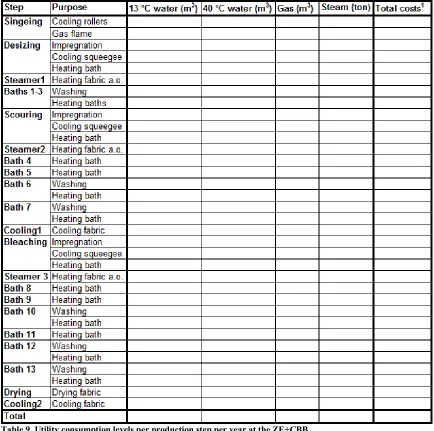
For the creation of the mass and thermal energy balances for the singeing machine (ZE) and the continuous bleaching machine (CBB), these machines are viewed as one as the fabric is transported automatically from the ZE to the CBB. Furthermore, the amount of steam used at the ZE (see table 6, page 20) is the amount actually used at the desizing stage of the CBB and the amount of 13 °C water used in this step on the CBB is also part of the total spring water consumption of the ZE in table 5 [18]. Based on the created balances (see Appendix 4.1) the utility consumption levels for the ZE and CBB are determined per production step and represented in table 9.
Furthermore, as most of the fabrics are led over the CBB and all these fabrics absorb an amount of water equal to about % of their weight [34], the drying section requires a large amount of steam too to remove this water from the fabrics again.
The last group mentioned here are the steamers. They too require a large amount of steam. Inside the steamers, the fabric is brought in direct contact with the steam to make sure that the fabric remains humid even by the required temperatures of about 100 °C. At that temperature the absorbed chemicals work in onto the fabric. The steam used inside the steamer also makes sure that the steamer is air-free to overcome negative side reactions with oxygen.
[image:25.612.89.523.265.696.2]So, based on the large steam consumption levels, especially the mentioned washing baths, steamers, and drying section are interesting for identifying saving options at the ZE and CBB in Chapter 4.
Table 9. Utility consumption levels per production step per year at the ZE+CBB
§2.4.3 Mercerizing machine
During the creation of the mass and thermal energy balances for the mercerizing machine (see Appendix 4.2) a discrepancy was noticed between the machine specifications and the actual water consumption level. According to the annual water consumption level more than twice the amount stated in the specifications is used at the heat exchanger, instead of m3/hr. However, it is also possible that the amount of cooling water used in the cooling
section is larger than indicated in the documentation. However, in both cases the amount of water entering bath 4 remains the same, as bath 4 is supplied of water by the cooling section and the heat exchanger only. As mentioned before, most machines are not equipped with measurement devices like e.g. flow and temperature meters. Here, a good example of the necessity of such equipment is given. Without these meters it is not possible to indicate where the possible discrepancies occur. For now, it might even be possible that the assumptions made on page 20 are not correct. However, this would mean that other machines would use more water as the total yearly consumption level of TCP is known. In anticipation of the other balances, it is stated here that these balances do not show such discrepancies. Therefore, it is most likely that somewhere on the mercerizing machine too much water is used than expected from the specifications. Where exactly, is difficult to indicate as mentioned above. For the creation of the mass and thermal energy balances in this report, it is assumed that the excess of water is led through the heat exchanger and it is not used as cooling water.
Based on the created mass and thermal energy balances for the mercerizing machine, the utility consumption levels are determined per production step and given in table 10. As can be seen, again the different washing baths require quite some steam to keep the baths at the required temperatures. Together with the drying section, these are interesting production steps to look for possible savings in Chapter 4. Furthermore, TCP is strongly recommended to install measurement devices for the different water streams to overcome the gaps between the specifications and the real production. For the ME, producing according the specifications would reduce the total utility costs of the machine with €, as not only less water is used, but also less steam is needed to heat this smaller amount of water inside the washing baths.
Table 10. Utility consumption levels per production step per year at the ME
§2.4.4 Pre-dyeing machine with/without thermosol
The third machine for which the mass and thermal energy balances are created is the pre-dyeing machine with and without thermosol part (see Appendix 4.3). One important parameter resulting from the creation of these balances needs to be mentioned here. The radiation efficiency of the infrared dryer – the amount of radiation heat that is used for the drying of the fabric - is only %. So, % of the radiation heat is used for unintended purposes. As the IR-zone is in direct contact with open-air, most of the radiation heat is lost due to the heating of this open-air.
Based on the created mass and thermal energy balance of the VV/TH, the utility consumption levels mentioned in table 11 are determined. As can be concluded from this table, especially the drying sections and the thermosol part are interesting options for possible savings in the utility consumption levels. In Chapter 4 at least a suggestion is made to increase the radiation efficiency of the IR-drying zone.
Table 11. Utility consumption levels per production step per year at the VV/TH
a. Based on the cost prices mentioned in table 7.
§2.4.5 Continuous dyeing machine
The fourth machine described here is the continuous dyeing machine. For this machine it is much harder than for the previous three machines to make its mass and heat balances on a yearly basis, as recipes are run over this machine. However, how much each recipe is used is not known [17]. Especially for the description of the washing baths, these different recipes give some trouble. As can be seen in the flowchart in Appendix 4.4 two heat exchangers are used to pre-heat the water of the baths with used water and steam. However, the baths that use this warmer water differ per recipe. Therefore, in the mass and heat balance the distinction has been made between the amount of fresh 13 °C spring water and pre-heated °C water used [43]. The subdivision of the washing baths, mentioned on page 16 in figure 9, still holds as there is no interaction of water and chemicals between these different groups of washing baths [43].
Based on the large steam consumption levels again the washing baths, steamer, and drying section are interesting options for identifying possible savings in the utility consumption levels in Chapter 4, as is the second heat exchanger.
Table 12. Utility consumption levels per production step per year at the CVM
a. Based on cost prices mentioned in table 7.
2.4.6 Discontinuous dyeing
Next, the mass and thermal energy balances for the discontinuous dyeing machines are programmed. In Appendix 4.5 only the yearly balances for the total HT and non-HT machines are given, as a distinction between the several HT-machines would only result in an adjustment of the consumption level figures per balance while these figures for the utilities are already given in Appendix 4.5.
Table 13. Utility consumption levels per year for the discontinuous dyeing machine types
a. Based on the cost prices mentioned in table 7.
2.4.7 Stenter frames
As the pretreatment and the dyeing machines are described, the finishing machines are up now, starting with the four stenter frames. Basically, the mass and thermal energy balances are the same for all four. Only the consumption levels differ. This is partly due to the amount of fabric running over the different machines and the recipes used. Based on the created mass and thermal energy balances in Appendix 4.6 the utility consumption levels per stenter frame are as represented in table 14. Based on these figures, especially the gas consumption of the gas burners is interesting for identifying saving options in Chapter 4.
Table 14. Utility consumption levels per production step per year at the SR's
a. Based on the cost prices mentioned in table 7.
2.4.8 Thermex hotflue
Table 15. Utility consumption levels per production step per year at the Thermex hotflue
a. Based on the cost prices mentioned in table 7.
2.4.9 Sanfor
The last machine of the machine park of TCP described in this report is the Sanfor. In fact, there are two identical Sanfor machines of which the newest one is used most frequently. The created mass and thermal energy balances are pretty straightforward as with the Thermex hotflue and describe both machines in one total balance in Appendix 4.8 as they are so identical. Based on the created balances, table 16 gives the annual consumption levels per production step for the Sanfor machines. Based on these figures especially the drying section is interesting for identifying savings options in Chapter 4.
Table 16. Utility consumption levels per production per year at the Sanfor
Chapter 3. Production situation in the near future
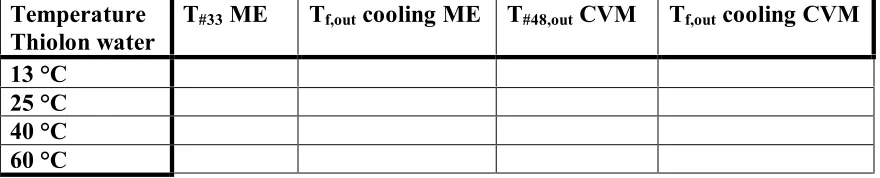
In the previous chapter a better insight has been created in the utility consumption levels of the current production processes at TCP by means of mass and thermal energy balances per machine. However, in the near future, within the next twelve months, some changes shall occur in these balances due to other projects running at TCP. One of these projects, in which the water used as cooling water at one of the production sites at Nijverdal-North (Thiolon) is reused at different other production sites on the same location including TCP, was already shortly mentioned before on page 9. There, it was mentioned that the total savings possible at TCP with this plan could not be determined, as information about possible reductions in energy consumption levels at TCP due to the use of the preheated water was not known. With the creation of the mass and thermal energy balances in Chapter 2 a better understanding is created about the energy consumption levels at TCP and with these balances it is also possible to calculate the expected savings possible with this plan. As water in four temperature gradients becomes available for TCP, several possible scenarios for allocating the water of these different temperature gradients to the production step at TCP are drawn up. Based on the created balances the savings possible with the different scenarios are determined in order to generate the highest possible savings in utility costs.
Before this is done in paragraph 3.2, paragraph 3.1 elaborates on another project influencing the utility consumption levels of TCP. As part of the integration of TCP and TenCate Technical Fabrics (TCTF), from another TenCate location in Nijverdal, at the location in Nijverdal-North were TCP is already at, the Flame Retardant Line (FRL) machine is moved over from TCTF to TCP. This machine is described in paragraph 3.1 in the same way as the other machines are in the previous chapter. One remark has to be made here in advance. As the FRL is a “new” machine, built up of machine parts from older machines not used anymore [35], and in operation for less than a year now, no annual consumption levels are present. Furthermore, no utility consumption levels are measured per production step. However, in order to give some indications about these consumption levels, temperatures and chemical usage during a production run are measured. Based on these measurements, the mass and heat balance for that run are created.
§3.1 Integration of the flame retardant line with TCP
The FRL machine is used in the finishing section for cotton and cotton rich fabrics to make it flame retardant. Flame retardancy is achieved by the formation of a strong cross-linked inert phosphorus-nitrogen polymer within the fiber. When a treated fabric is exposed to flames the fabric forms an insulating char that stays in place and protects the wearer as the flame extinguishes [52].
Figure 14. General Flowchart of the fabric on the FRL
As the FRL moves over to TCP, the utility consumption levels of TCP will rise in the coming year. How much is not known. As mentioned on the previous page, no consumption levels are measured per production step and annual consumption levels are not known yet, as the machine operates for less than a year now [35,51]. Therefore, this machine can only be described based on the process specifications, some additional measurements like fabric temperatures, cooling water temperatures, chemical consumption levels, and humidity of the fabric, and assumptions. The measurements are done by Andre van Rijn (refining technologist of TCTF) during a production run of m of a standard product on the 18th of February 2008. As the chemical consumption levels are
measured after m, this is the fabric length taken into account in the created balances for the FRL in Appendix 5.
Table 17 gives the main results for the utility consumption levels based on the production run of m ( min with a throughput of m/min) on the FRL determined with the in Appendix 5 created balances. Besides this standard product several other products are run over the machine, each having their own process specifications. Furthermore, no annual throughput or running time is known. Therefore, it is hard to extend the conclusions from table 17 to the FRL on a yearly basis. However, based on the running times of the other larger machines, like the CBB, CVM, ME and VV/TH, an annual running time of hours is a good average [9]. Table 18 therefore gives the consumption levels at the FRL, based on the production of the standard product only with a total annual running time of hours. The consumption levels stated in this table are used in the remainder of this research.
Table 18. Utility consumption levels per production per year at the FRL
a. Based on the cost prices mentioned in table 7.
b. See Appendix 5 for the discussion about information received too late to take into account in this report for these production steps
Based on the consumption levels stated in table 18, it can be concluded that especially the drying sections are interesting options for identifying utility saving options in Chapter 4, as they contribute for % in the total utility costs. The washing baths are less interesting as most baths are connected and operate at the same temperature.
Figure 15. Reaction scheme of PROBAN® on the FRL machine [52]
Table 17. Utility consumption levels at the FRL for a minutes production run of a standard product
§3.2 Effects of the water recycling plan
With the description of the FRL in the previous paragraph and Appendix 5 all the production machines of TCP in the coming year are mentioned and described with mass and thermal energy balances. Now, one more project will have its effects on the annual utility consumption levels of TCP in the coming year. This is the water recycling plan, already described on page 9 and 31. This paragraph elaborates on the effects this plan has on the consumption levels of TCP and the savings possible due to this plan.
As these kinds of savings are possible by the use of the preheated water of Thiolon, the water recycling plan should be almost completely implemented within the next twelve months. Due to this plan the following water streams become available at TCP when the complete plan has been implemented based on information from September 2007 [3,61]:
• m3/yr at 60 °C • m3/yr at 40 °C
• m3/yr at 25 °C
• Fresh spring water of 13 °C
It is expected that the above mentioned amounts shall increase in the future, as the production throughput at Thiolon is still increasing [3]. Furthermore, the given amount of 40 °C water is much lower than the amount used currently at the CBB. This is due to the fact that the current 40 °C water will be used to create water with the 60 °C temperature gradient in the near future.
As warmer water becomes available at TCP, the processes in which the water currently is heated with steam can now reach the right process temperature with less steam. As mentioned in Chapter 2, especially savings in the steam consumption are interesting, as steam contributes for about % in the total utility costs of TCP due to the relative high unit costs in comparison with the other utilities. As water becomes available in four temperature gradients with mostly limited amounts, these water streams need to be allocated to the production steps optimally. For this purpose, 21 scenarios are created in subparagraph 3.2.1. For each of these scenarios the savings are calculated with the in Chapter 2 created mass and thermal energy balances in paragraph 3.2.2. Finally, the conclusions from these calculations are given in paragraph 3.2.3.
Before adjusting the balances, two remarks have to be made here. First, for the impregnation stages, only fresh spring water can be used. This, to overcome the negative effects possible impurities, which might occur in the Thiolon water, can have on the impregnation of the fabric [3].
![Figure 1. Singeing machine and impregnation bath of the desizing step of the CBB [12]](https://thumb-us.123doks.com/thumbv2/123dok_us/2264.647206/13.612.91.298.552.692/figure-singeing-machine-impregnation-bath-desizing-step-cbb.webp)

![Figure 5. Discontinuous dyeing machine (jet) [12]](https://thumb-us.123doks.com/thumbv2/123dok_us/2264.647206/15.612.90.264.558.684/figure-discontinuous-dyeing-machine-jet.webp)
![Figure 8. Washing baths of the CVM [12]](https://thumb-us.123doks.com/thumbv2/123dok_us/2264.647206/16.612.91.293.244.404/figure-washing-baths-cvm.webp)
![Table 2. Gas consumption per machine for 2007 [8] a. Differences in gas use due to differences in running time and recipes run over the machines b](https://thumb-us.123doks.com/thumbv2/123dok_us/2264.647206/18.612.287.529.218.293/table-consumption-machine-differences-differences-running-recipes-machines.webp)
![Table 3. Utility consumption of the CBB for 2007 [8]](https://thumb-us.123doks.com/thumbv2/123dok_us/2264.647206/19.612.87.530.194.358/table-utility-consumption-cbb.webp)