160
©IJRASET: All Rights are ReservedSurvey based on Image Segmentation
Narendra Kumar S1, Varsha P M2
1
Asst. Professor, 2B.E, (MTech), Department of Computer Science .. Engineering, JNNCE, Shimoga
Abstract:Image Segmentation has played an important role in Computer vision it is used for object tracking and to identify image boundaries. It goals at fetching meaningful objects lying in the digital image of user captured or preprocessed image. Generally there is no unique method or approach for image segmentation. The different algorithms used in Image segmentation are Clustering-based, Region based and Edge based. Image segmentation is the fragmentation technique for an image into multiple fragments i.e. set of pixels, pixels in a specific region are similar according to some attribute. These attributes are such as color, intensity or texture. The proposed paper gives the overall view about the methods in image segmentation specifically thresholding , k-means clustering , grab-cut method , graph-cut method and Feature based segmentation. Every method is discussed along with its advantage and disadvantages which helps us in deciding which the best and efficient method of image segmentation is. The main aim of the paper is to come out with the more efficient method in image segmentation.
Index Terms: Thresholding, Clustering, Grab-cut and Graph-cut.
I. INTRODUCTIONOFIMAGESEGMENATION
Image segmentation is a kind of digital image process where in the given input is divided or fragmented into multiple segments/fragments based on user interest. The goal of image segmentation is to convert the pixels of a digital image into meaningful sub-image from which something useful information can be extracted as well as for analyzing the digital image to overcome some real world issues. The objects as well as boundaries (lines, curves, etc.) of a digital images were identified using this image segmentation approach. The image segmentation or fragmentation is the process of marking a label to all pixel within an image such that each pixel within it share same label having some shared/same characteristics. A set of segments that together wrap the complete image is the output of image segmentation. Each and every pixels of this process in a region will be parallel with respect to computed property value or certain characteristic based on the requirements, such as intensity, color or texture. Adjacent area are considerably different with respect to the same characteristics. Image segmentation technique, which is very often necessary step in image analysis of digital image, visualization of an digital image, object representation of an digital image, and many other image processing jobs of an digital image. A numerous alternate segmentation methodologies have been proposed in previous days, and some of the different approaches were discussed based on categorical aspect in detail.
The following different category of segmentations are used:
1) Threshold Based Segmentation: In this category Histogram based thresholding and image slicing techniques were used for
fetch the interested objects (segmentation). It could be directly implemented on a digital image, but it can also be merged with before and after image processing methods for solving real world issues.
2) EDGE Based Segmentation: This category of segmentation approach mainly meant for identifying the objects within the
digital image based in digital image boundaries which actually represents a boundary of an object with in the image.
3) Region Based Segmentation: In this category of image segmentation approach, the above technique could be used to find the
boundary of an object in order to detect the object itself and immediately filling them with proper colour in order to say it as a one region. In this way number of regions might be obtained by filling with different colors for different regions. This whole process will be done by growing the boundary of an image outward till it reaches the complete object edge.
4) Clustering Techniques: In this category of digital image segmentation, the clustering concept will be used in order to analyze
the data in exploratory data analysis way for measurement patterns with high-dimensional similarity data. Which intern gathers the data with some similarity property and groups them together as group of matching patterns which are similar in some way of digital image sense.
5) Matching: in this categorical segmentation approach, the object which you want to extract will be known well in advance and
161
©IJRASET: All Rights are ReservedII. METHODSOFIMAGESEGMENTATION A. Thresholding
The basic method of image segmentation is the thresholding method. The thresholding approach meant for replace each and
every pixel with a black pixel if the pixel intensity Ii,j is below some predefined fixed constant T (that is, Ii,j < T), or a white pixel
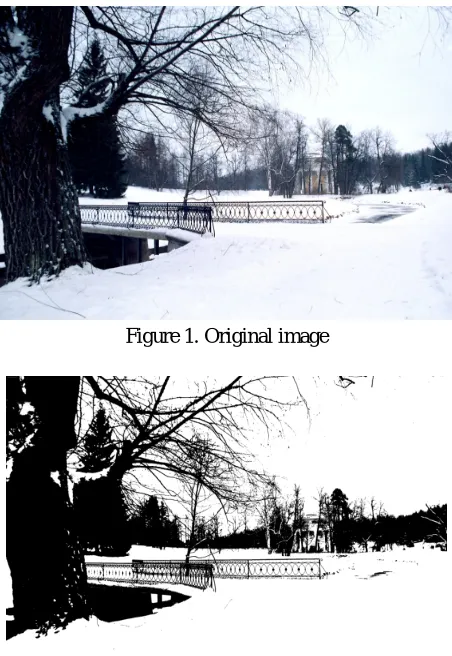
[image:2.612.193.419.244.572.2]if the pixel intensity is above that predefined constant. In the example Figure 1 & 2 shown below, this kind of results in the dark tree will becoming completely black, and in the same way white snow becoming completely white. This technique turns a gray-scale image into a binary image based completely on a clip level or a threshold value. Selecting the threshold value is the key point of this method. Numerous widespread methods are used in industry which includes the first one as balanced histogram i.e. thresholding, second on as maximum entropy method, third one as hybrid thresholding and finally fourth one as Otsu's method (maximum variance). The very recently innovative methods which has been developed in order for thresholding the computed tomography (CT) images in medical science.
Figure 1. Original image
Figure 2. Threshold effect used on an image.
1)Algorithm
a)Select initial eight bit as a value of threshold for the original image.
b)Then, split completely the original image as mainly two parts;
i) Based on pixel value, say it as background image. If, it is smaller than or equal to the given threshold vale.
ii) Based on pixel value, say it as foreground image. If, it is larger than to the given threshold vale.
c)Soon after this we are supposed to compute average mean values of these two newly generated images.
d)Then, compute the average of the two means and say it as new threshold value.
e)Finally, we are supposed to analyze the difference between the old threshold and new threshold value. If, there is no much
162
©IJRASET: All Rights are Reserved2)Advantages of Thresholding
a)Prior information of the image is not required.
b) Inexpensive in computation.
c)Implementation is simple and fast.
d)Used in real time applicatins.
3)Disadvantages of Thresholding
a)For a digital image with broad and flat kind of valleys or without any peak in the mountain it won’t work well.
b)The segmented regions are not always contiguous and neglects spatial information of an image
c)Highly noise sensitive.
d)Selection of threshold value or clip-level value is crucial. Over or under segmentation is the result of wrong choice.
B. Clustering Based Method
Clustering of an image is used for image segmentation.. This clustering based approach concept aim is to dividing the images based on some the partitioning decisions which should be developed with some initial set of clusters which is rigorously updated
after each iteration or step usually through the looping system .currently this clustering approach widely for segmenting the using
as one of the image segmentation technique. Clustering approach is truly one of the freely/openly learning approach in which important sets are fragmented (separated) into homogeneous groups. There are many different types of clustering methods are there: first based on Hierarchical(inverted tree) clustering, Second based on Fuzzy C-means clustering and the final one based on K-means clustering. The K means method which is listed as the last type of different clustering approach is one of the commonly used clustering technique in order to segment the image in various applications.
C. K-means Clustering
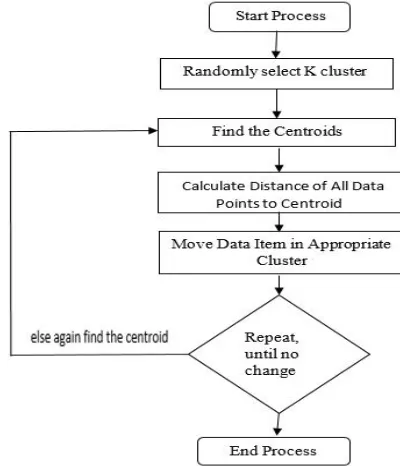
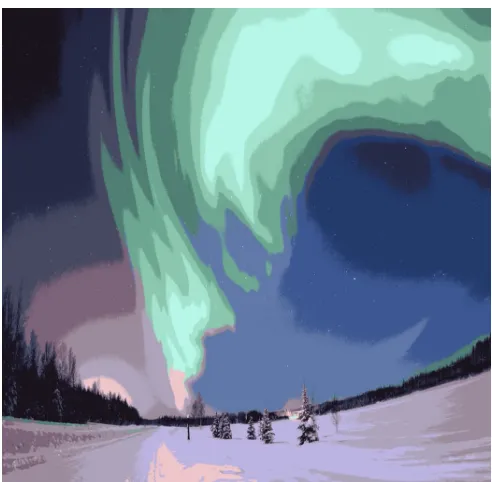
[image:3.612.201.401.481.714.2]This K-means clustering is a major type of clustering type which is widely used as one it is also called as Partition-based clustering analysis technique. This K-means clustering technique is a popularly throughout the global which has been implemented for solving the low-level image segmentation tasks for better result. In this technique the main ignition part is selection of initial cluster centers which is very important in order to avoid the clustering algorithm it works in produce wrong decisions. The elegant common approach for initialization procedure is to select the initial cluster centers randomly from the given input data. This procedure is detailed in below figure i.e. Figure 3 and Figure 4 which is the original image for this a k-means technique is implemented .The Figure 5. Shows the result of this algorithm.
163
©IJRASET: All Rights are ReservedFigure. 4 Original image
Figure 5. Image after running k-means with k = 16
1)Advantages of Clustering based segmentation
a)K-means is computationally faster for small values of k.
b)Noisy spots are eliminated.
c)False blobs are reduced.
d)More homogeneous areas are obtained.
2)Disadvantages of Clustering based segmentation
a)It is difficult to predict k with fixed number of clusters.
b)Sensitive to initialization condition of cluster number and centre.
c)Computationally expensive.
[image:4.612.183.429.311.552.2]164
©IJRASET: All Rights are ReservedD. Grab Cut Algorithm
Figure6. Graph with s-t network
This algorithm/technique determines which pixel supposed to belongs for the background image or which pixel suppose to belongs to the foreground image, in order to reach the energy minimization. Mincut/Maxflow based algorithm says that, the pixels of image were developed as (s – t) map, which is as shown in the Figure 6, where s and t are respectively the vertex of foreground (interested object) and background. At the starting stage, s and t are related to each and every pixels (called edge). After the segmentation process is completed, pixels are may be foreground image which is connected through s, or it will be background image connected with t.
Figure8. Grab Cut algorithm
According to the discussion of above analysis, this Grab-Cut algorithm’s working approach is shown in Figure 8 and it works is as follows:
1) Initially we are supposed to select a Region of interest by dragging a rectangle.
2) Pull a rectangle around the object in Region of interest
3) Arrange all pixels to three categories: the initial background pixels, the initial foreground pixels and abandoned pixels;
4) Initialize each gaussian component of two GMMs according to the RGB values of the initial background pixels and the initial
foreground pixels;
5) Calculate probabilities of each pixel inside the rectangle two belongs to each gaussian component of the GMMs, then the pixel
belongs to the gaussian component that has the largest probability;
6) Study and optimize GMM parameters;
7) Estimate the segmentation;
8) Repeat the above three steps until convergence;
165
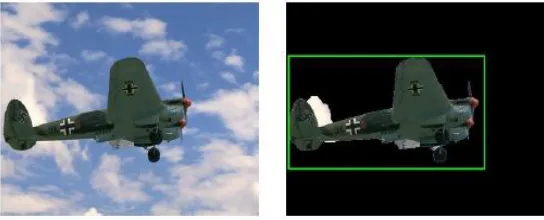
©IJRASET: All Rights are Reserved [image:6.612.170.442.111.221.2]The user process steps are as shown in fig. 5. The user selects a ROI , and then pulls a rectangle outside the object in ROI. After the image segmentation, the user can improve result of segmentation by user interaction.
Figure 9 . Effect of Grab-Cut algorithm
III. GRAPH-CUTSEGMENTATION
Graph cut segmentation, it is used for image segmentation, with the help of this partition of an image can be done into different regions or sub regions. It is a vital component of computer vision, tracking, objects recognition and image analysis and so on. This method is efficient and effective in today’s technological day, which is recognized throughout the world since it could achieve global optimal output for the energy function. It works for both the images that is image with known information and image without pre-known information. The usage of this Graph cut could be extended for N-dimensional image also. Various methods have been proposed due to the advantages of graph cut. Methods are classified into three categories. They are first method based on speed up-based graph cut, second method based on interactive-based graph cut and third method based on shape prior-based graph cut.
A. Speed-up Based Graph Cut
Implementation based on GPU with CUDA code increases the computation of graph cut algorithm. The speed up based approach is to accomplish the speed up by the same computing which is able to achieve good performance compared with linear or sequential computing. The maximum used kind of technique for bringing down the computational time for the graph-cut based algorithms is completely dependent on the reduction of the graph nodes. Each pixel in the content of an image would viewed as one specific node in the equivalent graph representation of a digital image. So, the image in graph representation will look very big and brings computation of graph-cut slowly with the increase of image resolution.
B. Interactive-Based Graph Cut
This technique based graph cut changes from easily by selecting the Region of Interest or simple starting or seed points /pixel to iteratively seed point selection. This method utilizes the bounding box for the purpose to select the Region of interest. The mid area within the bounding box is chosen as object. Histogram of the chosen object is gathered from the pixels and the region which is outside of this bounding box and it will be viewed as background. Then immediately the background histogram could be obtained by this approach/technique.
After this approach they have to choose all object starting points/seeds and background points/seeds at one time for the purpose of creating the graph with more sensible weight. This method is implemented step-by-step(iteratively). Seeds/starting point are added when the output of segmentation is not perfect and the segmented output could be checked/reviewed until the needed object is fetched. Iteratively(step-step procedure) interactive graph-cut which is also very robust to the object detection with poor boundary. The weight/value for the graph, hence this interactive approach/technique segmentation could be given as following table when the graph (image) is denoted as G=<V, E > (V-vertex set, E- edge set) where V=P {S,T}.
C. Shape Prior Based Graph Cut
166
©IJRASET: All Rights are ReservedIV. FEATURESEGMENTATION
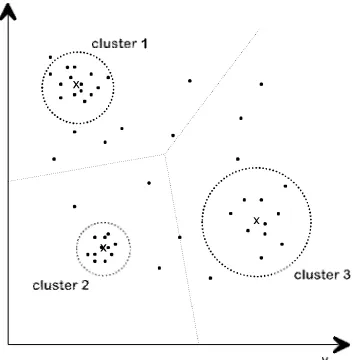
Feature-based segmentation algorithm is basically a clustering procedure, which can take into account different features like
color, motion, disparities (in stereo images), object position or gradient. An example with two different features v1 and v2 is
[image:7.612.228.408.157.337.2]shown in Figure 10.
Figure 10. Feature space with two different features, parti- tioned into three clusters.
All small dots indicate the feature points of individual pixels. Three clusters are shown, which are positioned where feature points accumulate. Feature points that do not fall into the near region of the cluster (dotted circles) can be either regarded as unclassified, or they can be subjoined to the cluster with the nearest centroid. We have implemented the second technique, which has much relation to the approach of vector quantization. The Voronoi regions of the different clusters are indicated by dotted lines. We apply different weights to particular features, according to their reliability. In general, if we have K features at position (x,y) within an image I(x,y), these are combined to a pixel-feature vector
v( x, y) v( x, y,1), v( x, y,2), , v( x, y, K) .
The pixel-feature vector at position (x,y) is compared to a set of cluster-feature vectors msfrom a set M and classi- fied into the
feature class
K
s( x, y) arg min wk ( x, y) v( x, y, k ) ms (k ) .
ms M k 1
The factors wkallow to attach a special weight to each of the features. It is possible to alter these weights according to the reliability
of a specific feature at a specific pixel position, e.g. to use a very low weight for the motion features around presumable object
edges. All the weights at a pixel position (x,y) can be combined to a weight vec- tor w(x,y).
It is necessary to adapt the set of cluster-feature vec- tors according to the feature statistics of the image se- quence. This
cluster-generation procedure is borrowed from the technique of vector quantization. Herein, the optimum cluster-feature vector ms
is the centroid of all pixel-feature vectors vsthat were classified into class s. If we take into account the weights that were used at
the specific pixel positions, we come to the solution
If the set of cluster-feature vectors M is updated at each image, and used for the segmentation of the next image, a temporal
167
©IJRASET: All Rights are Reservedvectors, which can be trained from the first frame after the change. One important parameter is the required number S of
cluster-feature vectors, which is highly scene-depend- ent. For a simple application of the algorithm, S has been fixed to a number
of 8 with good results. It is also possible to derive S automatically, e.g. to make it larger until the mean deviation from all cluster
centroids reaches some predefined minimum threshold. This can best be applied, if the cluster set M is designed in a tree-
structured way [4], where a cluster is split when it donates the highest mean deviation.
V. CONCLUSION
This paper deals with different types of techniques used in the segmentation of the image processing. Graph Cut methods usually
provides quite good result while compared to other segmentation techniques. Segmentation based on graph cuts works very well
for most of the images. Graph cut-based segmentation methods are structured into 3 categories. They are namely as discussed in graph cut segmentation i.e first method based on speed up-based graph cut, second method based on interactive-based graph cut and third method based on shape prior-based graph cut. However, mandate individual execution of these three kind of method is not necessary of the graph-cut approach. These methods are combined to improve the image segmentation result. Many algorithms for image segmentations such as K-mean clustering algorithms, edge based algorithms grab-cut and graph cut algorithms are used. And finally concluding that graph cut method is widely used for image segmentation.
REFERENCES
[1] F. C. Monteiro and A. Campilho, "Watershed framework to region-based image segmentation," in Proc. International Conference on Pattern Recognition, ICPR 19th, pp. 1-4, 2008.
[2] M. Hameed, M. Sharif, M. Raza, S. W. Haider, and M. Iqbal, "Framework for the comparison of classifiers for medical image segmentation with transform and moment based features," Research Journal of Recent Sciences, vol. 2277, p. 2502, 2012
[3] R. Patil and K. Jondhale, "Edge based technique to estimate number of clusters in k-means color image segmentation," in Proc. 3rd IEEE International Conference on Computer Science and Information Technology (ICCSIT), pp. 117-121, 2010.
[4] W. Cui and Y. Zhang, "Graph based multispectral high resolution image segmentation," in Proc. International Conference on Multimedia Technology (ICMT), pp. 1-5, 2010.
[5] A. Fabijanska, "Variance filter for edge detection and edge-basedimage segmentation," in Proc. International Conference on Perspective Technologies and Methods in MEMS Design (MEMSTECH), pp. 151-154, 2011.
[6] S. Zhu, X. Xia, Q. Zhang, and K. Belloulata, "An image segmentation algorithm in image processing based on threshold segmentation," in Proc. Third International IEEE Conference on Signal-Image Technologies and Internet-Based System, SITIS'0., pp. 673-678, 2007.
[7] A. Xu, L. Wang, S. Feng, and Y. Qu, "Threshold-based level set method of image segmentation," in Proc. 3rd International Conference on Intelligent Networks and Intelligent Systems (ICINIS), pp. 703-706, 2010.
[8] M. Yasmin, M. Sharif, S. Masood, M. Raza, and S. Mohsin, "Brain image enhancement-A survey," World Applied Sciences Journal, vol. 17, pp. 1192-1204, 2012. [9] F. Jiang, M. R. Frater, and M. Pickering, "Threshold-based image segmentation through an improved particle swarm optimisation," in Proc. International
Conference on Digital Image Computing Techniques and Applications (DICTA), pp. 1-5, 2012.
[10] D. Barbosa, T. Dietenbeck, J. Schaerer, J. D'hooge, D. Friboulet, and O. Bernard, "B-spline explicit active surfaces: An efficient framework for real-time 3-D region-based segmentation," IEEE Transactions on Image Processing, vol. 21, pp. 241-251, 2012.
[11] G. Chen, T. Hu, X. Guo, and X. Meng, "A fast region-based image segmentation based on least square method," in Proc. IEEE International Conference on Systems, Man and Cybernetics, SMC, pp. 972-977, 2009.
[12] Z. Hua, Y. Li, and J. Li, "Image segmentation algorithm based on improved visual attention model and region growing," in Proc. 6th International Conference on Wireless Communications Networking and Mobile Computing (WiCOM), pp. 1-4, 2010.
[13] S. M. M. Sharif, M. J. Jamal, M. Y. Javed, and M. Raza, "Face recognition for disguised variations using gabor feature extraction," Australian Journal of Basic and Applied Sciences, vol. 5, pp. 1648-1656, 2011.
[14] M. Sharif, S. Mohsin, M. Y. Javed, and M. A. Ali, ss"Single image face recognition using laplacian of gaussian and discrete cosine transforms," Int. Arab J. Inf. Technol., vol. 9, pp. 562-570, 2012.
[15] T. Mei, C. Zheng, and S. Zhong, "Hierarchical region based Markov random field for image segmentation," in Proc. International Conference on Remote Sensing, Environment and Transportation Engineering (RSETE), pp. 381-384, 2011.
[16] J. S. M. Sharif, S. Mohsin, and M Raza, "Sub-holistic hidden markov model for face recognition," Research Journal of Recent Sciences, vol. 2, pp. 10-14, 2013. [17] Yubing Li, Jinbo Zhang, Peng Gao, Liangcheng Jiang, Ming Chen, "Grab Cut Image Segmentation Based On Image Region", IEEE International Conference on