An Evaluation of Skill Development Training
Programme (With Special Reference to Sagar,
M.P.)
By Ankul Pandey1, Prof. D.K. Nema2 1
Research scholar of Dr Hari Singh Gour University Sagar
Abstract: India goes via distinctive part of demographic dividends, however, to derive actual advantages emphasis ought to lean to parts like strategic rules for youth, gigantic skill training and efficient employment prospects.
Skill and capability growth with corresponding job availability is essential to reap demographic dividends. However the truth is that manpower is growing; on the other hand, the job creation fails to maintain enough tempos.
An OCED survey on India 2017 revealed that more than 30.83 percentage of Indians in the age groups 15-29 are neither employed nor in education or training. Only 2.9 lakhs of 30.67 lakhs candidates have received job offers under skill development programme.
New jobs creation saw a downfall from 2.21 lakhs in financial year 15 to 1.5 lakhs in financial year 16.
The present study evaluates the government’s skill development training programme and the employability of youth. The Skill gap between education and industry requirements and innovations in the IT field.
I. INTRODUCTION
The growth and development of the economy of any country at all level it stimulates with their policy. The development at various levels is found only through the availability of quality of education system and skills which can help to increase the employability of workforces, the efficiency of enterprises and the all-inclusiveness of economic growth of the country.
It has an impact on a number of job opportunities is generated and the overall employability of the country’s workforce. The number of well-paid jobs is increased it automatically reflected their economic growth of the country. In today scenario, India has a huge amount of youth who have entered the workforce every year.
It is important to increase the employability of the young people by making the most of the demographic onus or dividend. This recognition has run to augmented concern in the formulation of skills development policies.
So, that the ministry of skill development and entrepreneurship is set up for coordinating all skill development endeavour crossways the country. It helps to bridge the gap between demand and supply of a skilled human resource, introducing a new framework of vocational and technical training, creating new skills and ground-breaking thinking in prevailing employments and also have developed some innovative concept in new job or business.
The policy gives equal attention through providing training to all people of the society like a formal and informal worker of the economy, youth who have completed their formal schooling, youth who have not completed their basic education, disadvantaged groups and adult workers.
There exists a requirement for seventeen to twenty million new jobs once a year. 83.6% of Indians are in informal employment. Therefore India is in sheer would like of generating a hundred and fifteen million non-farm jobs over next decade to employ manpower and reap the demographic dividend.
The employment creation and skill primarily based knowledge system in India should be placed on a check in addressing the social issues like poverty, unemployment, development and growth with sustainability.
It has an important effect on the efficiency and efficacy by the availability of skilled workforces of any organisation which helps to accomplish its instruction.
II. REVIEW OF LITERATURE
According to (Abhishek Venkatesh, Aditya Singh and MB Kiran, 2015) studied, “Evaluation of Skill Development Programmes: A Project Management Perspective” is more focused to analyse dropouts’ data (objective and subjective), and subsequently evaluate the existing model of a skill training, development and placement program. It concluded that human resource is a very crucial source of growth and development of any country.
The skill development training programme is one of the important ways for the young people to developing the qualities and skills which help them, to grabbing the ample amount of job opportunities and it reflects the perfect growth track of the country.
(Indira, 2008) in his research study stated that the requisite to know the evaluation of the training programme is a never-ending procedure, demanding at regular interval review and analysis of the requirements of the numerous areas of rural development. The best evaluation method for the four stages with respect to cost and efficiency. The participants were happy about the training they had received and watched forward to learning more from the Institute.
A. The objective of the study
1) To review the socio-economic profile of the participants of skill development training programmes in the study area.
2) To study the correlation between the government’s skill development programmes and employability of the youth with emphasis to the youth of Sagar city.
3) To assess the Impact of a skill development training program on the skill level of respondents
4) To study the challenges and hurdles faced by the government to operate the skills development programmes
B. Hypothesis
The following hypothesis are formulated and tested.
1) H1: There is a significant difference among the participants on the basis of their gender, age, marital status, and location of the
institution, educational qualification and their impact of a skill development training program on the skill level of respondents. 2) H0: There is a no significant difference among the participants on the basis of their gender, age, marital status, the location of
the institution, educational qualification and their impact of a skill development training program on the skill level of respondents
3) H1: There is a significant correlation between the government’s skill development programmes and the employability.
4) H0: There is no significant correlation between the government’s skill development programmes and the employability.
C. Significance Of Problem
1) The greater part of CSR initiatives is encompassed by Skill development programme. The prime objective is the complete skill
development through particular and general skill set. It has resulting consequent employment prospects in societies.
2) The present attention of this skill development programme is enlightening the employability of a young population in India. It is an important programme that sustains that the given targeted populace is a sensitive group of societies which required of chief significance by giving them a direction.
3) This study also points out to an inequality existing in the trainees, the low percentage of males attending the program, and the numbers of different castes that are the beneficiaries of this program. There is a need to identify suitable performance indicators so that there is consistency between performance indicators and the scheme objectives. It is also important to strengthen the capacity of the district/block level agency to generate and transmit quality data on identified parameters to help in decision making. On a whole, it contains a small element of social empowerment but keeps in mind the quintessentially existing bigger picture.
III. RESEARCH METHODOLOGY
A. Primary Data
The primary data were collected from a personal interview with the trainers and respondents. The well-designed pre-tested questionnaire is used to collect the information, by selecting the 50 trainee beneficiaries with the help of quota sampling from different skill development centres. Observation will also make at the respondents which were benefited by the skill development programmes. It based on the data collected from four skill development training centres i.e RSETI(RuralSelf Employment Training Institutes), PMKVY(Pradhan Mantri Kaushal Vikas Yojana), NRLM(National Rural Livelihoods Mission), DDU-GKY(Deen Dayal Upadhyaya Grameen Kaushalya Yojana), of Sagar city.
B. Secondary Data
The Secondary data is collected from authentic sources i.e published journals in national and international, published articles, Government annual reports and related websites viz., Ministry of Skill Development & Entrepreneurship, economic review, websites of labour and employment, and economic survey. For data analysis, Percentage method, Cronbach Alpha are used. For hypothsis testing spearmans correlation is used.
C. Reliability Analysis
To check the reliability of the questions which is related to the hypothesis testing.
The alpha shows a value more than 0.7 is high reliability and here,0.848 for the variables which indicate that 85% of the variables in the scores is a high reliable variable. Therefore, 15% is an error in a variable.
The below table shows the reliability of the variables used for the study.
D. Reliability Of The Variables
Variables No. of items Cronbach’s alpha
The government skill development training programme
2 0.848
Employability 2 0.848
Table No.1: Duration of the government skill development training programme (months/days):
Duration Number of the respondents Percentage
3 months (NRLM, PMKVY) 33 66
1 months(DDU-GKY) 11 22
Less than 1 months(RSETI) (MSDE)
6 12
Total 50 100
Source: Field study, (2018)
[image:3.612.79.530.633.724.2]1) Table No.1 shows the Duration of the skill development training programme (months/days) wise distribution of the total population of the sample. The training programme is distributed in three categories i.e. 3 months, 1 month and less than 1 month were the respondent take the training to develop some quality of skills which is used to set up their own business. There are total 50 respondents, out of which 66% of the respondents are registered the training programme for the 3 months and rest of them is 22% of the respondents is choose the training programme for the 1 months and 12% is enrolled that program which is less than one months.
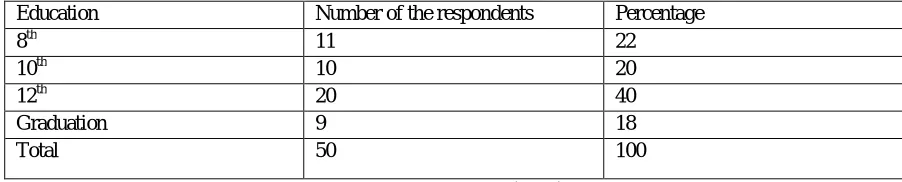
Table No.2: Level of education of the total population:
Education Number of the respondents Percentage
8th 11 22
10th 10 20
12th 20 40
Graduation 9 18
Total 50 100
2) In table No. 2. is shows the analysis of an educational qualification described that out of the (50) total respondents selected more than half (75%) of them are below the secondary level of education i.e 22 percent of the respondents are educated up to 8th standards, 20 percent of the respondents had completed high school, 40 percent of the respondents had completed secondary level, and after that it shows that only 18% of the total respondents had completed graduation level. Regarding the level of training, results also show that, higher level of education is among the factors that inhibit employees to undergo training. This table depicts that there is a negative correlation between higher education and skill development training programme. So that there is a need to focus on higher education which helps to improve the quality of skill development training programme.
Table No.3: Age wise distribution of the total population
Age Number of the respondents Percentage
18-25 37 74
25-35 6 12
35-45 6 12
45-ABOVE 1 2
Total 50 100
Source: Field study, (2018)
[image:4.612.85.535.428.492.2]3) In the table, No.3 The findings has represented Age wise distribution of the total population of the 50 sample. The total population is distributed between from 18 years of age to 45 and above years but not below the 18 years. Out of the total population a large percentage i.e. 74% are found in the age groups between 18-25 years. Remaining of them i.e. 12% are found in the age of 25-35 and 35-45. Lastly the old age between 45 and above years that comprised 2% of the population. The distribution of respondents in skill development training programme by age characteristics are as shown in Table 3. Results show that one among the factors that limit respondents to undergo training is age limitation. This suggests that some people hesitate to undergo training just because of fearing of their age limit.
Table No.4: Gender wise distribution of the total population of the sample families
Gender Number of the respondents Percentage
Male 17 34
Female 33 66
Total 50 100
Source: Field study, (2018)
[image:4.612.85.530.610.700.2]4) Table No. 4 reveals the gender wise distribution of the total population of the 50 sample. Out of the total population, 34% are males and the rest of 66% are females. It divulges that females are more interested in comparisons of males who enrol in the skill development training programmes. Then, the Researcher taken the interview from trainer and directors of the institute to know the reasons, than it finds that the unwillingness of men to undergo training because it involves in agriculture sector or running their small business, or sometimes they think it is just waste of time but on another hand, a large percentage of women are ready to develop some quality of skills in own life so they are able to allocate some time to undergo training.
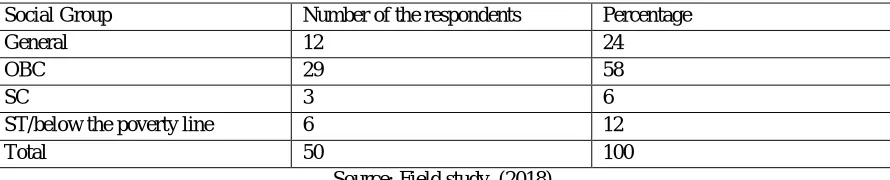
Table No.5: Social Group wise distribution of the respondents
Social Group Number of the respondents Percentage
General 12 24
OBC 29 58
SC 3 6
ST/below the poverty line 6 12
Total 50 100
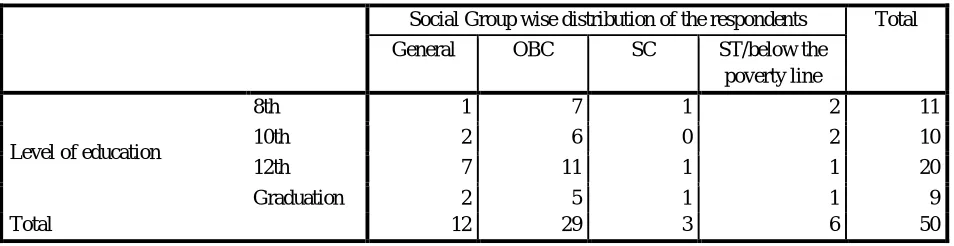
5) Table No.5 is the social Group wise distribution of sample families is presented in Table No. 5 which discloses that the weaker sections consist of Schedule Castes, Schedule Tribes/below the poverty line, and OBC. It represents that majority of trainee belongs OBC Categories i.e. 58%. Rest of them i.e. 24% of the respondent from the general group, 12% and 6 % of the respondent from ST and SC categories are simultaneous. 58% out of the 50 respondents come from OBC’s indicating that OBC’s are taking good advantage of the skill development training programmes organized by the government. No doubt overwhelming majority of them comes from weaker sections. After taking the interview and observations the researcher is discover that Schedule Castes, Schedule Tribes/below the poverty line is not much interest to take the part of this training programmes which reflects that their contributions is very less. In the modern era, it requires to give more attention to the upliftment of this group which hold a significant position in the growth and development of our society. In the below table, it also represents that the education level of this group is not very good. So that it requires to emphasis and motivate the people of this group towards a higher education by telling their importance in the present scenario.
Crosstabulation : Level of education and Social Group wise distribution of the respondents
Social Group wise distribution of the respondents Total
General OBC SC ST/below the
poverty line
Level of education
8th 1 7 1 2 11
10th 2 6 0 2 10
12th 7 11 1 1 20
Graduation 2 5 1 1 9
Total 12 29 3 6 50
Table No.6: Marital status of the respondents
Marital status Number of the respondents Percentage
Married 13 26
Unmarried 37 74
Total 50 100
Source: Field study, (2018)
6) Table, No.6 is shows the marital status wise distribution of the total population. Results shows that the majority of the respondents (74%) out of 50 are unmarried and 26 per cent are married. It exposes that unmarried group take actively part in the skill development training programme. The distribution of the respondents in skill development training programme by their marital status is shown in Table 6. On responding to whether they would prefer to attend training, the respondents interviewed and results show that many family responsibilities are among the factors that limit respondents to undergo training.
Table No.7: Location of the Institution
Location Number of the respondents Percentage
Rural 29 58
Urban 21 42
Total 50 100
Source: Field study, (2018)
[image:5.612.69.546.244.367.2]Table No.8: Sources of awareness about the skill development training programmes
Sources Number of the respondents Percentage
(a) T.V. advertisement/
hoardings/ phamplets
23 46
(b) Radio 8 16
(c) Newspaper/others 3 6
(d) Internet/D.I.C 16 32
Total 50 100
Source: Field study, (2018)
[image:6.612.80.532.410.645.2]8) Table No. 8 shows the Sources of awareness about the skill development training programmes wise distribution of the total population. The information dissemination about the skill development training programmes determines the accessibility of benefits. As seen from the table is 46% of the total respondent is known about the training programme information from T.V. advertisement/ hoardings/ pamphlets, 32% respondent get information from internet/DIC, 16% from radio and at last only 6% of the respondent is aware from Newspaper/others.
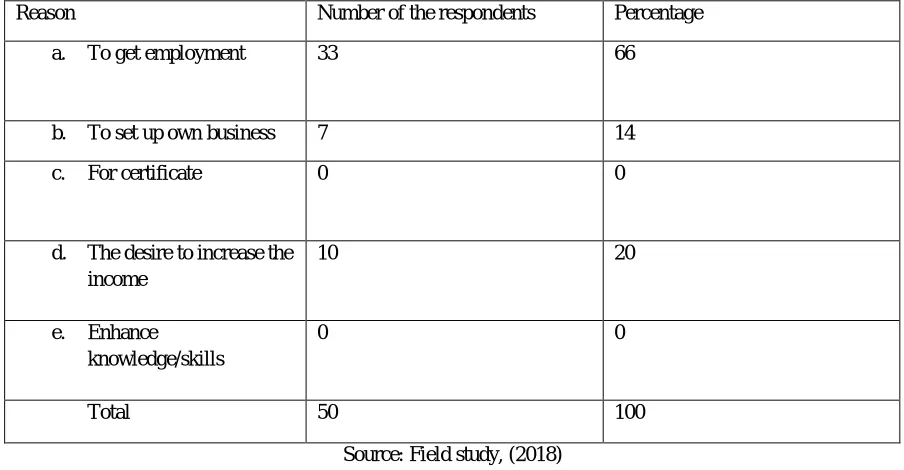
Table No.9: What is the main reason for joining the skill development training programme
Reason Number of the respondents Percentage
a. To get employment 33 66
b. To set up own business 7 14
c. For certificate 0 0
d. The desire to increase the income
10 20
e. Enhance
knowledge/skills
0 0
Total 50 100
Source: Field study, (2018)
Table No.10: What is the benefit of the skill development training program?
Benefit Number of the respondents Percentage
a. Provided training for
Entrepreneurship and skill development
21 42
b. Knowledge of technological
development & Technical skills
5 10
c. Facilitation for credit & market linkages
11 22
d. Attained key knowledge regarding
market strategies
4 8
e. To start their own business 9 18
f. Any other 0 0
Total 50 100
Source: Field study, (2018)
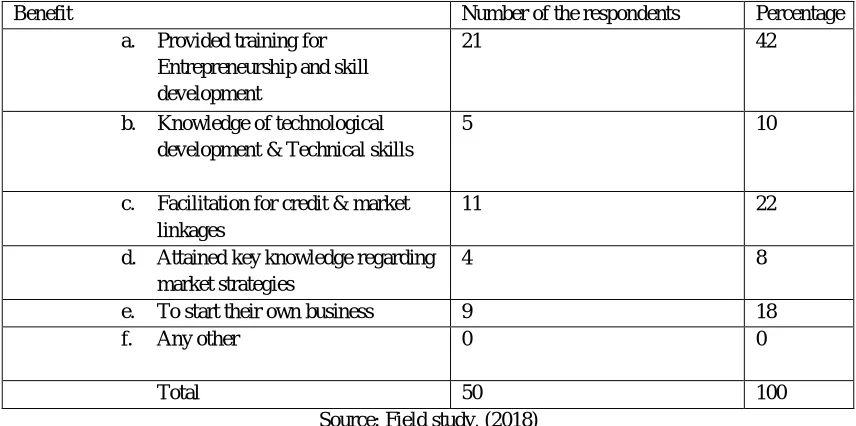
[image:7.612.69.546.407.579.2]10) Table No.10 is indicating the percentage of the various respondents has utilized all the benefits out of the training catered to them. Among training, benefits the majority of the respondents have given first preference for Entrepreneurship and skill development i.e 42%, Knowledge of technological development i.e 10%, With Facilitation for credit & market linkages for 22%, the remaining of the respondents has given preference are 18% to start their own business and 8% for Attained key knowledge regarding market strategies which they think they get to benefit from the skill development training program.
Table No.11: What type of problems is faced by you during the skill development training period?
Problems Number of the respondents Percentage
a) Inadequate teaching learning material
5 10
b) The long duration of training course
38 76
c) Inadequate facilities at the centre 3 6
d) Irregular attendance of resource persons
1 2
e) Indifferent attitude of resource persons
2 4
f) Inadequate and bad conditions of tools and equipment
1 2
Total 50 100
Source: Field study, (2018)
Table No.12. Methods of facilitation at the training
Facilitation method Number of the respondents Percentage
Lecture 3 6%
Demonstration 9 18%
Presentation 16 32%
Discussion 16 32%
Seminar 6 12%
Total 50 100
Source: Field study, (2018)
12) Table No.12 A number of methods of facilitation that are comely employed during training are presented in Table 12 above. These are important in understanding the different ways trainees receive training under both the on-the-job and off-the-job training method classifications. As revealed above, the most common methods of facilitation identified by the respondents as prevailing during their training are discussions (representing 32%) and presentations (representing 32%). The other methods demonstrations, seminars and lectures represent the remaining 18%, 12% and 6% respectively. These results indicate that the case companies strongly emphasis on discussions and presentations. This could be partly explained by the nature of the business of these three companies (being more customers oriented for example calls for a need to take on facilitation methods that seem more customers focused).
Table No.13: Is the training programme is helpful to enhance your skill?
Particulars Number of the respondents Percentage
Yes 44 88
No 4 8
Neutral 2 4
Total 50 100
Source: Field study, (2018)
[image:8.612.92.524.506.646.2]13) Table No.13 is the success of any skill development training programme on those who have been trained can be understood in terms of securing employment and initiating one’s own income generating activities. Examined from this perspective the training programmes organized by the government have been successful to a large extent and this is clear from table No.17 because 88% of the respondents felt that it have a significant impact on developing the quality of skills.
Table 14. The skill development training programme is helpful to achieve the aim.
Particulars Number of the respondents Percentage
a)strongly agree 17 34%
b)agree 27 54%
c)neutral 3 6%
d) strongly disagree 1 2%
e)disagree 2 4%
Total 50 100
Source: Field study, (2018)
Table 15. Impact of skill development training methods on their skills
Response Number of the respondents Percentage
Yes 47 94%
No 3 6%
Total 50 100
Source: Field study, (2018)
15) Table 15. In analysing the responses obtained from the respondents on the impact of training methods on their skills, the findings showed that the majority of the respondents, 94%, believed that the training methods used during training had positive impact on their skills. However, a small percentage (6%) doesnot believed that they had impact on their skills. This result indicates that the training methods used during training in the case companies clearly focus on particular skills and, thus, skill development is emphasized.
Table No.16: Have you think skill development program will increase the employability.
Particulars Number of the respondents Percentage
Yes 42 84
No 6 12
Neutral 2 4
Total 50 100
Source: Field study, (2018)
16) Table No.16 is disclosed the almost i.e. 84% of the selected respondents for the survey have thought that skill development program will increase the employability among the youth developing a specific type of skills and degrees which is required to the industry for the appointment and also help in future to start their business. Only 12% of the respondents have an opinion they don’t think that it is helpful to raise the employability and 4% don’t have any opinion.
Table No.17: What do you think about the duration of the training program/course?
Particulars Number of the respondents Percentage
a) Very long 13 26
b) Enough 34 68
c) very small 3 6
Total 50 100
Source: Field study, (2018)
17) Table No.17 is the respondents were asked about their opinion on the duration of the courses they attended. 68% of the total respondents felt that the duration of the course they attended was enough to gain sufficient knowledge. More than 60% in all the states expressed the same opinion. 26% of the respondents felt that the duration of the course was very long and 6 % felt the course was for very small.
IV. TESTING OF HYPOTHESIS
As per the analysis of table it find out that government’s skill development programmes response in positively in terms of the employability but to Testing of hypothesis the statistical tools is used.
1) H1: There is a significant correlation between the government’s skill development programmes and the employability.
2) H0: There is no significant correlation between the government’s skill development programmes and the employability
Descriptive Statistics
Mean Std. Deviation N
Duration of the government skill development training programme (months/days)
1.4600 0.70595 50
skill development program will increase the employability
1.2000 0.49487 50
Duration of the government skill development training programme (months/days) in which mean is 1.4600 and Std. Deviation is 0.70595.
[image:10.612.89.523.87.163.2]skill development program will increase the employability in which mean is 1.2000 and Std. Deviation is 0.49487.
Table 19- Spearman's rho Correlations
Duration of the government skill
development training programme (months/days)
skill development program will
increase the employability
Spearman's rho
Duration of the government skill development training programme (months/days)
Correlation Coefficient
1.000 0.719**
Sig. (2-tailed) . .000
N 50 50
skill development program will increase the
employability
Correlation Coefficient
0.719** 1.000
Sig. (2-tailed) .000 .
N 50 50
** Correlation is significant at the 0.01 level (2-tailed).
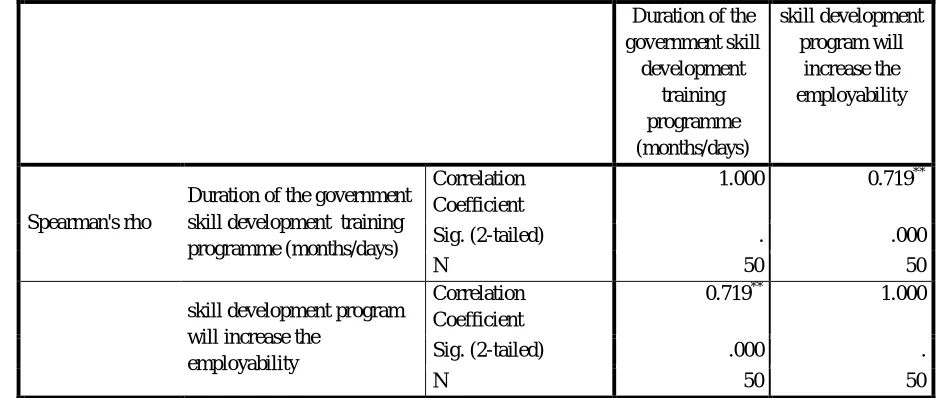
a) Table 19- shows that the correlation coefficient between skill development programmes run by the government and the employability is 0.719, which is significant at 1% level of significance. The results depict that when the duration of the government skill development training programme (months/days) is increased, then skill development program will increase the employability significantly. From the result, it can be inferred that overall the government skill development training programme significantly and strongly positively linear relationship affect the employability. Hence it was concluded that result rejects the null hypothesis (H0) and accept the alternate hypothesis (H1) that there is a significant correlation between skill development programmes run by the government and the employability.
V. THE CHALLENGES AND HURDLES FACED BY THE GOVERNMENT TO OPERATE THE SKILLS DEVELOPMENT PROGRAMMES
The second part of the study to know the challenges faced by the government to operate the skills development programmes. The information is collected from secondary sources and interview is taken to the trainer and other member of the institute by the researcher.
[image:10.612.68.537.239.438.2]A. Insufficient trainers
The researcher has been take an interview from directors or principle of institute and find out that insufficient trainer and training infrastructure due to this it doesnot conveys insufficient training to the participants. According to the secondary sources, researcher concluded that India wants to train 20,000 skills trainers of numerous types each year, but its current capacity was to train 8,268 skills. There is required’ to fix the selection criteria for the trainers like elementary entry qualification, training skills and minimum three or six months’ industry experience on a particular trade.
B. Lack Of Awareness And Not Understanding Of Human Resource Development Policy By Participants/Trainee/Workers The strong knowledge of Human Resource Development policy and the strategic objectives of the Integrated Development Plan was only the HRD staff. In overall, there is a weak connection between skills development training programme, equity of employment and performance management. Also, the skills development policies not properly address in the formal and informal sectors.
C. Bridging The Gap
Private vocational training institutes can play a pivotal role in assisting the government with the skill development training programme. In the modern scenario, India is a concern a very serious matter due to the increasing gaps between higher education and industry demands. There is a requirement to focus on academic performance, quality of higher education in top-ranked universities who are producing qualified graduates because the wider gap arise in employable graduates and the employability gap in every day. Skill development is an important constituent of our present educational programme.
D. Skill Deficit
From the secondary sources it find out that every year around12.8 million new entrants is enter into workforce of the country’s. And on the other side about 3.1 million is the capacity of skill development in India to train them. The twelfth Five Year Plan is set to increase the capacity to 15 million approximate and it can be possible only through the skill development involvement of private and public sectors stakeholders like NSDC (National Skill Development Corporation), skill India, PMKVY (Pradhan Mantri Kaushal Vikas Yojana), DDU-GKY (Deen Dayal Upadhyay Grameen Kaushalya Yogna) of skill training etc. The biggest challenge of skill development training programme is that lack of awareness, absence of vertical flexibility, not ready to adopt the flexibility with changing market demands.
1) Suggestions: Few suggestions that can be measured for accelerating employability opportunities with the help of government’s skill development programme
a) The government also take a necessary step by proper planning through organising a campaign in different areas by introducing
the importance of these programmes in today scenario which help to grab the several job opportunities which are an offer by numerous industries.
b) Table no 3. There is a demand for emphasis and motivate the people who belong to the age group of 18 to 35 to take an interest and part of the skill development training programme.
c) Table no -4 Further it is also possible that in the process of women empowerment economic independence plays an important
role and this factor may have persuaded a segment of women to take advantage of skill development training programmes organized by the government.
d) In table No. 7. Location is more important for any institution but more important is how many people are registered for the programme and getting a job or self-employed through this programme.
e) In table No. 8. It observes that source of awareness of the skill development training programme is more through TV advertisement/ hoardings/ pamphlets. It needs to an emphasis on that the advertisement must show at a prime time where the majority of people prefer to watch TV programme on this time which helps to aware this type of programme which is run by the Indian government.
f) More awareness campaigns should be conducted to create employment opportunities with the help of skill development programme among the young people for linking their skill needs with the industry demands.
g) Capital formation and industrialisation have to be increased in the country and which is opportunity will create employment prospects for rural and urban residents.
VI. CONCLUSION
The government’s skill development training programme will increase the employability significantly in Sagar city. After considering the various variables, it is found that there are various reasons, benefits and impacts of skill development training programme among the participants. This programmes help in improvement in interpersonal skill, expand the knowledge, upliftment of weaker sections of society if it properly implemented and regulated in different places of India. Skill development programme in the beginning is seen to be developed with government initiatives but once the nudge is created then it seems to occur automatically. All-time learning concluded continuous attainment of knowledge and skills not only improves active citizenship and individual growth, but also develops competitiveness and employability. Continuous up-skilling would be accepted to train the people so that they will be equipped with the changing environmental requirements.
REFERENCE
[1] https://economictimes.indiatimes.com/ small-biz/start-ups/india-will-be-home-to-10500- startups-by-2022-nasscom/articleshow/55068274.cms [2] http://planningcommission.nic.in/reports/sereport/ser/ser_impact0609.pdf.
[3] http://orsp.pdpu.ac.in/adminfacviewprofile.aspx?facid=MB.Kiran
[4] Abhishek Venkatesh, Aditya Singh and MB Kiran. ( (2015) ). Evaluation of Skill Development Programmes:A Project Management Perspective. International Journal of Humanities and Management Sciences (IJHMS), Volume 3, Issue 5, pp-358-364.
[5] Indira, A. (2008). Evaluation Of Training Programs. Journal Of Applied Quantative Methods, pp-139-150. [6] Evaluation of Placement Linked Skill Development Special Projects Under SGSY
[7] http://planningcommission.nic.in/reports/sereport/ser/ser_impact0609.pdf [8] http://www.isaet.org/images/extraimages/ED1015028.pdf.
[9] https://www.india.gov.in/website-ministry-skill-development-and-entrepreneurship
[10] Evaluation Report On Swarnjayanti Gram Swarozgar Yojana (SGSY) , Jammu & Kashmir, Planning Commission of India.