923
©IJRASET: All Rights are Reserved
Estimation Algorithm to Define Paris Law
Constants using Extended Kalman Filter (EKF) for
Crack Length Evolution in Aircraft Fuselage
Panels
Dhruv Girish Apte1, Mohit Dhoriya2, Nitinchandra Rameshchandra Patel3
1, 2
Undergraduate student, 3Assistant Professor, Department of Mechanical Engineering, G H Patel College of Engineering & Technology, Vallabh Vidhyanagar, Gujarat-388120
Abstract: Metal fatigue in aircraft fuselage structure is one of the leading causes in structural defects leading to accidents that include stall, mid-air disintegration and crashes. Several theories and laws have been devised to study the crack propagation properly, the most accurate of which is the Paris Law defined by Paris and Erdogan (1963). But the uncertainties present in crack growth model and measured crack size have to be determined systematically to ensure accurate predictions. This paper aims to estimate the two Paris Law constants m and C using an estimation algorithm based on the Extended Kalman Filter (EKF). Previous numerical experiments indicate the EKF indicated proper crack length and defined the unknown parameters accurately.
Keywords: Extended Kalman Filter (EKF), crack length evolution
I. INTRODUCTION
Several crack propagation theories have been studied beforehand. In addition, recently done research by Apte et al. [1] and Wang et al.
[2]
have been able to determine flaw size in fuselage panels using the Extended Kalman Filters (EKF) and the Unscented Kalman
Filter respectively. However, the theory [1] has not been verified on actual data and subsequently proved. This paper aims to prove it
by generating the Jacobian matrix of the augmented system matrix involving the variables of Paris Law.
Estimation in all non-linear systems is extremely important. The constants in the Paris Law are also non-linear [3]. In order to detect
faults within the system and predict damage in the aerospace structure before a disaster, there is an urgent need to accurately estimate the state of these systems. The optimal (Bayesian) solution to the problem requires the propagation of the description of the
full probability density function (PDF) [4]. This solution is extremely general and incorporates aspects such as asymmetries and
discontinuities. However, because the form of the PDF is not restricted, it cannot, in general, be described using a finite number of parameters. Therefore, any practical estimator must use an approximation of some kind. The Extended Kalman Filter aims to linearise all the non-linear models so that the Kalman Filter can be applied.
II. PARIS LAW
It was proved previously that speed of crack propagation was dependent on time. But it could not be understood as how. It was Paris
et al.[7][8] who suggested using the stress intensity factor range, there are three fracture regimes with respect to variation of crack
growth rate per loading cycle due to fatigue. Paris Law analyses the fatigue crack growth mechanism when 10-8< (da/dN) < 10-5
m/cycle. For a given load ration R = σmin/σmax, there exists a linear relationship between log (da/dN) and log ΔKtwhere ΔKt is the
range of the stress intensity factor.
Log10 (da/dN) = log10A + mlog10(ΔKt)
= log10A + log10{(ΔKt)m}
= log10{A(ΔKt)m}
Removing log, we obtain:
924
©IJRASET: All Rights are Reserved
The Paris Law was different from S-N curve as it took considerably different components than the latter. This caused slower damage propagation in uncracked surfaces which was expected. The Paris Law’s long crack propagation theory further implied that the dependence on the initial size of the crack was different from that calculated by crack propagation threshold and toughness value. The law often gives fairly accurate results and which may be termed as ‘beautiful’. But when it does not work, it gives a serious limitation of having stress intensity factor on the x-axis. If the factor range cannot correctly predict the crack, we are left with a multivariate function with sparse data points making it more difficult for analysis.
Although there has been significant development and modifications regarding Paris Law, most design processes use the empirical approaches of the Pre-Paris Law era for high cycle fatigue. Since cracks develop slowly and are undetectable until the final stages, it is very difficult to process a damage-tolerant approach. Crack propagation starts from the initiation phase, continuing with the propagation phase (where the Paris Law is supposed to be applied) and then fast crack propagation that leads to failure of the structure.
Scientists have therefore modified the Paris Law and published the variations. These variations include only a single factor removal
or departure from the ideal conditions. Modifications worth mentioning in this paper include crack closure [9] and short cracks
[10][11][12][13]
. Short cracks; however don’t have a single type of deviation and thus some authors have suggested a classification of short cracks:
1) Microscopic short crack where micro structural fracture mechanics is applied as in case of Hobsen et al [14] and Navarro and de
los Rios [15].
2) Physically small crack for which Elastic-Plastic Fracture Mechanics (EPFM) is needed where a general relation between da/dN
and crack tip decohesion is established under high strain fatigue.
3) Macroscopic long crack described by Linear Elastic Fracture Mechanics (LEFM)
The Paris Law as modified by Paris and Erdogan in 1963 gives the advancement of fatigue crack per unit cycle as a function of the
stress intensity factor [7]:
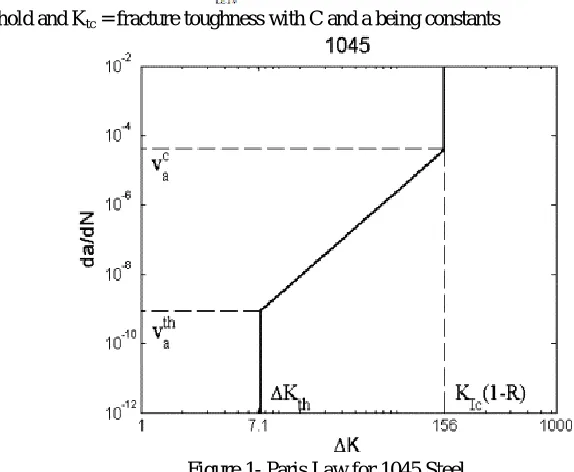
[image:2.612.143.430.385.621.2]Where Kth = fatigue threshold and Ktc = fracture toughness with C and a being constants
Figure 1- Paris Law for 1045 Steel
As observed from the graph in the figure given above, the law seems to be mostly valid in the range of 10-8 – 10-6 mm/cycle
approximately. ΔKth is at vath=10-9 mm/cycle where vath is conventional velocity at the threshold. Ktc is at vac =10-5 mm/cycle where
vac is defined as the velocity at the critical conditions. This means that the constant C is not arbitrary as previously thought of.
925
©IJRASET: All Rights are Reserved
III. EXTENDED KALMAN FILTER ALGORITHM
We will start the estimation using the extended Kalman filter algorithm [5]. We will be using the following additional variable
subscripts and superscripts in our algorithm.
Variable Significance
^
Estimate
k Time step
+
Prior estimate
-
Posterior estimate
For example, denotes the posterior estimate of augmented state vector at time step k.
A. Initialisation
The process covariance matrix Qaug, measurement noise covariance matrix Raug, estimated initial state value and initial state
error covariance matrix P0 should be initialized. Qaug is a 3-by-3 matrix with only Qk as the sole non-zero element. Raug is a 3-by-3
diagonal matrix. Ra, Rm , RC are taken as percentages of the orders of magnitude of m and C. The estimated initial state value
is a 3-by-1 vector containing , and which are the initial estimate for the crack length and other
parameters generated from a normal distribution. P0 or the confidence in the initial estimate for state is taken small in this paper.
B. Algorithm Definition
Expressing this in matrix form,
The error covariance is given by:
The function Φ represents the Jacobian matrix of the augmented system matrix given by:
=
The Kalman gain Kk is computed as a 3-by-3 matrix given as:
Where Hk is the Jacobian matrix of augmented measurement matrix given as:
=
The estimated measurement can be calculated by:
926
©IJRASET: All Rights are Reserved
The error covariance matrix is given as:
IV. METHODOLOGY FOR ALGORITHM
Pseudo-Code for Algorithm
1) Initialize
For each time step: k=1, 2, 3...
2) Compute system equation Jacobian matrix
3) Perform the extrapolation process of the state and error covariance as follows:
4) Compute the measurement equation Jacobian matrix
5) Calculate the Kalman Gain
6) Perform measurement update of state and covariance as follows:
V. PROGRAMMING FOR ALGORITHM
Function [X] = flawsize( K,T,C,t,f)
%FLAWSIZE Summary of this function goes here % Detailed explanation goes here
% We will be investigating and predicting the flaw size of steel plates in an aircraft with a given lifespan % Here K is fracture toughness
% T is the tensile load while C is compressive load % t is the time limit of the aircraft(in years)
% f is the frequency at which stress is applied per minutes
% Initial test values of K=80Mpa,T=500Mpa, C=60Mpa, f=1/5 cycles/minute and % t=10years
% Using Paris Law A = ((K/(1*T))^2)/pi ;
% Where Y is a geometry constant normally taken as 1 % Calculating the number of cycles per year (N) N = f*60*24*365*t;
% Applying modified equation of Paris Law
a = (exp((log((((N*(-1.2)*1.62*(10^-12)*(T^3.2)*(pi^1.6))/2)- (A^(-0.6)))*(-1)))/(-0.6)))*(10^3); % Where n and C are constant with value n=3.2 and C= 1.62*(10^-12)
X= ['The initial flaw size in mm will thus be ',num2str(a)]; disp(X);
927
©IJRASET: All Rights are Reserved
VI. RESULTS AND DISCUSSION
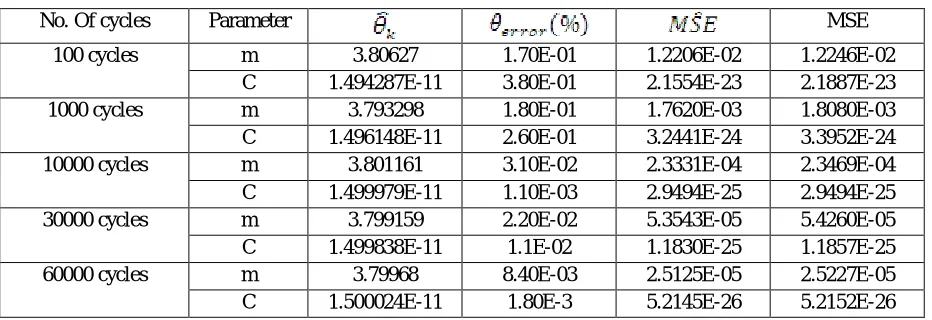
Extended Kalman Filter technique has been applied to determine the constants m and C and true crack size a based on noisy
[image:5.612.75.541.138.298.2]measurements and analytical data of crack size in an aircraft fuselage panel.
Table: 1 – Calculated values
No. Of cycles Parameter MSE
100 cycles m 3.80627 1.70E-01 1.2206E-02 1.2246E-02
C 1.494287E-11 3.80E-01 2.1554E-23 2.1887E-23
1000 cycles m 3.793298 1.80E-01 1.7620E-03 1.8080E-03
C 1.496148E-11 2.60E-01 3.2441E-24 3.3952E-24
10000 cycles m 3.801161 3.10E-02 2.3331E-04 2.3469E-04
C 1.499979E-11 1.10E-03 2.9494E-25 2.9494E-25
30000 cycles m 3.799159 2.20E-02 5.3543E-05 5.4260E-05
C 1.499838E-11 1.1E-02 1.1830E-25 1.1857E-25
60000 cycles m 3.79968 8.40E-03 2.5125E-05 2.5227E-05
C 1.500024E-11 1.80E-3 5.2145E-26 5.2152E-26
The total number of cycles has been set to 60000 cycles, which is the typical lifetime of short-range commercial aircrafts like an Airbus A380 or a Boeing 747. The measurement noise covariance matrix consists of the crack size and the material properties. 50 repetitions of the EKF estimation process have been carried out.
Here, means average value of 50 samples of the k th flight cycle where nsis the number of repetitions of the solution, 50.
is the absolute relative error on .
The estimated variance of the flight cycle for the true values, MSEk is determined by the equation below. is the estimated
variance in absence of the true values.
Despite the similarity in the above equations, MSE is used to indicate the distance range the collections of estimates are far from the
true values while is used to indicate the distance range of the collection of estimates from the averages of the estimate values.
[image:5.612.58.514.585.728.2]These factors are used to determine the convergence process of both the constants.
928
[image:6.612.68.538.66.568.2]©IJRASET: All Rights are Reserved
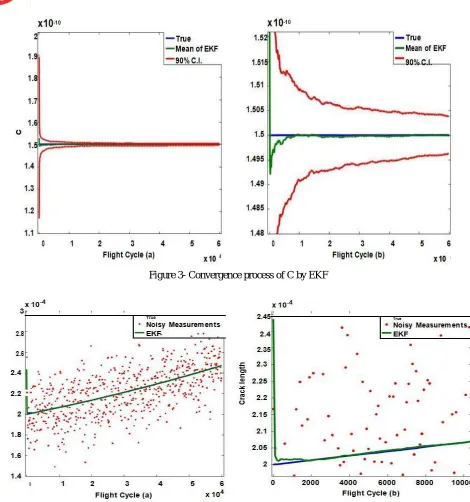
[image:6.612.85.523.84.328.2]Figure 3- Convergence process of C by EKF
Figure 4- Crack length evolution by EKF based on one simulation, measurement points are plotted every 100 cycles
It can be observed that both m and C have been accurately identified and they rapidly converge to the true value. Although we have
considered second order Taylor expression, the values are quite similar to the values defined by a first order expression with the crack length evolution identical. This proves that higher differential terms do not significantly affect the crack length evolution.
The initial values of m and C are uniformly distributed with a range of approximately 50% around the true values while the error of
the EKF estimate for m and C has decreased to 0.17% after 100 cycles and 0.38% respectively. These errors fluctuate to a small
extent but remain very low through the remainder of the cycles (up to 60,000 cycles): less than 0.32% for m and less than 0.53% for
C. Fig 4 illustrates the crack length evaluation estimated by EKF based on one simulation out of the 50 repetitions. Each point
929
©IJRASET: All Rights are Reserved
VII. CONCLUSION
In this paper, estimation for Paris' law constants and crack length evolution has been formalized as a nonlinear filtering problem. Extended Kalman filter has been applied to determine the Paris' law constants and the fatigue crack length behaviour using the second order Taylor expression in the original Paris’s law equation. The yielded results indicate that this method identifies Paris' law
constants and estimate the crack length fairly well. The error of the estimated EKF values for m and C are 0.17% and 0.38% after
100 cycles respectively. The errors seldom fluctuate in a normal aircraft cycle of 60,000 cycles. Accordingly, we conclude that EKF is an accurate and efficient state/parameter estimation approach for fatigue crack propagation problem. Future work may include investigating the truncated terms in a more proper basis to determine their effects on the crack length evolution.
REFERENCES
[1] Dhruv Apte, Mohit Dhoriya, Prof. Nitinchandra R Patel, , , , , ."Theoretical Approach to Determine Flaw Size in Aircraft Fuselage Panels using Extended Kalman Filters", Volume 7, III, International Journal for Research in Applied Science and Engineering Technology (IJRASET)
[2] Y.Wang,et al., Determination of Paris' law constants and crack length evolution via Extended and Unscented Kalman filter : An application to aircraft fuselage panels, Mech.Syst.SignalProcess.(2016), http://dx.doi.org/ 10.1016/j.ymssp.2016.04.027i
[3] P. Paris and F. Erdogan, “A Critical Analysis of Crack Propagation Laws”, J. Basic Eng 85(4),528-533, December,1963. doi:10.1115/1.3656900 [4] H. J. Kushner, “Dynamical equations for optimum nonlinear filtering,” J. Different. Equat., vol. 3, pp. 179–190, 1967.
[5] G. Welch, G. Bishop, An Introduction to the Kalman Filter, 1995.
ABOUT THE AUTHORS
Dhruv Girish Apte is a final year undergraduate student at Department of Mechanical Engineering, G H Patel College of Engineering & Technology, Vallabh Vidhyanagar, Gujarat, India. He has published one research paper in international journal.
Mohit Dhoriya is a final year undergraduate student at Department of Mechanical Engineering, G H Patel College of Engineering & Technology, Vallabh Vidhyanagar, Gujarat, India. He has published one research paper in international journal.