An Energy Efficient Multilevel Hierarchal Cache
based Scheme for Wireless Sensor Network
Nikita Ahuja1, Ms. Chaitali Choudhary2, Mr. Kaushal Kumar Sinha3 1
Mtech Scholar CSE BIT,
2, 3
Assistant Professor CSE BIT, Durg
Abstract: The wireless sensor network is the decentralized type of network in which sensor nodes join or leave the network when they want. The sensor network is deployed on the far places and size of sensor nodes is very small due to which energy consumption is the major issue of WSN. The data gathered from the aimed environment is sent directly to the main station because sensor nodes have only restricted power. The data from a bunch of sensor nodes is received by the base station. For the implementation of decision making procedure, base station identifies and removes the resemblance find between the data of different sensor nodes. Further, base station not only utilize the obtain data locally but it is also capable of transmitting these data to the distant situated networks. The existing research work CTNR is the energy efficient protocol which improve lifetime of wireless sensor networks. The CTNR protocol has the two level hierarchies to reduce energy consumption of wireless sensor network. In the CTNR protocol, the cluster heads are selected in the network on the basis of distance and energy. In this research work CTNR routing protocol will be further improved to improve lifetime of wireless sensor network.
I. INTRODUCTION
Wireless Sensor Networks can be described as a combination of thousands or hundreds devices small in shape and able to interact with each other with the restricted use of power. In order to show the effects of various environmental problems, these wireless sensors are placed in the actual environmental conditions. The data gathered from the aimed environment is sent directly to the main station because sensor nodes have only restricted power. The data from a bunch of sensor nodes is received by the base station. For the implementation of decision making procedure, base station identifies and removes the resemblance find between the data of different sensor nodes. Further, base station not only utilize the obtain data locally but it is also capable of transmitting these data to the distant situated networks [1]. Due to this process, high interaction transparency is achieved and the sensor nodes are not able to tolerate this. The data aggregation is known as the process of collecting and reporting of data collected from the entire sensors.
The technique of wireless sensor networks is utilized in a number of areas. The WSNs are used for object tracking, intelligent forming, congestion controlling, military application, survival monitoring and much more. Several issues are also presented in wireless sensor networks like development of a comprehensive addressing for the whole sensor nodes, security, small calculation capability, restricted and not chargeable battery and small memory. A one more delicate issue associated with the wireless sensor network’ node is the energy consumption. This issue is thought to be going further without any care for a long span of time. The necessity of applications decides the energy utilization. In addition, it is occasionally placed in unfriendly climate conditions where the replacement or the recharge of the batteries of sensor nodes cannot be performed. Thus as an indicator of life span of wireless sensor networks, batteries plays a significant role.
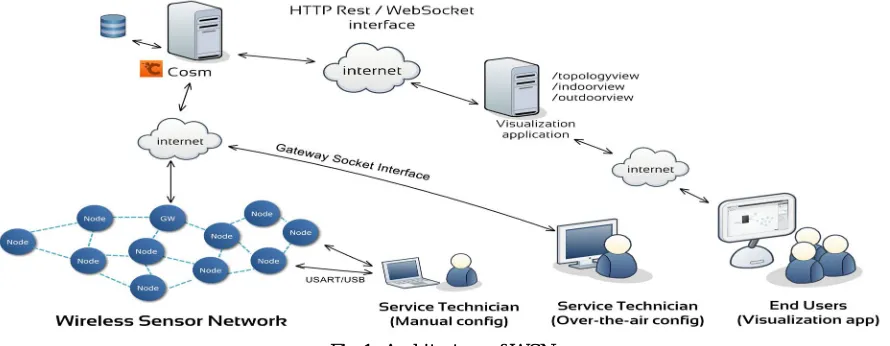
During the procedure of data transferring, a lot of energy is utilized in a wireless sensor network. Therefore a necessity of energy efficient protocols arises. For making the wireless sensor network energy efficient, a lot of research in the area of architecture of wireless sensor networks is going on. For making the WSN energy efficient, a lot of researches have been proposed. These investigations include physical layer which passes through routing protocols based on data improving attainment technologies. In the previous time, many researches on wireless sensor networks considered only homogeneous sensor nodes but now days, heterogeneous sensor nodes are being used where sensor nodes are different from each other in terms of their energy [2]. The problem of using relay nodes for fault tolerance for obtaining higher network connectivity in homogeneous sensor networks where sensor nodes possess different transmission radii is eliminated in the advanced networks which use heterogeneous designs. The design architecture of a typical wireless sensor network is shown in the fig 1.
The nodes can be thrown from helicopters to inaccessible areas. So, the need to go close to the field for deployment does not arise. The nodes thrown in a random fashion make an ad hoc network. The nodes are cheaper and quite tiny with non-replaceable or rechargeable batteries. So, the limited energy should be effectively utilized for gathering the data for a long period of time. The clustering is proved as the better method of getting the data with minimum energy consumption from the partitioned zones of the field for the following reasons. (i) The nodes can send the sensed information directly to the BS when the BS is in the communication range of them. However, since the transmission energy needed to send the information is proportionate to the distance to which the information is to be sent, the nodes which are placed far away from the BS lose energies soon. Similarly, some nodes which are still far from the BS cannot send the information directly. (ii) The nodes placed closer to each other send almost the same information which is considered as duplicate information. (iii) Instead of getting all the raw data from the individual sensor nodes, processed information which states the status of a particular zone is better. In every cluster, choosing the right candidate to be the leader among the nodes is a challenging task since the cluster leader has to do the tasks of receiving data from the remaining nodes, aggregating the data, and sending the aggregated data to the BS. Since taking the cluster head (CH) role is a high-energy consuming process, a single node cannot take the CH role continuously. So, rotating the CHs at right intervals is also a major task. In this paper, the parameters average communication distance (ACD) and lingering energy is used for the appropriate selection of CHs in two modes. In mode 1, the CH is selected based on the ACD. In mode 2, the selection of CH is done based on the residual energy. Cluster head selection process is depicted in fig 2
Fig 1- Architecture of WSN
A. Energy Consumption in WSN
network design can be developed with the help of cross layer approach in wireless sensor networks. The approach of cross layer was mainly based on the dependability among various layers of protocol stack and the permission of modified information sharing. This is also said that with the help of this, much improved performance results can be attained. The deployment of the obtained protocols should be on the wireless sensor networks. When the protocols are deployed in the firmly layered mechanism, then it causes problems. Architecture of two or more layers together or the transferring of parameters during run time among layers is some wide examples of cross layer architecture. For attaining the accurate outcomes for the whole energy utilization, there is no perfect method which can suggest which layers should be grouped together.
1) Leach Protocols: These protocols were invented for serving a different requirement of wireless sensor networks. In a wireless sensor network, one of the main functions of almost all application protocols design is to send the data further to the base station. A number of mechanisms have been developed for obtaining less energy utilization for avoiding power consumption. As every node cannot be deployed close to the base station therefore the nodes which are placed very far from the base station will use extreme energy for sending the data. This issue can be resolved with the help of Cluster-Head algorithms.
a) Leach (low-Energy Adaptive Clustering Hierarchy): For the minimization of comprehensive power consumption of nodes, the clustering based routing protocols are utilized instead of static clustering algorithms. For the distribution of load over different period of time, the nodes are essential. On the base of signal potential, the different sensor nodes will be joined to the suitable cluster heads in this approach. The maximum power nodes in cluster will provide help to the cluster head and after that comprehensive data will be delivered to the BS [6].
b) Improved Leach Protocols: Euclidean distance among a number of nodes was studied for advancing the position of cluster heads in an area. This study was performed because of the arbitrary installation of nodes. During the arbitrary placement, nodes are placed distant or sometimes close to each other. Thus the researchers developed a new cluster head choice mechanism for Leach protocols. The various similar methods take the residual energy of nodes into account. The protocol performs two operation level which are quite similar like Leach. This develops random delay before delivering the ADV information with the use of cluster head nodes. This makes the cluster better for joining the procedure and as a result 17% of elimination in cluster head achieved. The problem of this process is that there is no mention of inaccessible nodes.
c) LEACH-CE (Leach-Centralized Efficient) [13]: A lot of improvements in this protocol have been performed but still the problem of highest power nodes becoming a cluster head is present. Because of this, the sensor node with less power expires early. Higher nodes are chosen as cluster head during every round in association phase by the Leach-CH. This will result in the elimination of the average life span of the wireless sensor network. A new routing protocol named ME-LEACH is more power proficient as compared to the original LEACH. This new protocol is also based on LEACH. The energy efficiency by this newly developed protocol is obtained by reducing the interaction distances among the sensor nodes. This technique will prove more beneficial in large scale networks because this approach comes with a powerful ratio. Leach protocol has shown a great improvement in a number of fields and this improvement can be seen in both steady as well as in setup phase. The fields where LEACH protocol performed well are power efficiency, cluster formation algorithms and cluster head selection. This study focuses on the implementation of whole energy conservation and applies this to the modified Leach protocol by the means of new cluster head assortment.
2) HEED Protocols: In the HEED, cluster heads are chosen from the sensor nodes. This selection is based upon an assured possibility which is somewhat related to the combination of interaction expenditure and a fusion of power. The full form of HEED is Hybrid energy efficient distributed clustering. Thus this is basically a distributed clustering algorithm. For becoming cluster heads in this clustering algorithm, sensor nodes with lesser intra-interaction expenditure and with high remaining energy are essential. HEED protocols are more efficient than Leach protocols because the cluster heads originated by HEED are well-allotted in comparison with Leach [7]. The best possible number of selected cluster heads and the connectivity of the network cannot be guaranteed with the implementation of this method. A modified version of HEED protocol is EEDC which is also a clustering algorithm which can help in the improvement of the lifetime of network and also eliminates the repletion rate.
protocol is a heterogeneous wireless sensor network. This protocol extends the steady time period. The cluster heads in SEP are selected on the basis of the remaining energy of the sensor nodes. The nodes with less energy are categorized as normal nodes while the nodes with higher energy are categorized as advance nodes. These advance nodes generally becomes head nodes so that the density of the network remains unchanged. Because of this, steady period of the network increases which is very useful in many areas. In a multi-level heterogeneous network conditions, normal and advance nodes fails in the selection of cluster head.
II. PRIOR CORRELATED WORKS
Intense research is being carried out to make clustered communication more energy efficient. Among several ideologies, some of the works are listed here. The initial platform for the clustering-based algorithms is set by low-energy adaptive clustering hierarchy (LEACH) [14]. It introduced a simple way of selecting a set of CHs for each round. About 5% of total sensor nodes are expected to be selected as CHs for optimum performance. Each sensor node calculates a probability threshold value based on optimum percentage of CHs and non-repeatability of CH role to the same node within 1/P round.
A. Clustering parameters
Efficient clustering is done using the following parameters.
1) ACD: The ACD is the indication of the suitability of the node to become CH in terms of the node's location centrality. The ACD of a node is calculated by (1)
=
Where D is the distance to the Ith node and n is the number of nodes in the cluster. In mode 1, ACD is the main criteria for selecting the CH. The node which has the least ACD gets the CH role.
2) Lingering Energy: The nodes which are energy-rich should take the responsibility of the CH role. When the nodes with minimum energy are elected as CH, the packet losses are more. In mode 1, the lingering energy is utilized as an additional parameter In mode 2, the CH selection is done only by considering the remaining energy of the nodes. The node which has high lingering energy compared with other nodes in the cluster for a particular round gets the CH role.
B. Assumptions
The following assumptions are made to evaluate the performance of the network: 1) Nodes are homogeneous in nature with equally equipped resources.
2) Nodes can send the data directly to the BS. 3) Nodes can identify their location coordinates.
4) Power level variations are possible for nodes based on the distance of communication. 5) Information is available to be sent to BS every round.
6) Received signal strength indicator (RSSI) can provide the distance between two nodes.
C. EESCA Details
The algorithm works in two phases, namely network initialization and steady-state operation. Network initialization
1) Step1: The nodes identify their physical location themselves.
2) Step2: The BS broadcasts a HELLO message to all the nodes in the network. The nodes identify the distance from them to BS based on the RSSI.
3) Step 3: The nodes divide themselves into four clusters based on the physical location and the distance to BS. The zones are formed in the shape of squares. The nodes allocate cluster IDs themselves. In LEACH, 5% of the total number of nodes is elected as CHs for getting better efficiency. In EESCA, the optimum number of clusters is decided using the simulation analysis on a 100 node network. The number of clusters is varied from 2 to 10 for the first scenario shows that EESCA is energy efficient when there are four clusters.
4) Step 4: Each node in the cluster gathers the information of the distances between it and other nodes by sending control messages to other nodes. This information is vital throughout the operation.
5) Step5: Each node calculates the ACD.
D. CH Selection Process
CH is selected in hybrid modes based on the centrality and node's lingering energies. The flow diagram of the node level CH selection process is depicted in
1) Mode 1: The node which holds the least ACD and the residual energy >= 10% of the initial energy actss as the CH for the cluster for the initial rounds. The node which has least ACD would be in the centre of the cluster. It is quite obvious that the node in the centre position of the cluster can serve the remaining nodes well with overall minimum energy consumption. 2) Mode 2: The node which has highest lingering energy acquires the leadership role every round. This ensures the longevity
of the network lifetime. The node which is selected as CH starts its operation by broadcasting CH-MSG including its ID and a secret code to other nodes in the cluster. The non-CH nodes send JOINMSG to the respective cluster heads. Thus, the cluster is formed with minimum control overhead. A TDMA schedule is created for all the nodes for the communication to be taken place without traffic.
E. Comparison of The Modes
The first mode eliminates the requirement of re-clustering in each round. It minimizes the unnecessary control information sharing among the nodes. So, the control overhead is reduced drastically. All the nodes gain CH role once. Thus, the load balancing among the nodes is ensured. All the nodes are alive in mode 1 and hence good connectivity is established naturally. In the second mode, all the nodes have lesser residual energies. So here, the residual energy-based CH selection can extend the network lifetime in terms of the last node die (LND).
F. Steady-state operation
1) Step1: The normal nodes in all the clusters sense the information from the environment and send the sensed information to the corresponding CHs on TDMA slot allotted to them.
2) Step 2: After receiving all the data from the nodes, the CH performs the data aggregation.
3) Step 3: The CH checks for the intermediate CHs to route the information to BS. Thus, the CHs positioned far from the BS (lower-level CHs) can transmit the data to the BS via intermediate CHs (higher-level CHs) using multi-hop communication. The higher-level CHs send the data directly to the BS.
G. CH Role Rotation Process
1) CTNR: The CTNR is calculated by the ratio of energy spent by the node when acting as CH in mode 1 to the total energy of the node. This parameter should be selected optimally to get the maximal lifetime and minimal simulation time. 2) CH Role Rotation: In mode 1, the nodes which are selected as CHs retain the role of CHs up to CTNR <= 0.4. The reason for
selecting the value of CTNR as 0.4 is discussed in Section 4.5. When a node loses its CH role, it sends the LOSE-CH message to the node which holds the next least ACD. After receiving this message, the new node announces its CH-MSG to other nodes and continues its operation until CTNR is <= 0.4. This process is continued until all the nodes in the cluster gain the role of CH once. After every node gaining the CH role once, the mode 2 is initiated when no node receives any CH-MSG at a certain time. Now, the nodes exchange their residual energies among them. The node with high residual energy claims its CH role by sending the CH-MSG. This process continues for every round until all the nodes die. This ensures the uniform distribution of load amongst all the nodes in the cluster.
3) Optimum selection of CTNR: the effect of CTNR in complete useful data percentage (CUDP) and simulation time for the different scenarios. The CTNR is varied from 0 to 1 to identify the optimal value of CTNR. The algorithm works as a purely lingering energy-based one when the CTNR is set to 0. On the other hand, when the CTNR is set as 1, the algorithm works as a static clustering algorithm. Although the CUDP is good in scenes 1 and 3 when CTNR is <0.4, the simulation time is more because of high control overhead. Thus, to get a better CUDP and less simulation time, the CTNR value is set as 0.4 [19] selection of cluster head process is depicted in fig 2
III. PROPOSED EEMCBS DETAILS
A. Problem Formulation
sensor networks. In the CTNR protocol, the cluster heads are selected on the basis of two parameters which are distance and lingering energy. The lingering energy parameter helps of select the clustser head dynamically in the network after each round. In the CTNR protocol, the energy hole is the major problem which reduces its efficiency. In this research work, CTNR protocol will be further improved to solve energy hole problem in wireless sensor networks
B. Objectives
Following are the various objectives of this research work:-
1) To study and analyze various energy efficient protocols of wireless sensor networks
2) To improve CTNR routing protocol to solve energy whole problem in wireless sensor networks
3) Implement improved CTNR routing protocol and compare performance with CTNR protocol in terms of number of dead nodes, number of alive nodes and number of packets transmitted to base station
C. Research Methodology
This research work is related to improve lifetime of wireless sensor networks. The CTNR is the efficient routing protocol of wireless sensor network which increase lifetime of CTNR protocol. The CTNR routing protocol use the concept of clustering to increase lifetime of wireless sensor networks. In the approach of clustering, the cluster heads are selected in each cluster. The network is divided into clusters on the basis of sensor node location. The cluster heads are selected in each cluster based on distance and lingering energy. To solve the energy whole problem, the gateway nodes will be deployed near the base station. The cluster heads will transmit data to gateway nodes which forward data to base station. The research process is been converted from EESCA TO EEMCBS
IV. INVESTIGATIONAL OUTCOMES
A. Simulation Parameters
For the valuation of presented approach, some parameters like alive nodes in the network, dead nodes in the network, packet send to the base station, remaining energy is been considered. Simulation network energy efficiency is compared with the efficiency achieved from EEMCB protocol. A number of experiments were conducted for knowing the validity of the proposed approach. The tested results when compared with the conventionally used approaches, it was found that the proposed approach was very efficient for the wireless sensor networks. All the simulation parameter are listed in Table 1 are conducted using MATLAB installed on a standard PC.
Table 1. Simulation Parameters achieved by applying CTNR protocol
0 50 100 150 200
0 10 20 30 x(rounds) y (d e a d )
DEAD NODES DURING NETWORK LIFETIME
EXISTING Protocol PROPOSED Protocol
0 50 100 150 200
0 50 100 150 200 250
0 50 100 150 200
0 500 1000 1500 2000 x(rounds) y (d a ta )
PACKET SEND TO BASE STATION
EXISTING PROTOCOL PROPOSED PROTOCOL
0 50 100 150 200
0 0.02 0.04 0.06 x(rounds) y (d a ta ) Remaning Energy EXISTING PROTOCOL PROPOSED PROTOCOL
0 50 100 150 200
70 80 90 100 x(rounds) y (a liv e )
ALIVE NODES DURING NETWORK LIFETIME
EXISTING Protocol PROPOSED Protocol
A) cluster head selection B) Dead nodes during network lifetime
c) Packet sent to base station D) Alive nodes during network lifetime
V. CONCLUSION
Due to small size of sensor nodes and far deployment energy consumption is the major issue of wireless sensor networks. The WSNs are used for object tracking, intelligent forming, congestion controlling, military application, survival monitoring and much more. Several issues are also presented in wireless sensor networks like development of a comprehensive addressing for the whole sensor nodes, security, small calculation capability, restricted and not chargeable battery and small memory. The CTNR is the energy efficient routing protocol which improve lifetime of wireless sensor networks. In this research CTNR protocol, gateway nodes will deployed in the network to increase lifetimes of wireless sensor networks.
REFRENCES
[1] Mohamed Elshrkawey, Samiha M. Elsherif, M. Elsayed Wahed, “An Enhancement Approach for Reducing the Energy Consumption in Wireless Sensor Networks”, 2018, Journal of King Saud University –Computer and Information Sciences
[2] M.A. Matin and M.M. Islam, “Overview of Wireless Sensor Network”, 2012, IEEE Sensors Journal, Vol. 11, No. 3, pp. 699-710, [3] Jayakumar Loganathan, “Wireless sensor network applications: A study”, 2018, International Journal of Pure and Applied Mathematics
[4] Varun Prakash Saxena, “Wireless Sensor Networks: Introduction, Advantages, Applications and Research Challenges”, 2015, HCTL Open International Journal of Technology Innovations and Research (IJTIR)
[5] Ramin Yarinezhada, Amir Sarabib, “Reducing delay and energy consumption in wireless sensor networks by making virtual grid infrastructure and using mobile sink” 2018, Int. J. Electron. Commun. (AEÜ)
[6] Walid Abushiba, Princy Johnson, Saad Alharthi, “ An Energy Efficient and Adaptive Clustering for Wireless Sensor Network (CH-leach) using Leach Protocol”, 2017, 13th International Computer Engineering Conference (ICENCO)
[7] Jiguo Yu, Li Feng , Lili Jia , Xin Gu and Dongxiao Yu, “A Local Energy Consumption Prediction-Based Clustering Protocol for Wireless Sensor Networks”2014, Sensors 2014, 14, 23017-23040
[8] Tenzin Jinpa, Dr. B.V.R Reddy, “The Study of the Energy Efficient Protocols”, 2014, International Journal of Computer Science & Communication Networks, Vol 5(1), 32-38
[9] Mohamed Elshrkawey, Samiha M. Elsherif, M. Elsayed Wahed, “An Enhancement Approach for Reducing the Energy Consumption in Wireless Sensor Networks”, 2018, Journal of King Saud University –Computer and Information Sciences
[10] Đoko Banđur, Branimir Jakšić, Miloš Banđur, Srđan Jović, “An analysis of energy efficiency in Wireless Sensor Networks (WSNs) applied in smart agriculture”,
2019, Computers and Electronics in Agriculture
[12] M. Benaddy, B. El Habil, M. El Ouali, O. El Meslouhi, S. Krit, “A multipath routing algorithm for wireless sensor networks under distance and energy consumption constraints for reliable data transmission”,2017, ICEMIS2017, MONASTIR, TUNISIA
[13] Rym Ch´eour, Mohamed Wassim Jmal, Mohamed Abid, “Hybrid Energy-Efficient Power Management for Wireless Sensors Networks”, 2017, International Conference on Smart, Monitored and Controlled Cities (SM2C), Karenna, Tunisia, February
[14] Jie Huang, “Research on Balanced Energy Consumption of Wireless Sensor Network Nodes Based on Clustering Algorithm”, 2017 International Conference on Computer Network, Electronic and Automation
[15] A. Laouid, A. Dahmani A. Bounceurb, R. Euler F. Lalem, A. Tari, “Distributed Multi-path Routing Algorithm to Balance Energy Consumption in Wireless Sensor Networks”, 2017, ADHOC 1560
[16] Andrés Pillajo, Teresa Guarda, Geovanni Ninahualpa Quiña, “Access Control Protocols for Low Energy Consumption Mediun for Wireless Sensor Networks”, 2018, 13th Iberian Conference on Information Systems and Technologies (CISTI)
[17] K. Praghash, R. Ravi, “Energy Consumption Architecture for Wireless Sensor Networks With Different Clusters”, 2017, Third International Conference on Science Technology Engineering & Management (ICONSTEM)
[18] Fathima Shemim, Alavikunhu, Shahanas Shajahan, “Enhanced Energy Aware Multi-Hop Hierarchical Routing Algorithm for Wireless Sensor Networks”, 2017 International Conference on Electrical and Computing Technologies and Applications (ICECTA)
[19] Nabeel I. Sulieman, Student Member and Richard D. Gitlin, “Ultra-Reliable and Energy Efficient Wireless Sensor Networks”,2018, IEEE 19th Wireless and Microwave Technology Conference (WAMICON)