Hence, safety and reliability are the factors that need to be considered. Now-a-days, railway network has exceedingly become prone to accidents. Manual observation of the track is quite difficult. In order to avoid this hurdle and enhance the accuracy, an automated inspection system is put forth. The proposed system will identify the cracks in the track using IR sensor and send information over web server to Adafruit IO using Node MCU and GPS module. It will also find if there is any obstacle, fire, breakage between bogie’s, temperature of the engine using IR sensor, flame sensor, IR sensor, LM35 respectively. It also has automatic flushing. The door will automatically open if fire or any obstacle is detected. It also deals with automatic gate level controlling. At the tunnel side, the LED lights are turned ON if environment is dark and train is passing through the tunnel. Keywords: Microcontroller (Arduino UNO), IR sensor, Fire sensor, Microswitch, LM35 sensor, Adafruit IO, NodeMCU.
I. INTRODUCTION
The Indian, railroad system is the largest railway passenger transportation and is thought-out as the most important part of the India’s transport cadre. Many corporate transportations in India are done by the railroad network as it is the affordable means of transportation compared to other modes of transportations like trucks, buses, flights and so on. The rapid enhancing in Indian economy has an outcome in rapid increasing importunity for transportation now-a-days. Transport is mainly required for the specialization that permits manufacturing and consuming of commodity that happen at distinct locations. Transportation helps in carrying people and goods from locality to different locality. It also plays an important role in the evolution and development of industries. Railroad aid in delivering raw substances and other substances to the factories and completed goods to marketplace. So, safety and dependability should mainly be considered in the case of railways. As it is playing a major part in growth of the economy, so the importance of having modern and improved railway system is increasing day by day. More trade can be obtained is there is a better transport. Expansion of capacity and transport level determines the economic level.
II. EXISTINGSYSTEM
In the existing methods IR sensors are used in identifying the cracks on track and Bluetooth as a communicating media for sending the location of the crack to mobile phone. Identification of any obstacle on the track is done using vibration sensor. Load cell is used to identify whether train is entering into the tunnel or not. If load cell identifies train entering into the tunnel then lights will be turned ON else lights will be OFF. Reed sensors are used in the application of gate level-crossing which permits automatic opening and closing of gate.
III.PROPOSEDSYSTEM
The proposed system will identify the cracks in the track using IR sensor and send information over web server to Adafruit IO using Node MCU and GPS module. It will also find if there is any obstacle, fire, breakage between bogie’s, temperature of the engine using IR sensor, flame sensor, IR sensor, LM35 respectively. It also has automatic flushing. The door will automatically open if fire or any obstacle is detected. It also deals with automatic gate level controlling. At the tunnel side, the LED lights are turned ON if environment is dark and train is passing through the tunnel.
IV.FUNCTIONALBLOCKDIAGRAMANDDECRIPTION
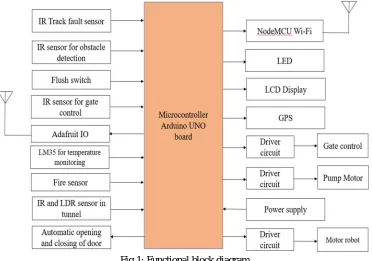
Fig 1: Functional block diagram
V. WORKINGMETHOD
Above fig-1 shows the complete block diagram of smart railway system. The working of whole project is divided into four sections like tunnel side, robot side, gate side and train side. The detailed working at each section is explained in further discussion. All sensors used in this project are Active low, which implies that upon detection it gives output as Logic 0 else Logic 1.
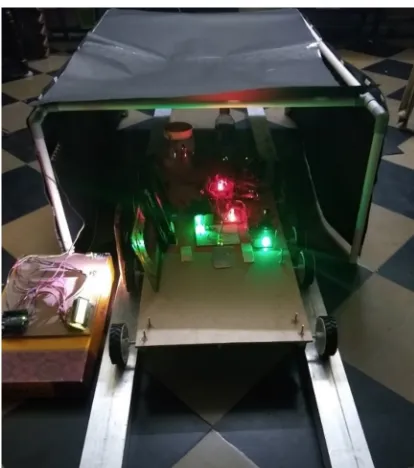
1) Tunnel Side: IR sensor is used to detect whether Train is entering into the tunnel, and LDR sensor is used to monitor whether environment is bright or dark. If both conditions are satisfied that is train is entering into the tunnel and environment is dark then LED lights are turned ON.
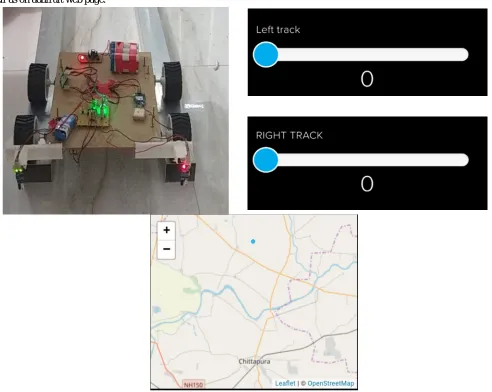
2) Robot Side: When robot moves on the track, IR sensor detects it as an obstacle, and rays transmitted from IR transmitter will be continuously reflecting back and these rays are received by the IR receiver, and hence motor is still ON and robot module will be moving in the forward direction. When a crack is detected, IR sensor detects as no obstacle is present, , the rays transmitted from IR transmitter and not reflected back to IR receiver. GPS module will be continuously monitoring the location, upon crack detection its location and its position (left or right track) is hosted on Adafruit IO.
3) Gate Side: In this section two Infrared sensors, microcontroller and two motors and buzzer are used. IR sensor 1 is used to detect whether train is coming or not and IR sensor 2 is used to determine whether train has passed the crossing or not. When train has not yet reached crossing both the IR sensors read logic 1 value, buzzer is not turned ON, and gates are OPEN. When train arrives at crossing data output of first IR sensor becomes zero gates whereas data output of second IR sensor remains same i.e., logic 1. Now buzzer makes a sound indicating that train is arriving and gate CLOSES. As train moves forward and if this sensed by the second IR sensor, data pin of IR sensor 2 reads a value equal to logic 0 and the gate OPENS.
4) Train Side: When fire is detected pump motor turns ON automatically, motor drivers will turn OFF and train stops moving, buzzer sounds and the sliding door opens automatically. Temperature senor (LM35) will be continuously monitoring the temperature of engine. If engine temperature is less than the specified threshold value then GREEN LED is ON, else if it is more than the specified threshold value then RED LED is ON. If an obstacle is present in front of IR obstacle sensor, motor drivers turns OFF and train stops moving, buzzer sounds and the sliding door opens automatically. In order to detect whether there is a breakage between bogie’s, two IR sensors are placed opposite to each other. When two IR sensors are in the range it implies that there is no breakage between bogie’s. If two IR sensors are not in range it implies that there is a breakage between bogie’s and buzzer sounds. Micro switch used as Flush switch. When flush switch is pressed pump motor turns ON automatically.
Fig 2: Crack detection and hosting the information on webserver
Fig 5: Fire detection Fig 6: Automatic flushing
[image:4.612.38.557.55.701.2] [image:4.612.52.259.260.494.2] [image:4.612.221.518.530.708.2][image:4.612.52.271.532.707.2]
Fig 7: Train passing in the tunnel during day time Fig 8: Train passing in the tunnel during night time
VIII. ACKNOWLEDGMENT
We are thankful to all the faculties of ECE department, Sharnbasva University, Kalaburagi, for their encouragement and support throughout the work. I extend my sincere gratitude to my parents and friends who directly and indirectly supported in carrying out the work.
REFERENCES
[1] B.Siva Rama Krishna, D.V.S Seshendra, G.Govinda Raja, T.Sudharshan, K.Srikanth, “Railway Track Fault Detection System by Using IR Sensors and Bluetooth Technology”, Asian Journal of Applied Science and Technology (AJAST) Volume 1, Issue 6, Pages 82-84, July 2017.
[2] Apurva S, Sagar, Pooja, Monika, “Wireless sensor network for real time monitoring and controlling of railway accidents”, International Conference on Trends in Electronics and informatics,2017.
[3] Nisha S, Archana Raut, “A Survey on railway security in wireless network”, International Journal of Computer Science and Network”, Vol 2, Issue I,2013. [4] Parag Nikhar, Rakesh Pise, Avinash, “IR Sensor based crack detection of railway track using GSM & GPS system”, Vol 5, Issue III, March 2017.
[5] G.J.Deepika, Gurpreet Kaur, Neha Kumari, Suruchi Rathod, Sonal Dahiya, Mahendra Singh Meena, “Railway Accident Monitoring”, International Journal on Recent and Innovation Trends in Computing and Communication, Volume: 5, Issue: 5, May 2017.