108
©IJRASET: All Rights are Reserved
A Review on Performance Base Challenges in
Cloud Storages Services
Aishwarya Patil1
1
Department of computer engineering, Bharati Vidyapeeth (Deemed to be University) College of Engineering Pune
Abstract: In Cloud computing administrative requirements scale up or scale down their capacity on network is an arrangement of IT benefits that are given to a client over a system. Who have individual infrastructure third party provider deliver the cloud computing services. Without the heavy investment offer the business model by cloud computing adopt for the IT services. Major issue is security which basket the development of cloud. Giving over basic data to another association is upsetting; with the true objective that the clients ought to be cautious understanding threats data breaks in new condition. It has several advantages include flexibility, elasticity, scalability, efficiency and subcontracting non-core actions of an organization. During the development of cloud some issues are occur or accept but it provides many advantages for IT organizations. The main fear is trust, security and privacy. This paper presents an itemized examination of the cloud computing security issues and difficulties concentrating on the cloud computing composes.
Keywords: IaaS, PaaS, SaaS, Public Cloud, Private Cloud, Hybrid Cloud
I. INTRODUCTION
For a significant long time until 2008 by cloud picture Internet has address on organize outlines when over the internet the new organization build up started that preparing process is known as cloud computing. The forms of interpersonal computing and social networking sites use are the activities which is included in the cloud computing, power processing, online software application access and data storage on cloud computing most of time it is concern with it. Without new infrastructure investing, approving new programing or planning new work Cloud computing is add their capability or increase their capacity dynamically. From the promising business concept to the IT industries fast growing segments the cloud computing is grown rapidly from the last few years. There are lots of companies and individual information are stored over the cloud, but main concern behind it is from beginning to growth is how the environment is safe. Cloud security is improved and increased the security focused resources by the data centralization. The worries drive forward about loss of power over certain dubious information, and the nonattendance of security for set away sections contributed to cloud suppliers. On the off chance that those suppliers have not done strong occupations secures their own specific condition, the buyers could be in a horrendous position. To the customer many cloud suppliers won't open their framework that why the overseeing and estimating the cloud suppliers security are hard to pass judgment [1].
109
©IJRASET: All Rights are Reserved
worries proceed about the loss of control over certain touchy information and the security of put away data gave over to the cloud specialist co-ops. On the off chance that those suppliers have not furnished with the effective security framework in their own surroundings, the shoppers could be in trouble. Estimating the nature of safety efforts executed by the cloud suppliers is troublesome in light of the fact that many cloud suppliers won't uncover their foundation offices to clients [2].
II. RELATED WORK
Cloud Computing Security Issues
A. Cloud Deployments Models
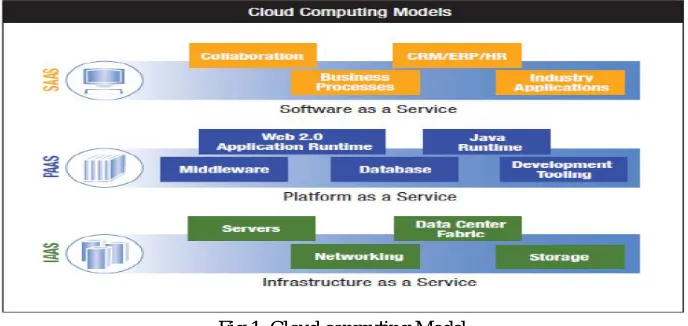
Cloud development model, stage, programming delineation, organizing and capacity are given organizations which is up the scale or down the scale dependent on demand which is depicted in fig 1. Cloud Computing model have three guideline association models as follow:
1) Private: Recently the cloud computing emulate the offers which is on the private network and it’s a new term that the vendors are used like a Private cloud. Internal enterprise data centre is a set inside the organization. Virtual application and adaptable resources are pooled together by the cloud venders for cloud users to use and share their private cloud. The private cloud is different from the public cloud because the organization are manage the all application and cloud resource itself like internet functionality. The use of private cloud is much secure than the public cloud because predefined internal presentation. Simply the affiliation and allotted accomplices may approach take a shot at a specific Private cloud [1] [3].
2) Public: Cloud computing is describe by the public cloud in the sense of traditional mainstream, here logically provisioned the resources on a fine-grained, person-advantage started on Internet, by methods for web organizations or application, on the basis of fined grained computing utility share their bills and resources by outside providers. It is routinely in perspective of remuneration for every usage illustrate, similar to a prepaid power metering structure which is adequately versatile to give sustenance to spikes looked for after for cloud optimization[4]. Open fogs are less secure than the other cloud models since it puts an additional weight of ensuring all applications and data got to on the overall public cloud are not subjected to dangerous strikes [1].
3) Hybrid: The linkage of one or more external private cloud services with each other is a Hybrid cloud, it’s managed centrally, constructed by a secured network and provisioned as a single unit [5]. With the combination of both private and public cloud gives the virtual IT plans. On to the internet gives the access of information and in this cloud have the application and data secure control. The hybrid cloud allows other system management interface because it is an open building. Local devices are combining to describe the configuration by the hybrid cloud such as cloud services with plug computer, and also with the help of physical and virtual servers describe the configuration [1].
B. Cloud Computing Service Delivery Models
In the model of cloud computing there is a basic three cloud computing delivery model as follows:
1) Infrastructure as a Service (IaaS): In this model it is a single resident cloud layer dedicated resources of cloud computing merchants are shared with those client who is contracted candidate at pay per use fee. In the computing hardware needs a huge amount of investment such as processing power, servers and networking devices. The functional feasibility and financial feasibility are not found with collection organization and in the internal data centre, because it is cost effective and release and add the computing resources quickly than the collection organization and internal data centre [6]. IaaS and other related organizations have enabled new organizations and distinctive associations base on their inside capacities without anguishing essentially finished the provisioning and organization of structure. In the IaaS we do not worry about the complexity and it allows the customer to gain IaaS [1].
110
©IJRASET: All Rights are Reserved
[5]. In cloud computing virtual machine is used as a compound in PaaS layer. In this layer virtual machine are used for to protect the layer from the external malware.
[image:3.612.135.479.237.400.2]3) Software as a Service (SaaS): SaaS is third layer of the cloud computing purpose of this layer is to provide the software over the internet and it is maintain by the organization provider or the builders. SaaS is transforming into an unyieldingly dominating transport appear as essential advancements that assistance web organizations and service oriented architecture (SOA) create new developmental techniques end up understood. SaaS is moreover consistently associated with a remuneration as-you-go participation allowing model. In the meantime, broadband organization has ended up being dynamically open to enable customer to access from more domains around the world. SaaS is much of the time realized to give business programming handiness to enormous business customers expecting practically no effort while empowering customers to protected comparative focal points financially agreed, inside worked programming without the related multifaceted nature of foundation, organization, support, allowing, and high beginning cost. The designing of SaaS-based applications is especially proposed to encourage various synchronous customers (multitenancy) immediately [7].
Fig 1. Cloud computing Model
The combination of this three cloud computing deployment delivery model get the complete cloud design which is shown in the above fig 1, which is coupled with security [8][1].
III.CHALLENGES OF CLOUD COMPUTING MODEL:
A. Security Challenges
In the cloud computing security is played the main role to delaying the acceptance. Organizational data are stored and execute that data on other hard disk drive and others processor it scary for someone. We know the lots of security issues like loss of data, active remotely on lots of machines and phishing this are serious issues for the software. In the cloud computing there are the collective computing resources and multitendancy models which is developed to face the major security issues to handle [9].
B. Costing Model Challenges
In the cloud computing cloud user kindly consider integration, computation and communication. Basically the moving of cloud model is reduce the development cost, but in communication term it high the cost, in the many cases the cost of shipping the data form the one side to another it depends on the computing resources per unit. If the customer or organizations are used the hybrid cloud model this cost is efficient. Along these lines, on-ask for circulated figuring resource usage looks good only for CPU genuine occupations [9].
C. Service Level Agreement (SLA) Challenges
111
©IJRASET: All Rights are Reserved
IV.CONCLUSIONS
This paper discuss about challenges and security examinations which is faced in cloud computing. The future cloud computing is most challenging, secure, and reasonable at the cost level in the future. Cloud computing is new model to use internet in another way. Now a days there are lots of technologies are developed in a huge amount of speed with the capability to give the simpler life to the human. In any case, the customer must be outstandingly mindful so as to appreciate the security risks and challenges displayed by utilizing these rising headways.
V. ACKNOWLEDGMENT
I would like to thanks to my parents, faculty and my friends to support me and guide me. I would like to thanks to my teacher staff member Dr. Prof. Jayakumar N sir to give this opportunity.
REFERENCES
[1] Kuyoro S. O., Ibikunle F. & Awodele O. “Cloud Computing Security Issues and Challenges” International Journal of Computer Networks (IJCN), Volume (3) : Issue (5) : 2011
[2] T. Vaikunth Pai* & Dr. P. S. Aithal**. “A REVIEW ON SECURITY ISSUES AND CHALLENGES IN CLOUD COMPUTING MODEL OF RESOURCE
MANAGEMENT” International Journal of Engineering Research and Modern Education (IJERME) Impact Factor: 6.525, ISSN (Online): 2455 - 4200 (www.rdmodernresearch.com) Volume 2, Issue 1, 2017
[3] S. Arnold (2009, Jul.). “Cloud computing and the issue of privacy.” KM World, pp14-22. Available: www.kmworld.com [Aug. 19, 2009]. [4] A Platform Computing Whitepaper. “Enterprise Cloud Computing: Transforming IT.” Platform Computing, pp6, 2010.
[5] Global Netoptex Incorporated. “Demystifying the cloud. Important opportunities, crucial choices.” pp4-14. Available: http://www.gni.com [Dec. 13, 2009]. [6] J. Brodkin. (2008, Jun.). “Gartner: Seven cloud-computing security risks.” Infoworld, Available: [Mar. 13, 2009].
[7] S. Subashini, and V. Kavitha. (2010) “A survey on security issues in service delivery models of cloud computing.” J Network Comput Appl doi:10.1016/j.jnca.2010.07.006. Jul., 2010
[8] M. Klems, A. Lenk, J. Nimis, T. Sandholm and S. Tai. “What’s Inside the Cloud? An Architectural Map of the Cloud Landscape.” IEEE Xplore, pp 23-31, Jun. 2009.
[9] Ramgovind, S., Eloff, M. M., & Smith, E. (2010). The management of security in cloud computing. In 2010 Information Security for South Africa (pp. 1-7). IEEE
[10] Dubey, A. (2016). Cloud Computing and Its Security Issues. International Journal, 4(7).
[11] Akash U. Suryawanshi, P. D. N. K. (2018). Review on Methods of Privacy-Preserving auditing for storing data security in cloud. International Journal of Advanced Research in Computer and Communication Engineering (IJARCCE), ISSN, 7(4), 247–251.
[12] Archana, R. C., Naveenkumar, J., & Patil, S. H. (2011). Iris Image Pre-Processing And Minutiae Points Extraction. International Journal of Computer Science and Information Security, 9(6), 171–176.
[13] Ayush Khare, D. N. J. (2017). Perspective Analysis Recommendation System in Machine Learning. International Journal of Emerging Trends & Technology in Computer Science, 6(2), 184–187.
[14] AyushKhare Nitish Bhatt, DrNaveen Kumar, J. G. (2017). Raspberry Pi Home Automation System Using Mobile App to Control Devices. International Journal of Innovative Research in Science, Engineering and Technology, 6(5), 7997–8003
[15] AyushKhare, J. G., Bhatt, N., & Kumar, N. (2017). Raspberry Pi Home Automation System Using Mobile App to Control Devices. International Journal of Innovative Research in Science, Engineering and Technology, 6(5), 7997–8003.
[16] Bhore, P. R., Joshi, S. D., & Jayakumar, N. (2016). A Survey on the Anomalies in System Design: A Novel Approach. International Journal of Control Theory and Applications, 9(44), 443–455.
[17] Bhore, P. R., Joshi, S. D., & Jayakumar, N. (2017a). A Stochastic Software Development Process Improvement Model To Identify And Resolve The Anomalies In System Design. Institute of Integrative Omics and Applied Biotechnology Journal, 8(2), 154–161.
[18] Bhore, P. R., Joshi, S. D., & Jayakumar, N. (2017b). Handling Anomalies in the System Design: A Unique Methodology and Solution. International Journal of Computer Science Trends and Technology, 5(2), 409–413.
[19] Desai, P., & Jayakumar, N. (n.d.). AN EXTENSIBLE FRAMEWORK USING MOBILITYRPC FOR POSSIBLE DEPLOYMENT OF ACTIVE STORAGE ON TRADITIONAL STORAGE ARCHITECTURE.
[20] Desai, P. R., & Jayakumar, N. K. (2017). A Survey on Mobile Agents. International Journal for Research in Applied Science & Engineering Technology (IJRASET), 5(XI), 2915–2918.
[21] Divyansh Shrivastava Amol K. Kadam, Aarushi Chhibber, Naveenkumar Jayakumar, S. K. (2017). Online Student Feedback Analysis System with Sentiment Analysis. International Journal of Innovative Research in Science, Engineering and Technology, 6(5), 8445–8451.
[22] Gawade, M. S. S., & Kumar, N. (2016). Three Effective Frameworks for semi- supervised feature selection. International Journal of Research in Management & Technology, 6(2), 107–110.
[23] GAWADE, S., & JAYKUMAR, N. (2017). ILLUSTRATION OF SEMI-SUPERVISED FEATURE SELECTION USING EFFECTIVE FRAMEWORKS.
Journal of Theoretical & Applied Information Technology, 95(20).
[24] Jaiswal, U., Pandey, R., Rana, R., Thakore, D. M., & JayaKumar, N. (2017). Direct Assessment Automator for Outcome Based System. International Journal of Computer Science Trends and Technology (IJCS T), 5(2), 337–340.
[25] Jayakumar, D. T., & Naveenkumar, R. (2012). SDjoshi,“. International Journal of Advanced Research in Computer Science and Software Engineering,” Int. J, 2(9), 62–70.
112
©IJRASET: All Rights are Reserved
[27] Jayakumar, N. (2014). Reducts and Discretization Concepts, tools for Predicting Student’s Performance. Int. J. Eng. Sci. Innov. Technol, 3(2), 7–15.Jayakumar, N. (2015). Active storage framework leveraging processing capabilities of embedded storage array.
[28] Jayakumar, N., Bhardwaj, T., Pant, K., Joshi, S. D., & Patil, S. H. (2015).
[29] A Holistic Approach for Performance Analysis of Embedded Storage Array. Int. J. Sci. Technol. Eng, 1(12), 247–250.
[30] Jayakumar, N., Iyer, M. S., Joshi, S. D., & Patil, S. H. (2016). A Mathematical Model in Support of Efficient offloading for Active Storage Architectures. In International Conference on Electronics, Electrical Engineering, Computer Science (EEECS) : Innovation and Convergence (Vol. 2, p. 103).
[31] Jayakumar, N., & Kulkarni, A. M. (2017). A Simple Measuring Model for Evaluating the Performance of Small Block Size Accesses in Lustre File System. Engineering, Technology & Applied Science Research, 7(6), 2313–2318.
[32] Jayakumar, N., Singh, S., Patil, S. H., & Joshi, S. D. (2015). Evaluation Parameters of Infrastructure Resources Required for Integrating Parallel Computing Algorithm and Distributed File System. IJSTE-Int. J. Sci. Technol. Eng, 1(12), 251–254.
[33] KAKAMANSHADI, M. G., J, N., & PATIL, S. H. (2011). A METHOD TO FIND SHORTEST RELIABLE PATH BY HARDWARE TESTING AND
SOFTWARE IMPLEMENTATION. International Journal of Engineering Science and Technology, 3(7), 5765–5768.
[34] Khare, A., & Jayakumar, N. (2017). Perspective Analysis Recommendation System in Machine Learning. International Journal of Emerging Trends & Technology in Computer Science (IJETTCS), 6(2), 184–187.
[35] Komalavalli, R., Kumari, P., Navya, S., & Naveenkumar, J. (2017). Reliability Modeling and Analysis of Service-Oriented Architectures. International Journal of Engineering Science, 5591.
[36] Kumar, N., Angral, S., & Sharma, R. (2014). Integrating Intrusion Detection System with Network Monitoring. International Journal of Scientific and Research Publications, 4, 1–4.
[37] Kumar, N., Kumar, J., Salunkhe, R. B., & Kadam, A. D. (2016). A Scalable Record Retrieval Methodology Using Relational Keyword Search System. In Proceedings of the Second International Conference on Information and Communication Technology for Competitive Strategies (p. 32). ACM.
[38] Namdeo, J., & Jayakumar, N. (2014). Predicting Students Performance Using Data Mining Technique with Rough Set Theory Concepts. International Journal, 2(2).
[39] Naveenkumar, J. (2011). Keyword Extraction through Applying Rules of Association and Threshold Values. International Journal of Advanced Research in Computer and Communication Engineering (IJARCCE), ISSN, 1021–2278.
[40] Naveenkumar, J. (2015). SDJ, 2015. Evaluation of Active Storage System Realized Through Hadoop. International Journal of Computer Science and Mobile Computing, 4(12), 67–73.
[41] Naveenkumar, J., & Joshi, S. D. (2015). Evaluation of Active Storage System Realized Through Hadoop. Int. J. Comput. Sci. Mob. Comput, 4(12), 67–73. [42] Naveenkumar, J., Makwana, R., Joshi, S. D., & Thakore, D. M. (2015a). OFFLOADING COMPRESSION AND DECOMPRESSION LOGIC CLOSER
TO VIDEO FILES USING REMOTE PROCEDURE CALL. International Journal of Computer Engineering and Technology, 6(3), 37–45.
[43] Naveenkumar, J., Makwana, R., Joshi, S. D., & Thakore, D. M. (2015b). Performance Impact Analysis of Application Implemented on Active Storage Framework. International Journal of Advanced Research in Computer Science and Software Engineering, 5(2), 550–554.
[44] Naveenkumar, J., & Raval, K. S. (2011). Clouds Explained Using Use-Case Scenarios. INDIACom-2011 Computing for Nation Development, 3. [45] Naveenkumar J, P. D. S. D. J. (2015). Evaluation of Active Storage System Realized through MobilityRPC. International Journal of Innovative Research in
Computer and Communication Engineering, 3(11), 11329–11335.
[46] NAVEENKUMAR, M. J., Bhor, M. P., & JOSHI, D. R. S. D. (2011). A Self Process Improvement For Achieving High Software Quality. International Journal of Engineering Science, 3(5), 3850–3853.
[47] Osho Tripathi Dr. Naveen Kumar Jayakumar, P. G. (2017). GARDUINO- The Garden Arduino. InternatIonal Journal of Computer SCIenCe and TeChnology, 8(2), 145–147.
[48] Prashant Desai, N. J. (2018). AN EXTENSIBLE FRAMEWORK USING MOBILITYRPC FOR POSSIBLE DEPLOYMENT OF ACTIVE STORAGE ON
TRADITIONAL STORAGE ARCHITECTURE. IIOAB Journal, 9(3), 25–30.
[49] R. Salunkhe N. Jayakumar, and S. Joshi, A. D. K. (2015). “Luster A Scalable Architecture File System: A Research Implementation on Active Storage Array Framework with Luster file System. In ICEEOT.
[50] RAVAL, K. S., SURYAWANSHI, R. S., NAVEENKUMAR, J., & THAKORE, D. M. (2011). The Anatomy of a Small-Scale Document Search Engine Tool: Incorporating a new Ranking Algorithm. International Journal of Engineering Science and Technology, 3(7), 5802–5808.
[51] Rishikesh Salunkhe, N. J. (2016). Query Bound Application Offloading: Approach Towards Increase Performance of Big Data Computing. Journal of Emerging Technologies and Innovative Research, 3(6), 188–191.
[52] Salunkhe, R., Kadam, A. D., Jayakumar, N., & Thakore, D. (2016). In search of a scalable file system state-of-the-art file systems review and map view of new Scalable File system. In Electrical, Electronics, and Optimization Techniques (ICEEOT), International Conference on (pp. 364–371). IEEE.
[53] Sawant, Y., Jayakumar, N., & Pawar, S. S. (2016). Scalable Telemonitoring Model in Cloud for Health Care Analysis. In International Conference on Advanced Material Technologies (ICAMT) (Vol. 2016).
[54] Singh, A. K., Pati, S. H., & Jayakumar, N. (2017). A Treatment for I/O Latency in I/O Stack. International Journal of Computer Science Trends and Technology (IJCS T), 5(2), 424–427.
[55] Yogesh Sawant, P. D. N. kumar. (2016). Crisp Literature Review One and Scalable Framework: Active Model to Create Synthetic Electrocardiogram Signals. International Journal of Application or Innovation in Engineering & Management, 5(11), 73–80.