257
©IJRASET: All Rights are Reserved
Seismic Analysis of Old Masonry Buildings using
Equivalent Static Method
Rashmi Sakalle1, Nitin Tiwari2, Saadiya Hamid Reshi3
1, 2, 3
Civil Engineering Department, T.I.E.I.T, MP, India
Abstract: In heritage protection, there is vital necessity to recognize the impending seismic risk in prevailing historic buildings for hazard moderation, disaster alertness and preceding knowledge of probable hazards. Seismic risk estimation remains centered on safety assessment which necessitates qualitative and computable data. This data is necessary before making slightly intervention verdict. The qualitative data is visual inspection of degenerations, structural damages and depreciations; and the computable data requires laboratory tests, structural analysis etc. Obtaining the computable data is thorough method, which demands specialists and takes extra time and money. The fact that there are numerous historic buildings and a limited professional on this arena, it is very significant to create condition survey based on visual inspection as a first step of safety assessment technique. Conferring to these results inevitability of detailed examination and intercession and renovation works can be ranked. This work aims at existing condition survey standards in general and laid emphasis on visual examination of the structure. The data given in this research is a visual examination method for judging the risk level of masonry monumental historic structures and then numerically analyzing the building by using equivalent static method and finally comparing the base shear, ensuring the safety of the structure from the damage due to seismic effects. The dissertation deals with Chaman Mahal, Bhopal (MP), as a case study.
Keywords: Equivalent static method, Seismic Analysis, Historic buildings, Visual assessment.
I. INTRODUCTION
The Masonry buildings are widely used for construction not only in India but in many other countries of the world. There are numerous advantages of masonry constructions over both types of construction i.e.; reinforced concrete and steel such as, thermal comfort, sound control, possibility of addition and alteration after construction, less formwork, easy and inexpensive repair, use of locally available materials, need of less skilled labour, less engineering intervention etc. However, there are some disadvantages as well, particularly, when it is built in seismic environment. The seismic resistance capacity of masonry construction is relatively low in comparison to engineered constructions. Therefore, many developed nations have imposed certain restrictions on the use of unreinforced masonry constructions.
A. Background of Chaman Mahal
Chaman mahal or the “garden palace” is an appropriate name for the marvelous palace built in 1715 by Dost Mohammad khan, the afghan commander who ruled Islam nagar of Bhopal, Madhya Pradesh, for a very short time. The sandstone palace is a spectacular sight to behold. The palace has a sheesh Mahal comprising of twelve doors that stands with pride at the entrance. The main attraction of the palace is a brilliant garden situated in the middle of the palace, having beautiful fountains for company. The palace is an example of a rich blend of Mughal and Malwa style of architecture. The columns and arches are decorated with motifs of intricately designed flowers.
258
©IJRASET: All Rights are Reserved
Condition survey
1) The core steps of condition survey of Chaman Mahal are given briefly:
2) Accomplishing the schematic plan drawing of the structure,
3) Study the history of the structure,
4) Giving axial system to the structure for signifying each structural element,
5) Attaining metric data of structural elements,
6) Visual review of the structure by aiming on the existing decay and damage state of structural elements,
7) Calculations according to the evaluation criteria,
8) Results and recommendations.
B. Seismic zone of Chaman Mahal
Main part of the building is specifically higher than adjacent parts. Construction type is masonry and used material is brick and stone masonry with mortar. The structure is located in Seismic Zone-2.
C. Brief overview on provisions of IS 1893: 2002
Earthquake motion causes vibration of the structure leading to inertia forces. Thus a structure must be able to safely transmit the horizontal and the vertical inertia forces generated in the super structure through the foundation to the ground. Hence, for most of the ordinary structures, earthquake-resistant design requires ensuring that the structure has adequate lateral load carrying capacity. Seismic codes will guide a designer to safely design the structure for its intended purpose. Seismic codes are unique to a particular region or country. In India, IS 1893 is the main code that provides outline for calculating seismic design force. This force depends on the mass and seismic coefficient of the structure and the latter in turn depends on properties like seismic zone in which structure lies, importance of the structure, its stiffness, the soil on which it rests, and its ductility. Part I of IS 1893:2002 (here after we refer it as the code) deals with assessment of seismic loads on various structures and buildings. Whole the code centres on the calculation of base shear and its distribution over height. Depending on the height of the structure and zone to which it belongs, type of analysis i.e., static analysis or dynamic analysis is performed.
In this dissertation, EQUIVALENT STATIC METHOD is used for the calculation base shear and lateral loads of the building.
II. REVIEWOFLITERATURE
The thorough review of literatures associated to seismic analysis of masonry buildings is very vast area. This literature review emphasizes the brief assessment of the seismic analysis of masonry structures.
1) Irjet Meltem Vatan [1] the study aimed to provide condition survey criteria in general and laid emphasis on visual examination as a first stage of protection assessment. In heritage conservation, there is critical necessity to recognize the potential seismic risk in current historic buildings for hazard mitigation, disaster preparedness and preceding awareness of potential risks. Seismic hazard assessment is based on safety evaluation which have need of qualitative and quantitative records. This record is essential before making any intervention conclusion. The qualitative data is visual examination of decays, structural damages and depreciations; and the quantitative data entails laboratory tests, structural analysis etc. Attaining the quantitative data is thorough process, which demands specialists and takes additional time and money. The fact that there are numerous historic structures and a few specialists on this field it is very significant to make condition survey based on visual inspection as a prior stage of safety evaluation method. According to these outcomes requirement of broad examination, intervention and renovation works can be prioritized.
2) Neethu Gopal, Sankaranarayanan K.M et al. 2017 [2] This paper focused on the analytical study of various masonry structures under numerous seismic conditions and the mitigation practices. It concluded the facts that Masonry structures belong to the most vulnerable class of structures which have experienced substantial destruction or even complete demolition in earthquakes. Non-linear seismic analysis is beneficial for evaluating inelastic strength and deformation of the building. The strength capacity varies, depends on the masonry parameters
259
©IJRASET: All Rights are Reserved
Everyone. So they studied some useful low price methods to resist earthquake effects. The purpose of the research paper was how to save lives through use of low cost construction methods and proper seismic information.
4) Kamran, Shakeel Ahmad et al. 2016 [4] Studied seismic performance of a heritage brick masonry structure. For this context, nonlinear time history analysis was done using SAP 2000 considering non-linearity of the material. various mode shapes with their equivalent natural frequencies and stresses (normal and shear) were attained. These stresses were equated with the permissible stresses provided in code of practice for unreinforced masonry structures(IS1905-1987).
5) Mahmud Sami Donduren 2016 [5] Horizontal earthquake forces affecting the masonry walls affect the walls in the negative direction. In this study, the performances and types of damages of masonry structures under the effect of earthquake were defined. Moreover, the stresses in masonry structure elements were calculated by considering the reactions of masonry structures in response to the effect of earthquakes. The structure was modelled according to the particular earthquake region. The structure weight was determined according to the stated slab, hatil (vertical or horizontal RC tie members) and wall thicknesses and the earthquake loads were obtained in terms of equivalent earthquake load method. The stresses that took place in the walls against the loads were calculated and compared with allowable stress. The selected model structure was determined with FEDRA computer program. Stress distribution patterns were on the walls.
6) Zeljka Radovanovic, Radmila sindic et al. 2015 [6] This paper proposes the research of the test results of mechanical properties of masonry walls. As part of the planned analysis the main objective is to ascertain the compressive strength, elasticity modulus, shear modulus, and the characteristic stability on the tensile of the masonry walls. Experimentally resolved values for the modulus of elasticity of the tested walls are more than those provided in regulations PIOVS'91, EN 1996-1-1: 2005; ACI 530. Values of characteristic compressive strength attained analytically and based on equations that are given in national and international standards are larger than the values of the characteristic compressive strengths of the walls that we have observed.
7) Narayanan S P, Sirajuddin M 2013 [7] Brick masonry unveils different directional properties due to the mortar joints, which act as planes of weakness, resulting in brick masonry structures viewing complex and non-linear mechanical behaviour. The examination of mechanical behaviour of brick masonry still remains a true challenge. Properties of brick masonry components are significant in the FEM analysis of masonry structures. Three varieties of brick and three mix proportion of mortar were considered for experiments. Compressive strength, water absorption, Modulus of elasticity and Poisson ratio of bricks and Compressive strength, Modulus of elasticity, Poisson ratio and density of different mortars were resolute. The outcomes were concomitant and discussed and suitable values for non-linear FE analysis of masonry buildings were suggested.
8) Mohammad Adil Dar, Prof (Dr) A.R. Dar, et al. 2013[8]This paper aimed on the provisions that apart from the recent methods which are well acknowledged in the codes of practice, there are some other old traditional earthquake resistant methods which have verified to be in effect for resisting earthquake loading and are also cost effective with easy constructability and various recommendations for earthquake resistant structures are provided in it also.
9) Michele Betti and Luciano Galano 2012[9] The paper investigated the seismic susceptibility of a specific monumental masonry structure. The structural behaviour of the Palace was examined using a finite element model in which the non-linearity of the masonry was considered by proper constitutive assumptions. The seismic behaviour was estimated by the pushover method, agreeing to the Italian Technical Recommendations. The outcomes were compared with the ones acquired by a simplified approach based on the kinematic theorem of limit analysis. Assessments of the expected seismic demand vs the seismic capacity of the building authorize the weakness of this type of structure to suffer wide destruction under earthquakes, as often perceived in similar building typologies. Moreover, the comprehension of the structural behaviour under seismic loading consents the identification of an appropriate retrofitting strategy.
260
©IJRASET: All Rights are Reserved
pseudo 3D non-linear structural model. The non-linear time history and pushover analysis is used. The buildings uncertain modelling parameters have huge influence on the computed vibration period.
11) Nataliya Y. Vorontsova 2012 [11] This paper studied about various means of providing seismic resistance to structures; on one side the traditional tactics to enhance the bearing capacity of structures, and on the other side – a technique to adapt or alter the dynamic performance of structures and to provide accessibility of the seismic isolation features and damping. In spite of the circumstance that there is an excessive amount of different proposals for renovation or strengthening structures, which might be used in architectural monuments, not all of them have been applied at specific structures and verified by earthquake.
12) Pere Roca et al.2005[12] studied the strength capacity of masonry wall buildings. They used the equivalent frame method which is to be developed for capably simulating the service and ultimate response of structural system of masonry load bearing wall. The non-linear response is noted by the use of biaxial equations. This process supports the prediction of whole response of the masonry constructions and their failure circumstances. It illustrates compatibility between wall panels and the transverse members joining them. The constitutive equations for the non-linear analysis of the masonry element have been implemented for permitting the use of the method for the valuation for the ultimate capacity of masonry structure comprising the load bearing or shear wall.
13) K S Jagadish, S Raghunath, et al. 2003 [13] showed behaviour of masonry constructions throughout earthquake. This paper made an attempt to assess the behaviour of masonry constructions based on the category of masonry used in places like Bhuj, Anjar, Bhachau, Morbi, Samakhyali and numerous other places. Several masonry constructions had used earthquake resistant features like lintel bands and corner reinforcements. The cracking and failure arrangements of such structures had also been observed. The paper concluded with a discussion on the relevance of the current codal provisions for earthquake resistance of masonry constructions and the direction of further investigation in the area.
14) Durgesh C. Rai 2000 [14] provided Upcoming developments in earthquake-resistant design of buildings. Earthquake-resistant design of buildings has developed into an exact multi-disciplinary arena of engineering wherein various stimulating progresses are yet to come. Most prominent among these are: (a) an inclusive probabilistic investigation and design approach; (b) performance-based design codes; (c) multiple annual probability hazard maps for response spectral accelerations and peak ground accelerations with improved characterization of site soils, topography, near-field effects; (d) new structural systems and devices using non-traditional civil engineering resources and methods; and (e) new refined analytical tools for reliable prediction of structural response, including nonlinearity, strength and stiffness degradation due to cyclic loads, geometry effects and more importantly, effects of soil structure interaction. Some substantial growths that the coming years will observe were also discussed in this paper.
15) Paulo b.Lourenço and jan g. Rots 1997[15] A lot of determination was being put into investigation on homogenization techniques for the examination of masonry buildings. The performance of the two step homogenization, which is based on the assumption of layered materials, was assessed in this paper by means of two examples. It was shown that large errors were likely to occur in the homogenization process if large differences of stiffness (>10) between the two masonry constituents were found. Therefore, the use of this technique in the presence of nonlinear material behaviour called for great care.
III.METHOD:EQUIVALENTSTATICANALYSIS
A. Calculation of design seismic base shear
The total design seismic base shear force, VB that acts on the building in a given direction is determined by following expression.
VB = Ah * W …(1)
where, W is the total weight of the building calculated using the structural details and Ah, the design horizontal seismic
coefficient is determined by the following expression:
Ah= (Z/2) * (I/R) * (Sa/g) ....(2)
where, Z is zone factor, I Is Importance factor, R is response reduction factor and Sa/g is spectral acceleration coefficient. Soil medium type, for which average response acceleration coefficient are as:
Sa/g = 1+15T, 0.00 < T < 0.10
261
©IJRASET: All Rights are Reserved
1.36/T, 0.55 < T < 4.00 Where T is time period.
B. Time Period calculations
The approximate fundamental natural period of a masonry building can be calculated from the clause 7.6.2 of IS 1893 (Part 1): 2002 as,
Ta = 0.09h/
Where,
h = height of building in m
d = base dimension of building at the plinth level, in m, along the considered direction of lateral force.
C. Vertical distribution of base shear to different floor levels
The design base shear (VB) computed shall be distributed along the height of the building as per the following expression:
Qi = VB
After calculating the base shear, it is distributed over the height of the structure, depending on the input parameters.
IV.CALCULATION
Different Formulae used for the calculation of different parameters are: -
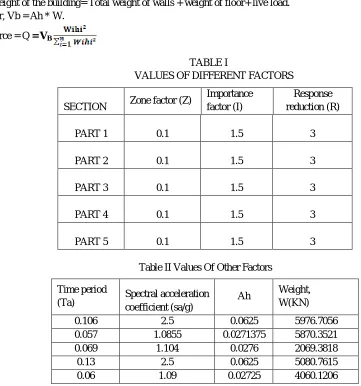
1) Seismic weight of the building= Total weight of walls + weight of floor+ live load.
2) Base Shear, Vb = Ah * W.
3) Lateral Force = Q = VB
TABLE I
VALUES OF DIFFERENT FACTORS
SECTION Zone factor (Z)
Importance factor (I)
Response reduction (R)
PART 1 0.1 1.5 3
PART 2 0.1 1.5 3
PART 3 0.1 1.5 3
PART 4 0.1 1.5 3
[image:5.612.101.462.330.716.2]PART 5 0.1 1.5 3
Table II Values Of Other Factors
Time period
(Ta) Spectral acceleration coefficient (sa/g) Ah
Weight, W(KN)
0.106 2.5 0.0625 5976.7056
0.057 1.0855 0.0271375 5870.3521
0.069 1.104 0.0276 2069.3818
0.13 2.5 0.0625 5080.7615
262
©IJRASET: All Rights are Reserved
TABLE III
[image:6.612.136.479.103.714.2]Calculation Of Base Shear And Lateral Force
Fig.2: Plan of Part 1 of Chaman Mahal
Fig. 3: Plan of Part 2 and 3 of Chaman Mahal SECTION
Base shear,Vb (KN)
Q (KN) at
ground level Q (KN) at
roof level
PART 1 373.5441 123.541 250.0031
PART 2 159.3067 159.306 0
PART 3 57.11494 57.1149 0
PART 4 317.5476 87.8740 229.6735
263
[image:7.612.149.473.74.482.2]©IJRASET: All Rights are Reserved
Fig. 3: Plan of Part 4 of Chaman Mahal
Fig. 5: Plan of Part 5 of Chaman Mahal
V. RESULT
While calculating all the parameters like dead load in both directions i.e.; x & y, columns, stairs, beams etc., the following results are obtained:
-1) Dead load in x direction: - 10363.73 KN.
2) Dead load in y direction: - 7984.016 KN.
3) Dead load of columns: - 253.44 KN.
4) Dead load of stairs: - 203.05 KN.
5) Dead load of Slab in KN
PART 1 465.70272
FLOOR 2 84.150144 PART 2 725.2256 PART 3 269.712 PART 4 378.435904
FLOOR 2 84.150144
264
©IJRASET: All Rights are Reserved
6) Dead load of Beam in KN
PART 1 17.0681 FLOOR 2(1) 3.5586 PART 2 37.048 PART 3 9.885 PART 4 13.8744 FLOOR 2(4) 3.5586 PART 5 14.6879
7) Seismic weight of the building in KN
Then by Using Equivalent Static Analysis method, Base shear (Vb) and Lateral Force (Q) is calculated and finally the calculations proved that lateral force is equally distributed between ground level and floor level and is equivalent to base shear in each part of the building. Thus, the building is safe by Equivalent Static Analysis Method.
VI.CONCLUSIONS
Technology is accessible to considerably improve the earthquake associated disasters. This is confirmed by nominal destruction usually without any loss of life when moderate to severe earthquake strikes developed countries, however even a moderate earthquake causes enormous destruction in developing countries as has been perceived in recent earthquakes. The cause being that quake resistant methods are rigorously followed in these countries where as such recommendations are despondently violated in developing countries.
The supervision system is well-organized and operative in developed countries, and it is not similar in developing countries – so the government should ensure the implementation of earthquake resistant design guiding principles.
Thus, it is here that civil engineers in general and structural engineers in particular have a great role to play in modifying the anguishes, affected by earthquake related destructions. Hence different inferences based on the research are summarized below: -
1) The fact that there are numerous historic structures and a few specialists on this field it is very significant to make condition survey based on visual inspection as a prior stage of safety evaluation method.
2) Masonry structures belong to the most vulnerable class of structures which have experienced substantial destruction or even complete demolition in earthquakes. Non-linear seismic analysis is beneficial for evaluating inelastic strength and deformation of the building.
3) Grade of mortar must be according to codes listed for diverse earthquake zones.
4) Horizontal bands must be provided at plinth, lintel and roof levels as per code.
5) The equivalent frame method which is to be developed for capably simulating the service and ultimate response of structural
system of masonry load bearing wall. The non-linear response is noted by the use of biaxial equations. This process supports the prediction of whole response of the masonry constructions and their failure circumstances.
6) Masonry unveils different directional properties due to the mortar joints, which act as planes of weakness, resulting in brick masonry structures viewing complex and non-linear mechanical behaviour.
PART 1 5976.70
PART 2 5870.35
PART 3 2069.38
PART 4 5080.76
265
©IJRASET: All Rights are Reserved
VII. FUTURESCOPE
Some requirements for investigation in the future, based on this study can be enumerated as follows:
A. A boundless deal of work has been conceded on destruction analysis of masonry structures with unvarying geometry after any
danger. It is very significant to make protection valuation of historic monumental constructions afore any danger.
B. The fact that the historic monumental structure stock is vast and professionals in this arena are rare obviously it is essential to develop phase by phase techniques for protection estimation of these constructions. As a primary step of thorough works and susceptibility estimation it is essential to predominant first step simplified techniques for prioritizing needs.
C. Documentation and observing of historic monumental constructions is the significant necessity in the field of preservation and safety of cultural heritage. Progress of the national data base system for historic monumental constructions is the vital need so as to list and observe all structures. And to assimilate this information in the risk supervision plan of the cultural heritage in national level.
D. Due to the fact that the large part of traditional heritage contains monumental masonry buildings improvement of "The code for Monumental Masonry Structures" will make a substantial contribution to the field of preservation and safety of cultural heritage.
REFERENCES
[1] Meltem Vatan, “Condition Survey of Historic Buildings by Visual Inspection - Case Study: Murat Pasha Mosque”, International Journal of Electronics, Mechanical and Mechatronics Engineering Vol.2 Num.1 Pp. (147-156).
[2] Neethu Gopal, et al. (2017), Behavior of Masonry Buildings Under Seismic Action International Research Journal of Engineering and Technology (IRJET), e-ISSN: 2395 -0056, Volume: 04 Issue: 04, p-e-ISSN: 2395-0072.
[3] Sourabh Bhargava, et al. (2017), A Study on the Earthquake Resistant Low Cost Construction Techniques, International Journal for Research in Applied Science & Engineering Technology (IJRASET), Volume 5 Issue IV, April 2017 IC Value: 45.98 ISSN: 2321-9653.
[4] Kamran, Shakeel Ahmad et al. (2016), Seismic Performance of a heritage school building,11th International symposium on Plasticity and impact mechanics, implast.
[5] Mahmud Sami Donduren (2016), Calculation of Loads and Stresses Acting on Masonry Walls, International Journal of Applied Mathematics, Electronics and Computers, ISSN: 2147-82282147.
[6] Zeljka Radovanovic, et al. (2015) The Mechanical Properties of Masonry Walls-Analysis of the Test Results, Procedia Engineering 117 (2015) 865873. [7] Narayanan S P, Sirajuddin M (2013) Properties of Brick Masonry for FE modeling, American Journal of Engineering Research (AJER) e-ISSN: 2320-0847
p-ISSN: 2320-0936 Volume-1 pp-06-11
[8] Mohammad Adil Dar, et al. (2013), A Study on Earthquake Resistant Construction Techniques American Journal of Engineering Research (AJER) e-ISSN: 2320-0847 p-ISSN: 2320-0936 Volume-02, Issue-12, pp-258-264.
[9] Michele Betti and Luciano Galano (2012), Seismic Analysis of Historic Masonry Buildings: The Vicarious Palace in Pescia (Italy) Buildings 2012, 2, 63-82; doi:10.3390/buildings2020063.
[10] J.Snoj, M.Osterreicher and M.Dolsek (2012), Experimentally supported modeling of an existing masonry building by measuring ambient and forced vibrations, Proceeding of 15th World Conference of Earthquake Engineering,LISBOA2012.
[11] Nataliya Y. Vorontsova (2012), Strengthening of Historical Monuments in Seismic Regions 15 WCEE, LISBOA 2012.
[12] Pere Roca et al. (2005), Strength Capacity of Masonry Wall Structures by the Equivalent Frame Method, Journal of Structural Engineering, Vol. 131, pp 1601-1610.
[13] K S Jagadish et al. (2003), Behavior of masonry structures during the Bhuj earthquake of January 2001, Proc. Indian Acad. Sci. (Earth Planet. Sci.), 112, No. 3, September 2003, pp. 431440.
[14] Durgesh C. Rai (2000), Future trends in earthquake-resistant design of structures, SEISMOLOGY 2000.