A Tentative Study on Two- Way Bubble Deck Slab
and Comparison between Bubble-Deck and
Conventional Slab
Akhand Pratap Singh1, Anish Krishnan2, Brijendra Pratap3 1, 3
Department of Civil Engineering, Rama University, Kanpur, India.
2
Department of Civil Engineering, SRGI, Jhansi, India
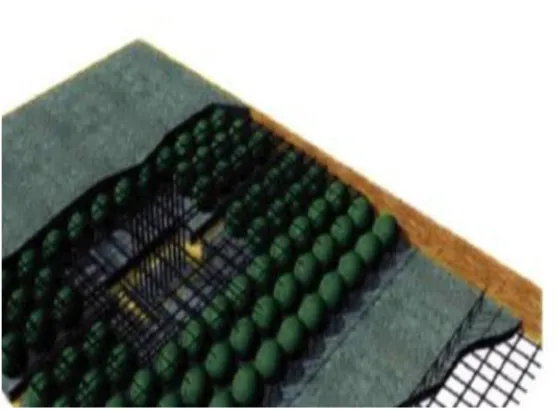
Abstract: Bubble deck is new concept through which we designed slab with the use of reinforcement mesh and (HDPE )High-density polyethylene hollow balls. It is founded on the unproved grouping technique that is the connection of air and bars (steel). It is a hollow deck in which HDPE ball. The main motive of it to reducing concrete that has no resounding effect. By taking the mesh width & the sphere, a single and augmented concrete construction is obtained, with steady maximum use of both shear and moment zone. The reinforcement network catches, distributes and fixes the spheres at exact position point, while the spheres shape the air volume.it controls the level of reinforcement mesh and also stabilizes the spatial lattice. This paper work aimed on the use of bubble deck in construction. M30 Grade of concrete was used. Two slabs were casted, one with spherical plastic bubbles and the other without bubbles.
Keywords: Structural behavior, Bubble deck slab, Reinforcement mesh, HDPE sphere balls
I. INTRODUCTION
[image:1.612.157.436.508.713.2]In any type of structure, slabs comprise the most imperative part, used for mooring point of view and used to stretch the loading to additional structure member. In general slabs are two classes. One is one-slab and second is two-way slab. In our project main effect of the plastic sphere is to reduce the dead load of the deck by1/3 in evaluate to solid slab having similar thickness without affecting its deflection behavior & bending strength. It locks spheres between the top and bottom reinforced meshes, thereby it formed a natural cell structure, acts like a solid slab. Bubble-Deck is a two-way spanning hollow deck in which we used recycled plastic bubbles for the purpose of eliminate non-structural concrete, and thereby it reducing the structural dead weight, void formers in the middle of a flat slab eliminates 24.6 % of a slabs self-weight.
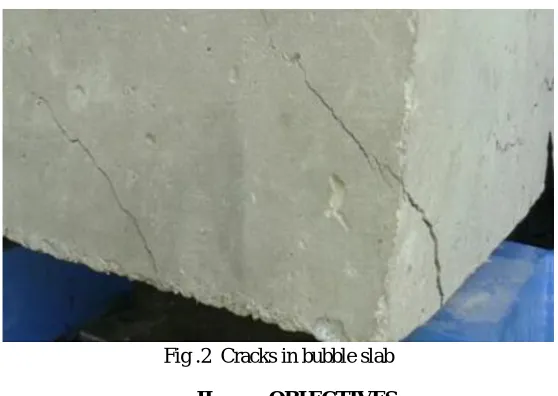
Fig .2 Cracks in bubble slab
II. OBJECTIVES
A. To calculate the loadbearing capacity of bubble-deck slab and conventional slab.
B. To evaluate the quantity of concrete which saved as a result of spherical balls.
III. LITERATURE REVIEW
M. Surendar, et al. (2016), Numerical and tentative Study on Bubble-Deck Slabs with the lone attainment to sinking the concrete in the center of the slab by using recycled plastic balls. Plastic balls were used to trade the in-effective concrete in the focus on the slab, thus dropping the dead load and growing the capacity of the floors and the performance of the bubble deck slab in moderate and severe seismic susceptibility areas. Finite element analysis (FEA) was carried out by using the FEA software ANSYS to study structural nature on the slab.
Diyala, (2013).Calculated the values of inflexibility of the Bubble-Deck slabs in consideration with solid slabs. The (BD2-bu80 and BD3- bu100) plastic spheres in RCC slabs of size (B/H=0.52, 0.82 and 0.63), were exposed to a flexure test in which they shows some one-way flexural cracks and lower inflexibility showing their flexural capability. The output were compared with solid slabs (without plastic spheres), (98%, 95% and 90%) apply the vital load of a similar reference solid slab but only (76%, 75% and 70%) of the concrete volume due to plastic balls, respectively. Results shows the deflections under service load of Bubble-Deck to be higher than those of an corresponding solid conventional slab. The concrete compressive strain in Bubble-Deck specimen is greater than that of an alike conventional solid specimen.
C Marais et.al. (2010) presented the fiscal value for internal spherical void formers (SVF) slabs in South Africa and compared with the direct creation cost to those of two other large span concrete slab systems. They determined that the stiffness of SVF slab should be reduced by roughly 10% related to that of a conventional solid slab with same thickness.
Bubble-Deck-UK (2008) studied usual Bubble-Deck technology using hollow spheres made of reused industrial plastic to formed voids while introducing strength through arch action. Its result shows a dramatic fall-down in dead load by as much as 52% permitting much longer spans. Therefore, the Bubble-Deck has various advantages as compare to conventional cement concrete slab, such as: reduce total cost, less material use, increase structural efficiency, reduce construction time.
IV. MATERIALS AND METHODOLOGY
A. Cement
1) Ordinary Portland cement 43 grade was used.
2) The test wasdone according to the IS 456-2000 Standard
Aggregates
a) Fine Aggregates
Those fractions from 4.75 mm to 150 microns are termed as fine aggregate.
B. Water
Clean water is used to prepare the mix and curing as per IS 456:2000. Water cement ratio should be limited as in case of normal concrete and it should preferablybe less than 0.45.
Flow chart diagram of methodology
1) Conventional Slab: This is a slab with specifications prepared to study experimentally with cement concrete of grade M30 by approving conventional methods of design which is mentioned on IS 456:2000 & IS 10262:2009.
2) Bubble Deck Slab: This type of slab prepared to study experimentally with normal cement concrete of grade M30 by using hollow plastic balls (HDPE- High density polyethylene).
Constuction of Slab
Comparesion bbetween Slabs
Bubble-Deck Slab Conventional
Slab
V. RESULT AND DISCUSSION Type of slab Load
(kN) Deflection (mm) Weight (kg) Conventional slab
194.5 8.7 321.0
Bubble-Deck Slab
251 9.2 242.0
Comparison of loads between conventional and Bubble-deck slab
Comparison of deflection between conventional slab and Bubble-deck slab
Comparison of weight between the conventional slab and Bubble-Deck slab.
A. Discussion
In the experiment we found that the weight of concrete mas is reduces as volume is reduces. And load carrying capacity increases in case of bubble-deck as compare to conventional slab but not less than the continues bubble-deck slab. In the research there is two
0 100 200 300
Conventional Slab Bubble-Deck slab
Loads In kN
8.4 8.6 8.8 9 9.2 9.4
Conventional Slab Bubble-Deck slab
Deflection in mm
0 50 100 150 200 250 300 350
VI. CONCLUSION
Weight reduction is 24.6 % compared to solid slab. In bubble deck slab volume of concrete is reduced, so that the weight of slab is decrease, comparative to Conventional slab.
REFERENCES
[1] Bhagyashri G. Bhade and S.M Barelikar an experimental study on two waybubbl e deck slab with spherical hollow balls International Journal of Recent Scientific Researc h Vol. 7, Issue, 6, pp. 11621-11626, 2016
[2] Harishma K.R and Reshmi K N A study on Bubble Deck slab, International Journal of Advanced Research Trends in Engineering and Technology (IJARTET) Vol. II, Special Issue X, March 2015.
[3] Subramanian K and Bhuvaneshwari P Finite Element Analysis of Voided Slab with High Density Polypropylene Void Formers International Journal of Chem Tech Research, CODEN (USA): IJCRGG ISSN: 0974-4290, Vol.8, No.2, pp. 746-753, 2015.
[4] AratiShetkar and NageshHanche. (2015). “An experimental study on bubble deck slab system with elliptical balls”. ISSN: 0976-2876
[5] SaifeeBhagat, Dr. K. B. Parikh Comparative Study of Voided Flat Plate Slab and Solid Flat Plate Slab, ISSN 2278 – 0211, Vol. 3 Issue 3, March, 2014. [6] Shaimaa Tariq Sakin Punching Shear in Voided Slab, ISSN 2224-5790, ISSN 2225-0514, Vol.6, No.10, 2014.
[7] Amer M. Ibrahim, Nazar K. Ali, Wissam D. Salman
[8] (June 2013). “Flexural capacities of reinforced concrete two-way bubble deck slabs of plastic spherical voids”, Diyala Journal of Engineering.
[9] SaifeeBhagat and Dr. K. B. Parikh Parametric Study of R.C.C Voided and Solid Flat Plate Slab using SAP 2000, IOSR Journal of Mechanical and Civil Engineering (IOSR-JMCE), e-ISSN: 2278-1684, p- ISSN: 2320-334X, Volume 11, Issue 2 Ver. VI (Mar- Apr. 2014), PP 12-16.