A Class-based Approach to Word
Alignment
Sue J. Ker"
National Tsing Hua University
Jason S. Chang*
National Tsing Hua University
This paper presents an algorithm capable of identifying the translation for each word in a bilingual corpus. Previously proposed methods rely heavily on word-based statistics. Under a word-based approach, frequent words with a consistent translation can be aligned at a high rate of precision. However, words that are less frequent or exhibit diverse translations generally do not have sta- tistically significant evidence for confident alignment, thereby leading to incomplete or incorrect alignments. The algorithm proposed herein attempts to broaden coverage by exploiting lexico- graphic resources. To this end, we draw on the two classification systems of words in Longman Lexicon of Contemporary English (LLOCE) and Tongyici Cilin (Synonym Forest, CILIN). Au- tomatically acquired class-based alignment rules are used to compensate for what is lacking in a bilingual dictionary such as the English-Chinese version of the Longman Dictionary of Contem- porary English (LecDOCE). In addition, this alignment method is implemented using LecDOCE examples and their translations for training and testing, while further examples from a technical manual in both English and Chinese are used for an open test. Quantitative results of the closed and open tests are also summarized.
1. Introduction
Brown, Cocke, Della Pietra, Della Pietra, Jelinek, Laffert~ Mercer, and Roosin (1990) advocate a statistical approach to machine translation (MT) and initiate much of the recent interest in bilingual corpora. Statistical machine translation (SMT) can be un- derstood as a word-by-word model consisting of two submodels: a language model for generating a source text segment S and a translation model for mapping S to its translation T. They recommend using a bilingual corpus to train the parameters of translation probability, Pr(S I T) in the translation model. For MT and other pur- poses, many methods have been proposed for sentence alignment of the Hansards, an English-French corpus of Canadian parliamentary debates (Brown, Lai, and Mer- cer 1991; Gale and Church 1991a; Sirnard, Foster, and Isabelle 1992; Chen 1993; Gale and Church 1993), and for other language pairs, including English-German, English- Chinese, and English-Japanese (Kay and ROscheisen 1993; Church, Dagan, Gale, Fung, Helfman, and Satish 1993; Fung and McKeown 1994; Wu 1994). Alignment at other levels of resolution is obviously useful. A section, paragraph, sentence, phrase, col- location, or word can be aligned to its translation (Kupiec 1993; Smadja, McKeown, and Hatzivassiloglou 1996). Other logical approaches involve aligning parse trees of a sentence and its translation (Matsumoto, Ishimoto, and Utsuro 1993; Meyers, Yan- garber, and Grishman 1996), or simultaneously generating parse trees and alignment arrangements (Wu 1995).
Computational Linguistics Volume 23, Number 2
In addition to machine translation, m a n y applications for aligned corpora have been suggested, including machine-aided translation (Shemtov 1993), translation as- sessment and critiquing tools (Isabelle 1992; des Tombe and Armstrong-Warwick 1993; Macklovitch 1994), text generation (Smadja 1992; Smadja, McKeown, and Hatzivas- siloglou 1996), bilingual lexicography (Klavans and Tzoukermann 1990; Church and Gale 1991; Daille, Gaussier, and Lange 1994; Kupiec 1993; van der Eijk 1993; Li 1994; Wu and Xia 1994), and word-sense disambiguation (Gale, Church, and Yarowsky 1992; Chang, Chen, Sheng, and Ker 1996). For these applications, we must go one step fur- ther from sentence alignment and identify alignment at the word level. In the process of word alignment, the translation of each source word is identified. This study con- centrates primarily on identifying alignment at the word level for a given sentence and its translation.
In the context of SMT, Brown et al. (1993) present a series of five models of Pr(S I T) for word alignment. Model 1 assumes that Pr(S ] T) depends only on lexical transla-
tion probability (LTP) t(s I t), that is, the probability that the ith word s in S translates
into the jth word t in T. The pair of words (s, t), or more precisely (s, t,
i,j)
since there could be more than one instance of s or t, is called a connection. Model 2 enhances Model I by considering the dependence of Pr(S I T) on the distortion probability (DP) d(i I J, l, m) where I and m are the respective lengths of S and T measured in number of words. Brown et al. (1990) propose using an adaptive Expectation and Maximization (EM) algorithm to estimate the parameters for LTP and DP from a bilingual corpus. The EM algorithm iterates between two phases to estimate LTP and DP until both functions converge. In the expectation phase, the parameters t(s I t) andd(i I J, l, m) in
the SMT model for all possible values of s, t, i, j, I, and m are estimated from the sample of an aligned bilingual corpus. In the maximization phase, each sentence-translation pair in the corpus is aligned by maximizing the translation probability, Pr(S I T). They examine the feasibility of aligning the English-French Hansards corpus using the SMT model, on both the sentence level and the word level. The SMT model is then tested for the task of machine translation. The model produces 35 acceptable translations for 73 sentences. However, to our knowledge, the degree of success of word alignment has not yet been explored.Dagan, Church, and Gale (1993) observe that reliably distinguishing sentence boundaries for a noisy bilingual text scanned by an OCR device is quite difficult. In such a circumstance, they recommend aligning words directly without the preprocess- ing phase of sentence alignment. Under that proposal, a rough character-by-character alignment is first performed. Based on the character alignment, words are subsequently aligned based on a modified version of Brown et al.'s Model 2. The authors report that 60.5% of 65,000 words in a noisy document are correctly aligned. For 84% of the words, the offset from correct alignment is at most 3.
Gale and Church (1991b) present an alternative algorithm that does not estimate and store probabilities for all word pairs to reduce m e m o r y requirement and to ensure robustness of probability estimation. Instead, for each source word s, only a handful of target words strongly associated with s are found and stored. Such a task is achieved by applying a X2-1ike statistic. They report that the method produces highly precise (95%) alignment for 61% of the words in the 800 sentences tested.
Sue J. Ker and Jason S. Chang Word Alignment
This paper presents a word alignment algorithm based on classification in existing thesauri. The proposed algorithm, called ClassAlign, relies on an automatic procedure to acquire class-based alignment rules; it does not employ word-by-word translation probabilities, nor does it use an iterative EM algorithm for estimating such proba- bilities. Experimental results indicate that classification based on existing thesauri is highly effective in broadening coverage while maintaining a high precision rate.
The rest of this paper is organized as follows: In Section 2 we briefly discuss the nature of text and translation that justifies a class-based approach. A set of three al- gorithms leading to class-based alignment are outlined in Section 3. The algorithms' effectiveness is demonstrated through examples and their translations in the LecDOCE (Longman Group 1992), a bilingual version of the Longman Dictionary of Contempo- rary English (LDOCE, Proctor 1988), as well as sentences from bilingual texts in the LightShip User's Guide (Pilot Software Inc. 1993; Galaxy Software Services 1994). The experiments we undertook to assess the performance of these algorithms are the topic of Section 4. Quantitative experimental results are also summarized. In Section 5, we analyze the experimental results and consider ways in which the proposed algorithms might be extended and improved. Concluding remarks are made in Section 6.
2. Text a n d Translation as a C l a s s - t o - C l a s s M a p p i n g
The discussion in Section 1 indicates the limitations of statistical methods. As an alternative, we examine the feasibility of using an everyday bilingual dictionary in machine-readable form for word alignment. With tens of thousands of headword-and- translation pairs that can be used to propose high-precision connections, a bilingual machine-readable dictionary (MRD) surprisingly leads to even lower coverage than a statistically-derived lexicon. Below, observations are made to account for the reason w h y a substantial portion of translations deviate from what is listed in the bilingual MRD or what is statistically probable. Such deviations inhibit word-based methods ' from achieving broad coverage. We contend that a word's translational deviation is mostly bounded within the relevant semantic classes, thus justifying a class-based approach to word alignment.
2.1 D i v e r s e I n - C o n t e x t Translations
Given that the translations for a headword (dictionary translations, DTs for short) can be extracted from a bilingual MRD such as the LecDOCE, a word in S can be aligned at a high precision rate with its DTs found in T. Headword-and-translation pairs are a reliable knowledge source for word alignment. However, they cover only a small part of the connections in an average sentence and its translation. Our experiments reveal that the translations of a word in context (in-context translations, ICTs for short) are frequently more diversified than the offerings in an everyday bilingual dictionary. More specifically, less than 30% of the English words in the context of LecDOCE examples translate into one of the relevant DTs in the same dictionary.
Computational Linguistics Volume 23, Number 2
the two languages, (3) collocation pattern, and (4) frequent use of interchangeable syn- onymous translation not covered in the dictionary. These factors are the reasons w h y m a n y translations are statistically unlikely, thereby leading to a low coverage rate for word-based methods.
Sense Gaps. Dictionary and statistically derived translations might not cover the word
sense appropriate to a given word in context. This is particularly true w h e n using an everyday dictionary for aligning bilingual technical manuals. For instance, the Lec- DOCE lists four senses and relevant translations for the word click, including (1) ~ ~ ~ { ~ 'to make a slight and short sound', ( 2 ) / ~ 'to succeed', (3) { , ~ ~ 'to fall into place', (4) ~ , K ~ , ~ 'to be a quick success, esp. with members of the opposite sex', none of which is the right sense for ~ 'to press', the translation of
click in the context of (El):
(El) Click anywhere else on the screen background or press ESC. (C1) ~ i ~ l ~ f l J ~ : l ~ i ' ~ _ _ - - F ] ~ ESCo
Mismatch in Sense Specificity. Dictionary treatment of word senses in the source lan-
guage might not correspond to the level of specificity for the relevant concepts in the target language. For instance, the LecDOCE differentiates two word senses for the word news by the means in which it is reported: whether it is via electronic (radio or television) or non-electronic (newspaper) media. In Chinese, the relevant concept is also differentiated according to how it is reported; however, the difference is between mass media (translated as ~ r ~ ) and personal communication (translated as ~,~,). The following examples (E2, C2) and (E3, C3) demonstrate this particular instance of mismatch in sense specificity.
(E2) to listen to the 7 o'clock news broadcast. (C2) ~ t ~ t i ~ ~ o
(E3) Our latest news of our son was a letter a month ago. (C3) ~ J ~-~ ~ ~ i i ~ l . ~ ~ f~I-- ~ ~J ~/0~J ~ ~ l ~ o
Collocation Pattern. The collocation pattern often forces the choice of an ICT quite dif-
ferent from the DTs. For instance, the LecDOCE lists ~ r ~ 'news' and ~ r ~ 'news reportage' as the translations for news. However, the translation for news modified by bad is usually ~j0~, 'message'. Similarly, lady modified by old almost surely trans- lates into 5 ~ 'wife' rather than the DTs, ~ 'lady' or ~;~f'~ 'woman' given in the LecDOCE. The following examples provide further details.
(E4) Nothing but bad news in the newspaper today. (C4) @ 3 ~ . ~ _ L ~ ~ 0g, o
(C4') ~ @ ~ W , ~ l - . ~ ~ r ~ o
Sue J. Ker and Jason S. Chang Word Alignment
(c5)
(cs')
(c5")
(E6) (c6)
(C6')
He abdicated all responsibility for the care of the child. ¢ ~ ~ ' ~ -~,J~ Fx ~ - t . B ~ o
Interchangeable Synonymous Translation. Disparity might arise simply because an in- terchangeable synonym of a DT is used. For instance, for the following LecDOCE examples, the synonyms ~ | , ~ g , and ,~oF,~ are present in the translations, instead of the respective DTs, ~ | , ~ J , and ,~,~. If these ICTs in (C7, C8, C9) are replaced by the DTs, the subsequent translations (C7 ~, C8', C9') remain correct.
(E7) I caught a fish yesterday.
(c7') ~ f J ~ ] - ~ . o
(E8) I have never met so nice a girl. (C8) ~ . ~ ~ _ ~ J ~ x - T " o
(c8') ~ ~ J ~ ~ o
(E9) He abandoned himself to grief. (C9) f l ~ m , ~ ~ o
(C9') { t ~ J j , ~ o
A statistically-derived lexicon generally fares better than MRDs in covering such syn- onymous translations. However, this is limited to synonyms that appear as an alter- native translation frequently and consistently in a bilingual corpus.
Computational Linguistics Volume 23, Number 2
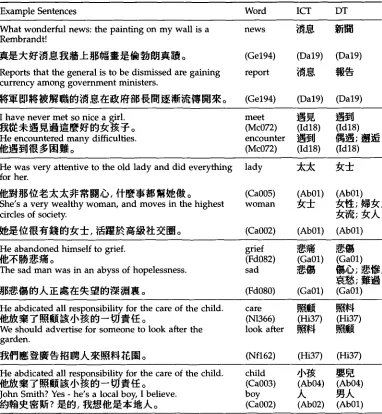
Table 1
Disparity between ICT and DT is bounded within thesaurus categories.
Example Sentences Word ICT DT
What wonderful news: the painting on my wall is a news ~]~0~, ~ ' ~ Rembrandt!
~ _ ~ ~j~ ~ ,~. ~J~J~_L ~ ] ~ ~ ;l~ ~ ~J ~ ~ ~ o (Gel94) (Dal9) (Dal9)
Reports that the general is to be dismissed are gaining report ~]~°~, ~ currency among government ministers.
~ i ~J] ~ ~ J~ I~ ~J ~]~ o~. ~ ~ ~J~ ~ - ~ ~ j~ ~Jl ~ ~ ~ ~ o (Gel94) (Dal9) (Da19)
I have never met so nice a girl.
~
~
_
~
~
o
He encountered many difficulties.
meet ~ ~ ]
(Mc072) (Idl8) (Id18) encounter ~ | ~ ; i ~
(Mc072) (Id18) (Id18)
He was very attentive to the old lady and did everything lady ~k~5~ for her.
~d~J ~]~ ~ ~ ~ ~ ~ ~ ~1~,/'.~, ~ 3 u ~ j $ ~ ~ t " ~ o (Ca005) (Ab01) She's a very wealthy woman, and moves in the highest woman 2 ~ circles of society.
~ _ ~ ~[~;J~ ~ J ~ , ~ ] ~ , ~ , ~ ± ~ . ~ ] o (Ca002) (Ab01) ~ ±
(Ab01) ~t~; ~ ;
(Ab01)
He abandoned himself to grief.
~ $ ~ L ~ . ~ o
The sad man was in an abyss of hopelessness.
grief , ~ ,~, {~
(Fd082) (Ga01) (Ga01) sad ,~{~ ~,/'.,; , ~ ;
(Fd080) (Ga01) (Ga01)
He abdicated all responsibility for the care of the child, care ~ 1 ~ ~ - [ {l~]J~ ~ IF ~(~ ~ -~ tJ' ~ ~J - - fg-J ~/r~ o (N1366) (Hi37) (Hi37) We should advertise for someone to look after the look after ,~$a~ ~ ¢ ~ garden.
~ J ~ ~,, ;~F~ ~ ~ ~ I~.K. ~ ~ ~5~ ~. [~ o (Nf162) (Hi37) (Hi37)
He abdicated all responsibility for the care of the child, child t]~]~ ~ ' ~ ~t~]j~ ~ ~" ~ ~ -~ sJ, ~ ~J - - fd-J ~ ~J~ o (Ca003) (Ab04) (Ab04)
John Smith? Yes - he's a local boy, I believe, boy ,/k ~J,K,
,,~tJ~]~I~r~J~? ~[~J, ~J~,~,~d~:~:i~.Jk o (CaO02) (Ab02) (Ab01)
that share a c o m m o n m o r p h e m e . For instance, the (ICT, DT) pairs, ( , ~ a n d ,~{~) a n d ( ~ a n d ~ ) share a c o m m o n m o r p h e m e ,~ ' s a d ' a n d ~ 'female', respectively. Fujii a n d Croft (1993) also p o i n t out a similar t h e s a u r u s effect of M a n d a r i n m o r p h e m e s in Japanese i n f o r m a t i o n retrieval (IR)J
Dictionary-based Alignment. The
a b o v e observations suggest that a DT-based algorithm, c o u p l e d w i t h m o r p h e m e - l e v e l partial matching, can be a d o p t e d to obtain a substantial [image:6.468.48.430.82.496.2]Sue J. Ker and Jason S. Chang Word Alignment
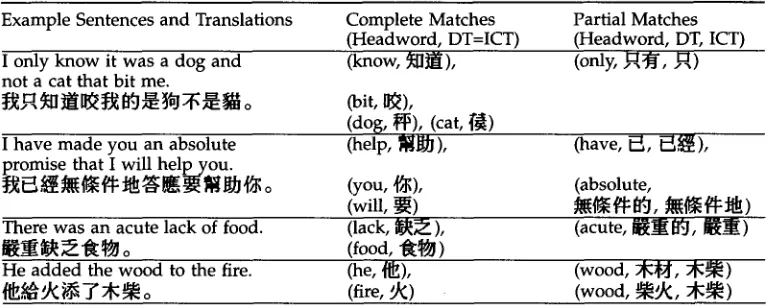
Table 2
Complete and partial matches against dictionary translations. Example Sentences and Translations
I only know it was a dog and not a cat that bit me.
I have made you an absolute promise that I will help you.
There was an acute lack of food.
~ _ ~
oHe added the wood to the fire.
Complete Matches (Headword, DT=ICT)
(know, ~1~/),
(bit, []~),
(dog, ~ ) , (cat, ~ ) (help, ~Jl~J ),
(you, ~ ) , (will, ~ )
(lack, ~ ),
(food, ~J.~) (he, fl~), (fire, ~ )
Partial Matches (Headword, DT, ICT) (only, ~ ' , ~ )
(have, ~ , ~..~), (absolute,
~
,
~ : ~ )
(acute, ~ ~ , ~ )
(wood, ~:~, : ~ )
(wood, ~ , ~ )
number of high-precision connections. Experimental results indicate that a DT-based method connects over 40% of words in LecDOCE examples with their ICTs using this rudimentary method. Table 2 presents some examples from the experiments, indicating the connections that are attributed to a complete or partial match using headword-and- DT pairs extracted from the LecDOCE. For instance, partial match enables the method to pair up
only
and F~ according to its DT J ~ ' . These connections can be subsequ6ntly used as the basis for generalizing to a class-based alignment rule in the form of (X, Y), which stipulate the connection between an X-class word and a Y-class word.2.2 Class-based Word Alignment
To ensure broad coverage, the class-based approach seems to be a promising alter- native to word-based methods. Classes can be formed from words in more than one way. Automatic statistical methods for derived classes (Brown, Della Pietra, deSouza, Lai, and Mercer 1992) are not appropriate, since they also suffer low coverage due to data sparseness. Classes formed from morphologically related words are easy to de- rive and apply. Morphological classes can be formed, either from words that start with the same five-character prefix as in Gale and Church (1991b), or rigorous analysis as suggested in Brown, Della Pietra, Della Pietra, Lafferty, and Mercer (1992). Although easily applicable, morphological classes are not particularly effective in broadening coverage of word alignment. Chang and Chen (1994) also examine the feasibility of using part-of-speech classes. A potential alternative involves adopting categories avail- able in machine-readable lexicographic resources such as Roget's thesaurus (Chapman 1977) or hand-crafted computer lexicons (Miller, Beckwith, Fellbaum, Gross, and Miller 1990; McRoy 1992).
3. Algorithms Leading to Class-based Word Alignment
[image:7.468.37.427.85.238.2]Computational Linguistics Volume 23, Number 2
3.1 Dictionary-based Word Alignment
This section describes a rudimentary word-alignment algorithm, DictAlign, based on the DTs from a bilingual MRD such as the LecDOCE. Consider a text and translation pair (S, T), a word s in S, and its ICT, t in T. Let DTs denote the set of translations listed in the LecDOCE for the headword s. Recall that if for a word t in T, there is a dt in DTs such that t matches dt completely or partially, then, t is likely to be the ICT of s. Taking advantage of this phenomenon, DictAlign computes the set WT = {t ] t is a word in T} and calculates the similarity between each t and the DTs relevant to S. A similarity measure based on the unweighted Dice coefficient (Dice 1945) can be given as follows:
2 x Id n tl (1)
Sim(d, t) - id [ + it I
where d, t
Idl
Itl
la n tl
= Mandarin morpheme strings, = the number of the morphemes in d, = the number of the morphemes in t,
= the number of the morphemes in the intersection of d and t.
Based on this similarity measure, the likelihood of a connection can be associated with the following formulation that links the likelihood of a connection to similarity with a DT:
DTSim(s, t) = max Sire(d, t) (2)
dEDTs
For instance, consider the following sentence and its Mandarin translation, focusing on the w o r d encounter:
S = He encountered many difficulties.
T =
We will have the following:
Ws = {he, encounter, many, difficulty}
wT = 2 , iil, Iil , }
DTencounter = { ~ , ~11~, ~ }.
Therefore, the connections relevant to encounter with nonzero DTSim values based on unweighted Dice coefficient are as follows:
DTSim( encounter, ~ )
DTSim( encounter, ~ ] )
= m a x { S i m ( ~ , ~ ) , S i m ( i t l l ~ , ~ ) , S i m ( ~ t l ~ , ~ ) } 2 x l 0 2 x l ~
= max 1 + 2 , 1 _ T _ 2 , i _ T _ ~ j = 0 . 6 7
= m a x { S i m ( ~ , ~ t ] ),Sim(i~t~, ~ f ] ) , S i m ( ~ , ~ ! ] )} { 2 x l 0 2 x 1 ~
= max 2 + 2 ' 2 + 2 ' 2 + 2 j = 0 " 5
Sue J. Ker and Jason S. Chang Word Alignment
experiments indicate that b y weighting morphemes, ICT ambiguity can be resolved more successfull3a Assuming that such weights can be obtained in a manner similar to what is done in IR when assigning weights to index terms, the weighted Dice coefficient can be used b y substituting weights for counts in equation (1) to arrive at the following:
2 x [d A t[ (3)
Sim(d,t) - jd l+ it]
where d, t
lal
itl
lantl
= the Mandarin morpheme strings, = total weights for the morphemes in d, = total weights for the morphemes in t,
= total weights for the morphemes in the intersection of d and t.
The above descriptions are summarized as the DictAlign Algorithm:
Algorithm 1
(DictAlign)
Align each word s in S with the ICT t in T based on DTs.Step 1: Remove all stop words in S to obtain a list of keywords, Ws. Step 2: Lookup all possible words WT of T in a dictionary.
Step 3: For each s in Ws, look up the root of s in a bilingual dictionary to obtain DTs. Step 4: For all d E DTs and all t E WT, calculate Sire(d, t) according to equation (3). Step 5: For each (s, t) E Ws x WT, calculate DTSim(s, t) according to equation (2). Step 6: For each word s, produce a connection (s, t), if DTSim(s, t) is maximized over
t E WT and DTSim(s, t) > hi where hi is a preset threshold. Step 7: Compile the list of Connections and denote the list as CONN.
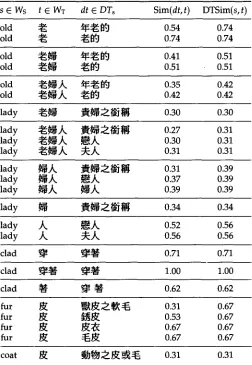
To illustrate how DictAlign works, consider the sentence pair (El0, C10). After the stopwords are removed, we obtain Ws = {old, lady, clad,fur, coat}. The list of words in T is also obtained by consulting a Chinese dictionary. 2 Subsequently, for each s in Ws, we lookup s in the LecDOCE to obtain DTs. Table 3 shows dictionary translations relevant to (El0). Table 4 lists all Ws words along with the relevant DTs, possible translation t, as well as the values of Sim(d, t) and DTSim(s, t). Table 5 displays the result CONN for various values of threshold hi.
(El0) The old lady was clad in a fur coat. (C10) ~.~i~ ~ ~,K. ~J~ ~F ~ ~ o
3.2 Acquisition of Mutually Translatable Class Pairs
ClassAlign is conceived to capture the diversity of translations for broad-coverage alignment. One w a y to do so is via the classification of words in thesauri. More specifically, one can generalize from a connection (s, t) to a class-to-class mapping (X, Y) where X and Y are thesaurus classes containing s and t respectively. However, this simple intuition is complicated by the fact that a word might belong to more than one class, that is, if the classification is based on a thesaurus that allows for word-sense ambiguity. For a word in a particular context, if one considers classes that are not intended for the context, noise can be introduced. For instance, consider the
Computational Linguistics Volume 23, Number 2
Table 3
The DT~ for each word s in INs for example (El0, C10).
Word Root Stopword Dictionary Translations of Words in S
the the yes None (all sense entries have an explanation in brackets; not a translation)
old no l-'-~l~,,~l~J, J~.,~Jl~J, ~J~l~J, ~1~1~I, ~l~i~fftJ, ~l~J, ~ ~ . . . .
~ : t : , ~ , 9~.K, ~ , ~ / ~ i ~ I , ~-.K,
~_, i ' ~ , ~ . . . ~ _ 1 : , ~ . . . ~ M . . . .
~ , t ~ -
_~,~- _ ~ _ ~ , ~ '
~ --. ~,, ~ . . . ~ ,
~ , ~ , ,
..
- ~ , - ~ , , ~ ~ , ~ - ~ . . . .
~ ,
~ ,
~ ,
~ ,
~ ~ ,
~
old
lady lady no
was be yes
clad clad no
in in yes
a a yes
fur fur no
[image:10.468.50.302.290.655.2]coat coat no
Table 4
All connection candidates and DTSim values in (El0, C10).
s E Ws t E WT dt E DTs Sim(dt, t) DTSim(s, t)
old ~ ~ l ~ J 0.54 0.74
old ~ ~l~l 0.74 0.74
old ~ ~EI~ fl~J 0.41 0.51
old ~ ~l~J 0.51 0.51
old ~ . h . ~ I ~ 0.35 0.42
old ~ . ) k ~l~J 0.42 0.42
lady ~ ~ ; ; ~ ~[tl 0.30 0.30
lady ~ , h , ~ j l ~ t t 0.27 0.31
lady ~ . K . ~.K. 0.30 0.31
lady ~ j ~ , ~ j ~ 0.31 0.31
lady ~ J ~ j ~ ~ t t 0.31 0.39
lady ~ , h . ~,j~ 0.37 0.39
lady ~j~, ~,h~ 0.39 0.39
lady ~ ~ J l ~ J 0.34 0.34
lady J~ ~ , / k 0.52 0.56
lady .h. 51~.)k 0.56 0.56
clad ~ ~ j ~ 0.71 0.71
clad ~ I ~ ~ ' ~ 1.00 1.00
clad ~ ~ ~ 0.62 0.62
fur ~ ~ J ~ ~1~ 0.31 0.67
fur ~ ~j~/~ 0.53 0.67
fur /~ ~ 0.67 0.67
fur /~ ~ ! ~ 0.67 0.67
Sue J. Ker and Jason S. Chang Word Alignment
Table 5
The results of running DictAlign on (El0, C10) under various thresholds. Threshold = 0.7
Word s Translation t DTSim(s, t)
old ~ 0.74
clad ~ j ~ 1.00
Threshold = 0.67
Word s Translation t DTSim(s, t)
old ~ 0.74
clad ~ 1.00
fur }J~ 0.67
Threshold = 0.5
Word s Translation t DTSim(s, t)
old ~ 0.74
lady ,K, 0.56
clad ~ j ~ 1.00
fur /~ 0.67
connection (have, ¢Z) found in the context of Example (Ell, Cll). According to the LLOCE, have belongs to the following topical sets: Cb024 (relating to sex), De081 (hav- ing and owning), EaO03 (eating and drinking), Li273 (auxiliary related to time), and Nil59 (making necessary). The LLOCE class EaO03 and CILIN class Fc06 (to eat, chew, suck, and drink) are intended for this context. However, without that information, the following noisy rules might be introduced: (Cb024, Fc06), (De081, Fc06), (Li273, Fc06), (Nf/59, Fc06), along with the signal (EaO03, Fc06).
(Ell) Let's have breakfast early for a change. (Cll) ~ J ~ 3 1 ~ l ~ q k , - ~ - - ~ i l ~ - ~ o
The noise is usually distributed randomly while the signal tends to repeat itself. Nevertheless, connections (s, t) related to some ambiguous words s or t may cause noise to accumulate, leading to erroneous generalization. Therefore, one should try to throw a w a y such noise. Moreover, any signal that gets thrown a w a y by not considering (s, t) is often filled by a connection (s', t) where s' is a synonym of s. For instance, get is many ways ambiguous, as indicated in diversified ICTs in the LecDOCE examples in Table 6. However, each of these ICTs seems to form a connection with a less-ambiguous synonym of get such as receive, reach, and understand in LecDOCE examples. Table 6 provides further details.
As is typical in IR research, highly frequent and ambiguous words (known as stopwords in the IR literature) can be thrown out to reduce such noise. A list of stopwords used in the experiments includes the following:
a, at, be, drive, eye, field, fix, for, from, function, get, go, have, head, idea, in, into, lot, of, on, place, the, to, up, with . . . . 3
Computational Linguistics Volume 23, Number 2
Table 6
Some sentence-translation pairs containing the word get.
Example and Translation Source/Class ICT
I got a letter today, get I ~ l ]
~@ ~ ~ ~J - ~ {~
o (De083, Getting and earning)It is unpleasant to receive anonymous letters. receive I[~[]
(De083, Getting and earning)
We got there at 8 o'clock.
His hunger was not appeased until he reached the hotel.
get ~ ] ~
(MaO05, Arriving and reaching)
reach ~ | ~
(Ma005, Arriving and reaching)
I don't ge___tt you; what do you mean? get ~]1~
(Gb031, Understand and realize)
I understood that it was time to leave. ~ t ~ ~)~ ~ ~ - ~ 3 " o
understand
(Gb031, Understand and realize)
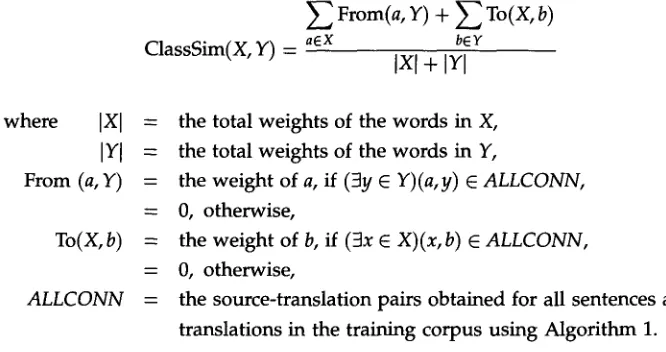
With the difficulties of finding a p p r o p r i a t e classification s y s t e m s a n d suppress- ing noise n o w resolved, the q u e s t i o n remains: H o w can class-to-class m a p p i n g be acquired? Just as w i t h the d e r i v a t i o n of a bilingual lexicon f r o m a corpus, acquisition of such m a p p i n g requires a statistical measure. The Dice coefficient (Dice 1945) is a similarity m e a s u r e that gauges the ratio of the m e m b e r s in one collection b e i n g iden- tical to those of a n o t h e r collection. Smadja, M c K e o w n , a n d H a t z i v a s s i l o g l o u (1996) p r o p o s e to link co-occurrence to the Dice coefficient in their s t u d y of bilingual collo- cations. T h e y observe that, unlike statistical m e a s u r e s related to m u t u a l information, the Dice coefficient is insensitive to s a m p l e size and, thus, m o r e effective for acquiring bilingual collocations f r o m a bilingual corpus. O u r e x p e r i m e n t a l results confirm their observation. U n d e r a f o r m u l a t i o n linking translation to c o n c e p t u a l similarity, the Dice coefficient is a v e r y useful e s t i m a t o r of the class-to-class m a p p i n g .
Therefore, in this w o r k , w e m e a s u r e the likelihood of class-to-class translation m a p p i n g in t e r m s of the ratio of m e m b e r pairs that are connections o b s e r v e d in a bilingual corpus. This ratio can be easily m e a s u r e d u s i n g the Dice coefficient as follows:
From(a, Y) + ~ To(X, b)
ClassSim(X, Y) = acx bEY
IX[ + ]Y] (4)
w h e r e IXI = the total n u m b e r of the w o r d s in X,
IYI = the total n u m b e r of the w o r d s in Y,
From(a,Y) = 1, if (3y E Y)(a,y) E ALLCONN,
= 0, otherwise,
treated as such because of their high frequency in the LDOCE and their involvement in diverse LLOCE topics and CILIN categories. For instance, the LLOCE lists eye under the following topical sets: Ac051
(part of an animal), Aj151 (part of a plant), Bc023 (part of human body), Dg152 (part of a shoe), Hd126
Sue J. Ker and Jason S. Chang Word Alignment
To(X, b) = 1, if (3x E X)(x, b) E ALLCONN, = 0, otherwise,
ALLCONN = the word-translation pairs compiled from the results of running DictAlign on all sentence-translation pairs of a bilingual corpus. This naive estimator works efficiently for classes of compatible sizes. Occasion- ally, for extremely small or large classes, the coefficient does not accurately reflect how likely words in one class are to translate to words in another class. To remedy this problem, we explore the feasibility of weighting the member words. According to our result, weighting eradicates most instances of the problem caused b y uneven classification. The weight assigned to each word should positively correlate to the frequency of the word so it reflects the expected ratio of word-translation pairs. As- suming that such weights can be obtained on the basis of each word's frequency in a bilingual corpus, weights can substitute for counts in equation (4) to arrive at the weighted version of the Dice coefficient shown below:
~ From(a, Y ) + y~To(X,b)
ClassSim(X, Y) = a~x bEY
IXI + IYI (5)
where IXI = the total weights of the words in X, IYI = the total weights of the words in Y,
From (a,Y) = the weight of a, if (3y E Y)(a,y) E ALLCONN, = 0, otherwise,
To(X,b) -- the weight of b, if (3x E X)(x,b) E ALLCONN, = 0, otherwise,
ALLCONN = the source-translation pairs obtained for all sentences and translations in the training corpus using Algorithm 1.
Algorithm 2 summarizes the ClassRule algorithm for acquiring class-based rules. Table 7 presents a random sample of class-based rules acquired from connections found in LecDOCE examples and translations.
Algorithm 2. (ClassRule) Acquisition of pairs of mutually translatable classes (X, Y).
Step 1: Run DictAlign on the sentences in a bilingual corpus to obtain a list of initial connections ALLCONN.
Step 2: For all X E CX and all Y E CY, compute similarity ClassSim(X, Y) based on weighted Dice coefficient given in (5), where CX and CY are some classifica- tion of words in the source and target languages, respectively.
Step 3: Produce an alignment rule (X, Y),
if ClassSirn(X, Y) > hi, a preset threshold,
or if ClassSim(X, Y) is maximized over all X in CX or all Y in CY.
[image:13.468.49.382.248.424.2]C o m p u t a t i o n a l L i n g u i s t i c s V o l u m e 23, N u m b e r 2
L~ 0
~J z
~J
o
<
~ , ._..~_ ~ - ~,~
~ - - ' ~ - . _ , ~ ~ ' ~ . . ~ " - ~ , ~
o ~ : ~ ~ = .
o ~ ~
.~
~ ~
o ~ ~ ~
¢xl L¢~ L¢3 0 3 C ) ~ C'1 " ~ " ~ t'~
Sue J. Ker and Jason S. Chang Word Alignment
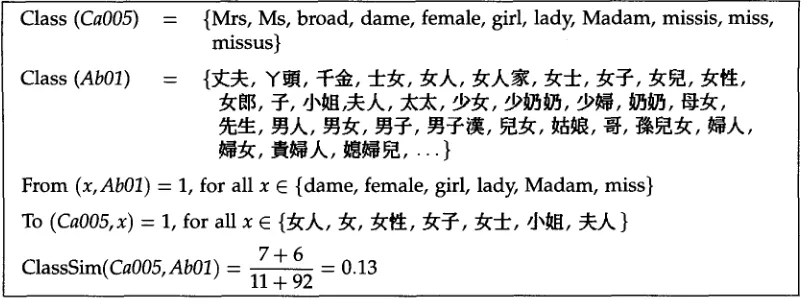
Class (CaO05) = {Mrs, Ms, broad, dame, female, girl, lad~ Madam, missis, miss,
missus}
Class (Ab01) = { ~ , Y i ~ , ~ ' ~ , ~ , ~.h., ~.K.~X, ~ff:, ~ , ~ , ~ ,
~ ,
7 , ,J,~l,9~A, ~ ,
' ~ , ~ , ' ~ , ~ ,
~ : ,
~ ,
~JA, ~ ,
~3~, ~ 1 ~ , ~ ,
~ ,
-~, ~ , ~ A ,
~ ,
~t~X, ~ , . }
From (x, Ab01) = 1, for all x ~ {dame, female, girl, lady, Madam, miss} To (CaO05, x) = 1, for all x ~ {~.h., ~ , ~d~, ~ - ~ , ~ [ ~ , ~J'~[~, 5~.h. }
7 + 6
[image:15.468.33.437.49.201.2]ClassSim(CaOO5,Ab01) - 11 + 9---2 - 0.13
Figure 1
The word classes CaO05 and Ab01 and their conceptual similarity.
The main step in ClassRule is illustrated through the calculation of the ClassSim value between LLOCE topical set CaO05 (kinds of woman) and CILIN category Ab01 (man and woman, ~].h., ~ , ~ ) . For simplicity, the unweighted value of Class- Sim(CaO05, Ab01) is calculated. CaO05 and Ab01 contain 11 and 92 words, respectively. In ALLCONN, six words in CaO05, i.e. dame, female, girl, lady, Madam, and miss, trans- late into words listed under AbO1. In the other direction, seven words listed under Ab01, i.e. !~J~, !~, ! ~ , ~ - ~ , ~ , t J ~ , and 5~.h., are the translations from words listed under CaO05. Thus, the ClassSim value between CaO05 and Ab01 can be valued at (7 + 6)/(11 + 92) = 0.13. Figure 1 presents further details.
3.3 Class-based Word Alignment
The proposed alignment algorithm ClassAlign is based on the following observations: First, dictionary translations can be used to produce high-precision connections. Thus, DictAlign should be employed to produce initial connections whose translations ex- hibit a high similarity to a DT. That is, a relatively high threshold, 0.7 should be used. Second, the class-based rules acquired through the ClassRule Algorithm should cap- ture the diversity of translations to a large extent. According to the observations in Section 2, the rules should stipulate most of the connections left out in the DictAlign step. Nevertheless, conflicting connections do occasionally arise. Such conflicts can be resolved according to an additional consideration of distortion mentioned in Section I
Estimating the Likelihood of a Connection Candidate. The above observations can be stated formally from the perspective of Brown et al.'s (1993) Model 2. As mentioned earlier, the model stipulates that a connection be given a probability value Pr(s, t), the product of lexical translation probability t(s I t) and distortion probability, d(i I j, 1, m). Also according to the model, we give each connection candidate a probabilistic value based on lexical and positional considerations:
Pr(s, t) = t(s, t) x d(i,j) (6)
Computational Linguistics Volume 23, Number 2
For this purpose, we define conceptual similarity between s and t as follows:
ConceptSim(s, t) = max ClassSim(X, Y) (7)
sE X, tE Y
Lexical and conceptual conditions are set up based on DTSim and ConceptSim, while positional conditions are set up based on dislocation, a distortion measure relative to both left and right context.
Estimation of LTP Based on Lexical and Conceptual Conditions. The LTP t(s, t) is defined by the following cases:
Case 1.
Case 2.
Case 3.
Case 4.
Connection (s, t) exhibits high lexical and conceptual similarit)5 i.e., ConceptSim (s, t) ~ hi and DTSim(s, t) > h2.
Connection (s, t) exhibits high conceptual similarity, i.e., ConceptSim (s, t) _> hi and DTSim(s, t) < h2.
Connection (s, t) exhibits high lexical similarity, i.e., ConceptSim (s, t) < hi and DTSim(s, t) _> h2.
Otherwise, ConceptSim (s, t) < hi and DTSim(s, t) < h2.
The connections satisfying each condition are given the same probability value determined by maximal likelihood estimation (MLE). For instance, if there are k true connections in a sample of n candidates (s, t) such that ConceptSim(s, t) > hi and DTSim(s, t) > h2, then all these candidates are given the same MLE value for LTP, i.e., t(s, t) = tl = k/n. Equation (8) sums up the above discussion:
t(s,t) = {
tl if ConceptSim (s, t) _> hi and DtSim(s, t) _> h2, t2 if ConceptSim (s, t) > hi and DtSim(s, t) < h2, t3 if ConceptSim (s, t) < hi and DtSim(s, t) ~ h2, t4 if ConceptSim (s, t) < hi and DtSim(s, t) < h2.
(8)
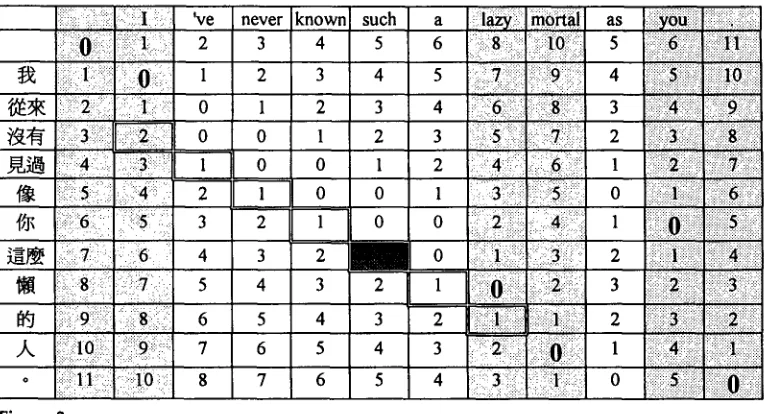
Estimation of Distortion Probability (DP). In a similar fashion, we formulate the distor- tion function by cases related to the monotonicity of translational position with respect to context. Such a formulation is inspired by Gale and Church's (1991b) treatment of distortion. In their study, the authors replace the distortion probability with a proba- bility function defined by different values of slope, a measure of the position of t with respect to the left context of s. This measure is generally quite accurate, leading to a distribution function concentrating at slope 1. Nevertheless, room for improvement still exists, as can be illustrated using the concept of a binary inversion transduction tree (ITT) proposed by Wu (1995). The ITT is a shared parse tree depicting the struc- tural difference between a sentence S and its translation T. Figure 2 presents the ITT of (E12, C12). The horizontal bar denotes that the noun phrase such a lazy mortal and the prepositional phrase as you are inverted w h e n translated into Mandarin. The slope of the first word in such an inverted structure is typically quite large, making the dis- tribution of the slope function slightly fiat. If multiword structural inversion occurs, as it frequently does, then the slope of the first word according to the right context is still very small.
Sue J. Ker and Jason S. Chang Word Alignment
Table 8
Alignment connections for example (El2, C12).
i 0 1 2 3 4 5 6 7 8 9 10 11
s $ I 're never known such a lazy mortal as you
t $ ~J~ ~ [ ~ ~?.~ ~" ~il~ l . ~ ~Jl ~ ,K. ~J/
j 1 2 3 4 7 8 9 10 5 6 ~1
I 've never known such a lazy mortal as you
[image:17.468.34.411.68.310.2]~ ¢ . , ~ ~ i~)~ '~!(~.~) ,~ ~ 4.7,
Figure 2
ITT of the example-translation pair (E12, C12).
For instance, the first w o r d as in the inverted structure as you has a high slope value w i t h respect to its left context such a lazy mortal. However, since the words as a n d you
translate into the fifth a n d sixth w o r d s in (C12), the w o r d as has a slope value of 1 w i t h respect to its right context, you.
We believe that b y considering the translational position relative to b o t h the left a n d right contexts, one obtains a distribution function w i t h a smaller deviation, thereby m a k i n g a tighter estimation possible for d(i,j). To this end, we define dislocation, dis, for the connection (s, t) of the ith a n d j t h words in S a n d T to denote I(J - j ' ) - (i - i')[, where i' is the position of a w o r d s' sharing the m i n i m u m syntactic structure w i t h s, a n d s' translates into t', the j ' t h w o r d in T. Short of syntactic analysis, dis(i,j) can be calculated w i t h respect to a nearby connection in CONN, the initial connections established b y DictAlign. Such treatment closely approximates the dislocation value. In light of this, dislocation can be defined as follows:
dis(i,j) = ( [j - j ' [ if 3(j')(i,j') E CONN,
min([dL[, [dR[) otherwise, (9)
where i = the sequence n u m b e r of s in S,
j = the sequence n u m b e r of t i n T, 4 dL = ( j - - j L ) - - ( i - - i L ) ,
dR = ( j - - j R ) - - ( i - - i R ) , (iL,jL) = argmax(i,,j,)ecoNN<i i',
(&,jR) = argmin(i,,j,)ecoNN>i /',
Computational Linguistics Volume 23, Number 2
::::i.~;z:: :::: .: :.:::I i:..::: 've never known such a [:::::1~:.:::, mb:h~! as ~i:i:,~you~ ::~::~::~:~ ... :.i?:.lii.::: ::i:: 2 3 4 5 6 : :i:::::8::::i::~: ::i::i~:.O:.::!i:i 5 :ii:.i:~:~:::i!~:ili ~:. :~:i~::::~.:~]:~::.i?.i!
w : : : ! : : : : : : : : : : : : : : : : : : : : : : : : : i : : : i . : : : :::::::: : : : : : ii:.::::.::: ::::::::::::::::::::::::::::: ::::::::::::::::::::::::::::::::
~ 0 1 2 3 4 3 ' ::i:~ i:~ :~ i~:~i:::: :::: i:~ i :~i, i: :!:: i z:~:::~! i:: i~::~!~::::ii,
~ :::: :::3!i:::;:::ii :ii~i::;2::i-:: 0 0 1 2 3 j z::::!:~::~:~:~:~i:! :!:i: 2 !i:ilili:]~::::~:!ii::i.i~i.!i::i.~.i~-i~8:.i~:i~:~.ii~: -
: : : . ' : • ! : : . . ~ ' : " . ' : . . :x:.: :::::::::::::::::::::: ::.:. ::::::::::::::::::::::::
5 , 4 3 2 ] 3 ~::::~ iii:: ii~: 2::: i:.i ::.~.::i ' :::::~ii:i:.::.ii::~ !~::~:i !!ii: :'
, . , . :::::::::::::::::::::::::::::::::::::::::::::::::::::::::::::::
0 : : ::: :
: : ' : ' " ' : : : : ": , : : : : ' , : : " " : : • ' : :" ::::: i;"[': :': ::::::::::::::::::::::::::::::::::::::::::::::::::::::::::::::
o :::: i::1:1::::: :::i;I0 i~: 8 7 6 5 4 ~::: 3::::i::: :::::::::::::::::::::: 0 l:~:.~::~)~:: $:~}i~:i:.i i!!.ii:~i:i~iiii~iO::ii.~;i~i~:ii~}:ii
F i g u r e 3
Dislocation values for the example-translation pair (E12, C12). Each connection candidate in (E12, C12) is represented as a cell. The connections in CONN are shown as a bold face 0. Each of these zero dislocation values extends vertically, incrementing by one for each upward or downward move, resulting in a shaded vertical bar of dislocation values. All other
connections take their dislocation values from the minimum diagonal projection of the related cell on the two bounding bars. For instance, the projections of the connection (such, ~ _ ~ ) (shaded in figure) on the left and right bounding bars (/-connections and lazy-connections) are 2 and 1, respectively. Therefore, the dislocation value is 1, the minimum of 2 and 1.
CONN>i = {(k, I) I kth a n d Ith w o r d in (S, T) f o r m a c o n n e c t i o n in CONN, k > i}, CONN = the initial c o n n e c t i o n s e s t a b l i s h e d a c c o r d i n g to DT.
T h e d i s t o r t i o n f u n c t i o n d e f i n e d b y cases c a n n o w b e g i v e n a c c o r d i n g to d i s l o c a t i o n values.
{ dl if dis(i,j) = 0,
d(i,j) = d2 if dis(i,j) 1, (10)
d3 if dis(i,j) 2,
d4 if dis(i,j) > 3.
T h e c o n n e c t i o n c a n d i d a t e s w i t h s m a l l d i s l o c a t i o n v a l u e s t e n d to b e t r u e c o n n e c - tions. For instance, 8 o u t of 15 z e r o - d i s l o c a t i o n c o n n e c t i o n s for (E12, C12) are correct, w h i l e o n l y 1 o u t of 20 c a n d i d a t e s w i t h a d i s l o c a t i o n of 1 is a t r u e c o n n e c t i o n . All c a n d i d a t e s w i t h d i s l o c a t i o n v a l u e s g r e a t e r t h a n 1 are false. F i g u r e 3 p r o v i d e s f u r t h e r details. Again, all c o n n e c t i o n s s a t i s f y i n g a c e r t a i n case in e q u a t i o n (10) are g i v e n the s a m e M L E value. For instance, if t h e r e are k t r u e c o n n e c t i o n s in a s a m p l e of n can- d i d a t e s (i,j) w i t h 0 dislocation, t h e n all of t h e s e c a n d i d a t e s are g i v e n the s a m e M L E v a l u e for DP, i.e., d(i,j) = dl = k/n for all i a n d j s u c h t h a t dis(i,j) = 0.
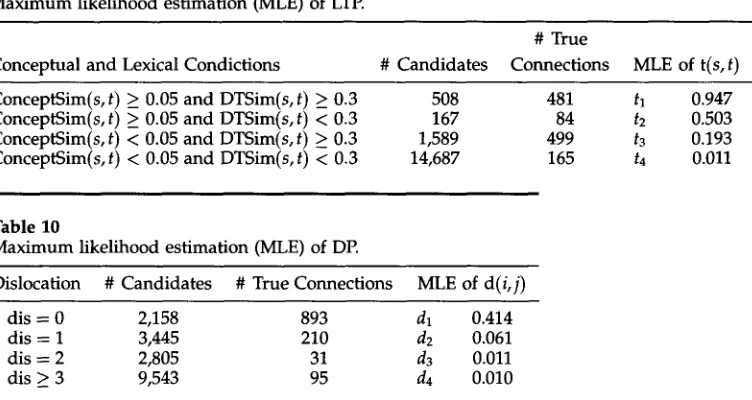
By u s i n g a s m a l l s a m p l e of 200 s e n t e n c e s f r o m t h e L e c D O C E , the LTP a n d D P v a l u e s ti a n d di for 1 < i < 4 can b e e s t i m a t e d b y the m a x i m u m l i k e l i h o o d princi- ple. Tables 9 a n d 10 s u m m a r i z e s t h e M L E probabilistic v a l u e s a s s o c i a t e d w i t h lexical,
[image:18.468.54.436.50.257.2]Sue J. Ker and Jason S. Chang Word Alignment
Table 9
Maximum likelihood estimation (MLE) of LTP.
# True
Conceptual and Lexical Condictions # Candidates Connections MLE of t(s, t)
ConceptSim(s, t) ~ 0.05 and DTSim(s, t) ~ 0.3 508 ConceptSim(s, t) ~ 0.05 and DTSim(s, t) < 0.3 167 ConceptSim(s, t) < 0.05 and DTSim(s, t) > 0.3 1,589 ConceptSim(s, t) < 0.05 and DTSim(s, t) < 0.3 14,687
481 h 0.947
84 t2 0.503
499 t3 0.193
[image:19.468.38.414.75.275.2]165 t4 0.011
Table 10
Maximum likelihood estimation (MLE) of DE
Dislocation # Candidates # True Connections MLE of d(i,j)
dis = 0 2,158 893 dl 0.414
dis = 1 3,445 210 d2 0.061
dis = 2 2,805 31 d3 0.011
dis > 3 9,543 95 d4 0.010
conceptual, a n d positional factors. The above description of w o r d alignment is sum- marized as the
ClassAlign
algorithm.Algorithm 3.
(ClassAlign)
Class-based word alignment for a pair of sentences (S, T). Step 1: Tag each w o r d in S w i t h POS information a n d convert each w o r d to theroot form to obtain the set Ws of w o r d s in S.
Step 2: Initialize the result
ANS
to an e m p t y list. RunDictAlign
on (S, T) to obtain a list of initial connections,CONN.
Step 3: Look u p the dictionary to obtain the set WT of possible w o r d s in T. Step 4: For each connection candidate (s, t) E Ws x WT, c o m p u t e Pr(s, t) according
to equations (6) t h r o u g h (10).
Step 5: A d d to
ANS
the connection(s*,t*)
that maximizes Pr(s,t) over all s, t E Ws x Ww w i t h a value greater t h a n h3. 5 Remove all conflicting candidates involving s* a n dt*
from subsequent consideration. This step repeats itself until the candidates r u n out or every remaining candidate (s, t) is associated w i t h a Pr(s, t) value lower t h a n h 3.Step 6: O u t p u t
ANS
as the final result of w o r d alignment.3.4 An Illustrative Example
In the following, w e demonstrate h o w
ClassAlign
works using example (El0, C10), reproduced below w i t h the sequence n u m b e r of each w o r d denoted b y a subscript number.(El0) The1 old2 lady3 was4 clads in6 a7 fur8 coat9.10
(C10) ~ 1 ~ 2 ~ 3 ~ . ~ 4 ~ 5 ~ 6 ~ 7 o 8
As d e m o n s t r a t e d earlier in Section 3.1,
DictAlign
produces connections(old, ~ )
a n d(clad, ~ )
from (El0, C10) using a threshold value of 0.7 forDTSim.
Table 11 listsComputational Linguistics Volume 23, Number 2
Table 11
Classes listed in LLOCE for Ws in (El0).
Word POS Classes in LLOCE
the det Gh285
old adj Lg200, Lg208, Lh241 lady n Ci157, Ci158, Ci160, Ca005
be v Aa001, De080, Li273, Na001, Nf159 clad adj Dg136
in prep Li272, Mh204
a det Nd098
fur n Hc088
coat n Dg142, Hc093
Table 12
Classes listed in CILIN for WT in (C10).
Word POS Classes in LLOCE
~_ det Ed61
~.~ n Ca31, Ka08 ~ n Cb01, Di15, Di17
~ cl Dn08
n Ab02
adj Eb15, Eb24, Eb29, Eb36, Ec05, Ed51, Ee21 ~ , h . n Ab01
n Ab01, Ah15
),. n Aa01, Dd17, De01, Dn03 ~ j ~ v Fa18
n Bb04, Bc02, Bkl0, Bml0, Bin13 adj Ee09
n Bq03 cl Dn08
the Ws w o r d s a n d their relevant POS a n d topical sets in the LLOCE. Table 12 displays the WT w o r d s a n d their relevant CILIN categories. Table 13 presents the dislocation values for all connection candidates in
Ws x WT. The
cells w i t h a boldface 0 in Table 13 represent the initial connections inCONN
a n d t w o d u m m y connections placed at the beginning a n d e n d of b o t h sentences. Table 14 lists the c o n n e c t i o n candidates w i t h higher Pr(s, t) values.After executing Step 5,
ClassAlign
selects the candidates,(lady,
~ , k . ) , 6(fur, ~.
), b o t h w i t h Pr(s, t) v a l u e of 0.392, in terms at Step 6. These connections are a d d e d to
ANS
a n d the conflicting candidates such as(old, ~ i ~ ) , (old,
~ , ] k ) ,(old, ~ A , ) ,
(lady,
~ ) ,(lady, Jk), (in, gl,), (coat, gF.), (fur, ~l~),
etc. are r e m o v e d . In the s u b s e q u e n t iterations, connections(coat, ~ )
(Pr(s, t) = 0.208),(old, ~ )
(Pr(s, t) = 0.080),(clad, ~ )
(Pr(s, t) = 0.080), a n d
(The,
~ ) 7 (Pr(s, t) = 0.005), are selected.ClassAlign
stops after r u n n i n g o u t of connections w i t h a probabilistic v a l u e greater t h a nh3,
0.005. Table 15 s u m m a r i z e s the connections chosen to f o r m the solution. The success rate is e v a l u a t e d [image:20.468.53.292.65.418.2]Sue J. Ker and Jason S. Chang Word Alignment
Table 13
Dislocation values for connection candidates (s, t) in (El0, C10).
.iiiiiiiiliiiiiiii{iii@i{ii{iiii~i The ii~jiiiiii~iaii{i
::::::::::::::::::::::::::: ::iiii!iiiiiii!i~ilil;iii!iil
r u - t ~ : E " . L ! 3 3
~,~
::::::::::::::::::::::::::::::::::iii@ililliiiiiiii!i!i!ii
:0 bi','~sll
: : : : : r : . . . : . : + : :iiiii!ii:ii:ii!ii!~iiiii 8 i ...
. . . ; . . . . .
~ A !i!iiiiiiii.i~i.{.i.ii!i 2 [iiiiii{iiiiiiiii{iiiiii{iiiii{i{]
~
iiiiiili!{iiiii',iiii'j! ~ iiiiiiii!ii{~:,~','~{
i
I~,!i',~'~ii{i~iiii~!i@ili@':l
4li~@iiii!Ui~ii!{iiiiiiiiiiil
:+:.:+x+:+:
'ii::iii;:ii?:i::i~::iii::iii:: ::::?
o
,iiiiiiiiiiiiii{!iiiUi, 6 ii!!iiiiii~iiii~',~ili'~!;!;
lady was 'iiiii~!~!iiiiil ' in a
3 4 ' ililiiiiiiiiii~iiii!iiiiiiiiii ' 4 5
2 3 ' iiiiiiiiiiiiii~iiiiiiiiiiiii{i ' 3 4
1 2 Liiii@ii~[iiiiiiiiiiiilil ' 2 3
0 1 iiiiiiiiiiiii!i~ii{{{il 1 2
o o ,
, o -iiiiiii! ii!iiiiiiiii • , o
2 1 ' iiiiii!iiji{{iiiii{i!i@ii' 0 1 3 2 "ii!ii{iiiiiiiii~iiii{{i{:i 1 0
4 3 ~ 2 1
:::::::::::::::::::::
fur coat iiiiiiii!iiii!iiiiiiii
6 7 [iliiiiiii!ilili~ili!iii!i!iil
5 6 iiiiii!iiii!iiii~iiiiiiiiiiiiii'
!J!iriiii irjili!i!ii!ii
3 4 iiiiii!i{iiii!.~.iiiiiiii
2 3 iiiiiii.iji.!~iiiiiiii
1 2
'ii:!:iiJi!iii~iiiii!ili!ii!iii'
!97!'!??!?????????{
o 1 .iii!iiiiiii{ii i{iiiiiiiiiiiii
l o !!i!i!iiii!ii!i!i!i!i!iii
o 1 liiiiiiiiiiiiii~iiiiiiiill
according to h o w m a n y English w o r d s are correctly aligned. 8 Evaluation is b a s e d on 100% coverage, i.e., each w o r d in the English sentence is checked for correct alignment. A w o r d not given a connection is considered a failure if it s h o u l d be connected to a M a n d a r i n w o r d ; o t h e r w i s e it is considered a success. For this example, all nine w o r d s are aligned correctly. Therefore, the success rate is 9 / 9 = 100%.
4. Experiments with
ClassAlign
To assess the p r o p o s e d m e t h o d ' s effectiveness, w e h a v e i m p l e m e n t e d the algorithms described in Section 3 a n d c o n d u c t e d a series of experiments. Tests are p e r f o r m e d on the sentences f o u n d in the LecDOCE a n d a u s e r ' s m a n u a l available in b o t h languages to assess the m e t h o d ' s robustness a n d generality. The similarities a n d differences be- t w e e n English a n d M a n d a r i n texts are briefly reviewed, since o u r experiments involve the alignment of English-Mandarin parallel corpora. A general description of the ma- terials u s e d in the e x p e r i m e n t s follows. Finally, the success rates are quantitatively evaluated.
4.1 Contrastive Analysis of English and Mandarin Chinese
L a n g u a g e t y p o l o g y is the s t u d y of similarities a n d differences b e t w e e n languages, f o r m a l i z e d in t e r m s of p a r a m e t e r s such as w o r d order a n d m o r p h o l o g i c a l structure. Li a n d T h o m p s o n (1981) examine M a n d a r i n Chinese according to four typological p a r a m e t e r s that reveal the basic structure of M a n d a r i n Chinese as c o m p a r e d to those of o t h e r languages, English in particular. These four p a r a m e t e r s are the morphological structure of w o r d s , the n u m b e r of syllables per w o r d , topic prominence, a n d w o r d order. Li a n d T h o m p s o n ' s typological description of M a n d a r i n is described below, from the perspective of the task of w o r d alignment.
[image:21.468.42.414.75.264.2]Computational Linguistics Volume 23, Number 2
Table 14
The connection candidates (s, t) in (El0, C10) with higher Pr(s, t) values.
Connection Candidates Lexical Translation Probability Distortion Prob TP
i j s t ConceptSim(i,j) DTSim(i,j) t(s,t) dis(i,j) d(i,j) Pr (s,t)
1 1 The ~t~ 0 0 0.011 0 0.414 0.005
1 2 The ~i~ 0 0 0.011 0 0.414 0.005
2 3 old ~ 0 0.74 0.193 0 0.414 0.080
2 3 old ~ ; ~ 0 0.51 0.193 0 0.414 0.080
2 3 old ~ , ~ 0 0.42 0.193 0 0.414 0.080
3 3 lady ~ 0 0.30 0.193 0 0.414 0.080
3 4 lady ~,]k 0.21 0.39 0.947 0 0.414 0.392
3 3 lady ~ j ~ 0 0.31 0.193 0 0.414 0.080
3 4 lady ~ 0.21 0.34 0.947 0 0.414 0.392
3 4 lady ,h. 0 0.56 0.193 0 0.414 0.080
4 3 was ~ 0 0 0.011 0 0.414 0.005
4 4 was ~,]k 0 0 0.011 0 0.414 0.005
5 5 clad ~ 0 0.71 0.193 0 0.414 0.080
5 5 clad ~ ] ~ 0 1.00 0.193 0 0.414 0.080
5 5 clad ~ 0 0.62 0.193 0 0.414 0.080
6 6 in g~ 0 0 0.011 0 0.414 0.005
7 7 a ~ 0 0 0.011 0 0.414 0.005
8 6 fur /~ 0.28 0.67 0.947 0 0.414 0.392
9 6 coat ~ 0 0.31 0.193 1 0.061 0.012
9 7 coat ~ 0.14 0 0.503 0 0.414 0.208
Table 15
Final alignment of example (El0, C10). Initial alignment connections are shown in shaded cells.
i ::i.O:::.i: 1 .:.2.7 . 3
• . x : : : " : : . : .
s The :~bld : lady
t .:i$:11:_ ~ ~ ' i i ~ ~ ) ~ ,
[ : : : i
j 1 2 ::::3 !i:. 4
• . : 7 7 " " v .
4
was
::5:1!i!i! 6 7 8 9 iiiiiiliiii~ii~i~]i01~iiii~iiiiil;
. : . . . . ~ : : : : : : : : : : : : : : : : : : : : : : : : : : : : : : : : : : : : : : : 1
71::ieladi.~:~il in a fur coat ... :::::i:;::,
i . : ? : : ? : : . l : : : : : : : : : : : : : : : : : : : : : : : : : : : : : : : : : : :
: : : : : : : : : : : : : : : : : : : : : : : : : : : : : : : : : : . . :-:
" • : : . . i ] [ " " . . .
:.: ~!53!..:!3;~ ~ 6 7 lii!!ii!iii;i!iiiiiSilil;i!iiiiiii!iii:l
Morphological Structure of Words. The
m o s t striking feature of M a n d a r i n as c o m p a r e d toEnglish is the relative simplicity of w o r d structure. That is, m o s t M a n d a r i n w o r d s are c o m p r i s e d of a single m o r p h e m e r a t h e r t h a n a stem m o r p h e m e a n d a suffix serving grammatical functions such as case (as in Turkish a n d Japanese), number, a g r e e m e n t , or tense (as in m a n y o t h e r languages including English). M a n d a r i n verbs d o h a v e aspect m o r p h e m e s , including -j"
(-le,
perfective), ~(-guo,
e x p e r i e n c e d action) a n d,~(-zhe,
durative). O t h e r grammatical functions are either non-existent or expressed t h r o u g h an additional function w o r d . In contrast to this lack of inflectional m o r p h o l o g i c a l complexity, M a n d a r i n is relatively rich in o t h e r t y p e s of m o r p h o l o g i c a l combinations, including c o m p o u n d i n g .
Sue J. Ker and Jason S. Chang Word Alignment
is beyond the reach of methods proposed in recent alignment works based on Brown et al.'s (1993) Model 1 and 2.
Basic Orientation of the Sentence: Topic vs. Subject. Another feature distinguishing Man- darin from other languages is
topic prominence.
In addition to the grammatical rela- tion of subject, a description of Mandarin must include the topic element, which can be characterized as follows: First, a topic always comes first in the sentence and is op- tionally followed by a pause in speech. Second, a topic is the old information of which both the speaker and listener have some knowledge. Third, what distinguishes a topic from a subject is that the subject must always have a direct syntactic and semantic relation with the verb, but the topic does not need to. For instance, in the sentence (E13, C13), the first word ~ (daxiang, 'elephant') is the topic and the second word ~ (bizi, 'nose') is the subject; ~ 'elephant' is the focus of the discourse, but it is the subject ~ 'nose' that is very long; not ~ 'elephant'.(E13) The elephant has a very long nose. (C13) ~ ~ : ~ ql~ ~ o
Daxiang bizi hen chang Elephant nose very long
The topic prominence of Mandarin sentences represents alignment connections with a large distortion in position, leading to difficulty in estimating the likelihood of a connection according to translational position.
Word Order. Greenberg (1963) stated that the world's languages fall into three word order groups according to the order of the subject (S), verb (V), and object (O) in a simple transitive sentence. A language, in general, belongs to one of three basic word order types, SVO, SOV, and VSO. By this notion, English is an SVO language in which the verb typically follows the subject and precedes the object. For most languages, other aspects of word order, such as that of modifier and modified elements, correlate with the order of V and O. However, Mandarin is not an easy language to classify according to this typology for a number of reasons. First, the notion of subject is not well-defined. Second, unlike in English, word order in Mandarin is not determined solely on grammatical grounds but rather depends on semantics. For instance, whether an adverbial expression appears in pre- or postverbal position depends on subtle semantic differences. More specificall~ a time phrase in preverbal position tends to denote punctual time, while that in postverbal position signals durative time, as in:
(E14) I have a meeting at three o'clock. (C14) ~J~ -~ ~d~ ~ ] ~ o
I three o'clock have-a-meeting (E15) I slept for three hours.
(C15) ~ • T ---~ ~ i ~ o
I sleep ASPECT three o'clock
(C15') ~ ~ ~ ! t ~ m To
I three o'clock sleep ASPECT
Computational Linguistics Volume 23, Number 2
Similar to the situation created for topic prominent sentences, the SOV features of Mandarin represent a deviation from the SVO order of English. Such a deviation further worsens our ability to estimate the likelihood of a connection according to translational position.
4.2 The Experimental Setup
The experimental results obtained from the proposed algorithm with respect to word alignment are presented in this section. Nearly 42,000 example sentences and their translations from the LecDOCE were used as training data, primarily to acquire rules and to determine MLE estimates for the cases of LTP and DP. The algorithm's per- formance was evaluated using the two sets of data. The closed test set consists of 200 examples and their Mandarin translations randomly selected from the LecDOCE. The English examples range from 8 to 23 words long; average example length is 11.5 words. There are, on average, 1.56 inversions per example-translation pair. The open test set consists of 200 sentences randomly drawn from the English and Chinese ver- sions of the LightShip User's Guide. The English sentences in this test set range from 4 to 34 words long; average sentence length is 11.8 words. There are, on average, 1.60 inversions per sentence pair. Table 16 provides some examples from the LightShip User's Guides.
The two thesauri, LLOCE and CILIN, are used as the classification systems of source and target words. The LLOCE contains 23,769 entries and CILIN contains 63,754 entries. Both thesauri cover just over 90% of the words in the test sets.
4.3 Evaluation
The first three experiments were designed to demonstrate the effectiveness of the naive
DictAlign
algorithm based on a bilingual MRD. According to the experimental results, althoughDictAlign
produces high-precision alignment, the coverage for both test sets is below 30%. However, if the thesaurus effect is exploited, the coverage can be increased considerably, at the cost of a decrease of less than 4% in precision. Table 17 provides further details.In the fourth experiment, the
ClassAlign
algorithm is employed to align both sets of test data again. Table 18 reveals that the acquired conceptual information compen- sates for what is lacking in the LecDOCE to yield optimum alignment results. TheClassAlign
algorithm expands coverage almost twofold to over 80%, while maintain-ing the same level of precision. The generality of the approach is evident from the open test's comparably high coverage and precision rates. As shown in Table 18, over 80% of the source words in both test sets are connected to a target and over 90% of the connections are true ones.
5. Discussion
This section thoroughly analyzes the alignment results from the experiments described in Section 4 and, in particular, the data relating to cases where the algorithms failed. Analytical results demonstrate the strengths and limitations of the methods and sug- gest possible improvements to the algorithms.
5.1 Compounding in Mandarin
S u e J. Ker a n d J a s o n S. C h a n g W o r d A l i g n m e n t
.o
~J
[.jr1
~J
~¢~
m ~ ~ o~ ~ ~ ~ o
~a o .~ o
~ ' ~ ' ~ , , ~ 0
~ ~ ~ ~ . ~ . ~ .
• ~ 0 ~ ~
. ~ ~ o ~ _ ~ ~ ~ _ ~ . ~
~.~ ~.~ ~.~ _~.
=~ ~0.~ ~'F~
= o ~.~O O "~ . ~ " ' ~
~ n o ~ ° ~ . ~ ~ ~ ~ ~a ~ ~ u~ ~
Computational Linguistics Volume 23, Number 2
Table 17
Experimental results for
DictAlign.
Test Set #1: LecDOCE Examples Test Set #2: LightShip Manual
# Matched # Correct Coverage Precision # Matched # Correct Coverage Precision
DictAlign
525 505 28.8% 96.2% 604 576 25.6% 95.4%(DTSim = 1.0)
DictAlign
808 755 44.3% 93.4% 767 705 32.5% 91.9%(DTSim > 0.7)
DictAlign
937 822 51.4% 87.7% 1023 825 43.4% 80.7%(DTSim > 0.5)
Table 18
Experimental results for
ClassAlign.
Test Set #1: LecDOCE Examples Test Set #2: LightShip Manual
# of Words # Correct Coverage Precision # of Words # Correct Coverage Precision
All words 1,823 1,460 100% 80.1% 2,359 1,800 100% 76.3%
Matched words 1,561 1,460 85.6% 93.5% 1,965 1,800 83.3% 91.6%
ClassAlign
incorrectly connects the compound @Ira in (C16) to a single English wordcompany
according to the alignment rule(Co292, Din07).
(E16) She is a star with the theatre company.
(C16) ~1~ I~l I~ i~,,~ ~i! o
Other methods for aligning English and Mandarin texts in the literature also fall prey to the problem of Mandarin compounds. For instance, the following partially correct connections complicated by compounding are reported in a recent study on alignment of Hong Kong Basic Law (Fung and McKeown 1994).
(E17) monoxide
(C17) - - ~ q ~ ('carbon monoxide')
(E18) Basic
(C18) : ~ ('Basic Law')
(E19) second
(C19) - ' ~ ('second reading')
[image:26.468.47.448.65.305.2]