Optimizing Supply Chain Collaboration Based on
Negotiation and Bargain Power for Single Retailer
And Single Supplier
Ping-Yu Chang
Abstract-In recent years, industries increase their flexibility, fasten their response, and enhance concurrent engineering design to react to shorter product life cycle and highly customization. To achieve these prospects, supply chain collaboration becomes a pertinent strategy for industries to strengthen their competitiveness. A well constructed collaboration between supply chain organizations will enhance trust between supply chain partners and reduce process time in complicated procedure. Moreover, a valid collaboration will consolidate the sharing of information, cost, profit, and risk within partners so that reducing inventory level and increasing on-time delivery can be achieved. However, some uncertainties within collaborative partners such as cost allocation, cost information, and methodology of decision making are difficult to be compromised and will affect the relationship between partners. Therefore, equally negotiation between collaborative partners in these uncertainties will resolve these uncertainties and have significant effect on supply chain collaboration. Hence, this research analyzes the effect of negotiation between echelons on supply chain collaboration. Mathematical models are developed to realize the significance of effect in using negotiation within collaboration. Our results shows that total cost can be reduced and customer satisfaction will be increased with the appropriate negotiation with in supply chain collaborative partners.
Keywords: Supply chain management, Collaboration, Negotiation, Bargain Power
1. Introduction
In recent years, the rising competitive environment with shorter product life cycle and highly customization force industries to increase their flexibility, fasten their response, and enhance concurrent engineering design. To integrate these prospects, supply chain collaboration becomes a pertinent strategy for industries to strengthen their competitiveness. A well constructed collaboration between supply chain organizations will enhance trust between supply chain partners and reduce process time in complicated procedure between them. Moreover, a valid collaboration will consolidate the sharing of information, cost, profit, and risk within partners so that reducing inventory level, and increasing on-time delivery and customer satisfaction can be achieved.
To integrate supply chain, objectives such as minimum cost and maximum customer satisfaction are always projected. However, these objectives are usually affected
P. Y. C. is with the Ming Chi University of Technology, New Taipei City, 243 Taiwan (corresponding author to provide phone: 886-2-29089899 ext 3113; fax: 886-2908-5900; e-mail: [email protected])
because of miscommunication between buyers and suppliers. Miscommunication between supply chain echelons might increase inventory levels of each echelon and causes the increment of cost. To reduce miscommunication, strategic alliance and information sharing are usually adapted for integrating supply chain. However, some information such as capacity planning, product design, and forecasting are classified for each company and will not be shared for supply chain partners. Hence, negotiation between supply chain alliances might bring vantages to collaborate information sharing so that the total profit of supply chain alliances can be achieved.
Furthermore, there are two types of supply chain partners in negotiation, cooperative and competitive. Different types of supply chain partners will have different strategies in resolving problems within supply chain. Although different strategies are adopted in negotiation, same objectives of distributing benefit and cost around supply chain are obtained. Moreover, negotiation through supply chain partners will assure the decision of maximizing the total profit of the supply chain but not the maximization of the total profit for each company. Therefore, this research develops a mathematical model to optimize supply chain profit with considerations of uncertainties in supply chain negotiation. Furthermore, capacity planning, demand of buyers and suppliers, production planning, distribution planning and purchasing are discussed within this proposed model. This research is organized as followed. Section 1 is the introduction of this research while Section 2 discusses the literature reviews. Section 3 demonstrates the developed model of this research and Section 4 shows the conclusion.
2. Literature Review
In recent years, the development of supply chain has focused on linking, integration, and collaboration that extend the range of efficiency from the internal company to suppliers and customers. Olhager [12] addresses the total product structure with the initial raw materials to the ultimate final product and the supply chain lead-time efficiency. A JIT perspective is examined to focus on linking mechanisms between successive companies and the collective efficiency of the supply chain.
become a challenging research topic.
Simatupang and Sridharan [14] thought that the exchange of information and the use of collaborative methods do not guarantee an immediate success. The more partners need to work together, the more time and money will have to be spent to ensure a viable collaboration. Moreover, the partnership will not continue if one of the members does not obtain enough gains or if a participant attempts to divert the collaboration in his favor. To avoid this kind of situation, Simatupang and Sridharan [14] realized that it is often necessary to use incentives such as pricing agreements or quantity discounts to influence actor decisions and tend towards an optimization of the global network.
Emberson, et al. [4] presents a critique of the normative, buyer–supplier literature and in addition suggests that the more empirically based literature needs to expand its scope of attention beyond its traditional confines. Four main deficiencies are identified within much of the existing buyer–supplier literature. Lambert et al. [8] presented supply chain partnerships in an attempt to reduce costs, improve service and gain competitive advantage. Lambert et al. [8] provides a model which can be used to determine whether a partnership is warranted and how close of a partnership is warranted. Anderson and Narus [1] pointed out that a successful work partner's relation contains six keys and cooperate a partner of the relation depend on trust, communication and cooperation, and solving conflict. Hagedoorn [6] pointed out that the partnership can be divided into strategic and non-strategic partnership. The difference is the goals and motives. If the cooperation is based on a strategic basis, the relative supply chain partnership is also dependent on relative. If he chooses to keep this information for himself, the producer will have to plan the production based on merchant orders and not on the real demand of printers. This lack of information can lead to inefficient utilization of capacity, stock in excess or shortages, poor quality of service, etc., throughout the network [9]. Therefore, in an ideal world, supply chain partners should share their knowledge so as to decrease negative effects of decentralized planning.
Talluri and Baker [17] propose a multi-phase mathematical programming approach for effective supply chain design. It considers potential suppliers, manufacturers, and distributors, and evaluates their efficiencies based on multiple factors in phase 1 and designs the supply chain network at an aggregate level by matching supply and demand of all potential nodes in phase 2. Phase 3 involves the initial deployment plans, which identifies the optimal routing of material from selected suppliers to manufacturers to warehouses by minimizing the total cost. According to the results, they obtain several partners with good performance.
Gaining a competitive advantage in international supply chains requires matching the value-adding activities of a chain with the unique comparative advantages. A supply chain manager must identify and control the factors that affect the performance of the chain in each of the three areas, that is, procurement, processing and distribution. Prasad and Sounderpandian [13] provide a checklist of factors and offer suggestions for international supply chain
managers to gain competitive advantage.
Feng and Yamashiro [5] presented an approach consisted of three stages, qualitative pre-qualification, quantitative evaluation, and comprehensive examination. They addressed the problem of manufacturing as a product in a virtual enterprise environment and decided the optimal process-plant combination. Simchi-Levi et al. [15] described business activities within supply chain into three levels, that is, strategic, tactical, and operating.
Supply chain management have been investigated in various areas and some research have studied the negotiation process between two or more partners in order to develop a planning model with minimum information exchange ([3] [7], [19]). Zartman [20] thought that negotiation is a decision-making process and participants must be from a number of possible options. However, the final decision is not depended on a negotiator. All negotiators have mutually influence to the decision-making within the supply chain.
Simon [16] defined a complete and rational decision-making process with four main stages, defining the target problem, to develop a variety of possible options , possible from a variety of possible options to choose the best program, and implementation. Lai [10] demonstrated the activity in the negotiation with several characteristics. First of all, it involves two or more members and negotiation process will be more complicated if more members are included. Second, there is an obvious or potential interest among members. Third, the dependence of negotiations among the members will have impact on the negotiation process and final decision. Fourth, if the negotiation did not resolve the question among members, a final decision will not be drawn.
Talluri et al. [18] constructed a two-phase quantitative framework to aid the decision-making process in effectively selecting an efficient and compatible set of partners. Cakravastia et al. [2] constructed a two-stage model for the design of supply chain networks. In this model, the performance of the supply chain is analyzed at two levels of decision-making, chain and operational level. At the chain level, objectives associated with each criterion are set for each stage of the supply chain meets the customer’s target. At the operational level, the manufacturing and logistical activities of each potential supplier are optimized in a way that matches the customer’s target. Their model obtains several suppliers with good performance for each of upstream layers.
3. Methodology
demand under the limitations of capacity and operational constraints. Lehoux et al. [11] investigated the collaboration in pulp and paper industry. A decision model is developed based on Collaborative Planning, Forecasting and Replenishment (CPFR) method to minimize total cost while capacity constraints are satisfied.
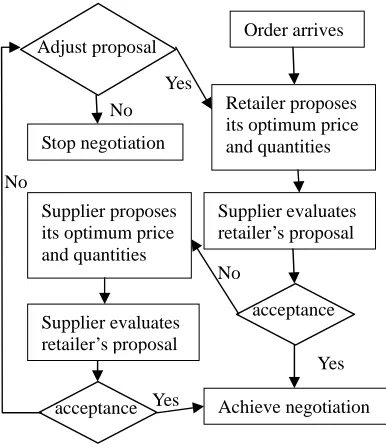
However, their research assumes a real collaboration between partners and the exchange of all the information. Real collaboration might not be practical in the supply chain and bargain power should be implemented to determine the level of a particular company within negotiation process. Bargain power can be determined based on the size, capital flows, and experiences of a company. Therefore, this research inserts bargain power as a factor into negotiation model so that the effect of different level of companies within negotiation can be realized. Two mathematical models, buyer model and supplier model, are provided. Moreover, the buyer will initiate production plan for both buyer and supplier after receiving orders from customers. The buyer will pass the production plan to the supplier and supplier will evaluate the production plan based on its capacity, inventory, and production situations. The supplier might pass the adjusted production plan back to the buyer and the buyer should determine if this proposal is acceptable. The agreement will be drawn until the production plan is optimized from both the buyer and the supplier. The ideas of mathematical models are demonstrated as follows.
Parameters:
Hr: inventory cost of retailer Iro: initial inventory of retailer
Lr: lower bound of order quantity of retailer Dr: demand of retailer
Ur: upper bound of order quantity of retailer Pro: price lower bound of retailer
Qro: order quantity of retailer with price of Pro α: bargain power of supplier
Hs: inventory cost of supplier Iso: initial inventory of supplier
Us: upper bound of order quantity of retailer Pso: price lower bound of retailer
Qso: manufacturing quantity of supplier with price of Pso
Decision variable
Pr: purchasing price of retailer Qr: order quantity of retailer Ir: inventory of retailer Ps: selling price of supplier
Qs: manufacturing quantity of supplier Is: inventory of supplier
Retailer model:
r r r
r
Q
I
H
P
Z
in
(1)s.t
r r ro
r
I
Q
-
D
I
(2)r r
r
Q
U
L
(3)r r
L
D
(4)r ro
P
P
(5)a -1
ro r r ro
Q
Q
P
P
(6)Constraint (1) minimizes the total cost while constraints (2), (3), (4), (5), and (6) generate the purchasing quantities, price, and inventory under the limitation of capacity. This model will pass the expected price and quantities to supplier so that supplier can decide whether to accept the proposal or start negotiation. The supplier model is demonstrated as follows.
Supplier model:
s s s
s
Q
-
I
H
P
MaxZ
(7)s.t.
r s so
s
I
Q
-
D
I
(8)s s r
Q
U
Q
(9)r s
P
P
(10)a 1
-so s s so
Q
Q
P
P
(11)The supplier will evaluate the proposal presented from buyer and generate its own production plan. Constraint (7) maximizes the total profit of the supplier while constraints (8), (9), (10), and (11) generate the producing quantities, selling price, and inventory under the capacity limitation. If the production plan is similar to buyer’s proposal, then the supplier will accept the proposal. If the production plan is different than the buyer’s proposal, then the supplier will pass the new production plan to the buyer and start the negotiation. The agreement will be drawn until the production for the supplier or for the buyer is acceptable. However, there is no guarantee of achieving the agreement with this negotiation. The bargain power will be a factor associated with the production plan and price that is demonstrated in constraint (11). It represents the will to adjust its own production plan and number of holding inventory.
Figure 1: Negotiation flow
4. Cases study and Conclusion
To test the usefulness of the proposed models, real data of DRAM and Notebook are adapted in the optimization. Seven types of bargain power are applied to realize the effect of the bargain power on the results of negotiation for the retailer and the supplier. Sections 4.1 and 4.2 describe the result and insights of these two cases.
4.1 DRAM
Table 1 demonstrates the price of DRAM after negotiation. In table 1, no price is equivalent in different combinations of bargain power for the supplier and the retailer. If both supplier and the retailer are not willing to adjust their price, the negotiation will be terminated without any agreement. If the supplier or the retailer can relax their price for about 1%, then the retailer and the supplier might reach agreement with bargain power of 4.5 to 7.5 and 1.5 to 7.5, respectively.
Table 1: DRAM price after negotiation based on different bargain power
Supplier\
retailer 2.5 3.5 4.5 5.5 6.5 7.5
[image:4.612.82.275.49.273.2]1.5 140\1 44 128\1 30 122\1 23 128\1 18 129\1 15 125\1 13 2.5 140\1 44 128\1 30 122\1 23 119\1 18 116\1 15 119\1 13 3.5 140\1 44 128\1 30 122\1 23 119\1 18 116\1 15 115\1 13 4.5 140\1 44 128\1 30 122\1 23 119\1 18 116\1 15 114\1 13 5.5 140\1 44 128\1 30 122\1 23 119\1 18 116\1 15 114\1 13 6.5 140\1 44 128\1 30 122\1 23 119\1 18 116\1 15 114\1 13 7.5 140\1 44 128\1 30 122\1 23 119\1 18 116\1 15 114\1 13
[image:4.612.309.548.138.331.2]Table 2 shows the quantities of DRAM after negotiation. In table 2, the supplier and the retailer achieve agreement in quantities produced and purchased. Tables 1 and 2 indicate that agreement will be achieved if both sides can relax their price constraint.
Table 2: DRAM quantities (in thousand) after negotiation based on different bargain power
Supplier\
retailer 2.5 3.5 4.5 5.5 6.5 7.5
1.5 15.00 1/15. 001 15.01 3/15. 013 15.01 9/15. 019 15.01 3/15. 013 15.01 2/15. 012 15.01 6/15. 016
2.5 15/15 15/15 15.00
1/15. 001 15.00 4/15. 004 15.00 7/15. 007 14.92 3/14. 923
3.5 15/15 15/15 15/15 15/15 15/15 15.00
1/15. 001
4.5 15/15 15/15 15/15 15/15 15/15 15/15
5.5 15/15 15/15 15/15 15/15 15/15 15/15
6.5 15/15 15/15 15/15 15/15 15/15 15/15
7.5 15/15 15/15 15/15 15/15 15/15 15/15
4.2 Notebook
Table 3 demonstrates the results of negotiation between notebook supplier and retailer with different bargain power. Note that bargain power of 5.5 to 7.5 is not applied for the retailer and the supplier since the negotiation is stopped within the first proposal from the retailer. In table 3, no price is equivalent in different combinations of bargain power for the supplier and the retailer. If both supplier and the retailer are not willing to adjust their price, the negotiation will be terminated without any agreement. If the supplier or the retailer can relax their price for about 1%, then the retailer and the supplier might reach agreement with bargain power of 4.5 and 1.5 to 7.5, respectively.
Table 3: Notebook price after negotiation based on different bargain power
Supplier\
retailer 2.5 3.5 4.5
1.5 1480.3\1526.
8
1397.2\1415. 8
1341.1\1345. 8
2.5 1477.2\1523.
5 1353.9\1372 1291.5\1296
3.5 1477.2\1523.
5
1353.9\1372
1290\1294.5
4.5 1477.2\1523.
5
1353.9\1372
1290\1294.5
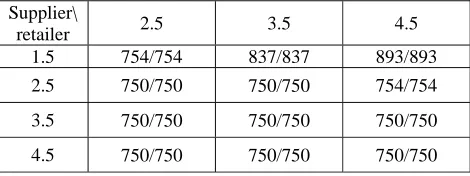
Table 4 shows the quantities of DRAM after negotiation. In table 4, the supplier and the retailer achieve agreement in quantities produced and purchased. Tables 1 and 2 indicate that agreement will be achieved if both sides can relax their price constraint.
Order arrives
Table 4: Notebook quantities after negotiation based on different bargain power
Supplier\
retailer 2.5 3.5 4.5
1.5 754/754 837/837 893/893
2.5 750/750 750/750 754/754
3.5 750/750 750/750 750/750
4.5 750/750 750/750 750/750
Supply chain collaboration has been studied to achieve minimum cost among supply chain partners. However, conflicts among objectives of supply chain partners are usually existed that affect the successfulness of collaboration. Therefore, negotiation is usually adapted among supply chain partners to achieve an appropriate decision. This research investigates the relation of partners within in supply chain alliance based on negotiation. Mathematical models are provided to minimize the total cost of supply chain and to realize the insights of implementing negotiation. Based on our model analysis, negotiation might reach a decision among supply chain partners.
References
[1] J. C. Anderson and A. Narus, “A model of distributor firm and manufacturer firm working partnerships,” Journal of
Marketing, 1990, vol. 54,42–58.
[2] A. Cakravastia, I. S. Toha, and N. Nakamura, “A two-stage model for the design of supply chain networks,”
International Journal of Production Economics, 2002, vol.
80, 231-248.
[3] G. Dudek and H. Stadtler, “Negotiation-based collaborative planning in divergent two-tier supply chains,” International
Journal of Production Research, 2007, vol. 45, no. 2, pp.
465-484.
[4] C. A. Emberson and J. Storey, “Buyer–supplier collaborative relationships: Beyond the normative accounts,” Journal of
Purchasing and Supply Management, 2006, vol. 12, no. 5,
pp. 236–245.
[5] D. Z. Feng and M. Yamashiro, “A pragmatic approach for optimal selection of plantspecific process plans in a virtual enterprise,” Production Planning & Control, 2003, vol. 14, no. 6, pp. 562-570.
[6] J. Hagedoorn, “Understanding the rationale of strategic technology partnering: interorganizational modes of cooperation and sectoral differences,” Strategic Management
Journal, 1993, vol.14, no.5, pp.371-385.
[7] H. Jung, B. Jeong and C. G. Lee, (2008). An order quantity negotiation model for distributor-driven supply chains,”
International Journal of Production Economics, 2008, vol.
111, pp. 147-158.
[8] D. M. Lambert, M. A. Emmelhainz, and J. T. Gardner, “Developing and Implementing Supply chain Partnerships,”
The International Journal of Logistics Management., 1996,
vol. 7, no. 2, pp. 1-18.
[9] H. L. Lee, V. Padmanabhan, and S. Whang, “Information Distortion in Supply Chain: the Bullwhip Effect,”
Management Science, 1997, vol. 43, no. 4, pp. 546-558.
[10] H. A. Lai, Theoretical Basis for Negotiation Support Systems, Unpublished doctoral dissertation, Purdue University. 1989.
[11] N. Lehoux, S. D’Amours, and A. Langevin, “Collaboration and decision models for a two-echelon supply chain: a case
study in the pulp and paper industry,” International Conference on Industrial Engineering and Systems
Management (IESM 07), Beijing, China, 2007.
[12] J. Olhager, “Supply chain management: a just-in-time perspective,” Production Planning & Control, 2002, vol. 13, no. 8, pp. 681-687.
[13] S. Prasad and F. Sounderpandian, “Factors influencing global supply chain efficiency: implications for information systems,” Supply Chain Management: An International
Journal, 2003, vol. 8, pp. 241-250.
[14] T. M. Simatupang, and R. Sridharan, “The collaborative supply chain,” International Journal of Logistics
Management, 2002, vol. 13, no. 1, pp. 15-30.
[15] D. Simchi-Levi, P. Kaminsky, and E. Simchi-Levi, Designing and Manging the Supply Chain, 2nd ed. McGraw Hill, Irwin, New York, NY, 2003.
[16] H. A. Simon, Administrative Behavior, 4th edition, New York, NY, 2007.
[17] S. Talluri and R. C. Baker, “A multi-phase mathematical programming approach for effective supply chain design,”
European Journal of Operational Research, 2002. vol. 141,
pp. 44-55.
[18] S. Talluri, R. C. Baker, and J. Sarkis, “A framework for designing efficient value chain networks,” International
Journal of Production Economics, 1999, vol. 62, pp.
133-144.
[19] B. L. Zhu, H. B. Yu, and X. Y. Huang, “Integrated production planning model and method for supply chain,”
IEEE, 2007, pp. 4709-4712.